Events in Japanese: a reinterpretation of
aspectual suffixes of the Uwajima dialect
著者
CIVIT Roger
journal or
publication title
Journal of foreign studies
volume
65
number
3
page range
71-91
year
2015-03-01
URL
http://id.nii.ac.jp/1085/00001721/
Creative Commons : 表示 - 非営利 - 改変禁止 http://creativecommons.org/licenses/by-nc-nd/3.0/deed.ja1. Objective
This paper1attempts to better explain the process of neutralization of grammatical
aspect that Oki (2000) claims that occurs in certain situations between auxiliaries “-yoru” and “-toru” used as aspectual markers in the Uwajima dialect of Western Japan.
(1) “A, minna hashiriyoru”
(“Ah, everybody run-DURATIVE-PRESENT”) (“Ah, everybody is running”)
(2) “A, minna hashittoru”
(Ah, everybody run-PERFECTIVE-PRESENT)
(According to Oki (2000), it is equivalent to (1) regardless of having a perfective marker)
Mypoint of view is that what Oki (2000) claims to be a neutralization can be better explained byassuming that events have sub-events; interaction between the values of grammatical aspect of “-yoru” and “-toru” on the one hand and the lexical aspectual features of each sub-event on the other enables constructions with “-yoru” and “-toru” without having to resort to an ad-hoc explanation such as the existence of a process of neutralization of the features inherent in the auxiliaries that mark grammatical aspect in the Uwajima dialect in particular and in Japanese in general. Therefore, the approach substantiated in this paper shows that there is no need to assume the existence of a process of neutralization in examples (1) and (2) above. The perfective marker “-toru” in (2) would mark perfective aspect of a sub-event of “starting to run” that kickstarts the durative activityof “running”.
This paper points out to the possibilitythat these phenomena are universal and therefore maybe applied to explain the interactions between lexical and grammatical aspectual features not onlyin Japanese, but at least Spanish and English.
Events in Japanese: a reinterpretation of aspectual
suffixes of the Uwajima dialect
Roger Civit
1 The current paper is a heavilyedited and simplified version of one of the topics in the author’s ongoing PhD. dissertation, due late 2014. Therefore, at the point of its writing, this paper was still lacking on a complete description of the new framework that the dissertation aims to provide.
2. Aspectual neutralization in the Uwajima dialect of Japanese (Oki, 2000) vs. event-based aspectual marking.
The Uwajima dialect of Japanese, spoken in parts of the Ehime prefecture in the island of Shikoku in Western Japan, has been the focus of research byseveral linguists, such as Kudo (1983, 1989, 1995), Kinsui (1995) and Oki (2000). The Uwajima dialect shows a system of grammatical aspect when it comes to marking continuous, resultative and perfective aspect that is far removed to the system used in Standard Japanese. Aspectual markers “-yoru” and “-toru” in the Uwajima dialect can express durative action (“-yoru”) and resulting state or action perfective (“-toru”) respectively, as seen in the examples below:
(3) “Doa ga akiyoru”
(“Door-NOM open-INTRANS-DURATIVE-PRESENT”) (“The door is opening”)
(4) “Doa ga aitoru”
(“Door-NOM open-INTRANS-RESULTATIVE-PRESENT”) (“The door is open”)
(5) “Taro wa doa wo aketoru”
(“Taro-TOPIC Door-ACC open-TRANS-PERFECTIVE-PRESENT”) (“Taro has opened the door”)
Whereas the Uwajima dialect employs two different auxiliaries (“-yoru” is used to mark continuous aspect and the auxiliary“-toru” is employed to mark both resultative and perfective aspects), their equivalent aspectual meanings are marked in standard Japanese using a single overt marker of grammatical aspect for continuous, resultative and perfective grammatical aspect, namely“-teiru”. Possible formal ambiguities between continuous, perfective and resultative are solved in standard Japanese with auxiliaries like “-kake-”, indicating inchoative aspect. The equivalents in standard Japanese for the above (3) (4) and (5) are as follows:
(6) “Doa ga akikaketeiru”
(“Door-NOM open-INTRANS-AUX-DURATIVE-PRESENT”) (“The door is opening”)
(7) “Doa ga aiteiru”
(“Door-NOM open-INTRANS-RESULTATIVE-PRESENT”) (“The door is open”)
(8) “Taro wa doa wo aketeiru”
(“Taro has opened the door”)
This paper is an attempt to shed light on the properties of grammatical aspect in the Uwajima dialect. The author will give his personal proposal to explain what Oki (2000) claims to be a neutralization of the aspectual values of “-yoru” and “-toru”, based on Event Theory2(Davidson, 1970; Pustejovsky, 1991). To do so, we first need to clarify
the concepts of lexical and grammatical aspect and how theyare realized in Japanese. 3. Properties of aspect regarding standard Japanese and Uwajima dialect of
Japanese.
In this section, a brief explanation of the properties of Japanese lexical and grammatical properties will be summarized. It will be of relevance when analyzing the properties of aspect in the Uwajima dialect and, later in this paper, when comparing aspect between Spanish and Japanese in order to justifya new approach to eventivityin Japanese that explains the phenomenon of neutralization (Oki, 2000) shown above. 3.1. Lexical aspect of Japanese, according to Kamata (1996).
In this section, I will summarize the properties of the categories of lexical aspect (Aktionsart) byfollowing the classification byKamata (1996). This classification, while following more established classifications of Aktionsart such as Vendler (1967)’s, is original and thorough enough to include the special characteristics of the Japanese system of lexical aspect.
Kamata (1996) builds upon both the analyses by Kindaichi (1950, 1976), Vendler (1967) and Smith (1991) to produce a valid classification of types of events in standard Japanese. Kamata classifies events as follows:
Types of events, by Kamata (1996):
a) States
- “Ie ni wa inu ga nihiki iru” – (“There are two dogs in the house”) b) Activities
- “Seito tachi wa puuru de oyoida” – (“The students swan in the pool”) c) Accomplishments
- “Kouen made aruita” – (“[I] walked to the park”)
2 Further research into syntax and semantics from a point of view of events can be read in Sanz (2013), Ferreira (2005), Jacobsen (1992), Landman (2000); Ritter & Rosen (2000), Rosen (1999), Schein (1993, 2005), Travis (2000) and Voorst (1988), to name a few.
d) Semelfactives
- “Tori ga habataki wo shita” – (“A bird flapped its wings”) e) Achievements
- “Chuukintou de sensou ga okotta” – (“There happened a war in the Middle East”)
f) Non-processes
- “Watashi wa kanojo wo yoku shitteiru” – (“I know her well”) The last class of Aktionsart, non-processes, is veryrelevant to this paper. Its existence itself, bythe way, could have a cascade effect in the issues faced byJapanese students of Spanish in the process of learning the language in general and the aspectual system of Spanish in particular, which is a phenomenon that has been observed in Sanz, Civit & Rodríguez (2005, 2006) and Sanz & Civit (2007). Non-processes would correspond to states in Spanish, yet in Japanese they make their own category due to their semantic properties and syntactic requirements. The class of non-processes corresponds to the so-called “4th class” verbs byKindaichi (1950,1976).
Paraphrasing and summarizing Kamata (1996), “Non-processes” (in Japanese, 非 過程, “hikatei”) can be described as states that are derived from an achievement, whose feature of continuityis undefined and therefore requires the atelic marker “-teiru” in standard Japanese in order to become grammatical. Because of this close dependency on a morpheme of grammatical aspect, non-processes could be considered as a special type of event. Unlike regular states (due to their origins as achievements) many processes allow for an imperative use. Theyshare, therefore, some properties with non-stative events.
Besides this new class of situations or events, in Kamata’s paper there are a few other bits of veryrelevant information that are extremelyimportant in order to fully comprehend the aspectual system of Japanese.
In the first place, Kamata states that the aspectual value of a verbal construction can change due to the influence of other phrases and adverbs appearing in the construction. The aspectual situations derived from the interaction of the features of the verb and the features of those additional elements (which tend to prevail) are called “derived situations”. Out of them, the so-called “derived activitysituations” happen frequently. These express a repetition of an event, which can be interpreted as an activity:
(9) “Kiyohara wa saikin yoku houmuran wo utsu” - (“Lately, Kiyohara is hitting a lot of homeruns”)
(10) “Watashi wa maiasa kouen made aruku” - (“I walk to the park every morning”)
Example (9) above is an activityderived from a repetition of semelfactive events of “hitting”. Example (10) above is an activityderived from a repetition of accomplishment events of “walking to the park”. Theyboth express a situation of repetition over an undefined and unbounded period of time.
The bottom line is that the interpretation of Aktionsart categories is not driven exclusivelybyproperties of the verb itself, but that verb-external elements carry aspectual features that will interact with the lexical aspectual properties of the verb. In sum, Aktionsart categories can be fluid and, in the case of Japanese, research shown in this paper seems to confirm Kamata’s approach.
After taking into account the lexical aspect value of the construction, an interaction with the features of grammatical aspect would take place. Grammatical aspect (“point of view”, in Smith (1991)’s terms) would exert its effect over the final lexical value of the whole lexical event to yield the final aspectual value of the construction. The properties of the markers of grammatical aspect in standard Japanese are explained in the following section.
3.2. Grammatical aspect of Japanese according to Kamata (1996)
Grammatical aspect is the aspectual value of linguistic features of non-lexical type. In the case of standard Japanese, for instance, this would be the case of morphemes “-ru”, “-ta”, “-teiru” and “-teita”. A large part of the research made so far in Japanese in the topic of aspect deals with the properties of these markers.
Several researchers, such as Kusanagi (1981), Konishi (1997), Yamamori-Matsui (1998), Kudo (1989, 1995), Oki (2000), Fukushima (2000) and Kamata (1996), amongst others, deal with the issue of the multiplicityof grammatical meanings of the “-teiru” marker, the temporal and aspectual properties of the “-ru” and “-ta” alternation and the essential differences that appear to exist between standard Japanese and Western Japan dialects regarding the grammatical aspect of “-teiru” and their corresponding dialectal variants. This paper will deal with the properties of grammatical markers in later sections.
For now, in order to explain Kamata (1996) and Smith (1991)’s research, suffice it to saythat markers of grammatical aspect (called “points of view” bySmith (1991)) can be divided in two groups:
“-ru” and “-ta” fall into this group. The action is viewed as potentiallywith a beginning and an end. In other words, the action is seen as a whole unit from an external point of view. Bear in mind, when Kamata says “perfective”, it has to be understood as an action that has or can be understood as having a beginning and an end and it is seen from the outside, as a discrete unit. This deserves notice because sometimes, the “-ru” form is translated as present tense, in both English and Spanish, which have an imperfective nuance. Japanese “-ru” form does not map present tense perfectly.
Group 2: Kamata calls this group “imperfective” (“Mikanryou”). This is the
group of morphemes “-teiru” and “-teita”. The action is viewed as disconnected from its beginning and end points. Therefore, the action is seen as focused from a point of view internal to the action itself. Bear in mind that both “-teiru” and “-teita” correspond to various different forms of grammatical aspect in Spanish and English, depending on whether theyare employed as means to express aspect or relative tense.
Of these markers, “-teiru” is the most interesting one. It comes in handywhen determining the distinct properties of events in Japanese. As summarized byTaga (2013), the morpheme “-teiru” can express:
- Continuation of action: It corresponds to a progressive aspect marker. - Continuation of result: It corresponds to a marker of state resulting from a
change.
- Perfective of action: It corresponds to a marker of perfective aspect of an action.
The interactions between these markers of grammatical aspect and the categories of lexical aspect will be dealt with in detail in the section below.
3. 3. Interactions between grammatical aspect markers and lexical aspect in Japanese
The morpheme “-teiru” interacts with different types of situations / events and yields different meanings (examples (11) through (15) below are mine). As it has been said already, non-processes require “-teiru” to be grammatical. Let us see what happens when “-teiru” is combined with other types of events, instead:
- States: Pure states refuse “-teiru”.
(11) * “Madorido wa Supein ni atteiru” – (“Madrid is in Spain”)
- Activities and accomplishments: The form “-teiru” expresses a continuous
process of the action.
- Achievements (and some of what Kamata includes as Accomplishments,
although theydo not fit the definition perfectly): The form “-teiru” expresses a state resulting from the event.
(13) “Shigoto ni tsuite iru” – (“I have arrived at mywork”)
- Semelfactive: Kamata States that, according to Smith (1991), the use of “-teiru”
with a semelfactive yields a multiple event, which can be considered a “derived activity”
(14) “Doa wo tataite iru” – (“I am knocking at the door”)
- Derived situations: Theyall become derived activities.
(15) “Kiyohara wa saikin yoku houmuran wo utteiru” - (“Lately, Kiyohara is hitting a lot of homeruns”)
Let us move on to the properties of non-processes and analyze them more deeply. As mentioned above, non-processes and states share the propertyof stativity. Non-processes, unlike states, derive from dynamic events. States can only take what Kamata calls a “perfective” marker of grammatical aspect (the term “perfective” here must be taken as “-ru” or “-ta”, not as the typical Western meaning of perfective - having a definite beginning and end - used in most research papers), instead of the “imperfective” marker (“-teiru”, -“teita”), yet they still in the end express an imperfective lexical aspect, which is the Aktionsart expected of states. This might be because “-teiru” and its past tense counterpart “-teita” are restricted to constructions of a dynamic, eventive nature (activities, accomplishments, semelfactives, achievements) or those that share some properties of dynamic events (non-processes). This would imply the existence, in Japanese, of an event quantifier in those cases where “-teiru” and “-teita” appear. In terms of syntactic structure, this could be an important point that will be dealt with later.
Non-processes can be divided into two groups: adjectival non-processes and plain non-processes. Both share the common trait that theyrequire the form “-teiru” to be grammatical when theyexpress a state. This would be the basic common propertyof a non-process: stativityalongside the “-teiru” morpheme, a form usuallyrestricted to states. Adjectival and plain non-processes have a few different traits, however:
“-teiru” in some cases when used in a subordinate adjectival clause, yet not in a main clause.
(16) “Kore wa totemo sugureteiru / sugureta sakuhin desu” – (“This is an excellent piece of work”)
(17) “Takaku sobieteiru / ?sobieta tou ga machi no doko kara demo me ni haittekuru”
– (“That high-rising tower can be seen from anywhere in town”)
Adjectival non-processes do not allow for the use of the imperative form, like regular states.
(18) * “Sugurero” – (“Be excellent!”)
On the other hand, plain non-processes do not allow the form “-ta” instead of “-teiru” when used in a subordinate adjectival clause without losing their stative meaning.
(19) “Kinou shitta koto wa himitsu datta” – (“What I found out yesterday was a a secret) → The state becomes an achievement.
Plain non-processes do allow for the imperative form. This happens because they are states derived from achievements, which do accept the imperative form. One of the most representative examples of this class is the psychological verb “shitteiru”, “to know”:
(20) “Onore wo shire” – (“Know thyself”)
Regarding states and non-processes: there still remains the doubt of whether verbs like “motsu - motteiru”, which would correspond to either a state or an activityin both Spanish and English (to have / to carry), are states, non-processes or activities in Japanese. Theydo not fit perfectlyin anycategory, yet theyshare properties of manyof them. It can be assumed that when a verb like “motsu – motteiru” expresses the meaning of “to carry”, its Aktionsart is that of an activity. Yet, when it expresses the meaning of “to have”, it can be considered a non-process, in the sense of “resulting state of the achievement of acquiring something”. This points to the possibilitythat the division of types of events between states, activities, accomplishments, achievements, semelfactives and non-processes might not be a clear-cut one, but a continuum or, more likely, the result of complex interactions of features of linguistic and contextual elements. This is a notion that will be reviewed later in this paper.
To summarize non-processes, theyare a whole group of verbs in Japanese, which are a cross between two different Aktionsart types, namely states and achievements; theycan appear in two different event structures, depending on whether theyexpress an
achievement or a state. This is a reason whythe aspectual system of a language should be described in terms of events or situations and not in terms of simplyproperties of verbs, as there is much more in terms of aspect than just the verb itself and the same verb can fit into more than one event structure.
The possibilityof having complex events, therefore, opens the door to explaining from a totallydifferent point of view the phenomenon of aspectual neutralization introduced byOki (2000) as seen in examples (1) and (2) above. This paper aims to prove that no such neutralization process actuallyhappens and instead events can be made up of different sub-events, with whom aspectual markers such as “-teiru” in standard Japanese and the “-yoru” / “-toru” pair in the Uwajima dialect interact and are licensed bythem in return.
The feasibilityof considering Aktionsart categories as being comprised of sub-events can also be justified bylooking at comparative data between Spanish and both standard Japanese and Uwajima dialect. This is shown in sections 4 and 5 of this paper. 4. The correspondences between Spanish and standard Japanese
As mentioned above, the morpheme “-teiru” of standard Japanese can express continuation of action, continuation of result and perfective of action. In Spanish, all these aspectual meanings are expressed with overtlydistinct markers of grammatical aspect. The following table attempts to summarize the equivalences. We shall use the Japanese “kiru” (“to wear” / “to dress up”) and subsequentlyfind equivalents in Spanish and English from there. Examples in standard Japanese are taken from Jacobsen (1992); translations are mine:
Table 1: Equivalents to standard Japanese “-teiru” in Spanish and English
Standard Japanese Spanish English
Continuation
of action “Ani wa tonari noheya de fuku o kiteiru”
“Mi hermano se está vistiendo en la habitación contigua”
“Mybrother is dressing up in the room next door” Continuation
of result “Aniyoufuku o kiteiru”wa kuroi “Mi hermano llevaropa negra” “Mybrotherwearing blackis clothes”
Perfective of
In the above table we see a series of veryinteresting phenomena that onlycome to light when both Japanese, Spanish and English are analyzed side to side. First, “kiteiru” (“to wear / to put on”) is ambiguous in that it can show continuation of result and perfective of action in the exact same sentence. In Spanish and English, however, very distinct forms are used to differentiate those meanings. In the case of Spanish, continuation of result (which happens to be a state), is expressed with a different verb from the perfective of action: “llevar” vs. “ponerse”. Notice also that the state is marked with Present tense form and the perfective is marked with Complex Perfect Past form (“Pretérito perfecto compuesto”). These two Spanish forms are distinct to the form employed to express continuation of action, which is the Progressive periphrasis “estar” + gerundio form.
On the other hand, we see that, in English, in this case, although the verb for continuation of action and continuation of result are different, the grammatical aspect markers are the same: the present continuous form. We see that, in English, continuation of result for this verb is actuallyan ongoing activityof “wearing”. It is obvious, then, that the mapping of events in Spanish and English is not direct and, therefore, no single form has a biunivocal equivalent in the other language. It is even more so when comparing these Spanish and English to standard Japanese, which uses one single form, “-teiru” to express three different aspectual values.
5. A comparison between Spanish and the Uwajima dialect
Bycomparing aspect between standard Japanese, English and Spanish, we see differences with standard Japanese but shocking similarities between the other two languages and the dialect of Uwajima. Let us start bycomparing progressive:
(21) “Pan wo tabete iru” (Standard Japanese) (22) “Pan wo tabeyoru” (Uwajima dialect) (23) “I am eating bread”
(24) “Estoycomiendo pan”
Examples (21) through (24) above show the same sentence in the 4 different forms. Standard Japanese expresses progressive with the “-teiru” morpheme, as stated before. However, progressive meaning is restricted to dynamic verbs that have a durative meaning (namely, verbs that express an activity (pure or derived) or an accomplishment). In the Uwajima dialect, progressive meaning is expressed through the use of the morpheme “-yoru”. In English, progressive aspect is expressed with a progressive construction (“to be” + gerund). In Spanish, the equivalent is a progressive
form with the verbs “estar” + gerund. Next, let us see the use of “-toru” expressing a resulting state:
(25) “Mado wa kowareteiru” (Standard Japanese) (26) “Mado wa kowaretoru” (Uwajima dialect) (27) “The window is broken”
(28) “La ventana está rota”
In standard Japanese, the meaning of resulting state is expressed with the morpheme “-teiru”, but this interpretation is commonlyrestricted to verbs that express a change of state. As we have seen before, the same morpheme “-teiru”, when added to a durative verb that does not express a change of state, yields a progressive interpretation instead. Therefore, in standard Japanese, “-teiru” is itself undefined in terms of whether it represents progressive or perfective. This does not happen with the Uwajima dialect, English or Spanish equivalent forms.
In the Uwajima dialect, the morpheme “-toru” is used instead of “-teiru”. When the said morpheme is applied to a verb that expresses a change of state, the resulting aspect is that of the state of something after it has undergone a change. English employs the resultative construction “to be” + past participle; Spanish makes use of the form “estar” + participio (or “haber” + participio, in verbs that do not express a change, such as “he llegado” [“I have arrived”]).
Both in English, Spanish and the Uwajima dialect, the linguistic form expressing a resulting state is morphologicallydifferent to that expressing progressive. Bear in mind, however, that there exist differences between English and Spanish regarding resultatives and progressives, but that falls beyond the scope of this analysis at the moment. Next, let us take a look at the use of “-toru” as a morpheme to mark the perfective of an action.
(29) “Ano eiga wo mou miteiru” (“mou” = already) (30) “Ano eiga wo (mou) mitoru”
(31) “I have (already) seen that movie” (32) “He visto (ya) esa película”
There is something that stands out from the above examples: we need to clarify first what a perfective action is. In this situation, perfective could be defined as a relative tense in which the consequences of an action are felt throughout time until a certain moment, in this case, the present. In the case of the example (31) in English , shown above, a perfective action means that the action happened in the past and the effects of it last to the present. In this case, the effect is having seen the movie. Neither
object nor subject suffers anychange. In English, as in Spanish, this is marked overtly so the form employed to express resulting state and the form used to express action perfective are different.
A similar phenomenon happens in Spanish, with verbs such as “hervir”, to boil. The verb “hervir” is an achievement resulting in an activity. It is possible to say the following in Spanish:
(33) “El agua hirvió” (“The water evaporated completely/ The water started boiling”)
The example above can express two different meanings: either all of the water evaporated (end of activity) or the water reached one hundred degrees Celsius and started boiling. The following sentence would also express the latter meaning:
(34) “El agua rompió a hervir” – (“The water started boiling”)
If we assume that “hervir” can take part into two different event structures, it seems self-evident, so far, that the phenomenon seen above with the verb “tobu” can be the result of the same durative verb taking over two different event structures, rather than a neutralization of aspect. This point of view will be explained in more detail in the following section of this paper, which will set up the basis for the conclusion already substantiated in section 1 regarding Oki (2000)’s claim to the existence of a process of neutralization of the auxiliaries “-yoru” and “-toru” in the Uwajima dialect in certain cases.
6. The properties of “-yoru” and “-toru” from a point of view of event theory. In section 6.1, I will attempt to analyze the properties of events in the Uwajima dialect, based on a comparison between them and the system of aspect in Spanish. As a result of this analysis, in section 6.2, I will provide with a framework of analysis of the properties of lexical and grammatical aspect and its interactions.
6. 1. Preliminary analysis of the properties of events in “-yoru” and “-toru” constructions vs. Oki (2000)’s feasibility of feasibility of neutralization. This paper claims that there is a better possible explanation to why“-toru” and “-yoru” can come to, seemingly, bear the same aspectual value. In short, rather than a neutralization of aspect, which in a waytarnishes the distinct aspectual values that “-yoru” and “-toru” have, one can saythat it is more feasible to saythat in realitytheir essential aspectual values staydistinct, and that interaction with different types of Aktionsart yields other aspectual meanings that are not incompatible with their basic
meanings. This can be summarized in the following way:
a) “-Yoru” expresses progressive aspect when it interacts with the [+ durative]
feature of Aktionsart of an activityor accomplishment, if we focus on the action as it happens. This is the basic meaning of “-yoru”.
b) “-Yoru” expresses prospective aspect (the time before an action starts) when it
interacts with the [-durative] feature of Aktionsart of an achievement that marks the beginning of an activity.
c) “-Toru” expresses action perfective aspect when it interacts with aspectual
features of finiteness as the final limit of an accomplishment or the arbitrarylimit applied to an activityis reached. This is the basic meaning of “-toru”.
d) “-Toru” expresses inchoative aspect when it interacts with the aspect of an
achievement marking the beginning of a durative event. This can be interpreted as a neutralization of the aspectual distinction between “-toru” and “-yoru”, as claimed by Oki (2000), or as a perfective aspect of the event that kick-starts a durative action, as this paper claims.
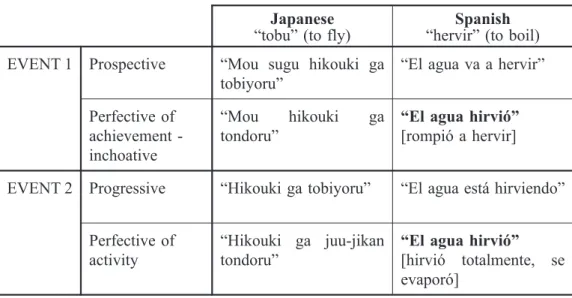
Table 4 below shows the aforementioned similitude in event structure some Spanish verbs, such as “hervir” (to boil) share with verbs such as “tobu” (“to fly”) in Uwajima dialect. Notice that the form for both perfective meanings of the two events in the complex event structure can be expressed using the same form, the root form of the verb “hervir”, although it is true that more accurate forms with a simple event structure can be used instead in order to clarifythe ambiguity(“rompió a hervir”, which roughly equals to “to begin to boil”, and “hirvió totalmente / se evaporó”, which roughly corresponds to “boiled up / evaporated”). The forms for prospective and progressive aspect, however, are not the same in Spanish: different aspectual periphrases are used and no ambiguityis seen due to the interaction between the Aktionsart of the each event and the grammatical aspectual values of the periphrases.
The meaning of events falling into the categories b) and d) above can be paraphrased in the Uwajima dialect, standard Japanese, English and Spanish using specialized, periphrastic constructions and different verbs with a clear, defined Aktionsart.
(35) “Hikouki wa tobiyoru” (Uwajima) = “Hikouki wa ririku shiyou to suru” (Japanese)
– “El avión va a despegar” – (“The plane is about to take off)
(36) “Hikouki wa tondoru” (Uwajima) = “Hikouki wa ririku shita / shiteiru” (Japanese)
– “El avión acaba de despegar” – (“The plane just took off / flew off”) We see, therefore, that the double aspectual meaning that “tobu” can have in the Uwajima dialect is not something exclusive of that dialect and that there are similar occurrences in Spanish, such as what happens with the verb “hervir” (“to boil”). We also see, however, that such formal ambiguities can be easilyavoided in Spanish, English and Japanese byparaphrasing the whole construction using a different, specialized verb for the starting action and another one for the main, durative action, as seen in examples (35) and (36) above.
In addition, we see that standard Japanese shows a different system for licensing aspectual features to that of the Uwajima dialect, Spanish and English, due to the lack of distinct forms for progressive and perfective forms in standard Japanese and the inevitable ambiguitythis could entail. The Japanese “-teiru” form is heavilydependent
Table 2: Complex events in Uwajima dialect and Spanish
Japanese
“tobu” (to fly) “hervir” (to boil)Spanish EVENT 1 Prospective “Mou sugu hikouki ga
tobiyoru” “El agua va a hervir” Perfective of
achievement -inchoative
“Mou hikouki ga
tondoru” “El agua hirvió”[rompió a hervir] EVENT 2 Progressive “Hikouki ga tobiyoru” “El agua está hirviendo”
Perfective of
activity “Hikouki ga juu-jikantondoru” “El agua hirvió”[hirvió totalmente, se evaporó]
on the lexical meaning of the VP and other phrases. Certain secondaryaspectual meanings that are common in the Uwajima dialect, such as the double event structure possible for “tobu” (“to fly”) as both a durative event and the point of start of the durative event, are likelyto be paraphrased with specialized constructions in standard Japanese or to relyheavilyon adjuncts bearing their own aspectual meanings to the sentence.
The data shown above in tables 1 and 2 regarding the correspondences between aspectual markers of Spanish and standard Japanese and Uwajima Japanese lead us to the following realization: just like non-processes can be considered composite events (kick-starting achievement + resulting state) and verbs such as “tobu” in the Uwajima dialect and its aspect-marked forms “tobiyoru” and “tondoru” can be comprised of similar subevents, which are also clearlyseen in Spanish in verbs such as “hervir”, it can be assumed that such event-internal structure can exist across the whole language in Spanish, Japanese and its dialects and arguablyEnglish. A new theoryof event structure relying on event quantification and aspectual feature checking between features of nuclear sub-events and features of aspectual marking constructions would better explain Oki (2000)’s ad-hoc process of neutralization between “-yoru” and “-toru” shown at the beginning of this paper
In order to justifysuch theory, it is essential to base it on established literature. Pustejovsky(1991)’s analysis of events in terms of transitions, processes and states is a fitting starting point to develop it.
6.2. The research from this point on: applying Pustejovksy (1991)’s event types to “-yoru” and “-toru”
Pustejovsky(1991) proposes three basic event types: states, transitions and processes. States are defined as “a single event, which is evaluated relative to no other
event”. Processes are defined as “a sequence of events identifying the same semantic expression”. Transitions are defined as “an event identifying a semantic expression, which is evaluated relative to its opposition (Jackendoff, 1972; Lakoff, 1970; von Wright, 1963)”.
The interactions between “-yoru” and “-toru” and the features of activities, achievements, accomplishments and states, which have been introduced in section 6.1 above, can be explained in a more thorough wayif Aktionsart categories are defined in terms of internal structure using Pustejovsky(1991)’s approach.
and lexical aspect can shed clear light to the properties of aspect in anylanguage. This new framework is still under development. In anycase, a preliminarysample of how to analyze the properties of an event and its aspectual values will be provided below.
This event structure can be visualized as a tower structured as follows:
• In the first (bottom) level are the basic event types as in Pustejovsky (1991), namely(S)tate, (Process) and (T)ransition.
• In the second level are Aktionsart categories. Theyare comprised of those elements in level 1. Both levels 1 and 2 define the properties of lexical aspect of the construction.
• In the third level (and possiblya fourth one, in the case of Spanish), we have the features of grammatical aspect in auxiliaries (“-yoru” and “-toru”) that will interact with certain features in level 1. Event quantifiers should be defined at this level depending on interactions.
The following table summarizes the levels of categorization of the properties of events. Sub-event primitives in level 1 will have features that will interact with features of markers of grammatical aspect in levels 3 and 4. The assumption that sub-events have semantic and syntactic properties that are checked in the derivation by VP allows us to extend a classification of the properties of events in Japanese to anyother language.
In anycase, the above structure needs to be refined and adapted in order to fit in an X’ syntactic structure. It is, therefore, a work in progress that will be further developed in the following months and it is likelyto be included. In order to provide with a usable example, table 4 below will show what properties lie in “tobu” (“to fly/ to take off”):
Table 3: Levels of representation of event structure
Contents Type of aspect
Level 4 Perfective and imperfective forms in languages that show the distinction, like Spanish.
Grammatical aspect of the verbal form
Level 3 Markers of aspect: “-ru”, “-ta”, “-teiru”,
“-teita” / “-yoru”, “-toru” / “estar”+ gerundio Grammatical markers ofaspect. Eventivityis established at this point.
Level 2 Aktionsart Lexical aspect categories
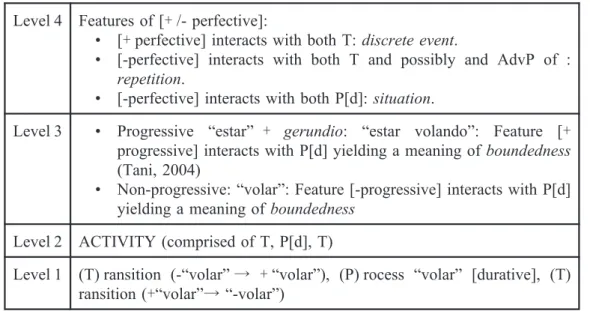
This framework assumes that T, P and S, the nuclear components of Aktionsart categories, bear aspectual features that interact with whatever grammatical aspect markers and other verbal and verb-external components appear in the construction. The claim this new framework aims to can be explained bylooking closelyat table 4 above. Even if “tobu” is considered to be an activity, in terms of Aktionsart, following Kamata (1996) above and all the established literature on lexical aspect, activities themselves, as anyother Aktionsart category, are not indivisible categories. Also, across languages, the interactions between levels 3 and 4 and level 1 (grammatical and lexical aspect) can be of a different nature, either because the internal structure of Aktionsart categories (level 2) is not the same across languages or because the features of grammatical aspect that can interact with those of lexical aspect are not equal across languages, too. See in table 5 below what would happen if “volar” (“to fly”, yet not “to take off”, in Spanish) is analyzed the same way as “tobu” in table 4 above. We see that, even though we start from the same primitives and possible interactions, the possible meanings of “tobu” after taking care of both lexical and grammatical aspect features in Japanese is not mapped into Spanish in a biunivocal way. In fact, “volar” in Spanish is semantically narrower than “tobu” in Japanese, as it does not allow for the verb to focus in anyway byitself on the initial (T)ransition ( -“volar”→ +“volar”).
Table 4: Event properties of “tobu”
Level 4 Japanese lacks a system for the marking of the imperfective / perfective distinction in grammar. Interactions in level 3, interactions between V and its arguments and pragmatical constraints would yield that distinction covertly.
Level 3 • “-ru” / “-ta” → Interact with either T, yielding the meaning of “taking off” (Prospective “tobu” / Inchoative “tonda”) or “finishing flying” (“tonda”)
• “-teiru” / “-teita” → Interact with P [d]), yielding the continuous meaning intrinsical to activities.
• Interaction between grammatical aspect and T / P[d] allows for an event quantifier.
Level 2 ACTIVITY (comprised of T, P[d], T)
Level 1 (T)ransition (-”tobu”→ +“tobu”), (P)rocess “tobu” [durative], (T)ransition (+”tobu”→ “-tobu”)
Bycomparing tables 4 and 5, it can be seen that the interactions between lexical and grammatical aspect in Japanese and Spanish for “tobu” and “volar” do not follow the same patterns. Arguably, Japanese “tobu” can express both the action of “flying” and the event of starting to fly(“taking off” or “flying off”), as the interactions in level 3 can focus on the initial T in level 1. On the other hand, Spanish “volar” does not allow for an inchoative meaning of “taking off” arguablybecause interactions between features in level 1 and those in levels 3 and 4 do not allow for focusing exclusivelyon the initial T, therefore onlyallowing for a meaning equivalent of “to fly”.
The above assumptions are, as mentioned at the beginning of this paper, a simplified version of the framework of the interaction between features of aspect the author is developing. Strong conclusions regarding the validityof this new framework can not be drawn at the moment of submission of this text, but theoretical and empirical evidence seems to suggest its validity. In section 7 below, a summary of the conclusions of this paper will be presented.
7. Conclusions
Research so far points to the feasibilityof explaining the phenomenon of neutralization seen in Oki (2000) regarding the markers of grammatical aspect “-yoru” (for progressive) and “-toru” (for perfective and resultative) in the Uwajima dialect of Japanese, seen in examples (1) and (2). I have claimed that there is no such neutralization and instead the distinction between “-yoru” and “-toru” is preserved. The
Table 5: Event properties of “volar” Level 4 Features of [+ /- perfective]:
• [+ perfective] interacts with both T: discrete event.
• [-perfective] interacts with both T and possiblyand AdvP of :
repetition.
• [-perfective] interacts with both P[d]: situation.
Level 3 • Progressive “estar” + gerundio: “estar volando”: Feature [+ progressive] interacts with P[d] yielding a meaning of boundedness (Tani, 2004)
• Non-progressive: “volar”: Feature [-progressive] interacts with P[d] yielding a meaning of boundedness
Level 2 ACTIVITY (comprised of T, P[d], T)
Level 1 (T) ransition (-“volar” → + “volar”), (P) rocess “volar” [durative], (T) ransition (+“volar”→ “-volar”)
apparent phenomenon of neutralization can be better explained bystructuring the internal properties of lexical aspect in a verb stem and its interactions with the properties of grammatical aspect of auxiliaries and tensed forms.
The conclusion is that a distinction such as “hashiriyoru / hashittoru” is that in the former, a (P)rocess (in terms of Pustejovsky(1991) receives the focus of the event and in the latter, an initial (T)ransition, marking a kick-starting sub-event of “starting to run” that leads to the (P)rocess of “running” receives the focus of the event instead. Because of “hashittoru” implies that there is an action of running after the runner begins to run, it is understandable that Oki (2000) claimed that “hashiriyoru” and “hashittoru” share both a progressive aspect. Neutralizations, however, as well as anyother ad-hoc mechanism, are never an elegant wayof explaining whylinguistic phenomena occur. Therefore, the position defended in this paper, namelythat the interactions between grammatical aspect markers “-yoru” and “-toru” and lexical aspectual features of the verb “hashiru” are not equal, is a legitimate one. This new framework regarding the interaction between features of lexical and grammatical aspect begets the interpretation that the distinct sub-events (T, P, S) in “hashiru” interact with either “-yoru” or “-toru”. As a result of this, there is no need to define “hashiriyoru” and “hashittoru” as the process of a neutralization of aspect, as it can be explained byan analysis of the interaction of event-internal features and grammatical aspect.
Bibliography
Davidson, D. (1970). Events as particulars. Nous, Vol.4.
Fukushima, T. (2000) Chuusei Makki Nihongo no -teiru, -tearu ni tsuite - Doushi
Keizoku wo arawashiteiru baai wo chuushin ni. [About the -teiru and -tearu Forms
in the Late Medieval Period Japanese] Tsukuba Gengo Kenkyuu. Vol.5. Tsukuba University
Jackendoff, R. (1972). Semantic Interpretation in Generative Grammar. Cambridge. MA: MIT Press.
Jacobsen, W. (1992) The Transitive Structure of Events in Japanes. Tokyo: Kuroshio Publishers
Kamata, S. (1996) Gendai Nihongo no “teiru” kei asupekuto no imi kaishaku. [A Semantic Analysis of the Japanese Aspectual Expression Te-Iru] Jousai Daigaku Kenkuyuu Nenpou. Jinbun Shakai Kagaku Hen. Jousai University
Kindaichi, H. (1950) Kokugo doushi no ichibunrui [A Classification of Japanese Verbs] in Kokugo Kenkyuu, 15, 48-65 Reprinted in H. Kindaichi (ed.) (1976) Nihongo
Doushi no Asupekuto [Aspect in Japanese Verbs] (pp. 5-26) Tokyo: Mugi Shobou
Kindaichi, H. (1976) Nihongo Dooshi no Asupekuto (Aspect in Japanese Verbs) Tokyo: Mugi Shobokan
Kinsui, S. (1995) Iwayuru “Shinkoutai” ni tsuite. In Tsukishima Hiroshi Haku Koki
Kinen Kokugogaku Ronshuu. Kyuuko Shoin
Konishi, M. (1997) Doushi no koyuu no imi to asupekutoteki imi: aruiwa gendai
nihongo no “Henka doushi” no asupekutoteki imi no tadashii toriatsukaikata. [The
Individual Meaning of Verbs and their Aspectual Meaning: Or the Correct Wayof Handling The Aspectual Meaning of “Verbs of Change” in Modern Japanese]. Gengogaku Kenkyuu 16
Kudo, M. (1983) Uwajima hougen no asupekuto. In Kokubungaku Kaishaku to
Kanshou, Vol. 48 Num. 6.
Kudo, M. (1989) Gendai Nihongo no Juuzokubun no tensu to asupekuto. [Tense and Aspect of Subordinate Clauses in Modern Japanese] Yokohama Kokuritsu Daigaku Jinbun kiyou. Dai 2 rui. Gogaku. Bungaku. Yokohama National University
Kudo, M. (1995) Asupekuto, Tensu Taikei to Tekusuto: Gendai Nihongo no Jikan no
Hyoogen [Aspect, Tense and Text: Temporal Expression in Modern Japanese]
Tokyo: Hitsuji Shobou
Kusanagi, Y. (1981) Nihongo no tensu, asupekuto no bunseki no arugorizumu. [Algorithm for the Analysis of Japanese Tense and Aspect] Bungei Gengo Kenkyuu. Gengo hen. Tsukuba Daigaku Bungei. Gengogaku kei. Tsukuba University
Lakoff, G. (1970). Irregularity in Syntax. New York: Holt, Rinehart, and Winston. Oki, H. (2000) Asupekuto kara mita Doushi bunrui saikou: “Kizukarenikui hougen” ni
furete. [A Reconsideration on the Classification of Verbs From the Point of View
of Aspect: Dealing with “Hard to Notice Dialects”] Jinbun Kagaku Ronshuu Bunka Comunication Gakkahen Vol.34
Pustejovsky, J. (1991) The Syntax of Event Structure. Cognition 41, 47-82
Sanz M. & Civit, R. (2007) The Poverty of the Stimulus in L2 Acquisition or the
Struggle between (Implicit) Hypothesis-Making and (Explicit) Reasoning
[Manuscript] Kobe CityUniversityof Foreign Studies (Japan). Presented at Japanese Societyfor the Language Sciences 9th Annual Conference, Miyagi Gakuin Women’s University, Sendai, Japan, July 7th 2007
Process: A Study of Japanese Native Speakers Learning Spanish”. Kobe City
Universityof Foreign Studies (Japan). Poster presented at the ISB5, Barcelona. Sanz, M., Civit, R. & Rodríguez, S. 2006. “Reestructuración de la interlengua en
alumnos de E/LE de nivel intermedio” (Restructuring of the Interlanguage of Intermediate Level Students of Spanish as a Foreign Laguage). Talk given at the
Círculo de Lingüística Hispánica de Kansai, Osaka (Japan).
Smith, C. (1991) The Parameter of Aspect. Dordrecht: Kluwer Academic Publishers Vendler, Z. (1967) Linguistics in Philosophy, Ithaca, NY: Cornell UniversityPress. Wright, G. H. von (1963). Norm and Action. London: Routledge and Kegan Paul. Yamamori - Matsui, Y. (1998) Gendai Nihongo no asupekuto ni tsuite. Oboegaki:
Paafekutosei wo megutte. [About Aspect in Modern Japanese. Memorandum:
Dealing wih Perfectivity] Kobe Daigaku Ryuugakusei sentaa kiyou, Vol 5. Kobe University