I
IntroductionIn recent years, increasing attention has been devoted to understanding the relationship be-tween civil war and natural resources (Collier and Hoeffler 2004; Fearon 2005; Humphreys 2005; Lujala et al. 2005; Ross 2004a, b). The pioneering works of Collier and Hoeffler (1998, 2004) argue that accessible resource wealth in-creases the motivation of rebels to accumulate private gain and provides rebel leaders suffi-cient funding opportunities to organize armed groups, thereby increasing the risk of civil war (See also, Lujala 2010; Ross 2004a) .
To precisely scrutinize the relationship be-tween resource wealth and conflict, existing studies pay attention to resource-specific fac-tors and examine how different resources— such as oil or diamonds—and different types of resources—diffuse or point resources—link to civil armed conflict (Le Billion 2001; Lujala 2010; Lujala et al. 2005; Ross 2004a, 2006). These studies provide a more convincing expla-nation than the traditional account of resource conflict. However, while they predict that the same natural resources and the same types of natural resources lead to the same consequenc-es, they do not offer a reasonable explanation for the puzzling reality that a number of coun-tries with similar resources and relative levels of resource wealth have experienced extremely different outcomes. For example, whereas oil dependence and abundance have not created political instability in Norway and Canada, oil-rich countries such as Sudan and Nigeria have experienced the oil curse and violent events.
These observations may suggest that the re-source-conflict relationship is not a simple pathway, and that several conditions vary the
Civil War, Natural Resources, and Democracy
When Do Natural Resources Lead to Civil War?
Hirotaka Ohmura
Shiga University / Lecturer
risk that a country suffers the resource conflict. To address the complicated causal linkages be-tween natural resources and civil war, this paper considers the relationship among the types of natural resources, the level of democ-racy, and the likelihood of civil war. The investigation of the relationships between these three important variables can provide us with a more clear understanding of the resource–con-flict link.
The next section of this paper probe the rela-tionship between the risk of civil war, the abundance of natural resources, and democracy and examines the conditional effect of democ-racy on the resource-conflict link. Section three explains the operationalization of vari-ables to conduct empirical tests for theoretical arguments. In section four, I conduct several quantitative tests and interpret the results. The final section concludes the paper by summariz-ing its main findsummariz-ings.
II
CIVIL WAR,NATURAL RESOURCES, AND DEMOCRACY
Previous Works on Civil War and Natural Resources
The studies of Collier and Hoeffler (1998, 2004) maintain that the abundance of natural resources represents a highly profitable oppor-tunity for greedy rebels, and thus, resource wealth is the most common source motivating and conditioning rebellion. The availability of natural resources increases rebels’ incentives to loot resources for private wealth and increases the value of overthrowing the government holding the resource wealth and dominating resource-rich areas. In addition, resource
wealth allows rebel leaders sufficient funding to recruit belligerents and profitable goals to attract each rebel. In wartime, relative to peace-time, individual rebels can easily continue to commit criminal activities, such as looting or the illegal trading of spoils, to accumulate their own private gains (Keen 2000). An environ-ment where illicit activities are widespread and committed with ease in turn lowers the barrier for potential rebels to enter into an armed con-flict situation. In summary, the cause of civil war is the rebels’ motivation to loot resource wealth and the opportunity for insurgents pro-vided by resource revenues.
It is clear that not all types of resources, how-ever, have the same effect on the rebels’ motivation and opportunity levels. Some natu-ral resources can be easily controlled, extracted, and transported by small groups, while other resources are hard to exploit. Subsequent stud-ies of Collier and Hoeffler investigate the types of natural resources that provoke greater risk of insurgency (See, Ross 2004b, 2006). A large number of empirical studies attempt to identi-fy the cause of the resource-conflict link by examining resource-specific factors, such as the degree of abundance or dependence, the types of resources, the geographical characteristics of resources, and the procedure for resource ex-ploitation (Basedau and Wegenast 2009).
Fuel resources, such as oil and natural gas, may be the most influential factors that affect the risk of the onset of civil war. Humphreys (2005) confirm that oil production and re-ser ves have a positive and statistically significant impact on the incidence of civil war. (See also, Fjelde 2009). Lujala (2010) and Ross (2006) disaggregate oil or fuel resources based on the geographical dimension of the
produc-tion area, namely onshore or offshore, and find that onshore production has a positive and sta-tistically significant effect on civil conflict while offshore production has no effect or a very weak effect on the likelihood of civil war. Onshore oil is easier to pillage by insurgent groups and may create more greedy predators than in offshore oil production zones. Lujala (2010) interprets only the onshore variable hav-ing a high statistical significance as evidenced by lootable resources are more likely to lead to armed conflict1).
Humphreys (2005) demonstrates that dia-mond production has a strong and positive effect on the onset of civil war. Lujala and her colleagues emphasize the importance of the geographical dimension and disaggregate dia-monds into primary diadia-monds and secondary diamonds, each creating a dummy variable (Lu-jala 2010; Lu(Lu-jala et al. 2005). According to their results, deposits and production of sec-ondary diamonds, which are scattered over alluvial plains, lead more frequently to the on-set of civil war than primary diamonds, which are mined from kimberlite and lamproite. However, Ross (2006) examines the relation-ship between primary and secondary diamond production per capita and civil war and indi-cated that primary diamond production is associated with several types of conflict, such as ethnic/non-ethnic civil war or separatist civil war, whereas secondary diamonds are linked only to ethnic civil war. Moreover, Regan and Norton (2005) find that the availability of gemstones reduces the risk of the onset of civil war.
Previous studies examine how different re-sources, such as oil and diamonds, and different types of resources, including lootable versus
non-lootable, link to civil armed conflict. However, studies that focus solely on the moti-vation and opportunity of rebels may fail to capture the causality between natural resources and civil war because the outbreak of civil war is a strategic outcome between a government and a rebel group. The onset of civil war is de-pendent not only on the rebels’ loot-seeking behavior, but also on the government’s ability and strategy to satisfy the rebels’ requirements and suppress their violent activity. This paper accounts for the conditional effect of demo-cratic institutions on the resource-conflict link and demonstrates that the level of democracy lead to various outcomes concerning resource wealth.
The Role of Democratic Institutions in the Resource-Conflict Link
Several researchers emphasize the impor-tance of country-specific factors, namely domestic institutions and state capacity, and argue resource dependence or abundance weakens state capacity, and then induces civil war (e.g., Fearon 2005; Fearon and Laitin 2003). They argue the intermediate effect of domestic institutions between natural resourc-es and the onset of civil war. Although institutional performance is robustly associated with civil war (Hendrix 2010), natural resourc-es do not always weaken state capacity and decay domestic institutions (Smith 2004). Therefore, it remains an open issue concerning how the effect of resource wealth on the risk of civil war varies according to different levels of institutional performance.
The interaction between natural resources and domestic institutions is thought to be an important factor for determining the
conse-1) According to Le Billon (200conse-1) and Ross (2003), lootable resources are defined as those that: (1) are scattered over a large area;
(2) can be easily explored, mined, and produced by individuals or small groups of unskilled workers; and (3) are not controlled under strong regulation for export and traffic of resources. Drugs, gemstones,
agricultural products, and timber can be identified as examples of lootable resources. In contrast, offshore oil and natural gas or deep-shaft minerals are clustered in a narrow area and require an enormous amount of investment in resource exploration and mining (e.g., sophisticated exploration technology, considerable mining equipment, and many skilled workers).
quences of resource abundance in the economic growth literature (Bulte et al. 2005; Isham et al. 2005; Mehlum et al. 2006). Empir-ical studies on natural resources and economic growth find that the main difference between the success cases (characterized by high eco-nomic growth rate) and the cases of failure (low economic growth rate) lies in the quality of institutions (i.e., rule of law, government ef-fectiveness, and level of democracy) because domestic institutions tend to determine politi-cal leaders’ behavior. Disentangling the puzzling relationships between natural resourc-es, domestic institutions, and civil wars may prove useful in explaining problematic real-world scenarios.
The theory that the effect of resource wealth on armed conflict varies with the types of do-mestic institutions is closely related to recent works by Snyder and his colleague (Snyder 2006; Snyder and Bhavnani 2005). These au-thors note that the risk of civil war depends on the availability of non-lootable resources, the government’s ability to control the extraction of lootable resources, and the patterns of state spending of resource revenues. According to their analysis, when rulers can establish institu-tions to control the resource revenues from lootable resources, the political instability does not typically occur2). Fjelde (2009) also focuses
on the conditional effect of institutional quali-ty on the link between oil wealth and civil war and finds that increasing levels of corruption mitigate the negative effect of oil wealth on do-mestic stability. She argues that political corruption actually reduces the destabilizing effect of oil wealth on domestic order because political elites in oil-rich countries commit cor-ruption acts to buy support from important
groups in society. Humphreys points to the conditional effect of state strength on the rela-tionship between the onset of civil war and natural resources (Humphreys 2005). He uses three proxies for state strength: political insta-bility, coherence of political institutions, and the Weberianness of state structures, and dem-onstrates that oil production is positively associated with the risk of civil war in weak states, but may lower the likelihood of conflict in strong states. These studies explicitly move the focus away from the rebels’ motivation lev-els and opportunity toward the roles of the government and institutional performance.
Political regimes and institutions generally constrain their policies according to decisions on their resource wealth utilization. Subse-quently, the impact of natural resources on domestic stability may depend on the domestic institutions in a country or the relative strength of the government vis-à-vis the rebels. While Snyder and Fjelde focus on specific aspects of domestic institutions (i.e., the exploitation of institutions or corruption levels of domestic in-stitutions), the broader institutional environment, such as the level of democracy, also determines the policies political leaders choose and how potential rebels react to gov-ernments in resource-rich countries. While it is unclear which aspects of domestic institutions are important for political stability, this paper focuses on the level of democracy.
Democracy inherently possesses some mech-anisms that alleviate the risk of the resource-conflict link. The most powerful is a free and fair election. Citizens can replace elected offi-cial through elections if government policies do not satisfy their demands. Therefore, gov-ernments with leaders who have to win
giving them incentives to begin either a government or territorial conflict (Ross 2003). Therefore,
this paper investigates the relationship between domestic institutions and both non-lootable and lootable resources.
2) Snyder and Bhavnani (2005) assume that a government can almost completely utilize revenues from non-lootable resources and examine
only the interaction between the type of domestic institutions and lootable resources.
However, non-lootable resources, such as oil, natural gas, and the like, also influence rebels’ motivations,
cratic countries are prone to divert a substantial share of resource revenues into their own per-sonal fortunes or use percentages to spend on patronage.
Moreover, instead of using resource revenues for social welfare, certain state officials, and sometimes a limited number of the elite, use revenues to enhance their coercive capacity to repress political dissent to continue to hold power. Resource wealth allows rulers fewer constraints the use of resource revenues and the opportunity to refine their power base to quell a rebellion. However, the risk of the re-source-conflict link may decrease little because the governments political, economic, and so-cial policies do not satisfy the people’s desires and decrease the opportunity cost of joining with the rebellion.
Furthermore, a non-democratic government has less incentive to establish a strong tradition regarding rule of law to secure property and contractual rights. Rebel groups often find it difficult to pursue their objectives through non-violent activities under non-democratic regimes and resource wealth could foster armed conflict allowing for the state or a specific re-source rich area to become a more attractive target for rebels.
In summary, the officials in countries with functioning democratic institutions are not likely to institute economic and social policies that generate public frustration. They pursue a policy of redistribution of resource revenues and provide opportunities for potential rebels to accumulate private wealth through nonvio-lent activities. Democratic institutions, elections to stay in office attempt to improve
inefficient administration, eradicate corrup-tion, and redistribute most benefits from resources to citizens. An example of the latter is the Norwegian government, who conducts oil production in cooperation with large petro-leum companies, redistribute the revenues from oil resources to the citizens as well as save them for future generations.
The institutional guarantee of free economic activity is also an important mechanism for the resource-conflict link. People, especially young men, may be more likely to take up arms when the opportunity cost of insurgency is lower than their expected incomes during the peace-time economy (Collier and Hoeffler 2004: 569). Democratic institutions often guarantee the protection of property rights and private economic transactions with such efficient insti-tutional performance enhancing the confidence of citizens by providing ample economic op-portunities and impartial distributions of revenue. In this environment, peaceful behav-ior is less costly and the opportunity cost of rebellion is quite high, leading people to not exhibit loot-seeking behavior, but rather accu-mulate private gains through normal economic activity.
On the other hand, resource wealth is more likely linked to civil war in non-democratic countries. Non-democratic regimes lack insti-tutional mechanisms, such as elections and political legitimacy, to attenuate the negative impact of resources on greedy rebels’ motiva-tion and opportunity. Due to the lack of electoral punishment, executives of
non-demo-therefore, can alleviate the negative impact of resources on civil conflicts and violence. By contrast, non-democratic states with resource abundance may be at greater risk of civil war because these systems fuel the motivation to pursue greed and increase the feasibility of in-surgency.
III
RESEARCH DESIGNDependent Variable
In the empirical analysis, I rely on Fearon and Laitin’s (2003) data on civil wars. They define civil war as an armed conflict between a state and an organized non-state actor such as a reb-el group that resulted in at least 1000 battle deaths over the course of conflict with a yearly average of at least 100 casualties on each side.
The dependent variable is measured here by a dichotomous variable coded 1 if civil war breaks out during a given year and 0 if other-wise. Collier and Hoeffler (2004) drop observations pertaining to an ongoing war in a given country until the war ends, but this cod-ing procedure excludes a number of conflicts from the dataset. For example, Burma/Myan-mar, India, and Indonesia have all experienced conflicts that break out during existing con-flicts. Thus, I code 1 whenever a conflict starts, even if another conflict is ongoing, and code 0 for two consecutive country-years without the onset of a new war. If a conflict falls below the casualty threshold for more than two consecu-tive years, the next observation of conflict is treated as a new onset even if the violent activi-ty remains between the same parties. Although
several countries have also experienced two or more separate conflicts in the same year, the statistical research design of this paper only counts one observation per country per year. Independent Variables
Natural Resources
This paper analyzes how the interaction be-tween natural resources and democratic institutions effects on the onset of civil war. I use the two most relevant categories of natural resources, namely oil and diamonds.
The data on the volume of oil and diamond production are from Humphreys’ (2005) datas-et. These variables cover the amount of oil and diamond production for the period 1960 to 1999. Humphreys collects these data from sev-eral sources and generates the continuous variables on two natural resource production statistics. In this analysis, I move away from the metric of per capita resource production and use the absolute amount of resource produc-tion3). Many studies employ a dichotomous
variable to measure oil and diamond resource wealth. Unlike a dichotomous variable, Hum-phreys’ data provide continuous measures for production that enable us to estimate more correctly the interaction effect between natural resources and democracy on the likelihood of civil war. Two variables are lagged one year. Conditional Variable
Democracy
The theoretical argument of this paper pro-poses that the level of democracy is an important institutional characteristic in
ex-revenues per capita are quite small due to the large population. However, both the government and rebel groups have fought over oil resources in Nigeria. This may indicate that the absolute amount of resources also has an effect on the rebels’ motivation and opportunity.
Therefore, I use the absolute amount of resource production.
3) Although almost all quantitative research on the resource–conflict link controls for population size, it is not clear which are the more appropriate indicators to capture the value of natural resources for
a rebel group: the absolute or the relative amount. Whereas Nigeria, for example, is one of the main oil-producing states in the world,
and the Nigerian economy relies heavily on the revenues derived from oil exports, oil production and export
Next, population size (Population) is included in the analysis and may be positively related to insurgency. The next variable, Mountainous Terrain, is measured by the percentage of the country’s area that is covered by mountains. Rough mountainous terrain should logically increase the feasibility for insurgents to engage in armed conflict, and are expected to relate positively to the incidence of civil war. Popula-tion and Mountainous Terrain are logged prior to empirical analysis to combat the outlier problem. Noncontiguous State is a relatively straightforward dummy variable to capture the effect of noncontiguous territory (e.g., extend-ed island countries or enclaves).
New State is a dichotomous variable that is coded 1 for countries in their first or second years of independence. Instability is coded 1 if states have recently experienced more than three scale changes on the Polity IV regime in-dex and 0 if otherwise. Political instability may breed disorder, and it is expected that instabili-ty have a positive effect on the likelihood of civil war. To control for ethnic diversity, I use an Ethnic Fractionalization index (ranging be-tween 0 and 1), which is measured by the probability that two randomly chosen persons in a country belong to different ethnic groups. A Religious Fractionalization index, which is measured by same procedure as ethnic fraction-alization, is included into my statistical model to control for religious diversity. Ethic and reli-gious fractionalization are expected to increase the probability of the onset of civil war.
To ease time dependence problems, Fearon and Laitin (2003) include previous war dummy variables in a regression model. This paper also uses the previous war dummy variable (Previous War).
plaining the differing performance of rulers potentially faced with the resource curse. While some other studies employ several proxy variables to capture the differences between domestic institutions, this analysis holds that the level of democracy can capture the key as-pects of institutional performance4). The
primary object is to investigate the general ef-fect of government performance on the natural resource curse. While some other data on do-mestic institutions address specific aspects of domestic institutions well, they do not capture the general institutional performance that is of interest here. The level of democracy is signifi-cantly related to the political, economic, and social policy performance of the government, and therefore it is a relevant measure of the health of domestic institutions. To measure the level of democracy, I use the ‘polity2’ index of the Polity IV dataset. The variable varies from -10 (representing the most autocratic state) to 10 (the most democratic state). The democracy variables are lagged one year to reduce endoge-neity problems.
Control Variables
I control for other important variables that are known to have an influence on the onset of civil war. All control variables are from Fearon and Laitin’s (2003) dataset5). First, to control
for economic conditions, GDP per capita in-come, which is based on Penn World Tables and World Bank statistics, is included in the empirical analysis. It is argued that countries with a high level of economic development are less likely to experience domestic violence. GDP per capita income is expected to have a negative impact on the risk of the onset of civil war. This variable is logged and lagged one year.
the quality of governance on the resource–conflict link and uses the absence of corruption, which is taken from the International Country Risk Guide, as a proxy for the quality of governance.
5) An oil export variable is excluded from my statistical model because of the risk of 4) Fearon and Laitin (2003) point out that
GDP per capita may indicate state strength and capacity. Humphreys (2005) uses political instability, state strength, and the Weberianness of state structures, taken together, as a proxy for institutional quality, and examines the intermediate causal links to civil war. Fjelde (2009) attempts to reveal the conditional effect of
IV
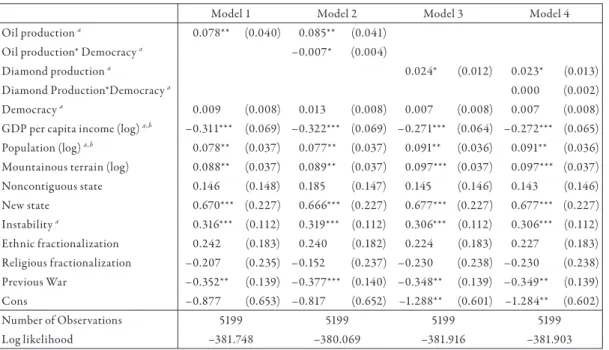
RESULTSThis section discusses the findings from the data analysis6). Table 1 presents the results from
the multivariate regression for the relationship between oil and diamond production and the onset of civil war. Models 2 and 4 of Table 1 in-clude the interaction terms between resource production and the level of democracy. Figures 1 and 2 illustrate the results of the interaction effect between natural resources and democra-cy on the onset of civil war. In all statistical analyses, probit regression models are used7).
I begin with the results concerning the re-source variables. The estimated coefficient of the oil production variable has a positive and statistically significant effect on conflict in Models 1 and 2. This result corresponds to
pre-vious studies that find that oil production is positively linked to the onset of civil war. Next, I explore the effect of diamond production on the occurrence of civil war in Models 3 and 4. As seen there, the coefficient of the diamond production variable is also positively signed and is statistically significant in Model 3 and 4. Previous research maintains that diamonds are the most powerful resource for providing loot-seeking incentives and the opportunity to cover start-up costs prior to launching an insur-gency (Lujala et al. 2005). In line with my expectations, the result indicates that diamond wealth may be positively related to the out-break of armed conflict.
Models 2 and 4 include interaction terms be-tween the oil and the diamond production variables and the level of democracy to reveal
multicollinearity between oil production and export variables.
6) All estimations are conducted using STATA 12. 7) The coefficients of logit regression analyses show similar signs and significant levels to the probit models.
Model 1 Model 2 Model 3 Model 4
Oil production a 0.078** (0.040) 0.085** (0.041)
Oil production* Democracy a –0.007* (0.004)
Diamond production a 0.024* (0.012) 0.023* (0.013)
Diamond Production*Democracy a 0.000 (0.002)
Democracy a 0.009 (0.008) 0.013 (0.008) 0.007 (0.008) 0.007 (0.008)
GDP per capita income (log) a,b –0.311*** (0.069) –0.322*** (0.069) –0.271*** (0.064) –0.272*** (0.065)
Population (log) a,b 0.078** (0.037) 0.077** (0.037) 0.091** (0.036) 0.091** (0.036)
Mountainous terrain (log) 0.088** (0.037) 0.089** (0.037) 0.097*** (0.037) 0.097*** (0.037)
Noncontiguous state 0.146 (0.148) 0.185 (0.147) 0.145 (0.146) 0.143 (0.146) New state 0.670*** (0.227) 0.666*** (0.227) 0.677*** (0.227) 0.677*** (0.227) Instability a 0.316*** (0.112) 0.319*** (0.112) 0.306*** (0.112) 0.306*** (0.112) Ethnic fractionalization 0.242 (0.183) 0.240 (0.182) 0.224 (0.183) 0.227 (0.183) Religious fractionalization –0.207 (0.235) –0.152 (0.237) –0.230 (0.238) –0.230 (0.238) Previous War –0.352** (0.139) –0.377*** (0.140) –0.348** (0.139) –0.349** (0.139) Cons –0.877 (0.653) –0.817 (0.652) –1.288** (0.601) –1.284** (0.602) Number of Observations 5199 5199 5199 5199 Log likelihood –381.748 –380.069 –381.916 –381.903
Robust standard errors are in parentheses.
a Lagged one year; b ln 1000’s.
* significant at 10 %; ** significant at 5%; *** significant at 1 %
how the effect of natural resources on the inci-dence of armed conflict differs depending on the degree of democracy. Model 2 shows that the coefficient of the interaction term between oil production and the level of democracy is negative and statistically significant. In Model 4, the interaction term of diamonds produc-tion and democracy fails to reach the level of statistical significance. How do we interpret the results of the two interaction terms?
Several scholars warn that interpreting inter-action terms as marginal effects yields incorrect conclusions (Ai and Norton 2003; Brambor et al. 2006). Their explanation on the interpreta-tion of interacinterpreta-tion terms advises that a traditional table of results does not provide enough information about the marginal effect of resource production on the onset of civil war for different levels of democracy. The interac-tive effect in a nonlinear model may be statistically significant for most observations, even if the interaction term appears as non-sig-nificant in a traditional results table (Ai and Norton 2003). The coefficient of interaction terms only indicates the marginal effect of nat-ural resource production when the value of the democracy variable is 0 or there is a marginal effect of democracy when there is no natural resource production (Brambor et al. 2006). Therefore, the result of Models 2 and 4 does not tell us that the marginal effect of natural resource production has a positive or negative impact on the likelihood of civil war at a par-ticular level of democracy.
To better understand what these results mean, this paper turns to a graphical procedure suggested by Brambor et al. (2006). Their pro-cedure calculates substantively marginal effects and correct standard errors for interaction
terms, and displays all the information from the interaction of the variables, including the information needed for inferences8).
The solid line in Figures 1 and 2 shows how the marginal effect of oil and diamond produc-tion changes with the degree of democracy. The dashed lines are 95% confidence intervals for the marginal effects, i.e., the degree of un-certainty of the estimated marginal effects of oil and diamond production on the onset of civil war. These intervals around the line allow us to determine the conditions under which oil and diamond production have a statistically significant effect on the risk of civil war. When the upper and lower bounds of the confidence intervals are either above or below the horizon-tal zero line, the effect of natural resource production is statistically significant. On the other hand, it is important to note that if the zero line is encompassed within the confidence interval, the variable is not significant. In this case, it cannot be said with confidence that natural resource production has a substantive and significant effect on the risk of the onset of civil war.
Figure 1 illustrates how the marginal effect of oil production changes across the range of de-mocracy. As is evident, the marginal effect of oil production on the likelihood of civil war monotonically decreases with the level of de-mocracy. The result captures the essence of the theoretical argument that democratic institu-tions reduce the positive relainstitu-tionship between oil production and the onset of civil war. Upon closer examination of Figure 1, it is evident that the marginal effect of oil production has a posi-tive and significant effect on the likelihood of conflict when governments adopt non-demo-cratic regimes (scored from -10 to 0). A greater
8) I use the CLARIFY program for STATA to simulate 10,000 iterations and calculate the marginal effects and standard errors of interaction terms holding other variables at their mean or median.
amount of oil production leads to the further aggravation of the oil curse in non-democratic countries.
In contrast, when the level of democracy is more than 1 on the score range, the confidence interval encompasses the zero line. This result demonstrates that oil production no longer has a significantly positive effect on civil war when countries have semi-democratic or adequately democratic institutions. This finding lends some credence to the proposed argument that democratic institutions have a greater allevia-tive effect on the connection between resource wealth and civil war. The level of democracy plays a key role in explaining cross-country dif-ferences in the oil resource-civil war link.
As Figure 2 shows, the 95% confidence inter-vals include the zero line at all levels of democracy. This result indicates the diamond production variable conditioned by the degree of democracy has no effect on the likelihood civil war. However, the result of Model 3, not including the interaction term, and Model 4 show that diamond production fuels the risk of
conflict. These results indicate that there is no conditional effect of democracy levels on the diamond resource-conflict link. In other words, this can be interpreted to mean that the level of democracy of domestic institutions is unlikely to be related to the aggravating effect of diamond production on political (dis)order.
Oil and diamonds are believed to represent typical non-lootable resources and lootable re-sources, respectively. Non-lootable resources may, as their name suggests, be more difficult for an insurgent group to loot. Governments can more easily control these non-lootable re-sources mobilizing the necessary manpower and information to organize large projects nec-essary for resource exploitation. Since domestic regimes tend to determine political leaders’ be-haviors, the different strength of government control over resource wealth suggests the de-gree of domestic institutions’ impact on the resource–conflict link. Thus, while the rela-tionship between non-lootable resources and conflict is strongly affected by the institutional environment, the conditional impact of
de--.0 05 0 .0 05 .0 1 M ar gi na l E ffe ct o f O il Pr od uc tio n -10 0 10 Level of Democracy
Marginal Effect 95% confidence interval 95% confidence interval
Dependent Variable: Civil War Onset
Figure 1. The Marginal Effect of Oil Production on the Risk of Civil War Onset Under Varying Levels of Democracy
Figure 2. The Marginal Effect of Diamonds Production on the Risk of Civil War Onset Under Varying Levels of Democracy -.0 01 0 .0 01 .0 02 .0 03 M ar gi na l E ffe ct o f D ia m on d Pr od uc tio n -10 0 10 Level of Democracy
Marginal Effect 95% confidence interval 95% confidence interval
mocracy decreases with resources’ increased lootability.
The negative impact of natural resource wealth may be reduced in cases where the do-mestic institutions are more democratic and is, in contrast, thought to be increased when non-democratic institutions are present. In addition, as the lootability of natural resources becomes greater, democratic institutions’ effec-tiveness against the resource curse is believed to weaken. The difference between the results of Figures 1 and 2 is evidence that the destabi-lizing effect of abundant resources is more easily alleviated in democratic states than in non-democratic states; however, the attenuat-ing effect of democratic institutions decreases with the resources’ lootability. There is thus a weak interaction between resources’ lootability and the mitigating effect of democracy on the resource curse.
Table 1 also tells us something about the risk of onset of civil war. The estimated coefficients of GDP and per capita income are negatively signed and statistically significant in all models. These results indicate that the improvement of economic and living conditions can reduce the probability of the onset of civil war. In other words, a less developed environment, economi-cally speaking, lowers the opportunity cost of rebellion for the people and likewise lowers the cost of recruitment for rebel leaders. Popula-tion size has a positive and significant effect on the onset of armed conflict. Mountainous ter-rain, which has been said to increase the feasibility of insurgency, is positive and statisti-cally significant across four models in Table 1. The coefficients for political instability and new state reach statistical significance with a positive sign in the models. Since these two
variables may proxy for state weakness, the re-sult indicates that weakened state capacity contributes to a higher risk of the onset of do-mestic conflict.
V
CONCLUSIONThis paper has aimed to explain why some resource-rich countries suffer the outbreak of civil war while others do not. Even though pre-vious research has intensely debated the subject of the resource–conflict link, it has not fully accounted for the fact that certain countries with similar natural resources and levels of re-source wealth have had vastly different experiences of civil conflict and violence. To confront this puzzle, this paper has investigat-ed the relationship among natural resources, the level of democracy, and civil war. Instead of researching the connection between these vari-ables separately, this paper has examined the interaction effect between natural resources and the level of democracy on the likelihood of civil war. In so doing, this paper has also suc-cessf u l ly confirme d a more complex relationship between conflict and resources than that which has been proposed in the pre-vious literature. The empirical findings presented in this article suggest two important findings which somewhat disentangle the aforementioned complex relationship.
First, this paper provides empirical evidence that, even controlling for other important ex-planatory variables, democratic institutions alleviate the negative impact of natural resourc-es on domresourc-estic political stability. In oil-rich countries, adequately democratic institutions prevent leaders from spending resource reve-nues on their personal fortunes or on
patronage because they must strive to maintain political legitimacy or else suffer electoral pun-ishment. Additionally, democratic institutions provide potential greedy rebels with sufficient opportunity to accumulate private gains through non-violent means, and thus such in-dividuals do not have an incentive to loot natural resources. On the other hand, non-democratic regimes in oil-rich countries fail to mute the impact of resource wealth on civil war.
Second, the results from the analysis of inter-action terms between resources’ lootability and democracy suggest that the alleviatory effect of democracy on the resource-conflict link de-creases with the resources’ lootability. The lootability of oil resources is lower than the lootability of diamond resources. The democ-ratization of domestic regimes, in the oil resource case, reduces the detrimental effect of natural resources. On the other hand, demo-cratic regimes do not have a conditional effect on the relationship between diamond resources and civil war. This result indicates that the con-ditional effect of democracy is higher in the non-lootable resource case than in the lootable resource case. In addition, it can be noted that lootable resources directly, not conditioned by domestic institutions, affect the motivation and opportunity of rebels.
【Acknowledgement】
This research is financially supported be the Grant-in-Aid for Scientific Research program of the Japan Society for the Promotion of Sci-ence (24730140) and the Konosuke Matsushita memorial foundation.
Reference
⦿ Ai, Chunrong & Edward C. Norton (2003) / Interaction Terms in Logit and Probit Models.
Economic Letters 80(1): 123-129.
⦿ Basedau, Matthias & Tim W. Wegenast (2009) / Oil and Diamonds as Causes of Civil War in sub-Saharan Africa: Under what Conditions?
Colombia Internacional 70(Julio-diciembre): 35-59. ⦿ Brambor, Thomas, William Roberts Clark & Matt Golder (2005) / Understanding Interaction Models: Improving Empirical Analyses.
Political Analysis 14(1): 63-82. ⦿ Bulte, Erwin H., Richard Damania & Robert T. Deacon (2005) /
Resource Intensity, Institutions, and Development.
World Development 33(7): 1029-1044. ⦿ Collier, Paul & Anke Hoeffler (1998) / On Economic Causes of Civil War.
Oxford Economic Paper 50(4): 563-573. ⦿ Collier, Paul & Anke Hoeffler (2004) / Greed and Grievance in Civil War.
Oxford Economic Paper 56(4): 563-596.
⦿ Fearon, James D. (2005) / Primary Commodity Exports and Civil War. Journal of Conflict Resolution 49(4):
483-507.
⦿ Fearon, James D. & David D. Latin (2003) / Ethnicity Insurgency, and Civil War.
American Political Science Review 97(1): 75-90. ⦿ Fjelde, Hanne(2009)/Buying Peace? Oil Wealth, Corruption, and Civil War, 1985-1999. Journal of Peace Research 46(2):199-218. ⦿ Gilmore Elisabeth, Gleditsch Nils Petter, Lujala Paivi & Rød Jan Ketil (2005) / Conflict Diamonds: A New Dataset.
Conflict Management and Peace Science 22(2):257–272 ⦿ Hendrix, Cullen S. (2010) /Measuring State Capacity: Theoretical and Empirical Implications for the Study of Civil Conflict. Journal of Peace Research 47(3): 273-285. ⦿ Humphreys, Macartan (2005) /Natural Resources, Conflict, and Conflict Resolution.
Journal of Conflict Resolution 49(4): 508-537. ⦿ Isham, Jonathan, Michael Woolcock, Lant Pritchett & Gwen Busby (2005) / The Varieties of Resource Experience: Natural Resource Export Structures and The Political Economy of Economic Growth.
⦿ Jensen, Nathan & Leonard Wantchekon (2004) / Resource Wealth and Political Regimes in Africa.
Comparative Political Studies 37(7): 816-841. ⦿ Keen, David (2000) / Incentives and Disincentives for Violence. In Mats R. Berdal and David M. Malone, eds.
Greed and Grievance: Economic Agendas in Civil Wars. / Boulder, CO: Lynne Rienner. ⦿ Le Billon, Philippe (2001) / The Political Ecology of War: Natural Resources and Armed Conflict.
Political Geography 20(5): 561-584. ⦿ Lujala, Päivi (2010) / The Spoils of Nature: Armed Civil Conflict and Rebel Access to
Natural Resources. Journal of Peace Research 47(1): 1-15. ⦿ Lujala, Päivi, Jan Ketil Rød & Nadja Thieme (2007)/ Fighting over Oil: Introducing a New Data.
Conflict Management and Peace Science 24(3): 239-256. ⦿ Lujala, Päivi, Nils Petter Gleditsch &
Elisabeth Gilmore (2005) / A Diamond Course?: Civil War and a Lootable Resource.
Journal of Conflict Resolution 49(4): 538-562.
⦿ Melhum, Halvor, Karl Moene & Ragnar Torvik (2006)/ Institutions and the Resource Curse.
Economic Journal 116: 1-20.
⦿ Regan, Patrick M. & Daniel Norton (2005)/ Greed, Grievance, and Mobilization in Civil War.
Journal of Conflict Resolution 49(3): 319-336. ⦿ Ross, Michael (2003) / Oil, Drugs, and Diamonds: The Varying Roles of Natural Resources in Civil War. In Karen Ballentine and Jake Sherman, eds.
The Political Economy of Armed Conflict. /
Boulder, CO: BoLynne Rienner.
⦿ Ross, Michael (2004a)/ How Dose Natural Resource Wealth Influence Civil War?
Evidence from Thirteen Cases.
International Organization 58(1): 35-67.
⦿ Ross, Michael (2004b) / What Do We Know about Natural Resources and Civil War?
Journal of Peace Research 41(3): 337-356. ⦿ Ross, Michael (2006)/ A Closer Look and Oil, Diamonds, and Civil War.
Annual Review of Political Science 9: 265-300. ⦿ Smith, Benjamin (2004)/ Oil Wealth and Regime Survival in the Developing World.
American Journal of Political Science 48(2): 232–246. ⦿ Snyder, Richard (2006)/ Does Lootable Wealth Breed Disorder? A Political Economy of
Extraction Framework.
Comparative Political Studies 39(8): 943-968.
⦿ Snyder, Richard & Ravi Bhavnani (2005)/ Diamonds, Blood, and Taxes: A Revenue-Centered Framework for Explaining Political Order.
Journal of Conflict Resolution 49(4): 563-597.
⦿ Tomz, Michael, Jason Wittenberg & Gary King (2003)/ CLARIFY: Software for Interpreting and
Presenting Statistical Results.
Civil War, Natural Resources, and Democracy
When Do Natural Resources Lead to Civil War?
Hirotaka Ohmura
Paul Collier and Anke Hoeffler argues that resource wealth increases the motivation of rebels to accumulate private gains and gives rebel leaders enough funding opportunities to organize armed groups. Although this hypoth-esis predicts that the same natural resources and the same types of natural resources lead to the same consequences, there are a number of countries that share the same resource profiles and yet have experienced very different histo-ries of political instability and violence. This paper examines how natural resources influ-ence the likelihood of civil war according to different government preferences and domestic institutions. In its data analysis, this paper con-siders the level of democracy of domestic institutions as a conditional variable, not as an intermediate variable, to examine the condi-tional effect of the level of democracy on the conflict–resource link. This analysis yields the following results: (1) The alleviatory effect of democracy on the resource–conflict link tends to work in non-lootable resource cases. (2) Lootable resources directly, not conditioned by domestic institutions, affect the risk of the on-set of civil war.