C-24
ONLINE HYBRID TEST BY INTERNET LINKAGE OF DISTRIBUTED ANALYSIS DOMAINS
Peng Pan, Motohide Tada, and Masayoshi Nakashima
1. Introduction
The online hybrid test (called online test), particularly when combined with substructuring techniques, is able to conduct large-scale tests. An extension of this technique is to combine tests conducted in remote lo-cations and also integrated with large numerical analysis codes. In this study, a new Internet online test system is devised, in which a physical test is con-ducted in one place, the associated numerical analysis is performed in a remote location, and the two communicated through Internet.
2. Method
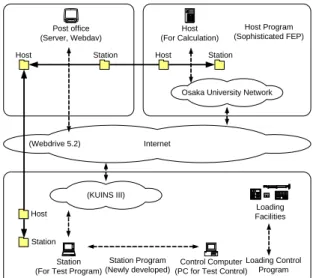
To implement the system, a technique that links test and analysis domains located at different places is proposed. An Internet data exchange interface, which is used to allow the communication across the Internet, and a practical Internet environment shown in Fig. 1 are constructed.
Osaka University Network Host
(For Calculation) Post office
(Server, Webdav)
Control Computer (PC for Test Control) Internet
(KUINS III)
Station (For Test Program)
Loading Facilities Host Program (Sophisticated FEP) Station Program (Newly developed) Loading Control Program Host Station Host Station Host Station (Webdrive 5.2)
Fig. 1. Internet environment developed
To incorporate an implicit finite element program into the online test, a stiffness prediction method shown in Fig. 2 (a) is proposed.
u s f I K S1S2 S3 p S Kp u s f I K S1S2 S3 p S Kp
Linear Least Square
-2000 0 2000 -400 0 400 Experimental Predicted H o ri z o nt al F o rc e ( k N ) Horizontal Disp (mm) (a) (b)
Fig. 2. Stiffness Perdition: (a) algorithm; (b) verification
Test on a base-isolated structure was carried out to validate the method. The hysteresis curves of the base-isolation layer obtained by the prediction method are compared with the physical test in Fig. 2 (b). Three physical Internet online tests (Test 1, 2, and 3) of the base-isolated structure model shown in Fig. 3 (a) were carried out to validate the applicability and efficiency of the proposed testing system. The JMA Kobe ground motions was adopted, and the duration was set to 15 seconds for all tests. Test 1 and 2 used initial stiffness all along but Test 3 predicted stiffness. Test 1 and 3 used time interval of 0.02 second, whereas Test 2 used 0.01 second.
RF 8F 7F 6F 5F 4F 3F 2F 1F Test Computation Lumped mass Beam element Column element -400 -300 -200 -100 0 100 200 300 400 0 5 10 15
Initial stiffness (0.02 sec) Initial stiffness (0.01 sec) Predictor stiffness (0.02 sec)
Time (sec) H o ri zo nt al D is p ( m m ) (a) (b)
Fig. 3. Online tests of base-isolated structure: (a) structural model; (b) test result of displacement time history
All tests went smoothly, and Test 3 gave the most ac-curate responses. Statistics on time consumption were given in Table 1, and example test results of base-isolation time histories are shown in Fig. 3 (b).
Table 1. Three type of Internet online test Total (min) Loading (min) Connection (min) Computation (min) Test 1 160 120 40 <1 Test 2 250 170 80 <2 Test 3 170 120 50 <1 3. Conclusion
Major findings obtained in this study are as follows: (1) applicability of the proposed system has been veri-fied, and finite element programs can be incorporated into the system by using the substructure technique; (2) the proposed internet data exchange interface is robust and secures the data transmission; (3) the pro-posed stiffness prediction method, which is necessary for accommodating an implicit integration finite ele-ment program, is effective; (4) Physical online tests of a base-isolated structure using the proposed system were carried out successfully.