Attribution Retraining in Improving Students’
Self-efficacy with English Learning
NAKAYAMA, Tomokazu
AbstractThis study reports the results of a study on the effectiveness of attribution retraining through an in-class extensive reading (ER) program in improving students’ self-efficacy with English learning. Nakayama and Matsunuma (2013) investigated the impact of attribution retraining through remedial English grammar lessons on learners’ self-efficacy when learning English. Based on their findings, this study investigated whether the in-class ER program with revised treatments based on Nakayama and Matsunuma improved trainees’ self-efficacy on English learning by comparing two groups that differed in their degree of exposure to English outside the classroom. The analysis suggests that the current ER program improves students’ self-efficacy in English learning. However, further investigation is required to draw conclusions by expanding the duration of experiments.
Keywords: attribution, self-efficacy, extensive reading
This study reports the results of research on the effectiveness of attribution retraining through the in-class extensive reading (ER) program in improving students’ self-efficacy with English learning. Based on the findings of Nakayama and Matsunuma (2013), this study investigated whether the in-class ER program with revised treatments improved trainees’ self-efficacy with English learning by comparing two groups that differed in their degree of exposure to English outside the classroom.
Extensive reading and benefits thereof
The spread of the networked society has made obtaining efficient reading proficiency in English a critical factor in surviving in global communities. There is also an increasing need to develop such proficiency in academic settings according to the growing use of English in classrooms to teach course content. To obtain efficient reading proficiency is not only to obtain syntactic knowledge such as grammatical knowledge or knowledge of vocabulary, but also to obtain the fluency to analyze content or search for the necessary information. Conventional reading classes alone do not enable students to achieve these goals. Therefore, extensive reading in English Language Teaching (ELT) has been garnering a great deal of attention among ELT researchers. ER is “reading in quantity and for pleasure, and usually done outside the class using graded readers or other material (Richards, 2015, p. 464)”. Richards (2015) further states that the purpose of ER is to “encourage students to develop an interest and a habit in reading on their own so that they can move from learning to read to reading to learn (p. 464).” Furthermore, many empirical studies have been conducted to verify the effectiveness of ER programs. These focus on improvement in reading comprehension (e.g., Bell, 2001; Mason & Krashen, 1997; Sheu, 2003; Tanaka & Stapleton, 2007), knowledge of vocabulary (e.g., Lao & Krashen, 2000; Pigada & Schmitt, 2006), improvement in fluency (e.g., Taguchi, Takayasu-Maass & Gorsuch, 2004; Iwahori, 2008), and perception of the ER program (Tanaka & Stapleton, 2007). However, very few studies reported on what type of program, course content, or instructors’ approach to students in ER are effective in improving students’ motivation and developing a new habit of reading outside the classroom. For ER to positively impact students and lead them to develop a habit of reading, it is necessary to motivate them and provide successful experiences through ER. Therefore, this study applies the reattribution training method developed by Nakayama and Matsunuma (2013) for an ER program for university students.
Attribution Retraining Method by Nakayama and Matsunuma (2013)
In a three-month study, Nakayama and Matsunuma (2013) investigated whether their attribution retraining treatment, which was based on Dweck (1975) and Bandura (1977), could improve false-beginner university students’ self-efficacy in English learning and English proficiency. They asked 19 university students to
attend 90-minute weekly training sessions for 3 months to help them recognize their responsibility for failure and to attribute their failure to a lack of effort. Pre- and post-analysis of the questionnaire and TOEIC Bridge mock exam scores indicated significant improvement in students’ self-efficacy on English learning and English proficiency.
Self-efficacy is one critical factor in determining students’ academic performance. It refers to individuals’ beliefs about their capabilities to attain a certain level of task performance. According to Bandura (1977), self-efficacy is derived from “four principal sources of information: performance accomplishment, vicarious experiences, verbal persuasion, and physiological states.” Furthermore, among these four, performance accomplishment or a successful experience is the most powerful source in improving self-efficacy. Regarding how students should gain successful experiences, Dweck (1975) verified the effectiveness of an attribution training treatment, in which students experience a circle of unsuccessful experiences to take responsibility for failure, and then experience successful experiences. This is compared to the condition in which students repeat only successful experiences. Nakayama and Matsunuma verified the attribution retraining program based on Bandura (1977) and Dweck (1975). Based on Bandura (1977) and Dweck (1975), Nakayama and Matsunuma created a program to improve students’ self-efficacy while learning English by training false-beginner students who repeated unsuccessful English learning experiences to attribute the causes of such experiences to a lack of their efforts.
Based on the above, this study attempts to apply the attribution retraining method by Nakayama and Matsunuma (2013) in an ER program for university students. However, Nakayama and Matsunuma (2013) only focused on one of the four critical sources of self-efficacy by Bandura (1977), namely performance achievement. Therefore, this study attempts treatments for all four sources in the ER program: performance accomplishment, vicarious experiences, verbal persuasion, and physiological states. Table 1 shows the treatments applied in this study.
Table 1 Treatments for the four major sources of self-efficacy applied in this study
Sources Treatments
Performance accomplishment 1. Participants choose books according to their interests and difficulty.
2. Participants keep records of how many books and how many words they read in an Extensive Reading Diary in the program to see their progress .
3. Participants set a small goal for each session and the final goal to be achieved by the end of all the sessions by filling out the goal sheet created by the author.
Vicarious experiences Participants can read books with friends so that they can see the progress of others.
Verbal persuasion 1. Participants can discuss the books they read with friends and create an atmosphere to encourage each other.
2. Participants will have a two-minute structured interview with the instructor to discuss their progress and be encouraged to read books outside the classroom in every session.
Physiological state Participants will read books at their preferred seats and be allowed to drink and eat freely in the session.
Measurements applied in this study
Following Nakayama and Matsunuma (2013), this study applies the English Self-efficacy Questionnaire (ESE) developed by Matsunuma (2006) to measure the improvement of participants’ self-efficacy during English learning.
Objective of this study
This study aims to investigate whether the in-class ER program with revised treatments based on Nakayama and Matsunuma improves trainees’ self-efficacy during English learning.
Method Participants
Two groups of English extensive reading classes comprising 80 female Japanese university students (aged between 18 and 19 years) participated in this study. All participants were Japanese with no experience of studying overseas. The participants were taking the author’s English extensive reading class, which constitutes part of the requirements for their graduation. The reason two groups were used was to avoid interventions of other factors such as exposure to English outside the ER classroom. The humanities group (N=40) was selected because the participants were taking another required English course at the same time they participated in the ER program. The other group was the nutrition group (N=40), in which participants did not start the required English course until the following semester. Comparing the two groups with different conditions in terms of exposure to English enables the measurement of more validated data on the effectiveness of the ER program.
This study was conducted as part of class activities from April 2017 and July 2017. Materials
Extensive reading materials. Three levels (novice, intermediate, and advanced) of graded readers were used. The novice level included 228 books of the Oxford Reading Trees series, which were divided into 9 streamlined stages. The easiest level, namely stage 1, starts from a book containing 2 words, while the most advanced level, stage 9, ends with a book containing 1,278 words. Each stage consists of 12 to 24 books. In total, 72,470 words are used in the series. The intermediate level included 176 books containing 946,448 words in total. These were a mix of graded readers such as the Oxford Bookworm series and Penguin readers and had eight stages. The advanced level included 50 books of 1,003,744 words in total, and consisted of the same series as the intermediate level. However, the books were more advanced and comprised three levels. Students read about 73,000 words by finishing the novice level, 1,000,000 words by the end of the intermediate level, and 2,000,000 words by the end of the advanced level.
Extensive Reading Diary. The Extensive Reading Diary was given to all participants before the first lesson. The diary consisted of the lists of book titles and word counts sorted by each stage and level so that students could record the dates they finished reading each book. The purpose of the diary was to increase students’ awareness of their goals and achievements.
Goal sheet. The goal sheet was a worksheet for students to state their goals for each lesson. Students set a goal for each lesson by looking at the books and created two worksheets in the first lesson. Students submitted a copy to the instructor at the end of the first lesson.
English Self-efficacy Questionnaire (ESE)
This study applied the ESE developed by Matsunuma (2006) to measure the improvement of their self-efficacy during English learning. It consisted of eight items. This questionnaire was used in the first and the final session; however, the order of questions was changed to avoid bias. The questionnaire was written in Japanese. The items in the ESE are shown in Table 2. The English translation is provided for reference in Table 2.
Questionnaire about the program
A questionnaire on the ER program was developed. The questionnaire was administered at the final session, and asked students to indicate (1) how many hours they read ER books outside the classroom and (2) their overall feedback of the program.
Table 2 Items in the ESE (Matsunuma, 2006)
Number Items
1 私は英語が得意だと思う。 I am good at English.
2 私は英語の授業で教えられたことを理解することができると思う。 I can understand what is taught in the English class.
3 私は英語で良い成績をとることができると思う。 I can obtain good grades in English.
4 私は英語の授業で与えられた課題に適切に答えることができると思う。 I can accomplish the tasks given in the English class.
5 私の英語の学力はすぐれていると思う。 My scholastic competence in English is great.
6 私は英語の学習内容についてたくさんのことを知っていると思う。 I obtain a lot of knowledge learned in the English class. 7 私は英語の学習内容を習得できると思う。
I can acquire knowledge in the English class. 8 私は英語の勉強方法を知っていると思う。
Procedure
The procedure had four phases: an orientation meeting and pretest, the practice lesson in the classroom, lessons with treatments at the cafeteria, and a post-test. Each session was 90 minutes long. A summary of the procedure is provided in Table 3. The humanities and nutrition groups followed the same procedure.
Session 1: Orientation and pretest. Students were provided with an orientation of the course guideline, class schedule, and classroom policy. Then, students were asked to set their goals for each lesson and fill out the goal sheet by checking the levels of books stored in the book carts. Once students completed the goal sheet, they were asked to submit a copy to the instructor and keep another for themselves. Students were then asked to complete the English learning self-efficacy questionnaire. They were informed that they could refuse to complete the ESE, and that this refusal would not affect their grades and attendance.
Session 2: Practice lesson in the classroom. To accustom students to the use of graded readers and interviews with the instructor before they began the lessons in the cafeteria, students stayed in the classroom and read the books in session 2. They were asked to fill in the dates they read the books in the list included in the Extensive Reading Diary. In addition, the instructor conducted a two-minute interview with each student, asking questions pertaining to (1) their interest in the books, (2) how many books they had read thus far in and outside the classroom, and (3) how many books they thought they could read by the following week. They were then given an opportunity to ask the instructor questions. Students read for approximately 60 minutes in the classroom. They were informed that from the next session, classes would be held in the school cafeteria.
Session 3 to Session 14: Lessons in the cafeteria. After taking attendance, students were asked to read books according to the schedule indicated on the goal sheet under the following treatments: (1) Students can be seated anywhere they wish
Improving Students’ Self-efficacy with English Learning
Table 3 Procedure 1. Session 1: Orientation and pretest
2. Session 2: Practice lesson in the classroom 3. Session 3 to Session 14: Lessons in the cafeteria 4. Session 15: Post-test
in the cafeteria, (2) students can talk to other students about the books they read, (3) students can drink or eat while reading books; however, (4) the use of smartphones is strictly prohibited in class, and (5) students need to participate in a two-minute structured interview with the instructor every time. The process of the structured interview is provided in Table 4.
Session 15. Students were asked to complete the ESE questionnaire and the questionnaire about the program after submitting an in-class report as part of their grade requirement. However, as for the pre-test, students were informed that they could refuse to complete the questionnaire, and that this refusal would not affect their grades and attendance.
Both the humanities and nutrition groups completed 15 sessions by the end of July 2017.
Results
Only the students who participated in all the sessions were included in the data analysis. As a result, seven students from each of the humanities and nutrition groups were excluded and 66 students ultimately included in the analysis.
Table 4 Process of the two-minute structured interview
Process Content
1 The instructor confirmed the progress with the student in a comfortable environment. The instructor complimented students if they were ahead of the schedule and encouraged them if behind.
2 The instructor asked students how much more they could read by the following session. To avoid pressuring the student, students were allowed to determine their schedule, even if behind.
3 The student was provided an opportunity to ask questions regarding the ER program.
Pre-post analysis of the ESE
Table 5 shows the descriptive analysis of the ESE scores of the humanities and nu-trition groups. The mean score of the pretest for the nunu-trition group was 2.66 (SD=.57) and 2.65 (SD=.73) for the humanities group. The mean score of the post-test for the nutrition group was 2.88 (SD=.57) and 2.84 (SD=.60) for the humanities group. A two-way analysis of variance (ANOVA) was performed with the groups (nutrition and humanities) as the between-subjects variable and the pre-and post-test scores as the within-subjects variable. All statistical tests were conducted at the α = .05 level.
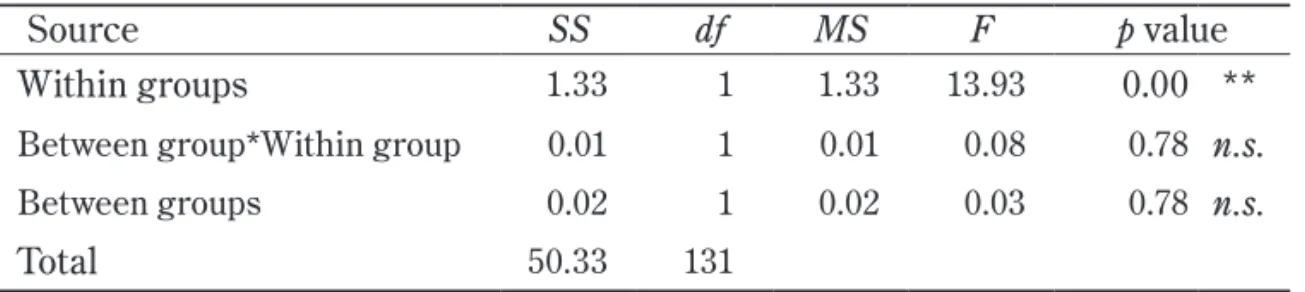
The two-way ANOVA analysis between the nutrition and humanities groups for the ESE revealed a significant main effect for the within groups (F(1, 65) = 13.93, p=.00); however, neither the main effect of groups nor the interaction between groups and within groups were significant (F(1, 65) =0.03, p = 0.86) (F(1, 65) =0.08, p = 0.78).
According to the analysis, both the nutrition group (less exposure to English outside the classroom) and humanities group (more exposure to English outside the classroom) demonstrated a greater effect on improving students’ self-efficacy . The results of the ANOVA for the pre-post analysis of the ESE are presented in Table 6.
Improving Students’ Self-efficacy with English Learning
Pre Post Nutrition N 33 33 M 2.66 2.88 SD .57 .57 Humanities N 33 33 M 2.65 2.84 SD .73 .60 Source SS df MS F p value Within groups 1.33 1 1.33 13.93 0.00 **
Between group*Within group 0.01 1 0.01 0.08 0.78 n.s.
Between groups 0.02 1 0.02 0.03 0.78 n.s.
Total 50.33 131
**p<.01
Table 5 Descriptive statistics of the ESE scores
Results of the questionnaire about the program
Table 7 provides the results of the questionnaire on the ER program. The results reveal that 75.56% (25 of 33 students) of students in the nutrition group and 72.73% (24 of 33 students) of those in the humanities group read ER books outside the classroom. The 75.76% of students who read ER books outside the classroom spent an average of 45 minutes per week doing so. The 72.73% of students in the humanities group spent an average of 30 minutes per week reading ER books outside the classroom. Overall, the ER program encourages students to read English books outside the classroom.
Discussion
This study investigated whether the in-class ER program with revised treatments based on Nakayama and Matsunuma improves trainees’ self-efficacy during English learning. Nakayama and Matsunuma investigated the impact of an attribution retrain-ing program on students’ self-efficacy durretrain-ing English learnretrain-ing. Addretrain-ing revised treat-ments to Nakayama and Matsunuma (2013), this study compared two groups that differ in their degree of exposure to English using the same conditions for the ER pro-gram. The pre- and post-test analysis of the ESE revealed that the self-efficacy of both groups during English learning improved through the current ER program. In addi-tion, around 70% of the students in both groups read ER books outside the classroom. Even though the number is relatively small, the current ER program received positive feedback.
Based on the findings, this study provides two significant implications. First, expo-sure to English through other English courses did not affect improvement in English self-efficacy. Second, this study suggests that the current ER program with treatments of the four main sources of self-efficacy might be effective in improving students’ per-ception of reading English. Since the number of studies on the impact of ER programs on students’ internal factors is limited, these research findings might provide new
in-Items Nutrition Humanity
Did you read ER books Yes: 25 (75.76%) Yes: 24 (72.73%) outside the classroom? No: 8 (24.24%) No: 9 (27.27%) Average time spent reading 45 minutes 43 minutes ER outside the classroom
sights into how to structure an in-class ER program. Future Research
This article reported a study on the effectiveness of an in-class ER program with treatments of the four main sources of self-efficacy in Japan. Further investigation is required by expanding the duration of experiments to determine whether students continue reading English books after completing the ER program. It is also necessary to compare ER programs with self-efficacy treatments and those without to determine any differences in the degree of improvements in students’ self-efficacy towards Eng-lish learning.
References
Bandura, A. (1977). Self-efficacy: Toward a unifying theory of behavioral change. Psy-chological Review, 84(2), 191-215.
Bell, T. (2001). Extensive reading: Speed and comprehension. The Reading Matrix, 1, 1-13.
Dweck, C. S. (1975). The role of expectations and attributions in the alleviation of learned helplessness. Journal of personality and Social Psychology, 31(4), 674-685.
Iwahori, Y. (2008). Developing reading fluency: A study of extensive reading in EFL. Reading in a Foreign language, 20(1), 70-91
Mason, B., & Krashen, S. (1997). Extensive reading in English as a foreign language. System, 25, 91-102.
松沼光泰. (2006).「英語自己効力感 (ESE)尺度の作成」.『早稲田大学大学院教育学研究 科紀要』別冊14号-1, 89-97.
中山誠一, & 松沼光泰. (2013). 再帰属訓練法は英語学習に対する自己効力感を向上させ るか. 『城西大学語学教育センター研究年報』, 7, 23-32.
Pigada, M., & Schmitt, N. (2006). Vocabulary acquisition from extensive reading: A case study. Reading in a foreign language, 18(1), 1-28.
Sheu, S. P-H. (2003). Extensive reading with EFL learners at beginning level. TESL Reporter, 36, 2, 8-26
Taguchi, E., Takayasu-Maass, M., & Gorsuch, G. J. (2004). Developing reading fluency in EFL: How assisted repeated reading and extensive reading affect fluency development. Reading in a Foreign Language, 16(2), 70-96.
Tanaka, H., & Stapleton, P. (2007). Increasing reading input in Japanese high school EFL classrooms: An empirical study exploring the efficacy of extensive read-ing. The Reading Matrix, 7(1), 115-131.