
Preliminary evaluation of the effects of carbonized chicken manure, refuse derived fuel and K fertilizer application on the growth, nodulation, yield, N and P contents of soybean and cowpea in the greenhouse
16
0
0
全文
(2) 760. Afr. J. Agric. Res.. amount of N is lost in the form of ammonia gas but the resulting carbonized material is higher in available P by up to 5 times compared to the original waste (Shinogi et al., 2003; Tagoe et al., 2008). Carbonized organic wastes can be used as soil amendments to supply plant nutrients especially N and P. The application of carbonized organic wastes to soil improve the physical properties of the soil, improve soil fertility and nutrient retention (Sombroek et al., 1993; Lehmann and Rondon., 2005), stimulate microbial activities in soil (Tejada et al., 2006), increase mycorrhizal abundance and/or functioning (Warnock et al., 2007), increase nodule abundance in soybean (Tagoe et al., 2008) as well as improve biological N2 fixation in common beans (Rondon et al., 2007). No work has been reported in the scientific literature on the use of carbonized refuse derived fuel (CRDF) as soil amendment for legume growth while only one work had been reported on the use of carbonized chicken manure as soil amendment for soybean growth (Tagoe et al., 2008). In this study, we assess the effects of two carbonized organic soil amendment materials (chicken manure and RDF) on the growth, nodulation, yield, N and P concentrations of two grain legumes (soybean and cowpea) with or without inorganic K fertilizer. We hypothesized that the application of carbonized organic materials will improve the growth, nodulation, seed yield, N and P concentrations of grain legumes more with K fertilizer than without K fertilizer because K could limit the response of grain legumes to P from carbonized organic materials in low P status soils (Carsky, 2003) and also because of the low K content of the experimental soil. Our major objectives are to elucidate the effect of carbonized chicken manure and carbonized RDF on 1) the growth, nodulation and seed yield and 2) plant and seed concentrations of N and P of both crops. MATERIALS AND METHODS Plant culture Experiments were conducted from May to October, 2007 at the greenhouse of Gifu University Experiment Farm (35o 27’ N, 136o 46’ E). Wagner pots (1/2000a) were filled with sandy loam soil with the following characteristics: pH; 5.62, EC; 0.28 mS cm-1, total N; 0.100%, total C; 0.88%, available P; 1.16 mg 100 g-1, available K; 13.3 mg 100 g-1, available Ca; 90.0 mg 100 g-1, and available Mg; 31.0 mg 100 g-1. The nutrient concentrations, pH and EC of the carbonized chicken manure and RDF used in the experiment are shown in Table 1. Carbonized chicken manure was obtained from Tokyo Yougyou Kabushiki Kaisha, Tajimi City, Gifu Prefecture, Japan. Carbonized chicken manure was produced from pelleted, dried chicken manure through pyrolysis at a temperature of 450oC for one hour in a furnace. Carbonized RDF was obtained from Kurimoto Tekkosho, In a City, Gifu Prefecture, Japan. Carbonized RDF was prepared from municipal organic waste through pyrolysis at a temperature of 500oC for 2 h in a kiln after drying the waste in a furnace for 10 h. The amounts of the carbonized organic materials applied per pot for the various treatments are shown in Table 2. Carbonized organic amendments were applied to the appropriate. treatments three weeks before sowing. Potassium fertilizer was applied as Muriate of Potash (KCl) at a rate of 83 kg K ha-1 to the appropriate treatments at sowing. No chemical pesticides were used in this experiment. Five seeds of soybean (Glycine max (L) Merrill cv Akishirome) and cowpea (V. unguiculata (L) Walp cv Tsurushi sasage) were sown per pot on 7th June, 2007. After emergence, seedlings were thinned to two per pot. Plants were watered as when necessary. All pots were kept completely free of weeds within the duration of the experiment by hand-picking when they appear. Experimental design The experiment was set up using two grain legumes (soybean and cowpea), two carbonized organic materials (carbonized chicken manure and carbonized RDF) with two rates of inorganic K fertilizer with or without K, 83 kg K ha-1 and 0 kg K ha-1 respectively in a factorial combination giving a total of 48 treatments (2 x 2 x 2 x 6) arranged in completely randomized design (CRD) of six replications. All data collected from the study were analyzed by using Duncan’s Multiple Range Test (DMRT) (Excel Statistical Package Version 6.0) and mean separations were done by the same method. Measurements Plant height and relative chlorophyll content (SPAD) were measured twice within the duration of the experiment. For both parameters, the first (pre-flowering) and second (post-flowering) samplings were done on 16th July and 31st July respectively. SPAD was measured with a chlorophyll meter model SPAD-502 (Minolta Co. Ltd., Japan). SPAD readings were taken from 12 randomly selected youngest and fully expanded leaves of plants in each pot. Each SPAD reading was taken on one side of the mid-rib of the leaf blade, midway between the leaf blade and tip. Sampling for leaf area, dry matter weight, and number of nodules was done on 26th July for cowpea and 1st August for soybean when the plants were at peak flowering stage. Shoots were harvested by cutting the plants in each pot at the soil level. Roots were harvested by lifting the soil in each pot and washing off the soil under running water from a tap. The harvested shoots were separated into leaves, stems (including petioles), flowers etc. The roots were washed clean of soil and root nodules were separated and counted. The leaves were used to estimate leaf area by the core borer method after oven-drying harvested samples at 80oC for 72 h. The dried samples were then weighed to determine dry weights of leaves, stems, roots and nodules and finally total dry matter weight. The total dry material was milled to pass 0.5 mm mesh sieve using a wonder blender (Model WB-1). The milled plant samples were used for total N and total P analyses and determination. Total N was determined with an automatic high sensitive NC analyzer (Sumigraph NC-95A, Shimadzu Co. Ltd., Japan). Total P was determined colorimetrically (HITACHI-U-1800) according to Bray and Kurtz (1945) and Murphy and Riley (1962). Residual experimental soil exchangeable cations (K+, Ca2+, and Mg2+) were measured with a Polarized Zeeman Atomic Absorption Spectrophotometer (HITACHI-180-60) after extraction of samples with 1.0N Ammonium acetate solution (pH 7.0).. RESULTS Plant growth At the pre-flowering sampling of the relative chlorophyll.
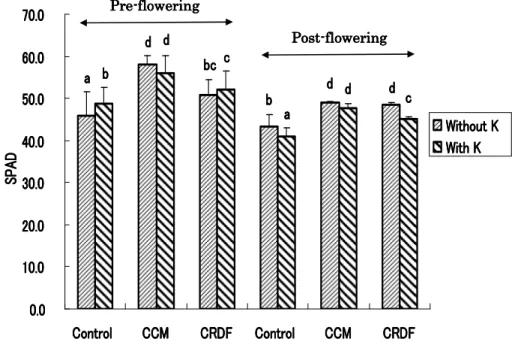
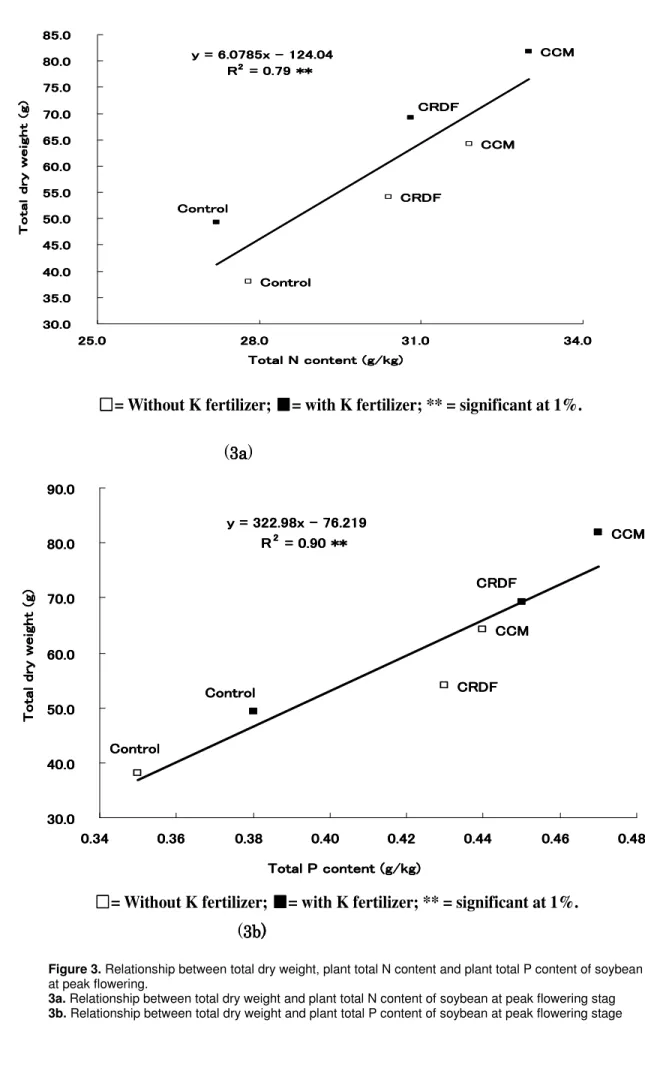
(3) Tagoe et al.. 761. Table 1. Nutrient composition of carbonized organic materials used in the experiment after pyrolysis. Property pH † EC (µS cm-1) Total N (g kg-1) NO3-N (mg kg-1) Total C (g kg-1) C/N ratio Na (g kg-1) P (g kg-1) K (g kg-1) Ca (g kg-1) Mg (g kg-1). Carbonized chicken Manure 9.93 3.64 44,0 1.90 497.5 11.31 2.37 24.6 37.00 7.67 1.93. Carbonized refuse derived fuel 7.76 65.03 20.2 500.9 25.00 3.38 5.22 3.45 30.28 2.10. † The pH and EC were measured in the extracts of carbonized organic materials in distilled water [ 1:20 (w/v)] on dry weight basis.. Table 2. Treatment details showing amounts of carbonized organic materials and inorganic K fertilizer applied per pot and treatment abbreviations. Treatment. No carbonized organic material (Control) No carbonized organic material (Control) Carbonized chicken manure Carbonized chicken manure Carbonized refuse derived fuel Carbonized refuse derived fuel. Amount of carbonized organic material applied (g) 0 0 11.40 11.40 24.75 24.75. content (SPAD) leaves of soybean plants treated with carbonized chicken manure were the greenest. Leaves of soybean plants treated with carbonized RDF were of intermediate greenness while those of the control were the least green with or without K fertilizer. Generally, leaves of soybean plants without K fertilizer were greener than those with K fertilizer (Figure 1). The observed differences were significant according to DMRT at p< 0.05. At the post-flowering sampling of SPAD, a similar trend was observed for the control and carbonized RDF treatments with or without K fertilizer. However, leaves of soybean plants treated with carbonized chicken manure were the greenest with or without K fertilizer (Figure 1). At the pre-flowering sampling of SPAD of cowpea, leaves of plants treated with carbonized chicken manure with or without K fertilizer were the greenest. Cowpea leaves of plants treated with carbonized RDF with or without K fertilizer were of intermediate greenness. Leaves of cowpea plants without any organic amendment (control) with or without K fertilizer were least green (Figure 2). For cowpea leaves of plants treated with carbonized chicken manure and carbonized RDF, no difference in greenness were observed for treatments with and without K fertilizer.. Amount of K fertilizer applied as muriate of potash (KCl) (mg) 0 830.0 0 410.0 0 740.0. Abbreviation. Control (Without K) Control (With K) CCM (Without K) CCM (With K) CRDF (Without K) CRDF (With K). Leaves of control cowpea plants that received K fertilizer were greener than those that did not (Figure 2). At the post-flowering sampling of SPAD for cowpea, a similar trend to the pre-flowering SPAD was observed except that leaves of control cowpea plants without K fertilizer were greener than those with K fertilizer (Figure 2). The observed differences among treatments for both preflowering and post-flowering were significant at p<0.05 according to DMRT. Total dry weight was significantly highest according to DMRT at p<0.05 in soybean plants treated with carbonized chicken manure followed by those treated with carbonized RDF. Control soybean plants were least heavy in total dry weight (Table 3). For all treatments, soybean plants with K fertilization produced heavier dry matter than the corresponding treatments without K fertilization (Table 3). There was a strong and significant positive relationship between total dry weight and plant 2 total N content of soybean (R = 0.79 **, Figure 3a). A strong and significant positive relationship was observed between soybean total dry weight and plant total P 2 content (R = 0.90 **, Figure 3b). Total dry weight of cowpea followed a similar trend as that of soybean. Cowpea plants treated with carbonized.
(4) 762. Afr. J. Agric. Res.. Figure 1. Effects of carbonized organic materials supply on the pre-flowering and post-flowering SPAD values of soybean. Data show the means ± SD of three independent replications.. Figure 2. Effects of carbonized organic materials supply on the pre-flowering and post-flowering SPAD values of cowpea. Data show the means ± SD of three independent replications.. chicken manure produced significantly the highest dry matter followed by those treated with carbonized RDF according to DMRT at p<0.05. Control cowpea plants. produced the least dry matter (Table 4). For all treatments, cowpea plants that received K fertilizer produced heavier dry matter than those that did not.
(5) Tagoe et al.. 763. Table 3. Growth, nodulation, total N and P contents of soybean as affected by the application of carbonized organic materials. Treatment. K fertilizer. Total dry weight (g). Number of nodules. Control. Without K With K Without K With K Without K With K. 38.0 a 49.3 b 64.2 c 81.8 d 54.1 b 69.2 c. 380.7 a 428.3 b 529.3 c 611.0 d 437.3 b 567.0 c. CCM CRDF. Plant total N content (g kg-1) 27.8 a 27.2 a 31.9 c 33.0 d 30.4 b 30.8 b. Seed total N content (g kg-1) 66.1 a 66.8 a 72.8 d 73.8 e 70.8 b 71.8 c. Plant total P content (g kg-1) 0.35 a 0.38 b 0.44 d 0.47 f 0.43 c 0.45 e. Seed total P content (g kg-1) 0.09 a 0.11 b 0.27 c 0.34 e 0.26 c 0.31 d. Within each column, means having a common letter(s) are not significantly different according to DMRT at p < 0.05. Table 4. Total dry weight, number of nodules, total N and P contents of cowpea as affected by the application of carbonized organic materials. Treatment. K fertilizer. Total dry weight (g). Number of nodules. Control. Without K With K Without K With K Without K With K. 17.5 a 31.7 bc 34.8 c 38.3 d 29.3 b 37.7 d. 103.3 a 140.0 b 122.0 ab 215.0 d 113.0 a 189.0 c. CCM CRDF. Plant total N content (g kg-1) 23.1 a 22.9 a 27.3 c 31.9 d 24.9 b 28.0 c. Seed total N content (g kg-1) 40.3 a 41.3 b 46.6 e 47.9 f 43.5 c 44.9 d. Plant total P content (g kg-1) 0.54 a 0.56 b 0.64 d 0.67 e 0.62 c 0.64 d. Seed total P content (g kg-1) 0.12 a 0.14 b 0.18 d 0.21 f 0.16 c 0.19 e. Within each column, means having a common letter(s) are not significantly different according to DMRT at p < 0.05.. (Table 4).There was a significant positive relationship between total dry weight and plant total N content of 2 cowpea (R = 0.56 *, Figure 4a). A strong and significant positive relationship was observed between total dry 2 weight and plant total P content of cowpea (R = 0.70 **, Figure 4b). Number of nodules of soybean was significantly highest in soybean plants treated with carbonized chicken manure followed by those treated with carbonized RDF according to DMRT at p<0.05. Control soybean plants produced the least number of nodules. For each carbonized organic amendment treatment, soybean plants that received K fertilizer produced more nodules than those that did not (Table 3). There was a strong and significant positive relationship between number of 2 nodules and plant total N content of soybean (R = 0.75**, Figure 5a). Also, a strong and significant positive relationship was observed between number of nodules 2 and plant total P content of soybean (R = 0.83**, Figure 5b). Cowpea plants of both carbonized organic amendment treatments without K fertilization produced similar number of nodules. However, cowpea plants treated with carbonized chicken manure and K fertilizer produced significantly the greatest number of nodules followed by cowpea plants treated with carbonized RDF and K fertilizer according to DMRT at p<0.05. Control cowpea plants with K fertilizer produced the least number of. nodules (Table 4). There was a significant positive relationship between number of nodules and plant total N 2 content of cowpea (R = 0.68 *, Figure 6a). No significant positive relationship was observed between number of 2 nodules and plant total P content of cowpea (R = 0.43 ns, Figure 6b). Yield and yield components Dry pod yield and seed yield of soybean followed a similar trend. Soybean seed yield was heaviest in treatments amended with carbonized chicken manure with or without K fertilizer followed by carbonized RDF amended treatments with or without K fertilizer. Soybean seed yield was least in control treatments with or without K fertilizer (Table 5). Generally, carbonized organic amendment treatments that received K fertilizer produced better dry pod and seed yields than those without K fertilizer. The application of carbonized chicken manure only increased soybean seed yield by 41% while the application of carbonized RDF only increased soybean seed yield by 20%. The application of carbonized chicken manure and K fertilizer increased soybean seed yield by 53% while the application of carbonized RDF and K fertilizer increased soybean seed yield by 45%. Dry pod yield and seed yield of cowpea followed a similar trend. Cowpea plants treated with carbonized.
(6) 764. Afr. J. Agric. Res.. = Without K fertilizer;. = with K fertilizer; ** = significant at 1%.. = Without K fertilizer;. = with K fertilizer; ** = significant at 1%.. Figure 3. Relationship between total dry weight, plant total N content and plant total P content of soybean at peak flowering. 3a. Relationship between total dry weight and plant total N content of soybean at peak flowering stag 3b. Relationship between total dry weight and plant total P content of soybean at peak flowering stage.
(7) Tagoe et al.. = Without K fertilizer;. = Without K fertilizer;. = with K fertilizer; ** = significant at 1%.. = with K fertilizer; * = significant at 5%.. Figure 4. Relationship between total dry weight, plant total N content and plant total P content of cowpea at peak flowering. 4a. Relationship between total dry weight and plant total N content of cowpea at peak flowering stage. 4b. Relationship between total dry weight and plant total P content of cowpea at peak flowering stage.. 765.
(8) 766. Afr. J. Agric. Res.. = Without K fertilizer;. = Without K fertilizer;. = with K fertilizer; ** = significant at 1%.. = with K fertilizer; ** = significant at 1%.. Figure 5. Relationship between number of nodules, plant total N content and plant total P content of soybean at peak flowering. 5a. Relationship between number of nodules and plant total N content of soybean at peak flowering stage. 5b. Relationship between number of nodules and plant total P content of soybean at peak flowering stage..
(9) Tagoe et al.. = Without K fertilizer;. = with K fertilizer;. 767. = significant at 5% .. (6a). = Without K fertilizer;. = with K fertilizer; ns = not significant .. 6b) Figure 6. Relationship between number of nodules, plant total N content and plant total P content of cowpea at peak flowering. 6a. Relationship between number of nodules and plant total N content of cowpea at peak flowering stage. 6b. Relationship between number of nodules and plant total P content of cowpea at peak flowering stage..
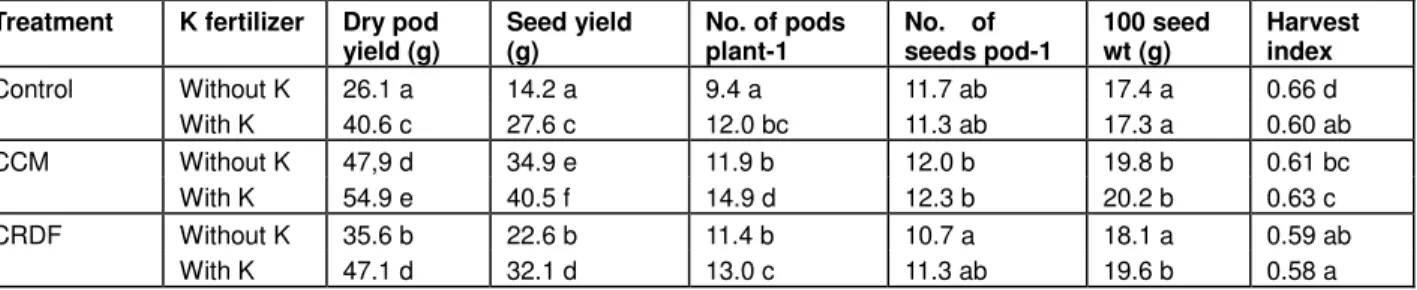
(10) 768. Afr. J. Agric. Res.. Table 5. Yield and yield components of soybean as affected by the application of carbonized organic materials. Treatment. K fertilizer. Dry pod yield (g). Seed yield (g). Control. Without K With K Without K With K Without K With K. 49.5 a 68.7 c 69.8 c 71.9 cd 59.7 b 75.8 d. 38.1 a 52.9 c 53.7 c 58.4 d 45.9 b 55.4 cd. CCM CRDF. No. of pods plant-1 50.4 a 108.7 c 79.0 c 137.5 d 68.9 b 103.7 d. No. of seeds pod-1 1.8 a 1.8 a 1.9 b 2.0 c 1.9 b 1.9 b. 100 seed wt (g). Harvest index. 26.4 a 28.0 b 28.9 c 29.9 e 27.8 b 29.6 d. 0.54 ab 0.63 e 0.57 bc 0.59 bc 0.67 e 0.52 a. Table 6. Yield and yield components of cowpea as affected by the application of carbonized organic materials. Treatment. K fertilizer. Control. Without K With K Without K With K Without K With K. CCM CRDF. Dry pod yield (g) 26.1 a 40.6 c 47,9 d 54.9 e 35.6 b 47.1 d. Seed yield (g) 14.2 a 27.6 c 34.9 e 40.5 f 22.6 b 32.1 d. chicken manure with or without K fertilizer produced the heaviest seed yield followed by those treated with carbonized RDF. Control cowpea plants with or without K fertilizer produced the least heavy seed yield. Generally, cowpea plants that received K fertilizer produced heavier seed yield than those that did not receive K fertilizer (Table 6). Cowpea seed yield increased 146% by the application of carbonized chicken manure only while it increased by 49% as a result of the application of carbonized RDF only. The application of carbonized chicken manure and K fertilizer increased cowpea seed yield by 185% while the application of carbonized RDF and K fertilizer increased it by 126%. Number of pods/plant of soybean followed a similar pattern to dry pod and seed yields of soybean. In all treatments, number of pods/plant of soybean was better for treatments that received K fertilizer than for those without K fertilizer (Table 5). Number of pods/plant was highest in cowpea plants that received K fertilizer than those that did not for all treatments. Number of pods/plant was significantly highest in cowpea plants treated with carbonized chicken manure followed by carbonized RDF. Number of pods/plant was least in control cowpea plants. Number of seeds per pod was only slightly increased by K fertilizer in soybean plants treated with carbonized chicken manure (Table 5). Number of seeds/pod of cowpea was neither affected by carbonized organic amendment material supply nor K fertilizer application (Table 6). 100 seed weight of soybean was increased by K fertilizer. No. of pods plant-1 9.4 a 12.0 bc 11.9 b 14.9 d 11.4 b 13.0 c. No. of seeds pod-1 11.7 ab 11.3 ab 12.0 b 12.3 b 10.7 a 11.3 ab. 100 seed wt (g) 17.4 a 17.3 a 19.8 b 20.2 b 18.1 a 19.6 b. Harvest index 0.66 d 0.60 ab 0.61 bc 0.63 c 0.59 ab 0.58 a. in all organic amendment treatments. 100 seed weight was significantly heaviest in carbonized chicken manure treated plants according to DMRT at p< 0.05 followed by carbonized RDF treated plants. 100 seed weight was least heavy in control soybean plants (Table 5). 100 seed weight of cowpea was not affected by K fertilizer application in control and carbonized chicken manure treated plants but was increased slightly in carbonized RDF treated plants. 100 seed weight of cowpea was highest in plants treated with carbonized chicken manure with or without K fertilizer and similar to plants treated with carbonized RDF and K fertilizer (Table 6). Harvest index was increased by K fertilizer application in control soybean plants and reduced in carbonized RDF treated soybean plants. K fertilizer application did not affect harvest index in carbonized chicken manure treated soybean plants (Table 5). Harvest index of cowpea did not follow any particular trend but was highest in control cowpea plants without K fertilizer and lowest in carbonized RDF treated plants with K fertilizer (Table 6).. N contents Plant total N content of soybean was highest in carbonized chicken manure amended plants followed by carbonized RDF amended plants. Control soybean plants were least in plant total N content (Table 3). K fertilizer.
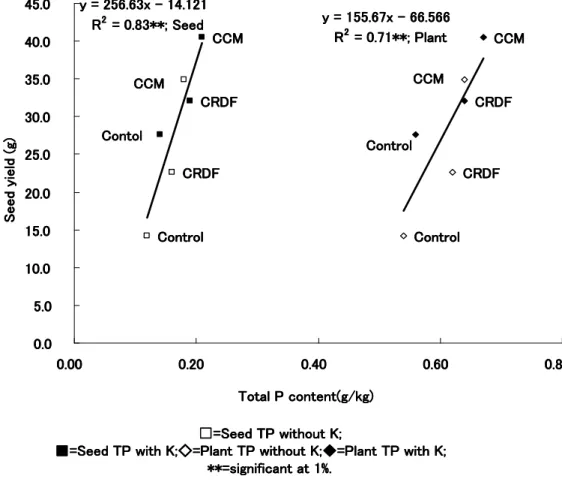
(11) Tagoe et al.. only slightly increased plant total N content of carbonized chicken manure amended soybean plants while it had no effect on plant total N content of carbonized RDF amended soybean plants (Table 3). Seed total N content of soybean followed a similar trend as plant total N content of soybean. The only difference is that K fertilizer application increased seed total N content of carbonized chicken manure and carbonized RDF amended soybean plants while it had no effect on seed total N content of control soybean plants (Table 3). There was a significant positive relationship between seed total N content and 2 seed yield of soybean (R = 0.50*, Figure 7). Plant total N content of cowpea was highest in plants treated with carbonized chicken manure with or without K fertilizer followed by plants treated with carbonized RDF with or without K fertilizer. Control cowpea plants were lowest in plant total N content with or without K fertilizer (Table 4). K fertilizer application increased plant total N content in carbonized chicken manure and carbonized RDF amended cowpea plants but not in control cowpea plants (Table 4). Seed total N content of cowpea followed a similar trend (Table 4). However, K fertilizer application increased cowpea seed total N content in all treatments (Table 4). There was a strong positive relationship between plant total N content and seed yield of cowpea 2 (R = 0.72**) as well as between seed total N content and 2 seed yield of cowpea (R = 0.81**, Figure 8). P contents Plant total P content of soybean was affected by both carbonized organic amendment supply and K fertilizer application. Plant total P content of soybean was highest in plants amended with carbonized chicken manure with or without K fertilizer followed by carbonized RDF treated plants with or without K fertilizer. Control soybean plants were lowest in plant total P content (Table 3). K fertilizer application increased plant total P contents of all treatments (Table 3). Seed total P content of soybean followed a similar trend as plant total P content of soybean (Table 3). There was a positive relationship between plant total P content and seed yield of soybean 2 (R = 0.62*, Figure 9). Plant total P content of cowpea was affected by both carbonized organic amendment and K fertilizer application. Plant total P content of cowpea was highest in carbonized chicken manure amended cowpea plants with or without K fertilizer followed by carbonized RDF amended plants with or without K fertilizer. Plant total P content was lowest in control cowpea plants (Table 4). K fertilizer application increased plant total P contents of cowpea in all treatments. Seed total P content of cowpea followed a similar trend as plant total P content of cowpea (Table 4). There was a strong positive relationship between plant total P content and seed yield of cowpea 2 (R = 0.71**, Figure 10). There was a strong positive relationship between seed total P content and seed yield. 769. 2. of cowpea (R = 0.83**, Figure 10). DISCUSSION The effects of two carbonized organic materials that is, chicken manure and refuse derived fuel (RDF) with or without inorganic K fertilizer on the growth, nodulation, yield, N and P contents of two grain legumes i.e. soybean and cowpea were explored in this greenhouse trial. The application of carbonized chicken manure only increased seed yield by 41 and 146% in soybean and cowpea respectively while the application of carbonized chicken manure and inorganic K fertilizer increased seed yield by 53 and 185% in soybean and cowpea respectively. The application of carbonized RDF only increased seed yield by 20 and 59% in soybean and cowpea respectively while the application of carbonized RDF and inorganic K fertilizer increased seed yield by 45 and 126% in soybean and cowpea respectively. The trends for dry pod yield and total dry weight of both grain legumes were similar to that of their respective seed yields. This result is consistent with that reported by Rondon et al. (2007) who observed a 46% increase in common bean yield over the control in response to bio-char application. Chan et al. (2007) observed in their work that in the absence of N fertilizer, green-waste bio-char application to soil did not increase radish yield even at higher rates but reported significant bio-char and N fertilizer interaction highlighting the role of bio-char in improving N fertilizer use efficiency of the plant. Although few works are available for comparison with the results of this study, our results are consistent with previous works done using ordinary un-carbonized chicken manure. Garcia and Blancaver (1983) reported that the application of poultry manure increased soybean seed yield by 62% over the control. Schmidt et al. (2001) found that soybean seed yield increased linearly with increasing swine manure rate. Several researchers have reported soybean seed yield increases with applied commercial N fertilizer (Lamb et al., 1990; Wesley et al., 1998). The higher seed yields of both grain legumes in response to the application of carbonized organic materials especially carbonized chicken manure suggest that both N and P are important nutrients that influence the growth and yield of soybean and cowpea. Carbonized chicken manure and carbonized RDF contain high levels of macro-nutrients especially N and P as well as micronutrients that would be available to plant roots and soil biota. Hariston et al. (1990) and Schmidt et al. (2001) observed that soybean not only requires a considerable amount of N to produce a crop, but also a constant supply of available P to maintain rapid growth and development. Carbonized chicken manure and carbonized RDF are particularly rich in both total and available P and their application to soil at high rates can supply a considerable amount of available P for plant uptake. Again, carbonized organic materials such as.
(12) 770. Afr. J. Agric. Res.. = Without K fertilizer;. = with K fertilizer;. = significant at 5%.. Figure 7. Relationship between seed total N content and seed yield of soybean.. Figure 8. Relationship between plant total N content, seed total N content and seed yield of cowpea.. carbonized chicken manure, carbonized RDF and biochar can act as soil conditioners to enhance plant growth by supplying macro and micro-nutrient elements,. retaining nutrients and improving soil physical and biological properties (Glaser et al., 2002; Lehmann and Randon, 2005). Abdelhamid et al. (2004) found increased.
(13) Tagoe et al.. = Without K fertilizer;. = with K fertilizer; * = significant at 5%.. Figure 9. Relationship between plant total P content at peak flowering and seed yield of soybean.. Figure 10. Relationship between plant total P content, seed total P content and seed yield of cowpea.. 771.
(14) 772. Afr. J. Agric. Res.. dry weight of faba bean as a result of chicken manure supply. Cowpea responded positively to the application of carbonized chicken manure and CRDF in this study in terms of growth parameters and seed yield. This response underscores the importance of P as a critical nutrient element influencing the performance of cowpea and soybean. Several researchers have reported significant responses of cowpea and soybean to P application (Tenebe et al., 1995; Ankomah et al., 1995; Okeleye and Okelana, 1997). They observed significant increases in total dry matter yield, number of flowers, pod and seeds per plant, seed yield and nodulation as a result of P application. Rondon et al. (2007) reported a 39% increase in biomass production of common bean in response to bio-char application which they attributed to greater availability of K, Ca and P. Chan et al. (2007) observed additional increase in dry matter of radish in the presence of N fertilizer varied from 95% in the control to 266% in the 100 t/ha bio-char amended soils. Carsky (2003) working on the response of cowpea and soybean to P and K on terre de barre soils in southern Benin, reported that soybean and cowpea grain yield increased by 147% and 95% respectively in response to P application. Number of nodules of soybean and cowpea increased with the application of carbonized organic materials. This observation is consistent with that of Tagoe et al. (2008) who reported increased nodule abundance of soybean as a result of carbonized chicken manure application and attributed it to the high available P content of carbonized chicken manure. The application of carbonized chicken manure increased nodule abundance of both grain legumes more than carbonized RDF. This observation can be attributed to the high P content of carbonized chicken manure relative to carbonized RDF. Rondon et al. (2007) also observed that biological N2 fixation of common bean increased with bio-char application. They reported that the proportion of fixed N increased from 50% without bio-char addition to 72% with 90 g kg-1 biochar added and attributed this observation to greater availability of B, and Mo and to a lesser extent K, Ca and P availability. The application of the carbonized organic materials plus K fertilizer further increased the number of nodules of both legumes thus confirming the hypothesis that K could limit the response of P from the carbonized organic materials in low P status soils (Carsky, 2003). P fertilization has been shown to increase number of nodules and their weight in soybean (Cassman et al., 1993; Jones et al., 1977) and in cowpea (Wan Othman et al., 1991). This is because P is known to initiate nodule formation, increases the number of nodule primordia and is essential for the development and functioning of formed nodules (Waluyo et al., 2004). Nodules are known to be a strong sink for P and P concentration in nodules can be three times higher than in other plant organs with a minimum effect from P deficiency (Vadez et al., 1999). Several researchers have reported that the supply of P. plays important roles in establishment, growth and function of nodules (Israel, 1987; Beck and Munns, 1984; Leung and Bottomley, 1987) and growth of host plants (Munns et al., 1981). Number of nodules is important because a positive correlation has been reported between nodule number and total nitrogenase activity of soybean (Singleton and Bohlool, 1984) and alfalfa (Porter, 1983). According to Gates and Muller (1979) the application of fertilizer containing N, P and S to soybean contributed to forming a stronger symbiotic mechanism and more active N2-fixation. Since the carbonized organic materials used in this experiment especially carbonized chicken manure contain N, P and S (Sharpley et al., 1993) their application to soybean and cowpea could be beneficial to the symbiotic N2-fixing mechanism. Low P availability is especially problematic for leguminous crops because legume nodules responsible for N2-fixation have high P requirement (Vance, 2001). P is essential for plant growth, nodulation and N2-fixation (Pereira and Bliss, 1989). Nodule number as well as nodule dry weight is greatly reduced by P deficiency (Ribet and Drevon, 1995) and nitrogenase activity varies with P availability (Israel, 1987). Acute P deficiency is known to prevent nodulation of grain legumes. P deficiency is more likely to affect N2fixation legumes than other species because symbiotic N2-fixation is an energetically expensive process which requires more P than does plant growth (Olivera et al., 2004). The strong positive relationship between number of nodules and plant total P content of soybean confirms the importance of P in legume nodulation. Total N and total P contents of plant and seed of soybean and cowpea increased with the application of carbonized organic materials with or without inorganic K fertilizer. This observation is consistent with that reported by Jassen (1998) that nutrient uptake requires N, P and K in balance to reach maximum values. Adeli (2005) observed increased N concentration in the above ground biomass of soybean in response to poultry manure application. The application of chicken manure to faba bean increased total N contents in roots, shoots and the whole plant (Abdelhamid et al., 2004). Belle (2006) reported significant increases in the uptake of N and P in common bean as a result of the application of N and P fertilizers. Barker and Sawyer (2005) observed that N concentration in plant dry matter of soybean was increased significantly with applied N. Studies with several legumes have consistently shown a positive response to P application; whole plant N concentration and plant dry matter were found to increase in response to phosphate in the growth media (Pereira and Bliss, 1987). P application has been reported to influence the contents of other nutrients in cowpea leaves (Kang and Nangju, 1983), shoots (Bagayoko et al., 2000) and seed (Omueti and Oyenuga, 1970). Seed total N content of soybean was positively correlated with seed yield. Also plant total N and seed total N contents of cowpea were.
(15) Tagoe et al.. correlated with seed yield of cowpea. These observations suggest the importance of N in the seed yields of these grain legumes due to the high protein contents of their seeds especially soybean. Plant total P content of soybean was positively correlated with soybean seed yield. Also, plant total P and seed total P contents were positively correlated with seed yield in cowpea. These observations underscore the importance of not only N, but P as well in increasing the growth and seed yield of these grain legumes. Bio-char addition can result in elevated quantities of bio-available nutrients such as N, P and metal ions, in the soil (Tryon, 1948; Lehmann et al., 2003; Gundale and DeLuca, 2006; DeLuca et al., 2006). Addition of bio-char to soil alters important soil physical and chemical properties such as pH (Lucas and Davis, 1961) and typically increase soil cation exchange capacity (CEC) (Glaser et al., 2002), and can lead to greater water holding capacity (WHC) while generally decreasing bulk density (Tryon, 1948) as well as increase bio-available P and cations in soils. Improvement in physical properties of the soil as a result of the addition of carbonized chicken manure and carbonized RDF to a lesser extent, may have contributed to the increased growth and yield of the grain legumes. Conclusion The growth, nodulation, seed yield, total N and P contents of plant and seed of soybean and cowpea all increased with the supply of carbonized chicken manure and carbonized RDF due to their high available P contents. The application of carbonized organic materials and inorganic K fertilizer increased grain yield and other parameters in both crops more than the sole application of the carbonized organic materials thus suggesting that it is a good potential option to be evaluated for use in the field and home garden for grain legume production. ACKNOWLEDGEMENT The authors would like to express their profound gratitude to the Ministry of Education, Culture, Sports, Science and Technology, Japan for financial support without which this research would not have been possible. REFERENCES Abdelhamid M, Horiuchi T, Shinya O (2004). Nitrogen uptake by faba bean from 15N labeled oilseed-rape residue and chicken manure with ryegrass as a reference crop. Plant Prod Sci 7:371-376. Adeli A, Sistani KR, Rowe DE, Tewolde H (2005). Effects of broiler litter on soybean production and soil nitrogen and phosphorus concentrations. Agron. J. 97:314-321. Ankomah AB, Zapata F, Hardarson G, Danso SKO (1995). Yield, nodulation and N2-fixation by cowpea cultivars at different phosphorus levels Biol. Fertil. Soil 22: 10-15.. 773. Bagayoko EG, Romheld V, Buerkert A (2000). Effects of mycorrhizae and phosphorus on the growth and nutrient uptake of millet, cowpea and sorghum on a West African soil. J. Agric. Sci. Cambridge 135:399-407. Bationo A, Mughogho SK, Mokwunye AU (1990). Agronomic evaluation of phosphate fertilizer in tropical Africa. In : Management of Nitrogen and Phosphorus Fertilizers of Sub-saharan Africa (eds A.U. Mokwunye & P.L.G. Vlek) Dordrecht, The Netherlands, Martinus Nijhoff, pp. 283-318. Barker DW, Sawyer JE (2005). Nitrogen application to soybean at early reproductive development. Agron. J. 97:615-619. Beck DP, Munns DN (1984). Phosphate nutrition of Rhizobium sp. Appl Environ Microbiol 47:278-282. Belle JO (2006). Effect of nitrogen and phosphorus fertilizers on seed quality and yield of common beans (Phaseolus vulgaris L.). 18th World Congress of Soil Science, July 9-15, 2006, Philadelphia, Pennsylvania, USA. Bray RH, Kurtz LT (1945). Determination of total organic and available forms of phosphorus in soils. Soil Sci. 59:39-45. Carsky RJ (2003). Response of cowpea and soybean to P and K on terre de barre soils in southern Benin. Agric. Ecosyst. Environ. 100: 241-249. Cassman KG, Singleton PW, Linguist BA (1993). Input/output analysis of the cumulative soybean response to phosphorus on an Ultisol. Field Crops Res. 34: 23-26. Chan KY, Van Zwieten L, Meszaros I, Downie A, Joseph S (2007). Agronomic values of green-waste bio-char as soil amendment. Astral J. Soil Res. 45(8): 629-634. DeLuca TH, MacKenzie MD, Gundale MJ, Holben WE (2006). Wildfire – produced charcoal directly influences nitrogen cycling in ponderosa pine forests. Soil Sci. Soc. Am. J. 70: 448-453. Fox RL, Kang BT (1977). Exploiting the legume-rhizobium symbiosis in Tropical Agriculture. In: University of Hawaii Publication No. 145 (eds JM. Vincent, AS. Whitney, J Bose) pp. 183-210. Garcia JM, Blancaver AT (1983). Effect of animal manure on the growth and yield of soybean and physical properties of the soil. J. Agric. Food Nutr. 4:196-212. Gates CT, Muller WJ (1979). Nodule and plant development in the soybean: Growth response to nitrogen, phosphorus and sulfur. Aust. J Bot. 27: 203-215. Glaser B, Lehmann J, Zech W (2002.). Ameliorating physical and chemical properties of highly weathered soils in the tropics with charcoal- a review. Biol. Fertil. Soils 35: 219-230. Gundale MJ, DeLuca TH (2006). Temperature and source material influence ecological attributes of Ponderosa pine and Douglas-fir charcoal. For Ecol Manag 231: 86-93. Hariston JE, Jones WF, Marshall LK, Gill KB (1990). Tillage and fertilizer management effects on soybean growth and yield on three Mississippi Soils. J Prod Agric 3: 317-323. Ishii T, Kadoya K (1994). Effects of charcoal as a soil conditioner on citrus growth and vesicular-arbuscular mycorrhizal development. J. Jpn Soc. Hort. Sci. 63: 529-535. Israel DW (1987). Investigation of the role of phosphorus in symbiotic nitrogen fixation. Plant Physiol 84:835-840. Jassen BH (1998). Efficient use of nutrients: an art of balancing. Field Crops Res. 56: 197-201. Jones GD, Lutz Jr. JA, Smith TJ (1977). Effects of phosphorus and potassium on soybean nodules and seed yield. Agron. J. 69:10031008. Kang BT, Nangju D (1983). Phosphorus response to cowpea (Vigna unguiculata L. Walp). Trop. Grain Legume Bul. 27: 11-16. Lamb JA, Rehm GW, Severson RK, Cymbaluk TE (1990). Impact of inoculation and use of fertilizer N on soybean production where growing seasons are short. J. Prod. Agric. 3: 241-245. Lehmann J, Da Silva JP Jr, Steiner C, Nehls T, Zech W, Glaser B (2003). Nutrient availability and leaching in an archaeological Anthrosol and a Ferralsol of the Central Amazon basin: fertilizer, manure and charcoal amendments. Plant Soil 249: 343-357. Lehmann J, Rondon M (2005). Bio-char soil management on highlyweathered soils in the humid tropics In: Biological Approaches to Sustainable Soil Systems (ed N Uphoff ), Boca Raton, CRC Press. Leung K, Bottomley PJ (1987). Influence of phosphate on the growth.
(16) 774. Afr. J. Agric. Res.. and nodulation characteristics of Rhizobium trifolii. Appl Environ. Microbiol. 53: 2098-2105. Lucas RE, Davis JF (1961). Relationship between pH values of organic soils and availabilities of 12 plant nutrients. Soil Sci 92: 177-182. Munns DN, Hohenberg JS, Righetti TL, Lauter DT (1981). Soil acidity tolerance of symbiotic and nitrogen fertilized soybeans. Agron. J. 73: 407-410. Murphy J, Riley JP (1962). A modified single solution method for the determination of phosphate in natural waters. Anal Chim. Acta, 27: 31-36. Okeleye KA, Okelana MAO (1997). Effects of phosphorus fertilizer on nodulation, growth and yield of cowpea (Vigna unguiculata L. Walp) varieties. Indian J. Agric. Sci 67: 10-12. Olivera M, Tejera N, Iribare C, Ocana A, Lluch C (2004). Growth, nitrogen fixation and ammonium assimilation in common bean (Phaseolus vulgaris L.): effect of phosphorus. Physiol. Plantarum 121:498-505. Omueti JO, Oyenuga VA (1970). Effect of phosphorus fertilizer on the protein and essential components of groundnut and cowpea. West Afr. Biol. Appl. Chem. J 13:299-305. Ortiz R (1998). Cowpea from Nigeria: a silent food revolution. Outl. Agric. 27: 125-128. Popov V, Itoh H, Brebbia CA, Kungoles A (2004). Waste management and the environment II. WIT Press Beston. Pereira PAA, Bliss FA (1987). Nitrogen fixation and plant growth of common bean (Phaseolus vulgaris L) at different levels of phosphorus availability. Plant Soil 104: 79-84. Pereira PAA, Bliss FA (1989). Selection of common beans (Phaseolus vulgaris L.) for N2 fixation at different levels of available P under field and environmentally controlled conditions. Plant Soil 115:75-82. Porter JR (1983). Variation in the relationship between nitrogen fixation, leghemoglobin, nodule numbers and plant biomass in alfalfa (Medicago sativa) caused by treatment with arsenate, heavy metals and fluoride. Physiol. Plantarum 57: 579-583. Ribet J, Drevon JJ (1995). Increase in permeability to oxygen diffusion and in oxygen uptake of soybean nodules under limiting P nutrition. Physiol. Plantarum 94: 298-304. Rondon MA, Lehmann J, Ramirez J, Hurtado M (2007). Biological nitrogen fixation by common beans (Phaseolus vulgaris L.) increases with bio-char additions. Biol. Fertil. Soils 43: 699-708. Schmidt JP, Lamb JA, Schmitt MA, Randall GW, Orf JH, Gollany HT (2001). Soybean varietal response to liquid swine manure application. Agron J 93:358-363. Sharpley AN, Smith SJ, Bain WR (1993). Nitrogen and phosphorus fate from long-term poultry manure application to Oklahoma soils. Soil Sci. Soc. Am. J. 57: 1131-1137. Shinogi Y, Yoshida H, Koizumi T, Yamaoka M, Saito T (2003). Basic characteristics of low temperature carbon products from waste sludge. Adv. Environ. Res. 7: 661-665. Singleton PW, Bohlool BB (1984). Effect of salinity on nodule formation by soybean. Plant Physiol 74: 72-76.. Sombroek W, Nachtergaele FO, Hebel A (1993). Amounts, dynamics and sequestering of carbon in tropical and subtropical soils. Ambio. 22: 517-426. Tagoe SO, Horiuchi T, Matsui T (2008). Effects of carbonized and dried chicken manures on the growth, yield and N content of soybean. Plant Soil 306: 211-220. Tejada M, Hernandez MT, Garcia C (2006). Application of two organic amendments on soil restoration: effects on the soil biological properties. J. Environ. Qual. 35: 1010-1017. Tenebe VA, Yusufu Y, Kaigama BK, Aseime IOE (1995). Effects of sources and levels of phosphorus on the growth and yield of cowpea variety. Trop. Sci. 35: 223-228. Tryon EH (1948). Effect of charcoal on certain physical, chemical, and biological properties of forest soils. Ecol. Monogr. 18: 81-115. Vadez V, Lasso JH, Beck DP, Drevon JJ (1999). Variability of N2-fixation in common beans (Phaseolus vulgaris L.) under P deficiency is related to P use efficiency. Euphytica 106: 231-242. Vance CP (2001). Symbiotic nitrogen fixation and phosphorus acquisition: Plant nutrition in a world of declining renewable resources. Plant Physiol. 127: 390-397. Waluyo SH, Lie TA, Mannetje L (2004). Effect of phosphate on nodule primordia of soybean (Glycine max) in acid soils in rhizotron experiments Indonesian J. Agric. Sci. 5:27-44. Wan Othman WM, Lie TA, Mannetje L, Wassink GY (1991). Low level phosphorus supply affecting nodulation, N2-fixation and growth of cowpea (Vigna unguiculata L. Walp). Plant Soil 135: 67-74. Warnock DD, Lehmann J, Kuyper TW, Rillig MC (2007). Mycorrhizal responses to bio-char in soil- concepts and mechanisms. Plant Soil 300: 9-20. Wesley TL, Lamond RE, Martin VL, Duncan SR (1998). Effects of lateseason nitrogen fixation on irrigated soybean yield and composition. J. Prod. Agric. 11: 331-336..
(17)
図


+7



関連したドキュメント
H ernández , Positive and free boundary solutions to singular nonlinear elliptic problems with absorption; An overview and open problems, in: Proceedings of the Variational
An easy-to-use procedure is presented for improving the ε-constraint method for computing the efficient frontier of the portfolio selection problem endowed with additional cardinality
If condition (2) holds then no line intersects all the segments AB, BC, DE, EA (if such line exists then it also intersects the segment CD by condition (2) which is impossible due
Keywords: Convex order ; Fréchet distribution ; Median ; Mittag-Leffler distribution ; Mittag- Leffler function ; Stable distribution ; Stochastic order.. AMS MSC 2010: Primary 60E05
2 Combining the lemma 5.4 with the main theorem of [SW1], we immediately obtain the following corollary.. Corollary 5.5 Let l > 3 be
In Section 3, we show that the clique- width is unbounded in any superfactorial class of graphs, and in Section 4, we prove that the clique-width is bounded in any hereditary
Inside this class, we identify a new subclass of Liouvillian integrable systems, under suitable conditions such Liouvillian integrable systems can have at most one limit cycle, and
Then it follows immediately from a suitable version of “Hensel’s Lemma” [cf., e.g., the argument of [4], Lemma 2.1] that S may be obtained, as the notation suggests, as the m A
