著者
YOSHINAGA Kenji
雑誌名
国際地域学研究
巻
-号
15
ページ
151-176
発行年
2012-03
URL
http://id.nii.ac.jp/1060/00003668/
Creative Commons : 表示 - 非営利 - 改変禁止 http://creativecommons.org/licenses/by-nc-nd/3.0/deed.jaSustainable
Sustainable
Sustainable
Sustainable Water Management for Food Security
Water Management for Food Security
Water Management for Food Security
Water Management for Food Security
---- Theoretical Considerations
Theoretical Considerations
Theoretical Considerations
Theoretical Considerations ----
Kenji YOSHINAGA∗
Abstract Abstract Abstract
Abstract: : : : Freshwater is a scarce resource. Agriculture is a dominant water users of more than 70% of world available water. An efficient water management in agricultural sector would contribute to an appropriate water allocation among farmers upstream and downstream, let alone for other stakeholders. The paper analyses the economic measures as an incentive and penalty as well as institutional arrangement for improving water management with theoretical considerations. It also discusses the uncertainty of impacts by the climate change on water availability including possible technologies development for adaptable in the future water constraint. Keeping these in mind, the paper considers the issue linkage between better water management and food security. It stresses the rebuilt of “water democracy” for improving the water management and thus, securing food security. Based on these analyses and discussion, the paper provides the issues to be further discussed in a future water management for the food security.
Key words Key words Key words
Key words: Water management, Water users association, Food security, Conflict and cooperation, Climate change, Water democracy, Institutional arrangements, Technology development.
1. 1. 1.
1. IntroductionIntroductionIntroduction Introduction
Freshwater is a scarce resource. Human-being cannot survive without water. It is also true for other livings such as biodiversity. Against this fact, people often neglect of saving water without recognizing a value of water. At the same time it should be noted that the poor in many developing countries suffers from difficulty of access to water and improved sanitation. In addition, future water availability will be uncertain in terms of rainfall pattern and amount, geographically and seasonally, if the impact of climate change is to be believed. The freshwater is a global issue which asks us the question on how we should use efficiently the scarce water. Agriculture sector is a dominant water user of more than 70% in world available water. The issues of water uses in agriculture have been discussed in various occasions at both national and international levels. In these discussions an efficient water management has always been taken up as one of agenda but which is still major concerns for farmers and other stakeholders. The arguments related to the water management have always accompanied with issues of
conflict, coordination and cooperation around the water uses among different stakeholders. These are closely related to issues of governance, institutional arrangement and conflict resolution.
Many studies and literatures are now available on water management and related issues, including a contribution of Ostrom, E.(1) who was awarded the 2009 Nobel Prize in Economic
Sciences. The approach of analyses has adapted of Game Theory, Principle-Agency Theory and Institutional Economics. The OECD has studied the roles of the market mechanism in achieving efficiency of water uses in agriculture by taking up the water pricing, water market and water privatization(2). An economic measures such as compensation and payment or
transfer from beneficiaries to providers of services are often applied as a conflict solution, in other words adaptation of beneficiary pays principle and provider gets principle. If farmers downstream can get water available due to efforts made by farmers downstream, the former should pay or compensate for a cost of efforts made for appropriate water allocation by the latter.
Better water management and food security is an issue linkage which needs an improvement of water management for enhancing a level of food security as well as ensuring the food security required efficient water management practice. The saved water by efficient water management practices at both upstream and downstream could contribute to enhance the water productivity and water allocation to biodiversity to preserve an ecosystem and its services. In this regard, policy arrangements for the water management should be set with a particular attention to the implication of enhancing the food security as well as improving the food insecurity.
With these contexts at hand, the paper provides theoretical considerations on the water management, efficient water uses and food security issues. The paper also aims at raising the issues for a discussion on better management for food security. Following by this introduction, the paper is consisted of 6 Chapters. In the Chapter 2, it defines the water scarcity and discusses the water efficiency using a simple water management model for water allocation between upstream and downstream. The Chapter 3 argues the incentive and penalty as institutional arrangements for water management. The analysis is preceded by using Coase Theorem and Game Theory. The Chapter 4 refers to uncertainty issues by the climate change and its effects on water constraint including the possible technology development for reducing water constraint and improving water productivity. In the Chapter 5, it introduces the
modification process of the food security definition and discusses the investment and improved water management for the food security. Finally, the Chapter 6 concludes the analyses and discussion in the above Chapters for future actions to be taken toward better water management.
2222.... Definition of Water Scarcity and EfficiencyDefinition of Water Scarcity and EfficiencyDefinition of Water Scarcity and Efficiency Definition of Water Scarcity and Efficiency
It often comes into the question on “water scarcity(3)” when we discuss the water related
issues. It has also been in ever unchanged issue taken up as an agenda in both domestic policy setting and international fora on water management. However, how it could define “water scarcity” in terms of water supply and demand? It may be different definition given different factors such as the geographical situation, accessibility to the water and pattern and amount of precipitation. That being said, it needs general definition of “water scarcity” which is common among water related stakeholders, otherwise they could not play at a same leveling field.
The definition of “water scarcity” in water supply and demand will be defined with the following three elements(4); the first is physical scarcity that is defined as shortage of supply to
meet demands even when all policies to use water efficiently and effectively have been implemented; the second is economic water scarcity that is defined as an ability to meet demand because the resources have not been developed including, for example, a lack of infrastructure; and the third is related to institutional water scarcity that could be defined as a failure of institutions to allocate available water supplies equitably or to the highest value user. If the water users or water management organizations fail to satisfy one of these elements, they cannot say water shortage or scarcity of their water uses and water delivery system. In other words, the situation of “water scarcity” is defined as the one where these three elements are filled up and still the water is short or scarce.
The issues related to water “efficiency” is likely discussed when water users faced with water shortage. The efficient water uses also have been discussed in every occasion at both national and international levels. It could possibly categorize “efficiency” in the three levels for discussion; at the field level, system level and watershed level. At the field level it is a responsible for farmers who use water in their own cultivated land. The effort made by farmers to use water efficiently is prerequisite but it requires the farmer, in particular upstream, to have knowledge on water management and value of water and then understanding of
cooperation. The efficiency at the system level is controlled by water users association or the government if the scale of system is large enough beyond management ability of water users association. The losses of water at the system level through evaporation and percolation are huge if it could not be well operated and maintained, the amount of which cannot be neglected as a whole water distribution system. The watershed could play important roles to collect and temporarily storage water for supplying it to the system and keep a constant flow for protecting the environment including biodiversity along the river. It is also a source for a high quality of water as far as the watershed area could be well managed. These three levels from the watershed to the field levels through the distribution system are closely related in achieving efficiency of water supply and water demand mechanism.
With this in mind, it should be recognized that the water shortage and efficiency improvement in water uses are a head and tail relationship of a coin. If the drought causes water shortage for crop production, farmers will often notice for the first time how important to use the limited water efficiently. If the farmers make less effort to use water efficiently they will learn a negative impact on the ecosystem because of available water below their required level. This indicates that efficient use of water helps the farming practice by farmers and save a life of freshwater biodiversity. An accumulation of knowledge and experience on efficient water uses by farmers themselves is a starting point to be taken in achieving a better water management practice.
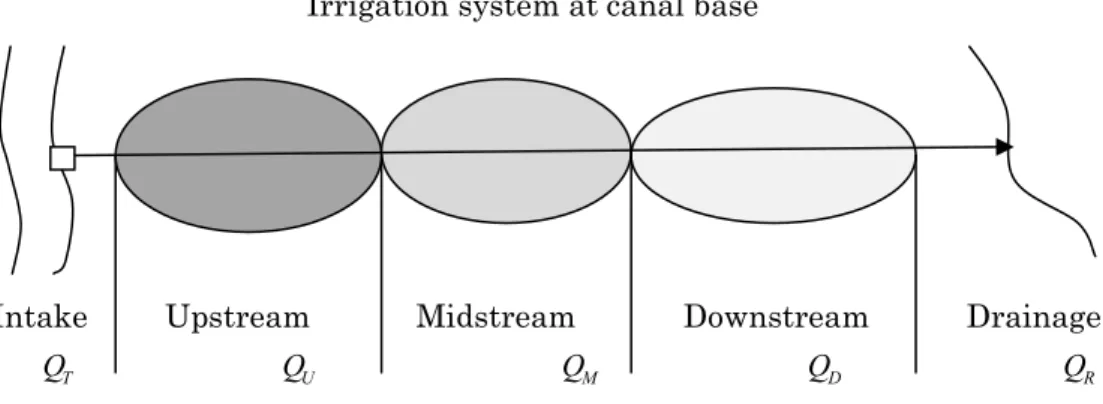
The Figure 1 draws a whole picture of irrigation water flow from upstream to downstream along a canal. Total water intake at the head of canal is
Q
T and then the water ofD M
U
Q
Q
Q
,
,
is allocated to upstream, midstream, and downstream levels, respectively. In the same vein actual water uses in each level are supposed to be ',
',
'D M
U
Q
Q
Q
, respectively. Now, suppose that it is uncertain about an effort made by farmers for an efficient water use in each level. In other words, there exists asymmetric information on water management practice among three levels. If farmers made a high effort to use water efficiently in each level, the saved water ofq
U,
q
M,
q
Dwill be used to downstream or drained at the end of the canal. In such case, the upstream will save an amount of water,=
−
'>
0
U U U
Q
Q
q
, followed by0
'+
>
−
=
M M U MQ
Q
q
q
for the midstream and=
−
'+
>
0
M D D
D
Q
Q
q
q
for the downstream.The saved amount of water,
q
D=
Q
Rwill be flowed into a river as a drainage water. This is a complete case as a result of which at all levels farmers made their efforts to use water efficiently. The real situation in many cases, however, is far from this reasonable water managementIrrigation system at canal base
Intake Upstream Midstream Downstream Drainage
QT QU QM QD QR
Fig. 1 : Water flow from upstream to downstream in irrigation system
where each level is different with a degree of efforts made of
q
U,
q
M,
q
D which resulted in different combination of>
0
or
=
0
or
<
0
. This produces 27 combinations with different effort level, accordingly those of efficient water use or inefficient water use at each level. There are 13 cases which cause no water shortage while the rest combinations will be a water shortage at the downstream level. It is, of course, noted that these cases depend on how much excess water is used or how much saved water can be available at each level. It is a combination of more effort and fewer effort made in the upstream, midstream or downstream, as a result of which causes no shortage of water at the downstream level. It includes those, for example, such asq
U>
0
,
q
M<
0
,
q
D≥
0
,q
U<
0
,
q
M≥
0
,
q
D≥
0
, the combinations of which mean in thefirst case where the upstream saved water , the midstream uses excess water and finally the downstream makes effort to satisfy with water allocation for the farmers. In a similar way, the second case where the upstream uses excess water beyond
Q
U originally allocated, the midstream uses water efficiently belowQ
M,
as a result of which the downstream farmers can enjoy enough water for their crop production.This simple analysis of water allocation with their efforts made among farmers upstream, midstream and downstream provides a couple of suggestions: Firstly, the farmers upstream in particular and midstream are required to make efforts for an efficient water use, otherwise farmers downstream will encounter the water shortage. Secondly, the farmers midstream and downstream should not be a free-rider when the upstream produce a saved water with their efforts. Thirdly, it needs coordination and cooperation through the water users association to eliminate asymmetric information on water uses between different levels. Fourthly, the water management practice with a mutual consensus among farmers on keeping rules and obligation is only way to avoid the water conflict between different levels along the same canal.
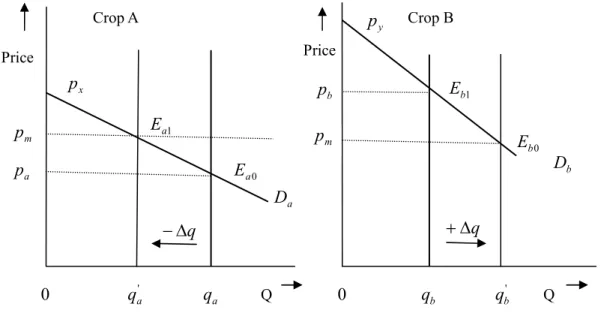
Another consideration of efficient water uses is reallocation of water from the lower value user to the highest value user. The Figure 2 shows the water productivity of crops of A and B. Suppose that the crop B is the higher value crop for the farmer. The crop A uses much water of
a
q
with the lower water price ofp
a while less water allocation ofq
bfor the crop B with the higher water price ofp
b. Now, consider the water price is set at the level ofp
m which could decrease the water amount of∆
q
from the production of crop A and reallocate it to the production of crop B with the same price. This results in increase of income for the farmer by reallocating more water to crop B which is identified by the area of0
q
b'E
b0p
m>
0
q
aE
a0p
m witha lower price if comparing it to the income before the transfer of water. 3.
3. 3.
3. Incentives and Penalties toward Improving Water Incentives and Penalties toward Improving Water Incentives and Penalties toward Improving Water Incentives and Penalties toward Improving Water ManagementManagementManagementManagement Upstream and downstream conflict
Upstream and downstream conflict Upstream and downstream conflict Upstream and downstream conflict
Many cases around water conflict are often those between upstream and downstream along a canal or a river. Water users located in the upstream is in an advantageous position to access available water at a particular time of drought. If farmers upstream use water as much as they like beyond allocated quantity, farmers downstream often suffer from the water shortage. This brings about various effects for farmers of both sides which includes, for example, negligence of efforts for efficient water use by farmers upstream and reduction of crop yields for farmers downstream. These cause an economic loss through inefficient water allocation between both sides. In such situation, a conflict would be observed between farmers upstream and
Crop A Crop B m
p
ap
bp
q
∆
−
+
∆
q
aD
bD
Fig. 2: Water transfer to the highest value water use
0
' aq
q
a Q0
q
b ' bq
Q Price Price xp
yp
1 aE
0 aE
1 bE
0 bE
mp
downstream everywhere in the water distribution systems over the world.
Why such conflict is common and what measures should be required to avoid it? At the same time, this puts questions on what reasons behind the conflict and why difficult to solve it? There are different reasons by different cases but explanatory common reasons are found in those such as an asymmetry of information on water allocation, a lack of institutional arrangement, an absence of altruistic behavior, and a weakened fabric of community. An asymmetric information on water allocation between the upstream and downstream causes farmers less communicable with each other and behave themselves only for maximizing own benefit. If the water distribution rules are not completely established or not well recognized among water users, it is not necessarily a problem of whether the existence or no-existence of water users association. A weakened fabric of community contributes negatively to reduce the farmer’s recognition of water as a common resource as well as sprit of mutual cooperation among water users.
The Coase Theory can be applied to this type of conflict for a solution(5). It depends on which
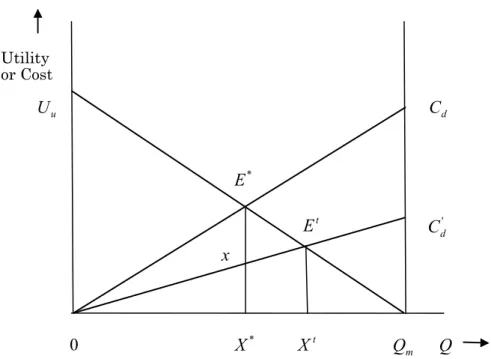
side has a right to get start a negotiation but usually the victim stands for the negotiator. If so, the farmers downstream are in a position to approach to the farmers upstream for negotiation seeking an appropriate water allocation. This provides a space for both sides to negotiate for Pareto-improvement solution. In the Figure 2, the vertical axis shows a utility or cost (per unit of water use) and the horizontal axis does water amount used for a crop production. The line of
m u
Q
U
means the utility curve for the farmers upstream using water without any restriction who maximize their utility atQ
m with the utility of0
U
uQ
m. On the other hand, the line ofd
C
0
does the cost (or disutility) caused by the water shortage which will be maximized atC
dwith the disutility of
0
C
dQ
m , when the farmers upstream use water inefficiently at the levelof
Q
m.Now, suppose that the farmers upstream has a water right (e.g. riparian right) on water use, the farmers downstream could take an action to negotiate with the farmers upstream to reduce inefficient water use. The negotiation will be started with agreement of payment from farmers downstream to upstream. The negotiation will be resulted in
E
*where is an optimal point of*
X
for both sides in terms of water allocation. The farmers upstream lose availability of water tantamount to the utility of E*X*Qmwhile the farmers downstream will get benefit ofd
mC
Q X
Q
mQ
0
Utility or Cost uU
*E
dC
' dC
tE
tX
X
*x
Fig 2: Upstream and downstream negotiation model
> d mC Q X E* * d m
C
Q
X
E
* * after the negotiation, the farmers downstream could pay as acompensation equivalent to the area of
E
*X
*Q
m to the farmers downstream. This improvesthe welfare for both sides with reallocation of available water from the upstream to the downstream by an economic measure.
The result, however, does not consider a transaction cost which needs in actual negotiation procedures. In the case of taking the transaction cost into account in the Figure 2, the line of
d
C
0
will shift downward to the line of0
' dC
which result in a new equilibrium ofE
t andoptimal water level at
X
t. Due to a consideration of the transaction cost, the payment by thefarmers downstream will be reduced, the result of which the area of
E
*xE
'is a residual cost.
Incentives and penalties for a fair water allocation Incentives and penalties for a fair water allocation Incentives and penalties for a fair water allocation Incentives and penalties for a fair water allocation
Improving water management needs efforts made by farmers, in particular upstream than downstream. Since the efforts need the farmers spent their time and labor, it costs them to a certain degree. If this cost exceeds over their reservation cost, they don’t prefer to take an action for improving the water management. In other words, if the cost of efforts made for water management exceeds the opportunity cost which otherwise can be obtained engaging in other economic activities. This is true for the farmers upstream who don’t care about the water management except the case of behavioral negligence.
The incentive is defined as a factor that motivates a person to achieve a particular goal. A particular incentive will direct a person's immediate behavior towards a particular goal only if it is the strongest of all competing incentives. If this could be applied to farmers upstream, it needs particular incentives for them to take an action for making effort to use available water more efficiently. It aims at getting water reach to downstream where the farmers can use water equally as the farmers upstream enjoy it. The incentive mechanism should be put in place if the cost of efforts made by farmers upstream exceeds over their reservation cost.
On the other hand, the penalty means that punitive measure that the law imposes for the performance of an act that is proscribed or for the failure to perform a required act. If the institutional rule is set forth and prescribed the rule of water allocation between both sides, the break of rule by the farmers upstream should be strictly penalized based on agreed rules as well as measures. The penalty rules will enforce the farmers, who are used to break the rule, to keep it as agreed among farmers of both sides.
A well designed incentives and penalties with a full participation of farmers who use water along the same canal or river could be effective as rule and discipline for the water allocation in terms of fairness and equality. In an actual situation, the organization such as water users association would play critical roles in applying these rule and discipline at the field level. In what follows it discusses the different types of economic measures as an incentive and penalty for the water management.
Economic measures as an incentive for the upstream an Economic measures as an incentive for the upstream an Economic measures as an incentive for the upstream an
Economic measures as an incentive for the upstream and downstream managementd downstream managementd downstream management d downstream management
An economic approach as an incentive measure is considered in view of market mechanism. The economic measures have been applied in different fields such as CO2 emission trade and
payment for environmental (or ecological) services. In principle, economic measures will be adopted with either compensation or transfer rule as Pareto improvement measure. There also exist intrinsic measures commonly applied among water users such as the case in the irrigation system in Philippines taken as an example below. Here, as the first case, the economic measure is analyzed using a simple strategic form of Game Theory.
Suppose, now, that farmers upstream and downstream have conflict around water distribution along the canal which they have used for crop production. Available amount of water will govern the yield of crops and thus their incomes. The farmers downstream insist that
the farmers upstream often neglect efficient water use without paying any attention to water shortage in the downstream. On the other hand, the farmers upstream argue against the claim by which they have to spend extra time and labor for further implementation of water management. The Figure 3 shows the strategic form showing two strategies of both upstream and downstream with “effort made” and “no-effort made”. The payoffs for combination of two strategies for both sides are shown with a >b >c>d in an ordinal order. The payoff is set taking a social benefit into account. Here also indicates the cost of efforts made by the farmers upstream with
x
e and the transfer witht
from the downstream to the upstream as acompensation for effort made by farmers upstream. Figure 3-(a) shows that the both sides cooperate to achieve a fair water allocation subjected to the prescribed rule. The Nash equilibrium is (effort, effort) with pay-off of
(
a,
a
)
. It is noted in this case that the farmersDownstream Downstream
Effort No - effort Effort No - effort
Effort
(
a,
a
)
( )
c,
b
Effort(
a
−
x
e,
a
)
(
c,
b
)
Up st re am No - Effort(
b,
c
)
(
d
,
d
)
Up st re am No - Effort(
b,
c
)
(
d
.
d
)
(a) (b) Downstream Effort No - effort Effort(
a
−
x
e+
t
,
a
−
t
)
(
c,
b
)
Up st re am No - Effort(
b,
c
)
(
d,
d
)
(c)Fig.3 : Upstream and downstream conflict and its solution (1)
Downstream Downstream
Effort No - effort Effort No - effort
Effort
(
b,
a
)
(
c,
b
)
Effort(
b,
a
)
(
c,
b
)
Up st re am No - Effort(
a,
c
)
(
d
,
d
)
Up st re am No - Effort(
a
−
p
,
c
)
(
d,
d
)
(a) (b) Fig.4 : Upstream and downstream conflict and its solution (2)upstream sacrifice their time and labor needed to enhance water efficiency for a benefit of downstream. This is the particular case where the water users association is functionally organized and the cost of effort made by the farmers upstream is internalized in their water management activities.
Now, the situation has changed by which the farmers upstream recognize their cost of effort and they know that the opportunity cost is higher than the cost of effort for the water management. They break the rule and neglect the water management once they have implemented. The Figure 3-(b) shows this change where the cost of effort
x
e will be used for other purposes for satisfying their reservation cost which causes no-effort made a best strategy for the farmers upstream because ofb
>
a
−
x
e. In this case Nash equilibrium is (no-effort, effort) with pay-off of(
b,
c
)
, whereby the farmers downstream reduce their available water, namely pay-off reduced forma
toc
. This often results in the conflict between both sides around the break of water management obligation.As a conflict solution, economic incentive will be effective measure which contributes to achieve Pareto improvement for both sides. To this end, suppose that the transfer (or compensation)
t
is made from the downstream to the upstream with a changed pay-off of(
a
−
x
e+
t
,
a
−
t
)
as shown in Figure 3-(c). It notesb
−
a
+
x
e<
t
<
a
−
b
, so that farmers upstream will conduct the water management because their efforts are now paid(6).In what follows the enforceable penalty can be incentive for keeping rule of water management. The Figure 4-(a) shows that the farmers upstream enjoy a higher pay-off by doing no-effort. The Nash equilibrium is (no-effort, effort) with the pay-off of
(
a,
c
)
. In this situation a conflict exists among both sides. Against this, the rule penalizes the farmers upstream with a cost ofp
which could reduce her pay-off toa
−
p
as shown in the Figure 4-(b). It notesp
>
a
−
b
, so that Nash equilibrium is changed to (effort, effort) with pay-off of(
b,
a
)
. The enforceable penalty rule avoids conflict otherwise the farmers upstream will break the rule of water management.The economic measures as an incentive for keeping rule of a fair water distribution are effective and enforceable if these are put appropriately in place. There are different types of economic measures such as compensation, transfer, fund raising and penalty. The economic measures should be integrated in an agreement or rule of the water users association and should be given enforceability as a contract.
Institutional incenti Institutional incenti Institutional incenti
Institutional incentives for enhancing activities of water users associationves for enhancing activities of water users associationves for enhancing activities of water users association ves for enhancing activities of water users association
An institutional incentive is another type of measures taken for a fair water allocation. It provides rule and discipline for water users to use water as a common resource among stakeholders. It is defined in different levels of organization, some of which are publicized under the government rule while others are established by the organizations such as water users association. Since the institutional incentive is an agreement among water users, they have a right to derive benefits by enhancing a motivation in their activities on water management. The institutional incentive targets an individual or a group of individuals with a given advantage when they attained the prescribed targets or goals. It is a sort of encouragement for motivation but usually the enforceability is weak and not binding.
Taking UPRIIS(7) in Philippines as an example, its characteristics of institutional incentive
are examined in terms of adaptability as a contract. It is a contract arrangement between National Irrigation Administration (NIA) and Irrigation Association(8) (IA) for the operation
and management (O&M) of the irrigation system under three options. As shown in Table 1, the IA under the Type I contract takes over an irrigation canal and performs maintenance activities such as clearing of debris, cutting of grasses and weeds that obstruct the flow of water. The length of canal covered by IA is about 3.5 km for earthen made and 7.0 km for concrete lining canal. For the services rendered by IA, the NIA pays to IA about 2,400 pesos (55 US$) per month. In the Type II, NIA transfer to IA the responsibility of Irrigation Service Fee (ISF) collection from the farmers. Under this agreement, the IA gets “commission” as incentive ranging from 2 to15% of the collected amount for current account as long as collection efficiency is at least 51%. An additional incentive of 2% of the collected amount is given to IA as the collection of back account. The Type III contract allows IA to fully take over the management of small National Irrigation System (NIS)(9). The IA assumes complete management of the system
and pays, through annual amortization, the construction or rehabilitation cost(10).
This is one of institutional incentives through contract arrangement between the water users association and public authority on the management of O&M of the irrigation system. The institutional incentive could be possibly established when the water association is well organized in its functions and have matured consensus among farmers to take action under the contract. A successful institutional incentive will contribute to community development, particularly strengthen a fabric of the community through collective actions by farmers as a water user.
Table 1: Institutional incentives in case of UPRIIS, Philippines
Contract Incentives
Type I ・clearing of debris
・cutting grasses and obstruct ・cleaning canals
・NIA pays 2,400 pesos per month to IA for their activities.
Type II ・responsibility of service fee collection
・IA gets commission of 2-15% from NIA if collection rate at least more than 51%. Type III ・full management of NIS ・IA pays, through annual amortization, the construction or rehabilitation cost. Source: based on Ofrecio (2005)
4. 4. 4.
4. Uncertainty due to the Climate Change: Water Constraint and Crop ProductionUncertainty due to the Climate Change: Water Constraint and Crop ProductionUncertainty due to the Climate Change: Water Constraint and Crop Production Uncertainty due to the Climate Change: Water Constraint and Crop Production
Uncertainty and water co Uncertainty and water co Uncertainty and water co
Uncertainty and water constraintnstraintnstraintnstraint
The 4th IPCC (IPCC, 2007) Report(11) clearly cautions that the climate change will have
various impacts on society, economy and environment. If this is to be believed, the impact on agricultural sector will be serious and will threat food security in many countries. The major concern is a change of rainfall pattern and thus water constraint to be expected. A series of impacts on and changes in agricultural sector from crop production to marketing and trade may or may not change the world food supply and demand system. It will cost extensively the society as a whole to adapt current farming practice, marketing and trade systems against these changes. In addition, what is troublesome is that these changes are an uncertain in terms of rainfall pattern, geographical water availability and degree of impact on agricultural production.
Uncertainty is difficult to reduce its degree comparing to a risk which is a matter of probability. Risk can be reduced by making a precautionary effort and adaptation under a risk management. What measures should be taken to tackle with the uncertainty in front of us, particularly for water users in agricultural sector? A considerable but best approach to tackle with the uncertainty is to reduce the certain problematic issues. There are many certain problematic issues around the uncertainty. For example, an inefficient water management practices and old irrigation facilities without rehabilitation are typical examples of certain issues that could be improved and managed by the water user association or farmers themselves, if any case. Suppose some irrigated area where a change of rainfall pattern has
caused a scarcity of available water, its impact can be ameliorated to a certain degree if the governance of water users association was well established for efficient water uses and the irrigation facilities have been rehabilitated at the system level.
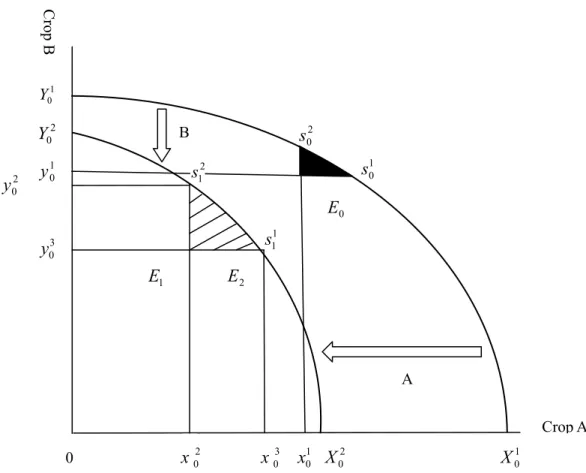
Now, consider about how the water constraint could negatively contribute to reduce the crop production. The Figure 5 shows the production possibilities curve of crop A and crop B. The curve of
(
1)
0 1 0
, Y
X
indicates the production possibilities with sufficient water for crop production while the curve of(
2)
0 2 0
, Y
X
with a water shortage due to the impact of climate change. The water constraint makes the production possibilities curve shift inside with different degrees of crop A and crop B as shown by arrows of A and B. The water requirement of crop A is higher than that of crop B. In other words, the crop A is more prone to have an impact of the water constraint. The farmer with sufficient water produces amount of crop A at 10
x
and crop B at 10
y
levels. The production is a close to optimal production level of both crops evenwith a small space of 2 0 1 0 0
s
s
E
for Pareto improvement. If the water becomes scarce, theCrop A 0
x
02x
03 1 0x
2 0X
X
01Fig. 5: Change of crop production by water constraint
Crop B 2 0
s
0E
1 0s
1 1s
1E
E
2 A B 1 0 Y 2 1s
2 0Y
1 0y
2 0y
3 0y
production levels of crop A and crop B drop to 2 0 2 0
, y
x
, respectively. The drop of crop A is largerthan crop B, namel 2
0 1 0 2 0 1 0
x
y
y
x
>
with a large space of 2 1 1 1 1s
s
E
for Pareto improvement. The reason behind is uncertainty of water availability because of possible impact by the climate change. The farmer tends to be a risk avoider. The optimal Pareto improvement at point of 11
s
in this case is to use water for crop A at 3 0
x
level so that the social benefit will be of2 0 2 1 2 0 3 0 1 1 3 0
0
0
x
s
y
>
x
s
y
. This means water productivity of crop A is higher than that of crop B which produces a high value for the farmer. The water should be allocated to high value crop in order to achieve in efficient water use in terms of income for the farmer.Technology development against water constraint Technology development against water constraint Technology development against water constraint Technology development against water constraint
Technology has historically contributed to various developments of agricultural sector. It includes “Green Revolution” at 1960s -1970s which has helped many Asian countries to achieve the self-sufficiency in rice production and at the present so-called “Gene Revolution” by adapting of biotechnology which has increased the production of major GM crops such as wheat, soybean and maize(12). It has made possible to develop a kind of crops with less water
requirement. Yet, it is noted at the same time that the Green Revolution has negatively contributed to the environment by excess application of water and fertilizer and GM crops are still scientifically uncertain of its effects on human health. The technology developments related to water utilization have benefited farmers to produce crops in agro-geographically dry zone. Those are technologies such as drip irrigation, water harvesting, and modernization of irrigation system as a whole. It also includes simple and low cost technologies for the poor farmer such as pedal-pump irrigation.
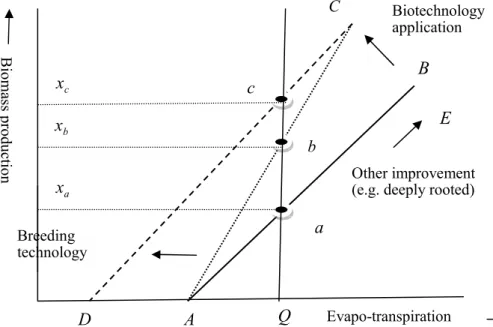
What types of technology can be developed to improve water productivity in future water constraint. FAO has demonstrated to achieve the water productivity by using the watch-word of “A crop, A drop”. Here, it proposes the combination of technologies to enhance efficiency of water uses in order to encounter the water scarcity. For example, alternative approaches are required in the marginal area where is prevailing the rainfed agriculture. The combination of technologies can be applied to save water and reduce crop water requirement which includes those such as water harvesting and farming practice including breeding (e.g. first grown crop) and biotechnology that can develop crop to grow under a water stress and a poor soil condition.
The Figure 6 depicts a model for a combination of technologies which could improve the water productivity(13). In the Figure 6, the horizontal axis indicates evaporation (i.e. green water)
while the vertical axis does biomass production. The line of
A
B
is a liner relationship betweenwater consumption and biomass production of crop
X
. The degree of slope of the line decides the biomass productivity. With the same of amount of water, the higher degree of slope, the more produce biomass. Now, if the biotechnology could enhance the water productivity, the line ofA
B
will shift to the line ofA
C
which makes possible to increase the biomass production level fromx
atox
b. Further, if crop grows with a canopy of larger leaves by breeding technology, it could cover to prevent soil from excess evaporation. This makes a shift the line ofC
A
to the line ofCD
which increases the biomass production at level ofx
c. On top of these technological applications, if the technology could develop a crop deeply rooted, it can catch more water in a soil. The result of the combination of technologies could contribute to increase biomass production in the process ofx
a→
x
b→
x
cwith the same amount of waterQ
. This responds to FAO’s catch-words of “A crop, A drop”.Since the changes of rainfall pattern by the climate change and thus available water is uncertain, it is difficult to forecast its changes at regional and country levels. Let alone it is more difficult to know changes of crop production with a water constraint. This threatens a food security of both national and international levels, in particular for the poor developing countries. Is the technology is all mighty for improving future water constraint as did so in the past? Only response to this question, at this moment, is to increase the investment in water sector which includes the research and development on the water distribution system as a
A
D
Evapo-transpiration Bi omass prod uct ion Biotechnology application Cc
ba
Breeding technology Other improvement (e.g. deeply rooted)E
Fig. 6: A combination of technologies for water productivity
B
cx
bx
ax
Q
whole toward an efficient water management. 5.
5. 5.
5. Food Security and its Implication of Water ManagementFood Security and its Implication of Water ManagementFood Security and its Implication of Water Management Food Security and its Implication of Water Management Definition and understanding of food security
Definition and understanding of food security Definition and understanding of food security Definition and understanding of food security
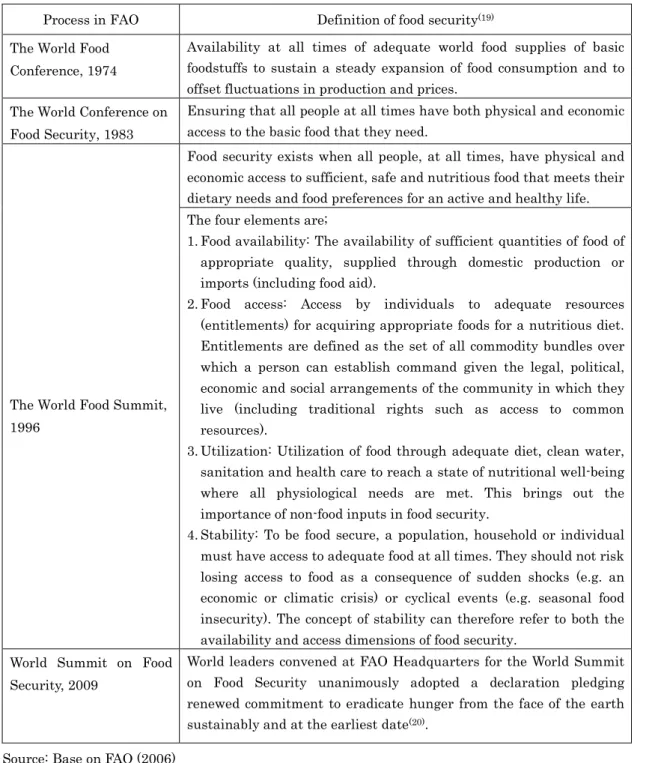
The right of access to food was recognized at the UN Declaration of Human Right in 1948. FAO has reviewed three times on the definition of food security in its General Assembly and the Food Summit at the time when the food situation of supply and demand has changed at international level. The Table 2 summarizes the modification of definition of the food security by FAO. At the time of 1973 when the food security was originally defined, it put a weight on supply side. Behind this definition, there was some worry about future food insecurity with a forecasted increase of world population as pointed out by the publication of “The Limits to Growth” by the Club of Rome’s Project in 1972(14).
In 1983, FAO focused on food access, leading to a definition based on the balance between the demand and supply sides of the food security equation which describes; “ensuring that all people at all times have both physical and economic access to the basic food that they need”(15).
This definition includes the analysis of food security not only at regional and national levels but at individual and livelihood levels. The World Bank(16) focused on temporal dynamics of the food
insecurity. The report introduced the distinction between chronic food insecurity, associated with problems of continuing or structural poverty and low incomes, and transitory food insecurity, which involved periods of intensified pressure caused by natural disasters, economic collapse or conflict. This was complemented by Amartya Sen’s theory of famine(17) which
highlighted the effect of personal entitlements on food access such as production, labor, trade and transfer based resources(18).
Taking a balance between supply and demand into consideration, the revised definition of food security adopted at the World Food Summit in 1996 includes four multilateral elements which are; (a) food availability, (b) stability, (c) utilization and (d) food access. These four elements are explained in the Table 2. This definition covers a concept of sustainable livelihood approach(21) which could be adaptive and manageable against a risk and vulnerability of food
supply and demand at an emergent period, whereby, in particular, contributing to an analysis on roles of food security in relation to building social and political structures in developing countries. In recent years, a particular attention has been put in place on ethics and human
right aspects in discussing food security issues.
A right of access to food is the right for human-being which accompanies with a binding obligation under international institutional arrangements. It has been recognized under the UN Declaration of Human Right and international contract on economic, social and culture. In other words, the right of access to food can be defined as a right of the community where every people, both men and women, including children could make an access to sufficient food
Table 2: Changes of the definition of food security Process in FAO Definition of food security(19)
The World Food Conference, 1974
Availability at all times of adequate world food supplies of basic foodstuffs to sustain a steady expansion of food consumption and to offset fluctuations in production and prices.
The World Conference on Food Security, 1983
Ensuring that all people at all times have both physical and economic access to the basic food that they need.
Food security exists when all people, at all times, have physical and economic access to sufficient, safe and nutritious food that meets their dietary needs and food preferences for an active and healthy life.
The World Food Summit, 1996
The four elements are;
1. Food availability: The availability of sufficient quantities of food of appropriate quality, supplied through domestic production or imports (including food aid).
2. Food access: Access by individuals to adequate resources (entitlements) for acquiring appropriate foods for a nutritious diet. Entitlements are defined as the set of all commodity bundles over which a person can establish command given the legal, political, economic and social arrangements of the community in which they live (including traditional rights such as access to common resources).
3. Utilization: Utilization of food through adequate diet, clean water, sanitation and health care to reach a state of nutritional well-being where all physiological needs are met. This brings out the importance of non-food inputs in food security.
4. Stability: To be food secure, a population, household or individual must have access to adequate food at all times. They should not risk losing access to food as a consequence of sudden shocks (e.g. an economic or climatic crisis) or cyclical events (e.g. seasonal food insecurity). The concept of stability can therefore refer to both the availability and access dimensions of food security.
World Summit on Food Security, 2009
World leaders convened at FAO Headquarters for the World Summit on Food Security unanimously adopted a declaration pledging renewed commitment to eradicate hunger from the face of the earth sustainably and at the earliest date(20).
physically and economically and have measures to access to food in a way to meet human dignity. According to UNESC (1999)(22), the right of access to food would accompany with
three types which includes; (a) the right to dignity, (b) measures of access to food utilization and food security, and (c) obligation to facilitate strengthening food security for all people. The government is responsible for an individual and a group of individuals who cannot enjoy benefits of right to food.
Water management for food secu Water management for food secu Water management for food secu Water management for food securityrityrityrity
It is clear that better water management could contribute to securing food security. However, the relationship between better water management and food security has not been taken up seriously as agenda in the past international water conferences. Rather, the food security has been discussed in relation to trade issues as a non-trade concern in WTO agreement. It means that if the free trade mechanism works, the food security will be secured for importing countries of agricultural commodities including developing countries. This thought would be a short-circuit argument. One of evidences is a high international price of agricultural commodities in recent years which threatens the food security in the poor developing countries who are a lack of purchasing power. Given this situation, the food security should be understood in a framework of food system. The food system from crop production, processing and marketing is a food supply chain until a consumer can access to the food. In a flow of food system, water management practice is positioned in its first stage of crop production. It means that inefficient water management would reduce a yield of crop production, then reduce amount treated in the international market and followed by pushing up the price higher, all of these negative processes which would cause food insecurity in some developing countries as a first victim.
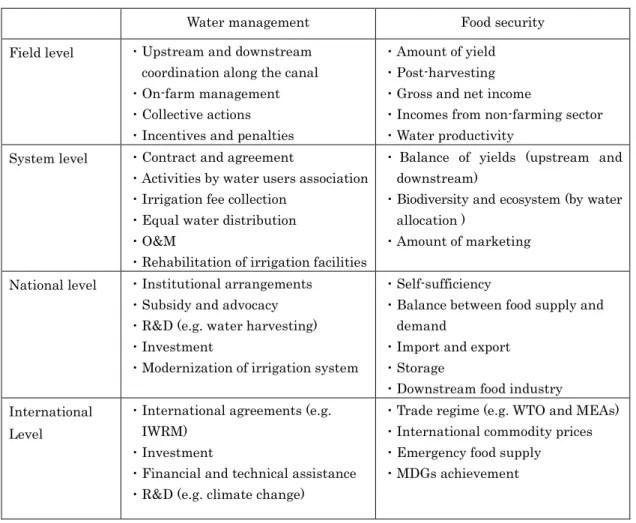
The Table 3 informs the relationship between the water management and food security at the different management levels. Each level plays different roles but interacts each other. At field level, main player are farmers whose decision making governs the actions taken for the water management. If farmers made collective efforts to coordinate upstream and downstream water distribution and on-farm management, the improved water productivity enhances yields if other conditions are constant. To this end, policy incentives should be given for encouraging farmer’s efforts on water management. The food security also depends on income from both farming and non-farming sources which is an indicator for purchasing power of farmers. At the level of a water distribution system, alternative player is a water users association consisting of
Table 3 : Water management for food security in different levels
Water management Food security
Field level ・Upstream and downstream coordination along the canal ・On-farm management ・Collective actions ・Incentives and penalties
・Amount of yield ・Post-harvesting ・Gross and net income
・Incomes from non-farming sector ・Water productivity
System level ・Contract and agreement
・Activities by water users association ・Irrigation fee collection
・Equal water distribution ・O&M
・Rehabilitation of irrigation facilities
・Balance of yields (upstream and downstream)
・Biodiversity and ecosystem (by water allocation )
・Amount of marketing National level ・Institutional arrangements
・Subsidy and advocacy ・R&D (e.g. water harvesting) ・Investment
・Modernization of irrigation system
・Self-sufficiency
・Balance between food supply and demand
・Import and export ・Storage
・Downstream food industry International
Level
・International agreements (e.g. IWRM)
・Investment
・Financial and technical assistance ・R&D (e.g. climate change)
・Trade regime (e.g. WTO and MEAs) ・International commodity prices ・Emergency food supply
・MDGs achievement
farmers as a member. The water users association dominates important services such as irrigation fee collection, operation and maintenance of facilities and administration, and rehabilitation works. The service will extend over a balance of yields between the upstream and downstream by keeping them equal access to the water. A better water management could save the extra water which can be allocated to the environment along the canal or river whereby a biodiversity and ecosystem services will be maintained. The poor heavily depends their livelihoods on biodiversity and ecosystem services. A sustainable preservation of biodiversity could contribute to food security, let alone wellbeing of human-being as pointed out by UN Millennium Ecosystem Assessment (23).
Institutional arrangement and investment in water Institutional arrangement and investment in water Institutional arrangement and investment in water Institutional arrangement and investment in water
Now, it sheds a light on the water management for food security at national and international levels. The institutional arrangement and investment are major targets at national level. Many developing countries are still insufficient for water related laws and legal procedures which have caused inefficient water allocation in various sectors of not only agriculture but sanitation
and potable water. The international agreement is usually integrated into national water related laws and regulations for taking actions as a country basis. If the institutional arrangement is not well structured, the country will fail to keep international agreement in its implementation. The investment in water at national and international levels have been reduced in past decades, it is the reason behind a delay of rehabilitation and modernization of irrigation system. It should be noted that there have existed a dilemma between international commitments of investment in agriculture or water and actual investment at field and national level(24). In reality actual investment has not been implemented as committed by the
international society.
Every country has given the first priority on achieving self-sufficiency of major cereals and animal products for their food security. It requires a balance of supply and demand of foods at national level by enhancing the ratio of self-sufficiency. On the other hand, it is a fact in the international debate that the food security could be only achieved through the free trade mechanism. The trade issues on agriculture have been for a long time put on the negotiation table at WTO without a visible progress, for example, of the Doha agreement. The negotiation on agricultural issues has always been difficult because of its linkage to food security of the country and often other political issues. A strong political-will should be put in place for facilitating the negotiation toward the establishment of international rules and principles of the food security.
Having said this, a rule-based multilateral trade system between the exporting countries and importing countries could only help achieve the food security for importing and developing countries. In recent years, many countries have joined in ETA or FTA as a bilateral free trade agreement. This trend toward an economic coalition between countries will threaten the food security of other countries in a certain sense if it could only works at the sacrifice of the supply and demand of foods at the international level. The situation will threaten the mandates and responsibility of WTO in the future if necessary steps were not taken for demarcation of roles and coverage of trade agreement, and thus consequently neglect the food security issues at the international level.
The MDGs covers eight goals of which are closely linked to the food security. The goal of poverty and hunger reduction cannot be reached without improving food insecurity in many poor developing countries. The enrolment into a primary education will continue to be a low
level if enough food is not supplied to the children. Maternity health improvement and child mortality reductions are difficult with a sufficient supply of nutrition owing to the food security establishment. Although a majority of ODA goes to the achievement of MDGs, an investment of private sector should be encouraged to improve food insecurity targeting countries who have confronted with a difficulty of achievement of MDGs. The successful achievement of MDGs by 2015 is one of indicators to measure whether the country secures food security or not for the poor.
Water democracy as an adaptation measure for the climate change impact Water democracy as an adaptation measure for the climate change impact Water democracy as an adaptation measure for the climate change impact Water democracy as an adaptation measure for the climate change impact
The democracy rules would play important roles in a decision making at a community level, let alone at the water users association. This is called as “water democracy”(25). The water
democracy has been observed in every water users association in many Asian countries including Japan. It has contributed to decision making on water management issues such as an equal water distribution and conflict resolution between the upstream and downstream. It is also effective to strengthen a fabric of water users association by ensuring a transparency in its decision making process. In recent years, however, the water democracy in many water associations has decayed its roles and responsibilities because of the aged of farmers, outmigration of the young and unchanged social system. The weakened water democracy has decreased its function of the water users association and thus, reduced and neglected collective actions in the water management practices. This brings the water users association in the question on a rebuilt of the water democracy.
How the water democracy can be rebuilt among the water users associations? It needs to rethink of its meaning of water democracy in view of the water management by taking into a possible future water scarcity consideration. There are a couple of suggestions; firstly, it asks the farmers to recognize a value of water; secondly, a collective action is only possible with a full participation and cooperation of farmers; thirdly, it needs to enhance the transparency in a process of decision making; and fourthly, institutional arrangements should be put in place for adapting the water users associations to an emerging circumstance under a progress of globalization. In addition, what is more important is a political-will to invest in agriculture and water so as to encourage the water users associations and farmers to renew their water management practices under a future uncertainty of water availability.
comparing to mitigation measures against an impact of the climate change. This is also true in the water management at different levels. If the water management is improved in terms of saving water and equal water distribution by the rebuilt of water democracy, it could be alternative adaptation measures at the time when the water become a scarce. A collective action in the water management should be reorganized which is the most powerful when the water system needs to encounter difficulties such as drought, water conflict and low level of water fee collection. It is underlined the importance of decision making under the water democracy which could be acceptable for every water users to use water efficiently.
6666.... Conclusions and Issues for Future DiscussionConclusions and Issues for Future DiscussionConclusions and Issues for Future Discussion Conclusions and Issues for Future Discussion
Although the water management issues have been discussed in the past at national and international levels, why it continues to be a major concern for different stakeholders? The paper focused mainly on theoretical considerations on the water management, efficient water uses and its implication of food security. It provides possible application of economic measures to coordinate a conflict around the water uses whereby leading it into cooperation. This is closely linked to the change of behavior of water users, namely farmers with a knowledge and understanding on a value of water and its scarcity. Suppose that the water resource is common resource for all farmers, how they will behave under the limited available water. If people behave in a way to maximize only own benefit, the result is a situation of prisoner’s dilemma. If some farmers do cooperate and the rest do not cooperate, the latter will be a free-rider for available water. This means that the better water management practice will be a sort of public goods, the benefit of which will spill over every farmers who use the same water resource.
The paper also discusses the compensation and payment as an economic measure to resolve the conflict or improve the water management among farmers upstream and downstream. The farmers, in particular, upstream usually prefer a higher opportunity cost to using the same time and labor for the water management because they can easily access to the water without any effort. The farmers downstream have a right to take an action to negotiate with farmers upstream for pursuing their obligation to keep a fair water allocation. The institutional settings with agreement of both sides are a starting point for the better water management which includes incentives and penalties for keeping rules and principles.
management could contribute to enhance a crop productivity which consequently, leads to increase income of the farmers. The farmers will improve their livelihoods if they have a purchasing power with an increased income. It is also noted that the poor heavily depends on their livelihoods on the biodiversity and ecosystem services for securing foods and other materials such as wood for cooking and warming. The allocation of water for the biodiversity with better water management could help improve their food insecurity and sustainable preservation of biodiversity and ecosystem.
Finally, taking into account the analyses and discussions in the paper, it is proposed the following issues for future discussion on the water management and food security.
(1) The water management is a flow of practices from the upstream to the downstream. It is also a flow of practices from the field level to the water distribution system level as a whole. How these flows of practice could be put into the integrated water management? To this end, how the water users association should play roles and responsibilities in their water management activities? Does it require for the water users association to change their current activities, if any?
(2) The food security is the issue linkage with the better water management practices. How the government could integrate this issue linkage into a national water policy setting? How does the international society evaluate this issue linkage in the context of the future water scarcity which is one of global issues?
(3) How could the international society encounter the impacts by the climate change on water availability and thus, on food security? Against this situation, what types of innovative technology, if any, could be possibly developed? How the water management practice could encounter the change of water availability at both national and international levels?
(4) How the concept of water democracy could be effective in reorganizing the water users association to achieve efficient water uses at a different water distribution levels? Does the rebuilt of the water democracy contribute to strengthen a fabric of community and thus, reduce conflicts around water uses?
change? If so, how the government could integrate it into the adaptation policy as a national strategy of the climate change? And how the international society could evaluate it in terms of effectiveness and adaptability as the policy for the climate change?
「Note for gratitude」It is noted here that paper is supported by the Grants -in-Aid for Scientific Research by Japan Society for the Promotion of Science. The subject is “An analysis on the impact on the agricultural production of exporting countries by the water constraint under the climate change and its consequences on the food security in Japan” (Research subject: No. 21405029) which was adopted in 2009.
References and Notes References and Notes References and Notes References and Notes::: :
1. She has conducted the research on economic governance, especially the common pool resource in terms of conflict and cooperation by using the Game Theory and institutional economics, her literatures of which includes; Governing the Commons (1990), Rule, Game, and Common-pool Resources (1994), Governing the Commons (1990) and understanding institutional Diversity (2005).
2. Many related publications on these subjects are available for reference including OECD Observers. 3. The words of water shortage and water scarcity are interchangeably used in the paper.
4. Rijisberman.F, Sanitation and access clean water in “Bjorn L. ed.(2001) Global Crisis, Global Solution,” pp.499
5. The Coase theory can be discussed in the case where a transaction cost is zero in a negotiation. However, usually, the negotiation needs the transaction cost in a different degree.
6. This means the pay-off exceeds the reservation cost which is
a
−
x
e+
t
>
b
.7. The Upper Pantabangan River Integrated Irrigation System is located in the Central Luzon, which covers more than beneficial area of 100,000 has. It has completed in 1980s with assistance of the World Bank and Japan in the later stage. It is one of biggest irrigation system which is currently managed under NIA responsibility.
8. Instead of water association, it is called Irrigators Association in Philippines.
9. There are three types of irrigation systems which are; (a) National Irrigation System (NIA), (b) Communal Irrigation System (CIS) and (c) Private Irrigation System (PIS) based on the size of beneficial area below and above 1,000 has.
10. Ofrecio.B.P (2005), Participatory Development and Management: A cornerstone of Philippine Irrigation Program, NIA.
11. IPCC, Working Group II (2007), Climate Change 2007: Synthesis Report, Summary for Policy makers, IPCC
12. Evans, L.Y. (1996) in his publication of “Feeding the Ten Billion – Plants and population growth”, proposes the necessity of “Brown Revolution” which means new agricultural technology development of applying it in marginal area where the majority of the poor live with poor crop productivities.
Sciences Technologies Agricoles en Afrique, 2004. The title of paper was “Science and Technology Needs for Water Management in West African Countries”.
14. Meadows D.H. et al. (1972), The Limits to Growth, A Potomac Associates Book 15. FAO (1983), The World Conference on Food Security, FAO, Rome
16. The World Bank (1986), Report on Poverty and Hunger, The World Bank
17. Sen, A.(1982), Poverty and Famines : An Essay on Entitlements and Deprivation, Clarendon Press 18. This paragraph is referred from “ FAO (2006), Policy Brief, Food Security, Issue 2”
19. Based on “FAO (2006), Policy Brief, Food Security, Issue 2” 20. FAO home page
21. The sustainable livelihoods approach is a way to improve understanding of the livelihoods of poor people. It draws on the main factors that affect poor people's livelihoods and the typical relationships between these factors. It can be used in planning new development activities and in assessing the contribution that existing activities have made to sustaining livelihoods (IFAD home page).
22. UNESC (1999), E/C.12/1999/5, United Nations Economic and Social Council
23. The Millennium Ecosystem Assessment (20001-2005) assessed the consequences of ecosystem. It provides a state-of-the-art scientific appraisal of the condition and trends in the world’s ecosystems and the services they provide, as well as the scientific basis for action to conserve and use them sustainably (based on Millennium Ecosystem Assessment: Home page )
24. For example, the G8 Summit held at the Touyako, Hokkaido in Japan, 2008 and followed by a series of international conferences made the commitments of the necessity of investment in the agriculture (including water) but fewer investment has been made in actual basis than promised.