第 巻 第 − 号 抜 刷
年 月 発 行
Development of Production Index
for Cell Manufacturing
by Advanced Mobile Robot System
for Cell Manufacturing
by Advanced Mobile Robot System
Keishi Matsuda
Abstract
In the manufacturing site, placement of industrial robot systems has been largely grown. In this paper, we have discussed on the effect of the knowledge sharing and Artificial Intelligence for the multiple mobile robot system which is equipped with the advanced telecommunication devices and sophisticated computer network system. Today, the broad bandwidth telecommunication method has been brought into the world of robotics. This has enabled the mobile robots to perform advanced communication. This is not only for master’s or administrator’s command use but for the exchange of the knowledge obtained from the operation. This knowledge sharing system will facilitate the sophistication of the knowledge level and the equalization of the intelligence level. Therefore, we propose the utilization of the knowledge sharing to robot system at the manufacturing scenes, and we have demonstrated the effects by the simulations. In this study, we have focused on the current problems of the line balancing and the quality problems. Using this knowledge sharing system, we have verified the effectiveness of the autonomous and cooperative behavior at manufacturing lines, and consequently, the feasibility of the cost reduction and improvement of the productivity.
Keywords Moving Robot, Agent System, Manufacturing System, Quality Control, Artificial Intelligence, Computer Networking, Manufacturing Line, Line balancing
Introduction
These days, research of multiple robots, which has distributed function and maximize their total ability have been frequently observed in the field of rescue robots or soccer robots tournament called ROBOCUP[ − ]. This shows the rapidly growing need of more sophisticated multiple robots which are more dependable compared to function-integrated single robots.
Accordingly, several studies have been made regarding sharing and distribution the knowledge which are obtained from the sensory operation[ ]. This knowledge must be utilized not only for geographical navigation but for highly complicated exercises[ ]. Asama et al. proposed the Intelligent Data Carrier(IDC)with the aim of sharing knowledge among the robots[ − ]. This utilization of memory media has disadvantage of an increase in cost and redundant need of supervising system for the memory modules.
Therefore, in this paper we propose the knowledge sharing system using the advanced wireless communication devices, such as wireless LAN and Bluetooth. If the robot modules are equipped with the independent communication systems, efficient and simplified unitary system shall become the practical use. This enables the robots to manage the knowledge. Furthermore, applications of advanced networking and virtual storage in the internet called cloud computing will accelerate the application of the advanced artificial intelligent system.
Aims of the Multiple Robot System
These days, Multiple Robot systems are largely needed required to replace the activities by human workers, such as cooperative actions with other human workers. The cooperative actions must include some suggestions and advices among humans
which are based on knowledge or information accumulated through daily operations or experience. Therefore, it is expected that the robot systems must have following technical skills :
)High level cooperative algorithm
)Telecommunication and networking function )Autonomous function by sophisticated sensors )Cooperative planning function between modules
Asaka et al. have stated that the Autonomous Behaviors must be defined as follows[ ]: Automated planning function under the certain direction and Control of their sensory operation under the execution of autonomous action plan.
The knowledge must be divided into factors : i. e. Administrative factor and Physical factor. These two factors must be properly combined and utilized for autonomous operations.
There are some good examples of the physical factors including Geographical location, Sensory information, Index for task load, Index for remaining power and Caution data for collision avoidance. The examples of the administrative factors include Objectives of the tasks, Progress report, Compliance check of the tasks, Support request from another robot. Fig. is a diagram of the interactions of the administrative knowledge. In this paper, the process of the quality improvement is added to administrative factor.
{Kp
1, ..., Kp
n}
{Ka
1, ..., Ka
n}
Agent N
Knowledge for Process
Knowledge for Line Control
Knowledge for Reference
Knowledge for Quality improvement
{Kr
1, ..., Kr
n}
Knowledge Distributions and Sharing among
the Multiple Robots
Huge integration of information and complicated algorithms is needed to design the coordinated work plan precisely. The sophisticated robots shall need to process the huge volume of obtained data. This mass of data is produced by advanced analytical method and its algorithm. This may confront with the problems how we should process and store the knowledge data and to maximize the utilization of them.
The problems which need to be discussed initially are : )Evaluation of knowledge value
)Distributed allocation of the knowledge )Knowledge sharing
)Categorization and suitable store of the knowledge
In this paper, focusing on the intelligence equalization among the robot
Fig. Dynamic Conversion between Centralized and De-centralized Systems
modules, we have discussed on the effectiveness of the knowledge sharing and its methodology. Additionally, the technical application of the CLOUD computing/ storage system in the internet must be discussed in our next steps.
Basic Configuration of the Multiple Robot System
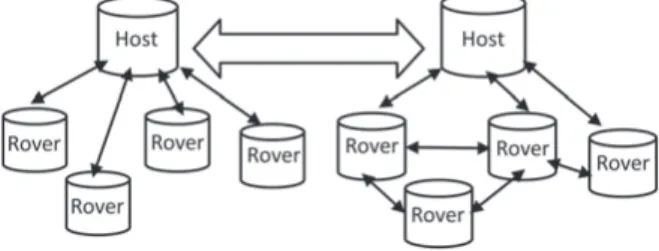
The group of modules forms a task domain which shares the same tasks or assignment. The domain is made of major elements : )Host Robot )Rover Robot(Fig. ).
Host robots control the Rover Robots on : )Rovers’ motion
)Tracking Rovers’ trajectories )Send/Receive emergency alarms )Planning, Execution and Stop tasks
)Irregular command to the robot out of the task groups by Advanced Mobile Robot System
Main responsibilities of Rovers are :
)Surveillance of work conditions through the data receive and transmission to another module
)Autonomous execution of simple tasks at the local site
)Transmission of support request to other robots in case of complicated tasks )Receive of the coordination requests from the Host Robot
The coordination of the both Host and Rover robot will realize the ideal system which includes advantages of Centralized and De-centralized systems. This concept is shown in Fig. above.
How to Evaluate the Usefulness of the Knowledge
Arai et al. stated that the independent motion of the autonomous robot will be disturbed by the excessive and regional concentration of the information[ ]. This may also cause the delay of the data processing. To solve this problem, the information must be distributed, and shared among the robots within the same task domain. Additionally, these information must be properly analyzed, classified and reallocated accessible locations. This reallocation shall be based on the classification or definition of the USEFULNESS of the obtained knowledge. We must figure out the usefulness of these by : Frequency of the reference, Dependability of the knowledge and Size of the contribution for cost reduction.
&($'&*!"(#!(%#(!! '$!
)
#'&!$%+&("%!!%(&
where, &*is the initial value of the usefulness. This value must be initially defined before the task operation is started. !(is the necessary cost without the knowledge utilization. #(is the frequency of the reference. "(is the dependability of the knowledge, indicates the occurrence of the ratio which the information transformed
Fig. Configuration of Knowledge Sharing
into the knowledge. !!%"is the time-series value of depreciation/appreciation of the knowledge. This time we must add an factor for Quality Improvement : i. e. the total value of usefulness shall gain by quality improvement"$.
Configuration of knowledge allocation
It is preferable that obtained knowledge must be synchronized in a short time and distributed equally among the updated modules. However, there might happen the limitation of both the size of data storage systems and the bandwidth of communication systems. Therefore, we propose the sharing/distribution style shown as Fig. .
The allocations are classified as following three types by their usages :
)CASE Sharing Every robots shares same data. (The data’s #$ is highest and its total size is small.)
)CASE Distribution The data must be possessed by the module which originally acquire. (The data’s #$is low and each of the data file is
smaller than a storage.)
)CASE Separated sharing The data files is stored among several modules as multi-files.
These separated files must be re-assembled at the point of reference. (The data must be less frequently referred and its data size is very large. The size of a data must be smaller than the total storage.)
Furthermore, the value of knowledge must be dynamically evaluated during the operation. And the less frequently referred data must be archived or deleted from the storage.
Study of Application to Manufacturing Process
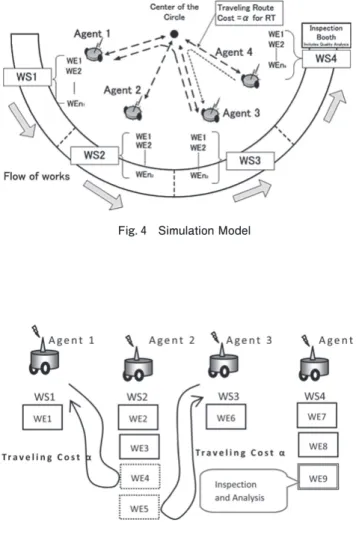
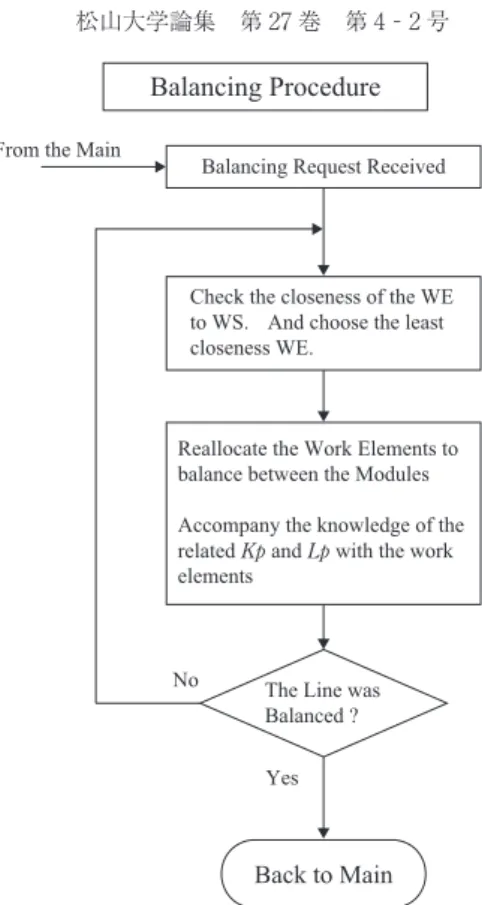
Using this method for knowledge utilization, I have performed the simulation of the multi-robot system for manufacturing process. The multi-robot system will be highly utilized when the system obtain the manufacturing-related knowledge and share it among other modules[ , ]. In this chapter, we discuss over the improvement of productivity of the manufacturing line by way of using knowledge sharing. Line balancing problems and quality problems are discussed in this study. Fig. shows the CELL production line which is designed for this study. Cell production is a form of team working and helps ensure worker commitment, as each cell is responsible for a complete unit of work[ ]. This semi-circle line facilitates the robot to minimize the traveling cost. The manufacturing line can be dynamically transformed by line-balancing calculation shown in Fig. . As for the quality improvement, necessary knowledge for the improvement are allocated by the robots, and performed as the Work Elements(WE).(Fig. )
Fig. Simulation Model
Fig. Re-allocation of Work Elements(WE)
Now let us discuss on the effect of knowledge sharing among the modules. We should add the factor of the time for data transmission and the cost reduction by the knowledge sharing. The cost reduction includes the improvement of the quality and the machine time.
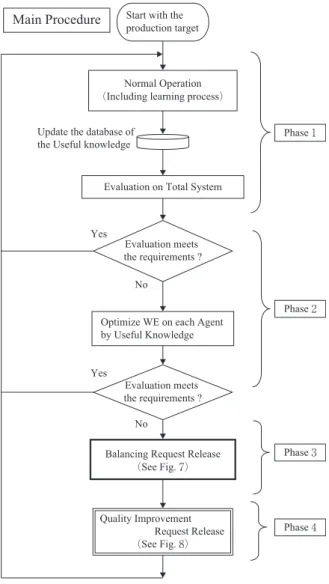
Autonomous algorithm for the line-balancing and the quality improvement are shown in Fig. , Fig. , and Fig. . Machine time of neighboring modules is described by following formula[ − ].
%#! *#! ,' $%#*"$*"*"#+*$&+*!-!!+*""+*%%"%'( "! *#! ,( $%#*"$*"*"#+*$&+*!-!!+*""+*%%"%() "! *#! ,) $%#*"$*"*"#+*$&+*!-!!+*""+*%%
where, %#*is the machine time of WE, %'(, %()is the traveling time between the WSs. &+*is the volume of the knowledge. p is the transmission bandwidth between the agents. #+*is the flag of the reference of the knowledge.(Yes= , No = )!+*is the reduction cost by referring the knowledge. "+*is the increased cost
Start with the production target
Evaluation on Total System
Evaluation meets the requirements ?
Evaluation meets the requirements ?
Balancing Request Release (See Fig. 7)
Quality Improvement Request Release
(See Fig. 8) Optimize WE on each Agent by Useful Knowledge
Normal Operation (Including learning process) Main Procedure
Phase1
Phase2
Phase3
Phase4 Update the database of
the Useful knowledge
Yes
No
Yes
No
Fig. Algorithm of Main Process
Yes No
Balancing Procedure
From the Main
Balancing Request Received
Back to Main
Check the closeness of the WE to WS. And choose the least closeness WE.
Reallocate the Work Elements to balance between the Modules Accompany the knowledge of the related Kp and Lp with the work
elements
The Line was Balanced ?
for knowledge transportation. &"&"!&#!&$is the total number of the line process. !%is the flag for the traveling of the agents. !%is the cost for traveling among WSs.
Quality Improvement Procedure
From the Main Quality Improvement Request Received Back to Main Product meets requirement ? Yes No Yes No Back to Main Rework Capacity of Line OK ?
Analyze the Cause of Defectives
Plan for the Countermeasure
Allocate the Plan as new WE to Robot And Execute the Countermeasure
Algorithm for Line-balancing and Quality Improvement
It is necessary to minimize the differential of machine time between the WS. The absolute value of the differential is
!%$$%%# " %#! '( $"#%"!&%%!" %#! ') $"#%!!"!&%!!% ! ! ! ! ! ! ! !
This line-balancing operation should be evaluated by Production Opt(Daily
Fig. Algorithm of Quality Improvement Process
output through hr operation)and Line-balancing Factor(LBF). The formulas are shown as below. $!#%!&# # '## ( &'#(" ! ""#"" Opt= sec× hrs C×n
Where&'the Machine Time, C is the cycle time, n is the number of the robot modules. Algorithm for this line-balancing process is shown in Fig. − .
Let us discuss on another process for Quality improvement. To evaluate the capability of the line as for the quality, it is common to refer the Process Capability index. The formula is shown below[ ].
")'#%#!'&%*!%$ &$
Where, k is bias value. %*is upper threshold, %$is lower threshold.
In the real world, ")'$#!%%, the line’s capability on quality control is excellent, ")'"#!%% is average, ")'"#!" is poor. ")'$$!" is a suggested threshold in the Six Sigma[ ].
Results of Simulations
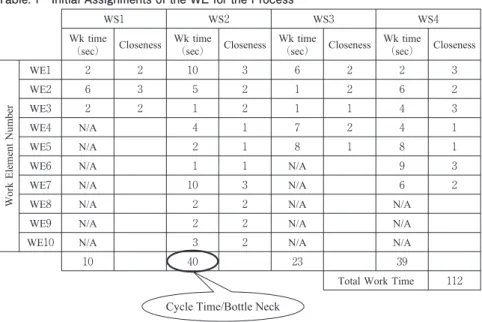
Under the conditions shown in Table. . Both a Line-balancing factor and a quality control index(i. e. elimination of defective products) are used for line performance. The simulations for the line-balancing and Quality Improvement were held. Fig. to Fig. shows the result of the improved balance of the line. Fig. shows % of the improvement of Opt(daily throughput)after the several re-allocation of the WEs with the knowledge. Fig. shows he improved Line Balancing Factor by using the knowledge. Furthermore, another five samples of
Cycle Time/Bottle Neck
the simulations was performed to validate the simulator. The results are shown in Table. Improvements of the efficiency in all evaluation factors are recognized on every condition which is generated randomly. Additionally, as for the simulation of improvement quality, the another results are shown in Table. . These initial conditions were also generated ramdomly.
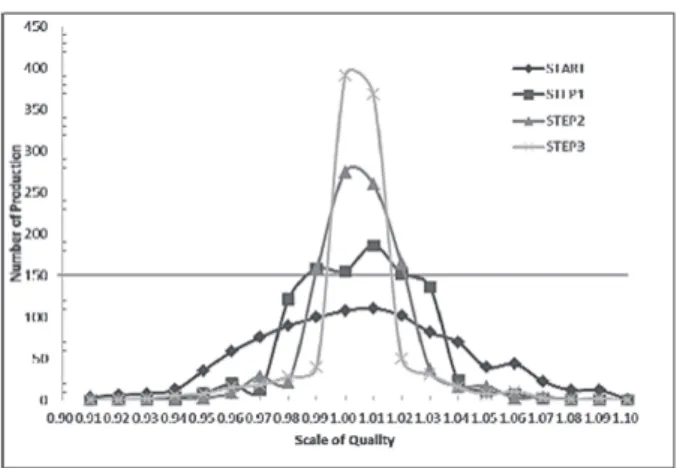
Fig. shows the transaction of the quality improvement by the countermeasures performed by the robots, indicating the decrease of the defective products as the countermeasures proceed. Table. also shows the improvement of the line in quality control index. Remarkable improvement of was observed as the countermeasures proceed. !#"is improved from . to . .
WS WS WS WS Wk time (sec) Closeness Wk time (sec) Closeness Wk time (sec) Closeness Wk time (sec) Closeness WE WE WE WE N/A WE N/A WE N/A N/A WE N/A N/A
WE N/A N/A N/A
WE N/A N/A N/A
WE N/A N/A N/A
Total Work Time
Table. Initial Assignments of the WE for the Process
W o rk E lem en t N u m b er
68 70 72 74 76 78 80 82 84 86 0 1 2 3 4 5 6 7 L ine B al anci ng F act o r % Number of Trial
Improvement of Line Balanicing Factor by Autonomous Balancing No Use of Knowledge Use of Knowledge
START STEP STEP STEP
MAX diff.(cm) . . . . MIN diff.(cm) . . . . Average diff.(cm) . . . . Yield Rate(%) . . . . Standard Dev.(cm) . . . . Cpk . . . .
Table. Improvement of the Line in Quality Control
100 120 140 160 180 200 220 240 0 1 2 3 4 5 6 7 P rod uc ti on p cs /d ay Number of Trial
Improvement of Daily Throughput by Autonomous Balancing No Use of Knowledge Use of Knowledge
Fig. Improvement of the Balancing Factor
Fig. Improvement of the Quality of the line
No Use of Knowledge Data Data Data Data Data Daily Production (pcs) Start . . . . . End . . . . . Value Improved . . . . . Ratio Improved . . . . . LBF (%) Start . . . . . End . . . . . Value Improved . . . . . Cycle Time (sec) Start End Value Improved Ratio Improved . . . . . Use of Knowledge
Data Data Data Data Data
Daily Production (pcs) Start . . . . . End . . . . . Value Improved . . . . . Ratio Improved . . . . . LBF (%) Start . . . . . End . . . . . Value Improved . . . . . Cycle Time (sec) Start End Value Improved Ratio Improved . . . . .
SAMPLE
START STEP STEP STEP
MAX diff. . . . . MIN diff. . . . . Average diff. . . . . Yield Rate% .% .% .% .% Standard Dev. . . . . Cpk . . . . SAMPLE
START STEP STEP STEP
MAX diff. . . . . MIN diff. . . . . Average diff. . . . . Yield Rate% .% .% .% .% Standard Dev. . . . . Cpk . . . . SAMPLE
START STEP STEP STEP
MAX diff. . . . . MIN diff. . . . . Average diff. . . . . Yield Rate% .% .% .% .% Standard Dev. . . . . Cpk . . . .
Table. Comparison of the Simulation for quality improvement
Summary and Outlook
In this research, we proposed the multi-robot system which performs knowledge distribution and sharing among the agents, and have focused on their autonomous and self-organizing functionalities for the manufacturing line. In these simulations, it is observed that the knowledge sharing among the robots improves the balance of the line, and the quality of product, which maximize its productivity. This research need to be continued because, in the real world, the knowledge must be classified by more complicated or multi-dimensional criteria.
Especially, the elements of the knowledge which affects the production in good quality must be analyzed. In this system the host organizes the system’s behavior after surveying the entire action of the robot agents. Therefore, maximizing the advantage of the multi-robot system, the organizational structure of the group must be more flexible. We will propose the algorithm which mitigates the distinction between the Host and the Rover. For example, the authority of the leadership must be passed to one another depending on tasks or the importance of the knowledge which modules possess.
In our future research, we will discuss on another categorization of the knowledge and optimization process, using the method such as machine learning which will helps the systems to demonstrate and perform the advanced quality control by autonomous robot system.
Another research to be discussed is algorism for contingency during the operation. For instance, a backup procedure must be discussed. In case of function failure of a robot agent, another robot is expected be a backup or take over the role of the robot out of order.
References
.Hiroaki Kitano ;“RoboCup as a Research Program”Proc. IROS , PS− , ,( ). .Zygmunt Vetulani ;“Decision making for a RoboCup multi-agent system”Third International Workshop on Robot Motion and Control, pp. − ,( ).
.M. Boehlen,“A robot in a cage”, in : Proc. Int. Symp. on Computational Intelligence in Robotics and Automation, Monterey, CA, pp. − ,( ).
.Joo-Ho Lee, H. Hashimoto ;“Controlling Mobile Robots in Distributed Intelligent Sensor Network”IEEE Transaction on International Electronic, Vol. No. ,( ).
.C. Laschi, B. Mazzolai, F. Patane, V. Mattoli, P. Dario, H. Ishii, M. Ogura, S. Kurisu, A. Komura and A. Takanishi,“Design and development of a legged rat robot for studying animal− robot interaction”, Proc. Int. Conf. on Biomedical Robotics and Biomechatronics, Pisa, pp. −
,( ).
.D. Kurabayashi, H. Asama et al. ;“Autonomous Knowledge Acquisition and Revision of Dynamic Environment by Intelligent Data Carriers”ROBMEC , PI− − ,( )(in Japanese).
.T. Fujii, H. Asama et al. ;“Function Emergence in Multirobot Systems Utilizing Intelligent Data Carriers”, J. the Robotics Society of Japan, Vol. , pp. − ,( )(in Japanese). .Y. Mae, T. Arai et al. ;“Navigation of Multiple Robots by Embedded Knowledge into Environment”ROBMEC , PI− − ,( )(in Japanese).
.S. Asaka et al. ;“Behavior Control of an Autonomous Mobile Robot in Dynamically Changing Environment”J. the Robotics Society of Japan, Vol. , pp. − ,( )(in Japanese). .T. Umetani, T. Arai et al. ;“Adaptive Relocation of Environment-Attached Storage Devices for Knowledge-Sharing among Autonomous Robots”J. the Robotics Society of Japan, Vol. , pp.
− ,( )(in Japanese).
.Geoff Riley ;“Study Notes : Cell Production”, http://beta.tutor u.net/business/reference/cell-production
.H. Kume ;“Quality Control, Fundamentals of Technology”Iwanami Shoten, Publishers, pp. − ,( )(in Japanese).
.M. Beetz, L. Mosenlechner, and M. Tenorth,“CRAM−A Cognitive“Robot Abstract Machine for Everyday Manipulation in Human Environments”, in Proceedings of the IEEE/RSJ International Conference on Intelligent Robots and Systems, pp. − ,( ).
.M. Tenorth and M. Beetz,“KnowRob−A Knowledge Processing Infrastructure for Cognition-enabled Robots”, International Journal of Robotics Research(IJRR), ( ), − ,( ). .G. Michalos, S. Makris, N. Papakostas, D. Mourtzis, G. Chryssolouris,“Automotive assembly technologies review : challenges and outlook for a flexible and adaptive approach”, CIRP Journal of Manufacturing Science and Technology, , pp. − ,( ).
.J. Paralikas, A. Fysikopoulos, J. Pandremenos, G. Chryssolouris Product modularity and assembly systems : An automotive case study CIRP Annals - Manufacturing Technology, , pp.