Journal of the Operati~ns Research Society of Japan
Vol. 39, No. 3, September 1996
RELIABILITY OF A CIRCULAR
CONNECTED-(r,s)-OUT-OF-(m,n):
F LATTICE SYSTEM
Hisashi Yamamoto Masami Miyakawa
Tezkyo Unzverszty of Sczence and Technolog9 Unzverszty of Tokyo
(Received November 11, 1994; Final August 25, 1995)
Abstract A circular connected-(r>s)-out-of-(m,n):F lattice system has mn n compoaen%s and is consisted of ri rays and m circles. The system fails if and only if a connected (r,s)-matrix of components fail. Fixskly, this paper proposes a recursive algorithm for the reliability of $he system> which requires O(rnn2sm) computing time. In the statisticaIly independent identically distributed case7 the c o m p u t i ~ ~ g time is able to be reduced. Secondly, the upper a ~ d lower bounds for the system reliability are obtained for the circular connected- (r,s)-out-of-(m,n):l? lattice system. FinalIy, it is proved that the reliability of the large system tmds to exp[-pArs] as n = , m Q - I 2 n
-+
m if every component has failure probability ~ n - ' / / ~ , where p 1 A and 7 are constant, ,LA, A > O l 7 > r ,I . INTRODUCTION
The linear (circular) consecutive-k-out-of-n:F system has n llnewly (circularly) ordered components. Each compnent either functkms or fails. The systems fail if and only if k consecutive compnents fail (see Figure 1.1). Defining the rmdom variable Zi by
if component i functions
zi
=if component i Fdils,
for i = 1 2 ,
.
*, n, the reliability of the linear consect~tive-k-out-of-n:F system can be expressed asn-k+l
PI-{
n{zi
= 0, a s i s a+
k-
1)') and the circular consecutive-k-out-of-n:F system asa=l
n
pro{^^
=Q a s i sa+k-I)'), whereZi z Z i " n , for i = n+l, n+2,e**y ni-k-1. Such systems a=lhave been studied by many reseachers including Bolfinger md S d ~ ~ i a [3],
&maz*
Liebenjzazad
Rom [4], Ftt [5] and Hwafig [6].
A linear (circular) connected-(r, s)-out-of-(m, n):F lattice system is a 2-dimer~sional version of the linear (circular) consecutive-k-out-of-n:F system [2]. Especially, the linear
connected-(r? s)-out-of-(m, n):F latt~ce system is an extended system of 2- dimensional consecutive-k-out-of-n: F system in Sd17i~ md Layher 191. The linear wnnected-(ry s)-out-of-(m, n):F lattice system has me n components and is consisted of II columns and m rows. The system
fails if and unjy if a connected-(r, s)-mairix of components fail (see F~gure 1-2)- Defining the
random variable Zjj by
if the cumpnent functions on the intersection of row i and column J if the component fails on the intersection of row i and column j,
for i = 1, 2 , * - * ,
m,
J = 1, 2,*-*, n, the reliability of the linear connected-(r, s)-out-of-(m, n):F lattice system can be expressed asXI-r+l n- s+l
~ r {
n
n{zij
=o,
a s i ~ a i - r - l ? b ~ j s b + s - i ) ' } . a=l b=lH. Yamamoto & M. Miyakiwa
k components
a) the linear case
k components
b) the circular case
o component functioning
@ component failing
Figure 1.1 Consecutive k-out-of-n:F System failing
column 1 - column j *column n
row 1 row 2 component (i, j) row i r rows row m
M
Figure 1.2 Linear Connected-(r, S) -out-of -(m, n): F Lattice System Failing
ray 1
. .
# . .Figure 1.3 Circular Connected-(r, S)-out-of-(m, n):F Lattice System Failing
Cjrculx (m,n) - Lattice System 391
Y m z m ~ o f o md Miyakawa [g] proposed the algorithm for obtaining the reliability of the linear connected-(r, S)-out-of-(m7 n):F lattice system and considered the limit value of the system reliability.
A circular connected-(r, S)-out-of-(m, n):F lattice system has m- n components and is consisted of n rays and m circles. The intersections of the circles and the rays represent the components, ie, each of the circles includes n components and each of the rays has m components. The system fails if and only if a connected (r, S)-matrix of components fail (see Figure 1.3). Such a system
m represent a system for measuring the temperature in a reactor, etc. (see Figure l. 4) 121. In the case of m = I- OI- n = S, the reliability of this system can be evaluated as the reliability of the
en m
,-
fun t., ion ing linear or circular consecutive-k-out-of-n: F system [2]. Recently, though Zuo @ sensor failing
[11] suggested that the SDP method [l]? [7] and [l01 was able to be
Figure 1.4 The System for Measuring applied for general cases, the
t h e T e m p e r a t u r e i n a R e a c t o r procedureoftheSDPmethodisver~~ complex.
In this paper, we consider the circular connected-(r7 S)-out-of-(m7 n):F lattice system, without any restrictions about r, S, m and n, where each component either functions or fails and all the components are statistically independent.
This paper is organized as f o l l o ~ ~ ~ s . In section 2, system description, their assumptions and notations used throughout this paper are introduced. In section 3, we develop a recursive algorithm to compute the system reliability, with unequal component failure probabilities. The system reliability can be computed in 0(r"n2sm) time by our algorithm7 that is, polynomial for m but exponential for n. The recursive algorithm is given by generalizing the algorithm for the linear case in Ymamoto azd Miydawa [g]. When all the components have an equal failure probability7 we can reduce the computing time for the system reliability. In section 4, the upper and lower bounds for the system reliability are obtained for the circular connected-(r, S)-out-of-(m, n):F lattice system. In order to evaluate how these bounds approximate the exact system reliability, some numerical results are investigated. In scction 5, it is proved that the reliability of the large system tends to exp[- !&Am] as m = pn"-l n-+m if every component has failure probability
'l --
An m , where p , A and
v
are constant, p A > 0 andv
> r. By the above7 we can obtainan approximate value for the reliability of the large circular connected-(r, S)-out-of-(m7 n):F lattice system.
2. SYSTEM DESCRIPTION, ASSUMPTIONS AND NOTATIONS
The circular connected-(r, S)-out-of-(m7 n):F lattice system is defined in the following. As shown in the Figure 1.3, the circular connected-(r, S)-out-of-(m7 n):F lattice sj~stem has m- n components and is consisted of n rays and m circles. Each circle is numbered from the center to
the outside, and each ray clock\vise from any chosen ray. The component on the intersection of circle i and ray J are denoted by component (1, J), for i = l 7 2,..+7 m and J = l , 2 , - - + 7 n. We denotes the random variable Zi. by
i t component (i , j) functions
z..
=IJ if component (1, J) fails,
n+2,* O S , n+s-l. Then, using Zij, the reliability of the circular connected-(r, S)-out-of-(m, n):F
lattice system can be expressed by
m-r+l n
P r { n n { z i = O , a s i s a + r - l b s j s b + s - l } ' } .
a = l b-l
Assumptions and some notations are defined to be used throughout this paper, as follotvs.
Assumptions
A. Each component and the system either function or fail. B. All the components are mutually statistically independent.
Notations
r, S, m, XI : parameters of the system considered
Pij, qij : Pr{Zij =l}, reliability of component (1, J) ; qijE l
-
pij, for i = l, 2 , S S , m and J= l , 2;-, n+s-l
P, : reliability, failure probability of the component in the statistically independent and identically distributed cae; q G l - p
n
: Pro{Zip = 0, b s f3 S b
+
S - l}'}, that is, reliability of the circularb=l
consecutive-S-out-of-n:F system composed of the components forming circle I on the system considered, for i = l , 2 ,+ *, m
: reliability of the circular mnsecutive-S-out-of-n:F system with the identical component reliability p
i - r + l n
:the event
{nn{zap
= o , a s a s a + r - l , b s p s b+s-l}'} if i 2 r, thea = l b = l
sample space if i -c r, that is, the event that the circular connected-(r, S)-out-of- (i, n):F lattice system functions, which consists of first i circles on the system considered, for i = l , 2;*., m
R( 0 - 3 S),
0,
n);[pijl ):Pr{A( i )}, that is, reliability of the circular connected-(r, S)-out-of-(1, n):F lattice system, which consists of first i circles on the system considered, for i =
l , 2,-, m
R( (r, S), (i, n); p ): reliabilik of the circular connected-(r, S)-out-of-(i, n):F lattice system, which consists of first i circles on the system considered with the identical component reliabilityp, for i = l , 2;-*, m
We let @ be the null event and Q the sample space, for the convenience's sake. 3. SYSTEM RELIABILITY
3.1 MAIN RESULTS FOR THE SYSTEM RELIABILITY
Our recursive algorithm is given in Theorem l . Before explaining our main results, We will describe some notations.
Firstly, we consider the states of circle 1, for i =l, 2; * *, m. In order to express the states
of circle i, we define n-dimensional binary random variable Yi =(Yil, Yi2,*--, Yin) by if the event { Zip = 0, j s f3 S j
+
S - l} occursif the event { Zip = 0, j S f3 s j
+
S - l}' occurs,forj = l , 2;--, n and i = l , 2;-., m. For example, as shoivn in Figure 3. l , in the case of s=2 and n=4, Yi =(l, l , 0, 0) means components (i, l), (i, 2) and (i, 3) failing and component (1, 4)
functioning and Yi =(O, 0, 0, 0) means that there does not exist 2 consecutive components failing on circle i.
Circular (m,n) - Idattice Sy.stem
0
component functioning0
none of S consecutivecomponents failing on their
@ component failing components
Figure
3.1 Yi in the case o f S=
2 and n=
40
component functioning @ componentfailingfI. Yamamoto & M. Miyakawa
Letting n-dimensional binary vector 6 be
(al a2,
..,
an),
we define the set Q byCP
={a
1
theevent {Yi = 6 } # + } - { O}?where 0 refers to n-dimensional vector (07 0;. e 7 0). I t follows from the definition of Yi that CD
depends only on n and S and not on i, m and r, as each of all the circles has a similar shape. In the
caseofs = 2andn = 4 , forexample, Yi=(817
a2? a3?
8 J = ( 1 7 O7 l , 1)is nottheelement of CD,as
a1
= l means component ( l 7 2) failing but h2 = 0 and h3 = l means component (1, 2)n
F ~ ( S, n;
a
) =PI-^^
=a}
= P I - ~ { Y ~ = tij}},j= l
for d E and i = 1 , . . - 7 m.
Furthermore, we define R( i ; h17 h2; e 7 hn ) in the following.
ray 1 ray 3 4 P ~ { A ( i ) n { n { a l l components in f a n j}c} J= 1 Figure 3.3 R ( i ; h , , h2, - , h,, ) i n t h e case of S = 2, n = 4, h, =3, h2=1, h 3 = 3 and h4 =2
Cj~cular (m,n) - Laffice Sysfem
whereh=min(hl, h2,..*, h n ) , for hp = 0, l , 2,.0~, r, 3 ,! = l , 2;--, nand i = 0, l , . , . , m. For example, when S = 2 and n = 4, R( i ; 3, l , 3 , 2 ) is shown in Figure 3.3.
By using the above notations, our recursive algorithm is given in Theorem l . R( 1 ; hl, h2,+*+, hn
1
Theorem l .
a) Let E be a n-dimensional vector (e1, E ~ , - - - , en). Then, the follo~ving recursive formula is obtained.
R( 1 ; hp h2,.-, hn ) =
= { l , (h > i 2 0) (3.2)
r n
~ r { ~ ( i ) f7
nvaj
= 1,i - hj+
1 S a S iy}, if i 2 l and h 2 lj= l
l, ifi = O a n d h ~ l
0, if h = 0,
where c j = h j - l , if & j = l c j = r , if hj = 0,
forj = l , 2,-9-, n and hp = 0, l , - * - , r, = l , 2,.-., nand i =O, l,..., m.
b) The reliability of the circular connected-(r, S)-out-of-(1, n): F lattice system is obtained by R( (r, S), (1, ');[Pij] ) = R( 1 ; '7 r,..., r
1,
(3.3)for i = l , 2;0*, m.
In order to prove Theorem l , we define the following events. Vj( i, d
1
[Q
if i < d,f o r d = l , 2 ; , . , r , j = l , 2,-.., n a n d i = l , 2,..-, m.
Some important relations among the events {Yij =e} for e = 0 and l and the events Vj( i ,d) are given in Lemma 3. l .
Lemma 3 . 1 . Vj(i, d ) n { Y i = e }
[Vj(i - l,d- l ) n{Yi = e), i f e = l , d 2 2 and1 2 2
pi
= e}, if (e = 1,d 2 2 and i = l) or(e = 0 and i = l) or
(e = 0,i d and i 2 21,
i f e = l andd = l , (Vj(i - l, r)
n
fij
= e}, if e = 0, i 2 d and i 2 2,Proof of Lemma 3 . 1 : By considering the intersection of the events, the proof of Lemma 3.1 is
given. Q . E . D .
Proof of Theorem 1:
The equation (3.3) holds obviously from the definition of V j ( i , d ) , ~ ( i ) and R(i; h1,h2 ;--,hn).
The proof of the equation (3.2) are given in the following. (A) The case of i s: ha: 1
In this case, as
it is obvious that R(i ;h1, h,,'", h n )
= 6 â ‚ sFY{fiVj(i,hj) j-1
l
Yi = bBy Lemma 3.1 and Assumption A , for 6 €< U
{o}
,= ~ ( i - l;e1,~,,-.-,en), (by Lemma 3.1) (3.5) where E, = h -1 if bj = l ,
e j = r if 6, = 0
f o r j = 1, 2;-, nand h , = 1 , 2 , - U , r,
P=
1 , 2 , - - , n a n d i = l , 2 , * * * , m. Therefore, theproof of Theorem 1 in this case becomes complete, by substituting the equationR( S, n; pil, pi;, " 7 pin ) = = O}, the equations (3.1) and (3.5) for the equation (3.4). (B) Thecase of h>ia:O
Whenh > i=O,thatisi=Oand h s : l , f r o m t h e d e f i n i t i o n o f R ( i ; h l , h , , - * * , h ) ,
n
R ( i ; h l , h,, * * * , hn)=landwhen h > i a : l , a s n v j ( i , h j ) = C 2 , R ( i ; h l , h , , - - * , h n ) = l .
j= l
Therefore, the equation (3.2) holds in this case. (C) The case of h = 0
when h = 0, from the definition of R( i ; h,, h,, *, hn ), R( i ; h,, h,, , h ) = 0.
Q . E . D .
From Theorem 1, if <I>, R( S, n; pip p,,, * , pin ) and Fi(s, n; 6 ), for i= 1, 2, , m and
6 €<I are given, R( i ; h,, h,, , h )' S can be obtained by the equation (3.2). The reliability
of the circular connected-(r, S)-out-of-(m, n):F lattice system is given as R( m ; r, r, * , r ) from
the equation (3.3).
As R( S, n; pi,, pi,, , pin ) means the reliability of the circular consecutive-s-out-of- n:F system, there are many well known methods for it, for example, Hwang [ 6 ] .
The recursive algorithm for <t> and the closed formula for Fi(s, n; 6 ) are given in the Appendix.
Circular (m,n) - Lattice System 397 reliability can be reduced when all the components on circle i have an equal reliability p. for i = 1,
2 , m.
Theorem 2.
Ifpij=pi, fo r j = 1 , 2 , * b 0 , n a n d i = 1,2,-0, m,
R(i;h,,h,, - * * , h , ) = R ( i ; h , , h j + l , * * - , h n , h , , - - - , h j - i ) ,
f o r j = l , 2 , - - 0 , n , i = l , 2 , * * * , m, h, =0,1,2,---,r and
p
= 1 , 2 , * * * , n. Proof: Theorem 2 is proven by mathematical induction for i.Firstly, from the assumptions of theorem 2,
~~(s,n;6,,&,,--,&,,) = e(s,n; &j,~-~,6n,61,---,6j,1), R(s, n; p, = R(s, n; p,,, pi,j+l, ,
forj= 1 , 2 , * * * , n a n d i = 1 , 2 , * * * , m.
(A) the case of i
=
0 or i=
1When i = 0 or (i = 1 and h # l), it is obvious that the equation (3.6) holds, from the definitionof R( i ;hl, h,, *, h,,).
When i = 1 and h = 1, the equation (3.6) is proven in the following. As r a: 1, R ( O ; r , r , * * * , r ) = l ,
from the equation (3.2). Therefore, R( l ; h l , h,, * " , h,)
= ~ ( s , n ; p , , , p ~ ~ , - , p ~ , ) + ^ ~ ( 0 ; e ) - ~ , ( s , n;6) 6 â ‚
holds, where E
,
= h, - 1, if 6, = 1 andE , = r , if 6, - 0 , forj = l , 2;- -, n, from the equation (3.2). R( 0 ; E ) is 1 or 0 for6 €<I Let 6 be a set
{ 6
I
R(O; E ) = l anda€<?
Therefore,
R ( l ; h , , h , , * * * , h , , )
= ~ ( 1 ; h,,. S , h,, h,,.
.,
h,.,) ,for j = 1 , 2 , , n, from the equations(3.7) and (3.8). (B) the case of i a: 2
Suppose that the equation (3.6) holds for i = 0, 1, 2,- * , t, where 1 S t S m - 1. By
using the equation (3.2), the equation (3.6) holds for i = t+ 1. Q . E . D .
3.2 RECURSIVE ALGORITHM AND EXAMPLE
It follows from the above that our algorithm has the following steps. STEP 1
.
Obtain <E> by using equation (A2.1).STEP 2. Calculate Fi(s, n; 6 ) for any 6 €< and i = 1, , m by using equations (A3.1) and (A3.2). The reliability of the linear consecutive-k-out-of-n:F system in their equations can be obtained, for example, by Hwang [ 6 ] .
STEP 3. Calculate R( m; r, r,
-
, r ) by using the equation (3.2) recursively , where, also,R( S , n; p,,, p,,, , pin ) ' S can be given by Hwaizg [6].
R( m; r, r, , r ) is the reliability of the circular connected-(r, S)-out-of-(m, n):F lattice system from the equation (3.3). If all the components on circle i have an equal reliability , for i = 1, 2, -, m, from the results of Theorem 2, we can reduce the number of the R( i ; h,, h,, ,
398 H. Yamamoto & M. Miyakawa
h,, )'S, which must be evaluated. Especially, in the statistically independent and identically distributed case, in addition to the above, the computing time for Fi(s, n; 6 )' s can be reduced, because Fi(s, n; 6 )' s are same for any fixed 6 E<!>.
In order to demonstrate our algorithm, an example will be shown as follows.
Example. The case of the circular connected-(2,2)-out-of-(m, 4):F lattice system
As an example, we will calculate the reliability of the circular connected-(2, 2)-out-of-(m, 4):F lattice system in statistically independent and identically distributed case, i.e., p., = p,, =
. . .-
-Pm3= P&= P.STEP 1 . Obtain @ (see Figure 3.3).
@ = { ( 1 , 0 ? 0 , 0 ) , ( 0 , 1 , 0 , 0 ) , (0707 1,0), (O,O,O, l ) ? (1 , 1 ? 0 , 0 ) , (0, 1, 1 , 0 ) ,
(O,O, 1, 11, ( 1 , 0 , 0 , 11, (1, 1, 1, 1))
STEP 2. Calculate Fi(s, n; 6 ) for any 6 €< and i = 1, * , m
Fi(2, 4; 1, 0, 0,O) = Fi(2, 4; 0, 1 , 0 , 0 ) =Fi(2, 4; 0 , 0 , 1 , 0) =Fi(2, 4; 0 , 0 , 0, 1) = p2q2, Fi(2, 4; l , 1, 0,O) = Fi(2, 4; 0, 1, 1, 0) =Fi(2, 4; 0, 0, 1, 1) =Fi(2, 4; 1 , 0 , 0, 1) = pq3 and F i ( 2 , 4 ; l , l , l , l ) = q 4 ,
for i = 1, 2, , m, are obtained respectively.
STEP 3. CalculateR( m ; r, r, * * , r ) .
As ~ ( 2 , 4 ; ~ ) = ~ ~ + 2 ~ ~ ~ - p ~ q ~ , for i = 1, 2, , m, the following recursive formulas are given, based on the equation (3.2).
R( i ; hp h,, h3, h,)
(p2
+
2pZq - pZq2) * ~ ( i - 1;2,2,2,2)+ '^R([ - l;el, e2 ,e3,e,) ¥F (2,4;&}. (m a i a h a l) set( 2 a h > i a 0 ) (h = 0)
where e j = h j - 1 if 6. = 1
e j = r , if 6, - 0 , f o r j = 1 , 2 , 3 , 4 . By using the results of Theorem 2, we get
R ( i ; l , O , O , O ) = R ( i ; O , 1 , 0 , 0 ) = R ( i ; 0 , 0 , l , O ) = R ( i ; O , O , O , 1 ) and R ( i ; l , l , O , O ) = R ( i ; O , l , l , O ) = R ( i ; O , O , 1, l ) = R ( i ; 1 , 0 , 0 , l ) ,
for i = 0, 1, 2, * , m. Therefore, the reliability of the circular connected-(2, 2)-out-of-(m, 4):F
lattice system can be given as R( m ; 2 , 2 , 2 , 2 ) by the equation (3.3).
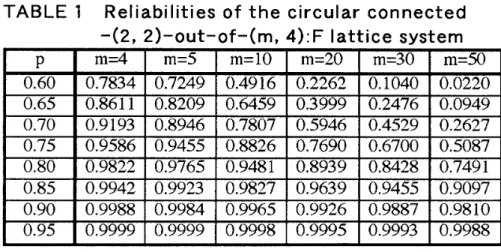
Table 1 includes the reliabilities of the circular connected-(2, 2)-out-of-(m, 4):F lattice system in the statistically independent and identically distributed case.
3.3 EVALUATION
In this section, we evaluate our algorithm as compared with the other methods. TABLE 1 Reliabilities of t h e circular connected
Circular (rn,n) - Lattice System 399
Firstly, we will obtain the order of the computing time for our algorithm. The order is given in the following. The cardinality of ^> does not exceed 2" . As the reliability of the linear consecutive-s-out-of-n:F system is computed in q n s ) time [6], the computing time for each Fi(s,n;6 ) is in q n 2 s ) . The reliability of the circular consecutive-s-out-of-n:F system is computed in Ofn2s) time [6]. The number of R( i ; hl, h,, , h. )'S is (r+ l)"(m+ l). Therefore, the system reliability can be computed in 0(r"n2sm) time by our algorithm.
We have compared our algorithm with the following two methods. One is the enumeration method, in which 2- states must be checked. Another is the ALW method that is a kind of the sum of disjoint products (SDP) methods. This method is available for the reliability of the general network system and was proposed by Abralzm [l], Locks [7] and Wilson [10]. If a
minimal-path set or a minimal-cut set is given, the ALW method gives the efficient algorithm for the system reliability by expressing it as the sum of probabilities of the exclusive events. It was Zuo[l l ] who proposed the ALW method was able to be used to compute the reliability of the linear ( circular ) connected-(r, S)-out-of-(m, n):F lattice S ys tem. We investigated the computing time for the circular connected-(r, S)-out-of-(m, n):F lattice system by the C language on a personal computer, NEC PC9801RA7 which is a i80386 machine. For the circular connected-(?, 2)-out-of-(4, 4):F lattice system, our algorithm took less than 1 second as compared with about 12 seconds for the ALW method and about 41 seconds for the enumeration method. For the circular connected-(2, 2)-out-of-(5, 4):F lattice system, the enumeration method took about 13 minutes and the ALW method could not obtain system reliability for lack of main memories. Our algorithm took less than 1 second. For the circular connected-(2, 2)-out-of-(50, 4):F lattice system, it is impossible for the enumeration method and the ALW method to obtain the system reliability on our machine. On the other hand, our algorithm took about 2 seconds.
4. UPPER & LOWER BOUNDS
As described in section 3, the order of our algorithm is polynomial for m but exponential for n. As n becomes larger, our algorithm needs much computing time. Therefore, in this section, we will propose the upper and lower bounds, which are easily obtained, for the reliability of the circular connected-(r, S)-out-of-(m, n):F lattice system. Before upper and lower bounds are given in Theorem 3, we define some notations.
i+r-1
W ; l - n q k j , f o r i = 1 , 2 , - * * , m - r + l a n d j = 1 , 2 , * * * , n
k - l
R( (r, S), (k, n); (1, n) ; [p,,] ) i+k-r n
;Pr
nn
Z 4 = 0 , a s a s a + r - l , b s p s b + s - l}'!,
, that is, the reliability of the{
a = icircular connected-(r, S)-out-of-(k, n):F lattice system, which consists of k circles from circle i to circle i+k - 1 on the system considered, for k = r, r+ 1, * , m - i+1 and i = 1,
f o r k l = r , r + l , * * * , m a n d k 2 = r , r + 1 , * * * , m, where . [ m l k ] UBl(k) =
r[
R((r,s),(k,n);((k - l)i+
l, n);[p,]) - 1 fork = r, r+1; * m,H, Yamamoto & M, Mjyaka wa
. . .
'(S, n;P(i-r+i),~ ,P(,-r+1).2 7 ,P(,-,+I), m- k + l L B ( ~ ) = 'rT~((r,s),(k,n);(i,n);[p,l), i -1 f o r k = r , r + l , * * * , m.For the proof of Theorem 3, we define the following events.
B( i ) :
{fi
{zip
= 0, b S fi S b+
S-
l} , that is, event that the circular wnsecuti~~e-S-out-of-b-1 c
I
n:F system functions, which is composed of circle i on the system considered, for i = 1, 2," * , m
i+k-r n
C ( i , k):
{
(l
Z4 = O , a a a s a + r - l , b s p s b + s - l}'1,
that is, event that the circulara=i b=l{
connected-(r, S)-out-of-(k, n):F lattice system functions, which is composed of k circles from circle i to circle i+k - l on the system considered, for k = r, r+ 1,
-
, m - i+ 1 and i = l , 2, * * * , m - r+lBy using the above notations, it follows from the discussions in Boehme, Kossow and
Preuss [2] that Pr{ A( r ) } = R( S, n; W,,, W,,, -, win ),
...
Pr{ C ( i - r+2, r ) } = R( S, n; r+2),17 . r+2),2, > .r+2),n ) and...
P r { B ( i - r + 1 ) } = R ( s , n ; p ( i - r + , ~ + l , P ( i - r + Ã £ 2 ,P(i-r+i),), f o r i = r + l , r + 2 , * * * , m-1.The relations among the events, A( i ), B ( i ) and C( i, r ) are given in Lemma 4.1. Lemma 4 . 1 .
Pr{ A( i+1 )'
I
A( i )} a Pr{ C ( i - r+2, r )'} Pr{ B( i - r + l )},for i = r, r + l , * 0 , m - 1.
Proof of Lemma 4.1 : The proof of Lemma4.1 is given in Appendix. Proof of Theorem 3:
(A) U B 2
From the same token for Fu's equation [5], it is shown that R(ir,sl,(m,n);[p^) =
PI-
{A(;')}fi
[l -PI-{
A(i + l)'l~f.i)}}i = r By Lemma 4.1, R((r, S), (m, n); [p,,
1)
S Pr { ~ ( r)}
fl
[l - h{ C(i - r + 2,r)'}~r{ - r + l)}] i = r ((i - l)k+
l , k)(l
C ([m/k]k+
l, m - [m/k]k) i= 1 m'k 1 = r [ ~ ( ( r , S), (k, n); ((i - l ) k + l , n ) ; [P,,])'
i = lCircular (m,n) - Lattice System 401
fork = r, r+1; U , m.
(C) LB(k) Note that
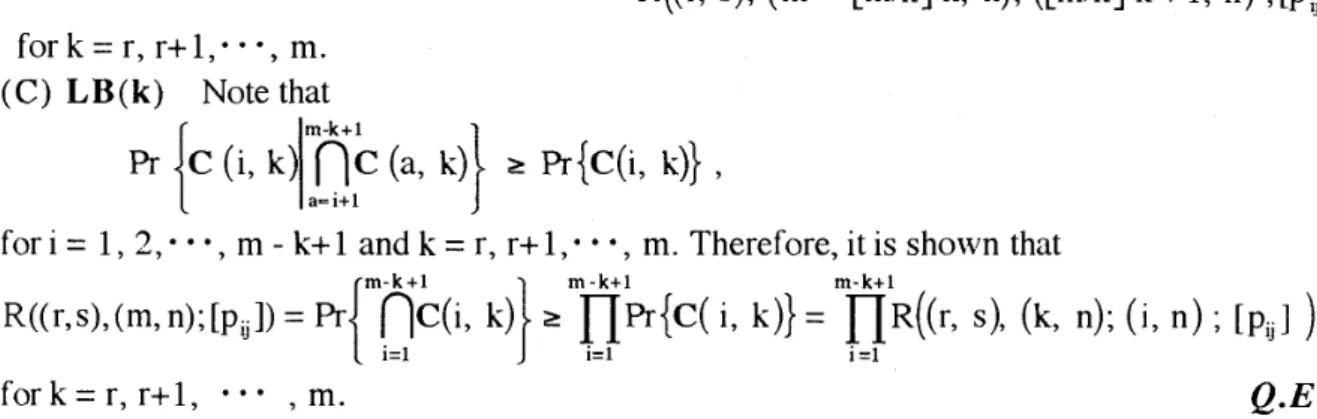
fori= 1, 2 , * * * , m - k+1 a n d k = r , r + 1 * * * m. Therefore,itis shown that
f o r k = r , r+1, * * * , m. Q . E . D .
If taking the small number as k, R( (r, S), (k, n); (i, n) ; [pi ), for i = l , 2, -, m - r+ l , can be given without much computing time by Theorem 1. The reliability of the circular consecutive-S-out-of-n:F system can be obtained in the polynomial computing time for n [6]. Therefore, UB l (k,), UB2 and LB(k) are obtained easily. If taking k, =r and k, =r, UB l(kl) and LB(k,) can be expressed by the reliabilities of some circular consecutive-S-out-of-n:F systems. Especially, in the statistically independent and identically distributed case, we can obtain Corollary
1 .
Corollary 1 .
In the statistically independent and identically distributed case, min { u B ~ , U B ~ } 2 R( (r, S), (m, n); 1 - q) a LB, where
UBI = R (S, n; 1 - q r f d r l
Proof: From Boehnze, Kossow cazd Preuss [2] and Theorem 3, it is obvious that Corollary 1
holds. Q . E . D .
Numerical results are shown in Table 2, where EXACT denotes the exact reliability obtained by our recursive algorithm in section 3. LB will give good approximations in all cases. I t is obtained that the values of UB 1 are not uniformly smaller than the values of UB2. UB2 tends to take the smaller value than UB 1 when the component reliability is high.
TABLE 2 T h e u p p e r and l o w e r bounds f o r r e l i a b i l i t y o f t h e c i r c u l a r connected-(2, 2)-out-of-(m, n):F l a t t i c e system
Table 2.1 m = 10, n = 1 0 T a b l e 2.2 m = 50. n = 10 LB 0.1289 0.2934 0.5087 0.7 170 0.8704 0.9564 0.99 1 1 0.9943 E X A C T 0.1682 0.3343 0.5380 0.73 16 0.8753 0.9574 0.99 12 0.9994
5 . LIMIT THEOREM
In this section, we study the reliability of the large circular connected-(r, S)-out-of-(m, n):F lattice system in the statistically independent and identically distributed case.
In this paper the limit theorem implies the following. For example, considering a series system consisted of n components, the system reliability
R
can be expressed as ( 1 - q,,)", where letting q be the failure probability of component as a function of n. Then when q n =h"',
Rnapproaches to l if T) > l , exp[-
L] if ? I = 1 and 0 if 11 < l as n becomes larger. By the result of the limit theorem, we can obtain an approximate value of the system reliability when n is large. The limit theorem for the linear consecutive-k-out-of-n:F system was given by Fu [5].The limit theorem for the linear connected-(r, S)-out-of-(m, n):F lattice system was given by Yaniamoto and Miyakawa [g]. But, the limit theorems for the circular case have not been given. The limit theorems are given in Lemma 5.1 for the circular consecutive-k-out-of-n:F system and in Theorem 4 for the circular connected-(r, S)-out-of-(m, n):F lattice system.
Lemma 5 . 1 .
Letqn = Ln' ,where L is a positive constant. Then, m ~ ( k , n; 1 - q n ) = lim (1 - qnk))" = exp
[-
P ]
.n + m n + m
Proof : The proof of Lemma 5.1 is given in Appendix. Theorem 4.
Let p,L and q be constant respectively.
If m p"-'
and q n = ~ ^ ' m , - a-
then lim R( (r, s), (m, n); 1 - q n ) = exp[-pLm]
n-m
where [i,L > 0, q > r.
Proof : It follows from the result of Lemma 5.1, r\ > r and the equation (5.2), that i m ~ ( s , n; 1 - q n ) = lirn R(S, n; 1 - q n r ) 1.
n+m n-m
As R( S, n; 1 - q r ) approaches to1 faster than R( S, n; 1 - q ) , it is shown that
,.
pq-'lim UB2 = lim
R
(S, n; 1 - q n)
. (by the equation (5.1) ) (5.4)n-m n 4 ~
Also, it follows that
r
lirn LB = lirn R (S, n; 1 - q n
)
.n-*m n e w
It is shown, by Lemma 5.1 and the equation (5.2), that
(by the equation (5.1) ) (5.5)
Therefore, from Corollary 1, the equations (5.4), (5.5) and (5.6), in the case of q > S ,
lim R ((r, S), (m, n); 1 - q n ) = exJ-fin]
n-*m
holds. Q . E . D .
By the result of theorem 4, w e can obtain exp[-qEmn] as an approximate value of the reliability of the large circular connected-(r, S)-out-of-(m, n):F lattice S ys tem, because the
rs
assumptions of theorem 4 imply that
I L L
= q mn .APPENDIX
A1 Proof of Lemmas A l . 1 Proof of Lemma 4 . 1
Circular (rn,n) - Lattice System
= P r p ( i + 1)'
IA
(i) ()B( i - r+
1) }R {B( i - r + l )IA
(i)},
for i = r, r+ 1, , m - 1. Furthermore, we can get~ r { A ( i + l ) ^ (1) n B (i - r + l ) } = &{C (i - r + 2 , r)'}, f o r i = r , r + l , , m - 1,and
R { B ( ~ - r + l ) IA(i)}a
PI-
{B (i - r + l ) } ,for i = r, r+ 1, , m - 1. Therefore,Lemma 4.1 has been proven. Q . E . D .
A1.2 Proof of Lemma 5.1
Let RL(k, n; 1 - q ) be the reliability of the linear consecutive-k-out-of-n:F system with an equal component failure probability q. Then, from Hwang [6],
~ ( k , n; 1 - q) =
E(
1 - q) 2 q - ~ ~ ( k , n - 2 - ( S + t); 1 - q ) .O s s + t < k
Therefore, as lim q = 0 , n+ CO
2
limR(k,n;l - q n ) = lim(1- q n ) ~ ~ ( k , n - 2;l- q n ) = exp[-^],
n+w n+w
by using the result of Fu's Theorem[5]. Q . E . D .
A2. How t o obtain
It is easy to see that, for 6 E $, 6 satisfies the following condition.
If 6, and = l , then 6,+, = * * * = 6 , + a =0, forj= 1 , 2 , * - 0 , n a n d a = l , 2 , - - 0 , S - 1
Considering the condition, we can get the recursive formula for .
To give <1> , we define L(s, k), for k = 0, 1, , n - 2, as a set of the k-dimensional binary vectors q
=
( ql , %,-
, %) as follows.q l i f qj = 1
and^,+^+^
= l, then qj+, = . - + = T}^, = 0,L(s,k) =
I,.,
forj = l, 2,-S-, k - a - l and a = l , 2 , - - - , S - l}, if k = l , 2,-v-, n-2, if k = 0,where { <t) } denotes the empty set.
L(s, k), for k=0, 1, , n - 2, can be obtained by the recursive formulas of k [g].
Let us assume that
4,
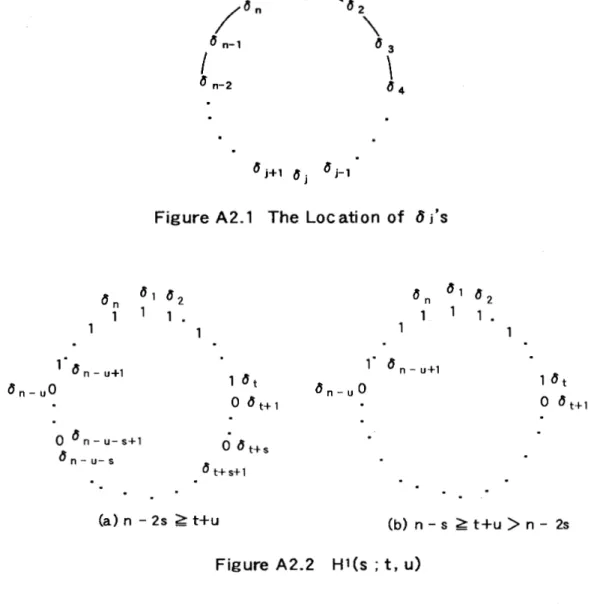
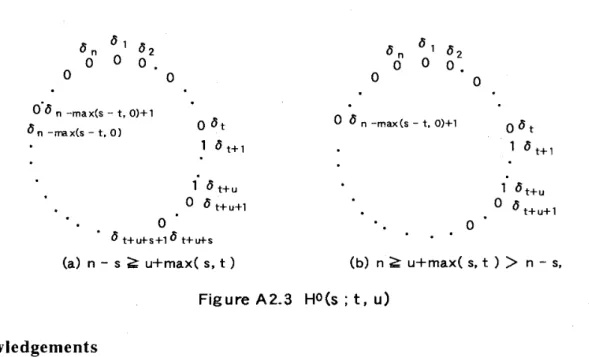
b2, , are located on a circle in a clockwise rotation as shown in Figure A2.1. We define two sets, H1(s ; t, U) for n - S 2 t+u, t 2 1 and u2O and HO(s ; t, U)for n 2 u+max( S, t ), t 2 1 and u 2 1 in the following.
H1(s ; t, U)
l
{616, =...
= 6, = 6n-u+1 =...
= 6,, = 1, 5 =.,.=
t +l = ¡n-u+l- = =q,-u
= 0, ('t+s+i,**+,'n-u-s ) E L ( S , I I - ( t + ~ ) - 2 ~ ) } , - - f o r n - 2 s s t + u ,4 04 H. Yamamoto & M. Mjyaka wa
where 6 ,
=
6,, for n - S 2 t+u,t a: 1andus:O. HO(s ; t, U) = S . . = n-max(s-t, o)+, bn = 0,)
<EL(S, n - S - U- max(s, t)} , E{
for n -S 2 U+
max(s, t),1
for n a u +max(s, t ) > n -S,where 6 ,
=
6,, forn 2 u+max(s, t ) , t 2 1 andu 2 1.As shown in Figure A2.2, H1(s ; t, U) implies a part set of { 6
1
6,=1, 6 E 4' except (0, 0, , 0) } and a set of the n-dimensional binary vectors, on whose circle, t and U respectively is the number of l's until the first 0 clockwise and counterclockwise from 6, and 6 respectively. As shown in Figure A2.3, HO(s ; t, U) implies a part set of { 6I
6, =0, 6 E <t> except ( 0 , 0 ,, 0) } and a set of the n-dimensional binary vectors, on whose circle, t is the number of 0's until the first 1 clockwise from 6 , and U is the number of l's until the first 0 clockwise from
h+,-
As HO(s ; t, U) and H1(s ; t, U) are disjoint, 4> can be expressed as
n- sn- S- t
/ -
\ t - l U-0
A3. How to obtain F,(s, n; 6 )
n
Itis easy tosee thatif 6=(1, l , * - - , l), Fi(s, n; lj)=nqr If 6 # ( l , l , - * * , l ) , the
j =l
closed formula for Fi(s, n; 6 ) is given in the following.
Without loss of generality, we assume that component (i, n) functions and the component (i, l), (i, 2),
-
, (i, S) fail. k(6) represents the cardinality of set <jI
6, = 1, for j = 1, 2, , n } and j(u; 6 ) is defined to be U-th element of the sequence, which is obtained byarranging elements of the set {J
I
6. = 1 } in ascending order in a line, for U = 1, 2, , k(6 ). That is, j( 1; 6 ) = 1, from the above assumption.We let i( U; 6 )
=
n+ 1, if U = k(6 )+ 1, for convenience'sake. Also, let Pi(u, 6 ) be the probability that components ( i, j(u; 6 )), ( i, j(u; 6 )+ 1 ),-
, ( i, j(u+ l ; 6 ) - 1 ) are in the states, which are necessary for the event {Yi = 8 } to occur, for U = 1 , 2 , , k(6 ).It is easy to see that Fi( S, n; 6 ) is obtained by equation (A3.1). k(6)
And Pi( U, 6 ) is obtained by the following equation (A3.2). F o r u = l , 2;-, k(6),
Circular (m,n) - Lattice System
(j(u
+
l;8) - j(u;6) = l)(j(u
+
i ; ~ ) - j ( ~ ; a ) = S + l)(A3.2) where, R&( S; U, v ; [ p 1 ) is defined to be the reliability of a linear consecutive-S-out-of-( v -
U+ 1):F S ys tem composed of components (i, U), (i, U+ l), , (i, v) on the system considered, for 1 s U, v s n, where RLi(s; U , v ; [pij])
-
l if U > v.Figure A2.1 The Location of 6 j's
H. Yamamoto & M. Miyaka wa
(a) n - S f i u+rnax( S , t ) (b) n 2 u+rnax( S, t )
>
n - S,Figure A2.3 HO(s ; t , U )
Acknowledgements
The authors thank the editor and referees for their comments. References:
[l] Abraham J. A. : An improved method for network reliability. IEEE Trails. Reliability, Vol. R- 28, (1979), 58-61.
[2] Boehme T. K., Kossow A. and Preuss W. : A Generalization of consecutive-k-out-of-n:F Systems. IEEE Trans. Reliability, Vol. 41, ( 1992), 45 1-457.
[3] Bollinger R. C. and Salvia A. A. : Consecutive-k-out-n:F networks. IEEE Trans. Reliability,
Vol. 39, (1990), 382-385.
[4] Derman C., Lieberman G, J. and Ross S. M. : On the consecutive-k-out-of-n:F sys tem. IEEE
Trans. Reliability, Vol. R-3 1 ( 1982), 57-63.
[S] Fu J. C. : On reliability of a large consecutive-k-out-of-n:F system. IEEE Trails. Reliability,
Vol. R-34 ( 1985), 127- 130.
[6] Hwang F. K.: Fast solutions for consecutive-k-out-of-n:F system. IEEE Trans. Reliability,
Vol. R-3 1 (1982), 447-448.
[7] Locks M. 0.: An minimizing algorithm for sum of disjoint products. IEEE Trms. Reliability,
Vol. R-36 (1987), 445-453.
[g] Yamamoto H. and Myakawa M. : Reliability of a linear connected-(r, S)-out-of- (m, n):F system, IEEE Trans. Reliability, Vol. 44 ( 1995), 333-336.
[9] Salvia A. A. and Lasher W. C.: 2-Dimensional consecutive-k-out-of-n:F models. IEEE Trcazs. Reliability, Vol. 39 (1990), 382-385.
[l01 Wilson J. M.: An improved minimizing algorithm for sum of disjoint products. IEEE Traizs.
Reliability, Vol. 39 (1990), 42-45.
[l11 Zuo M. J.: Reliability & design of 2-dimensional consecutive-k-out-of-n systems. IEEE
T r m . Reliability, Vol. 42 ( 1993), 488-490.
Hisashi YAMAMOTO : Masami MIY AKAWA :
Department of Management Engineering Department of Mathematical Engineering and Faculty of Science and Technology, Information Physics
Teikyo University of Science & Technology Graduate School of Engineering Uenohara, Y amanashi, 409-0 1, Japan University of Tokyo
E-mail: [email protected] p Hongo, Bunkyo-ku, Tokyo, 113, Japan