■ REPORT
Development of an educational program for
interprofessional collaboration:
A workshop approach involving undergraduates from
multiple departments
Yukako Setaka
1), Kazuhide Tomita
1), Toshiyuki Aoyama
1), Michiharu Sekimoto
2,3),
Yuichi Aita
2), Yukari Ohashi
1), Haruhiko Ninomiya
2)1) Department of Physical Therapy, Ibaraki Prefectural University of Health Sciences, 4669-2, Ami, Ibaraki 300-0394, Japan
Tel: 81-29-840-2176 Fax: 81-29-840-2276 E-mail: [email protected]
2) School of medical sciences, University of Tsukuba
3) Department of radiology technology, Niigata University of Health and Welfare
JAHS 10 (1): 10-18, 2019. Submitted Sep. 12, 2018. Accepted Dec. 26, 2018.
ABSTRACT:
[Purpose] We developed an educational program that encourages students from three departments −namely, Medical Technology, Radiology Science, and Physical Therapy− to learn collaboratively by working on a clinical case. The aim of this study was to evaluate whether this program was useful as an interprofessional education (IPE) program for physical therapy undergraduate students.
[Participants and Methods] One hundred and seventeen third-grade undergraduates enrolled in an undergraduate program, named “Biophysical Diagnosis Workshop”. We prepared tasks based on four clinical scenarios, whereby participants had to assess a patient’s biodata and clinical information to derive a diagnosis and then develop a treatment plan. The students had to confer with each other, exchange perspectives regarding their respective disciplines, and coordinate their opinions. After the workshop, we administered a questionnaire to 43 physical therapy students, seeking their subjective opinions about the usefulness of the workshop and their levels of satisfaction with the workshop.
[Results] Out of the physical therapy students that responded, 97.7% answered either “yes” or “yes, to some extent” when asked whether the workshop increased their interest in other medical professions, and 97.7% reported feeling either “satisfied” or “satisfied, to some extent” by the workshop.
[Conclusion] The program positively affects physical therapy students, and potentially improves their expertise in and understanding of interprofessional collaboration.
Japanese medical sector is under pressure to respond to several challenges, including an aged society, a change in disease structure, and an increase in chronic diseases. To solve these challenges, medical professionals must both develop their knowledge and skills as well as engage in interprofessional collaboration. The Ministry of Health, Labour and Welfare has defined team-based medical practice, or “team medical care,” as follows : “medical pro- fessionals from various medical sectors share goals and information among themselves according to their particular expertise, play their particular roles while backing each other up, and thereby provide medical care to suit the needs of patients”1). To promote team medical care, it is essential to enhance training in interprofessional collaboration beginning from the pre-licensure stage.
In 2014, Ibaraki Prefectural University of Health Sciences (IPU) started participating in CoMSEP (Coordinated, Continuing, Medical Staff Education Program), which falls under the “Problem-Solving Oriented Training Program for Advanced Medical Personnel” project by the Ministry of Education, Culture, Sports, Science, and Technology-Japan-. Also participating in CoMSEP is the University of Tsukuba, which, like IPU, trains medical technologists. One of the main programs of CoMSEP is an undergraduate program that promotes team care education. It also provides a certificate program for licensed medical workers, it aims to train medical professionals with excellent leadership skills. CoMSEP has prepared education content for both pre- and post-graduation courses.
Of these, the undergraduate program involves a collaborative exercise workshop called the “Biophysical Diagnosis Workshop,” which targets third-grade students from the School of Medical Sciences, University of Tsukuba, as well as from IPU’s Radiology Science and Physical Therapy departments. However,
teaching tools involving collaborative exercises for undergraduate students in the Depar- tments of Physical Therapy, Medical Tech- nology, or Radiology Science. Therefore, we developed a learning tool whereby the students from the three departments collaboratively tackle a clinical case. The aim of the present study is to evaluate the usefulness of this program as an IPE program for physical therapy students.
SUBJECTS AND METHOD
1. ParticipantsThe participants of this study were the aforementioned third-grade undergraduate students from the three departments that participated in the Biophysical Diagnosis Workshop held on January 17 and 20, 2017. Specifically, they included 37 medical technology students, 37 radiology science students, and 43 physical therapy students. There were 12 groups in total, and each group consisted of nine to ten students-at least three members from each of the three undergraduate departments.
2. Workshop and IPE Teaching Tool
The aim of the workshop is to have students experience the interprofessional collaboration process. In other words, the students are to fulfill their expert roles as members of a medical team, discuss with other members from different professions how to incorporate the patient’s biodata and information into diagnosis and treatment, understand one another’s professional perspectives, understand how important it is to work as a team and empower the people involved, and establish a care plan.
The workshop lasted two days. During the scenario tasks, the students had to interpret a patient’s biodata to derive a diagnosis and then work out how best to treat the patient. For this purpose, the students had to confer with each
other, exchanging the perspectives of their respective disciplines and finally coordinating their opinions. Instructors from different disciplines prepared the clinical scenarios so as to enable interprofessional collaboration. The clinical scenarios were as follows (see Table 1): 1) Reconstructive surgery is performed for an anterior cruciate ligament in the right knee in an attempt to enable the patient to resume sport activities; 2) A patient with cerebellar infarction experiences re-infarction during in-hospital care; 3) A patient experiences infarction in the right frontal cortex following cardiogenic shock and undergoes in-hospital care; and 4) A patient is admitted to hospital after heart failure, which becomes severe, and then undergoes cardiac rehabilitation in stages leading to an outpatient-based rehabilitation. Using the web-authoring tool “Homepage builder” (JustSystems Corporation), we developed digital material that linked these scenarios with biodata including image data. We gave the students USB memory sticks containing the digital material, and the students accessed the material via their PCs. They studied the cases by tracking the clinical test results over time, guided by a number of questions.
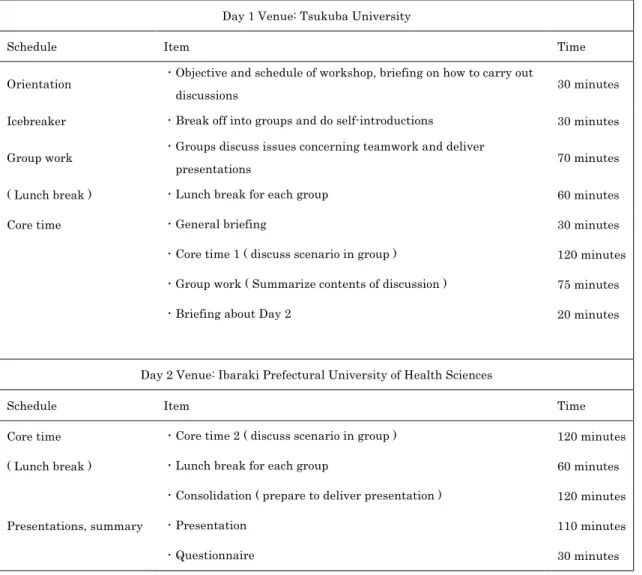
The workshop schedule is shown in Table 2. During orientation, students were advised to adopt a discussion approach that would ensure smooth interprofessional collaboration. During core time, each group assembled in the room allocated to them. “Core time” and group work sessions took place during both days of the workshop. We presented one clinical scenario to each group. Then, the students formed groups and examined the image and diagnostic data so as to derive the relevant diagnosis and the prognosis. Over the course of the program, the students were expected: 1) to understand the duty content and perspectives of medical professions; 2) to understand how important it is to engage in interprofessional collaboration and provide team medical care, and to
communicate the information with other team members; 3) to assume, should circumstances warrant, a lead role in the medical team and facilitate active discussions among the team members; and 4) to master the ability to care for the patient holistically, which goes beyond simply addressing the medical issues. After the presentations and Q&A sessions, the instructors—medical technologists, radiologists, and physical therapists—advised the students and presented summaries according to their particular expertise.
The instructors went from one room to another to inspect the students’ progress, but they refrained from intervening in their discussions. If something was unclear during core time, they were permitted to access textual materials, which the librarians and instructors from each university had prepared beforehand. 3. Feedback Questionnaire
Once the workshop was over, we conducted a questionnaire survey among the 43 physical therapy students, seeking their subjective opinions about the usefulness of the workshop and to find out whether they were satisfied with it. We had obtained the oral consent of these students regarding this questionnaire survey. The items of this survey were only questions on the scenarios and workshop not to give disadvantages to the students. The survey was unsigned so that the students could not be personally identified. It took only a few minutes to answer all questions to minimize the time disadvantages for the students. Furthermore, the teacher in other university conducted this survey and corporation to the survey was voluntary. Under these conditions, we had obtained the oral consent of these students regarding this questionnaire survey. In accordance with the analysis protocol, the research representative encoded the data from each student to ensure that the students could not be personally identified.
Table 2. Workshop Schedule
Day 1 Venue: Tsukuba University
Schedule Item Time
Orientation ・Objective and schedule of workshop, briefing on how to carry out
discussions 30 minutes
Icebreaker ・Break off into groups and do self-introductions 30 minutes Group work ・Groups discuss issues concerning teamwork and deliver
presentations 70 minutes
( Lunch break ) ・Lunch break for each group 60 minutes
Core time ・General briefing 30 minutes
・Core time 1 ( discuss scenario in group ) 120 minutes ・Group work ( Summarize contents of discussion ) 75 minutes
・Briefing about Day 2 20 minutes
Day 2 Venue: Ibaraki Prefectural University of Health Sciences
Schedule Item Time
Core time ・Core time 2 ( discuss scenario in group ) 120 minutes
( Lunch break ) ・Lunch break for each group 60 minutes
・Consolidation ( prepare to deliver presentation ) 120 minutes
Presentations, summary ・Presentation 110 minutes
Table 3. Questionnaire results for results for physical therapy department's students
Question items Number of people ( % )
1. What did you think about program's length? Too short 0 ( 0.0 )
A little short 19 ( 44.2 )
A little long 23 ( 53.5 )
Too long 1 ( 2.3 )
2. Did the group work and core time increase
your interest in other fields of work ? Yes 15 ( 34.9 )
Yes, to some extent 27 ( 62.8 )
Not very much 1 ( 2.3 )
No 0 ( 0.0 )
3. What did you think about the difficulty level
of the group work and core time sessions ? It was quite difficult 3 ( 7.0 ) It was somewhat difficult 30 ( 69.8 )
It was quite easy 10 ( 23.3 )
It was very easy 0 ( 0.0 )
4. How valuable do you think this class will be
with respect to your future ? It will be very valuable 17 ( 39.5 ) It will be valuable to some extent 22 ( 51.2 )
Cannot say either way 4 ( 9.3 )
It will be not very valuable 0 ( 0.0 ) It will be not valuable at all 0 ( 0.0 ) 5. How satisfied were you with the Biophysical
Diagnosis Workshop overall ? I was satisfied 20 ( 46.5 ) I was satisfied to some extent 22 ( 51.2 ) I was not very satisfied 1 ( 2.3 )
RESULTS
All 43 of the physical therapy students responded to the questionnaire, resulting in a response rate of 100%. The questionnaire results are shown in Table 3. Question 1, “What did you think about the program’s length?” elicited a mixed response: 19 answered “A little short,” while 23 answered “A little long.” In response to question 2, “Did the group work and core time increase your interest in other medical fields?” over 97% of the respondents answered either “Yes” or “Yes, to some extent.” In response to question 3, “What did you think about the difficulty level of the group work and core time sessions?” the majority of the respondents, over 65%, answered “It was quite difficult.” In response to question 4, “How valuable do you think this class will be for your future?” over 90% of the respondents answered either “It will be very valuable” or “It will be valuable to some extent.” As for the final question, E, which read “How satisfied were you with the Biophysical Diagnosis Workshop overall?” over 95% of the respondents either answered “I was satisfied” or answered “I was satisfied to some extent.”
From the descriptive answer data, we extracted many comments conveying a high level of satisfaction with the workshop. Of particular note are the following pieces of feedback and opinions from students in the physical therapy department: “I felt that learning about medical disciplines other than one’s own will result in better healthcare provision, and I now want to work from broader perspectives in the future”; “Being taught by other students about content I was unfamiliar with was a novel and beneficial experience”; and “The data was such that the members could each offer opinions and play roles according to their discipline”. Regarding the unfamiliar content in other fields, there were lively Q&A sessions; furthermore, the explanations and answers from members in the other fields were very easy to understand,
leading to a deeper understanding of each other’s field. By working on the same case from different perspectives, including those of disciplines that one is unfamiliar with, I realized anew how important it is to examine cases from multiple perspectives.”
DISCUSSION
Sioban et al.2) found that interprofessional team training initiatives are effective in improving team knowledge, and communi- cation skills. There are also several reports concerning IPE experiences involving physical therapy students. Sytsma et al. 3) reported on IPE experiences consisting of collaborative exercises related to gross anatomy education. These exercises featured peer-teaching and innovative learning technology. Additionally, Thompson et al.4) evaluated an IPE experience involving students in 13 different professions, including medicine, dentistry, and pharmacy. We, on the other hand, developed a new kind of IPE experience, the Biophysical Diagnosis Workshop, involving students aspiring to be medical technologists, physical therapists, or radiology technicians. Furthermore, in designing the digital learning tools, we incorporated a rich array of biophysical data, including medical test data, physiological data, and image data, and we devised tasks that required students to draw up a plan that would inform rehabilitation. In this way, we aimed to create a process in which students from different disciplines would have to confer with each other, as in clinical conferences, about the Biophysical data and other diagnostic information. According to the results of the feedback survey, over 95% of the physical therapy students answered either “yes” or “yes, to some extent” when asked whether the workshop increased their interest in other medical fields. Moreover, over 90% reported feeling either satisfied or satisfied to some extent with the workshop. These results
suggest that despite the short length of the workshop, the IPE experience was effective to some extent.
We received various opinion concerning the length of the workshop, with some students feeling it was a little short and others feeling it was a little long. This result might be attributable to the fact that the difficulty level varied between scenarios. As we amass further scenarios in the future, we will need to modify the tasks to ensure a consistent difficulty level. Alternatively, groups that complete a task relatively early could be presented with a different scenario, and to this end, we will need to adjust the volume of tasks so that students can use their core time fully.
In physical therapy practice, it is essential that physical therapists work with nurses and other rehabilitation specialists. However, by collaboratively engaging in their tasks with students in the Medical Science (Clinical Lab) and Radiology Science departments, we believe that the physical therapy students were able to evaluate the image and bio/clinical data in such a way that they gained new perspectives and
an enhanced understanding of
interprofessional collaboration. Additionally, they were able to accurately discuss the treatment and rehabilitation approach that followed the evaluation.
Since the workshop involves two universities and three departments, we must consider how we can adjust the schedule to accommodate curricular differences between the three departments. We will therefore develop a structure that allows smooth implementation. To verify the workshop’s educational efficacy, we will need to evaluate the workshop using
scales such as the Readiness for
Interprofessional Learning Scale (RIPLS)5-6) and the Interdisciplinary Education Perception Scale (IEPS)7).
ACKNOWLEDGMENTS AND CONFLICT OF INTEREST
This educational program was carried out with the support of "the Problem-Solving Oriented Training Program for Advanced Medical Personnel" from the Ministry of Education, Culture, Sports, Science and Technology.
All authors have declared that there are no additional relationships or activities that may appear to have influenced the submitted work
REFERENCES
1) Ministry of Health, Labour and Welfare. About promotion of the team medical treatment.
http://www.mhlw.go.jp/shingi/2010/03/dl/s 0319-8b.pdf, (Accessed Feb.1, 2018)
2) Nelson S, White CW, Hodges BD, et al: Interprofessional Team Training at the Prelicensure Level: A review of the Literature. Academic Medicine 92: 709-716, 2017.
3) Sytsma TT, Haller EP, Youdas JW, et al.: Long-term effect of a short
interprofessional education interaction between medical and physical therapy students. Anat Sci Educ 8: 317-323, 2015.
4) Thompson BM, Bratzler DW, Fisher MJ, et al.: Working together: Using a unique approach to evaluate an interactive and clinic-based longitudinal interprofessional education experience with 13 professions. J Interprof Care 30: 754-761, 2016.
5) Parsell G, Bligh J.: The development of a questionnaire to assess the readiness of health care students for interprofessional learning (RIPLS). Medical Education 33: 95-100, 1999.
6) Tamura Y, Seki K, Usami M, et al.: Cultural adaptation and validating a Japanese version of the readiness for interprofessional learning (RIPLS).
Journal of interprofessional care 26: 56-63, 2012.
7) Luecht RM, Madsen MK, Taugher MP, et al.: Assessing professional perceptions: design and validation of an
Interdisciplinary Education Perception Scale. J Allied Health 19: 181-191, 1990.