
1940年代後半から1990年代における日本の大企業男性正社員の賃金制度
10
0
0
全文
(2) 原 田 順 子. 70 ❖ Monthly salary. Scheduled cash earnings. Base pay & Allowances. Unscheduled cash earnings(e.g. overtime pay) ❖ Bonuses(normally biannual) ❖ Payment on quitting ❖ Fringe benefits. Figure 1 Compensation for standard employees. In fact, typical Japanese wages consist of both merit and seniority. Therefore, there is the matter of balance between merit and seniority in wage determination. Sano(1993)and Ohashi and Teruyama(1998) argued that seniority is the principal rule in wage determination, and the argument of Endo(1994)emphasised the importance of merit. Which view is more common among Japanese large firms? To answer this question, it is necessary to analyse both the basic pay concept and how it changes over time, namely, the rule of promotion. Moreover, it is important to pay attention to whether the rules of wages and promotion vary by career stage. According to the Japanese Ministry of Labour, Japan(1998), wage variances within the same age cohort steadily rise with age. The older the cohort, the larger the wage variances are. The Japanese Trade Union Confederation also surveyed wage differentials for each age cohort among 20,761 workers of 1,057 member unions2 in 1998(Nihon keizai shinbun, 1999) . Suppose the average wage is 100, the highest wage is 109.4 and the lowest wage is 92.0 at 30 years old, and the differential between the top and the bottom is 17.4% . However, this differential increases to 25% at 40 years old3 (the highest wage being 113.9 and the lowest is 88.9). These survey results are plausible because organisations normally have a pyramid shape and everybody cannot advance at the same speed by an equal amount for ever. Although the average age-wage profiles show upward slopes, clearly seniority cannot be the only principle to determine the speed and amount of promotion and of increments in wages. Every firm has its own personnel system. Nevertheless, there should be certain wage and promotion patterns, which are shared by the majority of firms in Japan. The next section will discuss what leads to the relatively steep upward sloping age-wage profiles of male standard employees in Japanese large firms from the aspect of wages.. 2.Pay system concept 2.1 Types of pay In general, all standard employees are remunerated with monthly salary, bonuses(normally biannual) , payment on quitting, and fringe benefits as Figure 1 shows. The monthly salary system(gekkyu-sei)is widely used in Japan and applies to 89.7% of standard employees including blue-collar workers(Ministry of Labour, Japan, 1996). The history of the monthly salary system is relatively long and it has been applied to both white-collar and blue-collar workers since the 1960s(Futamura, 1997). Blue-collar workers used to be paid wages, but single status was achieved due to labour disputes in the post-war period. In Japan, the monthly salary is used as the basic unit for job advertisement, pay negotiations and so on. Annual salary is rarely the matter of negotiations, even for white-collar workers, because it varies according to bonuses which vary by profits and the results of personal assessment. Monthly salary is the most common pay method for all types of standard employees. It is particularly common among large firms4 and applies to 96.5% of them. Annual income is the total of 12 monthly salaries and bonuses. Thus, in this paper we ignore the other payment methods(e.g. hourly wages, daily wages or Japanese-style annual salary(nenpo5) ), and focus on monthly salary. Monthly salary consists of base pay and miscellaneous allowances. There are two types of allowances which are related to life(e.g. allowances for dependents and housing allowances)and job(e.g. overtime pay, sales allowances and special-job allowances) . The proportion of base pay averaged 93% of monthly pay in the late 1990s(Roumu Gyousei Kenkyusho, 1998a6) . Therefore, it is most important to analyse. Since enterprise unionism is common in Japan, the number of member unions equals the number of firms surveyed. At 35 years old, the highest wage is 110.6 and the lowest is 90.7. 4 The definition is firms with 1,000 employees or more. 5 This is a kind of performance-related-pay with a very large part consisting of consolidated pay. It is applied mainly to managers, but only a few firms(1.1 % of firms)have introduced it(Ministry of Labour, Japan, 1996). 2 3 .
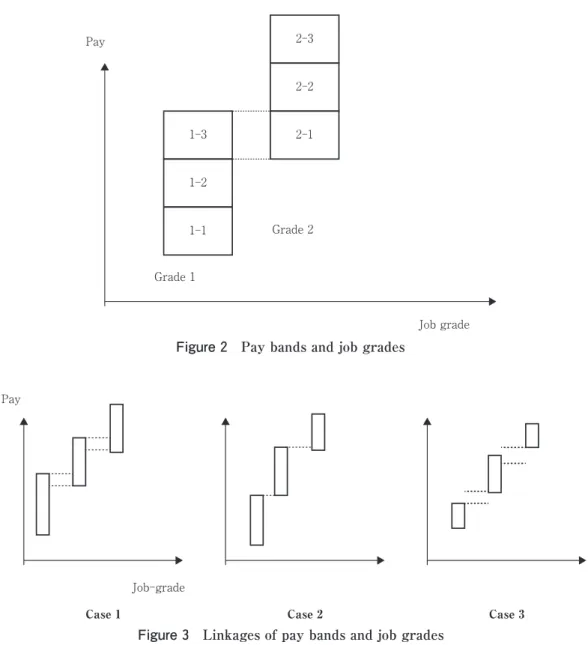
(3) 1940 年代後半から 1990 年代における日本の大企業男性正社員の賃金制度. 71. 2-3. Pay. 2-2. 1-3. 2-1. 1-2. 1-1. Grade 2. Grade 1. Job grade. Figure 2 Pay bands and job grades Pay. Job-grade Case 2. Case 1. Case 3. Figure 3 Linkages of pay bands and job grades how base pay is determined and how it changes over time in oneʼs career, in order to understand the pay system in Japan. 2.2 Job-grading system The job-grading system is central to the pay structure and influences not only base pay, but also bonuses and payment on quitting. In general, firms have job grades, which are linked with pay bands. Figure 2 shows an example of job grades. Grades 1 and 2 consist of ladders with three steps each, 1-1 to 1-3 and 2-1 to 2-3, respectively. In this example, Grade 1-3 and Grade 2-1 overlap and thus their pay is equal. The number of pay bands and job grades totally depends on firms. Moreover, they can differ by job track within the same firm. 6 . Every firm has its own pay structure in Japan, but in terms of linkage between job grades and pay there are three patterns(Figure 3) . In Case 1, job grades overlap in terms of pay scale. Due to the overlapping, the top of the ladder of a low grade means a higher salary than the bottom of the ladder of a high grade. This is the most popular pattern and in 1998 applied to 79% of upper managers, 66% of lower managers and 72% of staff in major firms(Table 1). In contrast, Cases 2 and 3 do not have overlapping pay bands. These pay structures are less popular in Japanese firms. In particular, their proportions are low among upper managers. When an employee starts to work, his/her initial job grade and pay band within the grade is determined by the job track, which the person intends to follow, and. This is the result of a statistical survey which was carried out in 1997 over 256 listed companies and 200 small and medium sized firms with 100 employees or more..
(4) 原 田 順 子. 72. Table 1 Proportions of three cases by job group Upper managers Lower managers Staff. Case 1. Case 2. Case 3. 79.1% 65.5 70.5 . 2.3% 5.2 4.9 . 18.6% 29.3 26.2 . Source: Roumu Gyousei Kenkyusho(1998a), p196. by school career. For example, somebody may start from 1-1 while another starts from 2-2 in Figure 2. In large Japanese firms, it is normal that most employees are taken directly from schools and universities. Therefore, they know their peer group who join the firm in the same year: have the same school career: and are in the same job grade. In this kind of peer group, all are placed at the same grade and receive the same salary at the start of their career. The status of their school and university is not reflected in job grade nor pay. This equal treatment continues for a number of years, and creates the notion of a peer group with which people are compared and evaluated. Aoki(1988)claimed that the job grades of Hitachi(a large electric/electronics manufacturer)show status which links with pay, but not functional demarcation. In general, grades “loosely” link with post, rather than “certainly” linking, and people in the same grade may have different posts(Storey et. al., 1997) . The Japanese Electrical Electronic and Information Union(Denki Rengo) (1993)argued that an ideal grading system should be accompanied by objective and practical statements, and each grade must be determined with job demarcation and individual abilities (i.e. whether a person gets used to the job, how much s/he has knowledge and skills for the job, how long s/ he has carried out the job) . However, due to the difficulties in job evaluation and the lack of stipulated job demarcation in Japan(see for example, Aoki, 1988), it is typical that individual abilities, which are difficult to evaluate objectively, are involved. This, and the loose connection with post, enables regular promotion for the majority of employees. Even if there is no vacant post, it is possible to promote employees to higher grades according to circumstances(Kumazawa 1997; Storey et. al., 1997) . The job-grading system is termed job-ability-grading system(shokunou shikaku seido)and is shared by the great majority of Japanese firms today. The system was introduced between 1965 and 1975(Kumazawa, 1997) . How were the characteristics of job-ability-grading system created in Japan? To answer this question, it is necessary to trace the history of pay systems in post-war Japan.. 3.History of wage systems As described above, the job-ability-grading system takes into account not only jobs, but also ability. The reason for emphasising ability in its name is that this was rather neglected before, though it was not totally ignored. In Japan, there are two basic concepts of pay: job-related wages and person-related wages. Job-related wages are paid for the value of work or ability; person-related wages are paid for a personʼs needs to survive. Due to poor living standards just after the Second World War, person-related wages became a principal factor in pay determination. The characteristics of job-ability-grading system was created later. In 1946, the Japan Federation of Electricity Unions obtained a pay system which was based on standard living expenses. This is well-known as the Electricity-Unions-Style pay(d e n s a n g a t a c h i n g i n or Densan system) , and subsequently it spread widely. The Densan system consisted of base pay(standard living expenses, ability pay with personal assessment and length of service pay)and regional allowances. According to Magota(1997), standard living expenses were the most important element and comprised 67% of base pay. In addition, there was length of service pay(5%)and regional allowances(8%). The regional allowances were city allowances to adjust for the high living cost in large cities and winter allowances to meet extra utility costs in cold regions. As a result, base pay was composed of: 80% forward personal needs and 20% for ability. It is notable that even at this time there was already ability-related pay with personal assessment, though the proportion was small. The standard living expenses were based on the minimum necessity of the energy value of food measured in calories. This basis was convincing in the late 1940s when starvation was serious, and management accepted the proposal(Magota, 1997). First, a manʼs necessary calories for a day was assumed to be 1584 kcal, which was the average calorific intake in 1946. Secondly, the cash value of a basket of food, which equalled 1584 kcal, was estimated. It was divided by 0.7(70%), as it was supposed that Engelʼs coefficient (the proportion of food in total living expenses)was 70% . The sum was then multiplied by the number of dependants. Since the number of dependants tends to increase with age, standard living expenses, which comprised the largest proportion of base pay, also tended to rise with age. In addition, length of service was taken into account, also closely related to age. It is noteworthy.
(5) 1940 年代後半から 1990 年代における日本の大企業男性正社員の賃金制度. that the most influential factor in pay determination was the consideration of life, and not seniority(length of service). Upward sloping age-wage profiles were not originally based on consideration of the rights of seniority. The Densan pay system included a number of person-related wage elements, such as minimum calories in a day, the number of dependants, length of service, the standard of prices and climate of regions. The philosophy that wages should fulfil the minimum needs of life still remains in Japanese firms, though its weight in base pay has dramatically decreased in the 1990s. Therefore, when a pay system has been modified in Japan, it has been a central issue of discussion as to how to balance personal needs and contribution to a job. Firms have attempted to establish “modern” systems of job grading, job evaluation and personal assessment since around 1950(Oyamada et. al., 1997). After the chaotic post-war period, firms needed to re-organise human resource management. Wage differentials were minimised in the late 1940s, and management wanted to enlarge them in order to motivate workers. In the job-grading system of the 1950s, initial job grades were determined by school career, and the speed of promotion was affected mainly by school career, age, length of service and length of experience in the job. These factors have been retained until the 1990s to some degree, but in the 1950s their influence was much stronger. As a result, the linkage of age and job grade was much closer than in the 1990s. The Densan pay system gradually decreased its influence. Because the economy steadily improved, the necessity to determine pay in relation to calories required came to be irrational. Accordingly, the contradictions of the system were criticised. Why should a young supervisor receive a lower salary than an old subordinate with many children? In addition, electricity companies merged and the electricity industry unionsʼ federation was dismantled, thereby weakening unions(Magota, 1997) . The management considered that Densan pay was meaningful with a high inflation rate, but it harmed work motivation in normal situations because wages automatically increased (Oyamada et al., 1997). In the 1950s, some innovative firms started to try a job wage(shokumukyu) , determined by American style job evaluation schemes(Oyamada et. al., 1997), and the Japan Federation of Employersʼ Associations (Nihon keizai dantai renmei)also promoted this. In theory, the job wage does not increase without promotion, and automatic pay increases by age cannot be expected. Due to the tradition of the pay system since. 73. 1946, however, it was particularly shocking for workers and unions who were used to automatic pay increases, and they opposed job wages(Kumazawa 1997; Iwasaki 1997). However, management overcame the opposition and introduced the job wage by modifying it. The President of Jujoseishi(a large manufacturer of paper-related products)stated that the job wage was useful to stimulate work motivation, but automatic pay increases should remain to some degree in order to successfully implement the job wage (Oyamada et. al., 1997). In the case of Tokyo Electricity, the job wage was introduced in 1955, and 80% (rather than 100%)of base pay consisted of job wage (Oyamada et. al., 1997). The proportion of job wage in base pay depended on firms. The timing of its implementation also relied on firms(in the 1950s and 1960s). For instance, firms in electric and iron industries introduced it in the mid 1960s(Iwasaki, 1997). It was an important issue especially in the early 1960s (Oyamada et. al., 1997). The management attempted to modernise pay systems and aimed to give more importance to contribution to job(Iwasaki, 1997). But, ultimately, the job wage was not consolidated in Japan. Iwasaki(1997)argued that there were four main problems with the job wage. First, job wages created problems with the frequent job rotation/changes which were required in the 1960s due to rapid economic growth. It was often necessary to rotate people into jobs with lower wages, and nobody was happy with the rotation. It was, however, difficult to arrange it so that wages would always rise. Therefore, there was a practical difficulty in terms of job rotation. Secondly, a job wage requires job evaluation, but job demarcation has generally been ambiguous in Japanese firms. Next, a job wage requires a market survey of comparative wage rates to be taken into consideration, but such surveys did not exist in Japan. Lastly, a job wage has the principle of a rate for a job, and a contingent element, which used to be seen as a motivator, was not included in the wage. Due to these problems, job wages did not root in Japan. As a result, management was concerned that job wages would not be the best way to stimulate work motivation, although they considered that the job wage was better than Densan pay. Consequently, the job wage was modified by adding automatic pay increases and it thereby lost its essential principle, a rate for a job (Kumazawa, 1997). The term(job wage)still remains in some Japanese firms, but it is different from its original meaning. For instance, the job wage at Hitachi is a disguised evaluation of personal attributes due to fluid and ambiguous job demarcation(Aoki,.
(6) 74. 原 田 順 子. 1988) . In almost the same period, other types of pay system were also introduced to Japanese firms, including shokunou shikaku seido(job-ability-grading system)and regular merit increase(this will be discussed later)which were the most important. Some firms implemented job wages; others introduced shokunou shikaku seido(or tried both) . The grading systems of shokunou shikaku seido are based on shoku(job)and nou(ability) . The former means job difficulty which is assessed by experience and responsibility required; the latter means the qualification and ability of the person who is in charge of the job. The job grading is the combination of both, and therefore the same job can be assigned to people with different qualifications or in different grades. As described in the previous section, in general, grades “loosely” link with post, rather than “certainly” linking, and people in the same grade might have different posts(Storey et. al., 1997) . Suppose that junior managersʼ posts are assigned to people with Grade 5(a lower grade)or 6 (a higher grade)and there are 10 posts. Under the job-ability grading system, there could be junior managers on Grade 5 and non-managers on Grade 6. Also, this loose connection between grades and posts enables a firm to provide many employees automatic promotion in relation to length of service and age by assuming that ability increases accordingly. If grades link rigorously with posts, promotion is undertaken only when there is a vacant post. Therefore, it is impossible to promote more than 10 people to Grades 5 and 6. In contrast, with job-ability grading system, it is possible to have 15 people on these grades. Since there are 10 posts only, 5 people are not titled junior managers. Yet, their pay is based on job grade, and they do not suffer any financial disadvantages. Automatic promotion can be carried out without considering the limited number of posts. However, in so far as firms are pyramid shaped organisations, this rule cannot apply to all employees including executives. Thus, this rule does not apply to upper grades. It is argued that automatic promotion reflects continuing concern with increasing living expenses with age(Ministry of Labour, Japan, 1999) . It is, however, unnecessary to consider this point for those in the top grades, because their salaries are supposed to be considerably higher than minimum living expenses. Thus, they can survive without automatic promotion. In conclusion, the characteristics of the job-abilitygrading system were created in revising Densan pay to give more importance to merit. When Densan pay lost its rationale, firms attempted to implement job wages. However, this did not suit Japanese firms with. frequent job rotation, ambiguous job demarcation and no market surveys of jobs. In addition, unions missed the automatic pay increase in Densan pay; management was also concerned about the lack of a contingent part in job wages. As a result, the job wage was abandoned or modified greatly until it lost its nature. Instead, the job-ability-grading system(shokunou shikaku seido)was introduced to many firms. Between 1965 and 1975, the system came to be popular (Kumazawa, 1997)and it became the major pay system in Japan by 1970(Ministry of Labour, Japan, 1999a). Under the job-ability-grading system, job grades connect loosely to posts, and this was suitable for frequent job rotation and ambiguous job demarcation. This attribute resulted in the use of personal assessment which focuses on individual abilities, which are difficult to evaluate objectively, and the assessment often leads to automatic pay increases to many employees. Automatic promotion(or pay increase) was possible due to the loose connection between job grade and post.. 4.External reasons for upward sloping agewage profiles As described above, upward sloping age-wage profiles were historically created in the postwar period of Japan. As a result, the concept of person-related wages and allowances widespread in wage formulae in Japanese firms. Employees advance by age or length of service to some degree. These personnel practices pose a question as to whether external powers contribute to retaining the practices still today. This section will discuss how external powers, namely, government, unions and management, influence firms toward keeping the upward sloping age-wage profiles. 4.1 Government In Japan, government is not directly involved in shaping the age-wage profiles of private firms. The main governmental regulation of wages concerns a minimum wage by region and by industry. Wages are generally determined between unions and management, but the proportion of unionisation is particularly low in small and medium sized firms in Japan. Because the employees of these firms are relatively weak, the minimum wage has a significant role(Japanese Electrical Electronic and Information Unions, 1993). The minimum wage has an indirect effect in determining the bottom of the wage ladder for large firms, but it does not influence the relationship between wages and age at all..
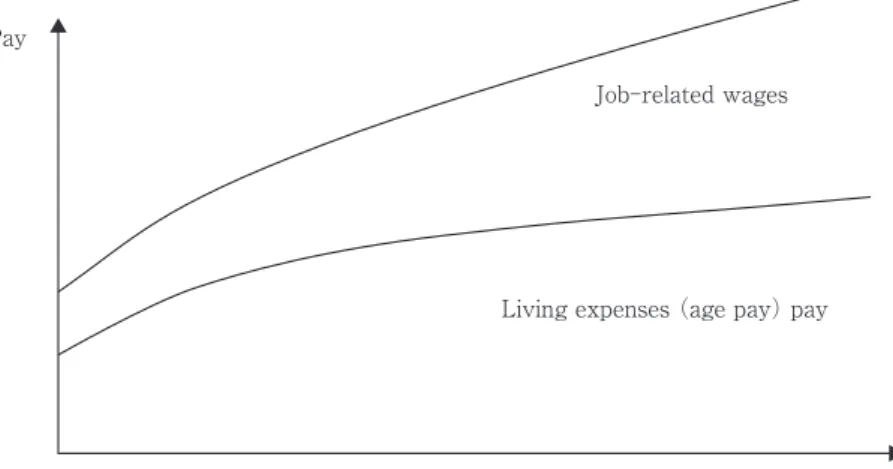
(7) 1940 年代後半から 1990 年代における日本の大企業男性正社員の賃金制度. 75. Pay Job-related wages. Living expenses(age pay)pay. Age. Figure 6 Ideal age-wage profiles of JEIU. Source:The Japanese Electrical Electronic and Information Unions(1993) , p9. However, the legal framework in Japan may have a more direct bearing. Most theories of upward sloping age-wage profiles emphasise their relationship with long tenure. As argued in the human capital theory, shirking theory and implicit contract theories, pay structures closely relate to length of tenure. Thus, if government affects length of tenure, it may have an indirect influence on upward sloping age-wage profiles. Koshiro(1997)argued that “life-time employment”(the custom of long tenure)is legally supported in Japan. Under Japanese law, it is prohibited to have a labour contract beyond a year, and firms have the freedom of dismissal. However, cases that have come to court have created a social norm that firms must avoid dismissing particular persons if they possibly can. If firms must dismiss, it has become common to pay top up cash on quitting and to help those dismissed find the next job. Large scale dismissals in depressed industries are also regulated by government. In so far as government or the law has these positive influences on long tenure, there is an indirect relationship between government and upward sloping agewage profiles. 4.2 Unions Most unions have a policy that wages must meet minimum living expenses, which increase with age. Thus, unions have generally pushed management to maintain upward sloping age-wage profiles. For instance, International Metalworkersʼ Federation-Japan Council(1997)states that a typical Japanese wage is composed of age pay to sustain family life and shokunou kyu(job-grade pay)for the value of labour. The former aims to establish stable lives and the latter is to stimulate work motivation. It is argued that the total of age pay, person-related wages and al-. lowances must exceed average living expenses, as determined by the survey of the Ministry of Labour(International Metalworkersʼ Federation-Japan Council, 1997). Because the number of dependants and necessary expenses increase with age, these unions effectively require upward sloping age-wage profiles. More explicitly, the Japanese Electrical Electronic and Information Unions(1993), a member of International Metalworkersʼ Federation-Japan Council, has had a family wage principle since 1967. It has claimed that minimum living expenses which can sustain a typical family must be guaranteed, regardless of the type of firm or job. Figure 6 shows the Japanese Electrical Electronic and Information Unionsʼ concept of how monthly pay should be. As Figure 6 shows, monthly pay is composed of job-related wages and person-related wages(living expenses pay). Both types of pay increase with age, but the proportion of person-related wages decreases gradually. Instead, the proportion of job-related wages increases with age. However, the Japanese Electrical Electronic and Information Unions(1998)argued that pay increases in job-related wages are also necessary to support rising living expenses with age, and that job skills must be increased with age. Consequently, upward sloping age-wage profiles are an essential demand from these unions. These unions attempt to maintain a certain amount of guaranteed pay increase in both person-related wages and job-related wages. It is however noteworthy that the effectiveness of this demand varies by industry. For example, the Japanese Electrical Electronic and Information Unions(1993)suggested in its 4th wage policy that the ideal proportions of job-related wages and person-related wages are 60% and 40% , respectively, at 35 years old. However, this was only a suggestion and.
(8) 76. 原 田 順 子. was ignored by some firms. For instance, Fujitsu(a member of the Japanese Electrical Electronic and Information Unions)abandoned person-related wages in 1998(Nihon keizai shinbun, 1998a) . Hitachi(a member of the Japanese Electrical Electronic and Information Unions)took an initiative to reduce the proportion of person-related wages from 60 % to 40 % from 1998 to 2001(Nihon keizai shinbun, 1998b) . In contrast, the Japan Federation of Steel Workersʼ Unions is more influential on its member firms. The author interviewed personnel officers from ABCD Steel(the real name is disguised) , a large steel and iron company, in 1998. According to the interview, all the major firms which belong to the Japan Federation of Steel Workersʼ Unions(i.e. Kawasaki Steel, NKK, Shinnittetsu and Sumitomo Kinzoku)have the same proportions of job-related wages(60%)and personrelated wages(40%)for all union members(nonmanagers and lower managers) . While the proportions are not a stipulated agreement, in practice all the major firms in the Japan Federation of Steel Workersʼ Unions follow the decision. The proportion of person-related wages had been 60% in 1970, but it decreased gradually to 40% in 1988. In addition, there are unions which have promotion guidelines for their members. The guidelines are loose and implicit agreements between the management and the union, and not contractually stipulated. According to the guidelines, promotion should be carried out steadily. Therefore, the existence of the promotion guidelines encourage upward sloping age-wage profiles. In Japan, there is enterprise-level wage bargaining and industry and inter-sectoral wage bargaining. The latter is known as the Spring Offensive(or Shunto) and is more influential than the former(Sako, 1997). In the Spring Offensive, normally unions request a certain amount of pay increase which is the total of two types of pay increase, namely, re-writing the table of pay scales(beisu appu)and the regular increase(teiki shoukyu or teisho)which includes promotion up the job l adder. Therefore, the Spring Offensive positively affects upward sloping age-wage profiles. Thus, unions widely assume that wages must meet minimum living expenses to support a family, and a monthly salary is composed of person-related wages and job-related wages. Unions focus on the proportions of the two types of pay. Unions are involved in the proportion of person-related wages in monthly salary in order to protect minimum living expenses for a family, which increase with age. As described above, the power of unions varies greatly. However,. clearly, the activities of unions is an external force supporting upward sloping age-wage profiles. 4.3 Management Japan Federation of Employersʼ Associations, one of the most influential business representatives, published an important book regarding their future management policy, Shinjidai no nihonteki keiei(Japanese management in the new era) (1995). In the book, Japan Federation of Employersʼ Associations argued that it is unnecessary to maintain long tenure and that it is necessary to alter the rules behind upward sloping age-wage profiles. In a typical Japanese firm, there are two types of promotion, namely, promotion by age/length of service and promotion by merit. Japan Federation of Employersʼ Associations emphasised that promotion by merit should be more important in the future. Furthermore, Japan Federation of Employersʼ Associations argues that traditional pay determination must be re-examined and promotion guidelines also must be revised. Management wants to decrease the influences of age and length of service on pay, and this will negatively affect upward sloping age-wage profiles in the future. 4.4 Influence of these external powers on Japanese age-wage profiles The tradition of the Japanese personnel system was created in the post-war period when there were chaotic labour disputes, and behind the system there is an idea that wages must meet the minimum living expenses of a family. Subsequently, the Japanese economy grew and starvation disappeared. Although the basic idea that wages must stabilise lives is alive, it is central to unionsʼ requests to management. In the demands from unions, the idea is observed as the emphasis on upward sloping person-related wages and job-related wages. Thus, it is suggested that this tradition has rooted deeply in Japanese firms and in the minds of Japanese workers.. 5.Conclusion In a Japanese firm, monthly salary is the basic measure of pay. It is composed of base pay and a number of allowances, and base pay is the most important factor. Therefore, this paper analysed mainly base pay. In base pay, the most important factor is a job grade, which is normally “loosely”, not tightly, linked with post, so that if there are no vacant posts, advancement is still possible. This job grading system(jobability-grading system or shokunou shikaku seido) suits ambiguous job demarcations in Japanese firms..
(9) 1940 年代後半から 1990 年代における日本の大企業男性正社員の賃金制度. It became widespread between 1965 and 1975, after the failure of moves toward the introduction of a job wage. Base pay can be divided into person-related wages (e.g. age/length of service pay)and job-related wages, as Whittaker(1990)pointed out. Person-related wages originated in Densan type pay which was widespread in the post war period(Magota, 1997). Due to low living standards in this period, it was crucial to satisfy minimum family needs(Oyamada et. al., 1997) . This concept has remained in Japan, and there are a number of cash payments which are offered according to a personʼs need. Because family numbers and the necessary living costs tend to increase with age, person-related wages are one of the reasons for upward sloping age-wage profiles. Age pay is one element of the person-related wage, and it also contributes to creating upward sloping age-wage profiles. Moreover, the legacy of Densan type pay is observed in allowances and fringe benefits which aim to meet personal need regardless of status. Personal assessment is reflected in bonuses, but normally the amount is predictable. However, bonuses play the role of a buffer for management due to their flexibility. When firms are desperate to reduce total labour costs, bonuses are the easiest target. Payment on quitting is large and increases with age. It is, therefore, considered that this is one of the reasons for long tenure in Japanese firms. Furthermore, there are external forces supporting upward sloping age-wage profiles directly and indirectly. The government legally protects workersʼ rights not to be dismissed easily. In addition, government supports long-term employment which is often associated with upward sloping age-wage profiles. Management has attempted to reduce the factors which create upward sloping age-wage profiles since the mid-1990s. However, unions try to maintain upward sloping age-wage profiles because they pursue minimum living expenses which increase with age. Accordingly, the idea of living expenses and the image of upward sloping age-wage profiles are used to attract employees. This implies that employees expect upward sloping age-wage profiles in general. References 【Published materials】 Aoki, M.(1988)Information, incentives, and bargaining in the Japanese economy, Cambridge, Cambridge University Press Endo, K(1994)ʻSatei(personal assessment)and inter-. 77. worker competition in Japanese firmsʼ, Industrial Relations, vol.33, no.1, January, pp.70-81 Futamura, K.(1997)ʻKouin shokuin no mibun sabetsu teppaiʼ, Nihon Roudou Kenkyu Zasshi, no.443, April, pp.48-49 Iwasaki, K.(1997)ʻShokumukyuʼ, Nihon Roudou Kenkyu Zasshi, no.443, April, pp.12-13 Japan Federation of Employersʼ Associations(Nihon keieisha dantai renmei) (1995)Shinjidai no nihonteki keiei, Tokyo, Nihon keieisha dantai renmei Koshiro, K.(1997)ʻSanshu no shingiʼ, Nihon Roudou Kenkyu Zasshi, no.443, April, pp.2-3 Kumazawa, M.(1997)Nouryokushugi to kigyou shakai, Tokyo, Iwanami shinsho Magota, R.(1997)ʻDensangata Chinginʼ, Nihon Roudou Kenkyu Zasshi, no.443, April, pp.6-7 Ministry of Labour, Japan(1996)Chingin kouzou kihon toukeichousa, cited in Ministry of Labour(1996), Roudou toukei youran, p154 Ministry of Labour, Japan(1998)Nihon no roudou seisaku, Tokyo Ministry of Labour, Japan(1999)Heisei 11 nen ban: Roudou hakusho, Tokyo Nihon keizai shinbun(1998a)ʻChingin kakusa shoninkyu kara: Sonyʼ, Nihon keizai shinbunsha, Tokyo, 21 February Nihon keizai shinubun(1998b)ʻKyutenkan suru koyou senryaku: nenkou chingin ha haishiʼ, Nihon keizai shinbunsha, Tokyo, 9 July Nihon keizai shinubun(1999)ʻNouryoku seika shugi kigyo ni shintouʼ, Nihon keizai shinbunsha, Tokyo, 20 May Ohashi, I. and Teruyama, H.(1998)ʻIntra-firm mobility, wages and promotion in the Japanese employment systemʼ, in Ohashi, I. and Tachibanaki, T.(eds.)Internal labour markets, incentives and employment, Chapter 11, London, MacMillan Press Ltd., pp.269-299 Oyamada, E., Hattori, O. and Kajiwara, Y.(1997)Keiei jinzai keiseishi; 1945-1995 nen no tenkai bunseki, Tokyo, Chuo Keizai Shinposha Roumu Gyousei Kenkyusho(1998a)ʻHenkakuki no chingin seido(jo):saikin no kaitei doko wo saguruʼ, Rosei jiho, no.3346, 10 April, pp.2-23 Roumu Gyousei Kenkyusho(1998b)Moderu jouken betsu shokyuu haibun, Tokyo Sako, M.(1997)ʻShunto: the role of employer and union coordination at the industry and inter-sectoral levelsʼ, in Sako, M. and Sato, H.(eds.), Japanese labour and management in transition, Chapter 10, Routledge, London, pp.236-264 Sano, Y.(1993)ʻChanges and continues stability in Japanese HRM systems: choice in share economyʼ, International Journal of Human Resource Management, vol.4, no.1, February, pp.11-27 Storey, J., Edwards, P. and Sisson, K.(1997)Managers in the making, London, SAGE Whittaker, D.H.(1990)Managing innovation: A study of British and Japanese factories, Cambridge, Cambridge University Press 【Unpublished materials】 International Metalworkersʼ Federation-Japan Council.
(10) 78. 原 田 順 子. (1997)Chingin roudou seisaku, dai 36 kai teiki taikai, 2 September, Tokyo Japanese Electrical Electronic and Information Union (Denki Rengo) (1993)Denki Rengo no Shin-Chingin Seisaku: Dai 4 ji chingin seisaku, Tokyo. Japanese Electrical Electronic and Information Union (Denki Rengo) (1998)Denki sangyo no seicho to chouki antei koyou wo mezasu atarashii nihongata koyou shogu shisutemu no kouchiku, Tokyo. (2015年11月4日受理).
(11)
図
関連したドキュメント
Then it follows immediately from a suitable version of “Hensel’s Lemma” [cf., e.g., the argument of [4], Lemma 2.1] that S may be obtained, as the notation suggests, as the m A
Finally, in Figure 19, the lower bound is compared with the curves of constant basin area, already shown in Figure 13, and the scatter of buckling loads obtained
19 世紀前半に進んだウクライナの民族アイデン ティティの形成過程を、 1830 年代から 1840
本事業における SFD システムの運転稼働は 2021 年 1 月 7 日(木)から開始された。しか し、翌週の 13 日(水)に、前年度末からの
Amount of Remuneration, etc. The Company does not pay to Directors who concurrently serve as Executive Officer the remuneration paid to Directors. Therefore, “Number of Persons”
継続企業の前提に関する注記に記載されているとおり、会社は、×年4月1日から×年3月 31
育児・介護休業等による正社
1に、直接応募の比率がほぼ一貫して上昇してい る。6 0年代から7 0年代後半にかけて比率が上昇
