INVITED PAPER
Special Section on Autonomous Decentralized Systems Technologies and Applications for Next-Generation Social InfrastructureAutonomous Decentralized Authorization and Authentication Management for Hierarchical Multi-Tenancy ∗
Qiong ZUO†a), Meiyi XIE†,andWei-Tek TSAI††b),Nonmembers
SUMMARY Hierarchical multi-tenancy, which enables tenants to be divided into subtenants, is a flexible and scalable architecture for represent- ing subsets of users and application resources in the real world. However, the resource isolation and sharing relations for tenants with hierarchies are more complicated than those between tenants in the flat Multi-Tenancy Architecture. In this paper, a hierarchical tenant-based access control model based on Administrative Role-Based Access Control in Software- as-a-Service is proposed. Autonomous Areas and AA-tree are used to de- scribe the autonomy and hierarchy of tenants, including their isolation and sharing relationships. AA is also used as an autonomous unit to create and deploy the access permissions for tenants. Autonomous decentralized au- thorization and authentication schemes for hierarchical multi-tenancy are given out to help different level tenants to customize efficient authority and authorization in large-scale SaaS systems.
key words: Multi-Tenancy Architecture, hierarchical multi-tenancy, Role- based Access Control Model, tenant-based access control model
1. Introduction
The Multi-Tenancy Architecture (MTA) is often used in Software-as-a-Service (SaaS) where multiple tenants can use the same code base stored in the SaaS to develop ap- plications, with assurance of each tenant’s privacy[1]. A tenant can be a single user or an organizational entity. To- day in many hierarchical organizations, a corporation may have multiple subsidiary companies, and these different sub- sidiaries may share significant requirements. Traditional multi-tenancy models are mostly flat: tenants have no rela- tions to one another. Each subsidiary is built either as an in- dependent tenant which makes customized resource sharing and re-customization among relative tenants difficult to im- plement, or as a user group of a tenant where the real world hierarchical relations are implied by complicated role hier- archy and sharing constraints. Recently more and more re- searches[1]–[4]are taking an interest in hierarchical multi- tenancy, which enables tenants to be divided into subtenants.
It is a flexible and scalable architecture for representing sub- Manuscript received July 25, 2015.
Manuscript revised November 16, 2015.
†The authors are with the Huazhong University of Science and Technology, Hubei, 430074, China.
††The author is with The Arizona State University, AZ, 85287, U.S.A.
∗This work is based on “Autonomous decentralized tenant ac- cess control model for sub-tenancy architecture in SaaS” by Qiong Zuo, Meiyi Xie and Wei-Tek Tsai, which appeared in Proc. IEEE International Symposium on Autonomous Decentralized Systems (ISADS 2015), Taichung, Taiwan, March 2015.
a) E-mail: qiong [email protected]
b) E-mail: [email protected] (Corresponding author) DOI: 10.1587/transcom.2015ADI0002
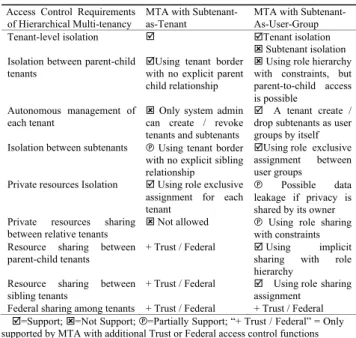
Table 1 Access control requirements of hierarchical multi-tenancy and how much MTA can satisfy.
sets of users and application resources in the real world.
Tsai[1] presents Sub-Tenancy Architecture (STA) to model tenant and subtenants relationships. In STA, multi- ple hierarchical autonomous tenants co-exist. A tenant ap- plication can be further customized to form subtenant ap- plications, and subtenants may share resource with fellow subtenants or their parent tenants. We summarize the access control requirements of hierarchical multi-tenancy and how much of them can be satisfied by existing MTA as shown in Table 1.
Currently, most existing access control models for MTA are based on Role-based Access Control Model (RBAC)[5] or Administrative Role-Based Access Control (ARBAC)[6], addressing multi-tenant isolating problems or out-resourcing sharing problems.
Beside the security strategies provided by MTA, hier- archical multi-tenancy access control needs to focus on the following issues:
• Privacy Sharing: A tenant may allow its subtenants or sibling tenants to access its private resources for application service reusability or data sharing. Mean- while, a tenant may not allow its privacy to be accessed by unauthorized users, including its ancestor-tenants or system administrators.
Copyright c2016 The Institute of Electronics, Information and Communication Engineers
• Autonomous Tenants: Each tenant acts like an au- tonomous agent to manage its own subtenants, users, and resources. A system administrator cannot inter- fere with tenants’ internal affairs. Also, a tenant cannot interfere with its subtenants’ internal affairs though a subtenant may inherit resources from its parent-tenant.
Furthermore, due to privacy isolation, role privilege in- heritance no longer exists in the system scope. What access privilege can/cannot be inherited and what re- sources can/cannot be cross-level controlled are differ- ent from those in traditional MTA systems, and need to be redefined.
• Sharing relationships among tenants: The sharing may be between two sibling tenants or parent-child ten- ants. Private resources can be granted to other tenants with their owners’ permissions. “Sharing directions”
may be from a parent-tenant to its subtenants, or from a subtenant to its parent, or from a tenant to its sibling.
To address the above issues, a flexible access control model for different-level autonomous tenants to share ex- isting resources, customize their own application and keep their secrets should be supported.
The contributions of this paper are: 1) A tenant-based access control model (TMS-ARBAC) based on ARBAC for hierarchical multi-tenancy is proposed; 2) Autonomous de- centralized authorization and authen-tication schemes are given out to help different-level tenants to customize effi- cient authority and authorization in large SaaS systems.
This paper is organized as follows: Sect. 2 reviews re- lated MTA infrastructure and security mechanisms; Sect. 3 defines the TMS-ARBAC model; Sect. 4 presents the autho- rization and authentication schemes of hierarchical multi- tenancy; Sect. 5 analyses our model and Sect. 6 concludes this paper.
2. Related Work
2.1 MTA in SaaS
Currently there are lots of ways to implement MTA[1]. But [7] points out that “multi-tenancy” lacks of a clear defini- tion. Most existing MTA technologies, such as data center, virtualization and middleware sharing, or PaaS-based MTA, are not real MTA, but multi-instance or multiple application deployment solutions lacking in resources sharing and in ef- ficiency.
In MTA, most existing systems treat tenants as individ- ual entities, fully isolated from other tenants. But SaaS pro- motes sharing. The relationships between tenants need to be further discussed, but only a few works related are pub- lished. [2] introduces a hierarchical tenant-tree model and its physical storage. But it only focuses on the efficiency and scalability for the authorization data access. Keystone pro- vides identity API of hierarchical multi-tenancy for Open- Stack, using domains and projects to build hierarchy of user groups and resources subsets [3]. A hierarchical multi-
tenant pattern is introduced to represent the hierarchical re- lationships among tenants[4]. But none of them further dis- cusses the resource sharing or application customization be- tween different-level tenants.
From the reusing of shared resources and easy cus- tomization view, STA [1] is proposed to allow tenants to offer services for subtenant developers to customize their applications. Various STA models are defined with differ- ent customization models.
2.2 Access Control in MTA
Security is an important topic in SaaS as all tenants share the same computing resources. This paper focuses on au- thentication and authorization of hierarchical multi-tenancy.
To apply RBAC, one needs to identifysubjects,objects, andpermissions. In a hierarchical multi-tenancy SaaS sys- tem, asubjectcan be 1) a tenant; 2) a subtenant; 3) a user of either tenant applications or subtenant applications; An object can be any application or data services; and theper- missionsare between subjects and objects within the system.
The following approaches have been used to apply RBAC to SaaS systems.
•Database schema and RBAC model
Traditional IT manufacturers [8], [9] develop data- centric PaaS-based SaaS. Multiple tenants are strictly iso- lated by database schema and RBAC model, sharing a data center. Security strategies are mainly focused on data.
•RBAC-alike model for MTA isolation in SaaS After identifying the problems of applying RBAC to SaaS systems, Li[10],[11]propose a H-RBAC model, in which access control is divided into tenant-level and system- level with role delegation and time-constraints.
T-Arbac[12]is proposed by adding “Tenant” into AR- BAC model. System-level and tenant-level administrations are separated. Isolated sub-resource pool is assigned to each tenant.
For organizations with subsidiaries, N-RBAC[13]uses hierarchical namespace structure to arrange users and roles for autonomous distributed role administration.
MHARBAC[14]is presented for multi-hierarchies de- centralized administration applications, using role-tree to support top-down authorization. Administrative scope is subdivided into user, role and permission scope.
All these access control models focus on the separation of multiple tenants, adding access borders and constraints for resources isolation. None of them mentions the security of cross-tenant or inner-tenant collaboration. Collaboration between tenants and/or subtenants offers users to create, dis- tribute, and access sensitive resources, causing the possibil- ity of externalizing data.
•RBAC-alike model for multi-tenant sharing
Extensions of RBAC model have been proposed for collaborative authorization in clouds. Except those with centralized authority that are not suitable for the cloud, there are three ways to build collaborative authorization[15]: 1) delegation in RBAC on basis of individual user decisions; 2)
federated identity and authorization services; 3) trust man- agement into access control mechanisms.
For cross-tenant collaboration on outsourcing re- sources, a MT-RBAC model family [16] is proposed to provide fine-grained authorization in collaborative cloud by building trust relations among tenants.
In SaaS ecosystem, service federation is established to allow customers to use the subscribed services across mul- tiple organizations[17].
These models are designed for cross-tenant sharing, but they are too complicated for close parent-child tenants or sibling tenants sharing.
In Salesforce[18],[19], role hierarchy, groups and ter- ritories with sharing rules are used to maintain the secu- rity of tenants, groups and users. Parent-child sharing are defined by both implicit sharing rules and explicitly grant access privileges. Delegated authentication and federated authentication are provided for cross-tenant sharing. Sub- tenants are treated as groups under the supervision of their parent tenants. Simple changes to groups can sometimes in- volve the substantial re-calculation of users’ access right.
To take advantage of the strengths of ARBAC97 and support autonomous decentralized different-level tenants to keep secret, do customization and share their resources, this research proposes the autonomous tenant access control model for hierarchical multi-tenancy in SaaS.
3. Autonomous Tenant Access Control Model for Hier- archical Multi-Tenancy in SaaS
This section introduces a new access control model for autonomous decentralized tenants called TMS-ARBAC, adding five new entity components: Autonomous Area (AA), Chief Administrative Roles (CAR), Chief Admin- istrative Permissions (CAP), Federals (F) and Outer-roles (O R) on ARBAC, for resource isolation and sharing of hi- erarchical tenants in SaaS. AA-tree is used to represent the tenants’ hierarchies.
3.1 Autonomous Area Tree Management
System administrators, tenants and their subtenants, roles and users all live in one SaaS platform. Each entity has its own work domain. Tenants and subtenants are autonomous entities with boundaries. Each tenant establishes its poli- cies. It owns the resources rented from the system, and cus- tomizes its own application. It can create subtenants (ST) and users, authorizing them the resources the tenant owned or controlled. Every subtenant must have a parent-tenant, but a parent-tenant may have many subtenants. A subtenant gets resources from its parent-tenant, can do customization and create its own users. In multi-level STA[1], a subtenant can create its own subtenants.
Once a tenant is created, the authorization and authenti- cation inside the tenant scope cannot be interfered by system administrators or other tenants. For tenant isolation, roles cannot be granted to users of other tenants. So, both roles
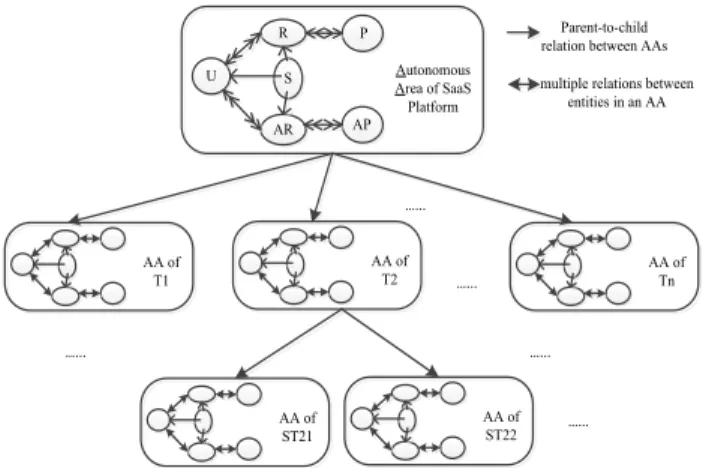
Fig. 1 An autonomous area tree (AA-tree) structure.
and users should be narrowed down to a tenant’s territory.
To meet the above requirements,“Autonomous Area”
(AA)is proposed to describe the security control area of one tenant. An AA is a named scope to restrict a tenant’s RBAC security administration range. Each AA has a unique name.
Every entity (such as a role, a user, or a set of permissions) of a tenant is unique inside the tenant’s AA with a unique entity name and its AA’s name as a prefix. Access control policies for one tenant can only be assigned to the entities inside its AA.
As a tenant may have its subtenants, an AA may have its sub-AAs. All the autonomous areas in a hierarchical multi-tenancy system form an AA-tree, representing the tenants’ hierarchies, as shown in Fig. 1. However, the im- plicit sharing from the child-node to its parent-node is un- supported. The objects inside an AA are invisible from any other AAs, unless there is an explicit authorization from an AA-federal (see Definition 2).
3.2 TMS-ARBAC Model Definition
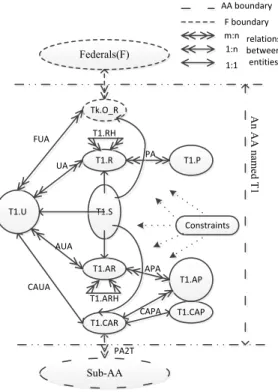
The entity components and their relationships in an AA are shown in Fig. 2, in which, Users (U), Roles (R), Adminis- trative roles (AR), Permissions (P), Administrative Permis- sions (AP), and Sessions (S), have the same definitions as in ARBAC, but are narrowed down to a tenant’s territory.
A user is distinguished by the roles assigned, to be an ad- ministrator, a tenant manger or a regular application user in its work zone. Chief administrative roles (CAR) and Chief Administrative Permissions (CAP) are added for the admin- istrative work management of an autonomous area. Fed- eral (F) is created for non-parent-child tenant resource shar- ing through Outer Roles (O R). The TMS-ARBAC model is composed of a set of AAs. Formal definitions of TMS- ARBAC are presented as follows.
Definition 1: An autonomous area has the following components:
U, R, AR, P, AP, UA, AUA, PA, APA, S, and RH ⊆ R × R, ARH ⊆AR× AR, user: S→ U, have the same definitions as in ARBAC97 model with restriction in current autonomous area;
Fig. 2 Components and relationships in an AA T1.
CAR, the one and ONLY one chief administrative role created in current autonomous area;
CAP, a set of chief administrative permissions in cur- rent autonomous area;
O R, outer roles shared by other autonomous areas to current autonomous area in the same federal;
PA2T ⊆ P × AA, many-to-many permission to au- tonomous area assignment relation;
CAPA⊆(AP∪CAP)×CAR, many-to-one permission to chief administrative role assignment relation;
FUA ⊆(U×O R), many-to-many user to outer-role (O R) assignment relation;
CAUA⊆U×CAR, many-to-one user to chief admin- istrative role assignment relation;
roles: S→ 2 ˆ(R∪ O R∪AR ∪CAR), maps each session sito a set of roles roles(si)⊆ {r|(∃r≥r) [(user(si), r)∈UA∪AUA∪FUA∪CAUA]}(which can change with time) and session sihas the permissions
r∈roles(si){p| (r∈(R∪AR)∧(∃r≤r) [(p, r)∈PA∪APA])∨(r∈CAR
∪(p, r)∈CAPA)∨(r∈O R∧(p, r)∈area(r).PA]}, where area(r) denotes the autonomous area in which the role r is created (partially ordered role hierarchy are written as≥in infix notation).
There is a collection of constraints stipulating which values of the various components enumerated above are al- lowed or forbidden.
Definition 2: The TMS-ARBAC model is denoted as a tupleAA, TR, FR:
• AA={a1,a2, . . . ,an}, whereaiis an autonomous area, nis the cardinality of AA;
• TR denotes the sharing set between parent-child ten-
ants. Ifn ≤1, TR is an empty set; else TR is a set of relationships denoted asai,ai j,p, whereaiis the par- ent autonomous area ofai j,pis the permission set that ai jinherited fromai, orai jshares with its parentai;
• FR denotes a set of federals. A federal f is defined as a five-tuple: f = Fid, Ca, Fm, Fo, Fc, representing the resource sharing relationships between non-parent- child tenants. In which,
◦ Fidis the unique ID of the federal f.
◦ Cais an AA, the chairman of f.
◦ Fm = {a1,a2, . . . ,ak}, (k ≥1), is a subset of AA joined in f.
◦ Fo={ai,ak,ai.r|ai ∈ Fm∧ak ∈Fm∧i k∧ai. r ∈ai.R}, which meansaishares a roleai.rwithak
in f.
◦ Fcis a group of constraints to f and to the assign- ments fromO Rto users.
According to definition 2, there may be two types of relationship between two autonomous areas: parent-child relationship and AA-federal relationship. The parent-child relationships always exist, constituting an AA-tree.
The federal relationship allows several AAs to unite a federal, and share roles between each other within the fed- eral. The O R of an AAaiis a set of roles given by other autonomous areas in the federal f. f.Fidis added to O R to distinguish outer roles assigned from the same AA of differ- ent federals.
ai.O R=
f∈FR{aj.r, f.Fid)|(∃ai,aj,aj.r∈ f.Fo|ij)};
To avoid implicit privilege inheritance in role hierar- chy, the partial order on outer roles is NOT allowed. To avoid privacy leakage among different federals, NO user can simultaneously belongs to different federals in one session.
The difference between TR and FR sharing is that: TR takes the granularity of permission, so that the grantee AA can flexibly combine the permissions into different roles to meet the access control requirement of tenants; FR takes the granularity of role, a local user can only access outer resources through specified roles to achieve more reliable security.
4. Autonomous Decentralized Authorization and Au- thentication Schemes on Autonomous Areas
4.1 Autonomous Access Control Unit
In a multi-tenancy SaaS environment, each tenant has its own users, administrators and/or subtenants, and owns elas- tic on-demand resources. As the number of tenants, sub- tenants, users and resources grows, the number of autho- rization roles and rules increases rapidly, a scalable archi- tecture for authorization and authentication is needed. We use the “autonomous area” (AA) as the Autonomous Ac- cess Control Unit. Every unit has its uniqueChief Security Officer (CSO), who has the highest authority in the AA, no matter this AA belongs to a tenant or a subtenant. So there is not one global centralized CSO but many CSOs dis- tributed throughout the whole system. The administrative
work includes creating users, regular roles (RR) and admin- istrative roles (AR), assigning permissions and creating sub- AA, which is continued dynamically in the life cycle of the SaaS system.
In TMS-RBAC, we still use the RBAC mechanism to authorize CSOs. Besides the original AR defined in AR- BAC97, we introduceChief Administrative Role (CAR), with highest authority in an AA. All the security adminis- trative work of CSOs can be performed through CAR. Each AA has one CAR, in charge of developing and maintaining RBAC policies in the AA.
The difference between CAR and AR is that the for- mer can be used to manage not only RR but also AR.
This difference is achieved through a special set of permis- sions calledChief Administrative Permissions (CAP). A CAP includes permissions to add/delete users or AR, create/ modify/revoke AA, create/drop federals, and share/revoke outer-roles.
When an autonomous area is created, its CAR is cre- ated and granted the entire CAP automatically. Meanwhile, a default CSO user is created and assigned the CAR auto- matically. Then the CSO can be in charge of this AA. No user could delete or modify the default CSO or the CAR.
They die with the deletion of AA.
4.2 Autonomous Authorization Work on an AA
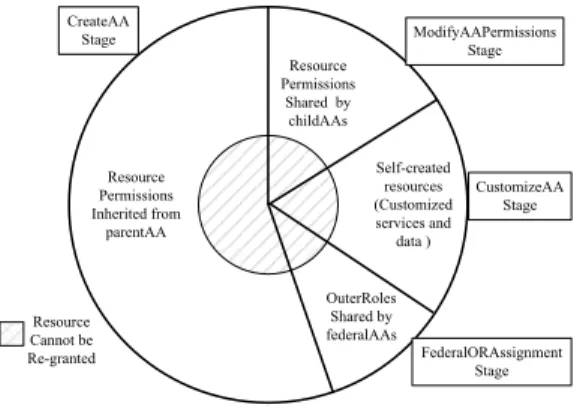
In a hierarchical SaaS platform, the resources held by an AA may come from different sources and change dynami- cally. According to the source type, the resources in an AA can be classified into 4 categories: resources with permis- sions inherited from the parent-AA, resources with permis- sions shared by the parent-AA or the child-AA, resources with outer roles assigned from federals and self-created re- sources (including customized services and private data), as shown in Fig. 3. The shading indicates those private re- sources are forbidden to be re-granted to others. Such re- sources are either secrets of current AA or private permis- sions shared by other AAs to current AA.
Thus the resources permissions of an AA can be di- vided into 3 subsets according to their security status, they are: PUBLIC (denotes public resource set that can be granted to others), PRIVATE (denotes private resource set that can only be granted to certain users of related AAs) and SECRET (denotes private resources set that can only be used in current AA).
The permissions to be granted in an AA are restricted to a subset of the AA’s resource permission set. The autho- rization work scheme on an AA can be divided into 4 parts according to its work zone, as show in Fig. 4. Their defini- tions are given as follows.
(1) SubAAAuthorizationWork(), which grants, updates or revokes inherited permissions to a sub-AA of current AA, including 3 kinds of services:
• InitSubAAPermissions(), when a sub-AA is created.
It creates CAP, CAR, CSO, and initializes inherited
Fig. 3 Resource types an AA holds.
Fig. 4 Authorization work scheme of an AA.
permissions for the sub-AA, which is implemented automatically by the SaaS platform;
• ModifySubAAPermissions(), when new permissions are added or given permissions are revoked dynami- cally by its parent-AA;
• RevokeSubAAPermissions(), when a sub-AA is re- voked. A tenant may determine to revoke per- missions from its subtenant, and then all related permission-to-role assignments should be revoked in turn. Furthermore, if the subtenant has re-granted the permissions to others, more complicated process is required to ensure an exhaustive revocation.
(2) ParentAAAuthorizationWork(), which grants or re- vokes private resources dynamically from current AA to its parent-AA.
(3) FederalAAAuthorizationWork(), which is respons-ible for federal sharing authorization, including 3 subsets of services:
• FederalCreation() and FederalDrop();
• AAJoinFederal() and AAQuitFederal();
• OuterRoleCreation(), OuterRoleShare() and Outer- RoleRovoke().
(4) LocalAAAuthorizationWork(), which works as tradi- tional ARBAC97 authorization jobs restricted in an AA, with only one exception: outer role specified to certain users with constraints.
In view of security status, roles and users are also di- vided into different access levels (TOP, MIDDLE, NOR- MAL) for resource access.
Sibling-AAs with similar organization structure or duty separation may have similar authorization requirement. Au- thorization workflow and template of demo sub-AAs can be recorded and recommended for sibling sub-AAs’ initializa- tion and authorization. Since each tenant is autonomous, authorization work on different AAs can be executed con- currently. Authority servers and separate databases are allo- cated to each subtenant for efficiency.
4.3 Decentralized Authentication Work on an AA The authentication work scheme on an AA can be divided into two parts: user authentication and resource authentica- tion.
(1) Decentralized user authentication
When a user login the platform, user authentication is triggered. In the SaaS system, there may be thousands or millions of tenants; each tenant may have multiple users and even subtenants; and a subtenant may also have users and even sub-subtenants. And a user may be a CSO, an admin- istrator, a tenant manager or an application user. Thousands of users may stay in the system synchronously, applying or using different resources, causing multiple read and write operations happened synchronously on the access control tables. The user authentication work is very busy.
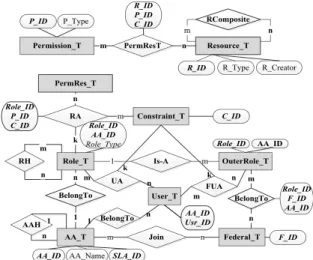
We use the ID of AA (named as AA ID) to narrow down the search within a single AA scope. Read or write op- erations on different AAs can be simultaneously performed.
As shown in Fig. 5, user Table and role Table are both par- tially indexed by AA ID. If such tables continue to scale up, AA ID can also be used to split the huge tables into smaller tables distributed to different database servers. An AA-catalog of AA IDs to their distributions is recorded and synchronized in master servers. An AA-tree-index is used for AA-catalog lookup.
(2) Resource authentication tracing
In a hierarchical multi-tenancy system, a resource cre- ator is not the only granter. The current resource holder AA with the “grant” option can grant the resource to other AAs, including its parent-AA, its sub-AA, and/or its federal members. To do resource authentication, each user and each granter of such resource should be audited.
Because privacy are forbidden to be spread one by one, only public resources permissions can be transmitted through different AAs. It seems this transmission will not cause security problems.
But if the resource is a composite one, every pieces of such resource should be traced. During the tracing chain, constraints on the grant permissions should also be noticed.
If some constraint is broken, or the deadline comes, revoca- tion will happen in such chain, recursive revocation may be triggered.
Resource authentication happens when a resource priv- ilege is to be assigned to other, or the resource status is
Fig. 5 E-R Diagram Design for Access Control in Hierarchical Multite- nancy SaaS.
changing, or the resource is deleted from the system. Fails of the resource authentication may cause re-calculation of the access rights of all its users.
5. Model Analysis
5.1 Security Analysis
Considering an autonomous area as a distributed au- tonomous organization in the cloud, the sharing security among autonomous areas turns to be a secure interoperation problem in a hierarchical multi-tenancy SaaS environment.
There are two kinds of security interoperations in our sys- tem: TR and FR.
Since TR only happens between the parent-child AAs with permissions, and the grant operations are implemented by system automatically with no secret re-grant constraints.
We assert that TR will cause no security interoperation prob- lem.
FR is built on federal member trust. The outer role sharing and user-role assignments are executed separately in their respective AAs. So no security interoperation happens in one federal. However, users belonging to two federals can steal resources from one federal to another. We use separa- tion of duty and federal constraints to reduce such violation.
5.2 Property Analysis
The typical characteristic of TMS-ARBAC is to reconcile the demand of tenant isolation and resource sharing in hier- archical multi-tenancy SaaS.
1) The isolation and autonomy of every tenant.
• Each tenant has its isolated work area AA. Resources, roles, users and permissions are all restricted in such AA. So, an autonomous area builds a strict isolation wall from other tenants.
• System-level and tenant-level administrations are clearly separated. The SaaS system is also an AA.
Each AA has its CAR and CSO, dominating its own job functions.
• Each tenant establishes its access control policies with application requirements in its AA. Only the resource allocation and revocation obey the AA hierarchies.
2) Resource sharing for tenants
• Federal sharing: subscribed resources are shared be- tween unrelated tenants or sibling tenants in one fed- eral. Security is ensured by federal trust and outer-role constraints.
• Inheritance sharing: system resources are easily inher- ited from parent to child tenants.
• Privacy sharing between tenants: private resources are privately shared between related tenants without data leakage, which is a kind of private resource reuse.
5.3 Scalability Analysis
In our model, thousands of subtenants of the same parent tenant can co-exist. Each subtenant may also have multiple sub-subtenants and millions of users.
Compared with Salesforce who treats subtenants as groups, the sub-AA initialization authorization work seems more complicated. But after initialization of the sub-AA territory, local authorization services for roles and users as- signment and management on different sub-AAs can be con- currently executed. This process is much faster than that in salesforce, since all groups are under supervision of their tenant, and all users under groups also wait for the autho- rization of the tenant.
As mentioned in 4.3, the two-step-user-authentication (including the AA-tree-index catalog search and the username-in-AA search) works efficiently even when the number of users increases. But in Salesforce, groups can- not be used to narrow down the username searching scope.
When the number of users increases, user authentication will be less effective.
For large-scale resource authentication, if a resource is only used in one AA, the process will be effective. But if not, cross-tenant resource authentication will reduce efficiency.
That is the cost of resource reusing.
6. Conclusions
This paper analyzed the access control requirements of hi- erarchical multi-tenancy on Software-as-a-Service platform, emphasizing the privacy and sharing issues raised between autonomous decentralized tenants, and then gave the defini- tion of a new TMS-ARBAC model. Autonomous Areas are used to isolate each autonomous tenant. An AA-tree with parent-child relationship and federal relationship is used to describe the tenants’ hierarchy and various sharing relation- ships. Authorization and authentication schemes on each autonomous area were proposed. Decentralizing authoriza- tion by autonomous area helps to improve efficiency in large
hierarchical multi-tenancy SaaS. Further research work will focus on the composite services authorization and authenti- cation work in hierarchical multi-tenancy PaaS.
References
[1] W.-T. Tsai and P. Zhong, “Multi-tenancy and sub-tenancy architec- ture in software-as-a-service (SaaS),” 2014 IEEE 8th International Symposium on Service Oriented System Engineering, pp.128–139, 2014.
[2] P.-J. Maenhaut, H. Moens, M. Decat, J. Bogaerts, B. Lagaisse, W.
Joosen, V. Ongenae, and F. De Turck, “Characterizing the perfor- mance of tenant data management in multi-tenant cloud authoriza- tion systems,” 2014 IEEE Network Operations and Management Symposium (NOMS), pp.1–8, 2014.
[3] Hierarchical Multitenancy in Keystone. http://raildo.me/hierarchical- multitenancy-in-openstack/, 2015.
[4] N.H. Bien and T.D. Thu, “Hierarchical multi-tenant pattern,” Proc.
2014 International Conference on Computing, Management and Telecommunications (ComManTel), pp.157–164, 2014.
[5] R.S. Sandhu, E.J. Coyne, H.L. Feinstein, and C.E. Youman,
“Role-based access control models,” Computer, vol.29, no.2, pp.38–47, 1996.
[6] R. Sandhu, V. Bhamidipati, and Q. Munawer, “The ARBAC97 model for role-based administration of roles,” ACM Trans. Inf. Syst.
Secur., vol.2, no.1, pp.105–135, 1999.
[7] R. Krebs, C. Momm, and S. Kounev, “Architectural concerns in mul- ti-tenant SaaS applications,” Proc. 2nd International Conference on Cloud Computing and Services Science, pp.426–431, 2012.
[8] R.F. Chong, “Designing a database for multi-tenancy on the cloud,”
http://www.ibm.com/developerworks/data/library/techarticle/dm-12 01dbdesigncloud/index.html, 2012.
[9] F. Chong, G. Carraro, and R. Wolter, “Multi-tenant data architec- ture,” http://msdn.microsoft.com/en-us/library/aa479086.aspx, 2006.
[10] D. Li, C. Liu, Q. Wei, Z. Liu, and B. Liu, “RBAC-based access control for SaaS systems,” Proc. 2010 2nd International Conference on Information Engineering and Computer Science, pp.1–4, 2010.
[11] D. Li, C. Liu, and B. Liu, “H-RBAC: A hierarchical access control model for SaaS systems,” International Journal of Modern Education and Computer Science, vol.3, no.5, pp.47–53, 2011.
[12] J. Cao, P. Li, Q. Zhu, and P. Qian, “A tenant-based access con- trol model T-Arbac,” Computer Science and Application, vol.3, pp.173–179, 2013.
[13] L. Xia and J. Jing, “An administrative model for role-based access control using hierarchical namespace,” Journal of Computer Re- search and Development, vol.44, no.12, pp.2020–2027, 2007.
[14] H. Zhong, W. Wang, G. Yan, and Y. Lei, “A role-based hierar- chical administrative model,” Proc. 2009 International Conference on Computational Intelligence and Software Engineering, pp.1–4, 2009.
[15] B. Tang, R. Sandhu, and Q. Li, “Multi-tenancy authorization models for collaborative cloud services,” 2013 International Conference on Collaboration Technologies and Systems (CTS), pp.132–138, 2013.
[16] B. Tang, Q. Li, and R. Sandhu, “A multi-tenant RBAC model for col- laborative cloud services,” Proc. 2013 Eleventh Annual Conference on Privacy, Security and Trust, pp.229–238, 2013.
[17] B. Wang, H.Y. Huang, X.X. Liu, and J.M. Xu, “Open identity man- agement framework for SaaS ecosystem,” 2009 IEEE International Conference on e-Business Engineering, pp.512–517, 2009.
[18] C.D. Weissman and S. Bobrowski, “The design of the Force.com multitenant internet application development platform,” Proc. 35th SIGMOD International Conference On Management of Data, SIG- MOD’09, pp.889–896, 2009.
[19] “Designing record access for enterprise scale,” https://twitter.com/ salesforcedocs, Oct. 2015.
Qiong Zuo received her M.S. and Ph.D.
degrees in Computer Science from Huazhong University of Science and Technology in 1999 and 2010, respectively. She is now a lecturer of the School of Computer Science and Technol- ogy, Huazhong University of Science and Tech- nology. Her research interests are in big data management and cloud computing.
Meiyi Xie received her M.S. and Ph.D.
degrees in Computer Science from Huazhong University of Science and Technology in 1999 and 2010, respectively. She is a lecturer of the School of Computer Science and Technology, Huazhong University of Science and Technol- ogy. Her research interests are in information security.
Wei-Tek Tsai received his Ph.D. in Com- puter Science from University of California at Berkeley in 1986. He is now Professor in the School of Computer Science and Engineering at Beihang University, Beijing, China, and Emeri- tus Professor at Arizona State University.