Part I Demand and Institutions: The Industry Environment in China. Chapter 3 Patent, New Drug Protection and Innovation Promotion Policy
権利 Copyrights 日本貿易振興機構(ジェトロ)アジア
経済研究所 / Institute of Developing
Economies, Japan External Trade Organization (IDE‑JETRO) http://www.ide.go.jp
シリーズタイトル(英 )
ASEDP
シリーズ番号 75
journal or
publication title
Pharmaceutical Industry in China‑Intellectual Property Protection, Pricing and Innovation‑
page range [29]‑53
year 2007
URL http://hdl.handle.net/2344/00015891
Chapter 3
Patent and New Drug Protection and Innovation Promotion Policy
1. Patent Protection in Chinese Pharmaceuticals 1.1. Historical Development of the Patent System
The pharmaceutical industry is considered a special and important high-technology industry: investment into exploring new drugs is huge, the risks are high, and the investment period is long. Every new chemical entity require an expenditure of US$0.8-1 billion on average. It can take 10 years or more from discovery of the new drug to it finally being listed on the market. Recently, the number of new drugs listed on the global market has been decreasing drastically.
Compared to other industries, it is becoming more difficult to see good results from research and development in terms of the number of new products. However, once a product has been successfully developed, not only can it contribute to humanity’s struggle with disease, protecting people’s health and lives, but it also provides massive profits to the innovators: the research institutes, pharmaceutical firms and distributors who invested in the project. This huge profit is guaranteed because of the market exclusivity afforded by intellectual property protection.
Thus, the development of new drugs depends far more on intellectual property rights protection than in other industries. This heavy dependency of intellectual property protection is also indicated by the fact that drug patent applications consistently rank within the top three patent applications of any industry in China.
On the other hand, drug applications have a bearing on the national health, and so the intellectual property protection system has to consider its impact on the public health.
1.1.1 Revisions of Patent Law
(1) In the Patent Law enacted on 1st April, 1985, the 25th clause clearly stated that a “patent will not be provided for a drug or new chemical entity.” In other words, the Patent Law did not give patent protection to drugs and chemical
entities themselves, but only to the process and methods used. In legislation, the weak innovation capacity of pharmaceutical firms in China because of its position as a developing economy is taken into greater consideration. If more rigorous intellectual property protection was taken, it was expected that this might damage the future development of China’s pharmaceutical industry. In order to affect the industry, sanctions on drug patent protection were then introduced.
(2) 7 years after the introduction of first version, the Patent Law was revised on 1st January, 1993. The revised Patent Law added protection towards drugs and new chemical entities, and extended the scope of protection to include products that were produced by a patented process, in order to keep the Chinese economic system consistent with international customs and in particular to revive China’s membership in the World Trade Organization. This was also consistent with the China’s Reform and Opening Policy.
(3) Revisions in 2000 confirmed the 1993 Patent Law, clearly providing all drugs in China with patent protection.
1.1.2 Objects of Patent Protection and Conditions
Drug patents consist of the innovation itself, the drug’s practical use and the product’s appearance and design. The subject of the protection is the discovery of a new chemical entity, namely innovation; the new form and compound of drugs;
and any new and revised process. Of these, the most important conditions to provide patent protection are novelty, creativity and practicality. “Novelty”
shows that a similar drug has not been published in domestic or foreign publications prior to the patent application, nor have they yet been used either in public or announced in any other form, nor has patent administration been applied for or publicized by other persons. “Creativity” shows that the new drug has prominently substantial features and advanced progress, compared to the technology that existed before its application. “Practicality” indicates that the innovated drug should actually be able to be manufactured and utilized, and that it generates a positive effect. Likewise, the patent protection on a drug or process is provided with the newest in the world and the products of innovative effort. In terms of practicality, the patent only requires that the drug or the process is
applicable in industrialization, or the prospect of industrialization. Application in industrialization indicates that not only is the drug or new process capable of curing a disease, but also that is has been rigorously inspected regarding toxicity and/or safety.
1.1.3. Time Period and Instruments of Patent Protection
The Patent law clearly provides that an innovation patent is protected for 20 years since the date of application. Practically speaking, those 20 years are classified in 3 stages, and the protection is strengthened step-by-step: as China’s patent system employs the principle of “publishing earlier, and investigating slowly,” during the period that a drug patent is applied for but has not yet been publicized, it is impossible for the other parties to know the details of any innovation, and thus cannot violate the patent as much. If an identical drug was innovated during this period, the innovator could not claim any compensation, because the patent protection would not yet have gone into effect, and the competition could neither apply a patent nor destroy the novelty inherent to this innovation. Therefore, this transitional period can be regarded as a period of
“mutual non-intervention.” In the second period, when patent has been applied for but not yet approved, the general public is able to know detailed contents of the particular innovation. Thus, if another party were to utilize the same innovation, he would have to make payment to the innovator for the appropriate costs. This can be regarded as the period of “transitory protection.” During the third period, when the patent has been approved, no institution or individual can utilize the patent to manufacture for sale, use, license the sale, sell, import the patented products, or utilize the patented process, nr can they use, sell, license the sale, or import products that directly rely on that particular patent. During this period, if somebody utilizes the patent without the approval of the patent holder, the patent holder or another stakeholder can file a complaint with the courts, or ask that the patent administration require the violator stop that violation and to make compensation. This is the period of “complete protection.”
According to clauses in the Patent Law, only one patent is approved for each one innovation. Because of this provision, patent protection provides exclusive marketability. In other words, each patent protects only one new drug. This exclusivity can lead to monopolized profit from the market, including production,
sales, use and importation of the new drug. The profit is huge.
1.1.4. Routes for Legal Relief
The Patent Law states that when the Intellectual Property Department under the State Council rejects a patent application, the applicant can ask the patent review committee for a re-investigation within a given period. After the publication date of patent announcement by the State Council, any institution or individual who finds it irrational, can request that the review committee make the patent invalid.
In the case where the applicant objects to the decision of the review committee, he can file a lawsuit to the court within a given period.
1.2 Data: Patents and Pharmaceutical Firms’ Development 1.2.1 Overall Situation
The number of patent applications and approvals indicates the growth of the number of patents and also indicates levels of innovation capacity and sustainability. We have analyzed the descriptive data of patent applications for new drugs and biotechnology in China for the 21 years between 1985 and 2005.
Figure 1 shows the historical development of number of patent applications and approvals. Here we can see a trend of steady growth. We must note at this point that as there exists a time lag between a patent’s application and publication - 18 months on average – the figures representing the number of patents for the final 2 years (2004 and 2005) are incomplete. A decrease is indicated because of this technicality, but it does not reflect the actual development.
Figure 1: Number of Applied Patents
0 2000 4000 6000 8000 10000 12000 14000
application numbe
198 5
198 7
198 9
1991 1993
1995 1997
1999 200
1 200
3 200
5 year
r
(Source)Author
1.2.2: Geographical Distribution
(1) Distribution by Country
In terms of the number of patent applications by foreign institutions between 1985 and 2005, the US remains consistently at the top, with Japan, Germany, Switzerland, and the UK following.
Figure 2: Number of Patent Applications by Country
59,318 6,124
3,864 2,180 1,855 1,575 975 835 810
12,211 China
American Japan Germany Switzerland U.K.
France Sweden Netherlands Korea
709 565 526 415
Italy Canada Belgium Australia
(Source)Author
(2) Distribution by Region
The number of patent applications indicates that a disparity apparently exists between different regions. Beijing, Shanghai, Guangdong, Shandong, Henan, Hunan, Hebei, Jiangsu, Tianjin, and Zhejiang rank as the Top 10, however the number of applications from Xinjiang and Tibet are very few. This shows that patent applications are concentrated in China’s developed areas: the Beijing-Tianjin area and the Yangzijiang River area.
Figure 3: Number of Patent Applications by Region
(Source)Author
.2.3. Content of Patented Technology
) Patented Technology by Drug Classification
number for new drugs and
igure 4: Distribution by Patent Technology
8,233 1,077
0 2000 4000 6000 8000 10000
Beijing Heilongjiang
6,413 2,668
2,459 2,104 1,991 1,987 1,793 1,551 1,489 1,295 1,262 1,163
Shanghai Guangdong Shandong Henan Hunan Hebei Jiangsu Tianjin Zhejiang Liaoning Yunan Sichuan
1
(1
There are three categories of IPC classification
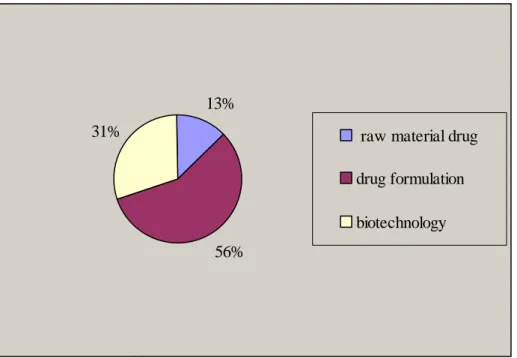
biotechnology: the raw material drug manufacturing patent, the drug formulation patent, and the biotechnology patent. Approved patents for raw material drugs from 1985 to 2005 numbered 12,401, drug formulation patents numbered 53,383, and biotechnology patents numbered 29,021 - making 94,805 in total.
F
13%
56%
31% raw material drug
drug formulation biotechnology
(Source)Author
The data shows that patents for drug formulation was dominant am
atent types. The 53,383 drug formulation patents can be classified in two
2,224, hile healthcare foods count for 6,039 items. Among the natural extract drug ong the three p
categories: the biotechnology category has 3,652 items and the organic chemistry category has 49,731. This explains that innovation in drug formulation has to date depended heavily on traditional chemistry methods. However, along with the development of biotechnology and the increase in society’s attention to it, biotechnological drug formulation has huge room for further development.
Of the 94,805 drug patents, patents on natural extract drugs count for 2 w
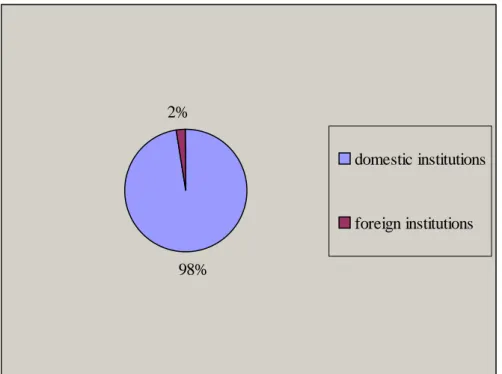
patents, domestic institutions applied for 21,709 – a 98% share - and foreign institutions applied for only 515 (shown in Figure 5). This phenomenon indicates that China has an apparent advantage in the natural extract drug category, and this is the area in which China has most independent innovation capacity and is the easiest field in which to acquire intellectual property.
Figure 5: Patent Applications for Natural Extract Drugs
98%
2%
domestic institutions
foreign institutions
(Source)Author
n between
shown as follows: patent applications for anti-tumor drugs numbered 13,050, drugs for 8,924, digestive (3) Patent Classification by Diagnosis Classification
Data on the number of patents by diagnosis classificatio 1985 and 2005 is
cardiovascular drugs accounted for 10,795, anti-biotic
drugs for 7,439, skeletal disease drugs for 6,490, skin disease drugs for 6,170, central nervous system drugs for 5,786, respiratory organ drugs for 4,586 reproductive organs drugs for 4,351 and metabolic drugs for 3,715. The above data indicates that patent applications concentrated on drugs for high frequency diseases. In particular anti-tumor and cardiovascular drugs are the core of new drugs development.
Figure 6: Number of Patents for Drugs by Diagnosis Classification
0 2000 4000 6000 8000 10000 12000
14000 antineoplastic
cardiovascular anti-infective digestive system skeleton dermatosis
central nervous system respiratory system venereal disease decompensation incretion
urogenital system peripheral nervous system
i i
(Source)Author
(3) Analysis by Patent Classification
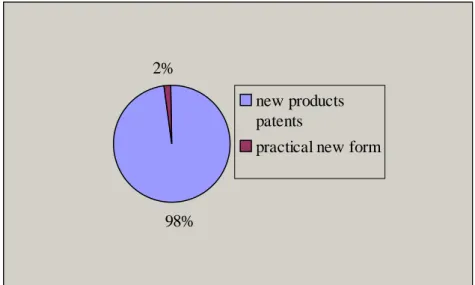
Among the 94,805 patents, there were 93,051 new product patents and 1,754 practical new forms. This indicates that the innovation of new product patents is dominant.
Figure 7: Number of Patents by Patent Type
98%
2%
new products patents
practical new form
(Source)Author
1.2.4 Analysis of Competitiveness by Institutions
(1) Distribution of Patent Application Types
In order to analyze competitiveness by institutions, we must look at the number of patent applications for new drugs and biotechnology by research institutions, universities, corporations, hospitals, individuals and other groups between 1985 and 2005. In twenty years, 94,805 patents were applied for in total: of these, corporations accounted for 43.42%, individuals and others for 32.9%, universities for 13%, research institutes for 9.4 % and hospitals for 1.3%. Figure 8 presents this data. Corporations and individuals are the dominant figures.
Figure 8: Number of Patent Applications by Applicant Type
5,0000 10,000 15,000 20,000 25,000 30,000 35,000 40,000 45,000
research in stitution
s
univers ity
corporat e
hos pital
individual and others
(Source)Author
(2) Patent Applications by Foreign Pharmaceuticals in China
Here we look at the patent applications for drugs and biotechnology by the top 10 pharmaceuticals in the world (1985-2005). Pfizer had 850 applications, Johnson and Johnson 35, Graxo Smith Kline 211, Novartis 35, Roche 16, Merk 427, Abbott 0, Astrazenega 58, Sanofi-Aventis 132, and Wyeth 348.
Figure 9: Global Top 10 Pharmaceuticals’ Patent Applications in China
0 100 200 300 400 500 600 700 800 900
Pfizer
Johnson and Johnson Graxo Smith Kline Novartis
Roche Merk Abbott Astrazenega Sanofi-Aventis Wyeth
(Source)Author
1.3. Current Situation and Future Analysis
Hereafter, we will relate the innovation capacity of the pharmaceutical industry in China by following a SWOT analysis. SWOT represents Strength, Weakness, Opportunity and Threat.
1.3.1. Strengths
(1) Academic Support for the Development of Pharmaceutical Patents
A scientific project called the “863 Plan” enacted by the State focuses on the pharmaceutical and drug industries. As we have already seen above, the number of patent applications for modern biotechnological products is gradually increasing, and the modern biotechnology industry is also developing rapidly.
More than 20 biotechnology science parks are operating in China, and each of them generates a supporting industry: these supporting industries may contribute
to the progress of the research into, and industrialization of, its products. Thanks to support from the 863 Plan and other development plans, scientists in China were able to organize inter-disciplinary joint research, and to accumulate abundant experience.
(2) Rapid Progress in the Patent Protection Systems
The number of applications for patents from the biological and new pharmaceutical industry reached 13,222 in 2003, a 30.61% growth compared to the previous year. It has increased to 25.33 times that of 1985.
(3) Rapid Growth of Biological and Natural Extract Patents
As we have seen in the data analysis above, patent applications based on biotechnology have grown aggressively since 1999. The potential for growth in this field is widely perceived and encouraging huge input.
On the other hand, domestic institutions are responsible for 98% of natural drug patents. This implies a potential for innovation in natural drugs, and a high possibility of Chinese institutions being able to acquire intellectual property rights.
1.3.2 Weaknesses
(1) Poor Outcomes and Poor Input in Medical Biotechnology Research As we have seen in the data on patent applications, its growth is currently very high. This is due to the fact that the starting base was small: the number of patent applications in the field of medical biology from 1985 to 2005 was only around 90 thousands, whereas applications in the US reached around 20 million. Input on medical biotechnology research was very poor, only one 500th of China’s foreign counterparts. Inputs on basic research would have been very small and, simultaneously, because of poor promotion, input by the commercial base was also particularly small, leading to slow development in this field.
(2) The Level of Technology in Drug Patents is Low
Currently, the level of technology drug patents is not high in general, and the number of patent applications for new chemical entities is very small. Patents for the form of drugs were primarily for traditional drug forms, and patents for innovative forms like slow or controlled emission were few. Although the number of patent applications for drugs made from plants by domestic institutions is large, the patent is limited to new combinations of drugs, which is far below the Modern Traditional Chinese drug requirement. In the area of biological technology, patent novelty is limited to traditional enzymes or fermentation in most cases, and in very few cases were patent applications made for genetic technology.
(3) Weak Perception of Patent Protection by Scientists
Although the Patent Law has been enacted for more than 20 years, and although systematic promotional activities have been conducted nationwide, they were limited to a few management positions, and most of staff working in the research and development departments lack any legal knowledge of patent protection and thus did not apply for patent protection immediately after the products were developed. As a result, the phenomenon referred to as “too much respect for the outcome, too much neglect of patents” has very prevalent in the pharmaceutical industry. For example, the two-step fermentation method of Vitamin C is an advanced technology at the international level, but the innovator did not apply for patent, but only published a paper. A foreign firm prepared US$5 million to buy out this technology along with the equipment, but the firm only paid several hundred thousand dollars for the paper once they knew that the innovator had not applied for a patent. They then produced generic versions in their home country.
After several years, Vitamin C produced with this technology abroad was unloaded and it seriously damaged the export price of Vitamin C from China, created a crisis for firms who produced Vitamin C in this country.
(4) Weak Innovation Capacity of Pharmaceutical Firms
In China, main innovators in pharmaceuticals have been the research institutes
and universities; the firms themselves have been weak at innovation. This is in contrast to situation abroad, where it is the firms that are the innovators of new drugs.
1.3.3 Opportunities
(1) WTO Entry
Re-entry into the World Trade Organization (WTO) has provided domestic pharmaceutical firms with a good opportunity for international alliances or acceptance of foreign investment. This is a strong advantage for upgrading the pharmaceutical industry’s research capability. International cooperation and alliance have seen progress after entry into WTO: both joint research and development and also product sharing of development results. International cooperation and alliances based on mutual advantages have seen a good response for high-risk and high-input projects like pharmaceutical development. In addition, re-entry into the WTO removed the obstacles to the entry of foreign firms and institutions into the Chinese market and their subsequent huge investments in research and development. This is good news for the Chinese pharmaceutical industry, which was suffering from shortages of funds.
(2) Drug Demand will Grow with Upgraded Living Standards
Currently, the consumption of drugs per capita in China is far lower than the international levels. However, following the natural increase and aging of the population, and the growth of the economy, the pharmaceutical industry has been growing rapidly. During the tenth Five Year Plan, a new focus on the development of the pharmaceutical industry was announced as follows: 1) Steps to induce internal development in order to upgrade innovation capacity and quality. 2) Investment should be concentrated on upgrading innovation and quality, and economies of scale should no longer be pursued. 3) The new “hot spots” of development will be traditional Chinese medicine, biotechnology development, and chemical raw materials. High growth of the macro economy and rationalization of administrative management will provide better
opportunities for development.
1.3.4. Threats
(1) Increase in Patent Applications by Foreign Pharmaceuticals
The data above shows not only the increase in patent applications by domestic institutions, but also shows that foreign institutions similarly increased the number of patent applications in China. The purpose of patent application is, of course, to monopolize the market for a particular drug category or research in China. China, as a huge market with a population of 1.3 billion, is a big cake that is tempting foreign pharmaceuticals to apply for patents. The US firms are a good example of this.
(2) Outflow of Human Resources and Output in Pharmaceutical Industry In the data analysis we found that Chinese individuals are the primary innovators in many patents, however the patent applications come from foreign institutions.
This implies that this is the outcome of Chinese scientists flowing abroad and subsequently being utilized by foreign institutions. Although the amount of Chinese innovators’ output might be a very small figure compared to the world’s innovation and patents, nevertheless this “small” number of innovations is not so small for Chinese scientists. This indicates that though although there are human resources in China, they are flowing out.
As a whole, though we have several problems in China that are now threatening the country’s development, we do not have to belittle ourselves as we have several advantages that could help us maintain a leading status in the market and also provide us with a huge opportunity. Thus, what we should do is to calmly analyze and set out a development strategy and response in order to respond to any challenge by those who are stronger.
1.4. Strategy for the Drug Patent Protection System in China
China’s pharmaceutical industry is facing all at once an opportunity and a challenge, difficulties and hopes. A development strategy should be designed to strengthen the industry’s strong points, and make the weak points strong, in order to achieve fast growth.
It is necessary to improve the perception of the importance of patent protection, in order to complete related policies and administrative management. (1) In order to strengthen intellectual property protection and management for all the processes of pharmaceutical supply, from research and development to production to sales, it is necessary to utilize the protection and information functions of an intellectual property rights protection system. (2) In order to improve innovation and industrial development in the pharmaceutical industry, it is really necessary to protect pharmaceutical firms, consumer welfare and to improve international competitiveness.
(1) Complete the Intellectual Property Protection System for Pharmaceuticals
As a member of the WTO, China should study and comply fully with the TRIPS agreement(Agreement on Trade-Related Aspects of Intellectual Property Rights) and any other related rules. Only under the TRIPS agreement and related rules can China resolve international conflicts over intellectual property rights.
In order to respond to intensive competition in both the domestic and export markets, new trends in the treatment of intellectual property rights in international markets should be reviewed, and any policies and administrative management by the central and local governments should comply with these.
In order to analyze, judge and set out a patent protection criteria that would prompt entities to exercise China’s comparative advantages, as well as the administrative management system that would prompt the State to grasp key technology, it is necessary to perform an in-depth study into a standard that
would protect new technology in the pharmaceutical industry, as well considering the different sources of competitiveness in both domestic and foreign firms. In addition, any intellectual property protection policy should be consistent with the current situation within China, based on an analysis and forecast of the development trends of pharmaceutical intellectual property rights.
(2) The Government Should Strengthen Policy Support
The government should support patent protection in the pharmaceutical industry by intervening through its technology policy, industrial policy, tax and monetary policy, human resources, imports and exports, investment and procurement, and international co-operation. An example would be to allow medical reform to be consistent with the innovation capacity, or offering favorable treatment of newly innovated products on the basic drug list.
In addition, a preferential universal tax policy toward any input on research and development is also necessary. Compared to in a developed economy, China’s current tax system, a production-based value-added tax, is unfavorable towards any input on research and development. The tax system needs to be revised: first of all, to transform it into consumption-based value-added tax, and at the same time reducing the tax rate for input to research and development by reducing the tax base and enlarging the tax reduction target. Secondly, the system should be revised to reduce the income tax for research and development input and to redeem it immediately when the firm has actually implemented that input for research and development. Thirdly, the system needs to be revised in order to universally redeem the value-added tax on any research development input, and to transform the favorable tax redemption policy from being direct towards a limited group of firms to being the universal policy. In that way, we can implement a tax redemption policy towards the research and development of all pharmaceutical firms.
(3) Rationalization of Procedures
The application and maintenance of patent are form of legal action, and the
patent administration department should manage whole process consistently.
Research institutions and universities should be established to deal with patent issues and at the same time a group of capable patent agents should be encouraged. By means of these, we can change the current management level, which suffers from poor content and a lack of efficiency. Patent management will only work effectively when patent agents that are highly capable and extremely efficient, and who have received expert training, appear, and when rationally-operated administrative management and regulations are established.
Patent investigation standards can act as a weather vane, and at the same time they have some leverage. Novelty is a hard index of the patent investigation, and creativity is a flexible index. In order to protect traditional Chinese medicine, a further study on the relationship between creativity and judgment of patent rights violation is necessary so as to set up a standard for creativity in traditional Chinese medicine. It would be more idealistic if quantification were feasible, and it was possible to control the investigation on creativity based on a quantified index.
(4) Firms Should be Agents of New Drug Innovation
Currently, research institutes, sponsored by the government, or the universities are the main undertakers of research and development. New drugs are listed through: (1) cooperative projects by research institutes and pharmaceuticals firms: the firm will finance the project, while the research institute conducts research, and they then apply the new drug together. This is a very common form of cooperation. (2) Research institutes complete the research into a new drug and applied the “New Drug Documents,” then they transfer them to pharmaceutical production firms. Research institute will invest this technology-transfer fee in future new research. (3) A research institute will not only complete the development work, but will also help the firm with the production process, and will receive fee based on a ratio to the sales. the research institute will use this to fund another new project.
In the rest of the world, large international firms shoulder the responsibility for new drug developments. These big pharmaceuticals, like Pfizer or Novartis, inject around 15-20 of sales or more of sales into research and development.
Huge investments, excellent scientists, fine precision machineries, and a rational innovation mechanism make these pharmaceutical firms able to “produce one generation, develop one generation, research one generation, and imagine one generation” a successive list new drugs. Merck & Co. employs almost 5,000 scientists conducting research and development, making distributions in 7 countries and 8 research laboratories. Because of the size of this investment, the corporation has been able to maintain its current rank as the top pharmaceutical company in the world.
Currently, universities and research institutes carry out research and development into new drugs in China. Pharmaceutical firms often do not have their own independent research and development departments, instead relying fully on buying in or transferring the outputs of research institutes for new drug listings.
However, as research institutes are far from market, the firms often find it difficult to purchase ideal development results that are appropriate to their market. Being faced with intensified international competition, the firms should instead build up their own research and development teams. In the future, the government should input basic research, and firms should then carry on applied development research. Currently, the firms are too small, and there is a historical division among firms, academics and research institutes. These factors become obstacles to the firms’ goal of being true innovators. As a result, when the government requires firm to develop new drugs, it is not enough to simply search for developed generics of market-bestsellers, but instead firms must first be allowed to build up a long-term development plan that includes their own development. The firms can become modern pharmaceutical firms that integrate the processes of research, production and trading, as well as such entities as manufacturers, academics and research institutions, by means of corporate alliances and mergers and acquisitions.
(5) Utilize the Advantages of Traditional Chinese Medicine
In the field of plant drugs, the US, Japan and Germany lead the world. These three countries share more than one fifth of the world’s patents. In particular, in terms of number of patent applications for plant drugs, Japan leads both the US and Germany – this indicates that cultural and natural plant resources are favorable to the research and development of drugs.
Artemisinin (Qinghaosu) is a very rare drug that a Chinese company has independently researched and developed based on science funding by the government in the 1970s, and held a patent in for 15 years since 1987. That patent expired in 2003 However, a foreign competitor, Novartis, succeeded in producing generics based on scientific literature, and then applied for a new patent for a new combination. However, because that company has a leading position in the market, by becoming leading supplier for the WHO, their patent protection can be extended in their own country. (See also the “Case-study on Fosun Pharmaceuticals” in Chapter 5). A second case is that of the “Jin Long Capsules,” which caused a US$2 billion loss for Beijing Jiansheng Pharmaceuticals. The company claims that Novartis plagiarized their development achievement: a new prescription method for the anti-cancer drug arteminisinin. Novartis utilized their research results, developed the anti-cancer pharmaceutical “Gleevec,” and already received permission for clinical trial from the US’ Food and Drug Administration (FDA). If Beijing Jiansheng Pharmaceutical had a stronger perception of intellectual property and had made an application for the new drug at the FDA in the US, they could have seized a leading position in the market. These two cases both act as a powerful warning to traditional Chinese manufacturers: due to poor intellectual property management, Chinese traditional medicine manufacturers have to pay patent fees for their own traditional prescriptions.
Traditional Chinese medicine is a specialized field of medicine. Chinese companies have advantages in research and development in this field: China already has abundant resources for this kind of medicine - not only 12,807
natural resources, but also prescriptions accumulated over several thousand years, which contains rich scientific information. This is an advantage that only China holds in the world.
Intellectual property protection is an internationalized legal system to protect intellectual property rights. It is critical for the legal system to protect natural resources in China and to support competitiveness of Chinese drugs in the international market. Development of new technology in traditional Chinese medicine relies not only on scientists in this field, but also institutional support from the government.
After its re-entry into the WTO, traditional Chinese medicine, particularly formed TCM and health food, are those fields that could most expect international competition. Apply for international patents in TCM, formed TCM, and TCM health food would work as a first step towards building international advantages for the whole Chinese pharmaceutical industry.
The pharmaceutical industry’s contribution towards intellectual property rights is huge. Faced with intensive competition and challenges, China must be sufficiently aware of the lag in intellectual property protection in the country, and should be more conscious of property protection. To summarize, in order to develop and acquire international competitiveness in the pharmaceutical industry, China must promote its intellectual property rights.
(CHEN Jing, CAO Jinyan and SHI Luwen)
2. New Drug Protection Policy
2.1 Laws and Regulations and the Incentive Structure
When the economic reform started in China, the first priority for the pharmaceutical industry was to secure a sufficient supply of pharmaceuticals to maintain the existing level of healthcare in the nation. In order to fulfill this target, government policy’s first priority was the production of generics policy:
protection” independent of patent protection. Any new pharmaceutical chemical entity could not be patented until the Patent Law was revised in1993. Even after new chemical entities in drugs were able to be patented, “new drug protection”
provided “market exclusivity’ with the protected pharmaceutical firms, independent of “patent protection.”
Under this scheme of new drug protection, market exclusivity was given to introduction of new technology, so to speak, but not to research and development into new chemical entities. This was a unique industrial policy for China, which contrasts with India. In India, patent protection for pharmaceuticals has been denied, as it is not inappropriate, ethically speaking, to allow a firm to monopolize on pharmaceutical production and the ensuing profits, as it matters of the life and death of the people. China accepted patent protection and, simultaneously, also provided market exclusivity to technology introduction by domestic firms, which remains consistent.
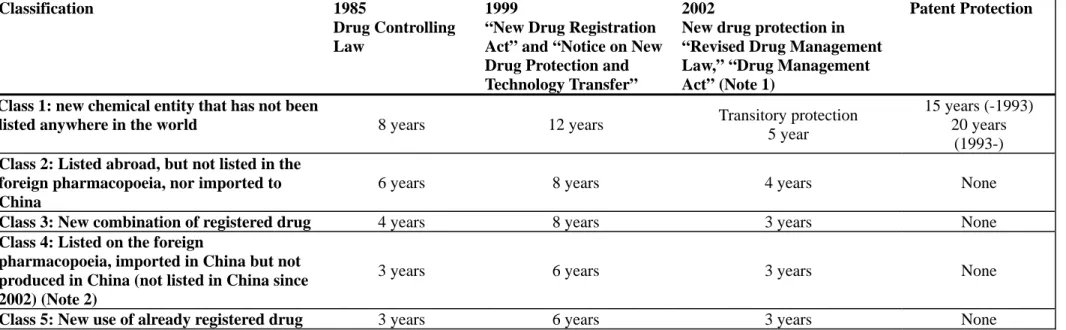
Table 1 shows the development of new drug protection: from 1999 to 2002, market exclusivity given to a new chemical entity (class 1) was as long as 12 years. This could be longer than patent protection on some occasions, as the patent protection period was counted from the date of application, not of product listing. Usually, the patent is applied for when research and development is underway, and it will take several years to list the new drug products after completing clinical tests. Thus, the protection period for new drugs could be longer than the patent protection.
In 2002, “New Drug Protection” was replaced with the “New Drug Monitoring scheme.” Upon re-entry into the WTO, new drug protection became inconsistent with the idea of intellectual property protection systems under TRIPS. Because of these circumstances, the Act was revised to be consistent with international customs: first, market exclusivity was not provided manufacturers’ introduction of a new technology, but instead is provided when responsibility to monitor the safety and effectiveness of the drugs is undertaken in exchange for market exclusivity. Secondly, the definition of “new drugs” was changed from “those not produced in China” to “ those not listed in China.” The New Drug Monitoring Scheme was planned to monitor new drugs for safety and effectiveness, by providing market exclusivity to the supplier of that new drug. However, the
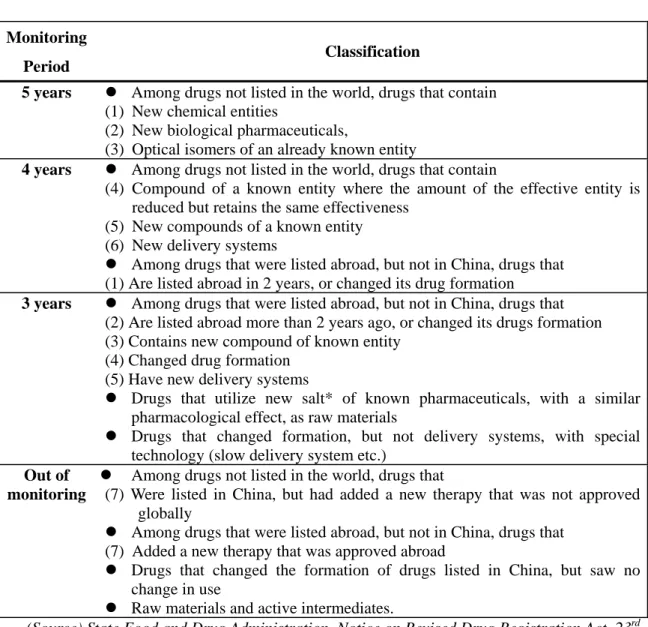
period of market exclusivity was reduced from 12 years to 5 years for the Class 1 new chemical entities, and raw materials and active/intermediate were taken off the monitoring list (Table 2). Thirdly, data on new drugs, which was submitted by the drug’s developer, became legally protected, which it previously had not been.
As a whole, property protection for pharmaceuticals was strengthened and become consistent with the current international standards.
Table 1: Market Exclusivity Under the New Drug and Patent Protections (Chemical Drugs)
Classification 1985
Drug Controlling Law
1999
“New Drug Registration Act” and “Notice on New Drug Protection and Technology Transfer”
2002
New drug protection in
“Revised Drug Management Law,” “Drug Management Act” (Note 1)
Patent Protection
Class 1: new chemical entity that has not been
listed anywhere in the world 8 years 12 years Transitory protection
5 year
15 years (-1993) 20 years
(1993-) Class 2: Listed abroad, but not listed in the
foreign pharmacopoeia, nor imported to China
6 years 8 years 4 years None
Class 3: New combination of registered drug 4 years 8 years 3 years None
Class 4: Listed on the foreign
pharmacopoeia, imported in China but not produced in China (not listed in China since 2002) (Note 2)
3 years 6 years 3 years None
Class 5: New use of already registered drug 3 years 6 years 3 years None
(Source) Related regulation and Deng and Kaitin [2004]
(Note 1) On introduction of the “Revised Drug Management Law” and “Drug Management Act” in 2002, “new drug protection” was abolished, and the “new drug monitoring” period was introduced in 2002. The following transitional measures were taken: 1) drugs that passed clinical tests on 15th September 2002, were given market exclusivity for the period of “new drug protection” in the 1999 scheme. 2) Drugs that were applied for to the government, but had not passed a clinical test yet, nor sold in China, were given a “monitoring period” in the new 2002 scheme. (Note 2) The class 4 category is unique in China to set up for protecting domestic firms in securing a sufficient supply of pharmaceuticals. The 1999 Drug Application Act provided 8 types in this category:
(1) Raw materials, Intermediate, and drugs listed on the foreign pharmacopoeia.
(2) Raw materials and intermediate and/or drugs already imported in China (drugs that was manufactured by the raw materials or intermediate which was imported for research and development are categorized here.)
(3) Any drug or its optical isomer whose synthesis method is already know and registered abroad.
(4) Any drug that utilizes acid or alkali or replaces metal elements of a drug already sold in China, or holds a similar pharmacology mechanism.
(5) Compound or change of drug formation of a drug that is listed in abroad.
(6) Drug that is manufactured from imported raw materials.
(7) Drug that changed drug formation.
(8) Drug that changed use
Table 2: Monitoring Period in “Notice Related to Revised Drug Registration Act”
Monitoring
Period Classification
5 years Among drugs not listed in the world, drugs that contain (1) New chemical entities
(2) New biological pharmaceuticals,
(3) Optical isomers of an already known entity
4 years Among drugs not listed in the world, drugs that contain
(4) Compound of a known entity where the amount of the effective entity is reduced but retains the same effectiveness
(5) New compounds of a known entity (6) New delivery systems
Among drugs that were listed abroad, but not in China, drugs that (1) Are listed abroad in 2 years, or changed its drug formation
3 years Among drugs that were listed abroad, but not in China, drugs that (2) Are listed abroad more than 2 years ago, or changed its drugs formation (3) Contains new compound of known entity
(4) Changed drug formation (5) Have new delivery systems
Drugs that utilize new salt* of known pharmaceuticals, with a similar pharmacological effect, as raw materials
Drugs that changed formation, but not delivery systems, with special technology (slow delivery system etc.)
Out of monitoring
Among drugs not listed in the world, drugs that
(7) Were listed in China, but had added a new therapy that was not approved globally
Among drugs that were listed abroad, but not in China, drugs that (7) Added a new therapy that was approved abroad
Drugs that changed the formation of drugs listed in China, but saw no change in use
Raw materials and active intermediates.
(Source) State Food and Drug Administration, Notice on Revised Drug Registration Act, 23rd June, 2005 (Note *) Salt is a material that is produced by an acid base reaction.
2.2 Outcome of “the New Drug Protection”
Criticism over inconsistencies in patent protection and the new drug protection was strong, and finally new drug protection was removed in 2002. The policy had the following outcomes: first, numerous Chinese firms invested in the industry, and started the production of drugs for 20 years and succeeded in meeting the basic needs of
“new drug” approval in China was separate from the outcome of actual research and development, as the policy designed to induce technological introduction was more or equally profitable to the actual research and development.
Table 3 shows the number of “approved new drugs” in China and the US. The number of new drugs approved in China is extraordinary larger than the US, taking into account that these drugs were introduced as part of a program to catch up with world. In worldwide trends, the number of new drugs discovered is decreasing. One respondent in our interview said that it was the time for synthesis technology to reach its limit, and that a new technological breakthrough seems to be necessary for the pharmaceutical industry.
Table 3: “New Drugs” Approved by Authorities in China and the US
2003 2004 2005
China Class 1 new drug 76 91 212
Actual # of new entities 11 24 17
US FDA approved new chemical entities 3
(Source) China: The industrial map of China Pharmaceuticals 2006-07, Social Sciences Academic Press. Caijing Magazine, 16th April, 2007, p.66.
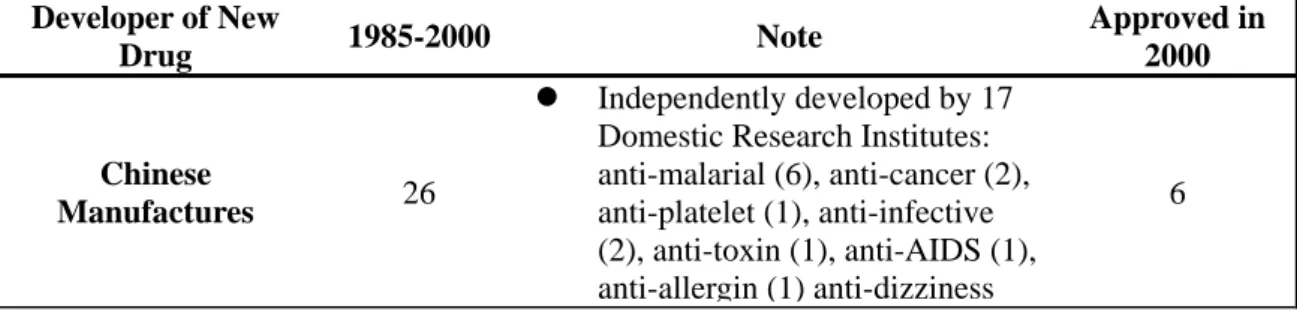
Table 4 demonstrates the development of a number of new chemical entities (Class 1 new drugs). Here we can see that number of new drug approved increased explosively since 2000, when 17 Class 1 drugs were approved, though only 23 were approved between 1985 - 1999. This implies that explosive registration of new drugs might be related to the corruption of the ex Director of the SFDA, who was arrested in 2006.
Table 4: New Chemical Entities Approved as Class 1 drugs between 1985-2000
Developer of New
Drug 1985-2000 Note Approved in
2000
Chinese
Manufactures 26
Independently developed by 17 Domestic Research Institutes:
anti-malarial (6), anti-cancer (2), anti-platelet (1), anti-infective (2), anti-toxin (1), anti-AIDS (1), anti-allergin (1) anti-dizziness
6
(1), abortifacient (2) and cardio-protective (1))
Developed by domestic research institutes based on the
information provided in foreign publications at the outset of the research program.
Foreign Manufactures (including joint
ventures with domestic maker)
12 10
Outsourced manufacturing by domestic maker to foreign research and
development firms
2 1
Total 40 17
(Source) Deng and Kaitin [2004]
Thirdly, a large number of new drugs have provided huge room for Chinese pharmaceutical firms to enter and operate in the industry, which has brought about sufficient production capacity in the industry. However, as the new drug protection could be more profitable to research and development at a certain moment, the pharmaceutical firms are less interested in research and development, although this activity requires long periods and sensitive management to induce scientists’ inspiration and abilities. This could have induced the current reduction in investment in innovation that is greatly worrying the Chinese government.
2.3 Relationship between Patent Protection and New Drug Protection
This section covers the “new drug protection policy” in detail. This is because new drug protection might open up patent protection, if it is provided without any connection to patent protection. Figure 10 defines the “market exclusivity protection period” by both patent and new drug protections. In accordance with global practices, patent protection will be provided from the date of a new drug’s application. Usually the patent is applied for during a stage of research, and it would take several years to list the products after completing the rest of the research work and clinical trials. If it takes 10 years between application and listing, 10 years’ exclusive market protection remains for
is provided since the date of listing. If the period for new drug protection is long enough, it effectively provides a longer protection period than patent protection.
Figure 10: Patent Protection and New Drug Protection (a) Patent Protection
Protection Period 15 years: 1987-1993
20 years: 1993-
Application Listing Date
(b) New Drug Protection
Protection Period (Class 1 New Drug) 8 years: 1985- 1999
12 years: 1999-2002 5 years: 2002-
Listing Date
(Source) Author
This confusing situation seems to have actually occurred from 1999 to 2002, when the
“Notice on New Drug Protection and Technology Transfer” was effective: the protection period of class 1 drug was as long as 12 years. Quite a few firms only applied for the new drug document, as its protection period was longer than the patent protection itself.
Furthermore, as the new drug protection did not explicitly require patent application, generic manufacturers could apply for new drug protection by following the work of a published paper and any other publication written by the innovator. This effectively weakened patent protection.
On the entry into WTO, the “Notice on New Drug Protection and Technology Transfer”
was invalidated, and currently market exclusivity is provided based on the “Monitoring Period of New Drug’s Side Effects.” The longer protection for new drug provided in 1999 to 2002 are now expiring, but its impact over the industry remains.
(Mariko WATANABE)
3. Innovation Promotion Policies
In the following subsections, we introduce several major factors that significantly affect the Chinese pharmaceutical industry’s innovative activities. Other than (1) policies directly encouraging innovation, (2) introduction of Drug Catalogues and (3) Price regulation policy substantially affect innovation incentives. We skip (2) and (3) as they are detailed in a separate section of this report: Drug Catalogues (Chapter 1: Demand) and Pricing Policy (Chapter 2: Price Setting Institutions).
3.1. Innovation-Encouragement Policies
There are a series of innovation-encouragement policies, which provide a great incentive for Chinese pharmaceutical firms to take up innovation activities. For example, the Chinese government has announced and implemented policies of revenue-encouragement, tax-incentives, direct financial aid, government purchasing, and increasing IPR protection, among others, to benefit the development of innovation in the pharmaceutical industry. Some of the detailed measures include:
1. Increased direct investment in pharmaceutical science and technical innovation, in order to build a pharmaceutical innovative system that is market-oriented, consists of enterprises as a main body, and combines the industry, universities, and institutes together to innovate;
2. Encouraging and supporting enterprises in setting up R&D centers by means of a series of favorable measures, such as tax credits or concessions, speeding up the depreciation of R&D facilities and equipments, etc;
3. Establishing and improving certain public platforms (for example, the public technology support platform of the pharmaceutical industry, the industrialization support platform, the pioneering service platform and the environmental policy platform) to help firms reach their innovation objectives;
4. Encouraging firms to provide effective and marketable innovative products by means of demand-encouragement, such as government purchasing;
5. Patent protection for pharmaceuticals became law in China in 1993, which is greatly encouraging firms to carry out more and more innovative activities.
References
International Research Center for Medicinal Administration [2006] Research on Distribution and Strategy of Domestic and Foreign Patents of Bio Technology and new Pharmaceutical Industry.