Mem. Fac. Agr. Kinki Univ. 29: 53~62 (996)
Steroid-Based SHG Material. I. Preparation
and Some Physical Properties of 4-Substituted-Benzylidene Derivatives of Estrone Methyl Ether, Dehydroepiandrosterone,
and Androsta-l,4-dine-3,17-dione
Seiji SANO·, Yuuji INOUE··, Ken'ichi ISHIGAKI", Masahiro TAKATAN[··, Makoto KAJ[··· and Tadashi OKAMOTO··
Synopsis
As a fundamental study searching for useful nonlinear optical material of secondary harmonic generation (SHG), the efficiency of regulation of parallel molecular arrangement by a steroidal subunit was examined by constructing a molecule having a large steroidal subunit attached with a conjugated 1T-electron system of substituted benzylidene group which contributes to generation of SHG. Starting from the three steroids shown in the title and 15 substituted benzaldehydes. 45 substituted benzylidenesteroid compounds were prepared and their physical properties were measured. This paper reports the syntheses and some properties such as electronic spectra and melting points of the products.
I. Introduction
Nonlinear optical material is a compound which is crucial for the development of photo
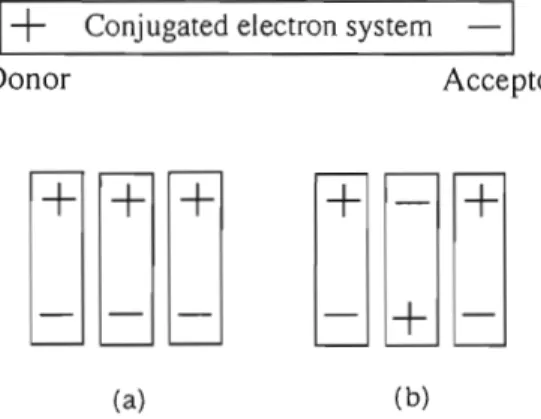
electronic devices in the future. I) One of the important properties of nonlinear optical effect is the second harmonic generation (SHG) which converts a laser light of high wavelength into a light of low wavelength (l/2 of original) inaccesible or hardly accessible directly. For the purpose of obtaining an efficient SHG material, two important conditions are known: One is the material of large molecular non-linear secondary optical susceptibility, /3, and the other is the parallel orientation of these molecules to prevent cancellation of the molecular effect (Fig. 1a). The former is satisfied by a molecule having an electronegative functional group at one end of a long-conjugated 1T-electron system and an electropositive group at the other end of conjugation (Fig. 2). However, this kind of compound has a large molecular dipole moment at the ground state, and this dipole induces the orientation of molecules in the antiparallel direction as shown in Figure lb. The positive end of a dipole attracts the negative end of the dipole of the adjacent molecule, cancelling the net polarization and SHG effect of the materia!.2l Therefore, the two requirements for large SHG effect described above are not easily satisfied by a planar molecule having a long conjugated 1T~electronsystem.
Our strategy toward this target is the construction of a parallel arrangement of molecules, each
Lab. or Wood Products, Graduate School ur Agriculture. Kinki Univ... ·ak.machi. Nara 631, J;.ll'an (l£Jf
=.
,,*lI!.flJIll~6lHIl: • ;a1lJ\:~ ~R.~i1 3!M.,...lt~.:w-!li:. ·>\Hlili"'llJ).. L.'b. or Natural High·Poll'm. Chern.. Dept. or Agri. Chern.. Kinki Univ.. Nakam3chi. Nara 631, Japan (#.tl!l_. EJil.-. illilH!lil!., IlII !J:, J<l'iillH 'f{l;~i1U. iIi.*~.~fII.~U~f'I. ~A1li<PIT)
... Ibaraki Research Lab.. Hitachi Chern. Ind. Co. LTD.• Hig iehu. Hitachi. Ibaraki 317. Japan (./!IN, OrLll:h£X 1!I<:<I:~tJ:;~*RiI,*ifi. BrL1liJl(IJ1
54
of which has an unsaturated subunit necessary for the generation of SHG (Fig. 3), by introducing a bulky and asymmetric steroid framework in the molecule. This type of material has one drawback, in principle, the dilution of the SHG effect by a bulky steroid group which is used only for the purpose of obtaining parallel orientation of the molecules and acts as a diluent of the SHG
I +
Conjugated electron system-I
Donor Acceptor
(a) (b)
Fig. 1 Molecular arrangement. (a) parallel, (b) antiparallel
+ + +
A ~om,"l
H
DFig.2 Supposed parallel arrangement of Fig.3 SHG active molecule. A, electron acceptor molecules assisted by steroid rings group; D, electron donor group
o 0
H3CO~ HO~
Estrone methyl ether (EME) Dehydroepiandrosterone (DA)
1,4-Androstadien-3, 17-dione (A) Fig. 4 Steroid substrates examined
Fig.5 Synthetic pathway
R=donor group (l\(CH,)" OCH" OCH" OC,H" CIi,. 3,4-(OCH,)" SCH,.
NliCOCH,), H, and acceptor group (C6H" F. CI, Br. CF" CN)
effect. However, if it is considered that even in an effective SHG material such as 2-methyl-4
nitroaniline,3l the effect of each molecure is not fully utilized in a bulk material because of some anti parallel arrangement involved. Our strategy is more likely to succeed in that the highly regulated parallel orientation of molecules might be attained by steroid groups and covers the decrease of molecular SUG effect due to dilution effect. To examine this idea, 45 compounds were prepared through condensation reaction of three steroids described in the title (Fig. 4) and 15 substituted benzaldehydes which are shown in Fig. 5. This paper describes the preparation and some physical properties of the condensed products.
II. Results and Discussion
Preparation of the compounds was carried out under alkaline reaction conditions using the three steroids indicated in the title and 15 substituted benzaldehydes. The substituents of the
Table 1. Substituents of benzaldehyde examined and its Hammett (J value
Donor Acceptor
R NMe, MeO BuO EtO Me (MeO), S Ie cNH H Ph F C1 Br CF, C
(J -0.60 -0.27
-
- -0.17 -0.t5 -0.05 -0.02 0.00 0.01 0.06 0.23 0.23 0.55 0.63Table 2. Physical constants of prepared benzylidenestf'roids a. Substituted ben7.ylidene strone methyl ether
'ubstituent NMe, Mea BuO Eta Me (~leO), SMe Ac'H H Ph F CI Sr CF, CN mp(' ) 219 t73 161 171 20 149 145 250 171 16] 150 144 172 148 217 A max(nm) 32.0310.2323.6323.8301.0333.2340.2367.2288.8321.6288. 303.0 298.8 286.2 296.4
b. Substituted benzylidenedehydroepiandro~lerone
'ubstituent NMe, Mea BuO EtO Ie NeOl, F CI Br CF, C
mp('C) 289 224 116 216 232 151 214 290 192 24 211 219 242 211 280 A rnax(nnl) 384.6322.2 324.0 323.8 303.8 334.6 33 .4 367.4 293.8320.6301.8296.2 299.2 2 6.0 298.2
c. Substituted benzylidpneandrostadienedione
Substituent .'Me. MeO BuO Eta M Ad\H H Ph F CI Br CF, eN
rnp('C) 244 251 206 195 296 176 271 >300 265 175 289 268 2.4 204 237 A rnax(nrn) 381.4 323.6 324.6 324.8 304.6 336.8 339.4 322.5293.0 321.5 299.4 297.4 295.02 5.2 29 .8
56
benzaldehydes are listed in Table 1 with each electron·donating or attracting property by the index of Hammett 11 value.')
The results of syntheses and some physical properties of the products are summarized in Table 2. The yields of products were moderate to excellent as shown in Table 2. There was no significant difference between the reactivities of the three steroids, indicating that small struc
tural changes in the A ring of steroid do not have meaningful influence on their reactivities.
Electronic spectra of the benzylidenesteroid showed a tendency of gradual change in the wave·
length of maximum absorption, Am • x , according to the electronic effect of the substituents on the benzylidene conjugation as indicated in the Table. Again, almost no significant difference in the absorption spectra was observed between the three steroid compounds. However, there are some exceptions when the Am • x is inspected in detail. The results suggest that there are differences in solvatochromic effect due to solvation, molecular association, hydrogen bonding, and so on, which may be discussed in detail when the results of the experiments, such as SHG efficiency and X ray crystallography of a single crystal of each compound, are available.
The regulation of molecular arrangements which is the end purpose of the present study cannot be discussed before knowing the SHG activities of these compounds. However, the substituent effect on the melting points of these compounds showed a rough tendency in accordance with the electronic effect of the substituent, suggesting rather regular arrangement of these molecules.
III. Experiment Reagents and Instuments
All reagents and solvents are used as received, unless otherwise stated. Steroids are GR-grade commercial product of Tokyo Kasei Chemical Co. Substituted benzaldehydes (4-methyl, 4·
methoxy, 4-chloro, 4-dimethylamino. and 3,4-dimethoxy derivatives) were purchased from Wako Chemical Co. 4-Cyanobenzaldehyde was the product of Aldrich Chemical Co., and 4-fluoro, 4
bromo, 4-methylthio, 4-ethoxy, 4-acetylamino, 4-butoxy, and 4-phenyl derivatives of benzalde·
hyde \\fere from the Tokyo Chemical Ind. Co., all of which were GR reagents. Benzaldehyde (EP grade reagent of Wako Purt' Chemical Ind. Co.) was used after single distillation under a nitrogen atmosphere. All other reagents and solvents are EP-grade reagents.
:'-lMR spectra were measured with a JOEL JNM-EX270 super magnet spectrophotometer. UV spectra were measured on a Shimazu UV -260 autograph. All melting points were measured by Yanagimoto melting point apparatus and the temperatures were uncorrected. Elemental Ana
lyses were carried out by the Analytical Laboratory of Institute for Chemical Research, Kyoto University.
Preparation
1) Synthesis of estrone methyl ether (EME), estrone 8.00 g (29.6 mmol) was dissolved in a 200 ml portion of THF in a 500 ml round bottom flask. The solution was cooled to S'C and 1.8 g of NaOH (27.6 mmol) and 6.4 g of methyl iodide (45.1 mmol) were added successively under stirring.
Then the reaction mixture was allowed to come to room temperature and stirring was continued for 20 hr. After making sure of the consumption of all estrone and the neutrality of the solution, THF was removed from the reaction mixture, and the residue was extracted with ethyl acetate/
water. The organic layer was washed with aqueous sodium bicarbonate and water three times each and dried over sodium sulfate overnight. After evaporation of the solvent, estrone methyl ether was obtained in a quantitative yield (8.5 g). Recrystallization from benzene·ethanol produced a colorless rhombohedra I prism, m.p. 171-17S'C.
2) Synthesis of benzylideneestrone methyl ether (BEME). In a 200 ml round bottom flask EME
(1.00 g, 3.53 mmoI), benzaldehyde (470 mg, 4.4 mmoI) , 4 ml of 2% aqueous NaOH solution, and a 100 ml portion of methanol were combined. The reaction mixture was stirred under reflux at 70' C for 2 h. After confirming the end of the reaction by TLC (eluent; ethyl acetate/hexane= 1/2), the reaction mixture was neutralized with 2 N HCI, and concentrated to about 50 ml. The concentrated solution was added to a 250 ml portion of water, saturated aqueous NaCI solution was added, and the mixture was kept at room temperature for crystallization. The crystalline product was then collected through filtration, washed several times with water, and air·dried to obtain 1.08 g (82.2%) of benzylideneestrone methyl ether. After recrystallization from ethanol, it is obtained as colorless needles, yield, 0.56 g, 42.2'\;; m.p.171"C.
3) Synthesis of 4'-methylbenzylideneestrone methyl ether (Me-BEME). In a 200 ml round bottom flask EME (1.00 g, 3.53 mmoI) , 4-methylbenzaldehyde (500 mg, 4.2 mmoI), 4 ml of 2%
agueous NaOH solution, and a 100 ml portion of 2-butanol were combined. The reaction mixture was stirred at 70'C for 2 h. After confirming the end of the reaction by TLC (eluent; ethyl acetate/hexane= 1/2), the reaction mixture was neutralized with 2 I\ HCI, and concentrated to about 50 ml of volume. The concentrated solution was extracted with ethyl acetate/water. The organic layer was washed successively with sodium bicarbonate and water three times each, and dried over sodium sulfate overnight. After evaporation of the solvent, the crude product was 1.03 g (75.2%) of benzylideneestrone methyl ether. Recrystallization of the product from ethanol produced :v1e- BE:v1E as colorless needles, yield 0.91 g, 66.7% ; m.p.207-209'C.
4) Synthesis of 4'-methoxybenzylideneestrone methyl ether (:'vleO-SEME). The procedure was the same as 3.2.3 except for the use of j-methoxybenzaldehyde (694 mg, 5.1 mmol), 2 m) of 10%
:--iaOH, and 90 ml of 2-butanol, and the reaction was continued for 7 h. The yield of crude product was 1.51 g, 106%, and, after recrystallization from ethanol, the product was obtained as colorless needles. Yield was 0.70 g, -18.9% ; m.p. 172-173'C.
5) Synthesis of 4'-chlorobenzylideneestrone methyl ether (CI-SEME). The procedure was the same as above except for the use of 4~chlorobenzaldehyde(5.1 g. 3.6 mmoI) and 2 ml of 10%
NaOH, and the reaction was cuntinued for 5 h. The yield of crude product was 1.27 g, 88%, and after recrystallization from ethanol, the product was obtained as colorless needles. Yield was 0.75 g 52%; m.p.144-l45'C.
6) Synthesis of 4'-dimcthylaminobenzylideneestrone methyl ether (Me2 -SEME). The proce·
dure was the same as 3.2.3 except for the use of -I dimethylaminobenzaldehyde (550 mg, 3.7 mmoI) and the reaction was continued for 8 h. The yield of crude product was 1.55 g, 106%, and after recrystallization in ethanol, the product was obtained as yellow needles. Yield was 0.81 g, 56% ; m.p. 21 -223'C.
7) Synthesis of 3',4'-dimethoxybenzylideneestrone methyl ether (Di:'vleO-BEME). The proce·
dure was the same as described in 3.2.2 except for the use of 3,4-dimethoxybenzaldehyde (636 mg, 3.8 mmoI) and 4 ml of 10% NaOH, and the reaction was continued for 20 h. The yield of crude product was 1.73 g, 133%, and after recrystallization from methanol. the product was obtained as colorless needles. M.p. 144-153"C.
8) Synthesis of 4'-cyanobenzylideneestrone methyl ether (CN-BEME). The procedure was the same as 3.2.2 except for the use of 4-cyanobenzaldehyde (480 mg, 3.7 mmoJ) and 3 m] of 50%
NaOH, and the reaction was continued for 21 h. The yield of crude product was 1.48 g, 105%, and after recrystallization from ethyl acetatC', the product was obtained as pale yellow needles. Yield was l.l~~ g, 81 %. m.p.215-218"C.
9) Synthesis of 4'-trifluoromethylbenzylideneestrone methyl ether (CF3-BEME). The reaction was started as 3.2.3 except for the U~L:of 4-trifluoromethylbenzaldehyde (1.55 g, 8.8 mmol) and 4 ml of 10% NaOH. The reaction was continued for 46 h with occasional addition of 2-butanol totalling 85 ml. The yield of crude product was 2.33 g, 150%, and after recrystallization from ethyl acetate, the product was obtained as colorless needles. Yield was 0.63 g, 40~o ; m.p. l47~ 150'
58 C.
10) Synthesis of 4'-fluorobenzyJideneestrone methyl ether (F - BEME). The procedure was the same as 3.2.2 except for the use of 4-fluorobenzaldehyde (510 mg, 3.6 mmol). 200 ml of methanol, and 4 ml of 10% 1\"aOH, and the reaction was continued for 29 h. The yield of crude product was 1.25 g, 87%. and after recrystallization from ethyl acetate the product was obtained as pale yellow needles. Yield was 0.79 g. 55%; m.p. 139-163'C.
11) Synthesis of 4'-bromobenzylideneestrone methyl ether (Br-BE:\IE). The procedure was the same as 3.2.2 except for the use of 4-bromobenzaldehyde (660 mg, 3.6 mmol), 200 ml of methanol, and 2 ml of 10% aOH, and the reaction was continued for 8 h. The yield of crude product was 1.47 g, 92%. and after recrystallization from ethyl acetate, the product was obtained as pale yellow needles. Yield was 1.15 g, 72%; m.p. 169· 1'liJ'C.
12) Synthesis of 4'- methylthiobenzylideneestrone methyl ether ( 1eS-BEME). The procedure was the same as 3.2.2 except for the use of 4-methylthiobenzaldehyde (600 mg, 3.9 mmol) and 2 ml of 10% NaOH, and the reaction was continued for 20 h. The yield of crude product was 1.44 g, 97%, and after recrystallization from ethyl acetate. the product was obtained as pale yellow needles. Yield was 10.97 g. 65%; m.p. 1,14-145"C.
13) Synthesis of 4' ethoxybenzylidencc:strone methyl ether (EtO-BE. 1E). The procedure was the same as 3.2.12 except for the use of " ethoxybenzaldehyde (66u mg, 4.4 mmol) and the reaction was continued for 26 h. After recrystallization of the crude product from ethyl acetate, the product was obtained as pale yellow needles. Yield was 0.65 g. 44% ; m.p. 168-175'C.
14) Synth sis of 4' acetylaminobenzylidenecstrone methyl ether (AcNH - BEME). The proce·
dure was the same as 3.2.12 except for the u!'e of 4· acetylaminobenzaldehyde (590 mg, 3.6 mmol) and the reaction was continued for 18 h. After recrystallization of the crude product (1.23 g. 81 %)
f1'0111 chloroform·methanol, the product was obtained as yellow needl . Yield wa 0.60 g, 40% ;
m.p.247-2-3'C.
15) Synthesi of 4' -buloxybenzylideneestrone methyl ether (BuO- BEJ\.IE). The procedure was the same as 3.2.12 except for the use of 4-butoxybenzaldehydc (657 mg, 3.7 mmol) and 0.5 ml of 50% aOH, and the readion was continued for :.'4 h. Aft I' recrystallization of the crude product (1.46 g, 93%) from methanol. the product was obtained as calorie needI s. Yield was 0.56 g, 35% ; m.p.161'C.
16) Synthesi of 4'-phenylbenzylideneestrone methyl ether (Ph -BEME). The procedure was the same as 3.2.12 xcept for the us of 4·phenylbenzaldehyde (646 mg, 3.6 mmol) and 5 ml of 50%
NaOH, and the reaction was continued for 93 h. Aft I' recrystallization of the crude product (1.56 g,99%) frOIll ethyl acetate, the product'" as obtained as calorIe"" crystals. Yi ld was 1.36 g, 8 % ; m.p. [61'C.
(7) Synthe is of benzylidenedehydroepiandrosterone (BDA). In a 200 ml round bottom flask a mixture of dehydroepiandrosterone (DA) 1.00 g (3.47 mmo]) , benzaldehyde U.75 g (7.1 mmol). I 1111 of 50% NaOH, and 100 ml of m thanol was refluxed at 70'C for 17 h under stirring. Aft I'
completion of the reaction was ensured by TLC (eluent; ethyl ac tate/h xane= 1/2), the reac·
tiun mixture was neutralized with 2 N HCI and concentrated to the volume of gO ml under reduced pres!'ure. The concentrate was added to a flask containing 200 ml of distilled water. brine was added to the mixture, and it was kept at room temperature. The crystalline which appeared was collected by filtration, washed thoroughly with water, and air·dried to obtain the crude product lAO g 007%). Recrystallization of the crude woduct from methanol produced the product <15 pale colorl fiber. Yield was 0.46 g. 36%; m.p.189-194'(.
1) Synthesis of 4' methylbenzylidenedehydroepiandrosterone I :\ire-BDA). The procedure was the same as 3.2.17 except for the use of 4 -methylbenzal,dehyde (R57 mg, 7.] mmol). The yield of crude product was 1.40 g, 103%, and after recrystallization from ethanol. the product was obtained as colorle fiber. Yield was 1.10 g, 82%; m.p.229-235"C.
19) Synthesis of 4"-methoxybenzylidenedehydroepiandrosterone (MeO- BOA). The procedure was the same as 3.2.17 except for the use of 4~methoxylbenzaldehyde(763 mg, 5.6 mmoJ) and 2 ml of 50% NaOH. The yield of crude product was 1.35 g, 96%, and after recrystallization from ethanol, the product was obtained as colorless needles. Yield was 0.99 g, 70% ; m.p.222-226'C.
20) Synthesis of 4'-chlorobenzylidenedehydroepiandrosterone (CI-BOA). The procedure was the same as 3.2.19 except for the use of 4~chlorobenzaldehyde (585 mg, 4.2 mmoJ) and the reaction was continued for 2U h. The yield of crude product was 1.40 g, 99%, and after recrystallization from ethanol, the product was obtained as colorless needles. Yield was 1.28 g, 90% ; m.p. 217~222'
C.
21) Synthesis of II'-dil11ethylaminobenzylidenedehydroepiandrosterone (Mezi\' - BOA). The procedure was the same as 3.2.19 except for the use of 4-dimethylaminobenzaldehyde (619 mg, 4.2 mmoI) and the reaction was continued for 27 h. The yield of crude product was 1.02 g, 70%, and after recrystallization from ethyl acetate the product was obtained as yellow needles. Yield was 0.14 g, 9% ; m.p.285-292'C.
22) Synthesis of 3'A'-dimethoxybenzylidenedehydroepiandrosterone (OiMeO~BOA). The pro- cedure was the same as 3.2.19 except for the use of 3,4-dimethoxybenzaldehyde (690 mg, 4.2 mmol) and the reaction was continued for 49 h. The yield of crude product was 1.46 g, 94%, and after recrystallization from ethanol, the product was obtained as pale brown· yellow fiber. Yield was 0.47 g, 31%; m.p.150-153·C.
23) Synthesis of 4'-cyanobenzylidenedehydroepiandrosterone (CN - BOA). The procedure was the same as 3.2.19 except for the use of 4-cyanobenzaldehyde (460 mg, 3.5 mmol) and the reaction was continued for 22 h. The yield of crude product was 1.28 g, 92%, and after recrystallization from ethyl acetate, the product was obtained as pale yellow crystals. Yield was 0.5 g, 36°'6; m.
p.277-282·C.
24) Synthesis of 4'-trifluoromethylbenzylidenedehydroepiandrosterone (CF3-BDA). The proce·
dure was the same as 3.2.19 except for the use of 4-trifluoromethylbenzaldehyde (766 mg, 4.4 ml11ol) and 3 ml of 50% l':aOH, and the reaction was continued for 15 h. The yield of crude product was 1.57 g, 102%, and after recrystallization from ethanol. the product was obtained as colorles fiber. Yield wa 1.15 g, 75% ; m.p.209-212'C.
25) Synthesis of 4' ~f1uorobenzylidenedehydroepiandrosterone (F - BOA). The procedure was the same as 3.2.19 except for the use of 4-fluorobenzaldehyde (707 mg, 5.0 mmoI) and the reaction was continued fur 18 h. Thp yield of crude product was 1.00 g, 70%. and after recrystallization from ethanol. the product was obtained as calorle fiber. Yield was 0.71 g, 50% ; m.p.208-214' C.
26) Synthesi~ of 4'-bromobenzylidenedehydroepiandrosterone (Br- BOA). The procedure was the same as 3.2.19 eXl'ppt for the use of .j hromobenzaldehyde (650 mg, 3.5 mmol) and reaction was continued for 23 h. The yield of crude product was Ul g, 90%, and after recrystallization from ethanol. the product was obtained as colorless fiber. Yield was 1.22 g, 78% ; m.p.238-246·
C.
27) Synthesi of 4' -methylthiobenzyliclcnedehydroepiandrosterone ( leS- BOA). The procedure was the same as 3.2.19 except for the USt' of 4-m thylthiobenzaldehyde (554 mg. 3.6 mmol) and 6 ml of 50% I aOH. and the reaction was continued for 18 h. The yield of crude product was 1.39 g, 95%, and aft r recrystallizati(ln from ethanol, the product was obtained as colorless needles, Yield was 1.37 g, 94% ; m.p.212·21 C.
28) Synthesis of 4' -ethoxybenzylidenedehydroepiandrosterone (EtO- BOA). The procedure was the same as ;U.27 except ior the use of 4-ethoxybenzaldehyde (530 mg, 3.5 mmol) and the reaction was continued for 61 h. The yield of crude product was 1.43 g, 98%, and after recrystall·
ization from ethanol, the product wa~ obtained as colorless fiber. Yield was 0.97 g, 67% ; m.p.214 -21ST.
60
29) Synthesis of 4'-acetylaminobenzylidenedehydroepiandrosterone (AcNH-BOA). The proce- dure was the same as 3.2.27 except for the use of 4~acetylaminobenzaldehyde(739 mg, 4.5 mmol).
The yield of crude product was 1.29 g, 86%, and after recrystallization from ethyl acetate, the product was obtained as yellow needles. Yield was 1.07 g, 71 %, m.p. 287-293°C.
30) Synthesis of 4' -butoxybenzylidenedehydroepiandrosterone (BuO- BOA). The procedure was the same as 3.2.27 except for the use of 4-butoxybenzaldehyde (632 mg, 3.6 mmol) and 2.5 ml of 25% I\'aOH, and the reaction was continued for 24 h. The yield of crude product was 1.47 g, 95%, and after recrystallization from ethanol, the product was obtained as colorless fiber. Yield was 1.21 g, 78% ; m.p. 1l0-122°C.
31) Synthesis of 4' -phenylbenzylidenedehydroepiandrosterone (Ph-BOA). The procedure was the same as 3.2.27 except for the use of 4-phenylbenzaldehyde (637 mg, 3.5 mmol) and the reaction was continued for 95 h. The yield of crude product was 1.53 g, 98%, and after recrystallization from ethanol, the product was obtained as colorless fiber. Yield was 0.99 g, 63%; m.p.246-250°C.
32) Synthesis of benzylideneandrostadienedione (BA). The procedure was the same as 3.2.17 except for the use of androsta-l,4-diene-3,17~dione(A) 1.00 g (3.52 mmol) and 1 ml of 25%
:\aOH, and the reaction was continued for 14 h. The yield of crude product was 1.24 g, 95%, and after recrystallization from methanol, the product was obtained as colorless plates. Yield, 1.16 g, 88%; m.p.265°C.
33) Synthesis of 4'-methylbenzylideneandrostadienedione (Me BA). The procedure was the same as 3.2.32 except for the use of 4~methylbenzaldehyde (505 mg, 4.2 mmol) and the reaction was continued for 7 h. The yield of crude product was 1.07 g, 79%, and after recrystallization from methanol, the product was obtained as colorless plates. Yield was 0.78 g, 57%; m.p.295- 29T(,
34) Synthesis of 4' -methoxybenzylideneandrostadit'nedione (MeO- BA). The procedure was the same as 3.2.32 except for the use of 4-methoxybenzaldehyde (500 mg, 3.7 mmol) and the reaction was continued for 8 h. The yield of crude product was 1.46 g, 103%, and after recrystallization from methanol, the product was obtained as colorless plates. Yield was 0.44 g, 31%; m.p.
250·2S2°C.
35) Synthesis of 4' -chlorobenzylideneandrostadienedione (CI' BA). The procedure was the same as 3.2.32 except for the use of 4-chlorobenzaldehyde (555 mg, 4.0 mmol) and the reaction was continued for 14 h. The yield of crude product was 1.35 g, 94%, and after recrystallization from methanol, the product was obtained as colorless prisms. Yield was 1.27 g,89%; m.p.226- 270°C.
36) Synthesis of 4' -dimethylaminobenzylideneandrostadienedione (Yle, N·BA). The procedure was the same as 3.2.32 except for the use of 4-'dimethylaminobenzaldehyde (549 mg, 3.7 mmol) and the reaction was continued for 45 h. The yield of crude product was 0.92 g. 63"0' Because suitable solvent for recrystallization of this product was not found, it was washt'd repeatedly with water. M.p.244°C.
37) Synthesis of 3',4' -dimethoxybenzylideneandrostadienedione (DiMeO- BA). The procedure was the same as 3.2.32 except for the use of 3',4'-dimethoxybenzaldehyde (619 mg, 3.7 mmol) and 2 ml of 25% NaOH, and the reaction was continued for 45 h. The yield of crude product was 1.36 g, 90llo , and after recrystallization from methanol, the product was obtained as colorless plates.
Yield was 1.24 g, 82% ; m.p. 17o-I7o"C.
3M) Synthesis of 4' cyanobenzylideneandrostadienedione (C -BA). The procedure was the same as 3.2.37 except for the use of 4-cyanobenzaldehyde (499 mg, 3.8 mmo1) and the reaction was continued for 23 h. The yield of crude product was 1.30 g, 93%. Again, no suitable solvent for recrystallization was found for this product. M.p.
23rc.
39) Synthesis of 4' -trifluoromethylbenzylideneandrostadienedione (CF3-BA). The procedure was the same as 3.2.3l except for the us of 4-trifluoromethylbenzaldehyde (559 mg, 3.2 mmol)
and the reaction was continued for 23 h. The yield of crude product was 1.27 g, 103%, and after recrystallization from ethanol, the product was obtained as colorless needles. Yield was 0.33 g, 27%; m.p. 203-204°C.
40) Synthesis of 4'-fluorobenzylideneandrostadienedione (F-BA). The procedure was the same as 3.2.32 except for the use of 4-fluorobenzaldehyde (460 mg, 3.2 mmol) and 1 ml of 25% ]:\;aOH, and the reaction was continued for 17 h. The yield of crude product was 1.20 g, 105%, and after recrystallization from ethanol, the product was obtained as colorless prisms. Yield was 1.08 g, 94% ; m.p.286-292°C.
41) Synthesis of 4-'-bromobenzylideneandrostadienedione (Br- BA). The procedure was the same as 3.2.40 except for the use of 4-bromobenzaldehyde (555 mg, 3.0 mmol). The yield of crude product was 0.81 g, 64%, and after recrystallization from ethyl acetate, the product was obtained as colorless plates. Yield was 0.64 g, 51 %; m.p. 253-255°e.
42) Synthesis of 4' -methylthiobenzylideneandrostadienedione (!\tIeS-BA). The procedure was the same as 3.2.40 except for the use of 4-methylthiobenzaldehyde (560 mg, 3.7 mmol) and the reaction was continued for 19 h. The yield of crude product was 1.12 g, 95%, and after recrystall- ization from methanol, the product was obtained as pale yellow plates. Yield was 0.83 g, 70% ; m.p. 268-273°C.
43) Synthesis of 4' -ethoxybenzylideneandrostadienedione (EtO-BA). The procedure was the same as 3.2.40 except for the use of 4~ethoxybenzaldehyde(440 mg, 2.9 mmol) and the reaction was continued for 19 h. The yield of crude product was 1.43 g, 99%, and after recrystallization from methanol, the product was obtained as colorless plates. Yield was 0.72 g, 62%; m.p.194- 196OC.
44) Synthesis of 4'-acetyJaminobenzylideneandrostadienedione (Ac:--lH - BA). The procedure was the same as 3.2.40 except for the use of 4-acetylaminobenzaldehyde (599 mg, 3.7 mmol) and the reaction was continued for 48 h. The yield of crude product was 1.22 g, 81% ; m.p.300·C.
45) Synthesis of 4'-butoxybenzylideneandrostadienedione (BuO-BA). The procedure was the same as 3.2.32 except for the use of 4-butoxybenzaldehyde (637 mg, 3.8 mmol) and 2.5 ml of 25%
~aOH, and the reaction was continued for 48 h. The yield of crude product was 1.47 g, 94%. and after recrystallization from ethanol, the product was obtained as colorless plates. Yield was 1.09 g, 70% ; m.p.206"C.
46) Synthesis of 4' -phenylbenzylideneandrostadienedione (Ph- BA). The procedure was the same as 3.2.32 except for the use of 800 mg (2.81 mmol) of steroid, 530 mg (2.9 mmol) of 4- phenylbenzaJdehyde and the reaction was continued for 48 h. The yield of crude product was 1.25 g, 99% ; m.p. 175°e.
References
1) O. Pugh and ].:--1. Shewood, Chemistry in B,itain, 24, 544-548 (1988).
2) R.B. Grubbs, S.R. Marder, and j,W. Perry, Chemistry
0/
Maten'als, 3, 3-4 (1991).3) B.F. Levine, e.G. Bethea, C.O. Thurmond, R.T. Lunch, and ].L. Bernstein, ]. Appl. Phys., 50, 2523-2527 (1979).
4) N.B. Chapman and]. Shorter, in "Advan. Linear Free Energy Relationship", 28-32, Plenum Press, London, (1972).
62 近畿大学農学部紀要 第 29号 (1996)
ステロイ ドを原料 とす る SHG 物質 (Ⅰ),エス トロンメチルエーテル, デ ヒ ドロエ ピア ン ドロステ ロン, ア ン ドロスタジェ ンジオ ンの
4 ‑置換ベ ンジ リデ ン誘 導体 の合成 とその性質
佐野誠二 ・井上裕二 ・石垣健一 ・ 高谷政弘 ・鍛治誠 ・岡本忠
要 糸勺 時得 られ る。本研究 は, ステ ロイ ド系天然物 の もつ 近年急速 に発展 した光エ レ クトロニ クスの分野で 非対称柵造 を分子配列 の制 御 に利用 す る SHG材料 は, レーザー波長 を自由に変換で きる素子 として非 開発 の可能性 について,表題 の三蔵 のステ ロイ ドと 線形光学材料が注 ETを媒 め,中で もL/‑ザー波長 を 15種 のベ ンズアルデ ヒ ドとか ら45種のfE換ベ ンジ リ
1/2に変換 す る第 2高調波発生 (SHG)に期待が よせ デ ンステ ロイ ドを合舵 して検討 を行 な った。本報告 られ てい る。大 きなSHGを持 つ材料 は,大 きな2次 は合成 と物性 の一部 を報告す る。
非線形分子分極率 (β)を持 つ分子が同一方向に並ぶ