Bi-crystals and crystal (GL(V ), GL(W )) duality
Vladimir I. Danilov and Gleb A. Koshevoy May 17, 2004
1 Introduction
Consider the tensor product of finite dimensional vector spaces V ⊗W. We have an action ofGL(V) on V ⊗W induced by standard action on V. Similarly the action of GL(W) on W gives us an action onV ⊗W. These actions ofGL(V) andGL(W) onV⊗W clearly commute with one another, so we have a joint action ofGL(V)×GL(W) on V ⊗W.
Let S•(V) and Λ•(V) denote the symmetric and exterior algebras on V, respectively. It is standard that the action of GL(V) gives rise to an action on S•(V) and Λ•(V) by algebra homomorphism. We can consider the restriction of the action of GL(V ⊗W) onS•(V ⊗W) (or Λ•(V ⊗W)) to GL(V) ×GL(W). For this action we have explicit decompositions of S•(V ⊗W) and Λ•(V ⊗W) into irreducible modules (see, for example [5]):
S•(V ⊗W)∼=
λ
Vλ⊗Wλ, (1)
Λ•(V ⊗W)∼=
λ
Vλ⊗Wλ, (2)
where summation is running over all partitionsλ= (λ1 ≥λ2 ≥. . .≥λn≥ 0) with at most n non-zero parts, λ denotes the conjugate partition (i.e.
the shape of the transpose Young diagram)1, andVλ denotes the irreducible representation ofGL(V) corresponding toλ.
The isomorphisms (1) and (2) are known as (GL(V), GL(W))-duality.
We are going to present the crystal variants of these isomorphisms.
The notion of crystals was initiated by Kashiwara (see [8] and the litera- ture cited there), which influences a lot in combinatorics and representation
1The conjugate partitionλ consists ofλ1 parts and there holdsλj = #{i:λi ≥j}, j , . . . , λ
theory. In [2] we invented the array model for A-type crystals. The set of integer n×m arrays2, denoted by A(n, m), we endowed with three crys- tal structures ofAn-type, Am-type and An×m-type. The set A(n, m) as an An×m-crystal corresponds to the representationS•(V ⊗W) ofGL(V ⊗W).
The An-type and Am-type crystal structures on A(n, m) commute. This provides the bi-crystal structure onA(n, m) and the corresponding decom- position into irreducible bi-crystals takes the form
A(n, m)∼=
λ
BV(λ) ˆ⊗BW(λ), (3)
whereBV(λ) denotes a crystal which corresponds to the irreducible represen- tationVλofGL(V), correspondinglyBW(λ) denotes that forW (n= dimV, m= dimW).
This decomposition is the crystal version of (GL(V), GL(W))-duality.
On this bi-crystal way we obtain a bijection between the set of arrays A(n, m) and the set of pairs of semistandard Young tableaux. This bijec- tion slightly differs from the well-known Robinson-Schensted-Knuth bijec- tion. Specifically, one of the tableau (Q-symbol) has to be replaced by the Sch¨utzenberger involution to it. Let us note that in [3] it was established that the combinatorics of the crystal structure corresponding to the representa- tion V⊗n of GL(V) is served by the Robinson-Schensted correspondence.
The reason why, in this case, there is no needs to replace Q-symbol by its Sch¨utzenberger involution, is that there is no second crystal structure on the set of{0,1}-arrays with at most one 1 in each row, or there is no bi-crystal structure on the crystal corresponding toV⊗n. The case of S•(V ×W) is more subtle, and this forces the modification of the RSK-correspondence.
The array model forA-type crystals allows to imbed normalAn-crystals intoA(n,∞). Namely, the irreducibleAn-crystalBV(λ) has infinitely many isomorphic embeddings inA(n,∞), and each such an embedding is charac- terized by a ”highest weight vector”, which, via our bijection, is identified to a semistandard Young tableau of shapeλin the alphabet 1, . . .. Because of this any An-type crystal might be imbedded in A(n, m) for an appro- priate m in such a manner that each irreducible summand takes its own highest vector. Thus via such an embedding we can distinguish the iso- morphic irreducible components of any normalAn-crystal. Of course, there exist many isomorphic embeddings of the same crystal. On this way, we get a a tensor categoryAnwhich is equivalent to the tensor category of normal
2We do not call them matrices, since we write them in the usual Cartesian coordinates, and do not add them.
crystals. Our conjecture is that the category An is a braided category in- deed. Namely, we define a natural isomorphismR:B1⊗B2→B2⊗B1,B1, B2 ∈ Ob(An), and claim that R satisfies the Yang-Baxter equation. Note that this isomorphism is a kind of a generalization of the Sch¨utzenberger involution (see Section 5).
To Λ•(V ⊗W) we associate theAn×m-crystal B(n, m), which is isomor- phic (as a set) to the set of Boolean (or, equivalently,{0,1}-) arrays. Despite B(n, m)⊂ A(n, m), the crystal structures, which make the setB(n, m) a bi- crystal, differ of what structures inA(n, m). In Section 6 we present details of the construction of commutingAn- andAm-crystal structures onB(n, m).
The corresponding bi-crystal decomposition takes the form B(n, m)∼=
λ
BV(λ) ˆ⊗BW(λ), (4) where λ denotes the form of the conjugate diagram to λ. On this way, we obtain a bijection between the set B(n, m) and the set of pair of semi- standard Young tableaux of the conjugate shapes. This correspondence also differs from the Knuth correspondence ([4]) by inverting one of tableau by the Sch¨utzenberger involution.
Again any normalAn-crystal might be imbedded intoB(n,∞). However, here we obtain a bijection between the highest weight vectors of irreducible crystals of the weight λ and semi-standard Young tableaux of the conju- gate shapeλ in the alphabet 1, . . . ,. This Boolean model provides us with another category Bn which is equivalent to the category of normal crystals.
“Commutative” versions of (3) and (4) (as well as (1) and (2)), i.e.
understanding the isomorphisms as isomorphisms of sets, take the form of Cauchy type formulae, and might be served by the usual RSK- and Knuth correspondences. Bi-crystal isomorphisms force the modifications of the above correspondences.
The categoriesAn and Bnprovide several combinatorial interpretations of the coefficients of the decomposition into irreducibles the tensor product of irreducible crystals, the Littlewood-Richardson coefficients. In particular, we obtain the classical interpretation of LR-coefficients, as semi-standard skew tableaux with lattice reading, and two new characterizations (see Sec- tion 8).
The set of real-valued arrays AR(n, m) has the structure of continuous bi-crystal. Namely, we introduce the notion of continuous An-crystal and define two commuting continuousAn- andAm-structures onAR(n, m). The irreducible continuous An-crystal of the weight λ, BVc(λ), is isomorphic as
a set to the Gelfand-Ceitlin polytopeGC(λ). The bi-crystal decomposition ofAR(n, m) into irreducibles takes the form
AR(n, m)∼=
λ
BVc(λ) ˆ⊗BcW(λ), (5) where the union is running over all vectors λ ∈ W(Rn), W(Rn) := {x ∈ Rn : x1 ≥x2≥. . . , xn}.
On this way, we obtain continuous variants of the modified RSK-correspondence and the Sch¨utzenberger involution.
An intriguing difference between continuous and usual An-crystals is that, in the continuous case, the crystal operations Eia, Fia, a ≥ 0, i = 1, . . . , n−1, infinitesimally satisfy the Verma relations, while the crystal operations Eia, Fia, a= 1,2, . . ., i= 1, . . . , n−1, do not satisfy the Verma relations.
Acknowledgements. We would like to thank M. Kashiwara, A. Las- coux, J.-C. Novelli, and J.-Y.Tibon for fruitful discussions. A portion of this paper was written during a stay of G.Koshevoy at the Research Institute for Mathematical Sciences at Kyoto University. G.Koshevoy thanks them for their hospitality and support during January-March 2004. The research is partially supported by the RFFI 00-15-98873 grant and G.Koshevoy is partially supported by LIFR MIIP.
2 A -type crystals
The notion of crystals is initiated by Kashiwara (see [8] and the literature cited there).
We adopt the definition ofAn-crystals in a slightly different setting cor- responding to the weight lattice of the reductive groupGLn(C). In this case the weight lattice is the latticeZn of integer points ofRn, the Weyl group is the symmetric groupSn acting on Rn by permuting the coordinates.
An-crystal is a (finite) set B endowed with operations Ei : B → B, Fi : B → B, i = 1, . . . , n−1, and functions i : B → Z, φi : B → Z, i= 1, . . . , n−1,wt:B →Zn, such that there holds
Ei(b) =b ⇔ Fi(b) =bifb=b; (6) wt(Ei(b)) =wt(b) +ei−ei+1 ifEi(b)=b; (7) wt(b)i−wt(b)i+1=φi(b)−i(b), (8)
where ei denotes the standard basis vector and wt(b)i denotes the i-th co- ordinate of the vectorwt(b).
Obviously, crystals due to our definition might be transformed into Kashiwara’s crystal.
Crystals form a category with a morphism f :B1 → B2 of crystals B1 andB2 being a mapping which commutes with the action of operationsEi, Fi,i= 1, . . . , n−1, and the weight function, wt(f(b)) =wt(b).
This definition of morphisms is a bit stronger than Kashiwara’s one, since due to the Kashiwara definition, we might have wt(f(b))−wt(b) = k(1, . . . ,1) with somek∈Z.
An element b of a crystal B is said to be a highest weight vector if Ei(b) =bfor any i= 1, . . . , n−1. An irreducible crystal contains a unique highest weight vector and the functionsφi andi of such a crystalB satisfy φi(b) = max{n : Fin(b) = Fin−1(b) and i(b) = max{n : Ein(b) = Ein−1(b) for any b ∈ B and i = 1, . . . , n−1. Normal crystals are direct sums of irreducible crystals.
Crystals are nice combinatorial objects and due to the tradition they were treated using combinatorics of semi-standard Young tableaux [8]. How- ever in [2] we demonstrated that main tools of combinatorics of Young tableaux, such as bumping procedure, jeu de taquin, Sch¨utzenberger’s in- volution, plactic relations, might be considered as combinations of some crystal operations. Specifically, the crystal, corresponding to S•(V ⊗W), has two commuting An- and Am-type crystal structures. Any normal An- crystal might be embedded (via a crystal morphism) into this crystal with an appropriateW, and the basic combinatorial operations take forms of prod- ucts of crystal operations with respect to the second (!) Am-type crystal structure.
The involution si(b) =
Ei−(αi,wt(b)b if (αi, wt(b))≤0, Fi(αi,wt(b)b if (αi, wt(b))≥0
defines the Weil group action (here the symmetric groupSnaction). Namely, s2i = 1, and the Coxeter-Moore relations sisi+1si = si+1sisi+1,sisj = sjsi for|i−j| ≥2 ([2, 8, 12]).
There are two Hecke algebra Hn(0) actions on crystals. Namely, define the operations
Ei(b) =Eii(b)(b), Fi(b) =Fiφi(b)(b).
ThenE2i =Eiand the Coxeter-Moore relations hold true, similarly,F2i =Fi and the Coxeter-Moore relations hold true. In [8] these facts are proven using a decomposition theorem (Theorem 9.3.1) for crystals, in [2] is presented a pure combinatorial proof using commuting crystal structures.
The category of crystals is endowed with tensor product. Namely, as a setB1⊗B2 equals the set B1×B2, the weight function is equal to the sum of the weight functions,wt(b1⊗b2) =wt(b1) +wt(b2), the operationsEiand Fi are set by the rule
Eia(b⊗b) =Eia(b)⊗Eia(b), (9) a = min{a, φi(b)−i(b)},a =a−a;
Fia(b⊗b) =Fia˜(b)⊗Fi˜˜a(b), (10)
˜
a= min{a, φi(b)−i(b)}, ˜˜a=a−˜a.
3 Bi-crystals
In [2] we proved that two natural crystal structures ofAn-type andAm-type on A(n, m) commute. These two structures naturally come via two crystal decompositions
A(n, m) = (A(n,1))⊗dim(W)= (A(1, m))⊗dim(V),
where A(n,1), the set of one-row arrays (of length n = dim(V)), denotes the crystal corresponding to the GL(V) representation S•(V), correspond- ingly, A(1, m) denotes a crystal corresponding to the GL(W) representa- tion S·(W), that is the set of one-column arrays (the column is of length dim(W)).
Let us endowA(n,1)∼=Zn+ with the crystal structure. For a∈ A(n,1), we set wt(a) = a; φi(a) = a(i), i(a) = a(i+ 1); Li(a)−a = ei −ei+1 if a(i+ 1) = 0 and Li(a) = a, otherwise, and Ri(a)−a = ei+1 −ei if a(i) = 0 and Ri(a) =a, otherwise. It is easy to see, that these operations and mapping endowA(n,1) with theAn-crystal structure.
Now, the first decomposition
A(n, m) = (A(n,1))⊗dim(W)
endowsA(n, m) with theAn-type crystal structure of the form of the tensor product of m copies of An-crystal A(n,1). We will precisely define the crystal action a bit later.
It is clear, that the second decomposition A(n, m) = (A(1, m))⊗dim(V)
endowsA(n, m) with theAm-type crystal structure of the form of the tensor product of n copies of Am-crystal A(1, m)3. The Am-crystal structure on A(1, m) is defined using the transpositiont:A(1, m)→ A(m,1).
In [2] we proved the following
Theorem 1. The two above defined crystal structures commutes.
Here are some comments to the proof.
Firstly, we explicitly define the action of the two types crystal opera- tions (recall, that the column’s sums is the weight functions for theAn-type structure, and the row’s sums is that for theAm-type and the functions φi andi are specified as for the normal crystals). Column-wise operations for An-type crystal operations we denote Li and Ri, i = 1, . . . , n−1, respec- tively: the action of the operator Li sends an array a to the array Li(a) which either differs froma only in two adjacent places (i, j) and (i+ 1, j), Li(a)(i, j) =a(i, j) + 1,Li(a)(i+ 1, j) =a(i+ 1, j)−1 (of course, the tensor product entryj is determined by the array a), or Li(a) =a.
Row-wise operations for Am-type crystal operations, we denote Dj and Uj, j = 1, . . . , m−1, respectively: the action of the operator Dj sends an array ato the arrayDj(a) which either differs fromaonly in two adjacent places (i, j) and (i, j+ 1),Dj(a)(i, j) =a(i, j) + 1,Dj(a)(i, j+ 1) =a(i, j+ 1)−1 (of course, the tensor product entry i is determined by the arraya), orDj(a) =a.
Operations Dj and Uj might be defined as Dj(a) = (Lj(at))t, where at denotes the transposition,at(i, j) =a(j, i).
Thus, we will specify the definition of these operation action by defining the operations L1,R1 on the two-column arrays. Consider an arraya
a(1, m) a(2, m) ... ... a(1,2) a(2,2) a(1,1) a(2,1)
In order to define the action ofL1, consider the following functionla: [m]→
3The double crystal structure on the set of bi-words introduced by Lascoux ([10]) differs from this structure.
Z,
la(j) =a(2,1) + j j=2
(a(2, j)−a(1, j−1)).
Denotej∗ the smallest element of the set Argmaxla(j). If fa(j∗) = 0, then L1(a) =a, otherwise L1(a) takes the form
a(1, m) a(2, m) ... ... a(1, j∗+ 1) a(2, j∗+ 1) a(1, j∗) + 1 a(2, j∗)−1 a(1, j∗−1) a(2, j∗−1)
... ... a(1,1) a(2,1)
In order to define the action ofR1, consider a functionra: [m]→Z, ra(j) =a(1, m) +
m−1
j=j
(a(1, j)−a(2, j+ 1)).
Denote ˆj the smallest element of the set Argmax ra(j). If ra(ˆj) = 0, then R1(a) =a, otherwise R1(a) takes the form
a(1, m) a(2, m) ... ... a(1,ˆj+ 1) a(2,ˆj+ 1) a(1,ˆj)−1 a(2,ˆj) + 1 a(1,ˆj−1) a(2,ˆj−1)
... ... a(1,1) a(2,1)
These operations endow the set of two columns arrays with the A2-type crystal structure ([2]).
The following property of the above defined functions play an important role for proving the theorem: firstly, a(2, j∗) > a(1, j∗ −1); secondly, if
a(2, j∗)> a(1, j∗)−1, then, for the array
a(1, m) a(2, m)
... ...
a(1, j∗+ 1) a(2, j∗+ 1) a(1, j∗) a(2, j∗)−1 a(1, j∗−1) a(2, j∗−1) + 1
... ...
a(1,1) a(2,1)
L1 acts at the j∗-s row; finally, if a(2, j∗) =a(1, j∗)−1, then, for the above array,L1 acts at the j∗−1 row.
Now we have two decompositions of A(n, m): the first one consists of irreducibleAn-crystals, i.e., connected orbits underLi,Ri actions, and the second one consists ofAm-crystals, connected orbits underDj,Uj actions.
The ”highest weight vectors” inA(n, m) underAn-crystal structure, i.e.
arraysa∈ A(n, m) such that Li(a) =afor any i= 1, . . . , n−1, are called L-tight. Correspondingly, ”highest weight vectors” in A(n, m) under Am- crystal structure, i.e. arrays a ∈ A(n, m) such that Dj(a) = a for any j= 1, . . . , m−1, are called D-tight. For each arrayathere exists a unique L-tight array in the orbit through aunder actions Li, Ri, i= 1, . . . , n−1 (correspondingly, a uniqueD-tight array in the Dj,Uj-orbit). This follows from the Coxeter-Moore relations among crystal operationsLi := L∞i , i= 1, . . . , n−1 ([2]).
As a corollary of the following proposition, we obtain that an irreducible crystal with the highest weight vector of weightλ∈Znas a set is isomorphic to the set of semi-standard Young tableaux of shapeλ, as it has to be ([3, 8]).
Proposition 1. 1) There is one-to-one correspondence between the set of L-tight arrays in A(n, m) and the set of semi-standard Young tableaux with at mostnrows and filled from an the alphabet on m letters.
2) There is one-to-one correspondence between the set ofD-tight arrays in A(n, m) and the set of semi-standard Young tableaux with at most m rows and filled from annletters alphabet.
For proof see [2].
Here we explain this proposition by an example.
Example.
Consider the following L-tight array inA(3,4)
3 4 3 2 0 0 1 4 0 5 0 0
To get a semi-standard Young tableaux we have to read this array from bottom to top and from left to right. Reading each column gives us filling of a corresponding row in the Young tableau, the contenta(i, j) is exactly the number of repetitions of the lettersj in thei-th row of the Young tableaux (we consider the French style of drawing Young diagrams and tableaux, that is the Young diagram for a partitionλ1 ≥λ2 ≥. . .≥λn≥0 is a collection of boxes in the grid N×N with north-east corners (i, j) such that j ≤ n, i≤λj, and a Young tableau is a filling of the diagram from some alphabet increasingly along each row (from left to right) and strictly increasing from bottom to top). Thus, for the above array, we get
4 4 4
2 2 2 2 4 4 4 4
1 1 1 1 1 2 3 3 4 4 4
Given an arraya, we denoteL(a) the tight array which is obtained by the ruleLn−1. . .(L2. . .Ln−1(L1L2. . .Ln−1(a))). Because of the Coxeter-Moore relations between Li, L(a) does not depend on a sequence of applications of the operationsLi,i= 1, . . . , n−1, in order to get anL-tight array froma.
We denoteD(a) theD-tight arrayDm−1. . .(D2. . .Dm−1(D1D2. . .Dm−1(a))).
Because the operationsLi andDj commute, for any arraya∈ A(n, m), the semi-standard Young tableaux, which correspond to the tight arrays L(a) and D(a), have the same shapes.
Denote by LA, DA and PA the set of L-tight arrays, D-tight arrays and LD-tight (or perfect arrays), respectively. Perfect arrays might have non-zero entries at the diagonal only (they correspond to the Yamanouchi tableau). Thus, we get a mapping
(L,D) :A →LA ×LDADA (11)
which sends the set of arraysAinto the fiber productLAandDAoverPA (we have in mind the natural mappingsD:LA →DLA L:DA →LDA).
The mapping (L,D) agrees with the crystal operationsLi,Dj, if we set them by the rule. Let (l, d) be a point of the fiber product, i.e. l is an
L-tight array,dis anD-tight array and there holdsDl=Ld. Then, we set Li(l, d) = (Lil, Lid) = (l, Lid).
In [2], we proved that (11) is a bijection indeed. It is slightly differs from the well-known RSK correspondence (see, for example, [4]). Namely, the semi-standard tableaux for D(a) coincides with the P-symbol of a, while the semi-standard tableaux forL(a) is the Sch¨utzenberger involution to the Q-symbol ofa.
Resume. We want to point out that there is no bi-crystal structure on A, which agrees with the tensor product and corresponds to the classical RSK.
4 Irreducible bi-crystals
Let us consider irreducible bi-crystals of A(n, m) and when decompose of the set of arrays as a sum of such irreducible ones.
An irreducible bi-crystal takes the form of orbit of an arrayaunder the operations Li, Ri, i= 1, . . . , n−1, and Dj,Uj, j = 1, . . . , m−1. Because these pairs of operators commute, this set is determined by the shape of a, that is irreducible bi-crystals of A(n, m) are in one-to-one correspondence with the set of partitions with at most min(n, m) non-zero parts.
In fact, since the pairs of the operators Li,Ri,i= 1, . . . , n−1, and Dj, Uj,j= 1, . . . , m−1, commute, we can first consider the orbit ofaunder the pair of operationsLi,Ri,i= 1, . . . , n−1, and than to consider orbits of all element of this orbit under the pair of operationsDj,Uj,j = 1, . . . , m−1.
Obviously, this bi-orbit contains a unique perfect array D(L(a)) (which is, of course, equals L(D(a))). Let λ be the diagonal of this perfect array (obviously, λ is a partition). Now, consider the orbit of this perfect array under the action of operations Ri, i = 1, . . . , n −1, as a result we get the collection of semi-standard Young tableaux of shape λ filled from the alphabet 1<2< . . . , < n. Thus, we get the crystalBV(λ) for the irreducible representation ofGL(V) of weightλ.
Now, considering the crystalBV(λ)⊂ A(n, m) as a ”point”, we get that the orbit of this ”point” under the action of the operationsUj,j= 1, . . . , m− 1, is isomorphic to the set of semi-standard Young tableaux of shapeλfilled from the alphabet 1 < 2 < . . . , m, and moreover it is isomorphic to the crystal BW(λ) for the irreducible representation of GL(W) of the highest weight λ.
Thus, the bi-orbit of a, an irreducible bi-crystal, takes the form of the exterior tensor product
BV(λ) ˆ⊗BW(λ).
We get the following bi-crystal multiplicity-free decomposition A(n, m)∼=
λ
BV(λ) ˆ⊗BW(λ). (12)
The decomposition (12) is the crystal version of the Howe GL(V), GL(W)- duality.
5 Combinatorial R-matrix and Sch¨ utzenberger’s involution
According to Theorem 9.3.1 in [8], any normalAncrystal might be embedded intoA(n, m) for an appropriate m. In fact, let B be a normal crystal and let λ(1), λ(2), . . . , λ(k) be a tuple of the highest weights of the irreducible components of B, that is a tuple of partitions. Let us pick a tuple without repetitions of semi-standard Young tableaux of shapesλ(1), λ(2), . . . , λ(k), obviously we can always do that with an appropriate alphabet 1<2< . . . <
m. Now we consider the L-tight arrays corresponding to these tableaux, than we consider the orbits of these arrays under the action of operations Ri,i= 1, . . . , n−1. The resulting set of arrays provide an embedding ofB and this embedding is a crystal isomorphism. Of course, such an embedding is not unique.
Now, we specify a categoryAnwhich corresponds to crystals ofA(n,∞).
The setOb(An) of objects of the category is constituted of finite subsets of A(n,∞) stable under actions of operationsLi, Ri,i= 1, . . . , n−1. We will consider such sets modulo the following equivalence: two objectsB and B ∈ Ob(An) are equivalent if there exists B ∈ A, such that B and B might be obtained by inserting some zero rows toB. The set of morphisms M or(B, B), B, B ∈ Ob(An) consists of all crystal morphisms from B to B. One can check that we obtain a category indeed. (Note, that, due to Proposition 1, the set of objects of the category An, is in one-to- one correspondence to the set of finite tuples without repetitions of semi- standard Young tableaux whose diagrams have at mostnrows. A morphism of two such tuples is a mappingh:{Λ1, . . .} → {Λ1, . . .}such that the shape of Λi coincides with the shape of h(Λi).)
The zero element of this category is the zero array.
The categoryAnis a tensor category. Namely, letB,B ∈Ob(An), then B⊗B is a subset ofA(n,∞) obtained by puttingB on the top of B, that is letB ⊂ A(n, m), for an appropriatem, and B ⊂ A(n, m), for some m, then B ⊗B ⊂ A(n, m+m) and the elements of the tensor product are n×(m+m) arrays of the form of concatenation of n×m arrays of B and n×m arrays ofB.
Now we define an involution on the category ∗ : An → An. Namely, let B ∈ Ob(An) be an object of the category, that is an invariant (under Li, Ri, i = 1, . . . , n−1) finite subset of A(n,∞), and let m be minimal integer such that B ⊂ A(n, m). Then we define ∗B ⊂ A(n, m) to be a set constituted of the arrays centrally symmetric to arrays ofB, that is, to a ∈ B is corresponded the centrally symmetric array a∗ ∈ ∗B, such that a∗(i, j) =a(n−i+ 1, m−j+ 1), i= 1, . . . , n,j= 1, . . . , m.
Lemma. LetB be an invariant finite subset ofA(n,∞). Then∗B is an invariant subset ofA(n,∞).
Proof. One can check that there holdLi(a∗) = (Rn−i(a))∗ andRi(a∗) =
(Ln−i(a))∗. Q.E.D.
Note, that the mapping B → ∗B, a → a∗, a ∈ B ⊂ A(n, m), is not a crystal morphism. For example, let a∈ B be a highest weight vector (i.e.
Lia=a,i= 1, . . . , n−1), then Ri(a∗) =a∗,i= 1, . . . , n−1.
Let us define a crystal isomorphism S : B → ∗B. This isomorphism might be seen as a generalization of the Sch¨utzenburger involution. Namely, let a∈B and let w be an effective word for a, that is a wordLis. . . Li1 in the alphabet L1, . . . , Ln−1 such that
1)wa=L(a);
2) for anyt= 1, . . . , s−1,Lit. . . Li1a=Lit+1Lit. . . Li1a.
Then the readingw from left to right and simultaneous replacing Li by Ri, i = 1, . . . , n −1, produce the word w = Ri1. . . Ris in the alphabet R1, . . . , Rn−1, such thata=w(L(a)). Then the mappinga→w(L(a∗)) is a crystal isomorphism, which we will denote S :B → ∗B. (Note thatS(a) does not depend on the effective word fora.)
Example. Let
a=
5 1 0 3 2 4 1 3 0 2 1 3
, then L31L52L31 is a reading word for aand
S(a) =
3 1 2 0 3 1 8 0 1 0 3 3
.
Note that this crystal isomorphism S : A(n, m) → A(n, m) sends an L-tight array a to the L-tight array L(a∗). Using the bijection between L-tight arrays of A(n, m) and semi-standard Young tableaux in the alpha- bet {1, . . . , m} with at most n rows (Proposition 1), we established ([2]) that the above defined crystal isomorphism coincides with the well-known Sch¨utzenberger involution on tableaux (for the original definition of the Sch¨utzenberger involution see, for example, [4]).
This crystal isomorphism gives rise to an interesting isomorphism B⊗ B ∼=B⊗B.
Namely, we setR(B⊗B) =S(S(B)⊗S(B)). Obviously the setS(B⊗ B) coincides with the set∗B× ∗B, and the latter set equalsS(B)×S(B).
SinceS is an involution, we get the isomorphism R:B⊗B ∼=B⊗B.
Conjecture. The isomorphism R is an involution and there holds the Yang-Baxter equation
R12R23R12(B⊗B⊗B) =R23R12R23(B⊗B⊗B).
Here some evidences supporting this conjecture.
Let B = BV(k), B = BV(l), B = BV(m) be crystals corresponding to the irreducible representations Sk(V), Sl(V) and Sm(V) of GL(V), re- spectively. Then, since there exists unique isomorphism BV(k)⊗BV(l) ∼= BV(l)⊗BV(k), R coincides with this isomorphism. Moreover, this isomor- phism is exactly the symmetric group involution σ : A(n,2) → A(n,2), σ(a) = D1(a)−φ1(a)(a) if 1(a) ≥ φ1(a), and σ(a) = Uφ1(a)−(a)(a) over- wise. Since the generators of the symmetric group satisfy the Coxeter- Moore relation, the Yang-Baxter equation holds true in the caseB =BV(k), B =BV(l),B =BV(m).
Lemma. Let B, B ∈ Ob(A3). Then the isomorphism R : B ⊗B ∼= B⊗B is an involution.
Proof. We have to check the following diagram is commutative.
B⊗B →S⊗S S(B)⊗S(B)
↓ ↓
S(B⊗B) →S⊗S B⊗B
In the casen≤3, this might be done by routine verification for irreducible orbits. LetB andB be the orbit of the weights (λ1, λ2, λ3) and (ν1, ν2, ν3), respectively. To check the commutativity, it suffices to do that for highest weight vectors ofB⊗B, i.e. L-tight arrays of the form bb, with someb∈B, b∈B (obviously, bis L-tight). These arrays take the form
0 0 ν3
0 ν2−c c
ν1−a−b a b
0 0 λ3
0 λ2 0
λ1 0 0
wherea≤λ1−λ2 and max{b, b+c−a} ≤λ2−λ3.
There are several cases for checking. Fora≤c, we haveS(S(b)⊗S(b)) = S⊗S(S(b⊗b)) =
0 0 λ3
0 λ2−(b+c−a) b+c−a
λ1−a−b b a
0 0 ν3
0 ν2 0
ν1 0 0
Other cases are left to the reader. Q.E.D.
Remark. There is the isomorphism R : BV(λ)⊗BV(ν) ∼= BV(ν)⊗ BV(λ) which obtains via degenerations of quantum deformations of the ten- sor product of the irreducible representations of GL(V), Vµ⊗Vν, at q = 0 and q=∞ (see [3]). It is interesting to compare R andR.
6 Bi-crystal structure of Λ
•(V ⊗ W )
The subset B(n, m) of Boolean arrays of A(n, m), that is the set of arrays with {0, 1} entries might be seen as the ground set for the An×m-type crystal corresponding to Λ•(V ⊗W). We introduce two commuting crystal structures onB(n, m). These structures will be different of what structures inA(n, m). (Obviously, B(n, m) is not stable under the crystal operations Li,Ri and Dj,Uj,i= 1, . . . , n−1, j= 1, . . . , m−1.)
Let us define the operations ˆL1 and ˆR1 in two column’s arraysB(2, m).
Consider such an arraya
a(1, m) a(2, m) ... ... a(1,2) a(2,2) a(1,1) a(2,1)
In order to define the action of ˆL1, consider the following function ˆla: [m]→ Z,
ˆla(j) = m j=j
(a(2, j)−a(1, j)).
Denotej∗ the greatest element of the set Argmax ˆla(·). If ˆla(j∗) ≤0, then Lˆ1(a) =a, otherwise ˆL1(a) takes the form
a(1, m) a(2, m) ... ... a(1, j∗+ 1) a(2, j∗+ 1) a(1, j∗) + 1 a(2, j∗)−1 a(1, j∗−1) a(2, j∗−1)
... ... a(1,1) a(2,1)
Note, that in this case, since we consider Boolean arrays, we geta(1, j∗) = 0 and a(2, j∗) = 1 from the definition of j∗. In order to define the action of Rˆ1, consider a function ˆra: [m]→Z,
ˆ ra(j) =
j j=1
(a(1, j)−a(2, j)).
Denote ˆj the least element of the set Argmax ˆra(·). If ˆra(ˆj) ≤ 0, then Rˆ1(a) =a, otherwise ˆR1(a) takes the form
a(1, m) a(2, m) ... ... a(1,ˆj+ 1) a(2,ˆj+ 1) a(1,ˆj)−1 a(2,ˆj) + 1 a(1,ˆj−1) a(2,ˆj−1)
... ... a(1,1) a(2,1)
It is easy to check that these operations setA2-type crystal structure on the set of two columns arraysB(2, m) with the weight function being column’s sum.
The pair of commuting operations ˆDj and ˆUj do not come of the form of the transposition as it was in the case of arrays of A(n, m). Specifically, we setU1 on the two-row’s array as follows: firstly we transform a two-row’s array a∈ B(n,2)
a=
a(1,2) a(2,2) . . . a(n,2) a(1,1) a(2,1) . . . a(n,1)
into two-column’s arraya∈ B(2, n) with entries
a =
a(1,1) a(1,2) a(2,1) a(2,2)
... ... a(n,1) a(n,2)
Then, we consider the inverse array in Z(n,2) for the array L1(a), that array we set asD1(a), i.e.
Dˆ1(a) = ( ˆL1(a))−. (13) Of course, U1(a) = ( ˆR1(a))−. Thus, we get two crystal structures on the set B(n, m). We claim that these A-type crystal structures commute.
Namely, there holds
Theorem 2. The operation ˆLi commutes with the operation ˆDj. Proof. We have to check the proposition for two cases. The first one, the operation ˆLi acts identically and ˆDj act either in the columni, ori+ 1.
The second case, when ˆLi acts either in the row j+ 1, orj.
We will imagine 1 at the (l, k)-th place as a ball in the corresponding box.
In the first case, all balls in the i+ 1-th column could be matched with the balls in thei-th column such that each ball of the i+ 1-th column has a paired partner located west or west-north of it. Assume that ˆDjtransforms a west-located partner down. Then the corresponding function ˆrj attains first maximum at ˆj =i, that forces the identitya(i+ 1, j) =a(i+ 1, j+ 1) = 1.
Now ˆLiDˆj = ˆDjLˆi follows since, ˆLi also does not acts on ˆDj(a), since a(i+1, j) anda(i+1, j+1) will exchange their partners in ˆDj(a), comparing the partnerships ina.
In the second case, eitherLi acts in thej-th or (j+ 1)-th rows (otherwise commuting is obvious). In the first case, we havea(i, j+ 1) =a(i+ 1, j+ 1), and one can check that ˆLiDˆj = ˆDjLˆi. In the second case,a(i, j)≥a(i+1, j), and again it is easy to check ˆLiDˆj = ˆDjLˆi. Q.E.D.
Because of this theorem, we can consider bi-invariant subsets ofB(n, m), and such subsets have bi-crystal structure. Let us consider ˆD-tight, ˆL-tight and ˆLD-tight arrays ofˆ B(n, m).
Proposition 2. 1) A ˆLD-tight array ofˆ B(n, m) takes the form of an array which has 1’s located at nodes of a Young diagram and 0’s outside.
2) There is a canonical bijection between ˆD-tight (and ˆL-tight) and semi-standard Young tableaux.
3) If the tableau for ˆL(a) has the shapeλ= (λ1 ≥λ2≥. . .≥λk), then the tableau for ˆD(a) has the transposed shape λ. Moreover, the shape of L(a) coincides with the shape of the Young diagram constituted of the 1’sˆ of the array ˆL( ˆD(a)).
Proof. We start from proving the item 2. The bijection is set by the following rule. Given a ˆD-tight array a, we associate to it a tableau such that thej-th column of this tableau is obtained by reading from left to right the j-th row of a in the alphabet 1 < 2 < . . . < n. Namely if a(j, i) = 1 then we insert the letter i in the column, otherwise we go to a(j, i+ 1).
For example, the row 110001010100 reads as the column (1 2 6 8 10)t. Thus, we have to verify that the result of such a transforming rows of arrays into columns of a tableau will get a semi-standard Young tableau. Because of the reading rule and since the arrays are Boolean, we get strict increasing along the columns. So, we have to check that each row of such a tableau is weakly increasing. It suffices to check this for a pair of adjoint rows, or, equivalently, for two row’s arrays. Due to the definition of ˆD-tightness, there exists a matching such that each ball in the second row has a partner in the south-west or south direction in the first row. This implies weak increasing along the row of the corresponding column. Obviously, this construction reverses, and, thus, the claimed bijection is established.
We associate a semi-standard tableau to an ˆL-tight array of B(n, m) as follows. We fill up thei-th column of the tableau by readingi-th column ofa from top to bottom in the alphabet 1<2< . . . < m. Namely, ifa(i, j) = 1, then we fill the letterm−j+ 1, overwise we go toa(i, j−1). For example,
the ˆL-tight array
1 1 0 0 0 0 1 0 1 0 0 1 0 1 1 1 1 0 0 0 produces the tableaux
5
3 4 4 4 1 1 2 3 Thus we established the item 2.
The item 3 follows from the above construction and the item 1. To establish the item 1, we show that ˆLD-tight arrays can not have “holes”, i.e.ˆ in such an array it can not happen thata(i, j) = 0 and eithera(i, j+ 1) = 1 or a(i+ 1, j) = 1. In fact, assume that such a hole exists, say a(i, j) = 0 and a(i, j+ 1) = 1 for some (i, j). We call such a hole vertical. Then, for some i < i, there holds a(i, j+ 1) = 0 and a(i + 1, j + 1) = 1. We call such a hole horizontal. In fact, if a(i, j + 1) = 1 with any i < i, then Uˆj(a) = a. Furthermore, there holds a(i, j) = 1 with some j > j+ 1, otherwise ˆLi(a)=a. That implies existence of a vertical hole being located strictly north-west to (i, j), that isa(i,˜j) = 0 anda(i,˜j+ 1) = 1 withi < i and ˜j > j. Hence, we can get an infinite sequence of vertical holes, that is
not the case. Q.E.D.
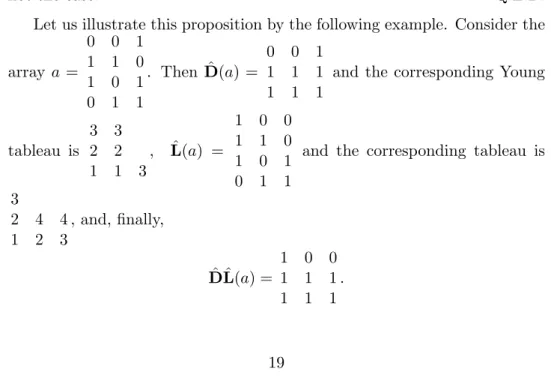
Let us illustrate this proposition by the following example. Consider the array a =
0 0 1 1 1 0 1 0 1 0 1 1
. Then ˆD(a) =
0 0 1 1 1 1 1 1 1
and the corresponding Young
tableau is 3 3 2 2
1 1 3
, L(a) =ˆ
1 0 0 1 1 0 1 0 1 0 1 1
and the corresponding tableau is 3
2 4 4
1 2 3
, and, finally,
DˆL(a) =ˆ
1 0 0 1 1 1 1 1 1 .
Remark. There is a bijection between the set of ˆD-tight arrays of B(n, m) and functions f : [m] → 2[n] which are monotone with respect to the following partial order4 on 2[n]: for subsets K = {i1, . . . , ik} and L={j1, . . . , jl} of [n], we set
K L ifk≤land it≥jtfort= 1, . . . , k.
In fact, let abe a ˆD-tight array. Then ˆDj(a) =a is equivalent to that we can provide to each 1 in the j+ 1-th row of a its own partner 1 located south or south-west in thej-th row. Thus, the collection fa(j) :={i∈[n] : a(i, j) = 1},j= 1, . . . , m, of subsets of [n] is monotone,fa(j+ 1)fa(j), j= 1, . . . , m−1.
Similarly ˆL-tight arrays ofB(n, m) are in bijection with monotone func- tions g : [n] → 2[m]. Specifically, a → ga, where ga(i) := {m−j + 1 : a(i, j) = 1},i= 1, . . . , n.
There is a bijection ∗c : B(n, m) → B(n, m), which is the composition of two mappings: the first one sends a Boolean array ato its complement ac,ac(i, j) = 1 iff a(i, j) = 0 andac(i, j) = 0 iff a(i, j) = 1, and the second sends an arrayato its middle-axe symmetryas(i, j) =a(n−i+ 1, j). Thus
(∗ca)(i, j) =ac(n−i+ 1, j), i= 1, . . . , n, j= 1, . . . , m.
Proposition 3. The mapping ∗c sends the set of ˆL-tight arrays to itself.
Proof. The proposition follows from the above remark and the following property of the ordering:
Let K,L be subsets of [n]. Then K L if and only if Lc Kc, where
Kc = [n]\K denotes the complement. Q.E.D.
As a consequence of this proposition and Proposition 3, we get the fol- lowing bijection (noted in [6])
The mapping ∗c provides is a bijection between the set of semi-standard Young tableaux of shape λ, n ≥ λ1 ≥ . . . ≥ λm ≥ 0, filled out from the alphabet1, . . . , m, of weight(µ1, . . . , µm)and the set of semi-standard Young tableaux of the dual shape λd := (n−λm, . . . , n−λ1) and the dual weight (n−µ1, . . . , n−µm).
Now we are going to define less trivial bijection. The mapping a → ( ˆL(a),D(a)) is a bijection. We have to show how to invert this mapping.ˆ The inversion procedure is parallel to that for the case of A(n, m) ([2]).
Namely, a word w = ˆLi1. . .Lˆis in the alphabet ˆL1, . . . ,Lˆn−1 is said to be
4This order was considered in [7].