Vol. 4, 5. (1965, 6)
010 EFFECTS OF IRRADIATION AND RADIO- CONTAMINATION DURING PREGNANCY
( I) STUDIES ON THE DETERMINATION OF STRONTIUM-gO AND CESIUM-137 IN THE HUMAN PLACENTA.
+by Yuichiro KIMUBA*, Hayami FUJIMORI**, Fumio YAMADA **, Yasushni NISHIW AKI***, Hiroshi KAWAI*, and Yoshihide HONDA*,
ABSTRACT
The radioactive substances produced by the nuclear explosion tests are incorporated into human body through various routes, and it is anticipated that they may have some effects on human. Among various radionuclides, Sr-90 and Cs-137 are considered to be the most important ones because of the relatively long half-life. Therefore, the accu- mulation of Sr-90 and Cs-137 in the human bone, blood muscles and others has been studied by many authors. Dr. Sternberg proposed that the study on the accumulation of these nuclides in the human placenta should be conducted more extensively from gynecological point of view. In this paper, the determination method of Sr-90 and Cs-137 in the human placenta is discussed and some results are introduced.
Among several methods of determining Sr-90 and Cs-137 in biological samples, the fuming-nit ric-acid method for Sr-90 and the chloroplatinic-acid method for Cs-137 were adopted. For the purpose of estimating the recovery of the nuclide with these methods, a micro amount of Sr-·90 and Cs-137 was added to the human placenta as thacers prior to the analysis and determined the recovery after separation. The recovery percentage was estimated at about 70 % for both nuclides. Taking the recovery percentage into consideration, the estimated activities of these nuclides in human placenta (average weight about 500g) in Osaka district for the period from May to July, 1966 were found to be in the following ranges: 0.42-2.0 pCi for Sr-90, and 4.9-44 pCi for Cs-137. Although considerable differences were observved from sample to sample, the average value of strontium unit was estimated at about 2.8 pCi Sr-90/g Ca and that of cesium unit at about 25.2 pCi Cs-137/g K. The average value of the ratio Cs-137/Sr-90 was about 13 in hUman placenta, while it may be estimated at about 1. 5 on an average in the fallout.
* Atomic Energy Research Institute, Kinki University, Osaka, Japan.
** Department of Gynecology, Osaka City Univeresity Hospital, Osaka, Japan.
*** Research Laboratory of Nuclear Reactor, Tokyo Institute of Technology, Meguro-ku, Tokyo Japan.
-/0. This paper was present at the V world congress of gynaecology and obstetrics.
The radioactive substances injected into the atmosphere due to the past nuclear tests are gradually falling down on the earth's surface, and accumulating each year. 1,2)
Some of these radionuclides are taken into hu-.
man body through various routes. Therefore it is anticipated that the radioactive fallout may have some effects on human. Among various radionuclides included in the fallout, Sr-90 and Cs-137 are considered to be the most important ones because of the relatively long half-life.
The accumulation of Sr-90 and Cs-137 in the human body, bone, blood, muscles and others was reported by many authorsl - 6). From the gynecological point of view, Dr. Joseph Stern'- berg 9), professor of University of Montreal, Canada, proposed that it was one of the most important problems to investigate what amo- unts of Sr-90 and Cs-137 accumulate in human placenta, in order to investigate what effects might be caused on the fetal development in.
the mother's body due to the transfer of radio- contamination. In Japan, the analysis of Cs-137 in the human placenta was carried out
i~
the past at a few instii:utes : Hiroshima University 10) , Shinshu University, National Institute of Radiological Science, Osaka City University and Kinki University, while that of Sr-90 in the human placenta only at Kinki University. We have conducted the analysis of Sr-90 and Cs-137 in the human placenta by radiochemical method. The recovery. of these nuclides was estimated and it was confirmed, that the ,method of separation and determina- tion was accurate enough for practical purpo- ses.ANAL YTICAL PROCEDURES
1) Ashing of the Sample.
Samples of human placenta for the activity determination were collected with the coopera-
were the normal, ones obtained from the mothers that have given birth to a normal child after 10 months of pregnancy. The samples were stored at 4°C in the icebox.
After weighing with barance each sample, it was cut in pieces about 3 cm in radius.
They are first carbonized in a stainless-steel dish 11cm in diameter, by heating at about 150° to 200°C for about 50 hours. The 'carbonized sample is transfered into a porce-
lain crucible, heated in an electric furnace by gradually raising temperature, and finally ashed by keeping the sample at about 450° to 500°C for about 15 to 20 hours. The ashed sample is weighed.
2) Separation of Sr-90 and Cs-137.
There are various methods oe analysis of Sr-90, Cs-137 and other radioactive nuclides in the biological samples. However, we have adopted the fuming-nit ric-acid method for Sr-903) and the chloroplatinic-acid method for Cs-1374) • Each sample containing about 6 g of ash was used for the analysis of Sr-90 and Cs-137. However 200 mg of ash was reserved for the gravimetric analysis of calcium.
The ash is leached with 300 ml of 6 N hydrochloric acid, and the residue is separated out by filter. Then heat the filtrate to dry up. Treat the dried sample with nitric acid to decompose the organic matters thoroughly and dry up. Add 6N hydrochloric acid to the dried sample and evaporate to dryness.
Leach the remaining solid matter with hot water, and filter out the silica precipitate.
Add strontium chloride and cesium chloride carrier solution containing 20 mg of Sr and 20 mg of Cs to the filtrate. Heat the filtrae and make barium sulfate precipitate by treat- ing the hot filtrate with 10 % hot solution of barium chloride. Allow it to stand overnight to cool and filter out the barium sulfate precipitate. Evaporate the filtrate by boil- -74 -
Vol. 4, 5. (1965, 6)
ing, to reduce the volume to 500 ml. Add 10 ml concentrated ammonia solution, (about 15N) and 10% ammonium carbonate solution and then filter. The filtrate (Fil-A) is used for the analysis of Cs-137, and the alkaline earth carbonate precipitate (Ppt-B) for the analysis of Sr-90 (Table 1, Part 1).
Y -90. Add barium chloride solution (20 mg as Ba) as carrier to the filtrate. Add 1 ml of 6 N acetic acid, 2 ml of 6 M ammonium acetate, and a few drops of 1. 5 M potassium chromate solution. Remove the barium chromate precipitate which Sample (Placenta) about 500 g (Wet)
Carbonize (about 2000, 50 h) and Ash (about 5000, 15 hr) Leach with 300ml. 6N-HCI
may contain radium and other radiocontaminations. Evporate the filtrate to reduce the vol- ume to 30ml, and treat it with 80-90 ml of fuming nitric acid.
The deposited strontium nitrate is dissolved with 10 ml of hot water. Add a few drops of 4N hydrochloric acid, and allow it to stand more than 2 weaks and to reach radioactive equi- llibrium between Sr-90 and
I I
HCI Extrate Residue
Evap. to Dryness
HN03 Treatment (Decomp. of Org. Matter) Add 6N-HCI, and to Dryness
Leach by Hot water Filtrate
Add Carriers
(Sr2+ 20mg, CS2+ 20mg) Add hot 10% BaCb in hot.
Ppt Si0I 2
Filtrate Ppt, BaS04 I
Evap. to 500ml
Add 10ml Conc. NH40H Add 10% (NH4)2C03
- - - - I
Y-90. Add 5 mg of Fe3+ and
Filtrate (Fil-A)
!
(Ppt-B), Alkaline Eaths
5 ml of saturated ammonium chloride solution to the solu- tion in radioactive equilibrium.
Adjust the pH of the solution For Anal. of Cs-137 For Anal. of Sr-90
!
at 8-9 with ammonium hydr-oxide, and co precipitate Y -90 with ferric hydroxide. Dis- Table 1. (Part 1) Separation of ,Sr-90 and Cs-137
3) Determination of Sr-gO.
The Precipitate (Ppt-B) of alkaline earth carbonate with Sr-90 is dissolved in 10 % nitric acid. Evaporate the solution to dryness, dissolve the residue with a smallest volume of water. Adjust the density of the solution at d 1.45 by adding fuming nitric acid Cd 1. 52) about 26 ml per 10 ml of water.
Collect the strontium nitrate precipitate.
By dissolving the precipitate again, repeat the above procedure a few times to reduce the contamination of calcium nitrate. The final strontium nitrate precipitate is dissolved with 20 ml of hot water. Add ferric chloride carrier solution (20.mg as Fe), 1 ml of 1 M ammonium chloride and 7 N ammonium hy- droxide to adjust the pH at 8. Filter off the ferric hydroxide precipitate containing
solved the precipitate again with 6 N hydrochloric' acid. Add to the solution 5 mg of stable carrier of strontium nitrate, ammonium hydroxide to adjust pH at 8-9, Filter off the ferric hydroxide containing Y -90 with the separable funnel. Wash the precipitate containing Y -90 with 0.2 N ammo- nium hydroxide. After drying the sa:nple the activity of Y -90 was estimated with low background counter (Table 2, part 2).
4) Determination of Cs-137.
The filtrate (Fil-A) is evaporated to dry- ness. The dried residue is leached with 500 mlof hot water. Filter and discard the undissolved residue. Boil the filtrate, add 20 ml of saturated ammonium oxalate soluti- on, and 10 ml of concentrated ammonium hydroxide to remove a small amount of al-
to Dryness in Erlenmeyer Flask Dissolve by Water
Add Fuming Nitric Acid 26ml per 10ml H 20 (3-4Time)
Ppt, Sr(N03)2
I
Filtrate, Ca(N03)2 Dissolve by 20ml Hot Water
Add 20mg Fe3+ Iml, IM.:...NH4CI NH40H (1: 1) to pH 8 (Separation of Y -90)
Filtrate Ppt, Fe(OH)3 + \ Y -90
1
20mg Ba2+ Carrier 1 ml, 6N -CH3COOH
I ;:' ;::;C1H~~O~:,~~O.
Filtrate Ppt, BaCr04+ Ra
I
I
Evap, to 30ml . 80-90ml Fuming Nitric Acid
. \
Flltrate Ppt. Sr(N03)2
Filtrate
I
!
Dissolve by 10m1 Hot Water Few Drops HCl (1: 9) Solution, Stand More than 2 Weeks
Add 5mg Fe3+ 5 ml Sat. NH4CI Conc. NH40H to pH 8-9 (Separation of Y -90) Ppt, Fe (OH)3+ Y -90
Dissolve by HCI (1: 1) 5 mg Sr(N03)2
Conc. NH40H to pH 8·-9 Fil. with Separable Funnel
~I
---"----1
Filtrate Ppt, Y -90
1
Wash by NH 40H (1: 100) Count the Activity of Y -90 (by Low background Counter) Table 2. (Part 2) Determination of Sr-90through the solution and keep it saturated with the gas under ice cooling. Remove the depositted sodium and potassi- um chloride with sintered glass filter, G-3 type. Evaporate the filtrate until the deposition occurrs. Add the same volume of 95% ethanol. Saturate with hydrogen chloride gas, and filter. Evaporate the filtrate to dryness, leach the dried residue with 70 ml of water.
Filter and dilute the filtrate to 100 ml with water. Add 0.5 ml of 10 % chloroplatinic acid, make precipitate by rubb- ing the inner wall of the breaker with glass rod.
Filter the precipitate of cesium chloropratinate, Cs2PtCl4 with filter paper Toyo Roshi No.5C (paper for quantitative analysis of fine particle precipitate) which is previously weighed.
Wash the precipitate with cold water and then with 95 % ethanol. Dry at lOO°C for 1 hour, weigh and count the beta-activity of Cs-137 with the low background counter (Table 3, Part 3).
kaline earth contamination as oxalate.
Evaporate the filtrate to dryness. Dissolve the dried residue with 6N hydrochloric acid and evaporate to dryness. After repeating the procedure, leach the dried residue with 250 ml of hot water and filter. An aliquot of 2 ml of the filtrate is reserved for the analysis of potassium. ' Evaporate the remaining portion of the filtrate until the deposition of
The cesium samples for beta counting may contain a small amount of potassium. The contamination tf potassium was examined with the flamephotometry with the solution of the cesium chloroplatinate precipitate dissolved in hot water. However, the potassium contamination was estimated to be loss than
o.
5 mg. The beta activity of K-40 from this small amount of potassium may be considered negligible as compared with -76 -Vol. 4, 5. (1965, 6)
(Fil-A)
I
Evap. to Dryness Leach with Hot Water Filtrate (500ml)
Boil
Add 20mI Saturated (NH4)2C204 10ml Conc. NH40H
Filtrate
Evap. to Dryness
6N-HCI, to Dryness (Twice) Leach with Hot Water
Extrate (250ml)~2ml for Anal. of K Evap. till Deposition of NaCI Saturate with HCI Gas (in Ice Cold.) Fi!. with Glass Filter-G3
Filtrate
Evap. till Deposition of Crystals Add Same Volume of 95% Ethanol Saturate with HCI Gas
Fil. with Glass Filter-G3 Filtrate I
Evap. to Dryness Leach wHh 7ml Water Extrate
Dilute to 100ml
Residue
I
Ppt,
I
Small Amounts of Alkaline Earths
Ppt.
I
NaCI, KCI
1 Ppt.
NaCI, KCl Ppt.
I
Add O. 5 ml 10% Chloroplatinic Acid (Make Ppt. by Rubbing Wall of Beaker)
I
Fil. by Toyo Roshi -No. 5~ with Known WeightFiltrate Ppt. Cs2PtC14
I
Wash with Cold Water Wash with 95% Ethanol Dry (100°C, 1 hr. )
~ Weigh
Count the Activity of Cs-137 (by Low background Counter) Table 3. (Part 3) Determination of Cs-137
Cs-137 was measured with 2n gas-flpw type low background counters made by Kobe Kogyo Co., Japan, or that by Aloka, Japan, with the background of 1. 0 - 2. 5 counts per minute (cpm). The counting efficiency was estimated at 63.7
% with the standard Sr-90+
Y -90 solution. The activity of Sr-90 was estimated from that of Y -90. The decay correction for Y -90 was consi- dered in the calculation.
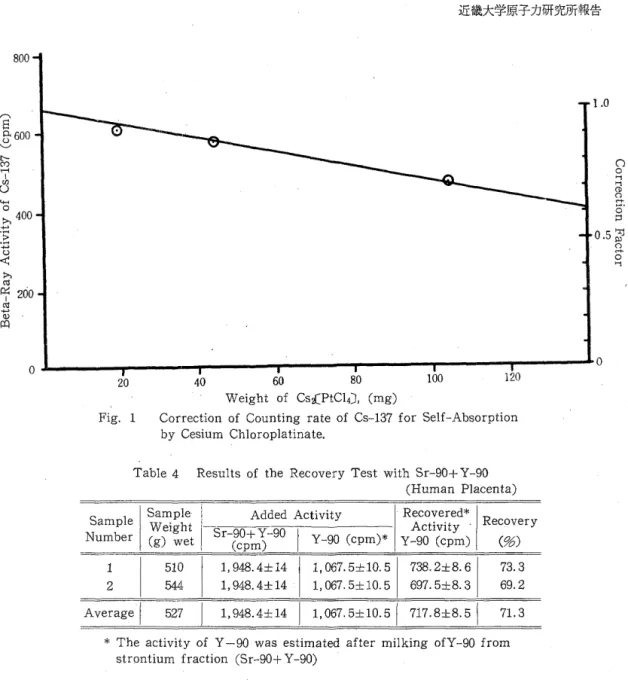
The correction curve of counting rate of Cs-137 for self-absorption of cesium chlor- oplatinate precipitate is shown in Fig.· 1. The counting efficiency was .found to be 18.9% without precipitate, by extrapolting the curve. The counting errors of the deter- mination of Sr-90 and Cs-137 in these experiments were about 10%.
RESULTS OF THE ANALYSIS
1 ) Recovery Test with Sr-90
+
Y-90.tnat of Cs-137 in the placenta.
5 ) Determination of Potassium and Calcium.
The concentration of Sr-90 and Cs-137· in the biological samples is usually represented as strontium unit and cesium unit respective- ly. The content of potassium in the sample was determined flamephotometrically, and that of calcium gravimetrically as oxalate.
To estimate the recovery percentage of Sr-90 in the abovementioned separation procedure, the radioactive tracer method was used. About 2,000 cpm of Sr-90+ Y -90 solution was mixed with a sample of human placenta prior to the analysis.
6) Measurement of Activity.
The beta-activity of Sr-90 + Y -90 and
The strontium fraction was separated with the same procedure and reagents, and the activity of Sr-90 was estimated from that of Y-90 after milking, Results of recovery test with Sr-90+ Y -90 are shown in Table 4.
The recovery percentage was about 70 % on
-77-
~
S fr600
'--"
~ M I (J)
U
1.0
o
o'"i '"i (l)
$?. O·
::;
0.5~
o~
______~---~---~---r---r---r---O
20 40 60 80
Weight of Cs2CPtC14J, (mg)
Fig. 1 Correction of Counting rate of Cs-137 for Self-Absorption by Cesium Chloroplatinate.
Table 4 Results of the Recovery Test with Sr-90+ Y -90 (Human Placenta) Sample
I ~~~~~ I
Number (g) wet
~~~~ Added Activity Recovered* Activity'
I
R ecoverysr-{2p~~-90
Y-90 (cpm)* Y-90 (cpm) C%) 12
~I
1, 948. 4± 14 1,067. 5± 10.51 738. 2±8. 61 73.3 1, 948. 4±14 1, 067. 5±10.5 697.5±8.3 69.2 Average'j 527 j 1,948.4±14I
1,067.5±10.5j 717.8±8.51 71.3*
The activity of Y -90 was estimated after milking ofY -90 from strontium fraction (Sr-90+ Y -90)an average. The Y -90 was confirmed from the decay curve, and no significant contami- nation by nuclides with long half":life could be detected.
2) Recovery Test with Cs-137.
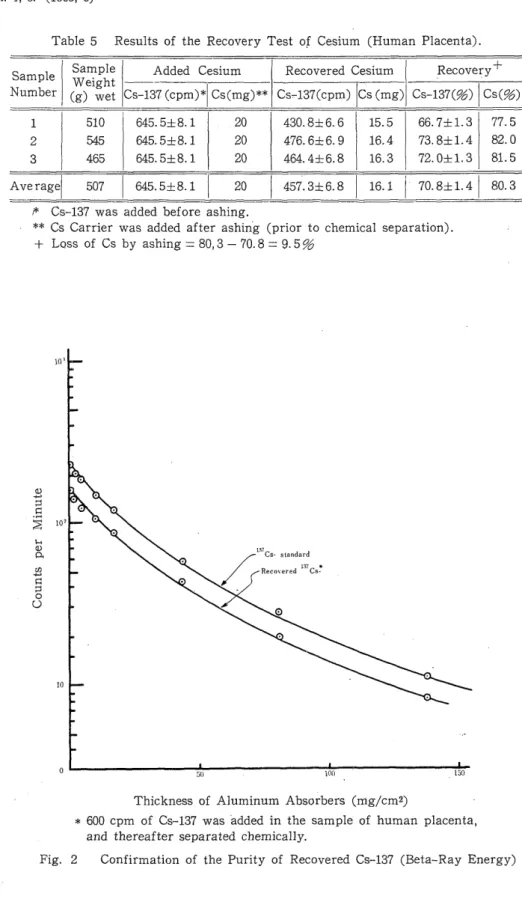
About 600 cpm of Cs-137 solution was added to the sample, and the recovery per- centage was also estimated with the radioactive tracer method. The results are shown in Table 5. The recovery percentage was about 70% on an average with the analytical proce- dure described in thie paper. In these ex-
periments, the radioactive tracer Cs-137 was added with the placenta sample before ashing, and the carrier of stable cesium was added after ashing prior to chemical separation.
Loss of cesium vaporized during ashing, at 450-500°C for 15 hours was estimated to be (recovery of Cs) - (recovery of Cs-137) = 80.3 -70.8= 9. 5 %.
J.
Akaishi 8) reported a loss of Cs during ashing at 450-600°C for 10 hours and leach with hydrochloric acid was 10-20%.The radiochemical purity of Cs-137 in the recovered cesium fraction was confirmed by -78 -
o ri-
o '"i
Vol. 4, 5. (1965, 6)
Table 5 Results of the Recovery Test of Cesium (Human Placenta).
Sample
I
Sample Added Cesium Recovered Cesium I Recovery+
Weight
CS7""137(cpm) Ics (mg)i Cs-137(%) ! Cs(%) Number (g) wet Cs-137 (cpm)*! Cs(mg)** I
I I
1 510 645.5±8.1 20 430.8±6.6 15.5 66. 7±1. 3 77.5 2 545 645.5±8.1 20 476. 6±6. 9 16.4 73.8±1.4 82.0 3 465 645.5±8.1 20 464.4±6.8 16.3 72. 0±1. 3 81. 5 Averagel 507 ! 645.5±8.1
I
20 ! 457.3±6.8 ! 16.1I
70.8±1.4! 80.3fr Cs-137 was added before ashing.
** Cs Carrier was added after ashin'g (prior to chemical separation).
+
Loss of Cs by ashing=
80,3 - 70.8=
9.5%"E
rJJ ::l oo
50 100
Thickness of Aluminum Absorbers (mg/cm2)
150
* 600 cpm of Cs-137 was added in the sample of human placenta, and thereafter separated chemically.
Fig. 2 Confirmation of the Purity of Recovered Cs-137 (Beta-Ray Energy)
standard Cs-137, as shown in Fig. 2. No significant contamination by hard beta-ray emitters as Sr-90+ Y -90 was not observed.
The radiochemical purity of Cs-137 separated from human placenta without any addition of the radioactive tracer Cs-137 was also con- firmed by the existence of Cs~137 photo peak in gamma-ray spectroscopy, as shown in Fig.
3.
·S
ci~
H Q)
0..
+' en
~
500
g
100 UFig. 3
R C L.512 Channel Pulse Height Analyzer, with 3/1x3/1 fNal(TI) Crystal .
... ,",
o
.5 1.0 . 1.5 2 .0r-Ray Eri.ergy (MeV)
Gamma-Ray Spectrum of Cs-137 Separated from Human Placenta, Without addition of any Cs-137.
After taking into consideration the re- covery percentage, the counting efficiency, the self-absoption and the possible decay, the concentration of Sr-90 and Cs-137 in the human placenta was estimated. As present- ed in Table 6. the estimated activities of these . nuclides in human placenta (average weight 500 g) in Osaka District for the period from May to July, 1966 were in the following ranges: 0.42-2.0 pCi for Sr-90, and 4.9-44 pCi for Cs-137. Although considerable differences were observ~d from sample to sample, the average value of strontium unit was estimated at about 2.8 pCi Sr-90/g-Ca, and that of cesium unit at about 25.2 pCi Cs- 137/g-K. The average value of the ratio Cs-137/Sr-90 was about 13 in human placenta, while it may be estimated on an average at about 1. 5 in fallout 7) • From these results, the concentration of Cs-137 is estimated to be roughly about 10 times that of Sr-90 in the human placenta. However, the present level
Table 6 The Concentration of Sr-90 and Cs-137 in the Human Placenta in Osaka District.
Sampling Date Weight (g) Sample
I
A h W . ht s e1gI
Concentration per One SampleWet (g) Sr"790(pCi)
I
S.u. *
j Cs-137 (pCi)Ic.
U,** I
CS-137/Sr-90 May, 1966 413I
5.254 0.425 0.58May, 1966 455 4.571 1. 996 12.88
May, 1966 - 530 7.243 1. 348 1.17
June. 1966 605 5. 775 0.758 1. 75
June, 1966 650 5.942 1. 087 1.16
June, 1966 605 4.472 0.658 0.92
July, 1966 408 4.591 1. 050 4.32
July, 1966 464
I
8.399 . 1. 343 1. 01 July, 1966 I 401 5.902
I
0.419 1. 32Average 503 5. 783 1. 013 I 2. 79 I
pCi
=
picocurie=
10-12 Curie*
Strontium Unit, PCi of Sr-90!g of Ca**
Cesium Unit, pei of Cs-137/g of K Counting Error: about ± 10%- 80-
7.23
I
13.6 16.91
10.38 18.2 5.25
6.61 \ 11. 7 4.78 9.69 19.4 12.78 43.90 79.8 43.86
4.93 13.8 7.49
10.09 24:1 9.61
9.36 I 18.8 6.98 10.96
I
27.5 26.1612. 35 I 25. 2 I 13.45
Vol. 4, 5. (1965, 6)
appears to be much lower than the permis- sible level for these nuclides.
REFERENCES
1) E. A. Martell; "The Chicago Sunshine Method", Chicago, (1956).'
2) Y. Nishiwaki; Annual Reports of Nuclear Reactor kinki Univ. (1961).
3) "Analytical Methods of Radioactive Strontium", p. 1-62 (1963), edited by the Bureau of Science and Technology, Japan.
4) N. Yamagata, et al.: Japan Analysts, 7, 433-438 (1958).
5) "Analytical Methods of Cesium-137", p.
1-64 (1963), edited by the Bureau of Science and Technology, Japan.
6) N. Yamagata, et al.: Nature, 211, 528-529 (1966) .
7) Y. Nishiwaki et al.; Annual Reports of Kinki Univ. Atomic Energy Research Institute, 3, 43-49 (1964).
8) ]. Akaishi, et al.; Radioisotopes, (Tokyo Japan), 15, 103-108 (1966).
9) J. Sternberg; (Radioisotopes, Tokyo, Japan), 14, 534-542 (1965).
10) A. Tabuchi, et al.; Journ. Hiroshima Obstetr. Gynecol. Soc., 5, 150-153 (1966).