Myanmar migrant laborers in Ranong, Thailand
著者 Fujita Koichi, Endo Tamaki, Okamoto Ikuko, Nakanishi Yoshihiro, Yamada Miwa
権利 Copyrights 日本貿易振興機構(ジェトロ)アジア
経済研究所 / Institute of Developing
Economies, Japan External Trade Organization (IDE‑JETRO) http://www.ide.go.jp
journal or
publication title
IDE Discussion Paper
volume 257
year 2010
URL http://hdl.handle.net/2344/919
INSTITUTE OF DEVELOPING ECONOMIES
IDE Discussion Papers are preliminary materials circulated to stimulate discussions and critical comments
Abstract
Thailand is the major destination for migrants in mainland Southeast Asia, and Myanmar (Burmese) migrants account for the dominant share. This paper sheds light on the actual working conditions and the life of Myanmar migrants in Thailand, based on our intensive survey in Ranong in southern Thailand in 2009. We found a wide range of serious problems that Myanmar migrants face in everyday life: very harsh working conditions, low income, heavy indebtedness, risk of being human-trafficking victims, harassment by the police and military (especially of sex workers), high risk of illness including malaria and HIV/AIDS and limited access to affordable medical facilities, and a poor educational environment for their children.
IDE DISCUSSION PAPER No. 257
Myanmar Migrant Laborers in Ranong, Thailand
Koichi Fujita,
a)Tamaki Endo,
b)Ikuko Okamoto,
c)Yoshihiro Nakanishi,
c)Miwa Yamada
c)Keywords: Migration, Household, Myanmar, Thailand JEL classification: E26, E22, J61, R23
a) Center for Southeast Asian Studies, Kyoto University b) Faculty of Economics, Saitama University
c) Institute of Developing Economies-JETRO
The Institute of Developing Economies (IDE) is a semigovernmental, nonpartisan, nonprofit research institute, founded in 1958. The Institute merged with the Japan External Trade Organization (JETRO) on July 1, 1998.
The Institute conducts basic and comprehensive studies on economic and related affairs in all developing countries and regions, including Asia, the Middle East, Africa, Latin America, Oceania, and Eastern Europe.
The views expressed in this publication are those of the author(s). Publication does not imply endorsement by the Institute of Developing Economies of any of the views expressed within.
INSTITUTE OF DEVELOPING ECONOMIES (IDE), JETRO 3-2-2, WAKABA,MIHAMA-KU,CHIBA-SHI
CHIBA 261-8545, JAPAN
©2010 by Institute of Developing Economies, JETRO
No part of this publication may be reproduced without the prior permission of the IDE-JETRO.
1
Myanmar Migrant Laborers in Ranong, Thailand
Introduction
As the globalization of the world economy has accelerated in recent years, more and more people have been moving across borders. This has been particularly noticeable in mainland Southeast Asia.
Thailand has been the major destination for the movement of people from neighboring countries.
This has been caused partly by the transitional process to market economies in these neighboring countries which began at the end of the 1980s, and partly induced by the increasing economic disparity between Thailand and these countries.1 Myanmar (Burmese) migrants account for the dominant share in the total flow of people from the three countries bordering Thailand, namely Cambodia, Laos and Myanmar. According to the Thai Department of Employment, Ministry of Labour in 2009, the number of foreign laborers in Thailand was estimated to be about two million, out of which 1.3 million were from these three countries, and Myanmar migrants accounted for 82% of them.
The Burmese socialist regime, set up by General Ne Win in 1962, collapsed in 1988. The major reason for the collapse lay in the failure of economic management under the ‘Burmese Way to Socialism’, which left the people destitute, leading to their discontent which peaked in 1988.
However, the military regime rejected any abdication of power even after it lost the general election in 1990, and for the past 20 years it has continued to hold onto power despite harsh international criticism.
To some extent the military regime has achieved economic recovery and development through promoting market liberalization. Nevertheless, the economy is far from sound and has never gotten back on track for further development. Murky and authoritarian economic policies and regulations are still in place in various economic spheres. The halt of international economic assistance has also made economic management of the country more difficult. As a result, the peoples’ living standards have not improved greatly in the past twenty years (See, for example, Fujita et al eds. [2009]).
Furthermore, the people are deprived of any political freedom under the military regime and continued to be repressed, which is particularly evident in the case of the ethnic minorities. The reason for the large scale migration from Myanmar to Thailand lies not only in the increasing economic disparity, but also in these kinds of political push factors within Myanmar.
In order to find out in detail the actual living and working conditions of Myanmar migrants in Thailand, we conducted a survey in Ranong Province in southern Thailand in 2009. According to the Department of Employment, Ministry of Labour, ‘documented’ Myanmar workers numbered
1 Another major flow of people is from China (especially Yunnan Province) to Myanmar and Laos.
However, this paper will not deal with this issue.
2
about 1.1 million at the end of 2009. The top-ranking provinces in the order of the number of
‘documented’ Myanmar migrant laborers are: Bangkok (195,244), Samut Sakhon (152,707),2 Chiang Mai (65,988), Surat Thani (60,787), Phukhet (56,705), Samut Prakan (49,290). Ranong ranks seventh, with a population of 48,992. Eighth is Tak (45,316). Since Ranong borders Myanmar, migrants from that country account for 99.9% of the migrants from the three countries bordering Thailand. This trend is the same in northern Thailand where Myanmar migrants account for 99.8%
in Chaing Mai and 100% in Tak. These figures are only for the ‘documented’ migrant laborers; as will be described later, much larger numbers of Myanmar migrants are living in these provinces when ‘undocumented’ workers are included.
The main purpose of this survey was to grasp the real working and living conditions of Myanmar migrants who are working in Ranong in a variety of occupations. As will be described later in more detail, their occupations are diverse. They work in agriculture, forestry, fishing, construction, seafood processing, general work in the public fish market, domestic work, waste-material collection, as sex workers, and more. We did not aim to capture an ‘average’ picture of Myanmar migrant households in Ranong, thus we did not conduct a random sampling. Even if we wanted to do such a sampling, information on the mother population, which is indispensable for random sampling, was not available from any source. Nor did we have the time to conduct a large-scale survey which could justify for not conducting a random sampling. Therefore, we had to give up doing a quantitative analysis, and decided to focus on obtaining very reliable, detailed, high-quality information. We were able to interview a total of 57 households in our survey.
The survey was done by a Japanese research team during the period of 2008-09.3 The most important component of the survey was the interviews with Myanmar migrants, which was done by the researchers themselves in the Myanmar language. World Vision, an NGO which has been operating in Ranong over the years while maintaining cooperative relations with the Thai authorities, kindly assisted us in conducting the survey, including the selection of sample migrant households for the interviews.
The paper is organized into five sections. Section 1 provides an overview of Ranong, the survey area. Section 2 to Section 4 explain the results of the survey of the 57 households (including 16 households of single people) in a precinct manner. Section 2 describes the timing of migration and its background; Section 3 takes up the working conditions and environment of Myanmar migrant workers, while Section 4 takes up the actual living conditions of their lives. The last section summarizes the survey findings and mentions some remaining issues to be explored in the future.
2 Samut Sakhon is also called Mahachai. It is the most important base for the marketing and processing of fishery products in Thailand. Large numbers of Myanmar workers are working in the fishery-related industries in this city.
3 The team consisted of five researchers who specialize in the following fields: two in agricultural economics, one in economics, one in politics and one in law.
3
1. Overview of the Survey Area
Ranong is a small fishing port town located in the southern part of Thailand. The Kra Buri River runs down from the north past Ranong town towards the Andaman Sea. This river forms the border between Thailand and Myanmar. Kawthaung, a town at the southern-most point of Myanmar, is located on the opposite side of the river (Figure 1). Ranong has been developed as a center for the fishing and seafood processing industries, where Thai fishing boats land their catches taken from Myanmar waters as well as from Thai waters.4 However, during our research period (2008-09), we found that Myanmar migrant workers were deeply embedded in the local economic structure of Ranong, not only in the fishery and seafood processing industries, but also in agriculture, forestry, construction, commerce, domestic service, and in the sex industry. Myanmar migrants were the dominant class of people who were at the bottom of the local economy.
The population of Ranong is about 300 thousand with Thais accounting for about 170 thousand while Myanmar migrants are estimated to be 130 thousand (Clarke [2007], p.44). Thus the Thai and Myanmar populations are relatively similar in size. On the other hand, according to the estimate of the Ministry of Public Health (MOPH) in 2002 (World Vision [2004], p.9), the Thai population was 133 thousand (2001) and foreign migrants (mostly Myanmar migrants in this case) were 60 thousand. The former figure for the Myanmar population is more than double that to the latter. This large gap does not necessarily come from the difference in the survey years, but rather it suggests the difficulty in estimating the exact number of migrant workers.
4 The industrial structure of Ranong is concentrated in primary industries. If we look at the Gross Regional Product (GRP), primary industries made up 60% of the town’s industrial sector in 1995 and about 50% in 2000 (during the same period, manufacturing made up 7% and 11%). Among primary industries, the share for the fishery industry is on top at more than 70%. Among all industries, the fishery industry also has the highest ratio, 46% in 1995 and 36% in 2000 (NESDB [2000]).
Source: Prepared by the authors.
According to the report of World Vision, referred to above, the number of ‘documented’
migrant workers in Ranong in 2002 was 22,406 based on an announcement that year by the Ministry of Labour. Among these workers, males numbered 13,887 and females 8,529. If we take a closer look at their occupational categories, 10,617 worked in the fishery and related industries, 3,697 in agriculture, 3,638 in general labor, 1,806 in domestic service, and 931 in the livestock industry. ‘Documented’ workers supposedly means workers having work permits, and if the estimation of the Ministry of Public Health was close to the real figure, we could infer that the total number of migrants was triple compared with the number of ‘documented’ workers. Dependent family members such as housewives, children and the elderly probably make up the majority of
‘undocumented’ workers, but at the same time, the number of illegal migrants is probably not negligible.
As indicated above, it is difficult to grasp the real figures for the number of migrant workers in Ranong. Nevertheless, it is very clear that the local economy of Ranong can no longer be sustained without these Myanmar workers.
4
5
2. Migration Period, Place of Origin, Migrating Reasons and Patterns
We conducted a household survey in Ranong in September 2009. The total number of households was 57. We will discuss some characteristics of the migrants, focusing on the period of migration, place of origin, the reasons for migrating and patterns of migration.
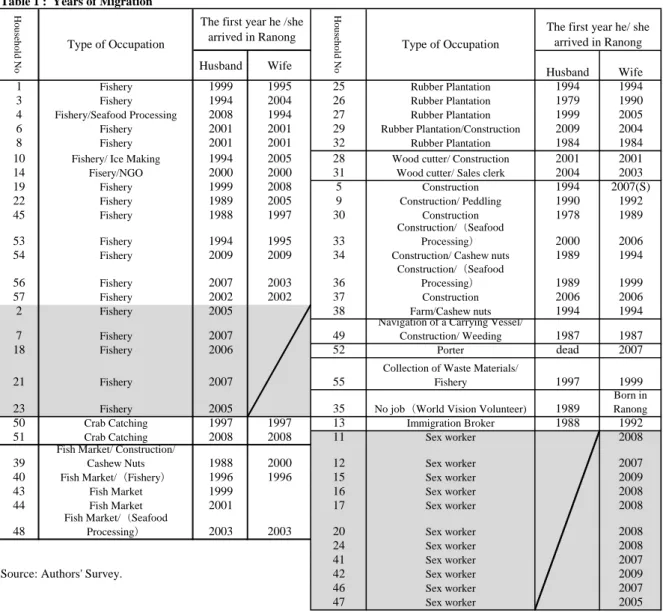
Table 1 illustrates the year of migration when household heads and their spouses arrived in Ranong. The latest arrival year was 2009 when one fisherman and two commercial sex workers came to Ranong. The earliest arrival year, on the other hand, was 1978 when the household head of No.30 arrived in Ranong,5 followed in 1979 by the arrival of the household head of No.26, who has been working in a rubber plantation since then.6
The distribution of the period of migration among 92 of the migrants is set forth in Table 1, i.e., 2 in the late 1970s, 2 in the early 1980s, 10 in the late 1980s, 14 in the early 1990s, 13 in the late 1990s, 20 in the 2000s, and 31 in the late 2000s. Considering that eight out of the ten migrants in the late 1980s came to Ranong in either 1988 or 1989 indicates that the overwhelming majority of the migrants arrived in Ranong after 1988, when the Myanmar economy started to liberalize. The table also shows that more than half of the migrants arrived in Ranong after 2000. Although migrant workers tend to be short-term migrants, the economic stagnation and relatively high inflation in Myanmar in recent years has motivated Myanmar people to emigrate to Thailand.
The patterns of migration among 37 married couples was generally either of the following: wife followed her husband to Ranong where he was already working (17 couples) or both came together (15 couples). There were only four couples where the husband later joined his wife who was already employed in Ranong.
5 He left Mawlamyaing, the town of his birth, in 1978 and worked in Myeik in Thanintharyi Division for three months, then in Kawthaung one month. He then migrated to Ranong and worked as a charcoal maker.
6 While he was helping on his parents’ farm in Dawei, one of his friends asked him to go and work on a rubber plantation in Ranong. He was 17 years old then. However, after he worked three years in Ranong, he returned to Dawei to do farming for five years before returning again to Ranong (No.26).
Table 1 : Years of Migration
Husband Wife
Husband Wife
1 Fishery 1999 1995 25 Rubber Plantation 1994 1994
3 Fishery 1994 2004 26 Rubber Plantation 1979 1990
4 Fishery/Seafood Processing 2008 1994 27 Rubber Plantation 1999 2005
6 Fishery 2001 2001 29 Rubber Plantation/Construction 2009 2004
8 Fishery 2001 2001 32 Rubber Plantation 1984 1984
10 Fishery/ Ice Making 1994 2005 28 Wood cutter/ Construction 2001 2001
14 Fisery/NGO 2000 2000 31 Wood cutter/ Sales clerk 2004 2003
19 Fishery 1999 2008 5 Construction 1994 2007(S)
22 Fishery 1989 2005 9 Construction/ Peddling 1990 1992
45 Fishery 1988 1997 30 Construction 1978 1989
53 Fishery 1994 1995 33
Construction/(Seafood
Processing) 2000 2006
54 Fishery 2009 2009 34 Construction/ Cashew nuts 1989 1994
56 Fishery 2007 2003 36
Construction/(Seafood
Processing) 1989 1999
57 Fishery 2002 2002 37 Construction 2006 2006
2 Fishery 2005 38 Farm/Cashew nuts 1994 1994
7 Fishery 2007 49
Navigation of a Carrying Vessel/
Construction/ Weeding 1987 1987
18 Fishery 2006 52 Porter dead 2007
21 Fishery 2007 55
Collection of Waste Materials/
Fishery 1997 1999
23 Fishery 2005 35 No job(World Vision Volunteer) 1989
Born in Ranong
50 Crab Catching 1997 1997 13 Immigration Broker 1988 1992
51 Crab Catching 2008 2008 11 Sex worker 2008
39
Fish Market/ Construction/
Cashew Nuts 1988 2000 12 Sex worker 2007
40 Fish Market/(Fishery) 1996 1996 15 Sex worker 2009
43 Fish Market 1999 16 Sex worker 2008
44 Fish Market 2001 17 Sex worker 2008
48
Fish Market/(Seafood
Processing) 2003 2003 20 Sex worker 2008
24 Sex worker 2008
41 Sex worker 2007
Source: Authors' Survey. 42 Sex worker 2009
46 Sex worker 2007
47 Sex worker 2005
Household No Household No
Type of Occupation
The first year he/ she arrived in Ranong Type of Occupation
The first year he /she arrived in Ranong
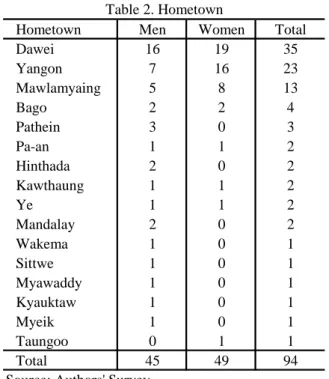
Table 2 indicates the migrants’ places of origin in Myanmar. Thirty five migrants hailed from Dawei, which is the capital of Tanintharyi Division, followed by 23 from Yangon. Those who were from Yangon consisted of 7 men and 16 women including 9 sex workers. The rest of the female sex workers were from Mawlamyaing, the capital of Mon State. In other words, in our samples no woman from Tanintharyi Division was engaged in the sex industry. The third major place of origin was Mawlamyaing (13 people). Other places of origin included Bago (the capital of Bago Division), Pathein (the capital of Ayeyarwaddy Division), Pa-an (the capital of Karen State), Sittwe (the capital of Rakhine State), and Mandalay (the capital of Mandalay Division).
6
Hometown Men Women Total
Dawei 16 19 35
Yangon 7 16 23
Mawlamyaing 5 8 13
Bago 2 2 4
Pathein 3 0 3
Pa-an 1 1 2
Hinthada 2 0 2
Kawthaung 1 1 2
Ye 1 1 2
Mandalay 2 0 2
Wakema 1 0 1
Sittwe 1 0 1
Myawaddy 1 0 1
Kyauktaw 1 0 1
Myeik 1 0 1
Taungoo 0 1 1
Total 45 49 94
Source: Authors' Survey.
Table 2. Hometown
The reasons for migrating were mainly economic, or accompanying a spouse who was seeking work. In many cases, migrants came to Ranong through personal networks such as relatives or friends. Due to differentials in wage rates between Myanmar and Thailand, Ranong seems to be one of the major destinations for Myanmar migrant workers, especially those from Tanintharyi Division.
Ranong, in comparison with other provinces in Thailand, is not necessarily the best workplace for migrant workers. Very few people in our samples came to Ranong from other places in Thailand; only three people came to Ranong after staying in other provinces in Thailand. The household head of No. 27 initially went to Surat Thani Province and worked on a rubber plantation before coming to Ranong. The household head of No. 29 left Dawei to avoid having to do forced labor for the military government in Myanmar; he lived in Phang Nga Province in Thailand before going to Trang Province, then to Ranong after he found a job on a rubber plantation. The last case was exceptional. The household head of No. 35 had been a soldier with anti-government insurgents in Myanmar. He had hid himself in Ranong during his participation in the resistance movement. He was captured and imprisoned in Myanmar; he escaped and lived in a refugee camp in Thailand. He finally came back to Ranong and got married to a local woman.
The other pattern of migration via another place was that of 15 people who had lived for a while in Kawthaung, the southern-most point of Myanmar, before acrossing to Ranong. In many cases, while they were working or looking for a job in Kawthaung, they obtained information about better jobs on the Thai side and crossed the border.
7
8
It is worth mentioning that female sex workers migrated through an exceptional recruitment process (as will be described in detail later), even though they migrated for economic reasons. It was found that 10 out of 11 sex workers were deceived by brokers or other people, even friends, who had told them that they would work in a market, restaurants or bars. There was only one migrant woman who knew that she would be a sex worker in Ranong.
3.Working Environment and Conditions of Myanmar Migrant Workers
1)Fishery industry
(1) Fishery workers (19 households)
Thai fishing boats can land their catches at the port of Ranong after operating in Myanmar waters, while Myanmar-owned fishing boats need to land theirs at Kawthaung where they are reloaded onto carrier boats that bring the fish to Ranong after paying duties to the Thai customs on the way.
The majority of Thai fishing boats engage in trawl fishing in Myanmar waters by paying very expensive fishing license fees.7 They accept this cost because fishery resources are still abundant in Myanmar waters compared to those in Thai waters. Normally these boats have a crew of 17-18 workers, including a pilot, an engineer, and a cook. Generally, a worker leader is appointed by the owner; this leader plays a very important role as will be described later. The pilot and engineer are normally Thais, while the rest of the crew are Myanmar, including the worker leader and cook. A boat goes out fishing for about 30-40 days and comes back to Ranong to rest for 3-5 days. Then it goes out to sea again.8 The duration of time at sea is longer if the operating fishing ground is far from Ranong. For example, a boat operating in Rakhine waters in Myanmar may stay at sea for up to 40 days, while the duration would be only about 30 days if the fishing ground is in Dawei, Myeik or Yangon waters.9 Though the number is far less than those operating in Myanmar waters, there are fishing boats operating in the Indian Ocean for six months (catches from these boats are
7 The license fee was set according to the gross registered tonnage (GRT) of a fishing vessel and the fishing ground where it operated. For example, the license fee for a boat of GRT 80 operating in the waters of Rakhine would be 11,600 US dollars per time, while it would be 8,700 US dollars if the fishing ground of operation was off Yangon. The fishing boat owner needed to pay 50,000 baht as a commission fee per time to an intermediary company named Siam Jonathan (this was lowered to 35,000 baht in 2009). The total number of licenses issued per year ranged between 100 and 200. Siam Jonathan had two fishing vessels (GRT 100) of its own. This information was obtained from a 21 September 2009 interview at the headquarters of Siam Jonathan in Ranong.
8 The timing for fishing operations is decided by the worker leader. In one very extreme case, a boat returned to sea after resting just for a night. By contrast, if a boat needed some major repairs, the fishing workers could spend anywhere from 10 to 30 days resting on land.
9 The duration of fishing operations per time was prescribed by agreement with the Myanmar government, together with the license fees.
9
reloaded to a carrier boat once a month), or those operating in Thai waters,10 and even in the Gulf of Thailand after passing through the Straits of Malacca and up the east coast of the Malay Peninsula.
The incomes of fishing workers on trawling boats fluctuate according to the catch. If there are more high-value fish in the catch, the workers are eligible to receive a higher reward; if not, their pay will decrease.11 The actual distribution of pay is decided by the worker leader who has been monitoring how each worker worked during the whole fishing period. Therefore, there can be discrepancies in wages among workers on the same boat. Nevertheless, the average wage per worker was 100-200 baht per day, or 3,000-6,000 baht per month. Income for a pilot could be much higher, as much as 12,000 baht monthly. We were unable to interview an engineer, but their pay was supposedly also high considering the required skills. Worker leaders were also paid higher wages than the general workers.12
Besides trawl fishing, there are some boats that specialize in long-line fishing.13 In this type of fishing, the catch is marked off for each individual worker and payment is made according to the respective catch. However, the average income for general workers doing this type of fishing did not differ much from that of trawl fishing workers, ranging between 3,000 and 6,000 baht per month.
In both types of fishing the cost of meals was borne by the boat owner. Meals consisting of rice, fish and vegetables were provided three to four times a day, although vegetables would be consumed after 15 days or so, thus the rest of the time meals were rice and fish only. The approximate cost of meals per day was about 50-100 baht. Thus, the real daily wage per worker was 150-300 baht if the cost of meals is taken into account.
It is customary for workers to receive some advance payment of wages before going out to sea.
For example, a worker told us that when his expected wage was 4,500 baht, 3,000 baht was paid in advance.14 According to a Myanmar intermediary wholesaler who worked at the public wholesale
10 Fishing boats operating in Thai waters are smaller in size and have seven workers on board on average. The duration of fishing is about ten days.
11 Therefore, when a boat is fortunate to have a bumper catch, the reward to workers is expected to be high. However, there was a case where a boat had a large catch, and the boat owner got greedy and hesitated to pay a fair share to his workers. He ended up killing the worker leader. However, the Thai owner did not face any criminal charges against for this murder.
12 Some boats have a rule to pay the leader 10% of the total sales of the catch.
13 Long-line fishing does not require a rod. The workers wear leather gloves and handhold a fishing line with several hooks attached. In interviews workers said they could handle 20-30 kg of fish at a time.
Bait is small dead fish which is provided by the boat owner. The duration of one fishing trip is ten days.
It takes two days to travel to and from the fishing ground. Thus they actually engage in fishing for eight days.
14 Another example was an advanced payment of 4,000 baht on an expected wage of 6,500 baht for 38 days of fishing. The advance payment can be regarded as a minimum guaranteed wage, and the rest can fluctuate according to the catch and the performance of the worker.
10
fish market (Mr. N), as will be described again later, he provided interest-free loans as working capital to Myanmar fishing boat owners who operated about ten days per fishing operation in Myeik waters. Part of this loan may have been used to provide advance wages to their fishing workers. A similar custom was also seen for Thai fishing boats.
The workers on fishing boats are only males, who are generally young. The way they work on the fishing boat is as follows.15 The boat searches for fish using sonar devices, and the workers spread nets once they hit a school of fish. The boat trawls the nets for about two hours. After this operation the workers take a rest for five hours during which the boat searches for more schools of fish, then the trawling starts again. This is repeated for 24 hours. When the workers take a rest, they have meals, bathe (with seawater and rinse with freshwater) and sleep. If it is raining they sleep inside the cabin; in fine weather they lie on the deck. When they get sick or are injured, they use medicine kept on the boat. In a case where the boat has no medicine, the workers use what they have brought with them.
These fishing workers do not necessarily stay with the same fishing boat. Rather, they tend to change boats quite frequently. It seemed that it is not difficult for a worker to find a new fishing boat that is willing to hire him.
Since these workers spend a good deal of time on their boats under very harsh working and living conditions, they tend to spend their few days on land in a great way. Some spent 500 to 1000 baht per night drinking beer and whisky, singing Karaoke, or going to brothels, although there were others who did not drink any alcohol and stayed at home enjoying eating snacks.
(2) Crab catching workers (2 households)
Two households engaged in crab catching. These workers caught crabs in a rocky stretch where many crabs could be found. There was only a single boat, owned by a Thai, for crab catching around that area. The boat normally carried three Myanmar workers. They would leave a small port (different from the one where the public wholesale market is located) and arrive at the rocky stretch in about an hour. As the tide rises, the crabs climb up the rocks. The workers catch the crabs by hand (wearing gloves) while in water up to their chests. They wear water-proof shoes which allow them to walk easily in the water. They wear long-sleeved shirt as well, in order to prevent any scratches from the rocks. They catch crabs of every size. When they have caught all the crabs in a specific spot, they move to another place. After repeating this, they come back to the port by 3-4 o’clock in the morning. The Thai boat owner is at the port awaiting their return to receive the catch of that day. Wages are paid according to the weight of the catch, and it was 15 baht per kilogram at
15 Interviews suggest that there are variations. For instance, in squid fishing the workers put down nets and pull them up three or four hours later, repeating this operation three times in the morning and twice in the afternoon.
11
the time of survey. On average, the workers earned about 200 baht per person (the minimum was 30 baht and maximum 300 baht). They told us that it was very tiresome work and they felt very exhausted before getting accustomed to it. We asked whether there was a danger of depleting the crab resources, but they told us that crabs could be found again in the same rocky stretches after four to five days. In the dry season they went out for crab catching about 15 days per month, but this decreased to ten days in the rainy season. They did not work everyday, but they did this job only as they believed the Thai owner (thaokae in Thai) they worked for did not like them working for others.16
(3) Crab farming workers (2 households)
There was no one working on any of the crab farms at the time of the survey. However, two couples used to work on them, so based on their interviews we will describe the working conditions on these farms. This farming is for soft-shell crabs which are marketed before the shells get too hard. These farms are generally located on sandy beaches. The Thai owners of these farms intentionally chose a couple for this work, and paid 6,000 baht per month per couple (the wage was same in 2004 and 2006). Their main tasks were to feed the crabs once a week and to look into the holes where the crabs hid and catch them when they were ready to be marketed.
(4) Crocodile farm worker (1 household)
This may not be within the fishery category in rigorous terms, but we would like to share the case of a Myanmar man (65 years old) who had been working for eight years on a crocodile farm.
The man commuted to the farm by bicycle which took him about ten minutes. He worked from 7:00 to 17:00. There was no day off, except when he got sick. He earned 4,000 baht per month at the time of the survey (it had been 2,400 baht in 2001). There were about 100 crocodiles on the farm, and their skins were exported to Malaysia. The worker’s main responsibility was to change the water and to feed chickens to the crocodiles every ten days. He had been bitten once by a crocodile.
The farm purchased baby crocodiles and sold them when they got 1.5-2 meters long after three to four years. There were two crocodile farms in the area, including this one.
2) General workers at the public wholesale fish market (4 households and 1 person)
We interviewed four Myanmar workers working in the public wholesale fish market at the Ranong port. Three were unskilled laborers and one was a middleman.
16 Another household gave us slightly different information. He caught crabs using nets and the tides did not matter. During low tide he caught crabs in the trees, and during high tide he caught them on the beach. The working hours were from 18:00 till 4:00 the next morning. His wage was paid on a piece-rate basis. The price for small crabs was 15 baht per kg and that for big crabs 25 baht per kilogram. He went out crab catching 3-4 times per week, thus the monthly income was around 5,000 baht.
12
One of the unskilled workers normally worked from 6:00 until 17:00. He worked overtime until 21:00 or 22:00 for 10-15 days per month. His thaokae provided him a supper around 18:00 when he worked overtime. He was responsible for sorting fish, packing ice and cleaning floors. He received 5,500 baht per month as his basic wage, and his overtime pay was added onto this at the rate of 50 baht per period of overtime. His wage was paid every 15 days and he could get one day paid leave.
Any other leave he took was deducted from his wage at a rate of 200 baht per day. He had to buy his own boots to wear at the market, which cost 600 baht per pair and which lasted about six month.
The second worker was employed by an intermediate wholesaler. He worked from 5:00 to 17:00 when the volume of fish was large. When the volume was small, his working hours were from 8:00 until 13:00. He received a fixed wage of 4,000 baht per month. His job was quite similar to that of the worker described above.
The last worker worked only for short hours, from 8:00 to 12:00. His salary was 3,700 baht. His Thai thaokae was managing a hotel in Bangkok, for which he bought fish. The worker’s task was to collect fish purchased by Thai workers, pack them with ice and load them onto trucks.
The Myanmar middleman we interviewed had a Thai partner. They bought fish in the public wholesale fish market and resold them to buyers coming from Phuket, Surat Thani and Krabi. Their emphasis was on low-margin and high turn over. He worked from 5:00 to 14:00 and received a fixed salary of 5,000 baht per month.17
Lastly, we would like to add some information about Mr. N, who was an intermediate wholesaler in the public wholesale fish market. He also worked for a Thai thaokae. This thaokae had an office in the wholesale fish market and he owned a processing factory which employed about 300 workers.
Mr. N owned four fishing boats with his family. He moved to Ranong in 1996, but his brothers and other relatives were still in Myeik and Kawthaung in Myanmar and they all were working together. He managed his own fishing boats while providing working capital (50 thousand baht per fishing operation) to 20 Myanmar fishing boats that operated for ten days in Myeik waters on condition that the catch be sold to Mr. N. However, since Myanmar fishing boats could not land their catches at Ranong port, they had to land them at Kawthaung and reload them onto carrier boats for transport to the Ranong port (which entailed custom clearing and duty payment on the way to Ranong).18 His turnover was 10 to 50 tons per day and 3% of the value of total sales went to his Thai thaokae. Mr. N took 20% of the remaining 97%. The rest went to the fishing boat owners.
Mr. N had to pay taxes to the Myanmar and Thai governments, the cost of carrier boats and other expenses such as the labor cost for landing fish at Ranong (350 baht per 70 kg). After deducting all these costs, his monthly income from his intermediate wholesale work was estimated to be around
17 The salary of his Thai partner was not known.
18 Low-valued fish that could not fetch a high price was sent to Myeik.
13 20 thousand baht.
Mr. N had to monitor not only the wholesale price movement in Ranong, but also those in Kawthaung and Myeik in Myanmar, as well as in Bangkok, China and Malaysia in order to capture business chances. The price movement he paid most attention to was that in Malaysia.
3) Agricultural workers (5 households)
Many Myanmar workers are working in the agricultural sector, notably on rubber, oil palm, cashew nut, and orchard plantations. These plantations are located in hilly sparsely populated areas far from the center of Ranong. Because of their remote locations, the majority of these households do not live in tenement houses, but live in old wooden houses located within the plantations. Since agriculture tends to provide only a seasonal income, many of the plantation workers need to find other daily employment, such as construction work, during slack periods.
On a rubber plantation we visited, all the family members who were able to work did so everyday from November to February, except when it rained. The owner allocated plots for collecting rubber latex depending on the available number of laborers in a family. From around 1:00 in the morning workers started to collect rubber latex into cups by chipping the bark, and they continued this until around 6:00 in the morning. After resting and having breakfast, they started mixing the coagulant with the rubber latex and waited for it to coagulate during the period between 7:00 and 10:00. Then from 13:00 they spread the mixture into rubber sheets and washed them. At 18:00 in the evening, they started hanging the sheets to dry. Thin sheets could dry within ten days, while thick ones took about one month. If they were to get wet because of rain, the workers dried the sheets by grilling them on fires. The finished products were handed over to the plantation owner who came to the plantation once every 3-4 days. They were paid on a piece-rate basis which was 15 baht per kilogram at the time of the survey. The average monthly income per worker was 5,000-6,000 baht. Income for a couple could amount to 30-40 thousand baht during the 3-4 month period of the dry season. The wage was not paid every month, but at the end of the season as a lump sum.
Rubber latex could be collected during the rainy season as well, if not everyday. If there was a day when there was a lull in the rain, workers would go out for collecting, in which case a couple’s income could reach about 10,000 baht per season (As in the case of the dry season, the wage was only paid as a lump sum at the end of the rainy season).
In the rainy season, besides collecting rubber latex, workers needed to do the weeding of the plantation (in some cases they needed to apply fertilizer) every three to four months. They worked 15 days per time for 2-3 times during 8-9 months (excluding the dry season), and received 100-130 baht per day per person. This weeding and application of fertilizer provided income of 1,500 to
14
2,000 baht per month.19
The rubber plantations are often attached to oil palm plantations in which case the workers were required to do weeding for the oil palm plantations as well. However, they did not engage in the harvesting and processing of oil palm, since other workers were employed for these operations.
Regarding the cashew nuts plantation, we were able to interviewed only three female workers who husked the harvested cashew nuts. This job was available only in the rainy season, thus the workers rested during the months of November, December and January. The workers started working from 3-4 o’clock in the morning and continued until noon or the evening. Their wage was on a piece-rate basis which was 15 baht per kilogram. Once accustomed to this work, a worker could finish 10 kg per day and earn 150 baht. But until then, she earned only 100 baht a day.
From the above observations it is quite clear that agricultural work has strong seasonality and there is virtually no work in the slack season. This problem is quite serious for male workers who are the main income earners. They need to seek daily employment opportunities such as construction work. Female workers also try to find opportunities to earn whatever income, by baby sitting, peddling, or even going out to do construction work with their husbands.
4) Wood cutters (2 households and 1 person)
These workers were transported daily by truck from where they lived to the places for cutting wood. These places were located within ten km from their residential quarters. Their working hours were from 7:30 to 17:00. They had a one-hour lunch break for which they brought their own lunches. Normally they formed a team of 6 workers; 4 cut the trees with chain saws while the remaining 2 workers carried the timber. Those who cut the trees got 220 baht per day, while the latter received 150 baht. They could cut 20-30 big trees or 100 smaller ones per day. This work was available 25 days per month on average.
5)Construction workers (8 households)
Construction workers were transported by big trucks everyday in the early morning from where they lived to construction sites and came home in the evening. When they completed the construction work in one place, they were transferred to another. The average working hours were from 7:30 to 17:30, and they had a one-hour lunch break. Male workers got 180-200 baht per day, while females got 150 baht. If a worker took part in a job on a temporary basis, the wage tended to be lower than these figures. They needed to bring their own lunch. Male workers could work 25 days per month, while it was only 20 days for female workers. Thus, the average monthly income
19 Some owners paid a daily wage only to one person, even though several family members engaged in weeding.
15
was around 4,500-5,000 baht for males, and 3,000 baht for females.
6)Navigation worker of a carrying vessel (1 household)
One male worker (21 years old) engaged in the navigation of a carrying vessel. This vessel transported iron, stones and cement to Phayam Island. His workday began around 3:00 in the morning, and he came home at around 15:00. He had started this job two months ago. His daily wage was 200 baht. This work was available for 4-6 days per week.
7) Porter (1 household)
In the carrying vessel described above, there were 3 to 4 Myanmar workers on board. One of them was a 20-year old male worker. He worked from 9:00 to 15:00 and earned 280 baht; he brought his own lunch. His working days per month varied from month to month, anywhere from 10 to 30 days, and the average was 20 days. Thus his monthly income was less than 6,000 baht.
8)Waste-materials collector (1 household)
This work was collecting waste materials(e.g. scrap iron, glass and plastic bottles, electric wire) to sell to a Thai employer (thaokae). He left home around 5:00 in the morning to start collecting and came home around 13:00 in the afternoon. The thaokae came to pick up the collected materials once a month. His monthly income varied, but was between 4,000 and 5,000 baht on average. It was 6,000 baht in July 2009, but in August the same year he earned nothing at all as it was Ramadan. He had been doing this job for 11 years. At one time there had been 10 workers collecting waste materials who had been living in his residential quarters, but this had dropped to 2-3 workers at the time of the survey. The main reason for this drop was the decrease in prices.
Those who quit this work left the residential quarters to be fishing workers.
9)NGO worker (1 temporary staff and 2 volunteers)
We interviewed one temporary staff worker who was hired only when World Vision held training. The working time was from 8:00 till 17:00 with a lunch break of one hour, the lunch being provided when a training session was held. The daily wage was 150 baht. Since the work was available only 15-20 days per month, it would was not sufficient to support a family. However, this worker’s household could do well enough because he had three sons who were working as fishing workers. There were two other volunteer workers (one male and one female) who worked occasionally, but they were not paid other than transportation cost.
16
10)Immigration brokers
Immigration brokers assist Myanmar people in crossing the border from Kawthaung, and take commission fees for this service. There were two female brokers in one household, but we could not obtain detailed information on how they did their business.
11)Seafood processing factory workers (12 cases)
A large number of seafood processing factories, especially for prawn (pealing, removing heads and guts) and fish (cutting off the heads), hire many Myanmar workers. The factories range from big ones, such as the Siamchai International Food Co. LTD (SIFCO) and Andaman Sea Food, to middle and marginal ones. Myanmar female workers make up a dominant share of the workforce in these factories. Based on our interviews, including with those who used to work in these factories, we were able to get a detailed description of their working environment and conditions.
The working conditions at SIFCO, which is the biggest company in Ranong, are as follows: The basic working hours were from 8:00 to 21:00. Workers had to work throughout these hours, except for the lunch time break (12:00-13:00) and one 30-minute break. After 17:00 was overtime work, and 25 additional baht per hour was paid. Toilet breaks were allowed but only five minutes per time, and one of the Thai staff would follow to monitor the worker. The workers could only take 4-5 days off per month. The wage was paid on a piece-rate basis, and if a worker had sufficient skills, she could earn 130-140 baht per day, or 4,000-5,000 baht per month. The wage was settled every 15 days but was paid in cash only 5 days later.20 What especially drew our attention was that the workers needed a fair amount of money to start working in the factory. They had to purchase 4 sets of jackets (50 baht per set), 2 sets of pants (100 baht per set), 2 sets of long rubber boots (200 baht per set) and they had to pay 1,000 baht as an entrance fee to the company (this could have, in fact, been a bribe).21 One female worker needed to sell her TV (1,000 baht) and took out a loan at an interest rate of 20% per month in order to meet all these costs. The company put up 4,500 baht for her, which was necessary to obtain a work permit (it was valid for one year), and 300 baht was deducted from the wage settled every 15 days. It took about six months for her to repay her debt.
Despite these harsh working conditions, many Myanmar female workers want to work at SIFCO. One 25-year old female worker transferred to a smaller Chinese seafood processing factory which employed about 80 workers, as she felt she could no longer endure working at SIFCO.
However, she returned to the SIFCO five months later because she found the working conditions at the Chinese factory were not as favorable as she had expected, including the wage which was as low as 2,500 baht per month. The benefit of working at SIFCO was that workers would not be
20 If they had perfect attendance, they got a reward of 15 kg of rice.
21 It was said that this entry fee system had been abolished two months before we did our survey.
17
arrested if they were employed by that company, and they could get free transportation to the factory they worked at.
The working conditions of another large company, the Andaman Sea Food, were as follows:
This company dealt only with prawns and the workers were responsible for pealing the shells and removing the heads and guts. The working hours were 15 hours per day; from 6 to 11 in the morning, 12 to 17 in the afternoon, and 18 to 23 in the evening. Workers did not work in three shifts; they continued working for 15 hours. The wage was paid on a piece-rate basis, regardless of the time slots. It was eight baht per kilogram for small prawns, and eight baht per two kilograms for big ones. An average worker could complete 20 kg in five hours (50 kg for a very efficient worker).
Their daily wage was only 160 baht, even though they work very long hours. Furthermore, the majority of workers in this factory tended to suffer very similar damage their health, and the cost of treatment was not negligible.22 They could take two unpaid days off a month, but if they took more than three days off, other than for health reasons, they would be fired instantly. This company did not provide a free transportation for workers unlike SIFCO, thus the workers felt very insecure when they went home very late at night.23
Similar to that of SIFCO, the workers needed a fair amount of money when they entered the company. According to one 25-year-old female worker, she needed to purchase 2 sets of long-sleeved jackets (200 baht per set), 2 sets of short-sleeved jackets (120 baht per set), 2 sets of pants (120 baht per set), 2 hats (80 baht each), 2 masks (20 baht each), 2 pairs of gloves (35 baht per pair) and 1 pair of long rubber boots (90 baht). She also needed to pay an entrance fee of 2,500 baht (considered to be a bribe). The total cost was 3,740 baht. As she did not have sufficient money, she had to take out a loan at an interest rate of 40% per month.24
The following is information from our interviews about other fishing-related factories.
a) A factory with 1,000 workers: The working hours were from 8:00 to 17:00; workers had 2-3 days off per month; the monthly wage was about 3,000 baht with lunch provided by the factory.
b) A factory with 200 workers: The working hours were from 5:00 to 18:00; there was a day off every week; the monthly wage was 3,000 baht. The workers had to commute on foot to the factory, and they brought their own lunches.
c) A Chinese factory with 80 workers: The workers degutted the fish; the monthly wage was
22 One worker worked at the factory from 2003 to 2004 and suffered damaged to her health. She returned to Kawthaung and was hospitalized for one month. She then had to stay at a rented house for five months to recover fully.
23 Payday was the most ‘dangerous day’ for workers. On that day they tried to go home in groups. There was a report of an incident in which 20-30 Myanmar female workers were attacked and killed on their way home on payday.
24 A Thai money lender had given a loan at to a Myanmar migrant who had acted as an intermediary for the interviewee, and that money was relent out to the interviewee at an additional 10% per month.
18 2,500 baht.
d) A shrimp processing factory with 30 workers: The working hours were 7:00 to 15:00; the work was available for ten days per month for six months; the daily wage was 50-70 baht.
e) A squid processing factory with 6-7 workers: The working hours were 5:00 to 17:00; the daily wage was 100-130 baht.
f) An ice factory: The working hours were 6:00 to 21:00; the wage for male workers was 3,300 baht per month.
12) Other employment opportunities for female workers a) Doing weeding on plantations for a daily wage of 100 baht.
b) Packing tobacco leaves in a factory. Working hours were from 8:30 to 17:00; wages were paid on a piece-rate basis; the workers normally got 40 baht for three hours of work; a workers daily income was between 80-100 baht.
c) Domestic worker (commuting): Monthly salary was 3,500 baht. A daily wage paid to a domestic worker who worked in the morning only (8:00 to 11:00) was 60 baht.
d) Sales clerk at a grocery store (selling sugar, chillies, etc): Working hours were from 8:00 to 17:00 with a 30-minute break; she worked a half-day on Sundays; her monthly wage was 4,000 baht.
e) A nurse: Patients came to see her at her house; she gave consultation and provided some medicine; she also worked as a birth attendant. Her income was 6,000-7,000 baht per month;
she received 1,500 -2,000 baht when she assisted in a delivery.
13) Sex workers (11 cases)
There are two areas in Ranong where many karaoke bars and brothels are located. One area is regarded as ‘high-grade’ where the clientele is mainly Thais. The other is seen as ‘low-grade’ where the main clients are Myanmar workers (mostly fishery workers). The latter is located in a back street of a residential area where many fishing workers live.
We interviewed 11 Myanmar sex workers, out of which 7 were from the ‘high-grade’ area and 4 from the ‘low-grade’ area. We requested World Vision to arrange the interviews; they were in the daytime. The interviews for the former group were done in the Ranong Public Hospital; for the latter, was they were done in the World Vision clinic. Key points of their lives that we obtained from the interviews are described below. A to G were from the ‘high-grade’ area; H-K were from the ‘lower-grade’ area.
A) Twenty-one years old. She was from Yangon. Her father (50 years old) was a masseur and mother (40 years old) was a street vender in Yangon. She completed only 1st standard in
19
primary school. She started to help her mother with her work when she was 15 years old. She got married at the age of 17 but divorced six months later. She came to Ranong in January 2008 and started to work as a sex worker. Four to five Myanmar girls were working in the same brothel. When she arrived in Ranong, she contacted a thaokae, who was introduced by a friend in Yangon (this thaokae was a Myanmar living in Ranong for ten years). She knew what she was supposed to do before she came to Ranong. She had more Thai clients. She did not like Myanmar clients as they tended to be rough. The payment was 300 baht for a ‘short’, from which she got 150 baht, and 900 baht for a ‘stay’, from which she got 450 baht.25She was paid in cash every 15 days from the thaokae.26 Her monthly income was between 25-30 thousand baht.27 She sent money to her parents, 100-200 thousand kyat (US $100-200) every month. She borrowed 100 thousand kyat from a friend when she came to Ranong, and was able to repay it after six months. She had a work permit which the thaokae had arranged at the cost of 6,000 baht. With the work permit, she felt secured as she would not get arrested. She had taken out a loan (20,000 baht) without interest from the thaokae a month earlier (August 2009). She used that money to buy a house in Yangon. She could speak a little Thai. She always asked all her clients to use condoms. She learned about HIV/AIDS only when she came to Ranong. She took HIV/AIDS test every month at the public hospital (where the interview took place) and also had a blood test once every three months. She got a sexually transmitted disease once and got treatment which the thaokae had paid for. She wanted to go back to Myanmar in April 2010.
She said she would tell her thaokae that she would go back only temporarily, but she would not come back to Ranong again.
B) Nineteen years old. She was a Mon from Mawlamyaing but lived with her grandmother in Yangon from the age of five. Her parents were farmers in Mawlamyaing. She had two elder brothers. She had completed up to 9th standard in school. She was single. She had had no job in Yangon. She met a broker there who told her that “there is a job selling things in a market.” She believed the broker, and she came to Ranong with her friend in November 2008. When she arrived at Ranong, she was told that she owed 32,000 baht to the broker, thus she had no choice but to start working as a sex worker two days later. Her clients were mostly Thais who were in their 40s and 50s. They paid 300 baht for a ‘short’ and 1,000 for a ‘stay.’ Half of that price went
25 A ‘short’ was a short-time stay with a client for a limited number of minutes or hours; under a ‘stay’
the worker spent the night with the client.
26 Besides the payment from the thaokae, girls may have received tips from clients, as has also been suggested by Human Rights Watch (1993).
27 This figure is obviously far higher compared to the incomes of other sex workers, thus she might have provided the ‘gross amount’, in which case, after deducting for various costs, she would have earned.
20
to her as her earnings. She earned 25-30 thousand baht per month.28 She repaid all her debt to thaokae in March 2009. She sent 100 thousand kyat in April, 300 thousand kyat in June and 200 thousand kyat in August to her family from Kawthaung (100 thousand kyat is equivalent of 100 US dollars). She was arrested once by the police in the market, and the thaokae paid the fine for her. She obtained a work permit with the assistance of her thaokae at the cost of 7,000 baht. She made a phone call to her parents once a month, but she told them that she was working in a seafood processing factory. She felt the job was mentally demanding. She hated drunken clients. She tried to reject any clients who declined to use condoms. She learned about HIV/AIDS only when she came to Ranong. She was tested for HIV/AIDS once every three months. The thaokae had told her that she could go back to Myanmar after she worked for one year and she definitely would do so. If she ran away and got brought back, she knew she would get beaten badly. She did not have anyone to talk to whenever she felt very sad. The only thing she could do was to write down those feelings in a notebook.
C) Seventeen years old. She was from Yangon. Her parents died when she was very young.
Her aunt raised her from the age of three. Her uncle was working in a timber factory and brother was a construction worker. She had no schooling. She worked as a factory worker for a year in Yangon. She met a female broker who told her that there was a job selling garments.
She and another girl were accompanied by a woman from Yangon to Kawthaung by air and crossed the border in a small boat which could carry ten people or so. This happened on 12 June 2009. Another Myanmar man was waiting in Ranong and took them to a brothel. The other girl ran away, saying she would never do the job. However, the interviewee said she gave up as she did not have any money and was told she had a debt and that she could go back after working for four months. She was a virgin and had to take clients from the first day. Thais made up 80-90% of her clients. She was told that the price was 1,200 baht per client and half of that would be her earnings. But she had not received any earnings up to the time of the survey, though she received 50-100 baht for daily expenses. She was also told that she had a debt of 9,000 baht, which included the cost of obtaining a work permit (which was 4,000 baht), but she had never seen her work permit. She did not know how to record figures, so she had no idea how much she had earned. There were ten Myanmar girls working in the same brothel. She suspected that three or four of them had been deceived into working in the brothel. A room was allotted to each girl, which was also where they took their clients. She felt that there was no way out, so she would go back to Myanmar after she earned enough money to cover the cost of an eye operation for her brother and to build a house. All her clients used condoms. She came
28 Same as footnote 27.
21
to the clinic to have an examination on the orders of her owner. It was her first time and she did not know the purpose of examination. She had no contact with her family as she could not afford to pay for a phone call which she had been told would cost 200 baht per call.
D) Twenty-two years old. She was from Yangon. She had parents, one elder brother and one younger sister. Her father and brother were in the army. She completed her schooling up to 4th standard. She worked in a garment factory for a year and earned 20 thousand kyat (20 US dollars) per month. A woman in her neighborhood approached her saying “there is work in a beer hall in Ranong.” The woman accompanied her and another girl to Ranong where she found out that the ‘job’ was being a ‘sex worker’ (she worked in the same brothel as C). She was told that she had a debt of 10,000 baht for the cost of bringing her to Ranong. She was a virgin, so her first client paid 5,000 baht. After that the price was 350 baht half of which was paid to her.
Her clients were 80-90% Thais. She had been arrested three times when she was out walking in the street. She was told by the owner that the fine, 20,000 baht, became her debt. The owner took all the money that clients paid, and she was given 50-100 baht for daily expenses.
However, she managed to record how much she earned. She got married in Ranong, but continued her job. She was now divorced and had a two-year old son. She contacted her mother once a month. Her mother was the only person who knew what she was doing in Ranong. Many clients were drunk and they sometimes refused to use condoms. She received a contraception injection once a month.
E) Nineteen years old. She was from Yangon. Her mother remarried to an artist who did not have a regular income: and thus her mother had a huge amount of debts. She had an elder brother who had completed 5th standard and worked in a processing factory. She had gone to school up to 8th standard. She wanted to be a cosmetics sales clerk, therefore she travelled from Yangon to Dawei by car and then took a boat to Kawthaung. From Kawthaung she crossed the border by small boat to Ranong after paying 1,000 baht. She spent all her money (60 thousand kyat or 60 US dollars) on the trip. It was just a year ago (2008). She found a friend in Ranong who used to be her class mate. The friend advised her to ‘sell beer’ and she ended up in the present job; she had been deceived. She was a virgin, but had no idea how much the client paid for it. She was arrested by the police three times, and had to pay a 2,000-baht fine each time.
She was also arrested by the military and was taken into custody for ten days. No meal was provided while she was being held by the military, and she had to survive on food given by someone outside. She was freed after paying a fine of 10,000 baht. Her priority was to send 3,000 baht to her mother. Many clients were drunk and refused to use condoms. In the worse
22
cases, she was beaten by the clients. She was checked for pregnancy at the clinic every week.
She also had a HIV/AIDS examination once a month. She still had a 16,000-baht debt to the owner, which was a bit less than the peak amount which had been 20,000 baht. She believed that she would be able to repay the debt in full within two months, and she wished to go back to Myanmar.
F) Twenty-three years old. She was from Yangon. She had two other sisters. Her parents divorced when she was very young, and she was raised in a village (the exact place was not known) by her uncle and aunt who were farmers. She went to a kindergarten for a month. She regained contact with her parents in 2000. She started to live with her father’s family in Yangon in 2002; she was 16 years old then. But she did not get along with the stepchildren of her father, so she started to live with her mother’s family in 2004. Her mother had also remarried and had a daughter. She worked in a restaurant earning 10-12 thousand kyat per month (equivalent of 10-20 US dollars) until 2007 when she moved to Myeik. During that period, she got married but divorced soon after. Her elder sister also divorced around 2007, but as she was pregnant her situation was worse. Her family needed money, therefore she moved to Myeik, and a friend who was a domestic worker for an affluent family in Myeik introduced her to the family to do the same job. She started working for the family as a domestic worker earning 15 thousand kyat (15 US dollars) per month. However, the friend working in the same house quit the job, and had to work alone in the huge house she decided to go back to her mother’s home in Yangon. A few days after she came home, the cyclone (Nargis) hit the city causing great hardship. A Myanmar woman whose husband was a Thai and whom she had come to know in Myeik told her that
“there is a job which pays 35 thousand kyat (35 dollars) per month in Kawthaung.” She believed these words and went with her. Eventually she was taken to Ranong and started work at a massage parlor for five days. At that time, the woman demanded that she repay her debt of 10,000 baht. She asked the massage shop owner to lend her money, but she was refused. In stead she was introduced to a brothel where she was working at the time of the survey. All these events happened in September 2008. When she came to the brothel, she discovered her debt had increased to 15,000 baht. However, she was able to repay the debt within four months. Her clients were charged a price of 350 baht for a ‘short’, 800-1200 baht for a ‘stay’, and half of the amount was her income. She was arrested twice by the police and had to pay fines of 2,000 baht and 3,000 baht. Her thaokae paid the fines, and she already repaid him. Her monthly income ranged between 5,000 and 6,000 baht and she sent 100 thousand kyat (3,000-3,500 baht) to her mother in Yangon. Most of her clients were willing to use condoms, but some were not. She had a contraception injection every three months. She wanted to go back to Myanmar, but she felt she could do so only after she saved enough money.