• 検索結果がありません。

DEC2 exerted an anti-apoptotic effect in paclitaxel-induced apoptosis of human prostate cancer cells.

N/A
N/A
Protected

Academic year: 2021

シェア "DEC2 exerted an anti-apoptotic effect in paclitaxel-induced apoptosis of human prostate cancer cells."

Copied!
7
0
0

読み込み中.... (全文を見る)

全文

(1)

Abstract. The functions of basic helix-loop-helix (bHLH) transcription factor-differentiated embryonic chondro- cyte (DEC)1 (BHLHE40) and 2 (BHLHE41) are involved in YDULRXVÀHOGVVXFKDVFLUFDGLDQUK\WKPVLPPXQHUHVSRQVHV cell proliferation, hypoxia reaction as well as malignant WXPRUV3UHYLRXVÀQGLQJVVKRZHGWKDW'(&VHUYHGDVDSRS- tosis regulators of various cancer cell lines. However, little is known regarding the expression of DEC1 and DEC2 in prostate cancer cells. The present study aimed to examine the roles of DEC1 and DEC2 in human prostate cancer DU145 and PC-3 cells that were treated with paclitaxel. The expres- sion of DEC1 and DEC2 was decreased in DU145 cells but was increased in PC-3 cells when treated with paclitaxel.

DU145 cells were more sensitive to paclitaxel than PC-3 cells since the amount of cleaved poly(ADP-ribose) polymerase (PARP) reached its peak at 50 μM of paclitaxel in DU145 cells but at 100 μM in PC-3 cells. In addition, the amount of cleaved PARP was decreased by DEC1 siRNA, while it was increased by DEC2 siRNA in the presence of paclitaxel.

Although DEC2 overexpression slightly inhibited cleaved PARP in the two cell lines, the effects of DEC1 overexpres- sion on apoptosis remain to be determined. In conclusion, DEC1, at least partly, exerted a pro-apoptotic effect, whereas

DEC2 exerted an anti-apoptotic effect in paclitaxel-induced apoptosis of human prostate cancer cells.

Introduction

Prostate cancer remains among the most frequently diagnosed solid tumors in men. According to the latest cancer statistics, prostate cancer accounts for 27% of all cancer incidences and ranks the second leading cause of cancer-related mortality among men in the United States (1). Although androgen deprivation therapy is initially effective for treating local- ized and androgen responsive prostate cancer, most patients relapse due to the development of castration-resistant prostate cancer (CRPC) after 2-3 years (2). Treatment options for castration-resistant prostate cancer are limited and often asso- FLDWHGZLWKVLJQLÀFDQWPRUELGLW\DQGPRUWDOLW\0LWR[DQWURQH plus prednisone were initially identified as the standard chemotherapy for hormone-refractory prostate cancers until the drug taxane was applied for treatment. Based on a simultaneous publication of two large randomized control trials, Tannock et al showed that combined taxane drugs and prednisone can significantly prolong survival in men with hormone-refractory prostate cancer (3,4).

Paclitaxel is one of the typical taxane drugs and is also a well-studied chemotherapeutic agent. Paclitaxel stabilizes guanosine diphosphate (GDP)-bound tubulin to prevent the depolymerization of microtubules, thereby terminating cell GLYLVLRQ3DFOLWD[HOKDVFOLQLFDOHIÀFDF\LQYDULRXVW\SHVRI cancer, including several refractory tumors such as ovarian carcinoma, acute myeloblastic leukemia, and CRPC (5-7).

6SHFLÀFPHFKDQLVPVIRUSDFOLWD[HOLQGXFLQJLQKLELWLRQLQFDQFHU cells are considered to be mediated by the activation of c-Jun N-terminal kinase (JNK), downregulation of Bcl-2/Bcl-xL and the activation of caspases and poly(ADP-ribose) polymerase PARP (8-11), resulting in the induction of apoptosis. It can also cause growth arrest at the G2/M phase of the cell cycle, leading to the promotion of cell apoptosis (11,12).

Differentiated embryonic chondrocyte gene (DEC)1 and 2 are members of the basic helix-loop-helix (bHLH)

Basic helix-loop-helix transcription factor DEC2 functions as an anti-apoptotic factor during paclitaxel-induced

apoptosis in human prostate cancer cells

QIANG LIU 1,2 , YUNYAN WU 1 , TADASHI YOSHIZAWA 1 , XU YAN 1 , SATOKO MOROHASHI 1 , HIROKO SEINO 1 , YUKIO KATO 3 and HIROSHI KIJIMA 1

1 Department of Pathology and Bioscience, Hirosaki University Graduate School of Medicine, Hirosaki, Aomori 036-8562, Japan; 2 Department of Nephrology, the First Hospital of

China Medical University, Shenyang 110001, P.R. China; 3 Department of Dental and Medical Biochemistry, Hiroshima University Graduate School of Biomedical Science, Hiroshima 734-8553, Japan

Received March 31, 2016; Accepted August 24, 2016 DOI: 10.3892/ijmm.2016.2798

Correspondence to: Dr Yunyan Wu, Department of Pathology and Bioscience, Hirosaki University Graduate School of Medicine, 5 Zaifu-cho, Hirosaki, Aomori 036-8562, Japan

E-mail: [email protected]

Abbreviations: DEC1, differentiated embryonic chondrocyte 1;

DEC2, differentiated embryonic chondrocyte 2; PARP, poly (ADP-ribose) polymerase; CRPC, castration-resistant prostate cancer

Key words: DEC1, DEC2, paclitaxel, prostate cancer, DU145 cells,

PC-3 cells

(2)

LIU et al: ANTI-APOPTOTIC EFFECT OF DEC2 AND PRO-APOPTOTIC EFFECT OF DEC1 IN PROSTATE CANCER

1728

superfamily of transcription factors that have been reported to be associated with cell proliferation, circadian rhythms, tumor progression, as well as the response to hypoxia (13-16).

In a previous study, we showed that DEC1 and DEC2 have opposite properties in regulating apoptosis, i.e., DEC2 has anti-apoptotic, whereas DEC1 has pro-apoptotic effects on an estrogen receptor-positive cell line, MCF-7, when treated with paclitaxel (17). However, the roles of DEC1 and DEC2 in apoptosis induced by paclitaxel in CRPC are unknown.

In the present study, we investigated the effects of DEC1 and DEC2 on paclitaxel-induced apoptosis of DU145 and PC-3 cells. The results demonstrated that DEC1 has pro- apoptotic effects, and DEC2 has anti-apoptotic effects on paclitaxel-treated DU145 and PC-3 cells.

Materials and methods

Cell culture and treatment. The DU145 and PC-3 human pros- tate cancer cells were purchased from RIKEN BRC through the National Bio-Resource Project of the MEXT (Japan). The cells were cultured in RPMI-1640 medium supplemented with IHWDOERYLQHVHUXPDWÝ&LQDKXPLGLÀHGDWPRVSKHUHRI 95% air and 5% CO

2

. In some experiments, the cells were incu- bated with various concentrations of paclitaxel (Calbiochem, San Diego, CA, USA) for 24, 48 or 72 h.

Knockdown of DEC1 or DEC2 by RNA interference. Short interference RNA (siRNA) against DEC1 or DEC2 were synthesized by Qiagen (Mississauga, ON, Canada). The sequences of DEC1, DEC2, and the negative control siRNA were described previously (18). For the siRNA transfection experiments, 5x10

4

cells of DU145 or PC-3 cells were seeded per 35-mm well. SiRNAs were transfected into the cells 24 h later using the Lipofectamine RNA iMAX reagent (Invitrogen, Carlsbad, CA, USA). After transfection, the cells were incu- bated for another 24 h and subjected to western blot analysis.

DEC1 and DEC2 overexpression. Human DEC1 and DEC2 plasmids were a kind gift from Dr Katsumi Fujimoto (Hiroshima University) (14). DU145 or PC-3 cells (5x10

4

) were seeded per 35-mm well. DEC1 or DEC2 plasmid was transiently transfected into the cells 24 h later using the Lipofectamine LTX reagent (Invitrogen). Following transfec- tion, the cells were incubated with paclitaxel for another 24 h and then subjected to western blot analysis.

Reverse transcription-quantitative polymerase chain reac- tion (RT-qPCR). Three independent RNA samples (n=3) from DU145 and PC-3 cells were prepared for RT-PCR. Total RNA was isolated using an RNeasy RNA isolation kit (Qiagen).

First-strand cDNA was synthesized from 1 μg of total RNA using ReverTra Ace (Toyobo Co., Ltd., Osaka, Japan). PCR was carried out using Taq PCR Master mix (Qiagen). The primer sequences used were: DEC1 F, 5'-GTCTGTGAGTCA CTCTTCAG-3' and R, 5'-GAGTCTAGTTCTGTTTGA AGG-3'; DEC2 F, 5'-CACCTTTGACGTCTTTGGAG-3' and R, 5'-GAGAGTGGGAATAGATGCAC-3' and GAPDH F, 5'-CCACCCATGGCAAATTCCATGGCA-3' and R, 5'-AGA

&&$&&7**7*&7&$*7*7$*&7KHDPSOLÀHGSURGXFWV of DEC1, DEC2 and GAPDH were 534, 502 and 696 bp in

length, respectively. The cDNAs for DEC1 and DEC2 were DPSOLÀHGIRU!F\FOHVDQGWKRVHIRU*$3'+ZHUHDPSOLÀHG at 20 cycles. The PCR products were separated on 1.5% (w/v) agarose gels.

Western blot analysis. Cells were lysed using M-PER lysis EXIIHU7KHUPR6FLHQWLÀF:DOWKDP0$86$DQGWKHLU protein concentrations were determined using the bicincho- ninic acid (BCA) assay. The obtained lysates (5 μg protein) were subjected to SDS-PAGE, and the separated proteins were transferred to PVDF membranes (Immobilon P, Millipore, Billerica, MA, USA), followed by immunoblot analysis utilizing the indicated antibodies. Signals were detected using Bio-Rad western blotting systems (Bio-Rad, Hercules, CA, USA) with the ECL-prime or ECL-select western blot analysis detection systems (GE Healthcare, Little Chalfont, UK).

Cell viability assay. The cells seeded in 96-well plate were cultured with different concentrations of paclitaxel for 24, 48 and 72 h. In another experiment, the cells were initially transfected with the DEC2 overexpression plasmid and culture was continued in medium with 50 μM paclitaxel for an additional 24 h; the cells transfected with pcDNA without paclitaxel treatment were used as the control. Cell viability analysis was performed using the MTS [3-(4,5-dimethylthiazol-2-yl)-5-(3- carboxymethoxyphenyl)-2-(4-sulfophenyl)-2H-tetrazolium] assay as described previously (19).

Statistical analysis. The results are presented as the means ± standard error of the mean (SEM). Statistical analysis was performed using the Student's t-test. A value of P<0.05 ZDVFRQVLGHUHGWRLQGLFDWHVWDWLVWLFDOO\VLJQLÀFDQWUHVXOWV Results

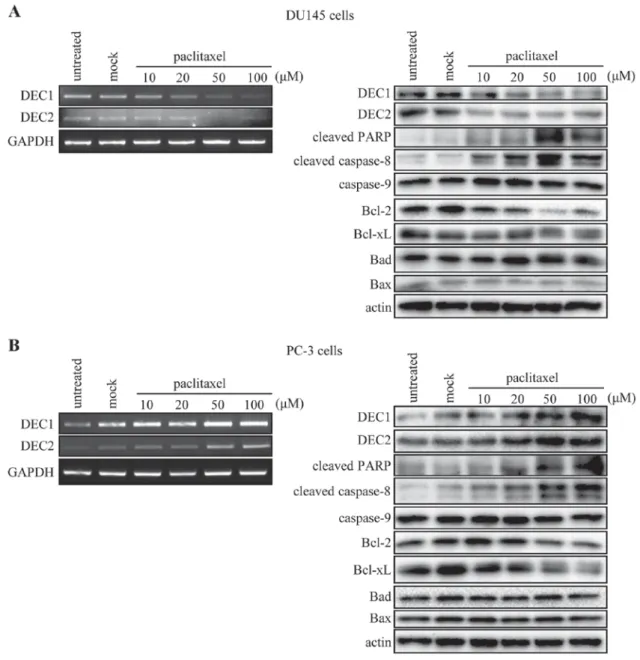
Effects of paclitaxel on DEC1 and DEC2 expression in DU145 and PC-3 cells. It is known that paclitaxel induces the apoptosis of various cancer cells. Thus, we examined the expression of apoptotic markers, as well as that of DEC1 and DEC2 in DU145 and PC-3 cells treated with 10, 20, 50 and 100 μM of paclitaxel. The mRNA and protein levels of DEC1 and DEC2 were decreased in a dose-dependent manner in DU145 cells when treated with paclitaxel for 24 h (Fig. 1A, left panel), but were increased in PC-3 cells (Fig. 1B, left panel).

In addition, paclitaxel increased the amount of cleaved PARP and cleaved caspase-8, but decreased that of Bcl-2 and Bcl-xL.

However, the level of caspase-9, Bad, and Bax was not affected by paclitaxel in the two cell lines (Fig. 1A and B right panel).

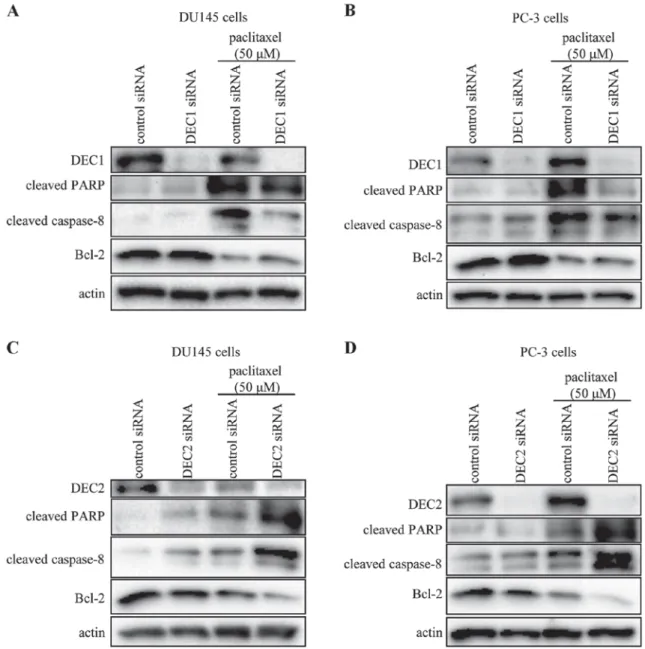
Knockdown of DEC1 and DEC2 in the presence of paclitaxel has opposite effects on apoptotic markers in DU145 and PC-3 cells. DEC1 or DEC2 knockdown by siRNA significantly reduced the expression of DEC1 or DEC2, respectively (Fig. 2).

Compared with DU145 or PC-3 cells transfected with control siRNA, paclitaxel-combined control siRNA induced the amount of cleaved PARP and cleaved caspase-8, which was decreased by DEC1 siRNA. On the other hand, the expression of Bcl-2 was downregulated by paclitaxel treatment, but was upregulated when DEC1 was knocked down (Fig. 2A and B).

By contrast, DEC2 knockdown increased the amount of

(3)

cleaved PARP and caspase-8, whether with or without pacli- taxel (Fig. 2C and D). The expression of Bcl-2, which was downregulated by paclitaxel treatment, was further inhibited when DEC2 was knocked down.

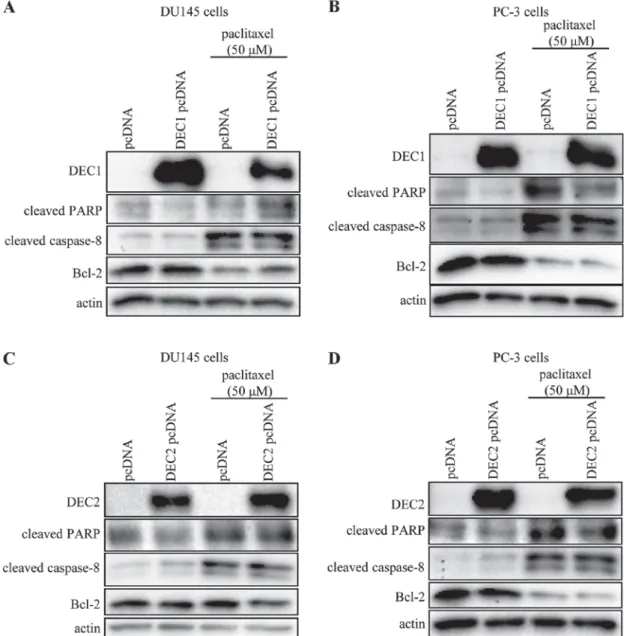
Overexpression of DEC1 or DEC2 has no effect on apoptotic markers in DU145 and PC-3 cells. Using transient transfec- tion, we examined whether the overexpression of DEC1 or DEC2 affected the expression of apoptotic markers in DU145 and PC-3 cells. DEC1 and DEC2 overexpression in the pres- ence or absence of paclitaxel (50 μM) showed little effect on the expression of cleaved PARP, cleaved caspase-8, and Bcl-2 (Fig. 3).

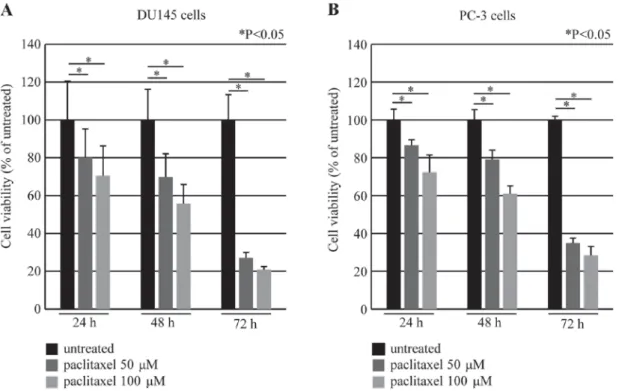
DEC2 overexpression inhibits cell death in DU145 and PC-3 cells. Paclitaxel induced cell death in a time- and dose-dependent

manner in DU145 and PC-3 cells using the MTS assay (Fig. 4).

We also investigated whether DEC2 overexpression affected cell viability in these cells. DEC2 overexpression in the pres- ence of paclitaxel (50 μM) significantly increased the cell viability compared with that in paclitaxel-treated control cells.

In addition, DEC2 overexpression in the absence of paclitaxel had little effect on the viability in these cells (Fig. 5).

Discussion

In the present study, we examined how DEC1 or DEC2 functions during apoptosis caused by the anti-cancer drug paclitaxel. Two of the well-characterized androgen-indepen- dent prostate cancer cell lines DU145 and PC-3, were selected in the present study as many prostate cancer patients showed androgen-independent growth. Paclitaxel-induced apoptosis in

Figure 1. Paclitaxel affects the expression of DEC1 and DEC2. DU145 and PC-3 cells were treated with various concentrations of paclitaxel. After 24 h, total

RNA was prepared and subjected to RT-PCR analysis of DEC1, DEC2 and GAPDH (A and B, left panel). DU145 and PC-3 cells were treated with paclitaxel for

24 h. The cells were lysed, and the lysates were subjected to western blot analysis of DEC1, DEC2, cleaved PARP, cleaved caspase-8, caspase-9, Bcl-2, Bcl-xL,

Bad, Bax, and actin (A and B, right panel). DEC, differentiated embryonic chondrocyte ; PARP, poly (ADP-ribose) polymerase.

(4)

LIU et al: ANTI-APOPTOTIC EFFECT OF DEC2 AND PRO-APOPTOTIC EFFECT OF DEC1 IN PROSTATE CANCER

1730

the two cells, however, differential chemotherapeutic response was found between the two cells. Paclitaxel treatment (50 μM) produced the largest amount of cleaved PARP in DU145 cells DQG—0ZDVQHHGHGLQ3&FHOOV$GGLWLRQDOO\!RI DU145 cells died when cultured in 100 μM of paclitaxel, which explains the relatively weaker band of cleaved-PARP obtained in these cells. Moreover, the viability of DU145 cells following paclitaxel treatment showed a more significant reduction than that of PC-3 cells. This difference may be caused by the status of a tumor suppressor gene, PTEN. Mutations or loss of expression of this gene was found in a high percentage of prostate cancer patients. Lee et al showed that PC-3 was a PTEN-negative cell line, while DU145 was a PTEN-positive cell line (20). On the other hand, the expression of apoptotic markers, as well as DEC was differentially regulated in the two cell lines. Thus, DEC1 and DEC2 were decreased by paclitaxel

in DU145 cells but increased in PC-3 cells. Previous studies showed that DEC1 and DEC2 were regulated by many envi- ronmental and endogenous factors in various cell lines (21-24).

Changes of DECs were dependent on the cell lines and the types of reagents, or even the amount of the reagents applied.

The function of paclitaxel on DEC in the breast MCF-7 adeno- carcinoma cell line has been previously discussed (17). In MCF-7 cells, the expression of DEC1 and DEC2 was increased by paclitaxel in a dose-dependent manner. Additionally, the extent of DEC2 upregulation was much higher than that of DEC1. In another report, we analyzed the effect of DEC during cisplatin-induced apoptosis (25). Cisplatin decreased DEC1 and DEC2 in an oral squamous carcinoma CA9-22 cell line, but DEC1 and DEC2 were not directly associ- ated with apoptosis in this cell line. By contrast, in HSC-3, another oral squamous carcinoma cell line, cisplatin increased

Figure 2. Analysis of apoptotic marker expression in DU145 and PC-3 cells by DEC1 or DEC2 knockdown. DU145 and PC-3 cells were transfected with DEC1

siRNA (A and B) or DEC2 siRNA (C and D) and incubated for 24 h. Subsequently, the cells were incubated with or without paclitaxel (50 μM) for another

24 h. Cell lysates were prepared and subjected to western blot analysis of DEC1, DEC2, cleaved PARP, cleaved caspase-8, Bcl-2 and actin. One representative

of at least three independent experiments with similar results is shown. DEC, differentiated embryonic chondrocyte; PARP, poly (ADP-ribose) polymerase.

(5)

DEC2, which inhibited apoptosis by regulating Bim protein.

Although a similar protein structure exists in DEC1 and DEC2, it is better to consider them distinctly when referring to WKHLUIXQFWLRQV)RUH[DPSOH'(&ZDVXVXDOO\LGHQWLÀHGDV an apoptosis inhibitor whereas the role of DEC1 in apoptosis is under debate (16,17). Another report suggested that DEC1 was induced but DEC2 was reduced when PANC-1 cells were exposed to transforming growth factor (TGF)-ơ(26). In addition, DEC1 exerted its effect on transcription factors that subsequently regulated the epithelial-mesenchymal molecules to progress the epithelial-mesenchymal transition (EMT) of carcinoma cells, whereas DEC2 did not exert such an effect.

As effectors of hypoxia, DEC1 response was more rapid to hypoxic stress than DEC2. Previous findings showed that the upregulation of DEC2 in the latter stage of hypoxia accompanied with the increase in cell proliferation led to oxygen-deprived stress (19).

In the present study, DU145 and PC-3 cells transfected with DEC1 siRNA under paclitaxel treatment showed decreased levels of cleaved PARP and cleaved caspase-8, but an increased level of anti-apoptotic factor Bcl-2 when compared with the control siRNA-transfected cells.

However, DEC2 siRNA-transfected cells exhibited opposite results to those mentioned above. Since DEC1 or DEC2 functioned similarly in regulating apoptosis but showed a distinct response to paclitaxel in DU145 and PC-3 cells, the key factor in modulating apoptosis was considered to be different in the two cell lines. In addition to the knockdown analyses, overexpression experiments were also applied in the present study and a weak downregulation of cleaved PARP as well as a slight upregulation in cell viability by DEC2 overexpression were obtained in the two cell lines, DOWKRXJKVLJQLÀFDQWFKDQJHVRIFOHDYHGFDVSDVHDQG%FO were not found. On the other hand, DEC1 overexpression had

Figure 3. Overexpression of DEC1 or DEC2 has no effect on the expression of apoptotic markers in DU145 and PC-3 cells. DU145 and PC-3 cells were transfected

with DEC1 pcDNA (A and B) or DEC2 pcDNA (C and D) and incubated for 24 h. The cells were treated with paclitaxel (50 μM) and incubated for an additional

24 h, before being lysed. The lysates were subjected to western blot analysis of DEC1, DEC2, cleaved PARP, cleaved caspase-8, Bcl-2 and actin. One representative

of at least three independent experiments with similar results is shown. DEC, differentiated embryonic chondrocyte; PARP, poly (ADP-ribose) polymerase.

(6)

LIU et al: ANTI-APOPTOTIC EFFECT OF DEC2 AND PRO-APOPTOTIC EFFECT OF DEC1 IN PROSTATE CANCER

1732

an unstable effect on the expression of apoptotic markers.

Since proteins exert their functions only at optimal concen- trations, this may provide a more plausible explanation for the fact that the results of overexpression treatment were not consistent with those of the knockdown treatment.

,QFRQFOXVLRQWKHUHVXOWVRIWKHSUHVHQWVWXG\FRQÀUPWKH anti-apoptotic character of DEC2 in paclitaxel-induced apop- tosis, in two prostate adenocarcinoma cell lines. In addition to DU145 and PC-3 cell lines, DEC2 has been shown to inhibit apoptosis in breast carcinoma MCF-7 cells (17) oral squamous

Figure 4. Paclitaxel-induced time- and dose-dependent cell death in DU145 and PC-3 cells. The cells were treated with 50 or 100 μM of paclitaxel for 24, 48 and 72 h, and cell viability was measured using the MTS-assay in (A) DU145 and (B) PC-3 cells. The values are shown as a percentage of each control.

Each value represents the mean ± SEM (bars) of three independent experiments (

*

P<0.05, compared with the untreated). MTS, [3-(4,5-dimethylthiazol-2-yl)- 5-(3-carboxymethoxyphenyl)-2-(4-sulfophenyl)-2H-tetrazolium].

Figure 5. DEC2 overexpression inhibits cell death induced by paclitaxel in DU145 and PC-3 cells. DU145 or PC-3 cells transfected with DEC2 pcDNA were

treated with or without 50 μM of paclitaxel for 24 h. Cell viability was measured using the MTS assay in (A) DU145 and (B) PC-3 cells. The values are shown

as a percentage of the control. Each value is the mean ± SEM (bars) of three independent experiments (

*

P<0.05, compared with the control pcDNA). DEC2,

differentiated embryonic chondrocyte 2; MTS, [3-(4,5-dimethylthiazol-2-yl)-5-(3-carboxymethoxyphenyl)-2-(4-sulfophenyl)-2H-tetrazolium].

(7)

cell carcinoma HSC-3 cells (25), and esophageal squamous cell carcinoma (ESCC) TE-11 cells (article accepted).

Inhibitor of DEC2 may be developed and be used as one of the choices when conferring CRPC in clinical chemotherapy in the future.

Acknowledgements

The present study was supported by Grants-in-Aid for Science from the Ministry of Education, Culture, Sports, Science and Technology of Japan; a grant for Hirosaki University Institutional Research; and the Fund for the Promotion of ,QWHUQDWLRQDO6FLHQWLÀF5HVHDUFK

References

1. Siegel R, Ma J, Zou Z and Jemal A: Cancer statistics, 2014. CA Cancer J Clin 64: 9-29, 2014.

2. Debes JD and Tindall DJ: Mechanisms of androgen-refractory prostate cancer. N Engl J Med 351: 1488-1490, 2004.

3. Tannock IF, de Wit R, Berry WR, Horti J, Pluzanska A, Chi KN, Oudard S, Théodore C, James ND, Turesson I, et al; TAX 327 Investigators: Docetaxel plus prednisone or mitoxantrone plus prednisone for advanced prostate cancer. N Engl J Med 351:

1502-1512, 2004.

4. Petrylak DP1, Tangen CM, Hussain MH, Lara PN Jr, Jones JA, Taplin ME, Burch PA, Berry D, Moinpour C, Kohli M, et al:

Docetaxel and estramustine compared with mitoxantrone and prednisone for advanced refractory prostate cancer. N Engl J Med: 351: 1513-1520, 2004.

5. Kelly WK, Curley T, Slovin S, Heller G, McCaffrey J, Bajorin D, Ciolino A, Regan K, Schwartz M, Kantoff P, et al: Paclitaxel, estramustine phosphate, and carboplatin in patients with advanced prostate cancer. J Clin Oncol 19: 44-53, 2001.

6. McGuire WP, Rowinsky EK, Rosenshein NB, Grumbine FC, Ettinger DS, Armstrong DK and Donehower RC: Taxol: A unique DQWLQHRSODVWLFDJHQWZLWKVLJQLÀFDQWDFWLYLW\LQDGYDQFHGRYDULDQ epithelial neoplasms. Ann Intern Med 111: 273-279, 1989.

7. Rowinsky EK, Burke PJ, Karp JE, Tucker RW, Ettinger DS and Donehower RC: Phase I and pharmacodynamic study of taxol in refractory acute leukemias. Cancer Res 49: 4640-4647, 1989.

8. Sunters A, Madureira PA, Pomeranz KM, Aubert M, Brosens JJ, Cook SJ, Burgering BM, Coombes RC and Lam EW: Paclitaxel- induced nuclear translocation of FOXO3a in breast cancer cells is mediated by c-Jun NH2-terminal kinase and Akt. Cancer Res 66: 212-220, 2006.

9. Kolomeichuk SN, Terrano DT, Lyle CS, Sabapathy K and Chambers TC: Distinct signaling pathways of microtubule inhibitors-vinblastine and Taxol induce JNK-dependent cell death but through AP-1-dependent and AP-1-independent mechanisms, respectively. FEBS J 275: 1889-1899, 2008.

10. Tudor G, Aguilera A, Halverson DO, Laing ND and Sausville EA:

Susceptibility to drug-induced apoptosis correlates with differ- ential modulation of Bad, Bcl-2 and Bcl-xL protein levels. Cell Death Differ 7: 574-586, 2000.

11. Lim SJ, Choi MK, Kim MJ and Kim JK: Alpha-tocopheryl succinate potentiates the paclitaxel-induced apoptosis through enforced caspase 8 activation in human H460 lung cancer cells.

Exp Mol Med 41: 737-745, 2009.

12. Saunders DE, Lawrence WD, Christensen C, Wappler NL, Ruan H and Deppe G: Paclitaxel-induced apoptosis in MCF-7 breast-cancer cells. Int J Cancer 70: 214-220, 1997.

13. Sun H and Taneja R: Stra13 expression is associated with growth arrest and represses transcription through histone deacetylase (HDAC)-dependent and HDAC-independent mechanisms. Proc Natl Acad Sci USA 97: 4058-4063, 2000.

14. Honma S, Kawamoto T, Takagi Y, Fujimoto K, Sato F, Noshiro M, Kato Y and Honma K: Dec1 and Dec2 are regulators of the mammalian molecular clock. Nature 419: 841-844, 2002.

15. Chakrabarti J, Turley H, Campo L, Han C, Harris AL, Gatter KC and Fox SB: The transcription factor DEC1 (stra13, SHARP2) is associated with the hypoxic response and high tumour grade in human breast cancers. Br J Cancer 91: 954-958, 2004.

16. Li Y, Xie M, Yang J, Yang D, Deng R, Wan Y and Yan B: The expression of antiapoptotic protein survivin is transcriptionally upregulated by DEC1 primarily through multiple sp1 binding sites in the proximal promoter. Oncogene 25: 3296-3306, 2006.

17. Wu Y, Sato F, Bhawal UK, Kawamoto T, Fujimoto K, Noshiro M, Morohashi S, Kato Y and Kijima H: Basic helix-loop-helix transcription factors DEC1 and DEC2 regulate the paclitaxel- induced apoptotic pathway of MCF-7 human breast cancer cells.

Int J Mol Med 27: 491-495, 2011.

18. Liu Y, Sato F, Kawamoto T, Fujimoto K, Morohashi S, Akasaka H, Kondo J, Wu Y, Noshiro M, Kato Y, et al: Anti-apoptotic effect of the basic helix-loop-helix (bHLH) transcription factor DEC2 in human breast cancer cells. Genes Cells 15: 315-325, 2010.

19. Wu Y, Sato H, Suzuki T, Yoshizawa T, Morohashi S, Seino H, Kawamoto T, Fujimoto K, Kato Y and Kijima H: Involvement of c-Myc in the proliferation of MCF-7 human breast cancer cells induced by bHLH transcription factor DEC2. Int J Mol Med 35:

815-820, 2015.

20. Lee JT, Jr, Steelman LS and McCubrey JA: Phosphatidylinositol 3'-kinase activation leads to multidrug resistance protein-1 expression and subsequent chemoresistance in advanced prostate cancer cells. Cancer Res 64: 8397-8404, 2004.

21. Thin TH, Li L, Chung TK, Sun H and Taneja R: Stra13 is induced by genotoxic stress and regulates ionizing-radiation-induced apoptosis. EMBO Rep 8: 401-407, 2007.

22. Miyazaki K, Kawamoto T, Tanimoto K, Nishiyama M, Honda H and Kato Y: Identification of functional hypoxia response elements in the promoter region of the DEC1 and DEC2 genes. J Biol Chem 277: 47014-47021, 2002.

23. Yamada K, Kawata H, Shou Z, Mizutani T, Noguchi T and Miyamoto K: Insulin induces the expression of the SHARP-2/Stra13/DEC1 gene via a phosphoinositide 3-kinase pathway. J Biol Chem 278: 30719-30724, 2003.

24. Kon N, Hirota T, Kawamoto T, Kato Y, Tsubota T and Fukada Y:

Activation of TGF-beta/activin signalling resets the circadian clock through rapid induction of Dec1 transcripts. Nat Cell Biol 10: 1463-1469, 2008.

25. Wu Y, Sato F, Bhawal UK, Kawamoto T, Fujimoto K, Noshiro M, Seino H, Morohashi S, Kato Y and Kijima H: BHLH transcription factor DEC2 regulates pro-apoptotic factor Bim in human oral cancer HSC-3 cells. Biomed Res 33: 75-82, 2012.

26. Wu Y, Sato F, Yamada T, Bhawal UK, Kawamoto T, Fujimoto K,

Noshiro M, Seino H, Morohashi S, Hakamada K, et al: The

BHLH transcription factor DEC1 plays an important role in the

epithelial-mesenchymal transition of pancreatic cancer. Int J

Oncol 41: 1337-1346, 2012.

Figure 1. Paclitaxel affects the expression of DEC1 and DEC2. DU145 and PC-3 cells were treated with various concentrations of paclitaxel
Figure 2. Analysis of apoptotic marker expression in DU145 and PC-3 cells by DEC1 or DEC2 knockdown
Figure 3. Overexpression of DEC1 or DEC2 has no effect on the expression of apoptotic markers in DU145 and PC-3 cells
Figure 4. Paclitaxel-induced time- and dose-dependent cell death in DU145 and PC-3 cells

参照

関連したドキュメント

reported that gemcitabine-mediated apoptosis is caspase- dependent in pancreatic cancers; Jones et al [14] showed that gemcitabine-induced apoptosis is achieved through the

induced CXCL8 mRNA expression (data not shown) and CXCL8 protein expression in pancreatic cancer cells in xenografted tumor tissues (Fig.. We next administered anti-CXCL8 antibody

Accordingly, our results showed that kahweol acetate and cafestol inhibited the proliferation and migration of both ACHN and Caki-1 cells, with their synergistic effects apparent

(14) Similarly, as observed on other members of Pim family, (15,16) we demonstrated that aberrantly expressed Pim-3 can inactivate a pro-apoptotic BH3-only Bcl-2-like molecule,

To determine the promoter activities of 5 ′ -flanking region of the human Pim-3 gene, we subcloned various deleted 5 ′ -flanking regions of the human Pim-3 gene into a

Pim-3, a proto-oncogene with serine ⁄ threonine kinase activity, is aberrantly expressed in human pancreatic cancer and phosphorylates Bad to block Bad-mediated apoptosis in

In this study, we attempt to show the cell fate of proliferating Müller cells after MNU treatment to address the question “Are proliferating Müller cells indeed the source

The impact of rotational error regarding the treatment of prostate cancer with VMAT has not yet been evaluated, and our preliminary study showed that pitch angle error affected