有本 茂*1 Massoud Amini*2 Hao Chen*3 福田信幸*4 Joseph E. LeBlanc*5 村上達也*6 成木勇夫*7 Mark Spivakovsky *8 竹内 茂*9 Keith F. Taylor*10
Hong Yi Wong*11 山中 聡*12 横谷正明*13 Peter Zizler*14
Mathematics and chemistry
interdisciplinary joint research and the Fukui Project
XXI
Shigeru ARIMOTO, Massoud AMINI, Hao CHEN, Nobuyuki FUKUDA, Joseph E. LEBLANC Tatsuya MURAKAMI, Isao NARUKI, Mark SPIVAKOVSKY, Shigeru TAKEUCHI
Keith F. TAYLOR, Hong Yi WONG, Satoshi YAMANAKA, Masaaki YOKOTANI and Peter ZIZLER
This is the 21st part of the series of articles that records and further develops essentials of the Mathematics and Chemistry Interdisciplinary Symposium 2013 Tsuyama, whose main themes were symmetry, periodicity, and repetition. The symposium was held on April 5th and 6th in Tsuyama city, Okayama, Japan, in conjunction with the Fukui Project and was devoted to the memory of the late Professor Kenichi Fukui (1981 Nobel Prize) who initiated the project. The present series also provides challenging cross-disciplinary problems which are directly related to the Fukui conjecture and to recent carbon nanotube research. Some of these problems are formulated using mathematical language not well known among chemists despite the importance of these notions in elucidating additivity and high-speed asymptotic phenomena in molecules having many repeating identical moieties. Some problems are formulated in terms of Fourier analysis connected to the theory of analytic curves, others are formulated in connection with the Science-Art Multi-angle Network (SAM Network) Project, which seeks to bridge Science and Art (visual, audial, and conceptual) for a creative collaboration, and is an important part of the Fukui Project.
Key Words: the Fukui conjecture, Memoir of Prof. K. Fukui, Unique factorization domain (UFD), Carbon nanotube, Fourier analysis
I Introduction
7. Unifying Approach in the Repeat Space Theory (RST) II
Shigeru Arimoto, Massoud Amini, Hao Chen Nobuyuki Fukuda, Isao Naruki, Mark Spivakovsky Shigeru Takeuchi, Keith F. Taylor, Satoshi Yamanaka
Masaaki Yokotani and Peter Zizler
This is a direct continuation of Section 2 of Part XIX.
In this section, we wish to unify the proofs of different versions of the Asymptotic Linearity Theorem Extension
原稿受付 平成29年9月21日
*1, *12, *13 総合理工学科 *4 総合理工学科非常勤講師
*2 Dept. of Math.Tarbiat Modares University, Iran
*3 Dept. of Fund.Ed., Dalian Neusoft University of Information, China
*5 School of Integrated Studies, Pennsylvania College of Technology USA
*6 富山県立大学 工学部・医薬品工学科
*7 立命館大学 理工学部・数学物理学系・数理科学科・元教授
*8 CNRS and Institute de Mathématiques de Toulouse, France
*9 岐阜大学 教育学部・数学科
*10 Dept. of Math. and Stat., Dalhousie University, Canada
*11 School of Communication, Arts and Social Sciences, Singapore Polytechnic, Singapore
*14 Dept. of Math., Phys., and Eng., Mount Royal University, Canada
-17-
Conjectures (ALTECs).
1. Introduction to the Asymptotic Linearity Theorem Extension Conjectures (ALTECs)
To prove the Asymptotic Linearity Extension Conjectures (ALTEC) [1-4] was a fundamental problem in repeat space theory. In Refs. [1,4], the Asymptotic Linearity Extension Conjectures, C(I) and CBV(I) versions, were proved for the first time by using two types of continuous fractal functions T and K and by using the Cantor function, by a method similar to proving Theorem 1 via the ALT (that is, by a method similar to proving Zizler’s Theorem via the ALT).
In Part XI [2], some tools for the proofs of the conjectures have been developed, but until now we could not see clearly the above versions in a single perspective.
In this section, we unify the two proofs of the Asymptotic Linearity Theorem Extension Conjecture (ALTEC) C(I) and CBV(I) versions and give solutions to the Challenging Problems V and VI in Ref. [3].
We retain the notation of Refs. [2-4], and recommend the reader to review these references before proceeding further. In what follows, we recall only essential notation and definitions from Refs. [2-4].
Throughout this section, let + and denote, respectively, the sets of all positive integers and real numbers.
Recall that a real sequence EN is said to have an asymptotic line if there exist , such that EN – (N + ) 0 as N , that is, if there exist , such that EN = N + + o(1), as N , where o(1) denotes the Landau notation. Note that for a real sequence EN to have an asymptotic line, it is necessary for the sequence EN/N to have a limit lim N/
N E N
. If this limit exists, the sequence EN has an asymptotic line if and only
if lim N
N E N
exists in .
In the present article, a real sequence EN is said to be on a line if there exist , such that EN – (N + ) = 0 for all N +.
Notation Let I = [a, b] (a, b , a < b) denote a closed interval.
VI (): the total variation of a real-valued function
on I, that is, VI () = sup
1 n
i
|(ti) – (ti- 1)| (1)(: a = t0 ≤ t1 ≤ . . . ≤ tn = b).
C(I): the Banach space of all real-valued continuous functions on I equipped with the norm given by
|| || = sup {| (t)|: t I}. (2) (In what follows, C(I) is often denoted by C[a, b].)
CBV(I) : the Banach space of all real-valued continuous functions of bounded variation on I equipped with the norm given by
|||| = sup {| (t)|: t I} + VI( ). (3) AC(I): the Banach space of all real-valued absolutely continuous functions on I equipped with the norm given by
|||| = sup {| (t)|: t I} + VI( ). (4) Before recalling the following practical version of the Asymptotic Linearity Theorem [5], the reader is referred to the Appendix to Part XX for the definition of the repeat space Xr(q).
Theorem 1 (Practical ALT, Xr(q)-version). Let {MN} Xr(q) be a fixed repeat sequence, let I be a fixed closed interval compatible with {MN}. Then, for any AC(I), there exist (), () R such that
Tr (MN) = ( )N + () + o(1) (5) as N .
Asymptotic Linearity Theorem Extension Conjecture (ALTEC C(I)-version) The Asymptotic Linearity Theorem (ALT) cannot be extended from AC(I) to C(I), where AC(I) denotes the functional space of all real-valued absolutely continuous functions defined on the closed interval I, and C(I) denotes the functional space of all real-valued continuous functions defined on the closed interval I.
Asymptotic Linearity Theorem Extension Conjecture (ALTEC CBV(I)-version) The Asymptotic Linearity Theorem (ALT) cannot be extended from AC(I) to CBV(I), where AC(I) denotes the functional space of all real-valued absolutely continuous functions defined on the closed interval I and CBV(I) denotes the functional space of all real-valued continuous functions of bounded variation defined on the closed interval I.
2. Unification of the proofs of the ALTECs
In recent publications [1] and [4], one of the authors
-18-
(S.A.) has proved the above two conjectures by using the following two Lemmas A0, A1, which were established, respectively, in Refs. [1,4]. (In Ref. [1], Lemmas A0 and A1 were called Lemmas 2.1 and A1, respectively.)
Lemma A0. If there exists a C[0, 1] such that the real sequence EN() :=
kN1 (k/N) does not have an asymptotic line, then the Asymptotic Linearity Theorem Extension Conjecture (ALTEC) C(I)-version is true.Lemma A1. If there exists a CBV[0, 1] such that the real sequence EN( ) := N1
k
(k/N) does nothave an asymptotic line, then the Asymptotic Linearity Theorem Extension Conjecture (ALTEC) CBV(I)-version is true.
The purpose of this section is to recall the prototypal approach given in [1] and develop new unifying tools for getting a deeper insight into the both versions of ALTEC.
For this purpose, we prove the following two key lemmas B and C.
Lemma B. Let f: Z+ R be a real sequence. Suppose that there exist a positive integer m 2 and a real number A such that the equality
f(mN) = f(N) + AN (6) holds for all N Z+. Let:= A/(m 1) and let g(N) :=
f(N) N. Then
g(mN) = g(N) (7)
for all N +. Moreover, the following conditions are equivalent.
(i) The sequence f(N) has an asymptotic line.
(ii) The sequence f(N) is on a line.
(iii) The sequence g(N) converges.
(iv) The sequence g(N) is a constant sequence, that is, (1)g g(2) ... .
Proof. First, observe that the following equalities hold for all N +.
g(mN) g(N) = f(mN) mN f(N) + N
= AN (m 1)N
= AN AN = 0. (8) Thus,
g(mN) = g(N) (9)
for all N +.
Assume (i). Since f(N) has an asymptotic line, there exist ,0 0 such that
f(N) = 0N + 0 + o(1), (10) as N . Hence, we have
f(mN) = 0mN + 0 + o(1), (11) as N . By (10) and (11), we see that
0
( ) ( ) 1
( 1) ,
f mN f N
m o
N N
(12)
as N .
Since the right-hand side of (12) is A by (6), letting N
, we infer that
0 1
A
m
= . (13)
Note that (10), (13) and the definition of g(N) imply that
g(N) = f(N) N = 0 + o(1) (14) as N . Thus, the sequence g(N) must converge to 0. We conclude that (i) => (iii).
The converse (iii) => (i) is easy to prove: Assume (iii) and let limNg N( ) . Then f(N) (N +
) 0 as N . Thus, we have (i).
Now under the assumption (i), suppose that for some N0 +
g(N0) 0. (15) Then we would have by (9),
0 g(N0) = g(mN0) = g(m2N0) = g(m3N0) = …, (16) which contradicts (14). Thus, we have
g(N) = 0 (17) for all N +, that is,
f(N) = N + 0 (18) for all N +. We therefore infer that the sequence is on a line. We conclude that (i) => (iv). Clearly, (iv) => (ii)
=> (i). This completes the proof. //
The following Lemma B’ is an improvement of Lemma B. This improvement is due to H. Chen:
Lemma B’. Let f: Z+ R be a real sequence. Suppose that there exist a positive integer m 2 and a real number such that the equality
f(mN) = f(N) + (m 1)N (19) holds for all N Z+. Let g(N) := f(N) N. We have
g(mN) = g(N) (20)
for all N +. Moreover, the following conditions are equivalent.
(i) The sequence f(N) has an asymptotic line.
(ii) The sequence f(N) is on a line.
-19-
(iii) The sequence g(N) converges.
(iv) The sequence g(N) is a constant sequence, i.e., (1) (2) ...
g g .
Proof. The proof proceeds in the same way as the proof of
Lemma B. //
Note that in Lemma B’, plays a role of ‘mth difference coefficient’ since
f(mN) = f(N +(m 1)N)
= f(N) + (increment from N)
= f(N) + (m 1)N.
Although Lemma B’ is better to geometrically understand the meaning of the assertion of the above two versions B and B’, we keep old version B to highlight the relationship between both versions and our earlier arguments in Refs. [1-3].
Lemma C. Fix either X = C[0, 1] or X = CBV[0, 1]. For any X, let EN( ) denote the real sequence defined by EN( ) :=
Nk1 (k/N). Suppose that there exists a positive integer m 2, real number A, and X such thatEmN() = EN() + AN (21) for all N +. Let N( ) := EN()(A/(m 1))N.
Then, the following conditions are equivalent.
(i) The sequence EN() has an asymptotic line.
(ii) The sequence EN() is on a line.
(iii) The sequence N( ) converges.
(iv) The sequence N( ) is a constant sequence, i.e., 1( ) 2( ) ... .
Moreover, if one of the conditions (i), (ii), (iii), (iv) is not fulfilled, then the Asymptotic Linearity Theorem Extension Conjecture (ALTEC X version) is true.
Proof. Suppose that there exists a X, a positive integer m 2, and a real number A such that the real sequence EN() satisfies (21) for all N +. Fix such a
X, an m 2, and real number A, and set EN = EN() and N = N( ). We know from Lemmas A0 and A1 that if (i) is not fulfilled, then the Asymptotic Linearity Theorem Extension Conjecture (ALTEC X version) is true. Thus, for the proof of the lemma, we have only to show the equivalence of the conditions (i), (ii), (iii), and (iv). Set f(N) = EN( ) and g(N) = N( ), and apply Lemma B, then the conclusion follows. //
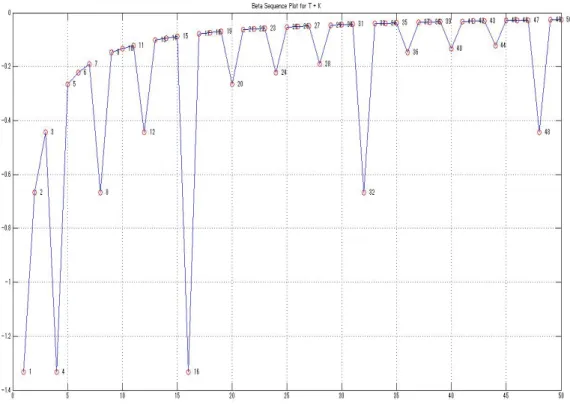
In what follows, we provide solutions to the following challenging problems stated in [3]. See Figs 1 and 2 on the next page for the graphs of EN(T + K) and EN(T K) numerically calculated by MATLAB.
Challenging problem V. Does EN(T + K) have an asymptotic line?
Challenging problem VI. Does EN(T K) have an asymptotic line?
Solution: From [3] references therein, recall the relations E2N(T) = EN(T) + N, (22) E4N(K) = EN(K) + N, (23) valid for all N +.
By (22), we have
E4N(T) = E2N(T) + 2N = EN(T) + 3N. (24) By the linearity of E4N and EN, we easily see that
E4N(T + K) = EN(T + K) + 4N, (25) E4N(T K) = EN(T K) + 2N, (26) for all N +.
Now, it is easily checked that neither of EN(T + K) and EN(T K) is on a line. Therefore, neither of EN(T + K) and EN(T K) has an asymptotic line.
References
[1] S. Arimoto, Proof of the Asymptotic Linearity Theorem Extension Conjecture (ALTEC), J. Math. Chem. 54 (2016) 72-84.
[2] S. Arimoto, M. Amini, N. Fukuda, I. Morishima, T. Murakami, I.
Naruki, K. Saito, M. Spivakovsky, S. Takeuchi, K.F. Taylor, S. Yamanaka, M. Yokotani, and P. Zizler, "Mathematics and Chemistry Interdisciplinary Joint Research and the Fukui Project XI", Bulletin of National Institute of Technology, Tsuyama College 57 (2015) 59-66.
[3] S. Arimoto, M. Amini, N. Fukuda, I. Morishima, T. Murakami, I.
Naruki, K. Saito, M. Spivakovsky, S. Takeuchi, K.F. Taylor, S. Yamanaka, M. Yokotani, and P. Zizler, "Mathematics and Chemistry Interdisciplinary Joint Research and the Fukui Project XII", Bulletin of National Institute of Technology, Tsuyama College 57 (2015) 67-72.
[4] S. Arimoto, M. Amini, N. Fukuda, I. Morishima, T. Murakami, I.
Naruki, K. Saito, M. Spivakovsky, S. Takeuchi, K.F. Taylor, S. Yamanaka, M. Yokotani, and P. Zizler, "Mathematics and Chemistry Interdisciplinary Joint Research and the Fukui Project XIII", Bulletin of National Institute of Technology, Tsuyama College 57 (2015) 73-78.
[5] S. Arimoto and K.F. Taylor, Practical Version of the Asymptotic Linearity Theorem with Applications to the Additivity Problems of Thermodynamic Quantities, J. Math. Chem. 13 (1993) 265-275.
-20-
Fig. 1. Sequence N(TK) calculated by using MATLAB
Fig. 2. Sequence N(TK) calculated by using MATLAB
-21-
8. Mindful Frontier International Project (MFI Project)
Shigeru Arimoto, Nobuyuki Fukuda, Hong Yi Wong Satoshi Yamanaka and Masaaki Yokotani
1. Origin of the Mindful Frontier International Project
A new project called Mindful Frontier International Project (MFI Project) started within the framework of the New Frontier Project, along with the Science-Art Multi-angle Network (SAM Network). This MFI project originates from earlier teachings of Prof. K. Fukui, his teacher Prof. Haruo Shingu, and Prof. Fukui’s English acquaintance, Prof. G.G.
Hall (Applied Mathematics). [Remarks. Prof. Hall is a pioneer in Quantum Chemistry, noted for his discovery of the Roothaan-Hall equations. Prof. Shingu was also a collaborator in the initial development of Fukui’s Frontier Electron Theory. It is also well-known that Prof. Shingu gave the name of the ‘Frontier Electron Theory’ to Fukui’s pioneering theory. Prof. G.G. Hall, Nottingham University, England, was invited to Kyoto University, in 1983, as the first full-time non-Japanese professor of national university in post-war Japan, through the efforts of Prof. Fukui and his Japanese colleagues.]
2. MFI Project for Innovative Thinking and Global Cross-disciplinary Education
The MFI Project originally aimed at enhancing the lively and creative activities of students and researchers using the assets of teaching mainly from the above-mentioned three pioneers in science. The first author of this section (S.A.) who was a student of all the three professors in Kyoto University, recalled their lectures, seminars, publications, and personal conversations which were especially related to innovative thinking and global cross-disciplinary education.
The first author began to store and share the assets from these teachers with the members of the New Frontier Project and also with people outside the circle of this project.
3. MFI Project for International Global Education and for Improving Public Speeches and Lectures in English
A new element began to be added to the MFI Project around the time when the first author visited Singapore Polytechnic in 2015 together with students from Tsuyama College for international global education. Singapore Polytechnic (SP) provides multi-cultural international education for students from non-English speaking countries. Singapore itself is a multi-racial and culturally diverse society. SP is aware of the challenges that come with learning a foreign language, and it seeks to help students (both from Singapore and abroad) to speak and express themselves in English effectively regardless of their mother tongue. SP positively accepts and celebrates accents of English beyond those of a British or North American origin. To the non-native speaker of English, accents such as Japanese, Filipino or Singaporean ought to be seen as a distinctive feature, not a weakness, given the diverse world we live in. We witness Asian students with accents having a psychological inhibition that hinders their natural flow of speaking.
Combined with other public speaking techniques, this psychological recognition and positive acceptance of diversity can instill greater confidence in the student and enable more effective use of English as a tool for global communication.
Through contacts with the teachers and instructors in Singapore Polytechnic and through actual participation in their English lectures for foreign (Japanese) students, the first author recalled Prof. Fukui’s and Prof. Hall’s seminars in Kyoto in 1980s, in which all the participants had to speak in English.
Through cooperative discussions, the authors of this section noticed the possibility of adding the pedagogical methods of Singaporean teachers to those of Prof. Fukui, Prof. Hall, and Prof. Shingu, for international global education and also for improving public speeches and lectures in English.
Here in this section, we pose the following questions, and we will give our answers to these questions in a future publication elsewhere.
(1) How can one give international global education effectively to students?
(2) How can one give lectures in English effectively to students whose mother tong is not English? [A specific question belonging to category (2): For mathematics or science lectures in English, the first author developed English & mother tong parallel text method and the ‘variable bilingual method’. Can
-22-
these methods be combined with Singaporean teachers’ more visual and schematic methods?]
(3) How can one train students for presentations in English?
In a ‘Challenge Seminar’ in Tsuyasma College, the first author taught techniques of brainstorming, analysis, organization, and structuring of data for presentation.
Besides these standard techniques he also taught, especially for ‘rigid students’ with mental inhibitions, the methods involving (i) Yoga-Zen-type exercises, (ii) breathing exercises, (iii) meditative exercises, which were all non-religious and neutral and thus suitable for any student from all over the world. In our future publication, we will also discuss these methods, which Prof. Shingu practiced in his later years, and which potentially enhance innovative and organizing power of those who practice the above exercises regularly.
9. InterdisciplinaryChallenging Problems Related to Fourier Analysis
Shigeru Arimoto, Nobuyuki Fukuda, Joseph E. LeBlanc Satoshi Yamanaka and Masaaki Yokotani 1. Quantum Linear Chain ChN (m, k)
Let ChN (m, k) denote the quantum mechanical network system of linear chain with free ends consisting of N particles each of mass m and separation 1 that can vibrate harmonically under a restoring force due to the first-neighbor interaction k > 0. The network ChN (m, k) is completely characterized by the N N positive-semidefinite real symmetric matrix AN which is referred to as the mass-weighted Hessian matrix of ChN (m, k):
AN(k/m)
1 1
1 2 1 0
1 2
2 1
0 1 2 1
1 1
. [Note. This matrix sequence with m = k = 1 is nothing but the matrix sequence we used for proving the ALTECs and Zizler’s Theorem via the ALT.] The zero-point vibrational energy of the ChN(m, k) with fixed m, k > 0, is expressed in terms of the N eigenvalues of AN:
EN =
1 N
i (/2)(i(AN))1/2, (1)where i(AN) denotes the i-th eigenvalue of AN, or, equivalently, in terms of the trace of the function of the matrix:
EN = Tr(/2)(AN)1/2. (2) We know that the number sequence EN has an asymptotic line, namely:
Tr(/2)(AN)1/2 = N + + o(1), (3) as N , where
= (/2)(k/m)1/2(4/),
= (/2)(k/m)1/2, and o denotes the Landau notation.
2. Classical Linear Chain CChN (m, k)
Let x(t) = (x1(t), x2(t), …, xN(t))T. The above quantum mechanical network system of linear chain ChN (m, k) has a classical mechanical analogue, which we denote by CChN(m, k). This system can be studied theoretically by solving the following differential equation with given initial conditions.
d2x(t)/dt2 = ANx(t).
3. Relation between ChN (m, k) and CChN (m, k), and Challenging Problems
It is well known that the above quantum and classical system involve the same eigenvalue analysis of the matrix AN. We are especially interested in the case where N is large enough. In such a case, one can study Ch(m, k) and its classical analogue CChN(m, k) in connection with the Fukui Conjecture and the Asymptotic Linearity Theorem Extension Conjectures (ALTECs), (cf. [1-4]). Moreover, as is well known, if N is large enough, the above oscillatory system CChN(m, k) can be regarded as a continuum oscillator with a good approximation. The reader is referred to LeBlanc’s Physics Laboratory Manual [5] for experiments involving transversal and longitudinal waves in a continuum oscillatory system and for experiments involving other interesting wave phenomena. Bearing in mind the above-mentioned quantum and classical vibrational systems, and the limiting correspondence between discrete and continuum systems, we pose the following interdisciplinary
-23-
Challenging Problems CQF:
(i) To study the above classical oscillator system CChN(m, k) for a large enough N, referring to [5-7]
and to the technique of Fourier analysis given in articles [8-10] for quantum chemistry problems.
(ii) To study the above quantum oscillator system ChN(m, k) using the method of difference equations (not differential equation), referring to [5-10] and recalling the Fukui Conjecture.
It is hoped that the above challenging problems help enrich the interdisciplinary investigation in physics and mathematical chemistry related to Fourier analysis. We remark that Fourier analysis is one of our common platforms for our interdisciplinary investigations in the New Frontier (Fukui) Project.
References
[1] S. Arimoto, Proof of the Asymptotic Linearity Theorem Extension Conjecture (ALTEC), J. Math. Chem. 54 (2016) 72-84.
[2] S. Arimoto, M. Amini, N. Fukuda, I. Morishima, T. Murakami, I. Naruki, K. Saito, M. Spivakovsky, S. Takeuchi, K.F. Taylor, S. Yamanaka, M.
Yokotani, and P. Zizler, "Mathematics and Chemistry Interdisciplinary Joint Research and the Fukui Project XI", Bulletin of National Institute of Technology, Tsuyama College 57 (2015) 59-66.
[3] S. Arimoto, M. Amini, N. Fukuda, I. Morishima, T. Murakami, I. Naruki, K. Saito, M. Spivakovsky, S. Takeuchi, K.F. Taylor, S. Yamanaka, M.
Yokotani, and P. Zizler, "Mathematics and Chemistry Interdisciplinary Joint Research and the Fukui Project XII", Bulletin of National Institute of Technology, Tsuyama College 57 (2015) 67-72.
[4] S. Arimoto, M. Amini, N. Fukuda, I. Morishima, T. Murakami, I. Naruki, K. Saito, M. Spivakovsky, S. Takeuchi, K.F. Taylor, S. Yamanaka, M.
Yokotani, and P. Zizler, "Mathematics and Chemistry Interdisciplinary Joint Research and the Fukui Project XIII", Bulletin of National Institute of Technology, Tsuyama College 57 (2015) 73-78.
[5] J.E. LeBlanc, PHYSICS Laboratory Manual, Physics with Technological Applications (Kendall Hunt, Dubuque, 2016).
[6] J.E. LeBlanc, Private notes and communications.
[7] L.A. Pipes, L.R. Harvill, Applied Mathematics for Engineers and Physicists (McGraw-Hill, Singapore, 1971).
[8] G.G. Hall, Private notes and communications.
[9] S. Arimoto and G.G. Hall, Integral Representation of a Fundamental Functional for the Study of the Zero-Point Vibrational Energy of Hydrocarbons and the Total Pi-Electron Energy of Alternant Hydrocarbons, Int. J. Quantum Chem. 46 (1992) 612-635.
[10] G.G. Hall and S. Arimoto, Eigenvalue Distributions and Asymptotic Lines of the Energy in Alternant Hydrocarbons, Int. J. Quantum Chem. 45 (1993) 303-328.
-24-