The Role of Civil Society Organisations in Democratic Transition: The Case of
International Democracy Assistance to Domestic Election Monitoring Organisations (DEMOs) in Indonesia
著者 VIRGIANITA, Asra year 2014‑11‑21
その他のタイトル 民主化移行期における市民社会団体の役割―インド ネシアの選挙監視団体に対する国際的な民主化支援 を事例として―
学位授与機関 明治学院大学 学位授与番号 32683乙第7号
URL http://hdl.handle.net/10723/2280
The Role of Civil Society Organisations in Democratic Transition:
The Case of International Democracy Assistance to
Domestic Election Monitoring Organisations (DEMOs) in Indonesia
「
民主化移行期における市民社会団体の役割
―インドネシアの選挙監視団体に対する国際的な民主化支援を事例として
―」
Division of International Studies Graduate School of Meiji Gakuin University
April, 2014
Asra Virgianita
The Role of Civil Society Organisations in Democratic Transition:
The Case of International Democracy Assistance to
Domestic Election Monitoring Organisations (DEMOs) in Indonesia
「
民主化移行期における市民社会団体の役割
―インドネシアの選挙監視団体に対する国際的な民主化支援を事例として
―」
A Dissertation Presented to the Division of International Studies Graduate School of Meiji Gakuin University, for the Degree of
Doctor of International Studies
Asra Virgianita April, 2014
ABSTRACT
The Role of Civil Society Organisations in Democratic Transition:
The Case of International Democracy Assistance to
Domestic Election Monitoring Organisations (DEMOs) in Indonesia Asra Virgianita
This thesis examines the international democracy assistance and Domestic Election Monitoring Organisations (DEMOs) during the democratisation process in Indonesia. This thesis highlights that the organisational structure, including networking and historical civil society organisations (CSOs) from both from institutional or individual/member aspects, and the cooperation between donors and CSOs were important elements of successful democracy assistance in Indonesia’s shift from the transitional to the consolidation phase.
In 1998, the economic crisis caused the decline of Soeharto's authority and, in 1999,a free and fair election was carried out in Indonesia. In this election, and the following 2004 election, DEMOs ensured that the elections were fair, and contributed significantly to the promotion of democracy in Indonesia. However, in the 2009 election, fewer DEMOs were active and the fairness of the election could not be ensured, unlike the previous two elections.
Using the case of elections in the transitional period in which Indonesian DEMOs and electoral management bodies (EMBs, such as KPU and BAWASLU) were the main domestic actors and democracy assistance providers (Japan, the US and the EU) as representatives of international actors, this study investigates the roles and dynamic relations between those actors in each phase of democratisation. It is noteworthy that new political actors, such as Indonesian DEMOs, play an important role in democratisation in spite of their inexperience. Why and how could they achieve this success? Was the international democracy assistance effective? Why did the activity of DEMOs decrease in the 2009 elections?
The existing studies on international democracy assistance do not always evaluate its effect on democratisation positively. Thus, it is necessary to examine its effect according to the Indonesian case. The categorisation of DEMOs in previous studies cannot be applied to Indonesian DEMOs.
Moreover, the changing effectiveness of the DEMOs and the interaction of DEMOs, the government and donors in the 1999 to 2009 elections cannot be explained by existing studies.
In this study, the democratisation process was analysed phase by phase as a preliminary step.
The following three points were then analysed:
1) The donor countries' assistance policy
2) The organisational characteristics of Indonesian DEMOs 3) The relationship of donors, the domestic government and CSOs.
As a result, the following three points are found.
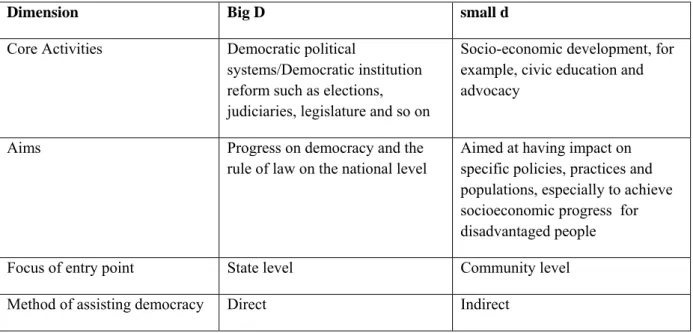
Firstly, the donors’ assistance policies were analysed in Chapter 4. A new analytical framework, combining Thomas Carothers’ framework (developmental and political approach) and Steven Golub's framework (Big D and small d), revealed that the assistance policy of the US and the EU tried to connect with domestic CSOs, thus providing democracy assistance via these CSOs. On the
other hand, Japanese assistance, which focused on development and linkage with the government, was not effective in terms of democratic assistance. An extreme focus on the government makes Japanese assistance very rigid, as it has less effect on the empowerment of society as one of the main factors in democratisation.
Secondly, the organisational characteristics of the DEMOs were analysed in Chapter 5. The role of “networking” in DEMOs and DOOs was found to be important here. Utilising the categories of DEMOs- networking and stand-alone, as proposed by Sharon Lean (2007) - this study acknowledges other type of DEMOs, referred to here as DOOs (Domestic Observer Organisations),which should be considered in election monitoring activities. Moreover, supported by the DEMOs’ internal and international donors (democracy aid providers), the Indonesian DEMOs could play significant roles in which the networking of DEMOs is seen as an ideal form.
Thirdly, the relationship of the donors, the domestic government and CSOs was analysed in Chapter 6, in which it was shown that the DEMOs’ activities were limited by governmental control of international assistance. The Paris Declaration in 2005, followed by the Jakarta Commitment in 2009, was the turning point. International assistance was put under the surveillance of the coordination committee, which consists of the Ministry of Internal Affairs, the National Development Planning Board (BAPPENAS) and the Election Commission (KPU). Donors can only allocate assistance to Indonesian DEMOs/NGOs that are endorsed in a coordination meeting. The increase in governmental control and the decline of the standing of Indonesian DEMOs becomes a paradox in the success of the democratisation process in Indonesia.
This study concludes that the existence of direct international assistance for domestic CSOs and the autonomous CSOs networks are the two important factors that ensure effective election monitoring and increased democratisation, particularly during the transition period. The control of international assistance by the domestic government takes the edge off civil society and its power for further democratisation.
民主化移行期における市民社会団体の役割
――インドネシアの選挙監視団体に対する国際的な民主化支援を事例として――
(アスラ・フィルジアニタ)
論文要旨
本論文は、民主化移行期のインドネシアにおける市民社会団体(CSOs, Civil Society Organisations)とそれに対する国際的な支援を分析したものである。制度及び個人レベルに 至る市民社会団体の構造とネットワークに焦点をあてて分析し、民主化移行期から定着期に かけて、インドネシアの市民社会団体、特に選挙監視団体(DEMOs, Domestic Election
Monitoring Organisations)に対して行われた国際社会の支援と協力が、同国の民主化に重要
な意味を持ったことを明らかにした。
経済危機が原因となって 1998 年にスハルト独裁体制は崩壊し、インドネシアでは 1999 年に44年ぶりに自由で公正な選挙が実施された。この1999 年選挙と次の2004 年選挙では
、インドネシアの多くの市民社会団体が選挙監視団体を組織し、公正な選挙の実現に寄与し た。しかし、2009 年の選挙では選挙監視を行った市民社会団体は少なく、それ以前の二つ の選挙に比べて選挙の公正さが完全に保障されたとは言い難い。
本論文は、選挙監視におけるインドネシアの主要な国内アクターとして、選挙管理委員会
(KPU, Komisi Pemilihan Umum)や選挙監視庁(Bawaslu, Badan Pengawas Pemilu)といっ た政府系の選挙管理組織(EMBs, Electoral Management Bodies)と、民間の選挙監視団体(
DEMOs)を分析対象とし、また民主化支援の国際アクターとして、日本、米国、欧州連合(
EU)を分析対象として、民主化の移行・定着段階におけるそれぞれの役割とそれらの関係性 のダイナミズムを分析した。民主化後のインドネシアにおける新しい政治アクターとして登 場した市民社会団体は、政治経験が乏しかったにもかかわらず、選挙監視団体としてインド ネシアの民主化に重要な役割を果たしたことは注目に値する。なぜ、どのように、それは可 能となったのであろうか。また、これらの市民社会団体に対する国際的な支援が効果的に行 われたのだとすれば、なぜ、どのように行われたのだろうか。2009 年の選挙では、1999 年
、2004 年の選挙と比べて選挙監視団体の活動が減少したが、その背景にはどのような理由 があったのだろうか。
民主化における国際的な支援や市民社会団体の役割については、すでに先行研究が存在す るものの、国際的な民主化支援の役割は必ずしも肯定的に評価されているわけではなく、イ ンドネシアの事例に即した分析が必要である。また、先行研究が提示する選挙監視団体の分 類概念は、インドネシアの選挙監視団体を分析する上で十分なものではない。さらに、1999 年、2004 年、2009 年の選挙ごとに、インドネシア政府と国際アクターとの関係性や、国際 アクターによるインドネシアの選挙監視団体に対する支援が変化し、その結果として選挙監 視団体の活動内容にも変化が生じたことについては、これまでの研究では明らかにされてこ なかった。
このような問題関心と先行研究の問題点をふまえて、本論文はまず、インドネシアの民主 化過程を俯瞰したうえで、①国際アクターである援助供与国の支援方針、②国内アクターで あるインドネシアの市民社会団体及び選挙監視団体の組織的特徴、③援助供与国・インドネ
シア政府・市民社会団体の三者関係、について分析を行った。その結果、次の三点が明らか になった。
第一に、第4 章で分析を行った援助供与国の支援方針についてである。本論文は、トーマ ス・カロザース(Thomas Carothers)の「開発アプローチ」と「政治アプローチ」の分析枠 組みと、スティーブン・ゴルプ(Steven Golub)の「政府への民主化支援(Big D)」と「草 の根レベルでの民主化支援(small d)」の分析枠組みとを統合した新しい分析枠組みを用い た。その結果、アメリカと EU の支援は、インドネシアの市民社会団体と連携し、それらを 通じての政治分野における直接的な民主化支援であったのに対して、日本の支援は、インド ネシア政府を通じた、開発分野の支援が中心であったという差異が明らかになった。日本の 支援はインドネシア政府に対象を限定したものであり、民主化において重要となる社会のエ ンパワーメントにはあまり効果を持たなかった。それゆえ、インドネシアの民主化に十分な 役割を果たしたとは言えないのである。
第二に、第5 章で分析を行った選挙監視団体の組織的特徴についてである。シャロン・リ ーン(Sharon Lean)は、2007年に選挙監視団体を「独立型」と「ネットワーク型」という 二つのタイプに類型化したが、本論文は選挙監視団体のもう一つのタイプとして、選挙監視 活動に携わる「オブザーバー団体」(DOOs, Domestic Observer Organisations)を提起した。
ここで強調したいのは、選挙監視団体とオブザーバー団体との連携とネットワークが選挙監 視において重要な役割を果たしたということである。さらに国際的な援助供与国の支援を受 けることで、インドネシアの選挙監視団体やオブザーバー団体は最大限の役割を発揮するこ とが可能となった。この意味において、ネットワーク型の選挙監視団体は理想的なタイプと 見なされるのである。
さいごに、第6 章で分析した、援助供与国・インドネシア政府・市民社会団体の三者関係 についてである。2005 年の「パリ宣言」、それに続いた 2009 年の「ジャカルタ・コミッ トメント」が転機となり、選挙監視団体の活動はインドネシア政府による国際支援の統制強 化によって制約を受けるようになった。それまで援助供与国からインドネシアの選挙監視団 体に対して直接行われていた国際支援は、内務省、国家開発企画庁、選挙管理委員会から成 る調整委員会の監督の下に置かれることが義務付けられた。その結果、援助供与国は、調整 委員会の承認を受けた選挙監視団体や NGO にしか援助を提供することができなくなったの である。インドネシア民主化プロセスの成功とは裏腹に、国際的な民主化支援に対するイン ドネシア政府の統制は強化され、選挙監視団体の立場は後退することになった。
以上から、本論文は次にように結論づけることができる。市民社会団体に対する直接的な 国際支援と自律的な市民社会団体のネットワークの存在は、とりわけ民主化移行期において
、効果的な選挙監視を実現するための重要な要因となり、民主化を促進するということであ る。政府が国際支援を統制することは、さらなる民主化のために必要な市民社会の力を削ぐ ことになろう。
ACKNOWLEDGEMENTS
First and foresmost, I would like to thank to all of the Professor and staff, Graduate School of International Studies, Meijigakuin University, specially to Professor Hideyuki Wakui, Professor Oki Akira, Professor Namioka Shintaro, Professor Nakata-Amiya, Prof. Takeo Takahara for all their support, encouragement and enthusiam.
Special thanks also to Professor Chiharu Takenaka who was be my supervisor for three years until she moved to Rikkyo University for her carries. I would like also thank to all of Professor of Institute of Social Sciences and Institute of Oriental Culture University of Tokyo (ISS-IOC UT) who are members of research project between University of Tokyo-Center for Japanese Studies, University of Indonesia.
I would like also to thank to JICA that provided scholarship for 3 years of my doctoral programme and Directorate of Higher Education, Ministry of Education, Republic of Indonesia which providing me some support to finish my study. Also, I would like to thank the Matsushita Foundation and Resona Foundation, Hitachi Foundation for providing the grants for my research. Also, special thanks to members and my colleague of Department of International Relations, Faculty of Social and Political Sciences, University of Indonesia for their encouragement and support.
Last but not least, I would like to thank to my beloved family for their support and patience.
Asra Virgianita April, 2014
TABLE OF CONTENTS
Abstract (In English) ...….. ………….. ………….. ………….. …………..…………..…………. i Abstract (In Japanese) ………….. ………….. ………….. …………..…………..…………... iii Acknowledgements…………..…………..…………..…………..…………..…………..…………... v List of Charts, Diagram, Figure, Photo and Table.………..…………..…………..…………..…….... x Glossary…………..…………..…………..…………..…………..…………..…………..………….. xiv
Chapter 1 Introduction …………..…………..…………..…………..…………..…………..………. 1
1.1. Democracy Assistance and The Emergence of DEMOs in Indonesia:
A Background…………..…………..…………..…………..…………..…………. 1 1.2. Problems Statement and Research Questions …………..…………..……….. 9 1.3. Previous Studies on Democracy assistance and Indonesian DEMOs:
Investigating the Unexplored Aspects..……..…………..…………..……… 10 1.4. Significance of the Study…………..…………..…………..…………..………... 12 1.5. Organization of Thesis…………..………..…………..………….14
Chapter 2 Theoretical Framework and Methodology
2.1. Some Theoretical Framework for Analysing Democratisation, Democracy
Assistance and Election Monitoring in Indonesia... …...16 2.1.1. Democratisation: Typology and Phases.. ………..…………..…………..……16 2.1.2. Democracy Assistance: Approaches and Types…………..…………..……… 22 2.1.3. The Importance of Election and Domestic Election Monitoring…………...35
2.2. Methodology …………..…………..…………..…………..…………..…………. 43 2.2.1. Primary Data…………..…………..…………..…………..…………..…... 44 2.2.2. Secondary Data …………..…………..…………..…………..…………...48
Chapter 3 Development of Elections in Indonesia: From Authoritarian to Democratic Elections ...49
3.1. Elections under Soeharto Authoritarian Regime
3.1.1. Regime Type and Electoral Processes (1971-1992) ………..…….……..…… 49 3.1.2. The Decline of Golkar and the Initial Movement of Democratisation………..55 3.1.3. The Progress of Democratic Reform in Indonesia…………..…………..…… 60
3.2. Elections under Reform Government…………..…………..…………..………….. 67 3.2.1. The 1999 Transitional Elections: The Phase of Regime Change…………... 68 3.2.2. The 2004 Elections: The Process of Transition to Consolidation………….. 73 3.2.3. The 2009 Elections: Chaos but Consolidated?....…………..…………..…… 77
Chapter 4 From Development Assistance to Democracy Aid: Comparing Japan’s Approach to the US and the EU Approaches ...…………..…………..…………..………….. 83
4.1. Japan’s Democracy Assistance to Indonesia: Half-Hearted Assistance?... 86 4.1.1. Japanese-Indonesian Relations under ODA Scheme…………....……..…. .. 86 4.1.2. Japan’s Half-Hearted Approach to Indonesia…………..…………..……... 97
4.2. American Democracy Assistance: A Political Approach………..…………..…... 111 4.2.1. US-Indonesian Relations under Soeharto……...……..…………...111 4.2.2. The US Democracy Aid to Indonesia: A Political Approach…………...113
4.3. The EU Democracy Assistance to Indonesia: A “Cautious” Approach…………...118 4.3.1. EU-Indonesian Relations………...…..…………..…………..………….... 118 4.3.2. EU Democracy Assistance: A “Cautious” Approach...…………... 121
4.4. Political Approaches versus Developmental Approaches and Big D versus small d:
A Comparison …………..…………..…………..…………..…………..………....127
Chapter 5 Characteristics of Indonesia DEMOs and Their Roles in Democratisation…………... 133
5.1. Elections and Indonesian Domestic Elections Monitoring Organizations (DEMOs) 5.1.1. The 1997 Elections: A Struggle Period for the First Indonesian DEMOs….. 135 5.1.2. The 1999 Elections: A Golden Era for Indonesian DEMOs…...…... 140 5.1.3. The 2004 Elections: A Crisis Period for Indonesia DEMOs …………...147 5.1.4. The 2009 Elections: The End Stage of DEMOs………..…..…………..…… 153
5.2. Types and Characteristics of Indonesian DEMOs: Survey Results and Findings... 158 5.2.1. Survey Results of Indonesian DEMOs…………..…………..…………..… 159 5.2.2. Some Findings of Indonesian DEMOs…………..…………..…………..… 166
5.3. Assessment of the Evolving Role of Democracy Assistance and Indonesian
DEMOs in Democratisation Process..…………..…………..…………..……….... 172 5.3.1. The Position of Democracy Assistance in the Process of Democratisation in
Indonesia…………..…………..…………..…………..…………..……….. 172 5.3.2. The Role of Indonesian DEMOs: From Transmitter to Advocacy…………..174
Chapter 6 Analysis of the Dynamics Relationship between International and Domestic Actors:
Donors-Government-Indonesian DEMOs…………..…………..…………..………… 179
6.1. Donors-Government-Civil Society Relationships during Soeharto’s Era..…... 182 6.1.1. The Period of Development (1967-1990) …..………..…………..……... 182 6.1.2. The Period of the Issues of Conditionality (1991-1996) …..…….………. 183 6.1.3. The Period of Economic Crisis (1997-1998) ………..………... 185
6.2. The Relationship between Indonesian DEMOs-Government (the EMBs)-Donors In Reform Period: Survey Results…………..…………..…………..…………... 187
6.2.1. The Relations “among Indonesian DEMOs” and “between Indonesian DEMOs and EMBs” …………..…………..…………..…………..………188 6.2.2. The Relations between Indonesian DEMOs and Donors…………..……...194
6.3. Direct Observation of Donors-Government-Indonesian DEMOs Relations
in the 2009 Elections... …………..…………..…………..…………..……… 202
6.3.1. Data from Direct Observation…………..…………..…………..………….202
6.3.2. Data Analysis of Direct Observation…………..…………..…………..…...208
6.3.3. The Dynamics Donor-Government-Indonesian DEMOs Relations: The Cases of the 1999, the 2004 and the 2009 Elections ……….. 210
6.4. The Patterns of Donors-Government-Indonesian DEMOs Relations and the Future of Democratisation in Indonesia…………..…………..…………..… 215
6.4.1. Mapping the Relations of Donor-Government-Indonesian DEMOs... 215
6.4.2. Democratisation in Indonesia under A New Pattern of Relations between International and Domestic Actors: A Paradox…………..…………..…... 220
Chapter 7 Conclusions…………..…………..…………..…………..…………..…………..…….. 224
7.1. Summary of Findings…………..…………..…………..…………..…………..… 224
7.2 Contributions of Research...…………..…………..…………..…... 229
7.2.1. Empirical Contributions ………...…………..…………..…... 229
7.2.2. Theoretical Contributions …………..……….…………...….... 232
7.3. Policy Recommendations…………..…………...…………..…... 235
Bibliography …………..…………...…………..…...…………..…………... 238
Appendix 1 Questionnaire Form
Appendix 2 List of Questions for Direct Observation of the 2009 Indonesia General Elections
LIST OF CHART, DIAGRAM, FIGURE, PHOTO AND TABLE
List of Chart, Diagram, Figure and Photo
Chart 2.1 Model of Analysis of the Roles of Indonesian DEMOs and Their Relationship with …. 42 Democracy Assistances in Democratisation of Indonesia
Chart 2.2 Methodology of Research………….. …………..…………..…………..…………..…… 44
Chart 4.1 Japan’s Total ODA to Indonesia Post Soeharto (1998-2010) ………….. …………..… .. 95 Chart 4.2 Distribution of Japan’s ODA to Indonesia (according to type) 1998-2010…………... 96 Chart 4.3 Distributions of US Democracy Assistance by Sector and by Region 1990-2005……….114
Chart 5.1 the Number of “New Indonesian DEMOs” based on Period ………….. ………….. ..160 Chart 5.2 Centre of Activity………….. ………….. ………….. ………….. ………….. …………160 Chart 5.3 the Number of Organization that operate via the Networking System ...………….. ... 161 Chart 5.4 the number of Indonesian DEMOs involved in the 1999, 2004 & 2009 Elections……... 161 Chart 5.5 Activities conducted by Indonesian DEMOs…………... ………….. …………..162 Chart 5.6 Methods of Monitoring conducted by Indonesian DEMOs………….. ………….. …….162 Chart 5.7 Funding Sources………….. ………….. ………….. ………….. ………….. …………..163 Chart 5.8 Internal Factors that influence the Performance of Indonesian DEMOs………….... ….. 164 Chart 5.9 External factors that influence the Performance of Indonesian DEMOs………….... ...165 Chart 5.10 Strong Points of the Indonesian DEMOs...………….. ………….. ………….. ...165
Chart 6.1 DEMOs Views on their Relations with Other DEMOs and EMBs………….. …………189 Chart 6.2 DEMOs Opinion regarding the KPU’s Support for DEMOs…………... ………….. …. 189 Chart 6.3 DEMOs Perspectives on the view of EMBs towards the existence of DEMOs…………190 Chart 6.4 DEMOs views on the changing relations among others DEMOs……...….. ………….191 Chart 6.5 DEMOs view on the Importance of Relations among DEMOs ………….. ………….. ..192 Chart 6.6 DEMOs Experiences of Conflicts with other DEMOs and EMBs………….. ………… .192 Chart 6.7 the views of DEMOs on the Relationship among DEMOs, KPU & BAWASLU……… 193 Chart 6.8 the number of DEMOs that had/had not experience in working with Donors………….. 195 Chart 6.9 DEMOs Activities funded by Donors…...……….. ………….. ………….. ………… 196
Chart 6.10 Variety of Donors Support to DEMOs…………... ………….. .………….. ………… 197
Chart 6.11 the Views of DEMOs regarding their Cooperation with Donors...……….. ………….... 197
Chart 6.12 DEMOs’ Perspectives regarding Donors Intervention……….. ………….. ………….. . 198
Chart 6.13 The Satisfaction of DEMOs regarding Relations with Donor……….. …….... 198
Chart 6.14 the Views of Indonesian DEMOs concerning the Issues of Dependency on Foreign Support ...199
Chart 6.15 the views of DEMOs on the New Mechanism of Donor-Government-DEMOs Relations…... 201
Chart 6.16 The View of DEMOs regarding the Role of Donors in bridging the relationship between The Government/EMBs - DEMOs ... 202
Chart 6.17 Government-Donors-DEMOs Relationship Based on the Level of Control..…….. ….... 216
Chart 6.18 Government-Donors-DEMOs Relationship Based on the Level of Coordination and Cooperation...217
Diagram 2.1 Mapping of International Democracy Assistance ………….. …………... 32
Diagram 4.1 Countries Exporting Coal to Japan ………….. …………... 92
Diagram 4.2 Japan’s Country Assistance Program for Indonesia 2004………… …………... 109
Diagram 4.3 EIHDR Projects World Wide by Theme 2000-2006………….. …………... 122
Diagram 4.4 Mapping of International Democracy Assistance to Indonesia …... ……….. .. .129
Diagram 5.1 Survey Results regarding the types of Indonesian DEMOs ………... 167
Figure 2.1 Regime Changes and Democratisation in Indonesia………….. ………….. ………….. 21
Figure 5.1 Democratisation and the Role of Indonesian DEMOs ………….. ………….. ……….. 176
Figure 6.1 The Shifting Relations of Government-Donors-Indonesian DEMOs……….. 214
Figure 7.1 Elements of Election Monitoring ……….227
Figure 7.2 Positive and Negative Impacts of Democratisation (Democratic Elections) ... 231
Figure 7.3 Contributions of Research and the Limitations thereof …………...234
List of Photo: Photo 6.1 Situation of the Voting Process at TPS 003, Banta-bantaeng Village, Rappocini Sub District Makassar City, South Sulawesi ...207
Photo 6.2 Situation of the Ballot Counting Process which is monitored by police, representatives of political parties, Committee of KPPS, TPS 003, Banta-bantaeng Village,
Rappocini Sub District, Makassar City, South Sulawesi ...208
List of Table
Table 1.1 Distribution of Electoral Assistance to Indonesian by Donors …....……….. ………….. ... 5 Table 1.2 Numbers of Violations in the 1999, 2004 and 2009 Elections………….. ………….. …… 8
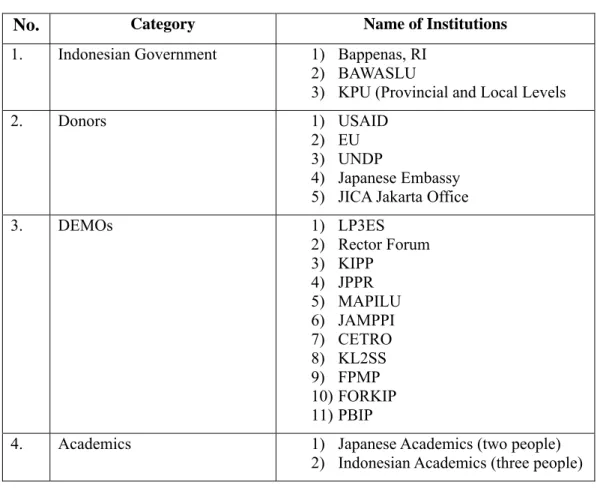
Table 2.1 the Political Approach and Developmental Approach towards Democracy Aid………….29 Table 2.2 The Distinction between Big D and small d………….. ………….. ………….. ………... 31 Table 2.3 List Recipient Countries of USAID Democracy Assistance in Asia 1990-2005……...…. 34 Table 2.4 List of Interviews………….. ………….. ………….. ………….. ………….. …………. 45 Table 2.5 List of Areas of Direct Observation in the 2009 Elections……….. ………….. ……….. 46 Table 2.6 List of DEMOs Surveyed.. ………….. ………….. ………….. ………….. …………... . 47
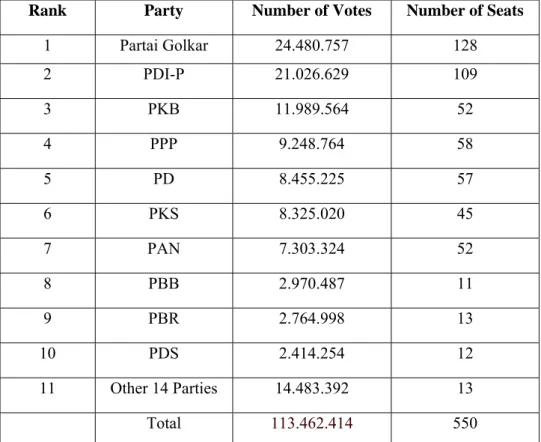
Table 3.1 Results of the 1999 General Elections………….. ………….. ………….. ………….. … 71 Table 3.2 Results of the 2004 General Elections………….. ………….. ………….. ………….. … 76 Table 3.3 Results of the 2009 elections ………….. ………….. ………….. ………….. ………….. 79 Table 3.4 Comparing of Elections under the New Order and the Reform Government …... 82
Table 4.1 Japan’s ODA to Indonesia 1966-1998………….. ………….. ………….. ………….. … 87 Table 4.2 Japan’s Loans to Indonesia 1993-1998 by Sector………….. ………….. ………….. …. 90 Table 4.3 Japan’s Grant Aid to Indonesia 1993-1998 by Sector………….. ………….. ………….. 91 Table 4.4 GSC Aid from Japan, the US and the EU 2000-2009………….. ………….. …………..100 Table 4.5 Japan’s Electoral Assistance to Indonesia………….. ………….. ………….. ………….105 Table 4.6 Japanese Aid for Democracy and Governance Programmes in Indonesia 1999-2007 ... 106 Table 4.7 US Economic and Military Assistance to Indonesia (1974-1978) …………...111 Table 4.8 the USAID Democracy and Governance Sector Programmes in Indonesia (2004-2008)..116 Table 4.9 the EU Aid Commitment to Indonesia 1990-1999 (in million EUC) ………….. ... 119 Table 4.10 EIDHR Funding and Project to Asian Countries 2002-2006………….. ...………...123 Table 4.11 the Implementation of EIDHR in Indonesia 2002-2006………….. ………….. ……... 124
Table 5.1 the Number of Volunteers in the 1999 Elections………….. ………….. ………….. … 143 Table 5.2 the Number of violations in the 1999 elections………….. ………….. ………….. ……145 Table 5.3 DEMOs’ Activities………….. ………….. ………….. ………….. …………..……... .150 Table 5.4 the Number of Violations in the 2004 Elections………….. ………….. ………….. …. 151 Table 5.5 Indonesian DEMOs and Voter Education Activities………….. ………….. ………….. 151 Table 5.6 Voters in the 2004 Elections ………….. ………….. ………….. ………….. ………... 153 Table 5.7 the Number of Violations in the 2009 Elections………….. ………….. ………….. … . 155 Table 5.8 Voters in the 2004 and 2009 Elections: A Comparison………….. ………….. …... 156 Table 5.9 Classifications of Indonesian DEMOs in the 1999, 2004 and 2009 Elections ………….168 Table 5.10 Characteristics of Indonesian DEMOs………….. ………….. ………….. ………….. ...171
Table 6.1 Characteristic of Donor-Government-Civil Society Relations under Soeharto ……...186 Table 6.2 Summary of Direct Observation Results of the 2009 Election ………….. …………... 210 Table 6.3 the Patterns of Relations among the Actors in the Democratisation Phase…... …………220
Table 7.1 Empirical Result …………...……….. ……...…….. ………….. ...231
GLOSSARY
ABRI : Angkatan Bersenjata Republik Indonesia (Indonesian Army)
ANFREL : Asian Network for Free Election
BAPPENAS : Badan Perencanaan dan Pembangunan Nasional (National Planning and Development Bureau) BAWALU : Badan Pengawas Pemilu
(Election Supervisory Body) CDI : Centre for Democratic Institutions CETRO : Centre for Electoral Reform CSOs : Civil Society Organizations
DEMOs : Domestic Election Monitoring Organizations DOOs : Domestic Observers Organizations
DPD : Dewan Perwakilan Daerah (Local Representatives Assembly)
EIHDR : European Initiative for Democracy and Human Rights EMBs : Electoral Management Bodies
EMOs : Election Monitoring Organizations FORKIP : Forum Komunikasi
FPMP : Forum Pemerhati Masalah Perempuan (Women Forum)
GAM : Gerakan Aceh Merdeka
(Free Aceh Movement) Golkar : Golongan Karya
(Functional Party)
ICW : Indonesian Corruption Watch
IGGI : Inter-Governmental Group for Indonesia IMF : International Monetary Fund
INFIGHT : Indonesian Front for the Defence of Human Rights INGOs : International Non-Governmental Organizations INSERT : Indonesia of Social Economy, Research and Training JAMPPI : Jaringan Masyarakat Pemantau Pemilu Indonesia
(Society Networking for Indonesia Election Monitoring) JICA : Japan International Cooperation Agency
JPPR : Jaringan Pemantau dan Pendidik Rakyat (People’s Voter Education Network) KIPP : Komite Independent Pemantau Pemilu
(Independent Committee for Election Monitoring) KL2SS : Koalisi Lembaga-Lembaga, Sulawesi Selatan
(NGOs Coalition, South Sulawesi) KOMNAS HAM : Komite Nasional Hak Asasi Manusia
(National Committee on Human Rights) KOPEL : Komite Pemantau Legislatif
(Legislative Monitoring Committee)
KOPPSS : Koalisi Organisasi Non Profit Pemantau Pemilu Sulawesi Selatan
(Coalltion for Non Profit Election Monitoring Organizations, South Sulawesi)
KPU : Komisi Pemilihan Umum
(General Election Commission)
KPRM : Komite Perjuangan Rakyat Miskin Kota (Committee for People Struggle)
KY : Komisi Yudisial
(Judicial Court)
LBH : Lembaga Bantuan Hukum
(Legal Aid Institute)
LKIN : Lembaga Kontrol Independen Indonesia
(Independent Organization for Supervising Indonesia)
LP3ES : Lembaga Penelitian, Pengembangan dan Pengkajian Ekonomi- Sosial (Institute of Reserach and Development for Social- Economics) LSM : Lembaga Swadaya Masyarakat
(Civil Society Organizations/CSOs)
MAPILU PWI : Masyarakat Pemantau Pemilu, Persatuan Wartawan Indonesia (Election Monitoring Society, Indonesian Journalist Association)
MK : Mahkamah Konstituti
(Constitutional Court)
MPR : MajelisPermusyawaratan Rakyat (People’s Consultative Assembly)
NAMFREL : National Citizens Movement for Free Election NDI : National Democratic Institute
NU : Nadhlatul Ulama (Islamic Organizations) ODA : Official Development Assistance
PANWASLAK : Panitia Pengawas Pelaksana Pemilu (Organization for Election Supervisory ) PBIP : Persatuan Buruh Independen
(Independent Labour Association) PDD : Partnership for Democratic Development PDI/P : Partai Demokrasi Indonesia/ Perjuangan
(Indonesian Democratic Party/ Struggle)
PIJAR : Pusat Informasi dan Jaringan Aksi untuk Reformasi (Information Centre and Action Network for Reform) PKS : Partai Kesejahteraan Sosial
(Social Welfare Party)
PPP : Partai Persatuan Pembangunan (United Development Party)
UNFREL : University Network for Free and Fair Election TEPI : Komite Pemilih Indonesia
(Indonesian Voters Committee)
UNDP : United Nation for Development Program
Chapter 1 Introduction
1.1. Democracy Assistance and The Emergence of Domestic Election Monitoring Organisations (DEMOs) in Indonesia: A Background
The end of the Cold War changed the world’s power-political constellation, from bipolar to unipolar, with the US as the sole super-power. Consequently, the US was able to spread unimpeded ideas of capitalism, globalisation, democratisation and human rights. The United States then embraced the “enlargement of the democratic community” as a key element of the US foreign policy,1 which also influenced other donor countries policies. European donor countries, as well as Canada, Australia, Japan and others also shifted their orientation towards the democracy aid field as the ideas of democracy, human rights and good governance became the objectives of donor countries when distributing aid. The tendency to incorporate democracy and good governance appeared in Japan’s Four Guidelines of ODA formulation in 1992, stressing the importance of democracy and human rights as the preconditions for aid. Further evidence was also confirmed when the members of the European Union (EU) began to impose human rights, participatory democracy and the rule of law as the criteria for the countries receiving aid.
In parallel, the rise of democracy movements in Latin America, Africa, Asia and other regions required a positive response, both domestically and internationally. Hence, democracy assistance has
1 Steven W. Hook, “Inconsistent U.S Efforts to Promote Democracy Abroad”, in Peter J. Schraeder, Exporting Democracy: Rhetoric vs. Reality, (London: Lynne Rienner Publishers, 2002), p.5.
recently become a substantial element of developmental cooperation and a tool for the international community to play a role in the democratisation process of a country. 2
However, each member of the international society has a different perspective regarding democratisation that affects its aid policy. The United States, Japan and certain international institutions, such as the United Nations and the World Bank, have their own concerns with regard to supporting democratisation in Indonesia. The United States’ policy of democracy formation consists of four specific points: (1) Support the establishment of the electoral process by the aid recipients; (2) Promotes the rule of law within the recipient governments; (3) Emphasises the practice of open and pluralistic decision-making process and effective regulations against government corruption; and (4) Promotes the growth of civil society by funding independent news media, labour unions and professional associations in order to enhance governmental accountability and to encourage broad- based political participation.3 In the case of Indonesia, the United States (through USAID) is more focused on strengthening the role of civil society as the key to democratic development in that country.
On the other hand, the United Nations and other international institutions, such as the World Bank, the IMF and the Asian Development Bank, emphasise improving good governance and reform programmes as the keys to democratisation, which determines the level of assistance in the future.4 The role of the World Bank and of the IMF in reforming Indonesia is undeniably noteworthy, as is their involvement in resolving Indonesia’s economic crisis in 1997.
Similarly, Japan’s policy towards democratisation in Indonesia is quite appealing, because its aid policy regards Indonesia is based on economic development instead of on political development.
2Marina Ottaway and Thomas Carothers (eds.), Funding Virtue: Civil Society Aid and Democracy Promotion, (Carnegie Endowment for International Peace, Washington, 2000)
,
p. 5-6.3 Op.Cit., p.116.
4World Bank Support New Assistance Strategy for Indonesia in Time of Transition, available at:
http://web.worldbank.org/WBSITE/EXTERNAL/NEWS/0,,contentMDK:20013644~menuPK:34466~pagePK:6 4003015~piPK:64003012~theSitePK:4607,00.html accessed on July 12, 2009.
However, the phenomenon of international democracy assistance in the early 1990s and the increase in democracy movements in developing countries, including Indonesia, has had an impact on the Japanese aid policy. The introduction of the Official Development Assistance (ODA) Charter (1992) and the initiative of the Partnership for Democratic Development (PDD) in 1996 upheld changes in Japan’s aid policy.
In Indonesia, the fall of President Soeharto’s regime in 1998, which was sparked by an economic crisis, added to the momentum of the democratic movement. Afterwards, Indonesia’s democratic movement generated various significant results, such as the recognition of freedom of speech and association, the abolishment of the dual function of the military and the organisation of democratic elections in 1999, 2004 and 2009. In this case, elections are seen as a crucial aspect of the transition phase of Indonesia. Some scholars emphasise that transitional elections will help new actors to emerge, who will rebuild the entire aspect of political life, which had been uncertain in transition period. Therefore, seeing their significance, elections should be conducted freely and fairly. One of the ideas in ensuring free and fair elections is through the involvement of election monitoring organisations (EMOs), both domestic and international, in each stage of the election process. This kind of election monitoring is surely important, because elections are the basis for creating a democratic political system.5
Election monitoring organisations have contributed to more authentic election processes by encouraging fair campaign practices and a more informed electorate, as well as reducing the possibility of fraud and irregularities on election-day. Moreover, “EMOs have motivated citizens to become involved in public affairs and have transformed attitudes regarding citizens’ participation in politics and governance through education.”6
5Eric Bjornlund, Beyond Free and Fair: Monitoring Election and Building Democracy, (Woodrow Wilson Center Press, Washington DC, 2004).
6Ibid.
In Southeast Asia, domestic election monitoring began in the Philippines in the mid-1980s, with the pioneering experience of the National Citizens Movement for Free elections (NAMFREL).
NAMFREL organized a voluntary citizen’s movement, dedicated to restoring democracy in the Philippines through free and fair elections. NAMFERL’s remarkable success in election monitoring capitalised on the Filipino people’s rejection of the regime of martial law regime under Ferdinand Marcos, which inspired the occurrence of similar actions around the world in later years. In Thailand, Pollwatch was set up for the same purpose after the military crackdown in May 1992.7 In addition, regional efforts to support domestic monitoring in Asia, such as the Asian Network for Free Elections (ANFREL) have developed in recent years. They have become involved in efforts to support domestic elections by offering technical advice or by sharing their experiences with colleagues elsewhere in the region.
Election monitoring is a new phenomenon in the Indonesian political system. During the 32 years of Soeharto’s presidency, elections were conducted for the purpose of maintaining the regime;
thus, election monitoring has become crucial for conducting a democratic election. Therefore, under domestic and international pressure, Habibie’s government formally gave an official opportunity for certified foreign and domestic monitors to observe each stage of the 1999 election.
Soon after Habibie’s authorised public monitoring of the election, hundreds of domestic election monitors participated. These included the University Network for Free and Fair Election, (UNFREL), the Rectors’ Forum and the Independent Election Monitoring Committee (Komite Independent Pemantau Pemilu, or KIPP). In the 1999 elections, international donors allocated a great amount of funding to assist with many of the activities of Indonesian DEMOs (see Table 1.1).
7Human Rights Watch Report, Vol. 8, No.5 (C), available at: http://hrw.org/reports/1996/Indonesi1.htm, accessed on July 15, 2009.
However, the funding then gradually decreased in the 2004 and 2009 elections, particularly with regard to election monitoring activities.
The role of the DEMOs in the 1999 elections was the first election monitoring process in Indonesia. Although at that time the election monitors lacked experience, the enthusiasm of the domestic people was very high. Their role meant that the 1999, 2004 and 2009 transitional elections were significantly different from elections under Soeharto’s presidency.
Table 1.1 Distribution of Electoral Assistance to Indonesia by Donors (in million US$)
Donor 1999 2004 2009 Japan 34 22.7 3.4
The US 30 24 8.8
The EU 7.5 8 Na
UNDP 90 32 9 Na: Not Available
Source: General Elections Commission, Republic of Indonesia.
However, in the 2004, the DEMOs reached a crisis point, caused by two situations. Firstly, there was less international funding for Indonesian DEMOs, which affected the number of DEMOs.
As explained previously, since Indonesia had worked towards a democratic election in 1999, international funding for electoral assistance was reduced. In the 1999 election, the USAID provided financial support to almost two hundred Indonesian NGOs for election monitoring and voter education activities. Specifically, through the Asia Foundation, the fund sponsored the People’s Voter Education Network (JPPR), which consisted of fifteen Indonesian organisations, including mass Islamic organisations such as NU and Muhammadiyah, enabling them to conduct voter education and election monitoring. Nevertheless, although USAID still distributed aid for DEMO activities in the 2004
election, the amount was significantly decreased. Moreover, funding from the Japanese government provided about US$ 270,000 for election monitoring and voter education in the 2004 election, whereas they had provided around US$ 3, 4 billion in 1999. In the 2009 election, only $147,878 was distributed for voter education programmes, which were conducted by two Indonesian NGOs.
The other situation that was a factor at that time was the new law launched by KPU regarding election-monitoring activities, which was interpreted by Indonesian DEMOs as an attempt by KPU to limit and to weaken the role of Indonesian DEMOs. Unlike the 1999 election in which the DEMOs could participate freely, in the 2004 and 2009 elections, DEMOs that wanted to participate in or monitor the elections process had to be accredited by KPU. This rule was criticised by various DEMOs, who felt that this rule could be viewed as a restriction for civil society when participating in the political process.
In 2004, there were certain fundamental changes and developing situations in the election. The first was the implementation of a direct presidential election, whereas Indonesia’s president had previously been elected by the partially appointed and partially elected People’s Consultative Assembly (Majelis Permusyawaratan Rakyat, MPR). Secondly, unlike the 1999 election in which the 53 members of the KPU comprised representatives of each political party (48) and representatives of the government (5), in 2004, 11 members of the KPU were chosen from an open recruitment system, which meant that everyone could apply to be a member of KPU through a selection process conducted by government. Thirdly, in this election, 24 political parties were competing with each other, whereas there were 48 parties in 1999. The smaller number of participating political parties was a result of the stringent requirements implemented by the KPU. These strict requirements were again seen as a response by the KPU to some critics that had complained about the large number of political parties that participated in the1999 elections. Although the participation of 48 parties in the1999 election could be seen as respect for the principle of freedom of association, a large number of parties could
also be a source of inefficiency and ineffectiveness, both in terms of the budget and the implementation of the election.
In the 2009 election, 34 political parties participated and 24 DEMOs were involved in monitoring the election. In this period, the government published a new law concerning election- monitoring activities8 which was then followed by the KPU’s regulations regarding procedures for monitoring elections9 (Peraturan KPU No. 45 Tahun 2008). The regulations defined the requirements for DEMOs, such as accreditation by the KPU and having qualifying financial resources. The regulations also stated that monitoring activities could only be implemented outside of the polling stations. These regulations were responded to with cynicism by Indonesian DEMOs. As the leader of Cetro said, “the KPU is positioning itself as a super body”.10 Moreover, the rules seemed to limit and to diminish the role of DEMOs. The KPU’s rules were considered to be more reactionary than they were in the 1999 elections, when the monitors actually worked in the arena of polling stations.
Concerns about the presence of observers disturbing public order were also over-exaggerated.
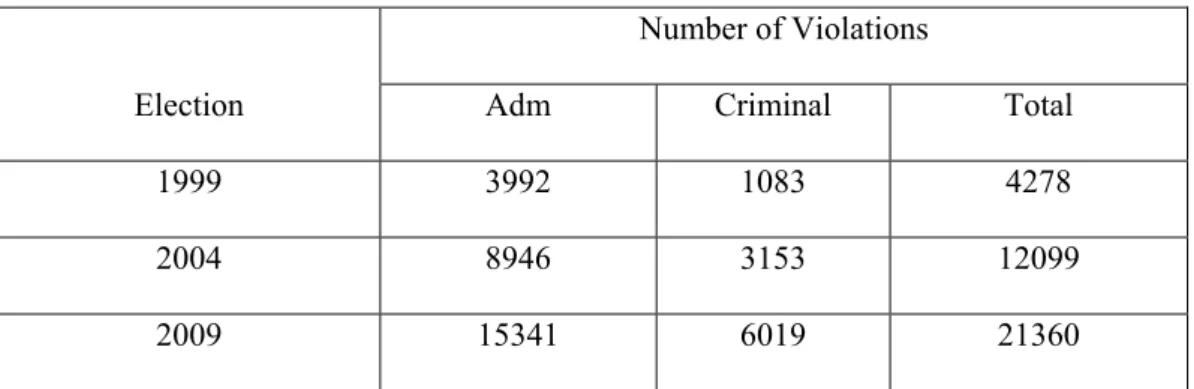
Although the elections had been acknowledged by international community as being free and fair, there were procedural mistakes involving voter privacy, the quality of the ink and the like. In the 2009 election, there had been many problems regarding the election process, for example the procedure of the election, money politics, intimidation and so on. Moreover, referring to Indonesia’s Election Supervisory Body, the number of violations increased in the 2004 and 2009 elections, compared to the 1999 election.
8See UU. Nomor 10 Tahun 2008 Pasal 233 tentang Tindak Pidana Pemilu (Indonesia Law No. 10/2008 Article 233 about Criminal Violations of Elections) available at:
http://www.kpu.go.id/index.php?option=com_docman&Itemid=78, accessed on May 09, 2009.
9See Peraturan KPU No. 45 Tahun 2008 tentang Pemantau dan Tata Cara Pemantauan Pemilu (KPU Law No.
45/2008about Observers and Methods of Election Monitoring) available at:
http://www.kpu.go.id/index.php?option=com_docman&Itemid=78, accessed on May 09, 2009
10 Interview with Leader of CETRO, March 20, 2009.
Table 1.2 Numbers of Violations in the 1999, 2004 and 2009 Elections
Election
Number of Violations
Adm Criminal Total
1999 3992 1083 4278
2004 8946 3153 12099
2009 15341 6019 21360
Source: Database of Indonesia’s Election Supervisory Committee. See also Ramdansyah (2009).
In the 2004 election, there were 8,946 cases of administrative violations and 3,153 criminal cases. Only 31, 66% (2,832) of administrative violations were successfully handled by the KPU. On the other hand, only 32% of criminal cases were brought to court. The number of violations was the summary of violations from all stages of the election process, from voter registration, verification of candidates and campaign processes. In the 2009 election, there were 15,341 administrative violations and 6019 criminal cases. This shows that the number of violations increased by almost 100%.11Therefore, the 2009 election was judged as being “the worst election” following Soeharto’s presidency, and the legitimacy there of was questionable.12 In spite of the reforms in election law and the election system that were implemented to improve the quality of the election, there were still many violations in the 2004 and 2009 elections.
Moreover, with regard to the 2009 election, Indonesian DEMOs criticised international observers for not making a press release concerning the implementation of the 2009 election as they had done in the previous elections. The coordinator of the Indonesian Voters Committee (Komite
11Ramdansyah, Sisi GelapPemilu 2009: Potret Aksesoris Demokrasi Indonesia (Dark Side of the 2009 Election:
Portrait of the Indonesian Democratic Accessories), Kawah Media Pustaka, Indonesia, 2010, Jakarta.
12Available at http://www.pemiluindonesia.com/pemilu-2009/pemilu-9-april-2009-dinilai-yang-terburuk.html, accessed on May 10, 2009. See also “Pesta Demokrasi Terburuk Sepanjang Sejarah (The Worst of Democratic Festival in the Indonesian History)”Jimly Asshiddiqie, Ex-head of the Constitutional Court, Suara Karya, April 11, 2009.
Pemilih Indonesia, TEPI), Jeirry Sumampow, responded, “it might be caused by the poor quality of the 2009 election.”13 The silence of international observers such as the Carter Center, the National Democratic Institute (NDI) and ANFREL was an oddity that complemented anomalies during the 2009 electoral process.
1.2. Problem Statement and Research Question
Based on the explanations above, the number of DEMOs involved in monitoring the elections decreased gradually. In the 1999 election, 66 groups participated in monitoring the election, while in 2004 there were only 30 DEMOs, and only 24 DEMOs in the 2009 election. This indicates that not only did the number of DEMOs decrease, but the activities and the number of volunteers also diminished in each election.14Despite this, Indonesian DEMOs have undoubtedly played a great role in enhancing the quality of the elections, particularly during the transitional elections that were an essential aspect of democratisation in Indonesia.
Moreover, although the roots of election monitoring did not originate in Indonesian political culture, the existence of Indonesian DEMOs has been accepted by Indonesian society and has a great influence on the implementation of elections, especially on the 1999 transitional election. As explained previously, international support is one external factor that has influenced the existence of Indonesian DEMOs. Therefore, the existence of the Indonesian DEMOs and the role of donors have influenced the relations of donors, the state and society in the democratisation of Indonesia.
Considering these explanations, this study raises some important questions:
1. Why could the Indonesian DEMOs perform such roles despite not having enough experience,
13Kompas, May 28, 2009.
14Available at:http://republika.co.id:8080/koran/203/144125/PENYUSUTAN_PEMANTAU, accessed on April 6, 2009.
resources, or a strong foundation in Indonesian political systems?
2. What was the role of international donors in the democratisation of Indonesia, especially with regard to supporting the Indonesian DEMOs?
3. What was the relationship of donors, the state and society in the democratisation of Indonesia?
In order to answer the above questions, this study employs both theoretical and empirical methodologies, as will be elaborated in the next chapter. In short, much of the vital information in this thesis is obtained from the field research conducted in several stages: preliminary research (June 2007), in-depth interviews (December 2008), observation of the general election (April 2009) and surveys (July-November 2009).
1.3. Previous Studies on Democracy Assistance and Indonesian DEMOs: Investigating The Unexplored Aspects
While studies on democracy assistance and DEMOs are not new, this thesis attempts to provide a better understanding of the phenomenon of democracy assistance, the role of Indonesian DEMOs and its relationship with democratisation in Indonesia. Most discussions on democracy assistance have been strongly coloured by debates regarding the positive and negative impacts on democratisation. As Finkel etal. (2005) argue,“…there are consistent positive impacts of direct USAID democracy assistance on overall levels of democracy in recipient countries…”15,while others works stressed the weak relationship between aid and democracy promotion.16Meanwhile, discussions on
15Finkel, Steven E., Aníbel Pérez-Liñán, Mitchell A. Seligson and Dinorah Azpuru, “Effects of US Foreign Assistance on Democracy Building, 1990-2003.” World Politics Vol.59. No. 3, 2007, p. 404-440. Other works see Marina Ottaway and Thomas Carothers (eds.), Op.Cit., Peter Burnell. Democracy Assistance: International Cooperation for Democratization, London. Frank Cass, 2000.
16Stephen Knack pointed out a weak relation between aid and democratisation. See Stephen Knack, “Does Foreign Aid Promote Democracy?”International Studies Quarterly, Vol.48, Issue 1, 2000, p. 251-266. Work by Deborah Brautigam explored the aid for civil society organizations and concluded that aid not only has a positive impact, it also has negative implications in terms of creating a strong dependency of CSOs on foreign donors.
DEMOs stress the importance of international actors in supporting election-monitoring activities conducted by international observers and DEMOs. However, most studies agree that domestic actors have several advantages when conducting monitoring.17
In using Indonesia as the object of this study, this thesis has two aims. The first is to map donor approaches in distributing democracy aid, particularly in Indonesia, and to identify the characteristics of Indonesian DEMOs. The second is to explore and analyse the dynamics of the donor- state-society (Indonesian DEMOs) relationship through an analysis of the 1999, 2004 and 2009elections. This study also explores the relationship among domestic actors, including DEMOs and other election bodies, such as the General Election Committee (Komisi Pemilihan Umum or KPU), as well as the relationship between domestic actors and donors. Overall, this study aims to investigate the factors that affected the role of Indonesian DEMOs and to map the dynamics of the donors, the state and society in the 1999 to 2009 elections.
Several works have already touched upon the issues of DEMOs. Most of works explore African and Latin American cases such as those of Chand (1997), Carothers (1997), Nevitte and Canton (1997), Lean (2007) and Makulilo (2011).18 Very few works explore the Indonesian case, among which are those by Bjornlund (2004) and Yamada (2008). In his work, Bjornlund explored the 1999 elections and stressed the relationship between international and domestic actors in the process of transitional elections in Indonesia. He emphasised the importance of collaboration between international and Indonesian DEMOs. He also stressed the necessity of supporting and working with See Deborah Brautigam, Aid Dependence and Governance, Stockholm, Almqvist and Wiksell International, 2000.
17Thomas Carothers, “The Rise of Election Monitoring: The Observers Observed,” Journal of Democracy, Vol.
8, No. 3. July 1997.
18Vikram K. Chand, “Democratisation from the Outside in: NGOs and International efforts to Promote Open Elections,” Third World Quarterly, Vol. 18, No. 3, 1997, p. 543-561, Thomas Carothers, ”The Rise of Election Monitoring: The Observers Observed, ”Loc. Cit., Neil Nevitte & Santiago A. Canton, “The Rise of Election Monitoring: The Role of Domestic Observer,” Journal of Democracy, Vol. 8, No. 3 July 1997, Sharon Lean,
“International Democracy Assistance to Domestic Election Monitoring: Conditions for Success, ”Journal of Democratisation, Vol. 14 No. 2, April 2007, and Alexander B. Makulilo, “Watching the Watcher: An Evaluation of Local election Observers in Tanzania,” Journal of Modern African Studies, Vo. 49, No. 2, 2011, p. 241-262.
Indonesian DEMOs as local actors in order to enhance the quality of the elections.19Meanwhile, Yamada, by exploring the first Indonesian DEMOs (KIPP), has stressed the role of international assistance and international networking (INGOs) in the success of Indonesian DEMOs in the 1997 and the 1999 elections in terms of conducting monitoring activities.20
In general, the academic literature has focused on the positive impact of domestic election monitoring organisations and the importance of international support for them. Moreover, they mainly investigate the practical aspects of Indonesian DEMOs, but focus less on the origin and characteristics of Indonesian DEMOs, which has affected the practical aspects thereof. Moreover, in relation to with democracy assistance, other works have focused on the role of democracy assistance during that period without paying more attention to analysing the dynamic relationship of DEMOs, the state and democracy aid providers (donors).
Despite the amount of literature on Indonesian DEMOs and democracy assistance, it is remarkable that there are so few attempts to explore a comprehensive background and the role of Indonesian DEMOs as new actors after the decline of the Soeharto regime. Also, most of the studies have paid less attention to investigating the dynamics of the political aspect, both domestic and international, surrounding the existence of Indonesian DEMOs and the relationship of Indonesian DEMOs, donors and the state. This thesis is an attempt to analyse and explore the unexamined aspects of previous literature.
1.4. Significance of the Study
Two important aspects will be explored in this study. The first is to identify the characteristics
19Bjornlund, 2004, Op.Cit.
20Mitsuru Yamada,“The Role of International NGOs in Democratization Assistance in Southeast Asia:
Cooperation with Local NGOs through Election Monitoring Activities, ”Journal of the Graduate of Toyo Eiwa University, Vol. 4/2008, pp. 33-44.
of Indonesian DEMOs and to map donor approaches in distributing aid. The second is to uncover and analyse the dynamics of the donor-state-society relationships in the 1999, 2004 and 2009 elections.
This study also pays attention to exploring the relationship of domestic actors, such as DEMOs and other election bodies like the General Election Committee (Komisi Pemilihan Umum or KPU), as well as the relationship between domestic actors and donors. Overall, this study strives to investigate the factors that affect the role of Indonesian DEMOs and to map the dynamic relationship of donors, the state and society during the elections from 1999 to 2009.
Therefore, this study is expected to contribute to the literature on democracy assistance and democratisation studies that focus on electoral matters, as well as donor-state-civil society relations.
As many works on democracy assistance has paid less attention to the role of DEMOs in transitional countries, this study will enrich the understanding of the phenomena of DEMOs and democracy assistance from the aspect of elections. Moreover, the relationship between international and domestic actors has been explored in many other studies. However, by using Indonesia’s case, this study will highlight the relationship between domestic and international actors in the democratisation process, which will give a unique perspective. The domestic actors in this study are Indonesian DEMOs/NGOs and the Indonesian government, while the international actors are the donor countries/institutions.
This research emphasises the importance of civil society-state-donor relationships in the democratisation process and the ways in which democracy assistance have a positive impact on supporting domestic actors at different levels, encouraging them to cooperate and involve themselves actively in the democratisation process in Indonesia. In addition, this study is expected to not only enrich the academic discourse on democracy assistance, but also to contribute practically to greater democratic development and to the synergy between international and domestic actors in supporting democratisation.
1.5. Organisation of the Thesis
This thesis consists of seven chapters, including the conclusion. Chapter 1 provides an introduction to the study and some initial data and arguments revealing the reasons that conducting this study is important. This chapter highlights the emergence of Indonesian DEMOs (historical aspects) and the importance of analysing the relationship between democracy assistance and Indonesian DEMOs as a new phenomenon in the Indonesian political context after the Soeharto regime.
Chapter 2 contains the theoretical framework and methodology that will be used to analyse and explore the questions raised in this study. The purpose of this chapter is to build the framework to analyse the relationship between international and domestic actors in the democratisation process, especially in the case of DEMOs in supporting the electoral democratic process in Indonesia after the Soeharto regime. After constructing the theoretical framework and explaining the methodologies, Chapter 3 explores the development of elections in Indonesia. This chapter will show the shift of election methods from the Soeharto authoritarian regime to the reform period. Moreover, this study emphasises the relationship between the political system and the way in which a regime will conduct elections.
Chapter 4 will analyse the donors’ approach to the implementation of democracy assistance in Indonesia, focusing on electoral assistance. Three influential donors in Indonesia will be explored, namely Japan, the US and the EU. This chapter will be divided into four sections. The first section will explore the implementation of Japanese democracy assistance in Indonesia, followed by the second and third sections that will focus on US and EU democracy aid. The fourth section will map donor approaches in distributing democracy aid to Indonesia. The mapping of donor approaches is one of findings of this study.
Following the mapping of donor approaches towards democracy assistance, chapters 5 and 6 present analyses of fieldwork results and findings of this study on the Indonesian DEMOs and the dynamic relationship between international and domestic actors in the democratisation of Indonesia.
Chapter 5 is divided into four sections, analysing the role of Indonesian DEMOs. This chapter will start with an analysis of the elections under the Soeharto regime and will encompass elections during the post-Soeharto regime. The next section will explore the characteristics of Indonesian DEMOs and the development of Indonesian DEMOs from 1997 until 2009. The last section will examine the role of Indonesian DEMOs in the democratisation of Indonesia.
Chapter 6 will emphasise the analysis of international and domestic actor relations in the 1999, 2004 and 2009 elections. It contains an analysis of the dynamics of donor-state-society relationships in the democratisation process of Indonesia, as well as in these relationships. This study attempts to identify changes and continuities in donor-state-society relations.
Chapter 7 presents the conclusions reached in this study. The findings of this thesis will be summarised in this section. The results conclude that first, the US and the EU frameworks that are linked to CSOs are more effective than is the Japanese framework, which is more focused on the government and less on the CSOs component; second, the network type of the Indonesian DEMOs is the best type. Moreover, network types and DOOs promote democratisation in Indonesia by playing a significant role in enhancing the quality of the electoral process; and last, the Paris Declaration and the positive results on the electoral process have strengthened governmental control of the donors and the society. This means that, in parallel with the positive trend of democratisation, the relationship of donors, the state and society have been negatively affected after the Soeharto regime.
Chapter 2
Theoretical Framework and Methodology
2.1. Some Theoretical Frameworks for Analysing Democratisation, Democracy Assistance and Election Monitoring in Indonesia
2.1.1. Democratisation: Typology and Phases
Welzel classified four types of democratisation processes. 21The first is responsive democratisation, which is claimed to be the dominant type democratisation in the global wave of democratisation. He argues, “responsive democratisation is the joint result of objective social conditions, motivational mass tendencies and intentional collective action, triggered by critical events”;22 therefore, it can create socially-embedded democracy. The second is enlightened democratisation, as can be seen in the cases of Germany, Italy and Japan in the post-World War II era.
This type is occurred “when elite respect democratic standards even in absence of mass pressure.”23 The next type is imposed democratisation when the process of Democratisation is depending on external power. It happened again in the democratisation of Germany, Japan and Italy after World War II, as well as in the US, which has attempted to install democracy in Afghanistan and Iraq. The fourth type is opportunistic democratisation, which emphasises the role of the international community, particularly donor agencies, in the process of democratisation.
21Christian Welzel, “Theories of Democratization”, in Christian W. Haerpher et.al., Democratization, (Oxford University Press, 2009), pp. 87-89.
22 Ibid.
23 Ibid.