Abstract
The purpose of this study was to answer the question of whether two types of input would facilitate more words correctly shadowed by low proficiency users than one type of input. Two groups of equally low-proficiency participants, each using a different shadowing technique, were studied. Based on this study, it can be reasonably concluded that for low-proficiency users, two types of input are no more effective than one type of input to facilitate increases in correctly shadowed words.
There is now a greater push in many teaching circles on speaking and listening rather than the traditional reading and translating tasks in English classes in Japan. How can teachers help learners become more proficient in speaking and listening? One of the first important steps is to help learners develop their phonological encoding of the English language. One technique that facilitates the encoding process is shadowing.
This paper was written based on an investigation comparing the correctly shadowed words of two groups of low proficiency English language learners. One group used two types of input to help them increase their shadowed word performance while the other group had only one type of input. The paper will begin by introducing definitions and explanations of key concepts such as memory, the Working Memory Model, and shadowing. The Working Memory Model will be used as the framework for the analysis.
Previous studies related to shadowing will be described and I will show how this study sets out to increase our knowledge of shadowing. The research question will be introduced, and the two techniques that were used in the study will be explained, and a description of the variables involved in the study will be presented along with a description of the learners.
The study’s procedure and data analysis will be shown and a plausible explanation for the
An Investigation Into Two Shadowing Techniques
Todd Armstrong
and how those limitations can be rectified through further research will be explained.
What is memory?
In psychology, memory is generally defined as the process in which information is encoded, stored, and retrieved. In the first stage of the process, encoding allows information from the external environment to reach one’s senses in the form of physical and chemical stimuli. Storage is the second memory stage. This involves the ability to maintain information over periods of time. Finally the third stage is the retrieval of information that has been stored. Subjects attempt to locate information and return it to their consciousness.
Some retrieval attempts may be effortless due to the type of information while others are not. Having defined what memory is, now, we will now look at one of the most famous models of memory that will help with our analysis.
A Brief Explanation of the Working Memory Model
According to Baddeley(2007)working memory involves the temporary storage and manipulation of information that is assumed to be necessary for a wide range of complex cognitive activities. This system is believed to be found in the frontal cortex of the brain. This model views the brain much like that of a personal computer. Baddeley and Hitch(1974)identified three components of working memory. The
central executive
is the most important. It is responsible for the regulation of information flow within working memory, the retrieval of information from long-term memory, and the processing and storage of information. There is a limited capacity of processing resources used by the central executive to perform the previously mentioned functions. The efficiency with which the central executive fulfils a particular function depends on whether or not other demands are placed on it. The greater the competition for the limited resources of the executive, the more its efficiency at fulfilling particular functions will be reduced.The central executive is supplemented by two components which are called
“slave systems”(Baddeley, 2007). Each slave system is for the processing and temporary maintenance of material within a particular field. The
phonological loop
, maintains verballycoded information, whereas the
visuo-spatial sketchpad
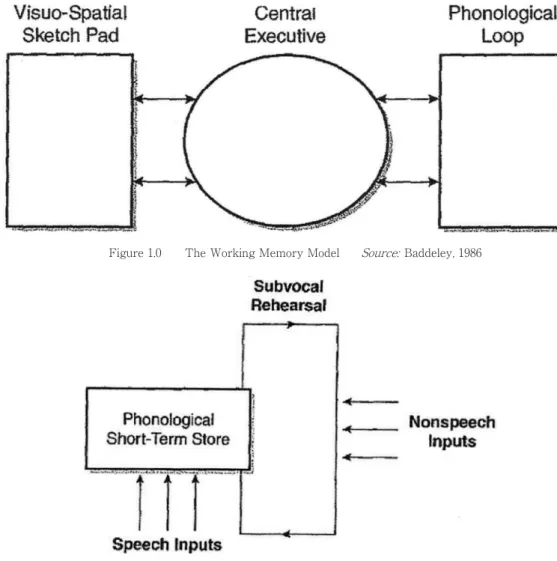
, is involved in the short-term processing and maintenance of material which has a strong visual or spatial element to it.Figure 1.0 provides a simple representation of the working memory model. We will now look at each component of the model in detail.
The Central Executive
The central executive executes many functions, some of which are regulatory in nature. The central executive coordinates activity within working memory and controls the transmission of information between other parts of the cognitive system. The executive also allocates inputs to the phonological loop and sketchpad slave systems and also retrieves information from long-term memory. These actions are powered by processing resources within the central executive, but which have a finite capacity. Theoretical progress on the central executive has been slow, and experimental methodologies for studying the involvement in particular tasks are still under development. However, there have been numerous studies that have been conducted whose outcomes the model of Working Memory can account for. Let us now look at the Phonological Loop.
The Phonological Loop
The phonological loop is a slave system specialized for the storage of verbal material. It is comprised of two components, as shown in Figure 1.1(Baddeley, 1986).
The phonological store represents material in a phonological code which deteriorates with time. A process of articulatory rehearsal serves to refresh the decaying representations in the phonological store. The rehearsal process is also used to recode non-phonological inputs such as printed words or pictures into their phonological form so that they can be retained in the phonological store. In contrast, spoken information gains direct access to the phonological store without articulatory rehearsal.
The two-component architecture of the phonological loop is based on a large body of experimental evidence which has been accumulated during the past thirty years. Recently, it has also been supported by studies of neuropsychological patients with deficiencies that appear to correspond to the subcomponents of the loop. These include An Investigation Into Two Shadowing Techniques
1975)and phonological similarity(Baddeley, 1966). Let us now look at the final component of the Working Memory Model which is the Sketchpad.
The Sketchpad
The visuo-spatial sketchpad is a slave system specialized for the processing and storing of visual and spatial information, and of verbal material that is subsequently encoded in the form of imagery.
Figure 1.0 The Working Memory Model Source: Baddeley, 1986
Figure 1.1 The Phonological Loop, with the Phonological Store and Articulatory Loop Source: Baddeley, 1986
Having a greater understanding of the Working Memory Model, a definition of shadowing is necessary. In essence, a person listens to a piece of text and then immediately tries to repeat out loud what they have heard. Tamai(2003)defined shadowing as a vocalized version of the phonological process. Tamai took the definition from Lambart(1998). There have been numerous studies done in the area of shadowing. For example, Ouchi and Tanaka(2005)tried shadowing as described by Lambart but their study showed that it was not very effective especially for lower level learners. This motivated other researchers to develop a new method of shadowing.
One such study conducted by Nakayama and Mori(2011)created Visual Auditory Shadowing based on learning transfer. In their study, Nakayama and Suzuki(2012)added the elements of self -monitoring and scaffolding audio shadowing. It is this last study that created the impetus for an investigation into Parallel Reading versus Reading Aloud. In the Nakayama and Mori study, the visual and audio inputs were alternated. Building upon that previous study, the participants in this study are exposed to the audio input and the visual input at the same time. This brings us to our research question: Which technique would facilitate more words being shadowed correctly: Parallel Reading or Reading Aloud?
Parallel Reading and Reading Aloud
Parallel Reading is the act of listening to a piece of text while reading the same text. An example is listening to an audio book while reading a text version of the very same thing. This differs from Reading Aloud in which the participant reads and enunciates the text orally. Examples of this are when a parent reads aloud to his or her child, or when a person reads aloud on stage to a group at a book club meeting. Understanding how Parallel Reading and Reading Aloud are defined for the purposes of this study, let us look in more detail at the experiment itself.
Methods
The dependent variable in this experiment is the amount of correctly shadowed words. The independent variable is the training technique. One group performed the Reading Aloud technique while the other group performed the Parallel Reading technique.
An Investigation Into Two Shadowing Techniques
two groups of thirteen.
One group of thirteen used the Reading Aloud technique while the other thirteen performed the Parallel Reading technique. The results of their TOEIC listening practice test prior to their participation showed that the participants had no significant differences in listening proficiency(p>.05). The following diagram shows the procedure as to how the experiment was conducted.
As the diagram shows, an initial shadowing attempt was done by both groups.
That initial attempt constitutes a Pre-Test. The Read Aloud group read three times while the other group, the Parallel Read group, also read three times. A fourth attempt was recorded for both groups. The total number of correctly shadowed words, the gain score, was used in the analysis. A Pre-Test/Post-Test analysis was conducted using a t-test. The following is the results.
PR RA
n 13 13
M 28.77 18.31
SD 21.06 18.87
n is the number of participants in each group. M represents the mean of the correctly shadowed per group. SD represents the standard deviation for each group. The results showed that there was no significant difference in improvement between the two groups.
This indicates that the Parallel Reading group, which had an audio input and the visual text to help them shadow words, performed no better than the Reading Aloud group, which only
Reading Aloud Group(RA)
RA RA RA
Shadow
(pre-test)
Shadow
(post-test)
Parallel Reading Group(PR)
PR PR PR
Shadow
(pre-test)
Shadow
(post-test)
had the visual text. The model of Working Memory can help explain the results.
An Plausible Explanation of the Results
The amount of processing power that lower proficient learners have, at their current level, is too low to effectively handle two kinds of input. Therefore, the learner will make a subconscious choice and will focus all of their attention resources on one type of input. According to the model, not enough cognitive resources are diverted to encode the audio. Meaning, lower proficiency learners are using attention resources in the descending order of comprehension followed by producing the correctly shadowed words.
Consequently, this leaves very few resources remaining, if any, for audio encoding of the auditory input.
In addition, the input that low proficiency learners will focus on is the visual input.
For most low proficiency learners, it takes more attention resources to concentrate on the auditory input than it does on the visual input. Low proficient learners limited exposure to auditory input in their prior learning experiences is the reason for a great deal of attention resources to be used. This is indicated by the participants keeping their eyes open during the procedure. If they were attempting to concentrate on the auditory input they would like have closed their eyes. When many people are trying to encode some information they rehearse and repeat the information a few times. Many times, people close their eyes or at least move their eyes in an upward direction. Closing one’s eyes eliminates any visual input allowing for more resources to be allocated to the rehearsal in the phonological loop.
Therefore, since most of the participants kept their eyes open, it can be reasonably inferred that they essentially ignored the auditory input.
From this research, it can be suggested that for low proficiency learners, two types of input is not more effective than just one type of input for Shadowing. The pedagogical implication for lower proficient learners is that one type of input for shadowing tasks is sufficient. The Working Memory model does state that attention resources are finite, but that does not mean that low proficient learners are incapable of processing two types of input.
An Investigation Into Two Shadowing Techniques
Though this study does contribute to our understanding of the efficacy of shadowing, there are limitations of this study which need to be considered and investigated.
This study investigated whether shadowing facilitates phonological learning in a short period of time. A longitudinal study with various materials using different voices and accents also needs to be conducted. Also, whether shadowing training facilitates improvement in listening comprehension should be further determined for listening is a crucial element in the phonological encoding process.
Furthermore, participant factors also need to be investigated. The participants in this experiment are from a small sample group of university students who had at least six years of learning experiences. The learners who have fewer learning experiences, such as junior high school or high school students might have different outcomes. Age is also another factor that needs to be investigated along with whether or not compensatory skills were used during this process.
Another limitation is that, in this study, the participants’ psychological factors were not determined. Recently, learners’ motivation or self-efficacy to the task has been reported to affect the results of shadowing tasks (Hamada, 2011).
Conclusion
Returning now to the research question, we will now comment on whether reading aloud or audio-visual shadowing would facilitate more words being shadowed correctly for low proficiency learners. After the participants participated in the trials, the analysis revealed that neither technique was superior to the other. Using the Working Memory Model as the framework to explain the results, a plausible conclusion is that low proficient learners do not have enough attention resources to fully process two types of input.
Therefore, the most familiar and least demanding type of input was focused on, indicating that the learners were focusing on the same type of input, mainly the visual input, which led to no discernable difference between the two methods. The pedagogical consequence is that lower learners are not being aided in shadowing tasks by having two types of input.
The limitations of the research such as the content of the visual input may also have had an
effect.
In spite of the various limitations, this research plausibly implies that for shadowing-type tasks, it is best to expose low-proficiency learners to one type of input in order to help them shadow more words correctly.
An Investigation Into Two Shadowing Techniques
Baddeley, A.D.(1986).
Working Memory
. Oxford: Oxford University Press.Baddeley, A.D.(2003). Working memory: Looking back and looking forward. Nature Reviews: Neuroscience, 4, 829-839.
Gathercole, Susan E. and Alan D. Baddeley. (1993).
Working Memory and Language
. NewYork: Psychology Press.Hamada, Y.(2011). Psychological aspects of shadowing training. Journal of the Japan Association for Developmental Education, 6(2), 60-71.
Logie, R.H.(1995).
Visuo-spatial working memory
, Hove, UK: Lawrence Eribaum Associates.Nakayama, T. & Mori, T.(2012). Efficacy of visual-auditory shadowing.
The studies in English Language, Literature and Culture
, 42, 55-68.Nakayama, T. and Suzuki, A.(2012). A study on learning strategies in shadowing training.
Journal of the Japan Association for Development Education, 7, 131-140.
Ochi, M.(2005). The Effectiveness and prospect of interpreting training methods as part of language education in Japanese senior high schools.
Interpretation Studies, 5, 203-224.
Tamai, Ken(1998)Assessment of Shadowing in the Classroom.
Theoretical and Applied Linguistics at Kobe Shoin, 1.
Tanaka, M.(2004). Current Pedagogical Issues in Teaching Interpresting at the Undergraduate Level. Interpretation Studies.
(2014年11月29日受理、2015年1月5日採択)