Summary
Fear of falling in the elderly has been reported to be more problematic than falling itself. Since conducting numerous living activities on the floor is a Japanese custom, we investigated the influence of vertical downward movement while standing, to clarify factors affecting activities restricted by fear of falling. The subjects were 44 elderly women (aged 74.8±7.1 years) with independent outdoor mobility. As a measure of fear of falling, self-efficacy in the execution of activities was evaluated. A significant correlation was noted between activity self-efficacy and fear of falling (r=0.417, p<0.01). Factors correlated with activity self-efficacy were a) timed up and go test (r= -0.324, p<0.05), b) times required for sitting on the floor (r=-0.321, p<0.05), and c) going up and down a 15-cm step(r=-0.365, p<0.05). It is suggested that vertical movement while standing should be included in the evaluation of and intervention in fear of falling, in addition to mobility.
Introduction
Fall-associated fracture and trauma are factors reducing independence in conducting activities of daily living. Following recent progress in studies on falling prevention, fear of falling
1)has been
reported to be more problematic than falling itself
3)14), and such a fear develops in elderly people who have not experienced falling
2). The incidence of fear of falling in elderly has been reported to be 25-55% in Europe and America
4)-8)and 50-60% in Japan
9)10), and activities were restricted due to fear of falling in 19-35% of these
7)13). Fear of falling restricts activities of daily living and their range in elderly people, despite their adequate mobility, and reduces physical function and quality of life (QOL)
11)12).
Fear of falling is measured by directly questioning subjects on its presence or absence, or as activity self-efficacy. For measurement using self-efficacy, Tinetti et al.
19)developed the falls efficacy scale (FES) to measure the degree of fear of falling based on the self-efficacy theory proposed by Bandura
15). Several indices have been subsequently developed
11)20)21), and the usefulness of the combination of several indices to identify individual problems has been reported
22).
In studies on fear of falling and physical function performed in Europe and America, fear of falling was significantly higher in a group with reduced equilibrium function and mobility
16)-18), showing the association of the fear with evaluation items of motor function involving
Relationship of activity self-efficacy, mobility and balance in community dwelling elderly women
Tomonori Nomura, Toshiko Futaki*
Key words : fear of falling, self-efficacy, mobility, balance, elderly women
Department of Occupational Therapy, School of Health Sciences, Niigata University of Health and Welfare
*Human Health Sciences, Graduate School of Medical and Faculty of Medicine, Kyoto University Address for Correspondence:
Tomonori Nomura
Department of Occupational Therapy, School of Health Sciences, Niigata University of Health and Welfare, 1398, Shimami, Niigata 950-3198, Japan
E-mail:[email protected]
standing and moving. However, more elderly people with independent outdoor mobility report difficulty in standing up from, and sitting on tatami mats rather than a reduction of physical strength, such as in balancing and walking. Since conducting numerous living activities on the floor is a Japanese custom, which is different from Western life-styles, observation of not only physical function related to falling but also activities and motions specific to elderly Japanese is necessary. Thus, we hypothesized that the ability to stand up from, and sit on the floor affects activity restriction associated with fear of falling.
The objective of this study was to clarify factors affecting activities restricted by fear of falling via measuring the speed of reactions of physical functional factors reported to be associated with fear of falling and activities and motion suggested.
The hypothesis investigated was: ‘vertical downward movement from the standing position affects activities and motion restricted by fear of falling’.
Methods
1. Subjects
The subjects were 44 elderly women, aged 74.8
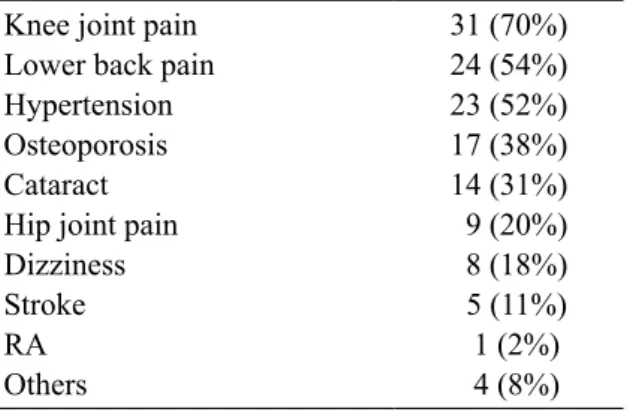
±7.1 years (mean±SD; range: 65-88 years). All subjects showed independent outdoor mobility, and had no apparent motor disturbance nor dementia symptoms (Tables 1 and 2). This study was approved by the ethics committee of Kanazawa University .
2.Methods
Fear of falling, restriction of leaving the home due to fear of falling, experience of falling over the past one year, history of falling over the past one year and activity self-efficacy were surveyed.
Regarding fear of falling, the subjects were asked,
‘are you fearful of falling?’, and chose the answer from ‘1: very fearful’, ‘2: slightly’, and ‘3: no’.
Regarding restriction of leaving the home due to fear of falling, experience of having almost stumbled, and history of falling over the past one year, the subjects gave answers simply as present or absent. As questions on activity self-efficacy, the questions of Modified Falls Efficacy Scale (MFES)
20), Activities-specific Balance Confidence (ABC)
21)and Survey of activities and fear of falling in the elderly (SAFE)
11)used for the measurement of fear of falling were referred to, and items regarding activities and motions specific to elderly Japanese, such as ‘wiping the floor or tatami mat clean’, were added (Table 3).
Table 1 Demographics of subjects
Female 44
Age (years)
Mean 74.8
SD 7.1
Range 65-88 Living situation
Alone 4 (9%) An old couple 12 (27%)
With others 28 (64%) Assistive device
None 28 (64%) Cane/Walker 16 (36%)
MSQ* Median (Range) 10 (8-10)
*MSQ: Mental status questionnaire
Table 2 Characteristics of participants’ main diagnoses
Knee joint pain 31 (70%)
Lower back pain 24 (54%)
Hypertension 23 (52%)
Osteoporosis 17 (38%)
Cataract 14 (31%)
Hip joint pain 9 (20%)
Dizziness 8 (18%)
Stroke 5 (11%)
RA 1 (2%)
Others 4 (8%)
Concerning questions on activity self-efficacy, the subjects were interviewed as to whether they were ‘1. not confident’, ‘2. slightly lacking confidence’, ‘3. fairly confident’, or ‘4. very confident’. The movements measured were timed up and go test (TUG), times required for standing up from the floor, sitting on the floor, and going up and down a step, as well as forward, lateral, and downward movement times of the upper limbs in the standing position. In TUG, the subject stood up from an armchair, walked for 3 m, turned around, walked back, and sat again on the chair, and the time required for this movement was measured
23). As for the time required for standing up from the floor, that required for standing up from the long sitting position to straight standing without holding onto any support was measured. Regarding the time required for sitting on the floor, that required to sit in the long sitting position from the straight standing position was measured. Concerning the time required for going up and down a step, that required to go up and down a 15-cm step without support one time was measured. In the measurement of forward, lateral, and downward movement times of the upper limbs in the standing position, an A/D converter (PC CARD, CONTEC) was connected to a PC (Panasonic), and the time required to turn a lamp from on to off was measured. The lamp was placed 50-cm anterior to the subject at a 80-cm level. The examiner manually lit the lamp, and the subject turned it off in the straight standing position. The subject turned off the switch with both hands in the forward, lateral, and downward directions.
For the forward and lateral directions, the switch was placed at the subject's left acromial level, and the initial limb position was set at a 45° flexion of the elbow joint
29). For the downward direction, the switch was placed at the subject’s patellar level.
Association between the total score of activity self-efficacy and the items was investigated by
Table 3 Activity self-efficacy itemsItems
1 Get dressed and undressed
2 Get in/out of bed or bedding on a tatami mat 3 Sit down/stand up from a tatami mat 4 Use toilet independently
5 Take a shower 6 Take a bath
7 Walk around inside the house 8 Go up and down stairs 9 Simple cleaning
10 Wiping the floor or tatami mat clean 11 Prepare a simple meal
12 Simple shopping 13 Light housekeeping 14 Answer door or telephone 15 Reach into cabinets or closets 16 Reach at eye level
17 Pick up slippers from floor 18 Reach on tiptoes
19 Stand on chair to reach 20 Walk around house 21 Walk outside to nearby car 22 Get in/out of car
23 Walk across the road 24 Go up and down ramps 25 Walk across a parking lot 26 Take public transportation 27 Walk in a crowded mall
28 Take an escalator holding the rail 29 Take an escalator not holding the rail 30 Walk on icy sidewalks
31 Go to the store
32 Visit a friend or relative 33 Go out to a movie or show 34 Go to a community activity 35 Go to a doctor or dentist 36 Put up an umbrella and walk 37 Put up an umbrella and go shopping 38 Walk on snow
39 Snow removal from around the house
40 Snow removal from the roof
Spearman’s rank correlation analysis. Statistical analysis software, JMP 6.0.3, was used, and a p level lower than 5% was regarded as significant.
Results
Eighteen and 21 of the 44 subjects (41% and 48%, respectively) answered that they were very or slightly fearful of falling, respectively, and 16 subjects (36%) refrained from leaving the home due to fear of falling (Table 4).
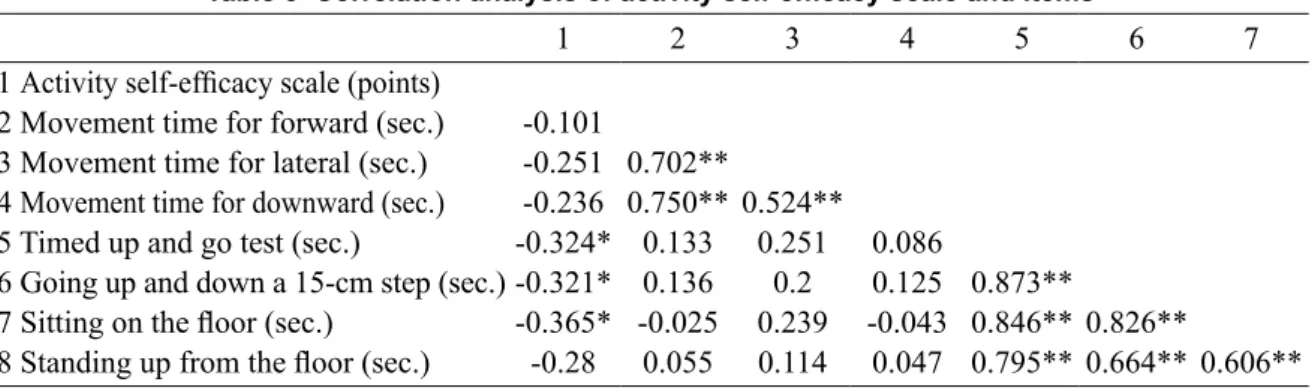
A significant correlation was noted between activity self-efficacy and fear of falling (r=0.417, p<0.01). As for physical function items, TUG (r=-0.324, p<0.05), times required for going up and down a step (r=-0.321, p<0.05), and sitting down on the floor (r=-0.365, p<0.05), were significantly correlated (Table 5).
Discussion
For elderly women, falling is a serious problem because it has a psychological influence, such as activity restriction due to fear of falling, in addition to the reduction of physical function by fracture. The objective of this study was to verify the hypothesis: vertical downward movement from the standing position affects activities and motion restricted by fear of falling.
The activity self-efficacy investigated was significantly correlated with fear of falling,
showing that it reflects the fear level. On physical function measurement, the time required for going up and down a 15-cm step, and times required for sitting on the floor were correlated with self-efficacy, showing an association with vertical motion required for the traditional Japanese life-style. This may be demonstrating our hypothesis that vertical downward movement from the standing position affects activities and motion restricted by fear of falling.
Many studies elderly have reported an association of fear of falling with a reduction in motor function, such as lower limb muscle strength, balance, and gait speed
16)-18)24). Binda et al.
25)reported that fear of falling was more strongly associated with balance than muscle strength, and the ability to move the center of gravity forward and laterally is particularly important for balance. Robinovitch et al.
Table 5 Correlation analysis of activity self-efficacy scale and items
1 2 3 4 5 6 7
1 Activity self-efficacy scale (points)
2 Movement time for forward (sec.) -0.101
3 Movement time for lateral (sec.) -0.251 0.702**
4 Movement time for downward (sec.) -0.236 0.750** 0.524**
5 Timed up and go test (sec.) -0.324* 0.133 0.251 0.086
6 Going up and down a 15-cm step (sec.) -0.321* 0.136 0.2 0.125 0.873**
7 Sitting on the floor (sec.) -0.365* -0.025 0.239 -0.043 0.846** 0.826**
8 Standing up from the floor (sec.) -0.28 0.055 0.114 0.047 0.795** 0.664** 0.606**
* p<0.05
** p<0.01
Table 4 Characteristics of participants
Falls in previous year 13 (29%) Stumble/Trip in previous year 28 (63%) Fear of falling
Very fearful 18 (41%)
Moderately fearful 21 (48%)
Not fearful 5 (11%)
Fear and activity restriction 16 (36%)
compared the forward and lateral movement times between elderly and young people, and found that the time required to move and touch a wall with the hands in response to a signal was significantly longer in the elderly
29). We measured the vertical downward movement time in addition to the experiment reported by Robinovitch et al., but did not confirmed that vertical downward movement of the center of gravity affected fear of falling. Although there has been no previous study elderly Japanese that showed an association with floor-related movements and vertical downward reactivity, elderly people may change from a Japanese life-style to a western life-style when they become anxious for their personal safety. They inevitably change life-style when these movement and reactivity levels decrease, reducing the QOL. To perform normal daily activities with confidence, it is necessary to take measures to prevent the reduction of floor-related movements and vertical downward movement. As a background to our findings, there may be found the influence of knee joint pain and lower back pain. It may be said that it is one of the characteristics of the Japanese woman.
The regaining of confidence increases independence in daily activities in persons with fear of falling. To overcome an excessive fear of falling, improvement of physical skills to increase self-efficacy against falling is effective
7). Reduction of fear of falling by balance training in elderly people has been reported
26)-28). The increase in vertical downward movement by this study, in addition to improvement of physical skills, may strengthen the ability to avoid falling, resulting in increasing activity self-efficacy. The possibility of preparing a program to increase defensive vertical downward movement for the prevention and improvement of fear of falling was shown.
Conclusion
Activity self-efficacy was associated with
TUG, and times required for sitting on the floor, and going up and down a 15-cm from the standing position. These are essential maneuvers for sitting on the floor customary to the Japanese life-style. Preventing a reduction of vertical downward motion ability while standing may lead to the prevention and improvement of fear of falling, and its application in evaluation and intervention programs is expected.
Acknowledgement
We thank the subject people who cooperated with this investigation. We are especially grateful to Associate Professor Kazuhiro Terajima, Niigata University of Health and Welfare.
Reference