Jura : Justice, Property Rights and Moral Economy
著者(英) Atsushi Miura
journal or
publication title
Senri Ethnological Studies
volume 81
page range 69‑98
year 2013‑01‑31
URL http://doi.org/10.15021/00002477
69
Edited by Akiko Mori
Sociability and Associations in Rural French Jura:
Justice, Property Rights and Moral Economy
Atsushi Miura
Saitama University
To Professor Hiroyuki Ninomiya and Professor Junzo Kawada
1. Introduction
1.1 Associations as social pattern
This paper examines a generation of social patterns of associations in daily life in Franche-Comté, an eastern rural region of France, and its implications for modern society in general.
1)The question is inspired by Boissevain’s argument on social network and coalitions.
When Boissevain’s work Friends of Friends (1974) was published, the processualist approach was developing in political anthropology. Emerging in the 1950s and stimulated by decolonization and urbanization, processualist political anthropology criticized the structuralist presumption of a society as a stable, closed community, and aimed at analysing dynamic social processes and mutation.
In the same time period, a number of anthropologists began to develop European studies. Inspired by processualist anthropology and using Mediterranean ethnographic data, Boissevain proposed a new approach to social dynamics. He argued that all human beings have their own formal or informal social networks. Some people who are at important intersections try to use these networks for their own profit become brokers.
These brokers seek particular social goals, and, if necessary, transform the networks into coalitions for reaching their goals.
Boissevain’s network approach provides a new perspective for the study of modern associations, which are seen as one of the keys in building a civil society. The idea of associations had great popularity in French socialist debates, especially in the first half of the 19th century. Interestingly, some socialist philosophers such as Fourier, Considérant, and Proudhon came from the eastern region of France, Franche-Comté. Their ideas were deeply rooted in the experience of cooperatives since in this region cooperatives played an active role in adapting social life to the modern market economy. Even today, the tradition of associative socialism remains active (Jeanneau 2010).
Associations, often considered one step in the creation of a democratic society, have
been discussed in philosophy and political science. Some of the analyses adopt normative
approaches and others empirical approaches; nevertheless, most of them have neglected
the cultural background. Boissevain’s model instead proposes to focus on the nature of social relations and social resources in the dynamic process of associative movements.
This approach allows us to understand the social and cultural background of successful cooperative development in Franche-Comté.
1.2 Associations in Franche-Comté
Franche-Comté, the land of the ancient County of Burgundy, is an eastern French region along the Jurassian Mountains on the French-Swiss border. Because local lords of the county exonerated its cities and villages from taxes beginning in the 13th century, the region has been called ‘Franche-Comté (Free County)’ since the 15th century. The cities and villages enjoyed relative liberty until their annexation to the French Kingdom in 1678. Though the region stayed economically rural and politically peripheral, it was prosperous in its autonomous status especially during the time of Holy Roman Emperor Charles V (1500-1556), whose chancellor Nicolas de Granvelle was from Franche-Comté.
Geographically, the greater part of the region shares the three-field system and an egalitarian inheritance with northern France.
The region has a marked personality with its communitarian tradition of cooperatives (called fruitières). While most agricultural modernization in France is characterized by agrarian individualism (Bloch 1952: 224-226), agriculture in Franche-Comté, especially in the two mountainous departments of Jura and Doubs, was modernized along with its
‘communitarian custom’ (Perrier-Cornet 1986: 69) of cooperatives and common pastures of medieval origin. When peasants began to settle in the mountain forests in the 13th century, they organized the first cooperatives to produce Gruyère-type hard cheese (nowadays called Comté); as the cheese was made to conserve milk for the long winter, a wheel of cheese needed a large quantity of milk produced by many cows; therefore, a need arose for associating peasants (and cows).
2)The zone of cooperatives was restricted to a small area until the 18th century, and most peasants in the region lived a subsistence lifestyle based on mixed farming of cereals and the production of milk.
In the late 18th century, cooperatives began to proliferate throughout the region because of both rapid population growth and the need for money owing to an expanding monetary economy and the imposition of monetary taxes; Gruyère was an appropriate product for commercialization due to its suitability for conservation and transportation.
Therefore, according to Boissevain’s terminology, fruitières were ‘action sets’ at the beginning of the 19th century insofar as they were temporal groups established for a particular purpose (cheese production to gain monetary income) without any particular leaders (Boissevain 1974: 186). Emerging cooperatives developed in the peasant societies where the official central government could not fully control the region (Brelot 1985:
385). During this time, most peasants were small- and middle-sized proprietors of less
than 30ha; landlords with more than 30ha were a very small minority (1% of the
population in Doubs; 10% of the land in Jura, 20% in Doubs) without dominant power
due to the excessive fragmentation of their lands and their absenteeism; furthermore,
more than a quarter of the lands were communal (26% in Jura, 31% in Doubs) (SEJ
1953: 63, 68; Mayaud 1986: 63, 90).
In the mid-19th century, Jura and Doubs became the principal zone of the cooperatives; almost every village had at least one fruitière, and sometimes more.
Fruitières became folkloric places where all the members came with their milk twice a day and discussed family and village matters; young girls also came there to see boys.
Another communitarian tradition was the common pasture, which, despite severe criticism by the intellectuals, was largely practiced for its profitability for both poor and rich peasants. During the 19th century, fruitières evolved through the establishment of written by-laws and the development of a production mechanism (e.g. the construction of cheese factories and improvements to the recording system). Nowadays, despite the disappearance of other communitarian traditions, fruitières are still key institutions in Jurassian agriculture and have inspired other local associations such as peasants’ unions, breeding cooperatives, wine-producing cooperatives, and even workers’ cooperatives.
3)Today, Jurassian villages in the highlands (above 450m altitude) are relatively homogenous. The farms are of similar economic status and mostly specialize in milk production. The homogeneity results from historical evolution since the beginning of the 19th century. The development of fruitières in the first half of the century transformed agriculture from mixed farming into milk production and excluded the poorest peasants who could not have any cows. The agricultural crisis of the 1870s triggered an exodus of big landlords out of the rural area.
Fruitières as simple coalitions (action sets) thus became associations of a permanent nature in order to face a new economic environment. As Boissevain (1974: 5) posed in his study on associations, two essential questions emerged from the local history of the associations: ‘How do such patterns emerge?’ and ‘How are they changing?’ Since the fruitières of the first half of the 19th century inspired socialist philosophers of the region, an examination of the social patterns also reveals the nature and significance of socialist ideas.
Figure 1 The Saint Vernier’s Day procession in a wine producing village in Jura. A. Miura, 1991.
In the following discussion, social patterns among the Jurassian farmers will be examined through an analysis of daily social interactions. The paper then discusses the political and economic significance of the social process thereby generated. At the end of the paper, the social and economic patterns will be shown in a comparative perspective.
The data presented here were mainly gathered during ethnographic fieldwork from December 1990 to July 1992 in village F and its neighbouring villages on the Premier Plateau (450m to 600m altitude) near the city of Poligny in the Department of Jura.
2. Social interaction and sociability
2.1 Discourse and history in daily conversation
As Boissevain (1974: 6) suggested, social processes develop through interactions between individuals who constantly try to maintain or better their social positions. For this purpose, they examine information on their situation and choose between alternative courses of action, considering their own self-interest as well as the accepted norms in relation to others. In rural French Jura, as in other societies, such interactions are accompanied by verbal exchanges. Case 1 (see Appendix) is an example. Here, the actors exchange information to share concrete images of what happens in the world to produce new knowledge (especially 2A, 6B, and 10C). However, information processing is not the only goal of the conversation. In Case 2, the actors try to demonstrate their intention to continue the verbal exchange (14B and 16B) as well as their hesitation to say something against others (15A). In Jura, when one says something against others, one always adds the following phrase, ‘Mais, oui, je suis d’accord avec toi, mais… (But, yes, I agree with you, but…)’. The expression clearly demonstrates the intention to continue the conversation despite the objection; the verbal exchange is thus a way to maintain a social relationship.
Hence, two different intentions appear in a verbal exchange: the informative intention to exchange and explore information and the social intention to maintain relationships with others. Benveniste’s idea helps us recognize the two intentions grammatically. He distinguished ‘discourse’ (discours) and ‘history’ (histoire) in French verbal expressions and concluded that discourse is expressed with ordinary past tenses (i.e. imperfect and compound past), while history is expressed with aorist tenses (i.e.
simple past) (Benveniste 1966: 245). Simonin-Grumbach developed this point claiming that discourse always refers to ‘now and here’ where interlocutors exchange words using shifters (deixis), and that history does not refer to it and has no shifter (deixis) in the expression (Simonin-Grumbach 1975: 115). Therefore, though aorist tenses are never used in Jurassian daily conversation, we can distinguish history and discourse according to the existence of deixis. Without any deictic reference to interlocutors, history explicitly exposes only informative intention, while discourse indicates social intention by explicitly referring to interlocutors with deictic expressions.
However, the two types of utterances sometimes interfere in daily conversation. In
Case 3, phrase 21C is not a simple assertion of a historical fact; by saying this, the
speaker wanted to agree with assertion 20A, and thus tried to maintain a social relation.
Here, talking about a historical event is an active intervention in human relations presented by discourse, so that human relations expressed in discourse can be influenced by what was told in history. The social relation is finally confirmed by the pronoun
‘notre’ (our) in 27C, implying that they were always together.
Discourse and history often interfere when people speak of past history or experiences. In this respect, two types of past are discernable according to verbal forms of historicity: the distant past and the close past. When one speaks of the distant past, the time is indicated with numeric means (e.g. ‘in the 19th century’) or historical personalities (e.g. ‘at the time of [the Holy Roman Emperor] Charles V’); when one speaks of the close past, the time is indicated by events in the lives of one’s kinsmen or friends.
Clearly, the major historical events people learn about in school or through books and the media are in the distant past, and rarely appear in daily conversation. Some people also speak of regional history as the distant past, though they did not learn it in school. As with the distant past, they like to talk about the prosperous time of the region under the Holy Roman Emperor Charles V, the heroic battle of Captain Lacuzon against the French invasion in the 17th century, or the republican revolt in the town of Arbois in 1834, when peasants retorted against the gendarmes, ‘Nous sommes tous chefs ! (We are all bosses!).’ All of these events are presented exactly as ‘history’ without any deixis (though aorist tenses are not used). However, people speak of a region’s distant past not only to exhibit their historical knowledge. They are proud of the history of ‘Franche- Comté’ for its autonomous status. Therefore, to speak of the regional history is to emphasize the regional values of autonomy, as if these values were inherited over the centuries.
When one speaks of events in the close past, the time is indicated with an experience of the speaker, an interlocutor, or their close kin or friend: ‘You know, it was when Cécil [daughter of the speaker] entered primary school...,’ or ‘When we were still young,’ for example. When asked, they can identify the year in which the event happened in the numeric way. However, people always talk about events that happened to their family or friends by indicating time through these episodes and not in numeric ways. The individuals who are referred to are always people that all participants in the conversation know, so that the time plays the role of deixis. Therefore, the close past necessarily indicates the social context of the conversation, and thus has the characteristics of
‘discourse’. When one speaks of the close past, the speaker has one of three purposes: to emphasize the change between the past and the present, to emphasize the continuity between the past and the present, or to explain the origin of the current situation.
When emphasizing changes between the past and the present, a speaker expresses temporality by the terms dans le temps (before) and aujourd’hui (today). In our research at the beginning of the 1990s, the boundary between ‘before’ and ‘today’ was mostly in the 1970s, however, it varied depending on what the speaker wanted to emphasize.
4)In all cases, dans le temps is described as a time of peaceful and harmonious life with discipline, while aujourd’hui as an unstable time when people lost harmony and morality.
However, people’s lives are always filled with both conflicts and cooperation no matter
when they live. Therefore, the aim of telling such ‘history’ is not to report past events, but to criticize the present. When a speaker emphasizes the continuity between the past and the present, it often concerns a characterization of one’s family: ‘He wanted to be the mayor, but he could not. That is why he makes noise in order to show his presence in the village. You know, it is the family. His father also wanted to be a mayor, and his grandfather, too.’ In this case, the speaker does not distinguish dans le temps from aujourd’hui, but rather attempts to confirm his or her judgment of the current situation.
Similarly, when a speaker describes the origins of the current situation, he or she does not distinguish the past from the present, but simply tries to justify judgment of the current situation. Therefore, discussing the close past is intended to say something about the current situation.
In all of the cases, to talk about the past, whether distant or close, is to say something about the present. In particular, in the close past, human relations indicating the time characterize the current situation. Therefore, we now examine the relationship between the close past and human relationships.
2.2 Personal identification and the intimate zone
The personages used to indicate temporality have a close relationship with at least one of the participants in a conversation and can be characterized by the relation of tu.
According to Jurassian (and French) custom of T/V distinction, two people in a family or two friends address each other with the familiar form (T-form) of the second person singular pronoun tu, while two people who are neither kinsmen nor friends address each other with the respectful form (V-form) of the second person singular pronoun vous.
In a family, people always address each other with tu; a person of the senior generation calls kin of a junior generation by the first name, and the latter calls the former by a kinship term such as Maman (Mama) or Pépé (Grandpa), or a kinship term with the first name as Tonton Alfred (Uncle Alfred). Here, the difference in generations is made obvious, and the system always demands individuals to show politeness towards those in the senior generations.
When two non-kin individuals meet for the first time, they address each other with vous and call each other by family names with honorifics as ‘Mr. Perrard’. However, once they begin to speak more familiarly with each other (and there is a tendency in this society to speak familiarly with others, as will be discussed later), they become copains (friends), begin to address each other with tu and call each other by their first names.
Very close friends or kinsmen often use diminutives of the first names. Once they enter a tu relation they never go back to a vous relation.
Consequently, in daily social interaction, people are classified by address terms
based on two elements: their generation in the family and their social distance outside
the family.
5)The close past is always indicated with those people whom participants in
the conversation address as tu. Therefore, the events of the close past are structured by
generation and social distance. There is no special term among Jurassians to describe this
world composed of close people addressed by tu, but it has a basic importance in their
daily interaction. Therefore, we refer to it as the ‘intimate zone’ in the following
discussion.
6)The intimate zone can be defined as an egocentric network of people that the ego addresses as tu and that is referred to in presentations of the close past. As the ‘history’
of the close past imposes some judgment on the present, the intimate zone has its own norms that affect this judgment. Obviously, this involves various kinds of social relations, whether harmonious or litigious. But whatever the origin, all non-kin relations tend to become just (unstructured) friendship.
In the intimate zone, each person is designated with a first name. To call an individual by his or her family name implies the speaker’s intent to maintain a distance with the addressee. In Jura, the general rule for bestowing first names is as follows. The eldest son receives the paternal grandfather’s (FF) first name, the second son the maternal grandfather’s (MF), and the third and others receive the name of one of the uncles (FB, MB) or granduncles (FFB, FMB, MMB, MFB). The eldest daughter receives the maternal grandmother’s (MM) first name, the second the paternal grandmother’s (FM), and the third and others receive the name of one of aunts (MZ, FZ) or grandaunts (MMZ, MFZ, FFZ, FMZ). Therefore, aside from exceptional cases, a limited number of first names circulate in a family, and there are always several persons of the same first name in a given family or in a village. However, calling someone by their first name never causes any confusion in identifying an individual in conversation because each person is identified not only by the first name, but also with one’s own personal history.
7)Obviously, reference to such a personal history is a reference to a person’s intimate zone, which is thus not only a group of people, but also a group of their personal stories.
Jurassian people place a high value on discuter bien (speaking familiarly with others) because it makes people copains (friends). Making friends thus involves sharing these episodes, and therefore strengthens and enlarges one’s intimate zone. Once two people enter into a tu relationship, they will never go back to that of vous and will share their stories and experiences. Thus we can see the unidirectional nature of the development of relationships in Jura.
2.3 Cultural codes and the reproduction of social relationships
Talking about experiences in an individual life is not only a presentation of objective facts. In conversations, people use qualifying adjectives that add subjective judgment to people’s behaviours. In most cases, one’s behaviour is positively qualified with the adjectives poli (polite) or gentil (kind) and negatively qualified with the adjectives orgueilleux (arrogant) or jaloux (jealous). To be poli is to respect a proper social distance towards others, close or distant. To be gentil is to treat others with respect, hence making the social relation closer. In contrast, to be orgueilleux is to disregard the dignity of others and to approach them without respect. Being jaloux is a reactive expression of a sense of inferiority towards others. These four adjectives can be explained in terms of the intimate zone: being poli and gentil is a respectful attitude toward others’ experiences, and being orgueilleux and jaloux represents a disregard for others’ experiences.
In daily life, people try to be poli and gentil, and to avoid being seen as orgueilleux
and jaloux. The term jaloux is especially important. Saying ‘Il est jaloux (He is jealous)’
is a provocation. Aggressive behaviour can also be interpreted as an act of jealousy. One informant said, ‘Conflicts in the village always come from jealousy’. In this society, you should behave carefully to avoid having someone else find out that you are jealous of others, or that someone else is jealous of you. To avoid such situations, you should always be poli and gentil, and never be orgueilleux. One who does not need to be jealous of others is considered indépendant (independent). Being indépendant is an ideal for them; an indépendant man can live without any moral support from others, as if his family (or his farm, in case of farmers) is his kingdom. This echoes the values emphasized in the distant past of the region. Clearly, it is not possible to be totally indépendant in this society. Therefore, it is necessary to control external intervention for one’s own sake. One who can manage this is highly appreciated as capable (capable).
Such individuals can even become charismatic leaders, like in the cases of some newly organized cooperatives.
These adjectives also serve as cultural codes to frame people’s behaviour. They can be semantically classified into two categories: attitudes towards others, and attitudes towards the social environment. Poli and gentil work positively in one’s attitude towards others, keeping a respectful distance, in the case of poli, and, if possible, bringing the two a little closer with a gracious act, in the case of gentil. To speak familiarly (discuter bien) with others is considered to be especially gentil. This means that being gentil contributes to enlarging the intimate zone, and being poli contributes to maintaining the social order in the intimate zone. Indépendant and capable work positively in one’s attitude toward the social environment, not being influenced by others, in the case of indépendant, or skilfully manipulating others, in case of capable. Being indépendant contributes to saving the intimate zone from external influence, and being capable contributes to using external resources in that support of the intimate zone. Orgueilleux and jaloux both work negatively towards others and toward the social environment. A person is orgueilleux when he or she is indépendant or capable but not poli or gentil. A person is judged as being jaloux when he or she is neither indépendant or capable nor poli or gentil. Being jaloux is interpreted as reflecting lack of confidence in one’s own intimate zone, and therefore of the individual himself or herself.
8)The system of cultural codes pushes an individual to include more people in the unstructured intimate zone without injecting any hierarchy. Showing superiority is considered to be an expression of orgueilleux or even jaloux. Therefore, even capable or indépendant people, whether wealthy or not and of noble origin or not, are forced to present themselves as equal to others with an attitude of being gentil towards them because this attitude of hospitality enhances his or her reputation. Consequently, by virtue of cultural codes that work either towards others or towards social environment, everyone is encouraged or even forced to enlarge one’s intimate zone, so that the development of human relationships appears to be unidirectional.
2.4 The religious effects of rites of passage
Most Jurassians are Catholic. While only women and children go to Mass every Sunday,
everyone, including men, attends Mass for the important rites of passage of the family.
Prayering and the Mass are the ordinary means of communicating with God. While praying is an individual act practiced in one’s private time, the Mass is performed collectively so that the relationship between God and people is presented socially.
Therefore, the Mass for the rites of passage of the family expresses the social frame of individual lives. Among such rites, the funeral Mass is the most interesting because it always presents the nature of a Christian individual by focusing on a particular individual who has died.
Case 4 is the funeral Mass for Maxime (Table 1). At the beginning of the Mass, the priest spontaneously spoke of Maxime’s particular history (34C-44C), using nous (we) to indicate himself and the audience (35C-44C), as well as vous (plural ‘you’) to indicate the audience. However, afterward (after 45C), the priest’s words became more formal as if the particular life of Maxime had been assimilated into the Christian life in general;
the nous (we) now indicated Christians in general, and the vous (plural ‘you’) disappeared (after 41C). This transition from ‘discourse’ to ‘history’ indicates that, in verbal expression, a particular individual life with its own personal history becomes integrated into that of the Christians in general. Biblical episodes of Jesus’ life are superimposed on the personal history of the deceased, as if each one’s life is Jesus’ life.
The intimate zone of Maxime ultimately included the whole audience as well as all Christians.
The superimposition of Jesus’ life on a human life is highlighted through the rites of passage of a person’s life. During each life, Jurassians celebrate Baptism, First Communion, Second Communion, the Declaration of Faith, Marriage, and Funeral; these also represent the course of Jesus’ life (with the exception of marriage), such that an individual retraces Jesus’ life in a succession of rites of passage. Therefore, Jesus Christ is presented as the model of a human. As these rites are always performed in the family, the family ritually structures the identity of each individual. The Trinitarian nature of Jesus, both transcendent and mortal, suggests that the temporal structure of human life is not cyclical but linear, beginning with birth and ending with death (followed by the Last Judgment). The ritual representation of linearity of human life also indicates unidirectional development of the intimate zone, where one is born in the family and develops one’s intimate zone as one grows up: at Baptism only parents and god-parents surround the baby; at the Second Communion, cousins, uncles and aunts also come to celebrate the child; at Marriage, close friends also come to celebrate the new couple; and at the Funeral, distant kinsmen and other friends come. Hence, together with cultural codes, the religious practice of rites of passage of life helps people to conceive human life as the development of the intimate zone, and time as the development of human relationships. By showing the importance of the family and the unidirectional nature of time, religious practice reproduces the intimate zone.
In this context, just as was the case with Jesus Christ, each person is asked to
sacrifice him or herself for the benefit of others and without any return. Such an action is
qualified as ‘gentil’. The norm does not explicitly enforce reciprocity, but instead
emphasizes hospitality. However, since each one is asked to sacrifice, the sacrificial
action necessarily results in a mutual sacrifice and thus in reciprocity; those who do not
show a willingness to be gentil will never be treated as poli and will often be severely criticized as orgueilleux or jaloux. Therefore, in the intimate zone, one is required to show hospitality and a willingness to support others, or risks losing one’s reputation both as a Christian and as a social subject.
3. Political and economic functions of the intimate zone 3.1 The three types of justification
Jurassian societies are never harmonious. Even though people pretend that life was peaceful in the old times (dans le temps), there have always been conflicts in the villages. Once a conflict breaks out, a process of resolution also begins. In this process, each protagonist tries to justify his or her actions and to manage the problem in order to avoid serious consequences. To justify their decisions, there are three options: idealist justification, juridical justification, and situational justification.
Idealist justification refers to a general idea of how society should be, as observed in the prospectus of a candidate for an election (Case 5). This is the prospectus of a socialist dissident in a regional election in 1992. The slogans it contains, however, appear to Jurassian people to be too abstract and utopian, without any concrete indications as to how to accomplish the solutions. No one is against the slogan ‘higher education for the
vous (you) nous (we)
34C: audience —
35C: audience audience and the priest
36C: audience —
37C: (historical narrative)
38C: (historical narrative)
39C: — audience and the priest
40C: family of the deceased audience and the priest
41C: — audience and the priest
42Ch: (hymn)
43C: (historical narrative)
44C: — audience
45C: — Christians in front of the deceased
46C: (religious words)
47C: — audience and the priest
48C: — Christians
49C: — Christians (formalized expression)
50P: — Christians (formalized expression)
51C: — Christians (formalized expression)
52P: — Christians (formalized expression)
Table 1 Addressee of Vous (You) and Nous (We) in the Funeral Mass of Maxime
young’, but the question is how it can be realized under difficult financial conditions.
Most Jurassians do not appreciate references to these idealistic images which appear to be too transcendent, arising from outside of their intimate zone. For the same reason, they do not like ideological discourse, whether from the right or the left.
Juridical justification refers to the use of legal and administrative texts to resolve problems, as in Case 6. This is a common way to resolve conflicts in modern societies such as in France, and therefore administrators are expected to follow the juridical justification. This justification can also (though not always) bring the most coherent solutions to problems because of the objectivity of legal and administrative texts.
However, in the villages, people do not always accept such justifications because they find the references to legal texts arrogant and authoritarian (as in 56A, 60A, 63A, cf.
66A in Case 6). They see them as being backed by higher authorities that refuse to enter into any negotiations with the people. For them, juridical justification refers to texts that are external to their intimate zone and threatening to their value of being indépendant.
Situational justification refers to episodes that happen to people in the intimate zone (Case 7). In this justification, people try to find similar experiences among these intimates and compare those experiences with the current problem to arrive at a proper solution (71D and 72A). For some people, this is the best way to make decisions.
Because the episodes referred to in situational justification are full of moral judgments with cultural codes, the induced conclusion is necessarily guided by these codes; for example, in 68A, the speaker talks about the orgueilleux attitude of the administration. It is also interesting that the mayor’s juridical justification in Case 6 is couched in formal expressions while his situational justification in Case 7 uses familiar expressions, proving that the latter is embedded in the intimate zone.
Therefore, the intimate zone plays a crucial role in the decision-making process.
However, situational justification has an inherent difficulty in bringing coherent solutions to all problems because it can bring different, and sometimes contradictory, conclusions according to the specific episodes referred to and their interpretation. As a consequence, negotiations are needed to reach a satisfactory conclusion. Refusing to enter a dialog is, for them, arrogant (those using idealist and judicial justifications often refuse negotiations and thus appear to be arrogant). When the situational justification put forward in the intervention leads to more complications, people are unable to resolve the issue through negotiation and cannot refuse to follow the juridical or administrative instructions. Yet, those who first ask the administration or the court (both of them outside the intimate zone) to intervene without any compromise can hardly be thought to be capable, but only orgueilleux.
3.2 The property system
The property system among the Jurassian people can also be understood in terms of the intimate zone. Though the property system is defined in the Civil Code, the decisions that farmers make regarding the land and its products do not always follow the formal legal framework; as was the case for the land consolidation launched in 1989 in village F.
Though land consolidation was said to be necessary for modernized agriculture, some
farmers were against the practice, saying, ‘This is the land where my grandfather, my father, and I removed stones, cut trees, and made walls. In land consolidation, we always find injustice. Land consolidation, it is legal theft.’ Here, episodes involving the family serve as justification of their right to the land.
Though often regarded as proof of the farmers’ ‘love of the land’ (Mendras 1984:
77), this attitude cannot be fully explained by it. In Jura, where land property is fragmented through egalitarian inheritance, farmers always practice land exchange (the friendly exchange of use rights to land between friends or kinsmen without any documents) and land lending in order to realize efficient agriculture.
9)In these cases, the farmers express their love not for their own land, but for the land they effectively cultivate. This means that the ‘love of the land’ does not come from the title but from the labour invested in that land. This is a kind of theory of labour value. Since farming is a family affair in which family members work together, labour investment on the land necessarily creates memories and episodes involving the family.
The situational justification of property also explains the custom of common pasture (vaine pâture). After the second harvest, land is considered to be open to all herdsmen regardless of its title until the snow falls. Initiated in the Middle Ages in northern France, but criticized for a long time for its neglect of private property rights, this custom was abolished by a National Assembly decision in 1881. Even so, in Jura, the custom continued to be practiced until the 1950s, and gave profit to both rich and poor farmers.
The farmers justified the practice as follows: with the second harvest, the pasture (pâture) is considered to have become empty (vaine) because all of the fruit of the farmer’s investment on that land is considered to have been harvested. Therefore, once cultivation became intensified after World War II with fertilizer and fertilizing plants, farmers felt that even with a second harvest they could not recover all of their investment. The land ameliorated, thus becoming the cultivator’s own permanent possession. The custom of common pasture disappeared.
According to this farmers’ theory of labour value, one’s labour investment creates one’s right to that product. The product is valuable because episodes involving the family and the neighbourhood are attached to it and reinforce these social relations. Therefore, the intimate zone justifies the property right. The same can be said of the local race of cattle, Montbéliarde. It is an original race of the region, which was genetically selected and elaborated through the farmers’ collective efforts in the region since the 19th century.
Therefore, they claim that it is ‘our cattle’.
3.3 The mechanism of cooperatives
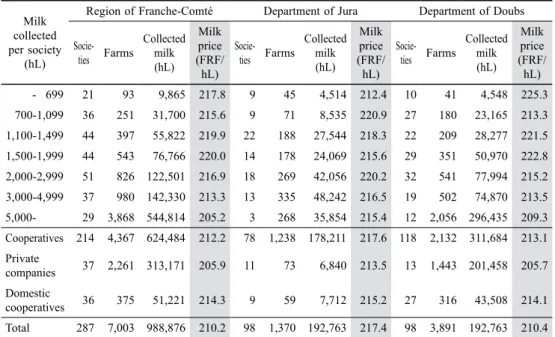
Fruitières function based on this theory of labour value with its logic of the intimate
zone. Most Comté cheese is made in cooperatives and most cooperatives are small with
less than 20 members (Table 2). Evidently, in a cooperative, especially a small one, the
network density is almost 100%; members often live in the neighbourhood and constitute
the intimate zone. While Boissevain observed the distinction between core members and
peripheral members in coalitions, small Jurassian cooperatives are often composed only
of core members. Just like Boissevain’s coalitions of a temporal nature, a cooperative
member’s individual identity within the organization ‘is not replaced by a group identity, nor is their individual commitment replaced by an ideological commitment to a uniform set of rights and obligations’ (Boissevain 1974: 172). However, cooperatives can be called associations because of their permanent nature.
The individuality of members’ identities stems from the payment system. Each member farmer produces ‘my milk’ in his or her farm and sells it to the cooperative. The cooperative then produces wheels of Comté, sells them to the market, and pays the farmers according to the quality and quantity of ‘my milk’ the farmers provided, so that each farmer receives payment according to his or her own efforts in milk production. By combining the ‘my milk’ of all members, the cheese becomes ‘ours’.
Because a cooperative is an association belonging to the members, each one claims a right to participate in making management decisions and follows situational justification when considering the choice of traders to sell the product, technological innovation, and the price of milk to pay to members. In this process, cooperatives have an egalitarian mechanism; by imposing a three-year mandate for the president and board members and refusing to grant one family a monopoly, they prevent a single person from obtaining exclusive power. The system is supported by the logic of the intimate zone. A president rarely renews the mandate unless he is considered to be highly capable; a farmer who tries to claim exclusive power without being highly capable is accused of being jaloux or orgueilleux, and thus could never be thought of as acceptable for such a post.
Service régional des statistiques agricoles de Franche-Comté (1993) Milk
collected per society
(hL)
Region of Franche-Comté Department of Jura Department of Doubs Socie-
ties Farms
Collected milk (hL)
Milk price (FRF/
hL) Socie-
ties Farms
Collected milk (hL)
Milk price (FRF/
hL) Socie-
ties Farms
Collected milk (hL)
Milk price (FRF/
hL)
- 699 21 93 9,865 217.8 9 45 4,514 212.4 10 41 4,548 225.3
700-1,099 36 251 31,700 215.6 9 71 8,535 220.9 27 180 23,165 213.3
1,100-1,499 44 397 55,822 219.9 22 188 27,544 218.3 22 209 28,277 221.5 1,500-1,999 44 543 76,766 220.0 14 178 24,069 215.6 29 351 50,970 222.8 2,000-2,999 51 826 122,501 216.9 18 269 42,056 220.2 32 541 77,994 215.2 3,000-4,999 37 980 142,330 213.3 13 335 48,242 216.5 19 502 74,870 213.5 5,000- 29 3,868 544,814 205.2 3 268 35,854 215.4 12 2,056 296,435 209.3 Cooperatives 214 4,367 624,484 212.2 78 1,238 178,211 217.6 118 2,132 311,684 213.1 Private
companies 37 2,261 313,171 205.9 11 73 6,840 213.5 13 1,443 201,458 205.7 Domestic
cooperatives 36 375 51,221 214.3 9 59 7,712 215.2 27 316 43,508 214.1
Total 287 7,003 988,876 210.2 98 1,370 192,763 217.4 98 3,891 192,763 210.4 N.B.: Among the four departments that compose the Region of Franche-Comté, only two departments in the
Jurassian Mountains (the Department of Jura and the Department of Doubs) are principle producers of cheese Comté.
Table 2 Dairy Cooperatives in Franche-Comté in 1992
In cooperatives, each member primarily seeks his or her own economic profit and not that of the cooperative as a group. Members’ profits come from their own family farms, using family land and family labour. The family is also the unit of everyday life;
education, health control, recreation, and religious activities provide a basic identity to individuals, so the family becomes the core of the intimate zone. To increase productivity and income excessively through labour intensification will necessarily neglect the non-economic functions of the family, thus damaging relationships in the intimate zone, and in turn causing deterioration in its economic activities. Therefore, family farming functions as a moral economy in that it allows economic activities only through social relations. By the same logic, a farmer’s strategy consists of reducing risks to secure family life by diversifying parcels and choosing qualifying products.
10)Through the farmers’ participation in the decision-making process, cooperatives naturally follow this strategy.
Farmers claim that cooperatives are preferable to private companies because they can enjoy equal participation in the cooperative decision-making process without depending on someone else’s decision, while in private companies farmers have no right to take part in the decision-making. Thus the cooperative realizes the farmers’ value of being indépendant and let them refuse the intervention of the external logic of the State and the market.
Figure 2 A cheese factory in a dairy cooperative in Jura. A. Miura, 1991.
4. The moral economy and associations 4.1 The intimate zone and the moral economy
Alongside a formal social system based on a modern legal and administrative arrangement, Jurassian rural society works on the basis of the intimate zone. Involving a particular historicity and addressing system, the intimate zone regulates conflict resolutions, property relations, and the economic activities of farming and cooperatives without fully following the modern system of administration, jurisprudence, and the market. Ethnographies of non-Western societies also report similar systems of moral economy, and claim that they are based on non-Western conceptions completely different from Western ideas. However, Jurassian practice demonstrates that European rural societies share common features with non-European societies (cf. Le Roy 1999: 152-157).
Property systems similar to the one in Jura are reported in various ethnographies. In Southeast Asia, the traditional land system works on such a theory of labour value. In the 17th century, according to Father Alcina’s report on the pre-colonial Philippines, no private ownership of lands existed, and peasants could appropriate only the result of his or her own labour, such as crops and fruit bearing trees (Alcina 2005: 98-101), just as with the common pasture in Jura. This system is sometimes expressed in written codes such as the Laws of Malacca (Liaw 1976: 111). Even nowadays, despite the adoption of the Western system of private property, people act as if the pre-colonial system still exists; cultivators are thought to lose their right to the field once they stop farming, unless they leave trees or landesque capital such as an irrigation system (ex. Urich 2003:
159). The land system in Southeast Asian societies was originally adapted to shifting cultivation. However, it also serves to ensure that poor people have access to land, while the imposition of the modern system of private property excludes poor people from the land and thus worsens economic inequality (Urich 2003: 160). Similar systems are also found in Sub-Saharan Africa, where ‘individuals gain use rights by initial clearing or inheritance and maintain such rights through continuous exploitation (Migot-Adholla et al. 1991: 157-158)’. In these societies, traditional land rights guarantee access to land for poor peasants, while the modern system of property rights is not deemed economically worthwhile (Migot-Adholla et al. 1991: 170).
Although the Western legal system of juridical justification has been introduced in
Southeast Asia and Africa, its disregard for the particular situation of each individual
involved in a dispute appears to farmers in those areas to be arrogant and demeaning. In
Southeast Asian rural societies, people believe that every human being is equal in their
essence, whatever their social and economic status may be (cf. Kerkvliet 1990: 250), and
that justice consists of mutual respect for equal essences. Therefore, for example, while
the modern legal system strictly follows the text of economic contracts, farmers find the
terms of contracts negotiable and sometimes invalid when they cannot fulfil the
conditions due to forces majeurs such as a bad climate change or sudden disease for
which they are not responsible. Here, the requirement of mutual respect asks the two
parties to consider each one’s particular situation and to refer to similar cases in the
decision-making process.
11)Therefore, justice is to be realized through negotiation based
on situational justification. In West Africa, too, conflict resolution is based on negotiation referring to tales (therefore, episodes) of ancestral experience and myth (Le Roy 1999:
193-196).
However, there are also differences between farmers in Franche-Comté and farmers in other societies. In Southeast Asian societies, people accept the political hierarchy of the patronage system as long as the leaders ensure the followers’ survival; therefore, central personages play an important role in social change, reducing farmers’ daily risks, but also facilitating corruption. In Africa, the lineage system asks people to respect and follow the aged chiefs of their lineage. In Jura, where people play the game of orgueilleux and jaloux to create an egalitarian interaction system, people refuse to give prominent leadership to a single individual unless he or she is found to be highly capable. Consequently neither a patronage system nor a chiefdom system could develop there.
Historically, the most important difference between the Jurassian moral economy and that of other societies is that the former has succeeded in being integrated into the market economy with cooperatives while the latter sometimes fails to do so. The difference in performance may well be linked to the difference in social systems.
Therefore, it is necessary to examine how Jurassian cooperatives have succeeded in integrating themselves into the capitalist economy.
4.2 The moral economy and the market
When entrepreneurs seek new profits by exploring new social networks, they change the social order. In this process, as noted by Boissevain (1974: 170), they may develop coalitions. In the 18th and 19th centuries, Jurassian farmers organized cooperatives as action sets in order to face the economic changes launched by the expanding monetary economy. Gruyère was suitable for commercialization, and even well-off peasants needed cooperation from poor peasants in the village because they did not have enough cows to produce a sufficient amount of milk for a wheel of Comté. The first cooperatives developed using existing resources such as their product (milk), social relations among the peasants, and external commercial relations that provided cash for local communities.
Boissevain’s claim that coalitions develop when the community cannot provide security for the people, while corporate associations proliferate when the community does provide security (1974: 203-205) holds true for Jurassian society; cooperatives developed at the margins of the central political power, and then became corporate associations.
Though cooperatives did not introduce any new resources, the development of
cooperatives changed rural communities in two ways. First, quantitative growth in cheese
production changed subsistent mixed farming into simple commodity production, and
then into petty commodity production specializing in milk. Second, the smallest peasants
having no cows but only goats could not remain in the cooperatives, and thus were
excluded from the village.
12)Hence, the quantitative strengthening of existing resources
through cooperatives brought a qualitative change in the rural economy, integrating rural
villages into the monetary economy and eliminating the poorest peasants. However, as
long as the cooperatives functioned without a ‘central figure’ such as a leader (Boissevain
1974: 200), the farmers subordinated the goals of the cooperatives to their own goals concerning the moral economy of domestic groups. Profit and the established shared capital then allowed cooperatives to become permanent associations.
In Franche-Comté, cooperatives have adapted to the market economy better than private companies (Table 2). The economic superiority of cooperatives stems from two factors: their internal relations based on the intimate zone and their external relations of brokerage.
Cooperative members are in the intimate zone with one another and thus know one another well through daily interaction. The price of cheese depends on the quality of the product, which in turn is subject to the hygiene of the breeding environment. When one farmer brings low quality milk caused by poor hygiene conditions, all of the cooperative’s cheese will be damaged, resulting in a low price. Hence, mutual control is required for milk of good quality. When members know each other well, mutual control is easy. Similarly, when they know each other well, decision-making is possible with a low transaction cost; agreement is further facilitated by their similar economic status and interests as historically, most Jurassian farmers have been homogeneous smallholders.
This mutuality accounts for the superiority (higher milk price) of the smaller cooperatives compared with the larger ones (Table 2). Fruitières thus efficiently use the intimate zone for organizing production in cases where only cooperative action brings profit. However, once the ambiance of teamwork deteriorates, cooperation becomes difficult. This was the case for the fruitière in Village F; a small quarrel among members escalated to a court conflict, launching the game of jaloux, and the farmers lost any willingness to cooperate.
The fruitière of Village F was dissolved in 1988, and farmers chose other cooperatives in neighbouring villages.
Cooperatives function as brokers linking family farms to the market. When market values go against the profit of family farms, self-reliant cooperatives without a central figure make decisions in favour of household economy by reducing their own capital in favour of household profit. This was the case in the economic crisis of 1968 (Gros 1980:
106). Nevertheless, the cooperative’s buffering function has a constraint in the form of limited capital. In times of economic crisis, some cooperatives cannot survive and members decide to dissolve their cooperative and join other cooperatives they know.
However, as long as the cooperative principles of decision-making and profit distribution remain the same, moving from one cooperative to another does no direct damage to the farmers’ economic activities.
To conclude, fruitières based on the intimate zone have allowed the survival of the farmers’ moral economy without radically changing rural social relations. The economic homogeneity of cooperative members, as well as the shared capital of their cheese production tools, has reduced the risk of internal conflicts of interest and made cooperatives into more or less permanent associations.
In developing countries, most rural cooperatives are organized by governments but
often end unsuccessfully. Some of the reasons for these failures come from their
disregard of the rural social system. As we saw, in Southeast Asia and Africa where such
leaders are important in the daily social system, associations give a prominent role to
leaders. Then, leaders acting as brokers can appropriate the means of production without sharing them with the farmers. In this situation, the cooperatives often lack a mechanism to force leaders to follow the logic of moral economy. Thus, leaders often become capitalist agents and neglect the moral economy, as was the in the case in the rural Philippines, for example. Cooperatives cannot protect farmers against market pressure.
Furthermore, while Boissevain insisted that action sets develop where the community cannot guarantee security, cooperatives in Southeast Asia and Africa were often promoted by the state itself and became merely governmental agents neglecting the local traditional systems. An imposed cooperative system thus goes against the moral economy of the local people.
4.3 The Jurassian economy and Proudhonian philosophy
Franche-Comté is the motherland of certain socialist philosophers of an associationist tendency. Despite widespread political conservatism among farmers, the influence of the cooperative tradition is evident in the social thought of Fourier and Proudhon. Their ideas interest us because they are rooted in local tradition and yet they have contributed to the development of the ideas of a civil society. Here, Proudhonian philosophy is briefly discussed as one example because it represents well the practice and logic of Jurassian farmers.
13)Proudhon is famous for his assertion ‘property is theft’; a conclusion derived from his ideas that the result of one’s own labour is one’s own property. Here he argues that the result of collective labour becomes a social property, and must be appropriated not just by the capitalists but by all parties concerned (Proudhon 1982a [1840]: 218) and that, in workers’ associations, the associated contribution consists chiefly of labour, with each being remunerated in proportion to his product, in wages and in profits (Proudhon 1876 [1854]: 411-412). Similarly, he rejects profits from credit activities and develops the idea of gratuitous credit, i.e. credit without interest where goods serve as money (Proudhon 1849: 27-28). He based these ideas on his own concept of justice, defined as mutual and reciprocal respect among people, and rejected the transcendent authority of the Church and the State (Proudhon 1982b [1968]: 426). While Proudhon accused the
‘association’ of posing a threat to individual freedom, he also finds it to be a good means of realizing an industrial republic. In all of these propositions, we find echoes of Jurassian practice, though further analysis is required in order to examine the similarities.
We can see that Proudhon’s idea of property is similar to that of the Jurassian farmers (and the farmers of non-Western societies), for whom the result of one’s own labour is one’s property; the functioning mechanism of workers’ associations is exactly that of the Jurassian cooperatives. Gratuitous credit was already practiced among Jurassian farmers, who, living in an economy of simple commodity production, obtained their daily necessities without cash in the village and formed what Braudel (1979: 503) described as the sphere of ‘material life’. Proudhon’s justice is exactly what Jurassian people today describe as ‘politeness’ (politesse), denying the intervention of any external authorities such as states and big companies.
If the farmers’ social and economic system in Franche-Comté can be characterized
as a moral economy established to avoid instability and to ensure the social life, then Proudhon’s economic system can as well. This system thus shares some principle features with peasant societies in Southeast Asia or Africa; a property system, decision-making through everyday justice, and gratuitous credit (free circulation of goods) are among these. Because Proudhon attempted to reorganize the modern globalizing economy by means of a system of moral economy, the similarity encourages us to think about the application of the Proudhonian perspective to today’s rural development in those societies.
The Proudhonian system differs from Boissevain’s coalitions because it seeks to establish an enduring and sustainable system, while coalitions are temporal with specific goals. However, as the history of cooperatives in Franche-Comté shows, establishing such permanent associations can begin with the organization of coalitions. Indeed, if associations deal with new economic and social resources, coalitions would be suitable to their introduction. When such introduction of new resources allows the people’s participation in decision-making, coalitions may encourage civil society movements.
However, the experience of cooperatives in other societies suggests the limits of the Proudhonian model; the social system in which cooperatives channel the circulation of resources differs from one society to another. This difference may affect the performance of coalitions, the first phase in the development of cooperatives. However, as the basic principles of the social system are shared among France, Southeast Asia, and Africa, this difference will not prevent non-European societies from organizing the economic associations Proudhon wanted to establish. Here, Boissevain’s perspective on social networks would be useful, focusing on entrepreneurs and social resources. This would contribute to the examination and reorganization of the flow of new resources inside and outside of associations to realize a moral economy, and the examination would allow us to determine the conditions for a transition from coalitions to associations.
Because Proudhon developed his ideas based on European experiences, a culturalist interpretation of his theory is needed to adapt it to other social systems. In this cultural interpretation, Boissevain’s perspective may be helpful. Obviously, this is also a way of imagining models of civil society adapted to the nature of each society.
5. Conclusion
The Jurassian social system gave birth to particular associations of cooperatives.
Developed from action sets, they contributed to the preservation of the moral economy of the farmers and framed Jurassian civil society. However, the Jurassian case shows that the functioning mechanism of its associations is based on the intimate zone so that the public sphere works on the logic of the intimate zone. Therefore, the consolidation of democratic values in a civil society should be based on the particular structure of intimate social relations; this suggests that non-European societies might have other types of civil societies.
Boissevain’s approach to society not only allows us to conduct efficient analyses of
European sociability, but also gives another perspective on the Western social ideas of
association and on the possibility of civil society in non-European societies. From this comparative perspective, we can better understand the implications of social thought for people in Europe as well as in developing countries.
Notes
1) The first version of this paper was prepared for the final report of the research project ‘Studies of European Elementary Cultures’ (1998-2001). The project was organized by Prof. Hiroyuki Ninomiya, a historian of modern France, and Prof. Junzo Kawada, an Africanist anthropologist, both prominent academic leaders who have been innovators in their fields in Japan and have promoted the anthropology of France. Unfortunately, the report went unpublished and Prof.
Ninomiya passed away in 2006. I owe them both a great deal for my entire perspective on what academic studies are. The current paper is a version of that earlier report supplemented with further analysis and additional discussion.
2) Today, a wheel of Comté cheese (a modern type of Gruyère) weighs 55kg, and requires 500L of milk; as a cow produces at maximum 30L a day, at least 17 cows are needed to produce one. However, at the beginning of the 20th century, each cow produced only 2L a day and a typical peasant family had only one or two cows, thereby necessitating the organization of a cooperative. In the Middle Ages, a wheel of Vachelin cheese (an old type Gruyère) weighed 20kg, and each cow produced less milk.
3) The communitarian tradition is an example of what Mendras (1988: 167) pointed to as a
‘mountainous democracy’ in which people cope with problems together. However, Le Bras et Todd (1981: 29-30) showed that people in Franche-Comté, like people in other zones of nuclear families, were individualists, making a sharp contrast to the communitarian tendencies of people in a zone of large families with uncontrolled marriage. Our informants also said that Jurassians were individualists and even egoists, despite the proliferation of cooperatives. At first look their explanations appear to be contradictory. However, as Dion-Salitot et Dion (1972:
335-336) assumed, the communitarian tradition and an individualist attitude are two sides of the same coin.
4) The distinction between ‘before’ and ‘today’ has already been reported by anthropologists of France. However, the boundaries reported were different. Bernot et Blancard (1953: 323) said in their study on a Normandy town, Nouville, that the boundary was around 1870. Zonabend (1980: 13) indicated that it was after World War II in a Burgundy village of Minot studied in the 1960s. Our interviews revealed that the date of the boundary could not be fixed. It could be the 1980s or the 1960s, depending on what people were discussing.
5) Gender relations also intervene in terms of address; women fall more easily into the tu relationship among themselves than men do. In earlier times, teachers called girls by their first names and boys by their family names. This partly indicates a gendered distinction of public and private. However, due to a lack of space, this problem is not discussed in detail here.
6) We use the term ‘intimate zone’ after Boissevain (1974: 47). However, while Boissevain defines the intimate zone only by social distance, we define it as the ego’s world, socially constructed through particular norms and episodes, as is discussed later. The intimate zone is closely related to secrets; the closer two people are, the more they share personal secrets.