and Its Procedures in the Nineteenth Century
MORIKAWA Tomoko
In Iraq, there are many important pilgrimage sites for Shi’i Muslims, such as Najaf, where the first Shi’i ImΣm ‘Al∏ b. Ab∏ T.Σlib (d. 661) was buried, and Karbala, where the third ImΣm H.usayn b. ‘Al∏ was martyred in 680. Baghdad and Samarra are also popular cities for pilgrimages to the tombs of the seventh ImΣm MπsΣ al-KΣz.im (d. 799), the ninth ImΣm Muh.ammad al-JavΣd (d. 835), the tenth ImΣm ‘Al∏ al-HΣd∏ (d. 868), and the eleventh ImΣm H.asan al-‘Askar∏ (d. 874). These mausoleum cities, called ‘AtabΣt al-‘ΣliyΣt (supreme thresholds) in Arabic, have attracted many Shi’i pilgrims, especially those from Iran. The majority of Iran’s inhabitants are Shi’i Muslims.
The Safavid period (1501–1736) was a major turning point for Iran.
ShΣh IsmΣ‘∏l, the founder of the dynasty, declared Shi’ism the official faith at his enthronement in 1501. From its beginning, the Safavids fought with the neighboring Ottomans for supremacy in West Asia, especially in Iraq and eastern Anatolia. The strong rivalry between the two dynas- ties brought the Safavids persistently and resolutely to the Shi’i faith, and under the severe control of the Safavid monarchies the Shi’i faith gradu- ally filtered throughout Iran. As the Shi’i faith spread among the people, Shi’i religious rituals, such as Ta‘z∏ya (mourning cession) of ‘≠shπrΣ (the day when ImΣm H.usayn, the grandson of Prophet Muh.ammad, was mar- tyred at the battle of Karbala in 680), and also pilgrimage to their spiritual ImΣms’ tombs in Iran and Iraq, were widely held. At the same time, Shi’i jurisprudents encouraged pilgrimage, particularly to the tombs of ImΣms, maintaining that it should be a religious duty (farz.) for every believer and its achievement would grant spiritual rewards equal even to the h.ajj pil- grimage to Mecca.
By the beginning of the Qajar dynasty (1796–1925), Iran became a mostly Shi’i country. The nineteenth century was the zenith of pilgrimage to the Iraqi ‘AtabΣt from Iran, although in this period, Iraq was under Ot- toman rule, and not in Iran’s territory. After the conclusion of the second Treaty of Erzurum in 1847, many Iranians visited Iraq for pilgrimage to
their ImΣms’ tombs. In the latter half of the nineteenth century, around one hundred thousand pilgrims visited Iraq annually, which was one per cent of the nation’s population at that time. In contrast, in the first half of the century, ten to twenty, and at most thirty thousand pilgrims visited Iraq annually.
Pilgrims started their long journey to Iraq with traditional caravans.
The pilgrimage season began in late summer because they could spend a pleasant winter in Iraq. The caravans became bigger, as they passed through station after station. Finally, one caravan might have consisted of hundreds, even a thousand pilgrims upon crossing the border of Iran and Iraq. It took approximately one month to forty days for a one-way journey to Baghdad on foot, and from the time of departure to their return home, their journeys might last for nearly half a year, because of the pilgrims’
relatively long stays at the shrine cities in Iraq.1)
Along with the increasing number of pilgrims, the importance of the Ottoman border town was growing, and many sources refer to the town of Khanaqin in the latter half of the nineteenth century. This paper will focus on the newly settled immigration office of Khanaqin in the mid- nineteenth century, which functioned as a “modern” system to control
“foreign” pilgrims. Based on Persian travelogues and archive documents in the Persian and Ottoman languages concerning Iranian pilgrims trav- elling to Ottoman Iraq, we can see how Iranian pilgrims struggled with
“modern systems” when they first confronted those systems at this new border town.
1. Khanaqin and the Immigration Office at the Iran-Iraq Border Concerning the Shi’i pilgrimage to the shrine cities in nineteenth cen- tury Iraq, eighty to ninety per cent of all pilgrims came by the land route, while the remaining pilgrims, mostly from India, used the sea route via Basra, the port city on the Persian Gulf to Baghdad. Among the Shi’i Mus- lims, most Iranian pilgrims took the traditional land caravan route from Kermanshah, the center city of western Iran, to Baghdad. At the center of the land route was Khanaqin, a border town between Ottoman Iraq and Qajar Iran. Khanaqin is located 150 kilometers north-east of Baghdad, ly- ing over the Alvand River and is five days away from Baghdad and seven days from Kermanshah.2)
The population of Khanaqin in the mid-nineteenth century was very small. It had only fifty Muslims and five Jewish households with three
mosques and three caravanserais. Even including the Kurdish tribes set- tled around the town, it only amounted to 260 households.3) It had been a mere caravan station until the mid-nineteenth century, but after the sec- ond treaty of Erzurum in 1847, it took on a greater significance as a fron- tier town. The border was established between Qasr-e Shirin in Iran and Khanaqin in Iraq after eight years of boundary commission, and Khana- qin became the gateway of Ottoman Iraq, being two and a half hours away from the frontier.4) The town had developed but its population had still not reached four thousand people at the end of the century.5)
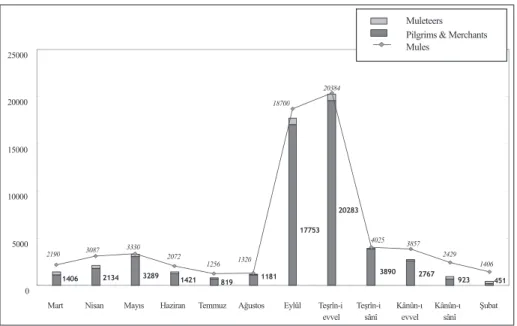
Through this small station, large caravans consisting of Shi’i pilgrims from Iran, Afghanistan, Central Asia and Caucasus passed. The table be- low shows the annual number of pilgrims and merchants at Khanaqin in the years between 1264–69 A.H./1848–52 which corresponds to the Ottoman boundary commission surveys.6) In this table, even though only men were counted, the number of pilgrims amounted to 52,969. Adding in the 3,348 muleteers, it came to a grand total of 56,317 people and 64,056 mules annually. In that year, the two months of Eylûl and Terîn-i Evvel (mid-September to mid-November) had a large number of pilgrims;
17,753 people in the month of Eylûl and 20,283 people in the month of Terîn-i Evvel. During the other months from winter till summer, the num- ber of pilgrims decreased remarkably.
Table 1: Annual Number of Quarantined Pilgrims at Khanaqin (mid-nineteenth century)
In order to control the bulk of pilgrims and travelers to Iraq, an immi- gration office was established there. The exact date of its establishment is unknown but the office might have been established shortly after the con- clusion of the second treaty of Erzurum, as seen in detail below. However, there is a detailed log of the number of passengers at Khanaqin in Table 1 between the years of 1848–52. The office had three sections (later, three buildings) consisting of immigration, customs house and quarantine sta- tion. At the end of the nineteenth century, a Japanese army colonel, Ya- sumasa Fukushima, passed through Khanaqin during his single-handed explorative investigation. He wrote:
Khanaqin is a big station at the border. The city is located over a riv- er. It has a population of four to five thousand people with a constant flow of traffic of caravans and pilgrims. The weather is extremely hot. Over half the city belongs to Turks [i.e. Ottomans], and in con- trast, there is a single caravanserai on the Persian side and we cannot recognize any customs house or post office there. That side presents a deserted and wintry sight. Above that, the land form is extensive, being flat, vast and ample. In fact, it is difficult to distinguish the bor- der of the two empires. For example, the house next to the Persian caravanserai belongs to the lands of Turks. Anyhow, I had arrived at the Turkish caravanserai under a native’s guidance at 4:30 in the afternoon, 8th November [1897], although I had thought it was in the Persian territory.7)
Fukushima reported that the buildings of quarantine and customs were near to the Ottoman caravanserai, and those buildings were constructed in a western style, with the Ottoman flags of the moon and star raised. No sooner had he entered the caravanserai than a cluster of officers came to him, and one after another made him pay money for obtaining a quaran- tine certification, show his passport, and open his baggage for customs.
His reference made it clear that at the end of the nineteenth century, pro- cedures for all three inspections in Khanaqin were simplified and under- gone all at one time, as opposed to mid-century, as seen below in detail.
As apparently seen in Fukushima’s case, this was the spot where for the first time, Iranian pilgrims confronted unfamiliar “modern” systems, namely certification of pass cards, quarantine and customs, that were introduced in the mid-nineteenth century. Customs clearance was not a new system for travelers in West Asia; however, they might have been
extremely confused at immigration control at Khanaqin because customs tax collection was conducted along with these two other “modern” sys- tems. After the introduction of these institutions to Khanaqin, pilgrims who would go across the border and travel around in Ottoman Iraq were required to bring a “pass” and to get its certification at Khanaqin. Af- ter the certification of their identity, they had to proceed to the customs house and be quarantined. More concisely, in the latter half of the nine- teenth century, certification was issued after quarantine and sometimes after customs clearance. These three institutions were so uncommon for unaccustomed pilgrims that many problems and quarrels occurred with Ottoman officers there. For those who were merely eager to go on a pil- grimage to Shi’i ImΣms’ mausoleums, the border and its immigration of- fice established at Khanaqin were nothing but an obstruction. We will see constant friction between pilgrims and “modern” systems in more detail below.
2. Ottoman-Qajar Correspondence Concerning Shi’i Pilgrimage Shi’i Iranian pilgrims to Ottoman Iraq were always the major concern for both countries and the Ottoman and Qajar dynasties had frequently discussed this issue. The first political protocol for Iranian pilgrims to Shi’i sacred sites in Iraq was drawn up in the first treaty of Erzurum which was concluded between the Ottomans and the Qajars in 1823.
1) Shi’i Pilgrimage and Two Erzurum Treaties
As early as in the first treaty of Erzurum in 1823, the issue of Ira- nian pilgrims was discussed and prescribed separately in the second of its seven articles. Article 2 provides for the safety of Iranian pilgrims, tax exemption of pilgrims who don’t bring any commercial goods, elimina- tion of discrimination against Iranians, preferential treatment for royal family members and couriers, imposition of a four percent tariff on com- mercial goods with the issuance of a certification paper, and one-off cus- toms throughout the country. This prescription fundamentally follows the former treaties concluded between Iran and the Ottomans, and is not a new topic.8)
With the conclusion of the first peace treaty, the political situation of the border region had not changed and Kurdish nomadic tribes remained free to migrate from place to place over the border. Frontier frictions
continued; the Ottomans invaded and occupied Muhammara (Khorram- shahr) of the Persian Gulf in 1837, while on the other hand, in 1840 the Qajars overran Sulaymaniyah in northern Iraq. Britain and Russia, un- willing to have Perso-Ottoman frictions, set out for intermediation of the two countries in the autumn of 1842, and after four years of negotiation, the new treaty was concluded.
The second treaty of Erzurum, concluded on the first of June 1847, was a real peace treaty for both dynasties. It consisted of eight articles prin- cipally based on the treaty of 1823 and settled boundary disputes. Most articles of this treaty were confirmed from the first one. As for Iranian pilgrims heading to Mecca and other holy sites in the Ottoman dynasty, their safety would be secured and their privileges should not be infringed upon, and this included merchants as well (Article 7). In addition, to help secure Iranian subjects, Iran was allowed to establish Iranian consulates in Ottoman cities, excluding Mecca and Medina. The treaty thus opened the path for Shi’i pilgrimage to Ottoman Iraq. From the mid-nineteenth century onward, fifty to one hundred thousand Iranian pilgrims set out for Iraq annually.
2) Two Correspondences concerning about Iranian Pilgrims to Iraq There were two official correspondences about Iranian pilgrims after the second treaty of Erzurum. The first (Document 1854) was a letter from the Ottoman ambassador, Ah.mad VΣfiq, to the grand vizier of Iran, M∏rzΣ ≠qΣ KhΣn Nπr∏, dated 29 Z
¯u’l-qa‘da 1270 A.H./23 August 1854.
The other (Document 1877) was dated 24 Z
¯u’l-h.ijja 1293 A.H./10 Janu- ary 1877, more than twenty years after the first document.
Document 1854 was the first correspondence inclusively between the two countries about Iranian pilgrims to Ottoman Iraq, and it contained eight issues9): 1. Ferriages, 2. Lawsuits of Iranians, 3. Exorbitant fee of in- terment, 4. Inheritance property of deceased Iranians, 5. Inflated prices, 6. Possession of private lands by Iranians, 7. Arms deposit, 8. Customs.
The Ottoman ambassador began his letter stating that “permission of performing pilgrimage to the ‘AtabΣt [shrine cities in Iraq] has been made in every direction without any ratification [by the Ottoman government]
and pilgrims are setting out for Kermanshah caravan by caravan”. Shortly before this notification, the Iranian government unbanned pilgrimage to the ‘AtabΣt because of the improvement of public order in Iraq and safety of the Iran-Iraq caravan route with its border area. In fact, the lifting of
the pilgrimage ban to Iraq was announced by the Iranian government in the official newspaper dated 22 Z
¯u’l-qa‘da 1270 A.H. (16 August 1854).10) By lifting the ‘AtabΣt pilgrimage ban, eight thousand nobles alone set out for Iraq from Azerbaijan province in north-west Iran in that year.11)
The ambassador’s reference to the disorderly situation of Shi’i pilgrim- age exactly shows the new flow of Iranian pilgrims to Iraq in the 1850s.
Many Iranian pilgrims rolled into Iraq after the peace treaty of Erzurum in 1847, before the Ottoman government took appropriate measures for this phenomenon. The influx of pilgrims caused many problems between Iranian pilgrims and the provincial government of Iraq, such as the above mentioned eight issues. Although among these issues none were directly related to the Khanaqin immigration, there are some related problems from its introduction and the fourth, fifth, and eighth issues; that is, “pass paper” (taz
¯kira-yi murπr), customs, and unfair treatments against Iranian pilgrims in Iraq.
The second document (Document 1877) was a response letter by the Ottoman government for claims and requirements posed by the Iranian government with thirteen issues, particularly about Iranian pilgrims head- ing for Iraq.12) The Iranian embassy in Istanbul investigated complaints by Iranian pilgrims through the Iranian consul in Baghdad, and subse- quently the Ottoman government answered each of their complaints.
The thirteen issues are as follows: 1. Pass paper (taz
¯kira-yi murπr), 2. Brutal treatments at quarantine stations, 3. Murder and robbery widespread in Iraq, 4. Awful inspection of dead bodies, 5. Treatment at quarantine sta- tions, 6. Quarantine, 7. Corruption of quarantine officers, 8. Travel tax, 9.
Customs house, 10. Customs, 11. Insults for Iranians, 12. Shi’i mourning cession of Ta‘z∏ya, 13. Illegal treatment to Iranians by Ottoman officials.
The points in dispute focus exclusively on the three matters of “pass paper”, “quarantine” and customs at the border town of Khanaqin. Quar- antine was a new issue that was not found in Document 1854. The Ot- toman government had taken a decisive stance on these procedures for pilgrims passing through the border. Particularly, “pass paper” and quar- antine were the largest issues after the second peace treaty of Erzurum in 1847. The Ottoman government advocated the importance of iden- tification cards, “pass papers,” and “quarantine” in another convention conducted between the two countries in 1875.13) They managed to strictly control the bulk of the pilgrims in the latter half of the nineteenth century.
Those matters will be discussed in more detail in the following chapter.
3. At the Border 1) Certification of the Pass
In 1845, the Ottoman government made it obligatory for their sub- jects to bring identification papers when they left home and went to an- other province.14) Due to this, on the second treaty of Erzurum it was provided that Iranians should have identification papers in Ottoman ter- ritory. This identification paper was called “pass paper” (taz
¯kira-yi murπr/
taz¯kirat al-murπr/mürûr tezkeresi), and a person’s name, nationality, age, pur- pose of travel, physical features such as height, eyebrows, eyes, beard and face were described. It was necessary to show this “pass paper” not only at the border but at the entrance gates of every city in Iraq. Taz
¯kira (paper) was definitely an identification card of the mid-nineteenth century, which acted as both passport and identification card. In addition, taz
¯kira had the further role of quarantine certification, which will be discussed later.
Therefore, the taz
¯kira of that time was the whole certification of identity (nüfûs), passport (mürûr) and quarantine (qarantîna).15)
The year of 1851 was the first year of issuance of the taz
¯kira paper in Iran, occurring six years after the Ottomans. As “a new system which was already popular in other countries but not in Iran”, an Iranian official newspaper said that taz
¯kira papersshould be issued at all cities in Iran and the government prohibited traveling to another cities or provinces with- out any taz
¯kira paper.16) After that year, taz
¯kira papers for pilgrims travel- ing to Iraq were issued at major cities, such as Kermanshah in Iran, and when they entered into Ottoman territory, pilgrims received certification at the Ottoman border town of Khanaqin.
At the beginning of Document 1854, the Ottoman government strongly insisted that “[Iranian] pilgrims should follow the rules of justice and not take local people’s properties. In particular, they should strictly observe the principles of the pass papers (taz
¯kira-yi murπr). If a taz
¯kira paper of a person does not have any signatures by consulates of the government [of Iran], nor certify any holder, absolutely nobody can get permission of passing into the country”. Underlying the statement by the Ottoman gov- ernment, the newly introduced taz
¯kira system might not have been com- mon at all for Iranians during its early years. The Ottoman government’s strong insistence of taz
¯kira papers revealed frequent disobedience of its regulations by Iranian pilgrims. On the Ottoman side, holding personal taz¯kira papers was crucially important to block illegal entry into the coun-
try which addressed the influx of Iranian pilgrims into Iraq, ultimately numbered up to one hundred thousand per year. The fourth issue of the same document once again stated the differences of Ottoman treatment between taz
¯kira holders and non holders inside Ottoman territory, espe- cially in the case of a deceased pilgrim’s belongings and body. A taz
¯kira holder’s possessions and body would be returned to the legal next to kin, but that would not be the case for a non holder.
As seen above, holding taz
¯kira paper was crucially important for the Ottoman government. However, after twenty years, the taz
¯kira paper was disputed again. In Document 1877 the Iranian government says:
Although Iranian pilgrims weren’t required to pay the taz
¯kira paper at their departure from Iran, they are uniformly levied for eight guru
in [Ottoman] Iraq, with no exception between rich and poor, on foot or on horseback. At the same time, they (Ottoman officers) detain pilgrims on the grounds of inspecting their taz
¯kira papers and collect- ing money to release them. They are indeed performing oppressive deeds [against Iranian pilgrims].
The answer of above mentioned appeal is as follows:
It is the principal rule to grant a pass paper (taz
¯kira-yi murπr) to subjects of all nations at the entrances of the border, to collect its taxes accord- ing to the law and to inspect their taz
¯kira papers at forts or ports where they will transit. Therefore, there is nothing to say about observing its principles. However, to realize the perfect safety and ease [of travel- ing] for Iranian pilgrims is necessary in all respects. Several inquiries into their taz
¯kira papers in Horasan district [in Iraq] had caused delay for pilgrims, though they had been already certified of their verifica- tion at Khanaqin. Then, hereafter, it is prescribed that taz
¯kira papers will not be inspected there [at cities inside Iraq].
Even though more than twenty years had passed from the introduction of the taz
¯kira papers, the Iranian government protested against the fee of taz¯kira papers. Eight Ottoman guru would be the certification fee, because the Iranian government had already issued taz
¯kira papers by themselves since 1854. It is not clear that the Iranian government actually issued taz¯kira papers without any charge, but they openly accused the Ottomans of levying fees on all pilgrims at the Iraqi border. On the other hand,
countering the accusation, the Ottoman government declared that tax charges for its certification was necessary based on laws and at the same time, showed a cooperative stance for lighter inspection of taz
¯kira papers in Iraq in order not to delay large caravans of pilgrims.
These Iranian pilgrims reluctantly paid the fee. Pilgrimage for Iraq, which might last a couple of months to half a year, cost almost a pilgrim’s annual income. Many of them were poor, and sometimes even ordinary pilgrims portrayed themselves as “poor” to dodge tax payments. At the same time, Iranians might consider “poor pilgrims” exempted from tax, because pilgrims, that is pious believers, were struggling with many dif- ficulties on the path of God. In any case, by the end of the nineteenth cen- tury, certification was issued after the complete detention of quarantine, as seen below. Due to the terrible system of quarantine, Iranian pilgrims had shown adverse reactions at the moment of payment. It cost 3,200 Persian d∏nΣr in 1855; however, fees went up and it was raised to 8,500 d∏nΣr in 1886, and finally up to 15,000 d∏nΣr in 1899. In fact, the price had increased fivefold during half a century.
According to Ottoman archives, at first the certification fee cost 5 to 20 Ottoman guru, which depended on personal status, and the fee was raised to 8 guru across the board in 1877 as seen above. Finally, the Ot- toman directions of 1892 established certification fees on condition that
“the fee is free for princes, viziers, couriers, some sayyids (descendants of Prophet Muh.ammad) and ‘ulamΣ (scholars) who will make a pilgrimage to the ‘House of God’ [Ka‘ba in Mecca] and other holy shrine cities”, and others as follows17):
First Resident Paper (taz
¯kira-yi iqΣmat) 100 guru
Second Resident Paper (taz
¯kira-yi iqΣmat) 50 guru
Third Resident Paper (taz
¯kira-yi iqΣmat) 20 guru
Pass Paper (taz
¯kira-yi murπr) in French 50 guru
Pass Paper (taz
¯kira-yi murπr) in Persian 50 guru
[Figure 1]
Pass Paper (taz
¯kira-yi murπr) for Study 10 guru
Erzurum, Trabzon 5 guru
Alexandria 10 guru
Jidda 15 guru
Damascus, Aleppo 10 guru
Khanaqin 10 guru
Baghdad 5 guru
[Figure 2]
Figure 1 constitutes fees of issuance of residential taz
¯kira paper and pass- ing taz
¯kira paper of the Ottoman territory. We have both French and Per- sian certifications for “foreigners” in this document and this illustrates how many Persian (Iranian) travelers had come within the Ottoman bor- ders. Most of them consisted of pilgrims and immigrants to Shi’i shrine cities, such as Najaf and Karbala in Iraq. If a pilgrim and an immigrant had no identification paper, they must buy it for 50 guru, which was a considerably high price. Figure 2, then, shows the main Ottoman cities of immigration, with annotations that fees should not be collected in any city except the above mentioned cities. We can see the name of Khanaqin among the eight gate cities in five border directions. Jidda was the most important as the entrance gate for h.ajj pilgrimage to Mecca, and exclu- sively had a 15 guru certification fee. With the exception of Jidda, the confirmation fee was almost the same in every border city, and as of 1892, it cost 10 guru in Khanaqin.
Before the establishment of borders and “nation” states, in West Asia there was no need for travelers to hold any identity card or passport and they could go anywhere they wanted.18) In the mid-nineteenth century, shortly after the establishment of the border between the Ottomans and the Qajars, certification of taz
¯kira papers and its fee were unpalatable, es- pecially for pilgrims who were used to traveling free of charge. Even at the end of the century, many pilgrims were to make the pilgrimage assuming it would be free of charge, were unwilling to pay taxes,19) and would have never shared the conception of the “nation” boundary nor recognized their restricted migration and transportation being controlled by govern- ments. The institution of taz
¯kira paper was incompatible with the previous experience of the pilgrims throughout the nineteenth century.
2) Quarantine (qarant∏n/qarantîna)
Quarantine was also a newly introduced institution from European countries to West Asia in the nineteenth century. The Ottoman dynasty decided to introduce quarantine in 1838 to prevent plagues and epidem- ics among h.ajj pilgrims to Mecca. During the year of 1831, the second pandemic cholera occurred. At that time, twelve thousand pilgrims had died in Mecca and it reached and ran riot through those h.ajj pilgrims, not only in Damascus and Jerusalem but also in Europe.20)
Iraq was also famous for its hot air and many rivers which were con- sidered causes of epidemics. Plagues and cholera had frequently occurred
in Baghdad province, such as in the years of 1802, 1831–34, 1846–47, 1865–66, 1867, 1869, 1871, 1874–76, 1877, 1881, 1889, 1892 and 1893.21) What is more, Iraq had been visited by one hundred thousand Shi’i pil- grims annually. This was in fact double or even three times the number of h.ajj pilgrims to Mecca at that period.22) The quarantine was, therefore, the most important and pressing matter for the Ottoman and the Bagh- dad provincial governments.
In Iraq, there were five quarantine stations in 1848: in Baghdad, Basra, Sulaymaniyah, Khanaqin and Mandali.23) Later, according to the Ottoman yearbook of 1882–83, Basra had three officers, and Kazimiya (a Shi’i quarter near the old city of Baghdad), Karbala, Najaf and Amara each had one, but only two stations, Baghdad and Khanaqin, had five quarantine officers. As far as stations that had several officers, the head doctor might have been European according to his name. This fact appar- ently indicates that the quarantine in the Ottoman territory was conduct- ed by European doctors after being pressed by European countries.24) Most importantly, the quarantine station at Khanaqin exceptionally had five officers, including one foreign doctor, which was tied with the station at Baghdad, the capital city of Iraq. The breakdown of those five officers was one foreign head doctor, three scribes and one coroner.25)
How was the quarantine operated at the time? According to the Ot- toman brochure entitled “Instructions to Quarantine” issued by the Otto- man government in 1850, officers should invariably ask for the travelers’
names and ask questions about where they came from and where they plan to go. If they came from an infected country, they should be placed in a room with ten people while one guard should be disposed there. On the other hand, the first reference from Persian sources on the Ottoman quarantine is found in the news dated November 1853. It explained that travelers might be detained at Khanaqin for five days and be fumigated.
After these procedures, the amount of 3,200 d∏nΣr would be levied per person.26) This is the same amount of the confirmation fee of a taz
¯kira paper, so there seems to be no difference between certification of a paper and of quarantine at the time. An Iranian courier named Ad∏b al-Mulk who made a pilgrimage to Iraq in 1856, some years after the introduction of the quarantine, faced it and mentioned it at the station of Khanaqin:
Outside the town of Khanaqin, on the Persian side, there is a big river, which has a sole bridge. This is the only way to cross the river and pilgrims should go over it. After the river, grand, two-meter high
walls come into sight. Here is the place for wretched pilgrims. Three thousand humans and animals are occupying the place inside the walls. Nobody will give a place to another pilgrim. Every handful of pilgrims are granted a place to stay and their papers are collected [by officers]. Unless any pilgrim of a group dies of plague within five days [of the quarantine], on the fifth day they (officers) collect 3,200 d∏nΣr from pilgrims, whether on foot or on horseback (that is, poor and rich). Then they give the paper (taz
¯kira) and let pilgrims leave.27) According to this citation, there was no building for the quarantine at this point, contrary to Fukushima’s time mentioned above, but it was a circle enclosed by walls where a few thousand pilgrims and animals would get jammed and crammed to wait for quarantine termination. It is not clearly mentioned whether they were fumigated, however, so fumigation may not have been provided for travelers besides during epidemics. Presum- ably, detention of pilgrims, caravan by caravan, for a fixed term was more important.
Due to the actual distressful situations of the quarantine at this early stage, Iranian pilgrims had many complaints about the quarantine, and they were frequently involved in trouble due to it. There wasn’t any prob- lem noted in Document 1854, which was issued shortly after the unban- ning of pilgrimage to Iraq. However, in a later period, several problems occurred at the quarantine of Khanaqin station. For instance, the sixth issue of Document 1877 refers to the quarantine. The Iranian govern- ment says:
It is said when, among pilgrims who are waiting for expiry of the quarantine, when one would get sick and then die, on all pilgrims a renewal of the terms of the quarantine would be imposed. It causes serious frustration among them. At the same time, some pilgrims who are eager to proceed on the pilgrimage give some money to quaran- tine officers secretly and get permission to leave in advance.
The Ottoman response to these complaints is as follows:
Renewal term [of the quarantine] is a fundamental rule when some- body dies [during its fixed term]. We cannot give any account of it.
Even so, an apt notice was officially issued to prevent such abhorrent deeds.
The next issue (the seventh issue) is also concerned with the quarantine.
Quarantine officers perform the quarantine in view of their profits, whether they will ascertain the true condition of the sick or not. Or they carry out the quarantine to get their own profits, even though they find no sick people.
In addition to this, the second and third issues are related to quarantine doctors and coroners, complaining of their terrible manners of inspec- tions and of their Jewish (or foreign, not Muslim) identity. In particular, accusations of Iranian pilgrims at Khanaqin converged on cruel treatment by Jewish or foreign quarantine doctors.28) It is uncertain where these Jewish doctors came from, because Khanaqin originally had a few Jewish inhabitants.29) All the same, quarantine doctors and coroners were main- ly foreigners and not Muslims, and their cruel inspections had offended Iranians acutely.
The complaints of Iranians were against not only quarantine doctors, but also its terms. There were five days of detention at the quarantine sta- tion of mid-nineteenth century Khanaqin, whether there were epidemics or not. Not surprisingly, quarantine terms might depend on the situation.
Iranian pilgrims, like Ad∏b al-Mulk, who had travelogues about their pil- grimage journeys to the Iraqi ‘AtabΣt in mid-nineteenth century, regularly mentioned their stay at Khanaqin for five days, but on the contrary, many authors of pilgrimage travelogues of later period, especially at the end of the century, stopped at Khanaqin only for one or two days.30) Of course, quarantine terms had been extended at suspicious cases of infection, as mentioned in the sixth issue of Document 1877. Detention sometimes even lasted twenty days.31) Consequently, in nineteenth century Iraq, a few thousand foreign travelers had been routinely detained and secluded inside enclosures or walls for a certain number of days, in the name of the quarantine.
At the time, quarantine had primarily intended to seclude suspicious people. It is reasonable to newly extend the terms for all quarantined people, if someone becomes sick or even if there is suspicion of infection among them. However, Iranian pilgrims who merely wished to make a pilgrimage to Shi’i ImΣms’ tombs did not comprehend the quarantine’s effect, and thus they argued profusely about the quarantine. One Iranian courier of the Qajars going on a pilgrimage to Iraq in 1855 recorded the following argument:
On the third day of the quarantine detention, H.usayn Efendi [Otto- man director of Khanaqin] came to greet us. I said to him, “I won’t obey the quarantine rules. I won’t stay here anymore. I will leave tomorrow. Is that fine by you, or not?” He replied, “There’s no way to give you my permission. It is not our regulations. Even if the king comes, we have to detain him. If you leave here by force, go ahead.
But you will violate the rule, and if you do so you will create further friction between our two countries. Besides, might not a misfortune befall you in the desert [without our escorts]?”32)
The director of Khanaqin pressed the unsatisfied author, saying that the director might be removed from his post for any reason, such as one dis- obedient man or a one-day reduction of the fixed terms at this quarantine station. Finally the author accepted his words and moved to a nice garden away from the other two thousand pilgrims, and stayed there until the completion of the quarantine.33)
Then there is the case of the only European, Henry W. Bellew, who was quarantined at Khanaqin in the nineteenth century. Bellew, a surgeon in the Bengal army, traveled from Afghanistan to Iraq through Iran and reached Khanaqin at the end of June 1872.34)
As we entered Khánakín a large caravan filing out took the road we had come. Some of the camels were beautiful creature, and perfectly white. Behind them followed a long string of pannier-mules, with their freight of fair Persians, and on either side marched a gay cavalcade of Persian gentlemen. Bringing up the rear was a mixed crowd of more humble travelers, menials, and beggars.
They filed by, and we found ourselves before a great sarae. Here some Turkish officials took possession of us, ushered us within its portals, and informed us the quarantine would last ten days. We were prepared for this delay, although we had cherished the hope that a clean bill of health might pass us through without detention. But the rules were strict, and rigidly observed: we had come from an infected country, and were consequently pronounced unclean, and only the quarantine could cleanse us.
He continues:
Looking around our prison-house, we found three or four parties of
wretched, half-starved pilgrims detained here on their way to Kar- balá. In their dirt and rags they were the very embodiment of poverty and misery. Turning from them to the quarters at our disposal, the revelation was still more disgusting. The place had not been swept for ages, and the floor was inches deep in filth and stable litter. The torments of the Mydasht [i.e. Miyan-e Taq] Sarae came back vividly to my mind. It was impossible for us to live here, so I asked to see the doctor in charge of the quarantine. “He died of fever ten days ago”, said our janitor, “and his successor has not yet arrived”.
Finally, they were allowed to stay in a pleasant garden owing to Bellew’s special status as British elite. But then, “A guard of Turkish soldiers was placed round us to prevent communication with the townspeople, except through the appointed quarantine servants” and pilgrims from Bukhara [in Central Asia] who had joined Bellew’s party one station before, could not get permission to staying with that British man but were detained with another group of quarantined people.35) In any case, even with his posi- tion, Bellew could not escape the quarantine and he had to be detained there for eight days.
Away from those elites and couriers, who were afforded some favor- able spaces in separated private gardens, for ordinary and poor pilgrims the quarantine system might be so undesirable that at moments, troubles and even riots occurred over it. Of course, for the Ottoman government, the detention was vitally important to prevent epidemics, but that was not important for ordinary quarantined people. During the pilgrimage sea- son, tens of thousands of people had passed through the border after their months’ journey with caravans on foot. When they reached Khanaqin, they were obliged to stay for a few days in narrow and unclean places with enclosures or walls until completing the quarantine terms with no understanding of its meaning. Beggars and vagrants were sometimes even detained with monkeys or bears.36) Detention of a certain term might be effective for the quarantine but not efficient for the bulk of people who just arrived at the small border town with a small population. Ad∏b al- Mulk says:
At Khanaqin, they [Ottoman officers] plundered and pillaged pil- grims’ properties and animals [i.e. sheep]. They imposed on pilgrims an additional ten days of detention to the fixed [five days] terms to expose them to a “perplexed” desert. During the five days, they had
collected 3,200 d∏nΣr from pilgrims every day, the upshot was that they had hurled many abuses and curses at them. Doctors of their government had inspected quarantined people every day and when they found someone invalid, they extended the terms. Even more tormenting for pilgrims was that if one hundred people died in a day, because of the lack of spades and picks their bodies were thrown into the river or buried in shallow places under the ground.37)
Quarantine, especially in the mid-nineteenth century, was awful because of a lack of its mastery and facilitation. Khanaqin was the only gateway for Iran on the land route, as pointed out above, and hundreds or thousands people would be quarantined there at any one time. Many rumors were spread about Ottoman quarantine among Iranian pilgrims, and not only Ad∏b al-Mulk’s one but also a rumor that Muslim children would be cooked and eaten at quarantine stations.38) It should be noted, because of the awful and terrible quarantine institution at the time, the number of pilgrims for Iraq considerably decreased according to the Ira- nian official newspaper of November 1853.39)
One of the most disputed problems of quarantine was the fee. The fee burdened both poor pilgrims and ordinary or rich ones without any exception. As seen above, the quarantine fee might be coupled with the certification fee of taz
¯kira papers throughout the nineteenth century. That is, a traveler should pay the certification fee of his taz
¯kira paper after their completed quarantine period at Khanaqin. However, because of the mis- erable situation of quarantine and the rough attitude of Ottoman offi- cers, among Iranian pilgrims it induced a feeling of unwillingness to pay money. Again, the Iranian government and pilgrims considered the fee of taz
¯kira papers unjust and unfair for the poor and even for pilgrims, and they frequently appealed to the Ottoman government and their officials to make it free of charge, saying that most of the pilgrims to Iraq consisted of poor people traveling with great difficulties on foot without money.40) Likewise, one Iranian courier tried to make the charge free for the poor at Khanaqin:
I asked [for the director of Khanaqin] to consider the poor, saying
“some pilgrims do not bring anything. I’ll ask you not to take money from them”. He said, “some people might disguise themselves like beggars, although they have enough money”. Then I requested him not to take money from a few poor pilgrims. After that, I asked some
questions about quarantine, such as the detention terms of five days and the levy of 3,200 d∏nΣr per pilgrim. He answered, “we have some reasons” and explained the terms of quarantine, “among pilgrims some of them come here with sickness or in bad condition. Those people will get fat and better during five-day detention, otherwise they will die. At any rate it makes [our work] easy. For collecting tax- es, how much we collect, none of the money remains with us, because we hand the whole amount of money over to the army and soldiers who are guarding this area”.41)
In this conversation, the Ottoman director’s remarks that sick travelers would die or get better during quarantine period mirrored the current situation of quarantine at the time. Officers regarded detention as the most important (or easiest) procedure for the quarantine institutions and they conducted, restrictedly and faithfully, their duties—sometimes with military arms. With these cruel attitudes to pilgrims at the small border town, Iranian pilgrims grew distrustful of the quarantine system itself. It prompted complaints about all of the “modern” procedures at Khana- qin and they developed an irrational aversion to Sunni Ottoman officials there.
One reason why Iranians in the nineteenth century distrusted and even refused the quarantine system would be attributed to the time lag of its introduction between the two countries. The Ottoman government, in compliance with European countries’ requests and pressures, adapted quarantine as early as 1838. On the contrary, quarantine had not really taken root in Iran. Even in the early twentieth century, one wealthy Ira- nian pilgrim did not follow the rule of quarantine at Khanaqin, flinging insults to officers. The Ottoman government immediately accused the Iranian consul about this matter so that “the result of an infringement on the regulations of quarantine would be epidemics”.42) Even at the turn of the century Iranian pilgrims did not understand its meaning nor accept it.
On their return, we have no information of the Iranian quarantine on the border at Khanaqin, nor Kermanshah by 1904.43)
At the end of the century, with medical progress and the invention of cholera bacillus, with the speedy closure of borders at epidemics, and even with former complaints and appeals for the institution by the Iranian government, quarantine inspections of pilgrims facilitated its procedures.
In 1899, pilgrims stopped at Khanaqin for no more than one day.
3) Customs (gumruk/ gümrük)
A customs house was also established at Khanaqin. Before the nine- teenth century, customs had been collected at city gates and it was not a novel system in West Asian society. Again, customs duty of pilgrims to the Iraqi ‘AtabΣt was statutorily prescribed in the treaty of Erzurum in 1823 that principally it would not be collected from pilgrims, and when pilgrims had commercial articles, the amount of customs duty should be four percent and would be collected only one time inside the country. A four percent tariff for commercial articles was confirmed in the second treaty of Erzurum in 1847 as with other provisions of the first treaty.
Iranian pilgrims played a very important role for commercial transac- tions between the two countries.44) Incomes from Iranian pilgrims were the main part of the revenue for the Baghdad provincial government.45) For example, annual revenue only from the quarantine and certification taxes collected at Khanaqin was estimated to be from fifty thousand Per- sian toman46) to a few hundred thousand toman, and for a more concrete amount, four thousand toman in tax revenue was collected from seventy thousand pilgrims annually at Khanaqin in the mid nineteenth century.
It amounted to 2,399 Turkish lira (138.207 francs) in 1889 and 5,766.70 Turkish lira (265.735 francs) in 1890 as quarantine taxes in the Baghdad province.47)
Furthermore, as for commercial transactions, in the latter half of the nineteenth century, import goods to the Baghdad province, which were mostly from Iran, were silk, tobacco for water pipes, salt, carpets and so on.48) These specialty products of Iran were exactly the goods that pil- grims could easily bring by themselves. At the time, Ottoman sources made less distinctions between merchants and pilgrims and tens of thou- sands Iranian pilgrims had brought some commercial articles to sell in Iraq and also had bought goods or souvenirs to bring back home. There is a widespread Persian proverb: “Both pilgrimage and commerce (ham ziyΣrat, ham tijΣrat)”. Pilgrims were indeed almost merchants.
In order not to have customs levied on their goods, pilgrims had con- tinually smuggled commercial goods. An Ottoman agent for the border in the mid-nineteenth century refers to their smuggling ways at the customs house of Khanaqin as follows:
Not to pay customs they are concealing expensive silks and such prof- itable goods inside coffins of dead bodies [for burial in sacred sites].
Additionally, they conceal those goods for sales in Baghdad or for presents and souvenirs to their friends. It’s quite popular to even put fruits such as apples and quinces in coffins.49)
Silk, tobacco, precious stones and shawls were particular easy items to evade taxes for pilgrims, because these were small but profitable. In fact, it was said that at the customs of Khanaqin, less wealthy pilgrims brought many articles with them and most pilgrims had goods such as shawls, car- pets, jewelries, gold or silver-works, opium and colts.50) Pilgrims had hid- den their articles under clothes, especially under women’s wear of chΣdor, or in sacks, or even in coffins. Among these tax-avoiding pilgrims who had taken some profitable goods in order to cover their travel costs by selling those goods in shrine cities, frequent quarrels and conflicts over customs in Khanaqin can be found. According to the ninth issue of Docu- ment 1877, the Iranian embassy accused that “officers of customs houses have conducted all kinds of torturous deeds. In short, they are rummag- ing in all belongings of every pilgrim, stabbing their saddlebags with iron lances, and checking women and their clothes on all sides from head to foot”. According to the source, these unfavorable procedures were lim- ited to the border, and needless to say it was Khanaqin. The Ottoman answer for this accusation from the Iranian side is,
It is prohibited to levy taxes to personal items and at the same time, endowments and donations for holy mausoleums are free of taxa- tion…. However, when a pilgrim has any chargeable articles, it is natu- ral to levy customs on it.
The principle rules according to the first treaty of Erzurum were that taxes would not be collected from pilgrims to the extent that “they have no commercial goods”. In fact, pilgrims had brought sufficient goods for covering their travel expenses, however. They needed profitable items for their comparatively long—commonly several months—sojourn in Iraq.
Almost every family had sheep to eat and sell,51) while sheep, fruits and carpets were necessities for long journey.
Under these circumstances, the Ottoman government was severely driven to levy and collect taxes from pilgrims. Pilgrims passed through customs at the customs house at the border in Khanaqin and perhaps imagined the ordeal to be over. In reality, however, there were several other customs houses in Iraq. The customs house of Baghdad, in particu-
lar, was so famous for its severe tax collection that “loads and properties of pilgrims were scattered while several officials were standing to check the taz
¯kira papers there. Those who did not have any certification papers were refused entrance to the city. They were quite severe in inspecting pilgrims’ belongings, supposing that pilgrims might have concealed some dutiable products inside their loads”.52) For the Ottoman side, Iranian pilgrims were the main targets to produce rich revenue. Also, it should be noted that the inspection by Ottoman officers was not only target- ing only commercial commodities, but books as well. This is because the Ottoman government was afraid of the propagation and diffusion of the Shi’i faith in Iraq. In the latter half of the nineteenth century along with the increase of the number of Shi’i pilgrims, Shi’i propagation was more active, especially in shrine cities such as Najaf, Karbala and Baghdad, and conversion to the Shi’i faith gradually became widespread among tribes settled around those cities.53)
In the tenth issue of Document 1877, the Iranian government ap- pealed to the fair treatment of customs, stating “in the matter of goods that pilgrims want to sell in Najaf and Karbala, although they want to sell them in other places after getting the taz
¯kira papers at the customs [of the border, i.e. Khanaqin], custom officers will not accept confirmation of those taz
¯kira papers. Furthermore they will collect taxes again and op- press [Iranian] pilgrims”. The answer of the Ottoman government was “as for these [profitable] goods, it must be written the name of places which they want to carry goods to, when they firstly arrive and get confirmation at any [boundary custom] spot. It is a principal rule to collect taxes again when they bring those goods to any place other than the places whose names are written on the paper”. The Ottoman government had so strict- ly levied and collected taxes for commercial goods of Iranian pilgrims without any exception. On the other side, Iranians might have stretched the interpretation of the text of the treaties that “taxes will not be col- lected from pilgrims when they have no commercial articles” too far so that any goods of pilgrims would be free charge. In any case, Iranians tried to smuggle profitable goods and were avid to avoid paying taxes using every trick at customs houses. Le Dr. Saad, a quarantine doctor at Khanaqin, said that Iranian pilgrims at the payment of certification were dickering taxes, or giving and showing counterfeit coins or paying only for his ass but not for his wife, and so on. They were not willing to, obediently and without any protest, pay at all.54) Of course bribery and backhanding were rampant at the border immigration of Khanaqin.55)
At Khanaqin it was quite common that officials and town people took unfair advantage of pilgrims and charged extravagant amounts of mon- ey.56) It would be summed up in the statement of the fifth issue of Docu- ment 1877 that “at the entrance of the border (apparently Khanaqin), the term spent by quarantine inspection has caused people many troubles and difficulties of meals and other supplies. In other words, officials of quarantine in collaboration with local officers limit and determine a few grocers which supply foods and victuals [for pilgrims]. Those grocers are mixing sand and soil with precious breads and other foods, and they are always grossly overcharging pilgrims”. Iranian pilgrims, just after arriv- ing at the border town of Khanaqin, were finding themselves boxed and secluded in quarantine for a certain number of days, and also they had to manage to spend those extra-overcharged days by themselves. Local merchants took unfair advantage of helplessly stuck Iranian pilgrims and charged extravagant prices. Under those circumstances it would be natu- ral for complaints and distrust to occur towards Ottoman officials among Iranian pilgrims, and if the Ottoman government had not threatened pil- grims with armed soldiers, they would have never obeyed the rules at the immigration office of the border.
Conclusion
After the establishment of the second treaty of Erzurum in 1847 which defined the boundary between the two countries, the situation at the border completely changed. The Ottomans recovered control over Iraq in the 1830s, which was accompanied by enhanced safety of the region and led to increased number of Shi’i pilgrims from Iran and its neighboring countries setting out for sacred sites in Ottoman Iraq. Follow- ing the boundary establishment, Iranian pilgrims confronted “modern systems”, such as taz
¯kira pass papers and quarantine, which were newly introduced by the Ottoman government in the mid-nineteenth century, at the Ottoman border town of Khanaqin. Many disputes and conflicts at the immigration office of Khanaqin in the latter half of the nineteenth century showed peoples’ puzzlement and inexperience with those new institutions. More concisely, it reflected a gap not only between the two countries but also a gap between the government and ordinary people.
The government, particularly the Ottomans, would control transporta- tion and travelers by imposing pass papers and its confirmation, while on the contrary, people would move anywhere they liked without any
political control. Those newly introduced institutions were totally alien to pilgrims of the nineteenth century and they had openly shown their rejection of and negative attitudes towards them. At once, the Ottoman government was compelled to introduce army forces to operate their pro- cedures regarding passports, quarantine detention and tax collection at the immigration office of Khanaqin. Ottoman officials had operated their tasks with the utmost severity and their cruel ways assuredly aroused in- tense aversion towards the Ottomans among Iranian pilgrims.
Through overcoming many obstacles as symbolized by the border town of Khanaqin and achieving pilgrimage to their Shi’i ImΣms’ tombs in Sunni Ottoman Iraq, pilgrims came to hold a “new identity”. They were Iranians by nationality, and also Shi’i Muslim by religion.
Notes
01) For further details of Iranian Shi’i pilgrimage to Iraq, see Morikawa, To- moko, “Pilgrimages to the Iraqi ‘Atabat from Qajar era Iran”, Saints and their Pilgrims in Iran and Neighbouring Countries, ed. by Pedram Khosronejad, Sean Kingston Publishing, 2012, pp. 41–60, and also Morikawa, Tomoko, Shîaha seichi sankei-no kenkyû (Shi’ite Pilgrimage to the Sacred ‘Atabat) (in Japanese), Kyo- to University Press, 2007, especially Chapter 3.
02) Traditional post stations from Kermanshah to Baghdad are as follows: Ker- manshah, Mahidasht, Harunabad (Eslamabad-e Gharb), Kerend, Miyan-e Taq, Sar-e Pol-e Zohab, Qasr-e Shirin, Khanaqin, Qizil Ribat, Shahravan, Ba’quba, Khan Bani Sa’d (Urta Khan) and Baghdad.
03) Hurîd [Paa], Mehmed, Seyâhatnâme-i Hudûd, ed. by Alâattin Eser, I.
stanbul, 1997, pp. 87–91.
04) Le Dr. Saad, [Lamec], “La Frontière Turco-Persane et les Pèlerins de Kerbé- la, par M. Le Dr. Saad, Médecin sanitaire à Hanéghuine”, Journal Asiatique, Huitième Série, Tome V (1885), p. 532.
05) Le Dr. Saad, “La Frontière Turco-Persane”, p. 532.
06) Hurîd, Seyâhatnâme-i Hudûd, p. 93. See more details of this table, Morikawa,
“Pilgrimages to the Iraqi ‘Atabat”, pp. 48–49.
07) Fukushima, Yasumasa, “Toryô Arabia Kikô” (Travelogue of Turkish Ara- bia), Chûô Ajia yori Arabia he (From Central Asia to Arabia) (in Japanese: 福島 安正「土 亞拉比亞紀行」『中央亞細亞より亞拉比亞へ』), ed. by Azan Ôta, Tokyo: Tôa-kyôkai, 1943, pp. 213–214.
08) Most articles of the treaty of Erzurum were based on the treaty of Kardan/
Kurdan concluded between NΣdir ShΣh of Iran and the Ottoman Sultan, Mah.mûd in 1746, which goes as far back as the treaty of Amasiya in 1555 between the Safavids and the Ottomans. See Morikawa, Shîaha seichi sankei, Chapter 6, pp. 162–189.
09) AsnΣd va mukΣtibΣt-i tΣr∏kh∏-yi ∞rΣn (QΣjΣr∏ya), ed. by Moh.ammad Rez.Σ Nas.∏r∏,
Tehran: SΣzmΣn-e EnteshΣrΣt-e KeyhΣn, 1987, vol. 3, pp. 60–62.
10) RπznΣma-yi vaqΣyi‘-i ittifΣq∏ya, Lithography, Tehran, 1994, vol. 2, p. 1192.
11) RπznΣma-yi vaqΣyi‘-i ittifΣq∏ya, vol. 2, pp. 1252–53.
12) MATD (Markaz-e AsnΣd va TΣr∏kh-e DiplomΣs∏): 1292/15/9/1, 2, 3; Guz∏da- yi asnΣd-i siyΣs∏-yi ∞rΣn va ‘UthmΣn∏, ed. by VΣh.ed-e Nashr-e AsnΣd, Tehran:
Daftar-e Mot.Σle‘Σt-e SiyΣs∏ va Beyn ol-melal∏, [1991], vol. 3, pp. 538–543.
13) BOA (Babakanlık Osmanlı Arivi). HR.SYS : 726/4; Guz∏da-yi asnΣd-i siyΣs∏-yi
∞rΣn va ‘UthmΣn∏, vol. 3, p. 439.
14) BOA. I.
-MVL: 203.
15) Refer to an official document dated 8th December 1847 [BOA. A.DVN.
DVE(20): 11/40].
16) RπznΣma-yi vaqΣyi‘-i ittifΣq∏ya, vol. 1, pp. 7, 45. Until that year taz
¯kira papers had been issued by the Ottoman government and all commission charges had come into the Ottoman profits over Iran. This was another reason that the Iranian government decided to issue taz
¯kira papers by themselves.
17) AsnΣd va mukΣtibΣt-i tΣr∏kh∏-yi ∞rΣn (QΣjΣr∏ya), vol. 3, p. 290.
18) Chardin, Jean, Voyages du Chevalier Chardin en Perse, ed. by Louis Langlès, Pa- ris, 1811, vol. 3, p. 272.
19) Le Dr. Saad, “La Frontière Turco-Persane”, p. 540.
20) Lorimer, John Gordon, Gazetteer of the Persian Gulf, ’Oman, and Central Arabia, Calcutta, 1908, vol. 1, pp. 2518–19.
21) Lorimer, Gazetteer of the Persian Gulf, vol. 1, pp. 2518–39 and vol. 2, p. 767.
22) According to an official report of the year 1316 A.H/1898–99, there were 36,768 quarantined pilgrims to Mecca from all over the world. Refer to Dr. Cozzonis’s statistical table of Mouvement général du pèlerinage du Hédjaz (Constantinople, 1900).
23) BOA. C-SH: 1065, 1201. Also see Pistor-Hatam, Anja, “Pilger, Pest und Cholera: Die Wallfahrt zu den Heiligen Stätten im Irak als Gesundheitspoli- tisches Problem im 19. Jahrhundert”, Die Welt des Islams, 31 (1991), p. 232.
24) Bag˘dad vilâyeti sâlnâmesi 1300, pp. 92, 124, 158, 131, 160, 163, 171, 193. In addition, the quarantine doctor of Khanaqin was an Italian in 1897 [Fuku- shima, “Toryô Arabia Kikô”, p. 215]. By the early twentieth century, the number of quarantine stations had increased to twelve in Iraq [Lorimer, Gazetteer of the Persian Gulf, vol. 2, p. 855].
25) Bag˘dad vilâyeti sâlnâmesi 1300, p. 124.
26) RπznΣma-yi vaqΣyi‘-i ittifΣq∏ya, vol. 2, p. 923.
27) Ad∏b al-Mulk, SafarnΣma-yi Ad∏b al-Mulk bih ‘AtabΣt, ed. by Mas‘πd GolzΣr∏, Tehran: EnteshΣrΣt-e DΣdjπ, [1985]. pp. 73–74.
28) Iranian pilgrims had transported dead bodies to be buried in sacred soils at the vicinity of their ImΣms. So coroners were necessary for inspection of bodies at the border. For further details, see Morikawa, Tomoko, “Les lieux de commémoration et les funérailes Qajars: ‘Le Transport de Corps’ dans la Société Chiite”, Mythes, rites et émotions: Les funérailes le long de la Route de la soie, ed. by Anna Caiozzo, Honoré Champion (forthcoming); Ate, Sabri, “Bones of Contention: Corpse Traffic and Ottoman-Iranian Rivalry in Nineteenth- Century Iraq”, Comparative Studies of South Asia, Africa and the Middle East, 30-3
(2010), pp. 512–532; Morikawa, Shîaha seichi sankei, Chapter 5; Nakash, Yit- zhak, The Shi‘is of Iraq, Princeton University Press, 1994, Chapter 7.
29) Hurîd, Seyâhatnâme-i Hudûd, p. 87; Cuinet, Vital, La Turquie d’Asie, Paris, 1893, Tome 3ème, pp. 119, 123.
30) See Time-Tables of Persian travelogues in Morikawa, Shîaha seichi sankei, pp.
335–342; Ad∏b al-Mulk, SafarnΣma-yi Ad∏b al-Mulk, pp. 72–76. Those who traveled at the end of the nineteenth century stayed at Khanaqin only for a day.
31) BOA. Y.A.HUS: 166/141 etc. This case occurred in Najaf, a Shi’i shrine city of Iraq in 1881, and another twenty days of detention was imposed there when someone died.
32) Anonymus, “RπznΣma-yi vaqΣyi‘-i safar-i KarbalΣ-yi mu‘allΣ”, ed. by ‘Al∏
MokhtΣr∏ Riz.vΣnshahr∏, M∏rΣth-e IslΣm∏-ye ∞rΣn, 1 (1994), p. 32.
33) “RπznΣma-yi vaqΣyi‘”, pp. 32–33.
34) Bellew, H. W. From the Indus to the Tigris, London, 1874, pp. 456–458.
35) Bellew, From the Indus to the Tigris, p. 458.
36) Ad∏b al-Mulk, SafarnΣma-yi Ad∏b al-Mulk, p. 74.
37) Ad∏b al-Mulk, SafarnΣma-yi Ad∏b al-Mulk, p. 74.
38) See Pistor-Hatam, “Pilger, Pest und Cholera”, p. 233.
39) RπznΣma-yi vaqΣyi‘-i ittifΣq∏ya, vol. 2, p. 923.
40) BOA. HR.SYS: 722/10; BOA. A.DVN.DVE(20): 11/40.
41) “RπznΣma-yi vaqΣyi‘”, p. 32.
42) BOA. A.MKT, MHM: 586/28.
43) At quarantine stations on the Persian Gulf, seditions often broke out be- cause of rigid enforcement of quarantine rules in the turn of the twentieth century [Morikawa, Shîaha seichi sankei, p. 230]. For opposition against west- ern medicine and late progress of quarantine inspection in Iran, see also Floor, Willem, Public Health in Qajar Iran, Washington, DC: Mage Publishers, 2004, pp. 179–188, 204–213.
44) Lorimer, Gazetteer of the Persian Gulf, vol. 2, p. 799.
45) See Morikawa, Shîaha seichi sankei, Chapter 9. For economic effects of Indian Shi’i Muslims on holy shrine cities in Iraq, see Cole, Juan, Sacred Space and Holy War, London: I.B. Tauris, 2002, Chapter 5.
46) One Persian toman is ten thousand Persian d∏nΣr.
47) “RπznΣma-yi vaqΣyi‘”, p. 57; Cuinet, La Turquie d’Asie, p. 16; Fukushima,
“Toryô Arabia Kikô”, p. 216. For concrete amounts of taxes from Iranian pilgrims and cadavers during the years of 1872–1904, see Ate, “Bones of Contention”, p. 527.
48) Issawi, Charles, The Economic History of Iran 1800–1914, Chicago and Lon- don, 1971, pp. 120–121; Cuinet, La Turquie d’Asie, p. 110; Lorimer, Gazetteer of the Persian Gulf, vol. 2, p. 803.
49) Hurîd, Seyâhatnâme-i Hudûd, p. 93.
50) Le Dr. Saad, “La Frontière Turco-Persane”, p. 535.
51) Hurîd, Seyâhatnâme-i Hudûd, p. 93.
52) “RπznΣma-yi vaqΣyi‘”, p. 37; BOA.HR-SYS: 722/1.
53) Çetinsaya, Gökhan, Ottoman Administration of Iraq, 1890–1908, SOAS/Rout-
ledge, 2006, especially Chapter 5.
54) Le Dr. Saad, “La Frontière Turco-Persane”, pp. 542–543.
55) Harris, Walter B., From Batum to Baghdad, Edinburgh and London, 1896, pp.
264, 287.
56) Ad∏b al-Mulk, SafarnΣma-yi Ad∏b al-Mulk, p. 73.