Spectroscopy of Metastable Helium-like Ions
Naoki Numadate
Atomic and Molecular Physics Laboratory Department of Physics
Tokyo Metropolitan University February 27, 2019
論 文 名
準安定ヘリウム様イオンの電荷交換衝突と分光実験
著 者
沼舘 直樹
審査担当者 主 査 委 員 委 員 委 員
上記の論文を合格と判定する 年 月 日
首都大学東京大学院理工学研究科教授会 研究科長
DOCTOR OF PHILOSOPHY IN SCIENCE TOKYO METROPOLITAN UNIVERSITY
TITLE:
Charge Exchange Collisions and Spectroscopy of Metastable Helium-like Ions
AUTHOR:
Naoki Numadate
EXAMINED BY
Examiner in chief
Examiner
Examiner
Examiner
QUALIFIED BY THE GRADUATE SCHOOL OF SCIENCE AND ENGINEERING
TOKYO METROPOLITAN UNIVERSITY
Dean
Date
It is well known that part of soft X-ray background emission stems from charge exchange collisions between solar wind ions and neutrals in the helio- sphere, and this phenomenon is called Solar Wind Charge eXchange (SWCX).
The SWCX emission has attracted much attention, because it appears in soft X-ray spectra obtained by observatory satellites as foreground emission when astronomical objects are observed, and can act as a new probe of low den- sity neutrals in the solar system. According to observations by the Suzaku satellite, the forbidden 1s2 1S0–1s2s3S1 transition in metastable He-like O6+
ions produced by charge exchange is one of main features in the SWCX. In order to analyze the observed spectra and to construct a model of the soft X-ray emission, absolute values of emission cross sections are required by astrophysicists, but the forbidden transition following the SWCX had not been observed in ground based experiments.
Moreover, K-shell emissions from inner-shell excited Li-like ions have a great potential for astrophysical applications such as precise diagnostics of astrophysical plasma and dense planetary atmosphere. Whereas numerous papers about the Auger electron spectroscopy of the inner-shell excited ions have been published, papers about the X-ray emission spectroscopy of such ions are very few, because radiative rates are much smaller than Auger rates for inner-shell excited light elements.
In these contexts, we aimed to investigate charge exchange collisions and spectroscopy of metastable He-like ions. In particularly, we developed an ion trap system for externally injected metastable ions, conducted a laboratory observation of the forbidden transition following the SWCX by using the ion trap. We also observed soft X-ray emissions from the inner-shell excited Li-like ions produced by charge exchange collisions of metastable He-like ions.
1
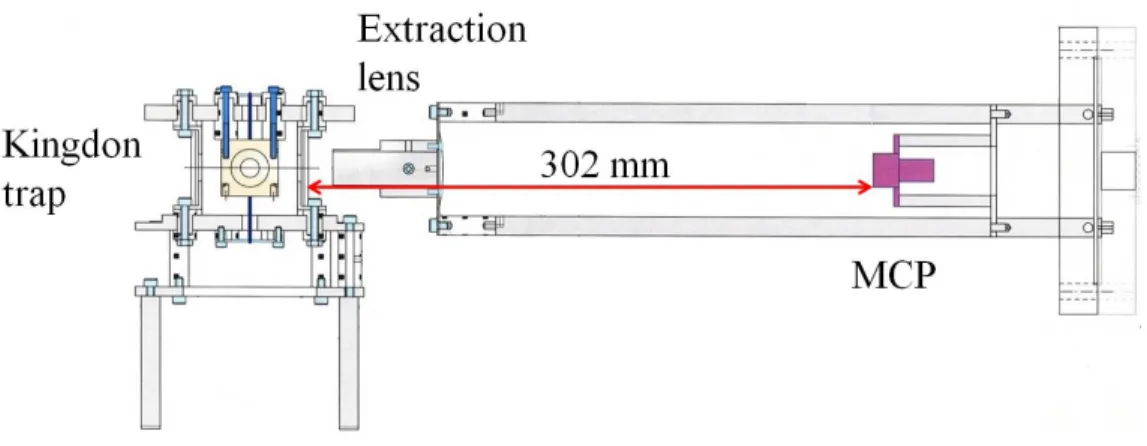
Development of a Kingdon ions trap
We have developed a Kingdon ion trap in order to observe the X-ray forbid- den transitions following charge exchange in ion beam experiments. Exter- nally injected Arq+(q= 5–7) with kinetic energies of 6qkeV were successfully trapped in the ion trap. The energy distribution of trapped ions was deter- mined by numerical simulations. As a performance test of the instrument, we measured trapping lifetimes of Arq+(q = 5–7) under a constant number density of H2. Moreover, we determined the charge transfer cross sections of Arq+(q = 5, 6)–H2 collision systems at binary collision energies of a few eV.
It was confirmed that the present data is consistent with previous data and the values estimated by some scaling formula.
Laboratory observation of forbidden transition following the SWCX The dominant electron capture level in collisions of O7+ ions with He is a principal quantum number n = 4 according to the classical over barrier model and the two-center atomic orbital close coupling method. After the charge exchange, populations of the metastable 1s2s3S states of He-like O6+
ions become large due to cascade transitions from the higher excited states.
Therefore, the long-lived forbidden transition to the 1s2 1S0 ground state is one of main features observed in the charge exchange spectra.
By using a spectroscopic beamline at Tokyo Metropolitan University, we have reproduced the SWCX between H-like O7+ ions with He gas at colli- sion energies of 42 keV and also observed soft X-ray emission form trapped metastable He-like O6+ ions produced by single electron capture. The mea- sured soft X-ray spectrum had a peak at 560 eV which corresponds to the energy of the forbidden 1s2 1S0–1s2s3S1 transition in the O6+ ion Moreover, a reasonable energy difference of 10 eV between peak positions of the observed forbidden and resonance lines was found, which ensured that we succeeded in observing the forbidden transition of the metastable O6+ ions.
Spectroscopy of inner-shell excited Li-like ions
We conducted collision experiments of metastable He-like C, N, and O ions with He, Ne, Ar, Kr, Xe, N2, O2 and CO2 targets in order to investigate ra- diative transitions of inner-shell excited Li-like ions and target dependence of emission spectra. In this experiment, we took advantage of the fact that an He-like ions produced by an ECRIS include metastable 1s2s states at least a
few percent of the total beam. The inner-shell excited Li-like ions were pro- duced by electron capture and transfer-excitation between He-like ions in the 1s2s 3S1 state and neutral atoms and molecules. Most of observed soft X-ray emissions are identified as the resonance and inter-combination 1s–2p, 3p, 4p transitions of the 1s2s(3S)nl and 1s2p(1,3P)nl states. The present spectra were clearly different from those measured in previous experiments, in terms of the number of the observed lines and line intensity ratios in spite of the same collision systems and collision energies being used. Furthermore, the emission spectra depend on the choice of target, and significant differences were observed especially between the spectra on the Xe and O2 gas targets regardless of their having similar ionization potentials. With rare gas tar- gets, spectra show characteristic lines and their intensities increase with the increasing atomic number of the targets. These new lines are identified as two-electron one-photon (TEOP) transitions from highly excited 1s2s(3S)4l states. This is the first observation of the discrete TEOP lines following charge exchange collisions of C4+ and N5+ ions. In the oxygen spectra, a line with the same target dependence was observed, but it is due to the one-electron one-photon transitions.
1 Introduction 7
1.1 Solar Wind Charge eXchange . . . . 7
1.1.1 Solar Wind . . . . 8
1.2 Charge eXchange outside Solar System . . . . 9
1.3 Inner-Shell Excited Li-like Ions . . . . 9
1.4 Previous Studies . . . . 11
1.4.1 Ground-Based Experiments of SWCX . . . . 11
1.4.2 Spectroscopy of Inner-Shell Excited Li-like Ions . . . . 13
1.5 Purpose of This Research . . . . 13
2 Principles 15 2.1 Slow Collisions of Multiply Charged Ions . . . . 15
2.1.1 Collision Processes . . . . 15
2.1.2 Classical Orbiting by Polarization Forces . . . . 16
2.1.3 Reaction Rate Coefficients . . . . 18
2.2 Charge eXchange . . . . 20
2.2.1 Classical Over-Barrier Model . . . . 20
2.2.2 Scaling Formulae for CX Cross Sections . . . . 27
2.3 Optical Transitions . . . . 29
2.3.1 Einstein A Coefficients . . . . 29
2.3.2 Electric Dipole (E1) Transitions . . . . 30
2.3.3 Magnetic Dipole (M1) Transitions . . . . 30
2.3.4 Selection Rule for E1 and M1 Transitions . . . . 32
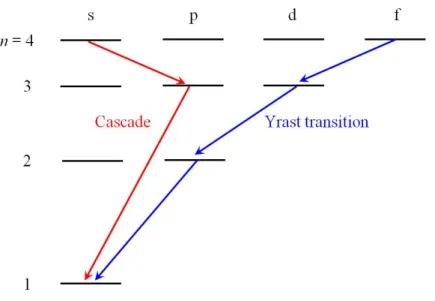
2.3.5 Cascade Transitions . . . . 33
2.3.6 Yrast Transitions . . . . 33
2.4 Theoretical Calculation . . . . 34
2.4.1 Hartree-Fock Method . . . . 34
2.4.2 Cowan’s Suite of Atomic Structure Codes . . . . 36 4
3 Experimental apparatus 37
3.1 Electron Cyclotron Resonance Ion Source . . . . 37
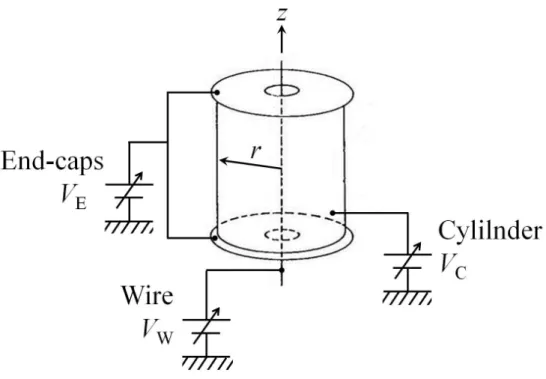
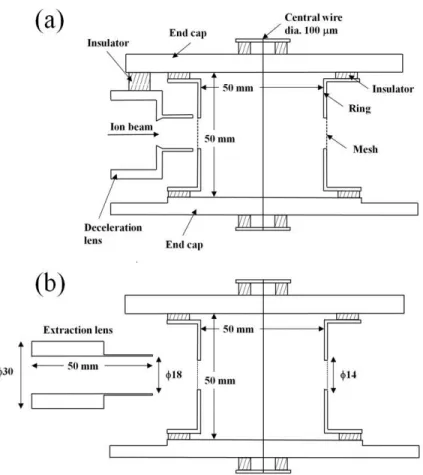
3.2 Kingdon Ion Trap . . . . 42
3.3 Ion Trapping Experiments . . . . 46
3.3.1 ECRIS at Sophia Univ. . . . 46
3.3.2 Production of Multiply Charged Argon and Oxygen Ions 46 3.3.3 Beamline at Sophia Univ. . . . . 47
3.3.4 Kingdon Ion Trap . . . . 48
3.3.5 Time-of-Flight Mass Spectrometer . . . . 51
3.4 Forbidden Transition Measurements . . . . 54
3.4.1 TMU-ECRIS . . . . 54
3.4.2 Production of Multiply Charged Oxygen Ions . . . . . 55
3.4.3 Beamline at TMU . . . . 55
3.4.4 Silicon Drift Detector . . . . 57
3.5 Spectroscopy of Inner-Shell Excited Li-like C, N and O Ions . 59 3.5.1 Production of Inner-Shell Excited Li-like Ions . . . . . 59
3.5.2 Spectroscopic Beamline at TMU . . . . 59
3.5.3 Grazing-Incidence Spectrometer . . . . 59
4 Ion Trapping Experiments 63 4.1 Experimental Procedures . . . . 63
4.2 Velocity Distribution of Trapped Ions . . . . 68
4.2.1 Ideal Logarithmic Potential . . . . 68
4.2.2 Realistic Potential . . . . 68
4.3 Trapping Externally Injected Argon Ions . . . . 73
4.4 TOF Measurements . . . . 75
4.5 Trapping Lifetime of Externally Injected O6+ Ions . . . . 78
4.6 Conclusion . . . . 80
5 Forbidden Transition Measurements 81 5.1 Experimental Procedures . . . . 81
5.1.1 Energy Calibration of SDD . . . . 82
5.2 1s2–1s2s 3S (M1) Transition Measurements . . . . 83
5.3 1s2–1s2p 1,3P (E1) Transition Measurement . . . . 84
5.4 Conclusion . . . . 87
6 Spectroscopy of Inner-Shell Excited Li-like Ions 88
6.1 Experimental Procedures . . . . 88
6.1.1 Soft X-ray Emission Spectra . . . . 89
6.1.2 Second Order Diffraction . . . . 89
6.1.3 Wavelength Calibration . . . . 90
6.2 Collision Processes . . . . 93
6.3 Radiative Decay Processes . . . . 93
6.4 Soft X-ray Spectra for Each Collision System . . . . 98
6.5 Conclusion . . . 107
7 Summary 109
Introduction
1.1 Solar Wind Charge eXchange
The Roentgen satellite, ROSAT, which was launched in 1990 as an X-ray observatory satellite, conducted the all-sky survey of soft X-ray background emission. In 1994, soft X-ray emission whose intensity varied in cycles of several days was observed during the all-sky survey [1]. This emission came from areas where there was no particular hot object, so it remained mys- terious. It had known that the galactic discs and halos could not be the origin of the soft X-rays with such short time intensity fluctuation. There- fore it had been assumed that the solar system was attributed to the soft X-ray enhancement but its origin was not identified at the time. In 1996, the ROSAT also observed the soft X-ray emission from Comet C/Hyakutake 1996 B2 approaching to Earth [2]. This was also mysterious and surprising, because the comet which was composed mainly of ice and dust was too cold to emit soft X-rays. Following this initial observation, soft X-ray emission was subsequently observed from various comets. According to Cravens’ sug- gestion [3], it has been recognized that part of the soft X-ray background emission stems from charge exchange collisions between solar wind ions and neutrals in the heliosphere, and this phenomenon is called Solar Wind Charge eXchange (SWCX). During the all-sky survey, intensity fluctuation of solar wind proton observed by the ACE satellite corresponded to that of the soft X-rays, which supports the SWCX [4, 5]. The Suzaku satellite installing a high resolution detector had also observed the SWCX emission, whose oper- ation was terminated in 2015. According to the observations, the forbidden
7
1s2 1S0–1s2s 3S1 transition from metastable O6+ ions produced by charge exchange was one of main features in the SWCX [6, 7]. Forbidden, reso- nance and inter-combination transitions following charge exchange collisions of H-like ions with neutrals can be written as
H-like P (1s2S) + T → He-like P (1snl 1,3L) + T+
→ He-like P (1s2s 3S) +hν1
→ He-like P (1s2 1S) +hν2 or
H-like P (1s2S) + T → He-like P (1snl 1,3L) + T+
→ He-like P (1snp 1,3P) +hν3
→ He-like P (1s2 1S) +hν4
where P and T mean projectile ion and neutral targets, respectively. The SWCX emission has attracted much attention, because it appears in soft X- ray spectra obtained by observatory satellites as foreground emission when astronomical objects are observed, and can act as a new probe of neutral density measurements in the solar system.
1.1.1 Solar Wind
The solar wind is a fast and thin flow of charged particles. This plasma is almost completely ionized and electrically neutral as a whole. The main composition of the solar wind is shown below.
Negative charge Positive charge
e− H+, He2+, Cq+, Nq+, Oq+, Neq+, Mgq+, Siq+, Feq+...
Typical charge states of the positive ions correspond to those of H-like or He-like ions. H+ accounts for 95% of the positive ions, He2+ for 4% and the rest is carbon, nitrogen, oxygen, neon, magnesium, silicon, iron ions and so on [8]. Near the earth, solar wind particle density is approximately 10 cm−3 and temperature is approximately 105 K. The solar wind can be classified as fast and slow components and each has velocity of about 700–800 km/s and 300–400 km/s, respectively. The solar wind ions come towards the earth at the incident angle of about 45◦ to the Sun-Earth line due to the geomagnetic field.
1.2 Charge eXchange outside Solar System
Recently, X-ray emission was observed from some astrophysical objects out- side the solar system such as large supernova remnants (SNRs) of the Vela [9], the Puppis A [10] and the Cygnus Loop [11]. It has considered that RNSs are hot plasmas and emit X-ray by thermal bremsstrahlung and non-thermal synchrotron radiation. These SNRs have been observed by some X-ray obser- vatory satellites and characteristic soft X-ray line structures which could not be explain with thermal radiation and synchrotron radiation were discovered.
This was due to charge exchange reactions because observed forbidden lines were stronger than resonant lines. The enhancement of the forbidden lines is one of features of the charge exchange. X-ray emission following the charge exchange reactions was also observed from a starburst galaxy, Messier 82 [12].
The observed lines mainly consisted of inter-combination and forbidden lines which can not result from thermal excitation.
In order to analyze the observed spectra and to construct a model of the soft X-ray emission, absolute values of emission cross sections are required by astrophysicists [13, 14].
1.3 Inner-Shell Excited Li-like Ions
An inner-shell excited state means an excited state which has inner-shell vacancy. This state has an potential above an ionization energy and hence radiative and Auger transitions are competitive decay processes of inner-shell excited states. These two processes have attracted much attention because photon and electron emissions from this state are of great importance for diagnostics of fusion and astrophysical plasmas [15], investigations of decay dynamics of molecules [16] and radiation induced damage on DNA [17]. Fur- thermore, multi-electron correlation effects such as post-collision interactions have been studied in Auger electron spectroscopy [18, 19]. Whereas numer- ous papers about the Auger electron spectroscopy of the inner-shell excited atomic and molecular ions have been published [20, 21, 22, 23, 24], papers about the X-ray emission spectroscopy of such ions are very few, because ra- diative rates are much smaller than Auger rates for inner-shell excited light elements [25]. These states of multiply charged ions are closely related to astrophysics, and we focus attention on application to diagnostics of astro- physical plasma in this thesis.
It is well known that part of K-shell emission observed by observation satellites are caused by charge exchange reactions between solar wind H-like ions and neutrals in the heliosphere as described in Section 1.1. After the reactions, metastable He-like ions (1s2s 3S1) are mainly produced. If the sequential charge exchange occurs before they de-excite, inner-shell excited Li-like ions can be produced as below.
H-like P (1s 2S) + T → He-like P (1snl 1,3L) + T+
→ He-like P (1s2s 3S) +hν (1.1) He-like P (1s2s 3S) + T0 → Li-like P (1s2s 3Snl) + T0+
→ Li-like P (1s2s 3Sn’p) +hν0
→ Li-like P (1s22s 2S) +hν00 (1.2) X-ray emissions following this sequence of charge exchange collisions can occur in the regions with high particle gas density such as comets, molecular clouds and exospheres of planets. Soft X-ray derived from the SWCX was actually observed not only in comets but also in Mars and Venus [26, 27].
Furthermore, it has known that Jupiter’s X-ray aurora is strongly related to the solar wind [28, 29]. These X-ray emissions following the SWCX can be a new tool for diagnostics of dense planetary atmosphere.
In addition to the above, the radiative decay processes of the inner-shell excited Li-like ions are important for diagnostic of photo-ionized plasmas such as active galactic nuclei and planetary nebulae. Soft X-ray emitted from their own hot cores can produce inner-shell excited Li-like ions on the outside.
Ratio of resonance, intercombination and forbidden lines of He-like ions are a great tool for plasma diagnostic [30]. However, Wang et al. proposed that satellite lines from Li-like ions contribute temperature diagnostics with the He-like triplet lines in photo-ionized plasma [31]. Kα and Kβ emissions from inner-shell excited multiply charged heavy ions were also observed in the measurement of Tycho’s supernova remnant (SNR) [32]. The atomic inner-shell processes in SNRs make it difficult to analyze X-ray spectra, but information about physical states and evolutions of the observed SNRs can be extracted from them [33, 34]. K-shell emissions from the inner-shell excited Li-like ions have a great potential for the astrophysical analysis.
As described before, absolute values of emission cross sections are needed in order to extract quantitative information from the observed spectra, but
it is significantly difficult to measure them experimentally. Therefore, the- oretical calculations such as n, l state-selective charge transfer cross sec- tions and cascade calculations including both Auger and radiative transi- tions, are required for X-ray astrophysics. Recently, some groups have con- ducted slow He-like ion-neutral collision spectroscopy and related calcula- tions [35, 36, 37, 38]. They have focused on only ground states as projectile ions but metastable ion-neutral collisions are also important. Experimental data will be useful for verifying the validity of the theoretical calculations.
1.4 Previous Studies
1.4.1 Ground-Based Experiments of SWCX
Laboratory studies of the SWCX started around 2000, which were mainly soft X-ray spectroscopy and cross section measurements.
Jet Propulsion Laboratory
Greenwoodet al. performed collision experiments with an electron cyclotron resonance ion source (ECRIS) and gas cell. They measured charge ex- change and X-ray emission cross sections in collisions of solar wind ions with cometary neutrals by using a Ge solid-state detector with a Be win- dow [39, 40]. However, they have not measured absolute values of emission cross sections yet.
Kernfysisch Versneller Instituut Groningen
Bodewits et al. conducted collision experiments with an ECRIS and a su- personic neutral gas jet. They measured high resolution VUV spectra with a grazing incidence spectrometer in collisions of He, C and O ions with H2O, CO2, CO and CH4 targets [41].
Oak Ridge National Laboratory
Draganic et al. carried out collision experiments of bare and H-like C and O ions with H atom target by using a merged-beams technique [42, 43]. This method enables very low velocity collision experiments by changing relative velocity of the ion and neutral target beams. Moreover, they measured high
resolution soft X-ray spectra with a micro calorimeter in gas target experi- ments using a gas cell [44]. In the SWCX, long-lived forbidden transitions following charge exchange are more important, but only resonant transitions with short lifetimes were subject to their studies.
Lawrence Livermore National Laboratory
Beiersdorfer et al. conducted charge exchange spectroscopy with an electron beam ion trap (EBIT). They measured high resolution soft X-ray spectra in collisions of C, N and O ions with CO2 and CH4 targets by using a micro calorimeter [45]. The EBIT makes it possible to observe long-lived forbidden transitions following charge exchange because it can produce and confine multiply charged ions for a long time. However, collision energy in the EBIT is much lower than that in the SWCX, and hence it is difficult to make use of the obtained data for analysis of astronomical observations.
Tokyo Metropolitan University (TMU)
In 2011, atomic and molecular physics lab. in TMU started a project of lab- oratory observations of forbidden transitions in the SWCX. At first, resonant transitions were observed by using an ECRIS. Kanda et al. measured soft X- ray spectra in collisions of H-like N and O ions with He target with a window- less Si(Li) detector with an energy resolution of 160 eV at 5.9 keV [46]. The observed dominant emission lines corresponded to the 1s2–1s2p transitions from He-like ions produced by single electron capture. According to the TC- AOCC (two-center atomic orbital close coupling) method, the direct capture cross section into the 2p states were much smaller than those into then = 3 and 4 states. This could be understood by considering cascade effects after the charge exchange. In this measurement, the target gases were ejected from a multi-capillary plate as an effusive beam, but this method had a problem that the target gas density could not be measured directly.
In order to measure absolute values of cross sections, Ishidaet al. adopted a gas cell system instead of the gas jet system and made it possible to measure absolute pressure of the target gas by installing a capacitance manometer.
A window-less silicon drift detector with an energy resolution of 135 eV at 5.9 keV was also installed to obtain high resolution spectra. Shimaya et al.
measured soft X-ray spectra in collisions of bare O ions with He target [47].
The observed dominant emission line corresponded to the 1s–2p transitions
from H-like O ions and other emission lines corresponded to the 1s–3p, 1s–4p and 1s–5p transitions.
1.4.2 Spectroscopy of Inner-Shell Excited Li-like Ions
Still now, many papers about Auger electron spectroscopy of the inner-shell excited Li-like light ions have been published, but very few about soft X-ray spectroscopy. In this section, some of them are briefly introduced here.
Centre d’Etudes Nuclbaires de Grenoble
Druetta et al. measured VUV spectra in collisions of metastable He-like C and N ions with H2 and He targets [48]. They produced the metastable ions by an ECRIS and single electron capture of H-like ions with the neutrals and observed radiative transitions from the inner-shell excited Li-like ions with a crystal spectrometer. They also measured metastable beam fractions and the absolute values of emission cross sections of the observed lines.
Suraud et al. observed soft X-ray following the 1s22s–1s2snl resonant transitions from inner-shell excited Li-like C, N and O ions [49, 50, 51]. The Li-like ions were produced by single electron capture and transfer-excitation in collisions of metastable He-like ions with H2 and He targets. The experi- ments were performed by using an ECRIS and gas cell and emission spectra were measured with a crystal spectrometer.
Heidelberg
Steinbr¨ugge et al. measured absolute radiative and Auger decay rates of K-shell-vacancy states in multiply charged Fe ions by simultaneous measure- ments of photoions and X-ray fluorescence [52, 53]. The multiply charged Fe ions were produced with an EBIT and then inner-shell excited states were produced by K-shell photoionization with synchrotron radiation. The photoions were detected by using a Wien type velocity filter and position sensitive ion detector and X-ray fluorescence was detected by Ge detectors.
1.5 Purpose of This Research
Absolute values of emission or charge transfer cross sections are required for quantitative analysis of X-ray spectra observed with observatory satellites.
The forbidden 1s2 1S0–1s2s 3S1 transitions from O6+ ions is one of the main transitions following the SWCX, but had not been measured yet in the labo- ratory. This is because that the solar wind ions travel several hundred meters during the forbidden transitions due to their velocities of 300–800 km/s and transition lifetimes of milliseconds. However, this background motivated us to try the first laboratory observation of the forbidden transitions following the SWCX. Furthermore, the radiative transitions from the inner-shell ex- cited light ions are also important for diagnostic of the astrophysical plasmas, but very few studies have been conducted. Therefore, we also performed soft X-ray spectroscopy of the inner-shell excited Li-like C, N and O ions pro- duced by electron capture and transfer-excitation in collisions of metastable He-like ions with neutrals.
In summary, three contents below are mainly discussed in this thesis.
(i) Development of an electrostatic ion trap and its performance test with Ar5,6+ and O6+ ions produced with an ECRIS
(ii) Laboratory observation of the forbidden 1s2 1S0–1s2s 3S1 transitions from O6+ ions produced in the SWCX by using the ion trap
(iii) Measurements and line identifications of soft X-ray spectra of the inner- shell excited Li-like C, N and O ions produced by charge exchange collisions of metastable He-like C, N and O ions with several rare gas and molecular targets.
Principles
In this chapter, basic principles and theoretical models associated with the present study are given. Mechanism and models in collisions of multiply charged ions, and optical transitions from excited ions are explained.
2.1 Slow Collisions of Multiply Charged Ions
Multiply charged ions mean ions with electric charge of two or more, and have very high internal energy due to coulomb potential and likely to interact with matters. The internal energy of a multiply charged ion is a sum of ionization potentials from a neutral to the charge state.
2.1.1 Collision Processes
The following four inelastic processes can be considered in collisions of mul- tiply charged ions with neutral targets.
Xq++Y −→
X(q−r)+ + Yr+ : Charge exchange
Xq+ + Yr+ + re− : Ionization of target
X(q+r)+ + Y + re− : Ionization of projectile ion Xq+ + Y∗ : Excitation of target
Cross sections of each process above depend on relative velocity between a projectile ion and target. The collision velocity is classified as “fast” or
“slow”, which depends on whether the relative velocity is higher than electron orbital velocity in a hydrogen atom in a Bohr’s model, namely 1 a.u. ('
15
2.19×10⁶ m/s) or not. In the case of collisions between projectile ions and targets with very high velocity, charge exchange is unlikely to occur and ionizations of the ion or target are dominant. It is because that the ion quickly move away from a target before an electron in the target is captured into an electron orbital in the ion. Contrary to this, when the ion slowly approaches the target, the two particles become a quasi-molecule. Hence, an electron in the target is likely to transfer to the ion and charge exchange is dominant. In our experiments, “slow” collisions of multiply charged ions with atoms or molecules have been performed, which is dominated by charge exchange.
2.1.2 Classical Orbiting by Polarization Forces
Atomic and molecular targets are polarized by coulomb fields produced by projectile ions in very “slow” collisions. An trajectory of the projectile ion is bent due to the attractive polarization forces between the ion and target (Fig. 2.1). An effective potential Veff between them is shown as below,
Veff = b2
r2Ecm− αq2
2r4 (2.1)
whereb,r,Ecm andαmean impact parameter, internuclear distance between the ion and target, collision energy in the center-of-mass system and polar- izability of the target, respectively. In the case that the impact parameter is much smaller than borb (b3 in Fig. 2.1), a local maximum of the effective potential is smaller than an energy of the projectile ion and the ion moves to the collision center through a spiral path. When the impact parameter borb is adjusted so as to get the effective potential maximum, Eeff = Ecm and ∂ Veff/∂ R= 0 are given. From these, we obtain relation between borb and rorb as below.
borb =√
2rorb =
2αq2 Ecm
14
(2.2) A cross section for such collision is described as below.
σL=πb2orb =πq 2α
Ecm 12
(2.3)
This cross section of σL is inversely proportional to collision velocity, and it is well known as the Langevin cross section or orbiting cross section. The orbiting radius of rorb increases as collision energy decreases. When the collision energy is very low, the orbiting radius of rorb becomes bigger than reaction region between the ion and target. Hence, a cross section for such reaction is approximated as below,
σ = 2π Z borb
0
P(v, b) b db≈2P π Z borb
0
b db=P σL (2.4) where ¯P is an average of reaction probabilities P which is a function of v and b. This indicates that the Langevin cross section gives an upper limit of the reaction cross section. The product of the cross section σ and velocity v is defined as a reaction rate constant k, which is independent of the collision velocity and temperature. The rate constant measured in slow collisions is approximately constant, but in fast collisions, it practically depends on the collision velocity and temperature. In the b > borb range, relation of impact parameter b1 and closest internuclear distancer1 is given as below.
b1 =r1
1 + αq2 2r14Ecm
12
=r1
1 + r4orb r14
12
(2.5) A ring region produced by two circles with radius of impact parameters of b1 and b2 in Fig. 2.1 is smaller than that produced by two circles with radius of internuclear distances ofr1 andr2. This impact parameter ring area increases as the collision energy decreases.
π(b21−b22) = π
r12
1 + rorb4 r14
−r22
1 + rorb4 r42
= π(r21−r22)
1− rorb4 r12r22
(2.6) From this equation, it is considered that an energy dependence of the reac- tion cross section changes significantly because of a relationship between the interaction region and orbiting radius. In fact, it is well known that charge exchange reactions occur state-selectively at a specific internuclear distance in collisions of multiply charged ions with neutrals.
Figure 2.1: Impact parameters and orbiting trajectories.
2.1.3 Reaction Rate Coefficients
A + BC→AB + C (2.7)
In a reaction above, a reaction rate R and reaction coefficient k are defined as below.
R = −d[A]
dt =−[BC]
dt (2.8)
R = k[A][BC] (2.9)
[A] and [BC] mean each particle density cm−3. Reaction rate means the number of collisions between A and BC per unit volume and time. Therefore, collision cross section σ can be described as below,
R=< σv > nAnBC (2.10)
where nA, nBC and v indicate particle densities of A and BC and relative velocity of A with respect to BC, respectively. By comparing this to Eq. (2.9), the following can be deduced.
k =< σv > (2.11)
Denoting distribution function of the relative velocity as f(v), Eq. (2.11) is
given as below.
k=< σv >=
Z ∞ 0
σ(v)vf(v)dv Z ∞
0
f(v)dv
(2.12)
The following shows normalized Maxwell-Boltzmann distribution at a tem- perature of T.
f(v)dv= 4πv2 µ
2πkBT 32
exp
− µv2 2kBT
dv (2.13)
Therefore, reaction rate constants can be written as below.
k(T) = Z
σ(v)vf(v)dv (2.14)
2.2 Charge eXchange
Charge exchange processes as below can occur in collisions of multiply charged ions with neutrals.
Single Electron Capture:
Aq++B→A(q−1)+∗+B+→A(q−1)++B++hν Transfer Ionization:
Aq++B→A(q−2)+∗∗+B2+→A(q−1)++B2++e− True Double Capture:
Aq++B→A(q−2)+∗+B2+→A(q−2)++B2++hν
In the energy range from dozens to hundreds keV, single electron capture pro- cess is usually dominant. Its cross section is almost independent of projectile ion energy and approximately 10−15 cm2. When electron capture process is dominant, relative velocity of projectile ions to targets is lower than classical velocity of an electron in hydrogen atom (1 a.u. ' 25 keV/amu).
Double electron capture has two categories, namely transfer ionization and true double capture. In transfer ionization process, a captured electron de-excites without radiation and gives its energy to the other captured elec- tron. Then the electron which receive the energy is emitted from the ion.
It is difficult to distinguish this process from single electron capture because both processes give the same final state. True double capture results in de-excitation by radiations. Recently, experiments on multielectron capture have been performed in various collision systems due to improvements of ex- perimental technique and triple electron capture cross sections which is very small have been measured. Especially Recoil Ion Momentum Spectroscopy (RIMS) made it possible to separate reaction processes precisely. All ions after reactions can be measured by using this technique.
2.2.1 Classical Over-Barrier Model
The over-barrier model provides estimation of dominant capture level (princi- pal quantum numbern) after charge exchange reactions. This is based on an idea that an electron can transfer from a multiply charge ion to a target when potential barrier between collision particles gets lower than binding energy of the electron as shown in Fig. 2.2. The COBM was formulated by Ryufuku et al. for single electron system of a bare ion and hydrogen atom [54]. Then
it was extended to multielectron system by B´ar´any et al. [55], and Niehaus refined it [56]. Niehaus’s model is called the Extended Classical Over-Barrier Model (ECOBM) or the Molecular Coulombic Barrier Model (MCBM) and widely accepted as a standard model.
Figure 2.2: Single electron capture process based on the COBM.
Single Electron Model (Bare Ion - Hydrogen)
This is a one dimension model depending on inter-atomic distanceRbased on a classical theory. By putting a nucleus A with a charge ofZA on coordinate origin and defining coordinates of an electron and a nucleus B with a charge of ZB as x and R, respectively, Coulomb potential for the electron can be written as below.
V(x, R) = −ZA
x − ZB
R−x (2.15)
Maximum of the potential exists between the nuclei A and B (0 < x < R).
Considering this three dimensionally, the maximum can be regarded as a saddle point. Hence, by defining its position to xsp, it meets the following condition.
dV(x, R) dx
x=xsp
= ZA
x2sp − ZB
(R−xsp)2 = 0 (2.16) This give us the following results.
xsp(R) = 1 + rZB
ZA
!−1
R (2.17)
Vsp(R) = −1 R
pZA+p ZB2
(2.18) In the case that the electron is around B at first, energy of the electron is equal to −ZB2/2. Ionization energy of the atom, IB, is written as ZB2/2. As A approaches B, energy of the electron in B, EB, gradually decreases due to coulomb field produced by A. When the internuclear distant has a specific value, R, EB corresponds to the potential of the saddle point.
EB(R) = −IB− ZA
R =−ZB2 2 −ZA
R =Vsp(Rc) (2.19) The internuclear distance and potential energy which meet the condition above are called the critical internuclear distance Rc and critical potential
energy Vc. By using the equation above, Ec and Vc can be written as below.
Ec = ZB+ 2p ZAZB
IB (2.20)
Vc =− p
ZA+ZB2
ZB+ 2p
ZAZBIB (2.21)
In R < Rc, A and B become a quasi-molecule because the electron is shared by them. When they are separated again, the electron is captured by A or B. If the electron is captured by A, the electron energy ofEA is expressed as below by using the formula for H-like ions.
EA(R) =−ZA2 2n2 − ZB
R (2.22)
A condition below is required to bring about the reaction.
EB(R) =−EA(R)≥Vsp(R) (2.23) Therefor, the principal quantum number n and internuclear distance Rn(R) in this case are given as below.
n ≤
ZB+ 2p ZAZB 2IB
ZA+ 2p
ZAZB
1 2
ZA
= ZB+ 2p ZAZB
ZA+ 2p ZAZB
!12 ZA
ZB (2.24)
Rn(R) = 2(ZA−ZB)n2
ZA2 −ZB2n2 = 2(ZA−ZB)
ZA2/n2−ZB2 (2.25) Assuming the straight line trajectory, charge exchange cross section σ is obtained as the product of reaction probability W and geometrical area of a
circle with radius of Rnp corresponding to maximum n(=np).
σ=πR2npW (2.26)
Ryufuku et al. approximated W = 12, but in multiply charged ion collisions (ZAZB), we can assume W ∼1. As shown above discussions, this model includes no term of collision velocity. Charge exchange cross section has almost constant value at collision velocity lower than 1 a.u. It is considered that the cross sections estimated by the COBM correspond to this velocity region. On the other hand, at collision velocity higher than 1 a.u., the cross sections gradually decrease as the velocity increases.
Multielectron Model
Before collisions,t-th electron from the outermost in a target is screened from nuclear charge by inner electrons. When the screen is neglected, effective nuclear charge is considered to be equal to +t. By using this model, the effective nuclear charge of a multiply charged ion, +q, is kept after electron capture to the outer shell. Models by B´ar´any et al. and Niehaus have large discrepancy in the way of handling the effective nuclear charge. In the first half part of the collisions (‘way in’) which means A is approaching to B, the position of the potential saddle point xinsp(R) for the t-th electron, its height Vspin(R), the internuclear distance Rint and its energyEtin, where the potential barrier corresponds to the electron energy, are given as below.
xinsp(R) =
1 + rt
q −1
R =αtR (2.27)
Vspin(R) = −1 R
pq+p t2
=− q
α2tR (2.28)
Rint = t+ 2p qt It =
q
1 αt −1
+ t
1−αt 1
It (2.29)
Etin =− p
q+p t2
t+ 2p
qt It =− q
α2tRint (2.30) As shown in Eq. (2.29), on the ‘way in’, the particles become the quasi- molecule in ascending order of t, that is, as the internuclear distance de- creases. In the model by B´ar´any et al., it is considered that the electron which once put into orbitals in the quasi-molecule must be captured into the multiply charged ion. However, in the Niehaus’s model, re-capture process on the ‘way out’ is taken into account. The ‘way out’ is the latter half of the collisions, which means A is coming away from B. On the ‘way out’, the internuclear distance gradually increases and the electron is re-captured into the atomic orbitals from the quasi-molecular orbitals. The height of the potential barrier for the t-th electron depends on the number of electrons captured into the multiply charged ions, where the electrons are restricted to the range from (t+ 1) to N. Hence, the effective nuclear charges of the projectile ion and target atom are expresses to be q−rt and t+rt, and the potential barrier for the t-th electron can be written as follows.
xoutsp (R) =
1 +
rt+rt q−rt
−1
R=βtR (2.31)
Vspout(R) = −1 R
pq−rt+p
t−rt2
=−q−rt
βt2R (2.32) Next, we consider whether thet-th electron is captured into the projectile or re-captured into the target at the point where the height of the potential barrier corresponds to Etin. Its internuclear distance Rtout and energy Etout are provided as follows.
Routt,rt =
q−rt
βt + t+rt
1−βt It+ q Rint
−1
(2.33)
Et,routt =−It− q
Rint =− 1 Routt
q−rt
βt + t+rt 1−βt
−1
(2.34)