The Study on
Sulfur-Vanadium Pentoxide Composites as
Cathode Materials
for Magnesium Secondary Battery
by
Masashi INAMOTO
PREFACE
Nowadays, secondary batteries that have high capacity and are intrinsically safe are required due to the significant progress of electronic devices, especially portable devices such as mobile phones, tablets and power sources for electric vehicles. The study on magnesium secondary batteries is still in the early stages. There are some impediments to the practical use of such devices: slower diffusion and intercalation of Mg2+ into cathode materials.
This is the thesis for a doctorate of Saitama Institute of Technology and relates to a vanadium pentoxide (V2O5) and sulfur composite as a magnesium secondary battery
cathode, with the aim of developing a cathode material that would allow the repeated insertion/extraction of Mg2+ ions and would exhibit high capacity.
In Chapter 2 of the thesis, a V2O5 and sulfur composite synthesized by carbon
felt-assisted microwave plasma of water (CF-MWP) that is symbolized as S-V2O5
showed a capacity of 300 mAh/g. It was found that the S-V2O5 particles were composed
of two parts; an inner core of rigid V2O5 crystals covered by an approximately 10 nm
thick surface layer similar to a V2O5 xerogel and incorporating sulfur. X-ray
photoelectron spectroscopic analysis of the S-V2O5 electrode surface after charge and
discharge indicated the presence of an electrolyte layer, representing a so-called solid electrolyte interphase (SEI), formed at the interface between the electrolyte and the S-V2O5 electrode surface. This SEI plays an important role in promoting the solid-state
diffusion of Mg2+ ions. In Chapter 3, it was found the S-V2O5 achieved the higher
composite SMn-V2O5. Structural assessments showed that the bulk of the SMn-V2O5
had an orthorhombic V2O5 structure, while the surface was composed of xerogel-like
V2O5 and a solid solution of MnO2 and sulfur. In Chapter 4, the author summarized
work to prepare a V2O5 xerogel by microwave irradiation and the results of structural
and electrochemical properties assessments. X-ray diffraction showed that the V2O5
xerogel prepared by microwave irradiation had a low degree of crystallinity, while charge-discharge tests revealed a specific capacity of 463 mAh/g. In Chapter 5, the preparation of a S-V2O5 gel using a new process and subsequent evaluation of the
structure and electrode performance is discussed. Structural analysis showed that the bulk S-V2O5 gel adopted a V2O5 xerogel-like structure with a surface layer
incorporating the sulfur and in a stable planar orientation, and that the surface had a reformed hard amorphous structure due to the CF-MWP treatment. Charge-discharge tests determined a specific capacity of 450 mAh/g, and cyclic voltammetry found almost perfect stability after the second cycle.
Through these Chapters, the S-V2O5 composite can be expected to function as a
cathode material via Mg2+ ion insertion/extraction based on its enhanced cycling ability and structural stability. This study did not undertake a detailed analysis of the sulfur states in the S-V2O5, although such states are believed to have a significant effect on ion
insertion/extraction. In future work, the effect of sulfur states on Mg2+ ion insertion/extraction should be assessed. I believe the results herein demonstrate the feasibility of using magnesium secondary batteries for practical applications based on further advances in the anode and electrolyte.
ACKNOWLEDGEMENT
I wish to express my deepest gratitude to Professor Tatsuhiko Yajima of Saitama Institute of Technology for supervising and supporting this study. I would also like to thank Professor Uchiyama Shunichi, Professor Osamu Niwa, Professor Yasushi Hasebe and Associate Professor Hiroaki Matsuura for taking the time to review this thesis. I also wish to sincerely thank Dr. Hideki Kurihara for his instruction in electrochemistry and microwave theory and for providing the opportunity to perform this study. Thanks are also extended to Mr. Teruyasu Mutaguchi of the Comprehensive Open Innovation Center of Saitama University (formerly the President of the Saitama Industrial Technology Center) and Mr. Yasuyuki Suzuki of the Saitama Industrial Technology Center for their assistance in entering the doctoral course and for providing guidance and encouragement. I am indebted to members of the Yajima Laboratory and to related people of the Saitama Industrial Technology Center for their support and advice during my research. Lastly, special thanks are due to my wife Sachiko Inamoto for giving me moral support.
LIST OF PUBLICATIONS
1. M. Inamoto, H. Kurihara, T. Yajima, Electrode Performance of S-doped Vanadium Pentoxide as Cathode Active Material for Rechargeable Magnesium Battery,
Journal of the Surface Finishing Society of Japan, 62 (10), 516-520 (2011), In
Japanese.
2. M. Inamoto, H. Kurihara, T. Yajima, Electrode Performance of Vanadium Pentoxide Xerogel Prepared by Microwave Irradiation as Active Cathode Material for Rechargeable Magnesium batteries, Electrochemistry, 80 (6), 421-422 (2012).
3. M. Inamoto, H. Kurihara, T. Yajima, Vanadium pentoxide-based composite synthesized using microwave water plasma for cathode material in rechargeable magnesium batteries, Materials, 6 (10), 4514-4522 (2013).
- 1 -
CONTENTS
Chapter 1
General Introduction
1.1 Battery Introduction 6 1.2 Lithium Secondary Batteries 8 1.3 Magnesium Secondary Batteries 11
1.3.1 Cathode materials 14
1.4 Plasma Theory 17
1.4.1 Atmospheric Pressure Discharge Plasma 17 1.4.2 Atmosphere Pressure Discharge Plasma Using Carbon Felt 20 1.4.3 Carbon-felt Microwave Water Plasma (CF-MWP) 22 1.5 Background of this study 24 1.6 Purpose and significance of this research 26
1.7 Reference 28
Chapter 2
Electrode Performance of Sulfur-Vanadium Pentoxide Composite Cathode
Materials
2.1 Introduction 32
2.2 Experimental 34
2.2.1 Synthesis of sulfur-vanadium pentoxide composite (S-V2O5) 34
- 2 -
2.3 Results and discussion 38 2.3.1 Electrochemical characteristics 38 2.3.2 Structural analysis 40 2.3.3 Electrochemical characteristic of S-V2O5 electrode 49
2.3.4 Electrochemical behavior of the S-V2O5 electrode surface 52
2.4 Conclusions 57
2.5 References 58
Chapter 3
Electrode Performance of Vanadium Pentoxide-based Composite Cathode
Materials
3.1 Introduction 62
3.2 Experimental 63
3.2.1 Preparation of cathode material by CF-MWP 63 3.2.2 Electrochemical characteristics 64 3.2.3 Structural analysis 65 3.3 Results and discussion 66 3.3.1 Electrochemical characteristics 66 3.3.2 Structural analysis 68
3.4 Conclusions 73
- 3 -
Chapter 4
Electrode Performance of Vanadium Pentoxide Xerogel Prepared by Microwave Irradiation as an Active Cathode Material
4.1 Introduction 76
4.2 Experimental 77
4.3 Results and discussion 79
4.4 Conclusions 85
4.5 References 86
Chapter 5
Electrode Performance of Sulfur-Doped Vanadium Pentoxide Gel Composite
Cathode Materials
5.1 Introduction 88
5.2 Experimental 90
5.2.1 Preparation method for sulfur-containing V2O5 gel 90
5.2.2 Electrochemical analysis 92 5.3 Results and discussion 93 5.3.1 Structural analysis 93 5.3.2 Electrochemical analysis 98
5.4 Conclusions 102
- 4 -
Chapter 6
- 5 -
Chapter 1
General Introduction
1.1 Battery Introduction
1.2 Lithium Secondary Batteries 1.3 Magnesium Secondary Batteries
1.3.1 Cathode materials 1.4 Plasma Theory
1.4.1 Atmospheric Pressure Discharge Plasma
1.4.2 Atmosphere Pressure Discharge Plasma Using Carbon Felt 1.4.3 Carbon-felt Microwave Water Plasma (CF-MWP)
1.5 Background of this study
- 6 -
1.1 Battery Introduction
There are two main types of batteries in everyday usage; primary and secondary (or rechargeable). Primary batteries are capable of one time use only and so are used until they are depleted and then disposed of. The most common primary batteries are alkaline manganese and zinc-air. In contrast, secondary batteries are constructed in a manner that allows for the original electrode materials to be restored by applying an external voltage. The first-generation secondary batteries, which are still in use, were lead-acid. More modern secondary batteries are the nickel-cadmium, nickel-metal hydride and lithium-ion types.
Circa 1980, secondary batteries appeared that incorporated so-called aqueous electrolytes, such as the nickel-cadmium and nickel-metal hydride batteries. Aqueous batteries such as these generate an electromotive force less than 1.5 V because of the electrolysis of water, and their applications are limited based on their size and weight. However, the demand for small rechargeable batteries has increased in association with the development and diffusion of portable electronic devices such as mobile phones.
The lithium-ion battery, the first nonaqueous electrolyte device, was subsequently developed by Yoshino et al.1) in the late 1980s, and the Sony Corporation put lithium-ion batteries into commercial use in the early 1990s.2) Lithium-ion batteries are now widely used in many practical applications.3) In fact, these are now the standard battery technology and have been optimized to a large extent. Recently, the use of lithium-ion batteries as power sources for hybrid and electric vehicles has grown rapidly as a means of reducing fossil fuel dependence.
- 7 -
- 8 -
1.2 Lithium Secondary Batteries
- 9 -
Cathode Materials
A lithium-ion battery employs so-called intercalation cathodes based on crystalline materials in which lithium is one of the major constituents. The key characteristics that are important for cathode materials are high ionic conductivity, favorable volume expansion upon discharge, high energy density and the ability to accommodate the extra charge and tension left in the structure when lithium ions are removed. The chemical equation summarizing the charge reaction at the cathode is as follows.
LiMO(s) → Li+
(sol) + MO(s) + e- (1.1) MO: metal oxide
- 10 -
Table 1.1 typical lithium-ion cathode materials.5)
Material Voltage vs. Li/Li+ Theoretical Capacity Usable Capacity LiCoO2 4.3 V 273.8 mAh/g 160 mAh/g
LiNiO2 4.3 V 274.4 mAh/g 220 mAh/g
LiFePO4 4.0 V 169.9 mAh/g 160 mAh/g
- 11 -
1.3 Magnesium Secondary Batteries
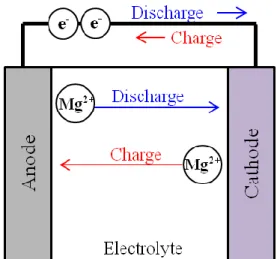
Figure 1-1 summarizes the operating principles of a magnesium secondary battery. Magnesium offers benefits as a battery constituent because it is divalent, i.e., the Mg2+ ion carries twice the charge of a Li ion.
Magnesium secondary batteries are a promising candidate to meet the future electrical energy storage needs of large-scale mobile and stationary devices, due to their advantages in terms of low cost as well as the high environmental abundance of magnesium metal and the divalent character of the Mg2+ ion. Among the possible alternatives to lithium-ion devices, magnesium secondary batteries have been much researched over the last two decades and magnesium is thought to represent the best metal anode material for high energy density batteries. The standard electrode potential of magnesium is -2.367 V. Although the theoretical gravimetric charge density of magnesium is lower than that of pure lithium (2233 mAh/g for Mg vs. 3884 mAh/g for Li), the divalent nature of magnesium ions presents a potential advantage in terms of volumetric capacity (3833 mAh/cm3 for Mg vs. 2046 mAh/cm3 for Li). Thus, while magnesium batteries might be heavier, they will be smaller. Despite its potential reactivity, magnesium is suitably stable in ambient air so as to allow handling and electrode preparation processes. Magnesium is also relatively benign and is the fifth most abundant element in the earth’s crust; at present, 700,000 tons of magnesium are produced per year.
- 12 -
- 13 -
- 14 -
1.3.1 Cathode materials
With the recent increase in reports involving cathode materials for rechargeable magnesium batteries, it is important to assess the research in order to obtain new concepts for future study. Specifically, there have been many Mg2+ ion studies involving numerous cathode compositions and various phases. The choice of cathode materials for magnesium secondary batteries is extremely limited because divalent Mg2+ insertion/extraction in a host compound is difficult, presumably due to the stronger ionic interaction and differing charge redistribution of magnesium compared to the lithium ion.13) Various cathode materials have been reported, however, including molybdenum sulfide (Mo3S4), vanadium pentoxide (V2O5), manganese oxide (MnO2) and sulfur.
Mo3S4
Mo3S4 was first synthesized by Chevrel et al.14) in 1974 and is therefore termed a
Chevrel-type compound (Figure 1-2). It was investigated as a rechargeable magnesium battery electrode in 2000 by Aubach et al.,8) who synthesized CuMo3S4 and removed the
copper either chemically, with FeCl3, or electrochemically. This compound was cycled
against pure magnesium metal and it was found that, as a magnesium intercalation electrode, MgMo3S4 has a theoretical charge density of 121.8 mAh/g.
V2O5
V2O5 and the hydrated vanadium bronzes (V3O8(H2O)x) were studied as possible
- 15 -
170 mAh/g, in an acetonitrile solution containing H2O.16) MgXV2O5 prepared by a sol
gel method was shown to be quasi-reversible and had a delivered capacity above 250 mAh/g over several cycles.17) Imamura et al. was able to fabricate a cathode in which Mg2+ was inserted in a manner similar to the usual Li+ insertion.18)
MnO2
Zhang et al. reported potassium-stabilized manganese dioxide as a candidate cathode material.19) The capacity of this cathode was 282 mAh/g on the initial discharge, although this value quickly faded to 134 mAh/g on the second cycle and continued to decrease with prolonged cycling. Spinel MnO2 has also been synthesized using a
microwave reactor20) and the capacity of this material was found to be 80 mAh/g on the first discharge.
Sulfur
- 16 -
Figure 1-2 Chevrel phase of molybdenum sulfide.21)
- 17 -
1.4 Plasma Theory
1.4.1 Atmospheric Pressure Discharge Plasma
There are several methods of producing a plasma, but it is common to use atmospheric pressure discharge. Atmospheric pressure discharge occurs when a certain relationship holds true between two electrodes in a gas as a function of pressure and gap length, termed Paschen's Law. This relationship is given below.
Vs = f (Pd) (1.2) P: gas pressure [Torr]
d: gap length [m]
An atmospheric pressure discharge plasma is an industrially effective technology because it requires no vacuum apparatus or exhaust system and is capable of high throughput.
- 18 -
potential is maintained, a population of ions and electrons remains. The discharge current in this apparatus is less than 1 A. In contrast, arc discharge achieves a completely ionized state by thermal ionization. As the discharge current increases, the gas temperature is raised and thermal ionization occurs. A discharge current is typically more than 10 A.
Corona discharge is a continuous discharge that is caused by the unequal electric field around a needle electrode. There are different types of corona, including a glow corona, which regularly occurs in the region of the electrode, and a streamer corona, which develops linearly and occurs intermittently and can inflict damage on electrodes. Corona discharge is unsuitable for gaseous processing, since it is generated in a linear space. Finally, barrier discharge devices consist of two electrodes with a dielectric layer set between the two electrodes. Barrier discharge is generated by the application of an alternating voltage. In this device, the dielectric layer prevents damage to the electrodes by streamer coronas.
- 19 -
the apparatus for treatment using an arc plasma is difficult to manufacture.
- 20 -
1.4.2 Atmosphere Pressure Discharge Plasma Using Carbon Felt
In the present work, atmospheric pressure microwave discharge (APMD) was generated by the microwave irradiation of two pieces of carbon felt (CF), upon which the temperature between the CF pieces increased. The temperature between the CF pieces was raised to more than 1000 °C after 10 sec of microwave irradiation3) and the associated discharge and heating can induce various reactions.
- 21 -
- 22 -
1.4.3 Carbon-felt Microwave Water Plasma (CF-MWP)
- 23 -
- 24 -
1.5 Background of this study
At present, secondary batteries that have high capacity and are intrinsically safe are required due to the significant progress of electronic devices, especially portable devices such as mobile phones and tablets, and as power source for electric vehicles. Magnesium secondary, lithium-sulfur and lithium-air batteries are all being developed as next-generation devices to satisfy these requirements. Of these, the magnesium secondary battery is the most promising based on the anticipated safety advantage.
At the moment, the study of magnesium secondary batteries is in the early stages. There are two main impediments to the practical use of such devices: (1) slower diffusion and intercalation of Mg2+ into cathode materials and (2) incompatibility between anodes and electrolytes due to the high polarizability of Mg2+. Therefore, it is essential to design an adequate cathode and compatible anode and electrolyte.24) Cathode materials for magnesium secondary battery candidates are limited to those employed in the lithium-ion batteries, and include Mo3S4, MnO2 and V2O5 as described
above. Levi et al. has suggested three main strategies to improve the kinetics of Mg transport in relevant cathode materials, using nanoscale materials, hydrates or similar intercalation compounds or cluster-containing compounds that readily attain local electroneutrality.11) A combination of the first and second strategies in a material, such as a V2O5 gel and its derivatives, can generate relatively high voltage and capacity, but
the associated kinetics are insufficient for practical battery use because of the incomplete charge screening upon cation insertion. Nevertheless, the development of cathode materials using V2O5 has been studied for some time, and has even been
- 25 -
Crystalline V2O5 consists of layers of V2O5-based polyhedra and this structure
provides pathways for ion insertion and extraction. The insertion of Mg2+ into V2O5 is a
slow process, possibly due to the concurrent chemical modification of the V2O5 crystal
surface. In recent studies, various groups have investigated hydrated V2O5 xerogels26)
and aerogels27) in which water molecules are bound between the layers of V2O5. It is
reported that a V2O5 xerogel exhibits a high capacity.28) However, some of the water
- 26 -
1.6 Purpose and significance of this research
Layered V2O5 represents a stable structure and Mg2+ ions inserted into V2O5 layers
are not readily extracted because of the chemical interactions between the Mg2+ ions and the V2O5 oxygen. Sulfur is known to have a high theoretical capacity (1672 mAh/g)
but also has an unstable crystalline structure that may dissolve in the electrolyte upon extraction of Mg2+ ions from the sulfur. V2O5 with added sulfur has been studied as a
cathode material for lithium batteries because of the unique charge-discharge properties of this material.29) However, the addition of sulfur requires a highly precise and well controlled synthesis.29)
In the work reported herein, an attempt was made to apply sulfur-vanadium pentoxide prepared by CF-MWP as a cathode material for used in magnesium secondary batteries. The goal was to develop a unique cathode material allowing the insertion/extraction of magnesium ions and exhibiting high capacity.
This thesis is presented in two parts. The first part (Chapters 2 to 3) explains the crystal core structure of a proposed V2O5 cathode, while the second part (Chapters 4 and
5) focuses on the design of a V2O5 cathode with a xerogel core structure. Chapter 1
serves as a general introduction and Chapter 6 presents conclusions.
Chapter 1 describes the characteristic of plasma-based synthesis and the possibilities suggested by previous studies of magnesium secondary batteries and V2O5 cathodes.
Chapter 2 (Electrode Performance of Sulfur-Vanadium Pentoxide Composite Cathode Materials) discusses the treatment of V2O5 and sulfur using CF-MWP to inhibit the
reduction of V2O5 and the oxidation of sulfur, generating S-V2O5. The structure of
S-V2O5 and the electrochemical characteristics of a S-V2O5 electrode are described.
- 27 -
Cathode Materials), the synthesis of V2O5 with sulfur and metal oxides (MnO2, Mo2O3,
Fe2O3, ZrO2, NiO) using CF-MWP is detailed.
Chapter 4 (Electrode Performance of Vanadium Pentoxide Xerogel Prepared by Microwave Irradiation as an Active Cathode Material) involves the desorption of structural water from a V2O5 xerogel using microwave irradiation. The electrode
performance of a V2O5 xerogel formed by microwave irradiation is discussed based on
structural and electrochemical analyses.
In Chapter 5 (Electrode Performance of Sulfur-Doped Vanadium Pentoxide Gel Composite Cathode Materials), investigations of the electrochemical performance and structure of a S-V2O5 gel prepared by CF-MWP after mixing of a V2O5 xerogel and
sulfur are detailed.
- 28 -
1.7 Reference for Chapter 1
1) A. Yoshino, K. Sanechika and T. Nakajima, US4668595 A (1987) 2) Y. Nishi, H. Azuma and A. Omaru, US4959281 A (1990)
3) S. Okamoto, T. Ichitsubo, T. Kawaguchi, Y. Kumagai, F. Oba, S. Yagi, K. Shimokawa, N. Goto, T. Doi and E. Matsubara, Advanced Science, 2 (8), 1-9 (2015)
4) H. D. Yoo, I. Shterenberg, Y. Gofer, G. Gershinsky, N. Pour and D. Aurbach, Energy
& Environmental Science, 6 (8), 2265-2279 (2013)
5) M. Yoshio, R.J. Brodd and A. Kozawa, editors. Lithium-ion batteries Science and
Technologies (2009)
6) P. Novák, R. Imhof and O. Haas, Electrochim. Acta, 45 (1-2), 351-367 (1999)
7) M. M. Huie, D. C. Bock, E. S. Takeuchi, A. C. Marschilok and K. J. Takeuchi, Coord.
Chem. Rev., 287, 15-27 (2015)
8) D. Aurbach, Z. Lu, A. Schechter, Y. Gofer, H. Gizbar, R. Turgeman, Y. Cohen, M. Moshkovich and E. Levi, Nature, 407 (6805), 724-727 (2000)
9) D. Aurbach, G. S. Suresh, E. Levi, A. Mitelman, O. Mizrahi, O. Chusid and M. Brunelli, Adv. Mater., 19 (23), 4260-4267 (2007)
10) H. S. Kim, T. S. Arthur, G. D. Allred, J. Zajicek, J. G. Newman, A. E. Rodnyansky, A. G. Oliver, W. C. Boggess and J. Muldoon, Nat Commun, 2, 427 (2011)
11) E. Levi, Y. Gofer and D. Aurbach, Chem. Mater., 22 (3), 860-868 (2010)
12) E. Lancry, E. Levi, Y. Gofer, M. D. Levi and D. Aurbach, J. Solid State
Electrochem., 9 (5), 259-266 (2005)
- 29 -
(2012)
14) R. Chevrel, M. Sergent and J. Prigent, Mater. Res. Bull., 9 (11), 1487-1498 (1974) 15) P. Novák, W. Scheifele, F. Joho and O. Haas, J. Electrochem. Soc., 142 (8), 2544-2550 (1995)
16) P. Novák and J. Desilvestro, J. Electrochem. Soc., 140 (1), 140-144 (1993)
17) S. H. Lee, R. A. DiLeo, A. C. Marschilok, K. J. Takeuchi and E. S. Takeuchi, ECS
Electrochemistry Letters, 3 (8), A87-A90 (2014)
18) D. Imamura and M. Miyayama, Solid State Ionics, 161 (1-2), 173-180 (2003)
19) R. Zhang, X. Yu, K.-W. Nam, C. Ling, T. S. Arthur, W. Song, A. M. Knapp, S. N. Ehrlich, X.-Q. Yang and M. Matsui, Electrochem. Commun., 23, 110-113 (2012)
20) H. Kurihara, T. Yajima and S. Suzuki, Chem. Lett., 37 (3), 376-377 (2008)
21) E. Levi, E. Lancry, A. Mitelman, D. Aurbach, O. Isnard and D. Djurado, Chem.
Mater., 18 (16), 3705-3714 (2006)
22) A. Schutze, J. Y. Jeong, S. E. Babayan, J. Park, G. S. Selwyn and R. F. Hicks,
Plasma Science, IEEE Transactions on, 26 (6), 1685-1694 (1998)
23) H. Kurihara, Saitama Institute of Technology, Ph.D., (2008)
24) Y. Liu, L. Jiao, Q. Wu, J. Du, Y. Zhao, Y. Si, Y. Wang and H. Yuan, Journal of
Materials Chemistry A, 1 (19), 5822-5826 (2013)
25) Y. Li, J. Yao, E. Uchaker, M. Zhang, J. Tian, X. Liu and G. Cao, The Journal of
Physical Chemistry C, 117 (45), 23507-23514 (2013)
26) C.-Y. Lee, A. C. Marschilok, A. Subramanian, K. J. Takeuchi and E. S. Takeuchi,
PCCP, 13 (40), 18047-18054 (2011)
- 30 -
28) D. Imamura, M. Miyayama, M. Hibino and T. Kudo, J. Electrochem. Soc., 150 (6), A753-A758 (2003)
- 31 -
Chapter 2
Electrode Performance of Sulfur-Vanadium Pentoxide Composite Cathode Materials
2.1 Introduction 2.2 Experimental
2.2.1 Synthesis of sulfur-vanadium pentoxide composite (S-V2O5)
2.2.2 Electrochemical characteristics
2.2.3 Electrochemical behavior of the S-V2O5 electrode surface
2.3 Results and discussion
2.3.1 Electrochemical characteristics 2.3.2 Structural analysis
2.3.3 Electrochemical characteristic of S-V2O5 electrode
2.3.4 Electrochemical behavior of the S-V2O5 electrode surface
- 32 -
2.1 Introduction
High-density secondary batteries are expected to be used as power sources for electrical vehicles. Divalent cation secondary batteries are promising because they can produce twice the current per atom of lithium batteries and have a higher energy density. The beryllium ion, which has the largest theoretical capacity of divalent cations, is not a good secondary battery cathode material because it forms covalent bonds. On the other hand, the magnesium ion, which has the second largest theoretical capacity of divalent cations, is expected to be applied for secondary battery cathode materials because of its higher tendency to undergo ionic bonding compared with covalent bonding. Therefore, magnesium secondary batteries, which have a long history of research, have begun to draw attention for next-generation power storage applications. Magnesium is inexpensive, safe to handle, environmentally friendly, and naturally abundant.1)
However, Mg2+ ions form strong electrostatic interactions with anions, undergo slow diffusion into cathode materials, and are easily trapped at the cathode. In addition, the crystal structure of cathode materials deteriorates or the electrolyte degrades during cycles of insertion/desorption of Mg2+ ions on/from the cathode at high voltage. For these reasons, magnesium secondary batteries do not have a high capacity or a long cycle life.2-6)
- 33 -
the other hand, metal sulfides do not easily trap Mg2+ ions; however, they tend to have unstable crystalline structures that could possibly dissolve in the electrolyte.
Therefore, we have investigated ways to resolve such problems by changing the crystalline structure of the surface through the addition of sulfur to a metal oxide. The conduction properties of sulfur, which are low, could be improved by mixing it with metal oxide and carrying out a heat treatment. Metal oxide such as vanadium pentoxide (V2O5) with added sulfur has been previously examined as a cathode material for
lithium secondary batteries because it has promising charge-discharge depth properties.14) However, the addition of sulfur requires high-precision control of the
synthesis conditions.14) In this chapter, we discuss the application of V2O5 with added
sulfur (S-V2O5), prepared by the carbon-felt microwave water plasma (CF-MWP)
technique, as a cathode material.15,16) The electrode performance and structural analysis
of S-V2O5, and the electrochemical behavior of the S-V2O5 electrode surface are
- 34 -
2.2 Experimental
2.2.1 Synthesis of sulfur-vanadium pentoxide composite (S-V2O5)
V2O5 and sulfur were mixed in a molar ratio of 3:1 in a ball mill (P-6, Fritsch Co.,
Ltd.) under an air atmosphere. The composite was wetted down and then treated with CF-MWP. Figure 2-1 shows the experimental setup for the CF-MWP process. Specifically, 2.0 g of each raw material was placed between pieces of carbon felt (30 mm diameter) and a 500 W, 2.45 GHz microwave was used to irradiate the material under reduced pressure (0.001 MPa) for 2 min to synthesize S-V2O5. The structure and
the binding state of S-V2O5 were measured using X-ray diffraction (XRD; RINT 2000,
- 35 -
- 36 -
2.2.2 Electrochemical characteristics
The electrode performance was evaluated using three-electrode cells. The electrodes were prepared from a mixture of the cathode material, acetylene black, and a polyvinylidene fluoride binder with N-methyl-2-pyrrolidone with a weight ratio of 10:3:1. The resulting slurry was spread on carbon paper. The electrode was dried at 110 °C for 1.5 h. S-V2O5 was charged with magnesium ions and used as a counter
electrode. A magnesium ribbon was used as the reference electrode. This electrode showed the same potential changes as a magnesium alloy plate. Namely, the S-V2O5
was had Mg2+ insertion at 30 mAh/g at 0.7 V versus Mg/Mg2+. For the electrolyte solution, 0.3 M Mg(ClO4)2 and 1.8 M H2O dissolved in propylene carbonate (PC) was
- 37 -
2.2.3 Electrochemical behavior of the S-V2O5 electrode surface
Depth profiles of the electrode surface and chemical-bonding state after the first charge-discharge cycle were analyzed using X-ray photoelectron spectroscopy (XPS; ESCA Quantum 2000, Ulvac-Phi, Inc.). The discharged sample was prepared by discharging to 0.9 V, and the charged sample was prepared by discharging to 0.9 V and then charging to 2.4 V. For the electrolyte solution, 0.3 M Mg(ClO4)2 and 1.8 M H2O
dissolved in propylene carbonate was used. A magnesium ribbon was used as the reference electrode, and S-V2O5 was charged with magnesium ions and used as a
- 38 -
2.3 Results and discussion
2.3.1 Charge-discharge characteristics
The charge-discharge test results are shown in Figure 2-2 for V2O5, mixed V2O5 and
sulfur, and S-V2O5. The capacity of the V2O5 electrode was 160 mAh g-1 at the first
cycle but decreased to 70 mAh g-1 from the second cycle. This result corresponds with a previous report.14) The discharge curve for the composite mixture of V2O5 and sulfur
showed two plateaus at 1.4 V (P1) and 1.0 V (P2) vs. Mg/Mg2+, which are attributed to
V2O5 and sulfur, respectively. The P2 plateau was observed only at the first discharge,
and was not evident from the second discharge, which indicates that the sulfur is dissolved in the electrolyte when Mg2+ is extracted from the electrode during the first charge. The curve for S-V2O5 did not show a plateau but decreased linearly from 1.6 V
to 1.0 V, in contrast to the composite mixture of V2O5 and sulfur. S-V2O5 has a high
capacity (300 mAh g-1) and good cycleability, which indicates that the surface of S-V2O5 is amorphous. The bulk of S-V2O5 has a V2O5 crystalline structure and the
change in the S-V2O5 surface occurs not only due to the CF-MWP process, as discussed
- 39 -
Figure 2-2 Charge-discharge curves: (a) V2O5, (b) Mixture of S and V2O5, and (c)
S-V2O5. P o te n ti al / V v s. M g /M g 2+ (a) V2O5 (b) Mixture of S and V2O5 P1 P2 (c) S-V2O5
- 40 -
2.3.2 Structural analysis
Figure 2-3 shows the emission spectrum of CF-MWP interacting with the raw materials. Intense H and OH spectral peaks mainly observed. These species may be derived from water molecules released from the raw materials and decomposed in CF-MWP. CF-MWP causes the surface color of the raw materials to change from orange to green. We attempted to steam the raw materials to synthesize S-V2O5 (100 °C,
- 41 -
- 42 -
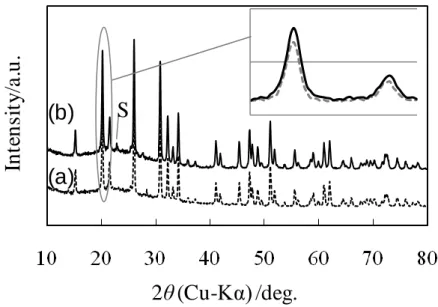
Figure 2-4 shows XRD patterns for the V2O5 standard and S-V2O5. The XRD pattern
for S-V2O5 shows only peaks for V2O5 and sulfur without peak shifts or broadening,
which indicates that CF-MWP does not change the V2O5 bulk structure. The composite
mixture of V2O5 and sulfur is sintered and then generates VO2 according to Equation
(2.1). Figure 2-4 indicates that there is no reduction in bulk V2O5 using CF-MWP
because the temperature of the reaction field during CF-MWP is probably low (under the boiling point of water in the standard-state).
S + 2V2O5 → SO2 + 2VO2 (2.1)
Figure 2-5 shows Raman spectra for V2O5 and S-V2O5 measured at an excitation
wavelength of 532 nm. The scattering intensity of S-V2O5 decreases compared with
V2O5, which is probably due to a decrease in the scattering intensity from the particle
surfaces. The fact may indicate that V2O5 particles in S-V2O5 system were covered with
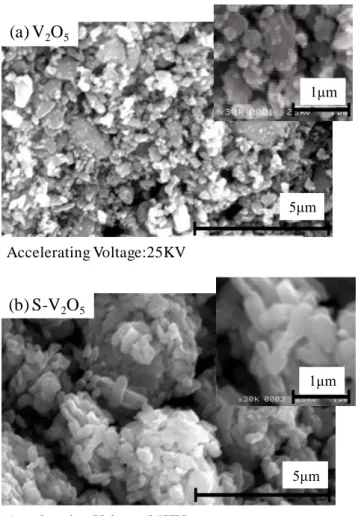
a low scattering intensity material. Figure 2-6 shows SEM images of V2O5 and S-V2O5.
The V2O5 particles have angular geometry, whereas the S-V2O5 particles are
- 43 -
Figure 2-4 XRD patterns: (a) V2O5 (---), and (b) S-V2O5 (―).
Figure 2-5 Raman spectra: (a) V2O5 (---), and (b) S-V2O5 (―).
- 44 -
Figure 2-6 SEM images: (a) V2O5, and (b) S-V2O5.
- 45 -
Figure 2-7 shows S 2p and V 2p3/2 XPS spectra for S-V2O5. The narrow S 2p
spectrum (Figure 2-7a) has a peak at 162.5 eV. The binding energy of this peak is lower than the of S8, which indicates that the chemical-binding state of sulfur in S-V2O5 is
different from that of S8. The narrow V 2p3/2 spectrum (Figure 2-7b) has a peak at 160
eV. The binding energy of this peak is higher than that of V2O5. These results and the
XRD analysis (Figure 2-4) suggest V-S chemical bonding near the surface of S-V2O5.
The surface of S-V2O5 lowers the S-S binding energy due to the decreasing crystallinity
of the sulfur.
Figure 2-8 shows DRS-FTIR spectra for V2O5 and S-V2O5. The spectrum for
S-V2O5 has two peaks around 850 and 1020 cm-1, which are attributed to V-O-V and
V=O stretching vibrations, respectively. These peaks are broad toward the low wavenumber side, in contrast to the spectrum for V2O5. This indicates that the S-V2O5
surface has a broad range of V-O bond distances17-20) due to its amorphous structure, which generated by sulfur doping with CF-MWP. The DRS attachment can detect information regarding the powder surface, and the results indicate the bulk of S-V2O5
- 46 -
Figure 2-7 XPS narrow spectra of S-V2O5: (a) S 2p (narrow spectrum), and (b) V 2p3/2
(narrow spectrum).
- 47 -
Figure 2-9 shows a TEM image and electron diffraction (ED) patterns of as-prepared S-V2O5 at two different points in the sample. The surface of the sample is composed of
a thin 10-nm-thick layer (Figure 2-9a). The ED pattern of the S-V2O5 bulk indicates an
orthorhombic V2O5 structure (Figure 2-9b), while that of the thin surface layer had a
broader V-O band than that of orthorhombic V2O5 (Figure 2-9c).
V2O5 can easily absorb water from the atmosphere into the V2O5 layer, and this water
interferes with the insertion/extraction of Mg2+ ions. However, the S-V2O5 surface
accrues V-S bonds via the CF-MWP treatment, and the surface becomes amorphous with a xerogel structure. Therefore, the high capacity and a good cycle life of S-V2O5
are due to the special structure consisting of a bulk of crystalline V2O5 and an
amorphous surface similar to V2O5 xerogel, which we call especially as the core-shell
- 48 -
Figure 2-9 Characterization of S-V2O5; (a) is TEM image, (b) and (c) are ED patterns
measured at point 1 and point 2 in (a), respectively.
Point 2
Point 1
(a)
(b)
(c)
- 49 -
2.3.3 Electrochemical characteristic of S-V2O5 electrode
Figure 2-10 shows Cole-Cole plots for V2O5 and S-V2O5 in the frequency range from
10 mHz to 20 kHz. The charge-transfer resistance (Rct) of S-V2O5 is composed of two
semicircles, in contrast to the one semicircle for V2O5. The Rct of S-V2O5 is not a simple
analogous circuit as with V2O5. This result indicates two transfer resistances of Mg2+
ions, which is consistent with the results shown in section 2.3.1 explaining the change in the surface structure of S-V2O5.
Figure 2-11 shows the discharge rate characteristics of S-V2O5. S-V2O5 maintained
discharge potentials and specific discharge capacities, even though the discharge rate increases to C/2. Therefore, the magnesium secondary battery has high rate characteristics. Levi et al. proposed using hybrid intercalation compounds containing bound water or other additional anion groups that can presumably screen the charge of the inserted cations.21) However, it is not possible to use the hybrid compound cathode at a high rate because the diffusion rate of Mg2+ ions decreases with repeated insertion in the system. On the other hand, it is reported that a Chevrel phase compound such as Mo6S8 shows high discharge rate characteristics because of immediately occurring the
relocation of the charge between Mo and S and the ease of extracting inserted Mg2+ ions. For example, the discharge capacity of Mo6S8 is maintained at 100 mAh g-1 after 100
cycles at a rate of C/8.22)
In this study, S-V2O5 is structurally classed as a hybrid compound cathode; however,
it has high capacity at 300 mAh/g with a rate of C/2. S-V2O5 is not just a hybrid
compound with a layered structure of V2O5 with inserted sulfur but forms an amorphous
- 50 -
S-V2O5 because there is no passivated sulfur layer with low conductive properties but
instead charge transfer between V2O5 and sulfur can take place.
- 51 -
Figure 2-10 Cole-Cole plots: (a) V2O5 (◇), and (b) S-V2O5 (○).
Figure 2-11 Rate profiles of S-V2O5.
Specific capacity /mAhg
-1- 52 -
2.3.4 Electrochemical behavior of the S-V2O5 electrode surface
Figure 2-12 shows XPS depth profiles for S-V2O5 in the upper five panels and those
for V2O5 in the lower five panels. In the V 2p depth profile for the S-V2O5 electrode
after discharge (Figure 2-12e), the peak of vanadium is not shown, although the S-V2O5
electrode sample was sputtered ten times with Ar+ ions. This result indicates that a solid electrolyte interphase (SEI) is probably formed at the interface between the electrolytic solution and the S-V2O5 electrode surface. In addition, the O 1s, C 1s, and Cl 2p depth
profiles indicate the formation of an SEI layer because each result shows a different structure before and after 10 times Ar+ sputtering. The detected atoms of O, C and Cl may come from the electrolytic solution used in this study that was composed of the electrolyte Mg(ClO4)2 and the solvent PC whose chemical formula is C4H6O3. The O 1s
depth profile of the S-V2O5 electrode after discharge (Figure 2-12c) has two peaks of
532 and 529 eV at the surface, which indicates the presence of CO32- 23) and MgO24),
respectively. However, these peaks are not observed after charging (Figure 2-12d). The C 1s depth profile of the S-V2O5 electrode after discharge (Figure 2-12g) indicates the
formation of the SEI. The surface layer of the S-V2O5 electrode sample after discharge
has a peak at 290 eV, although the sample after sputtering 10 times shows a peak at 285 eV. The peak at 290 eV indicates CO32-, which indicates that the electrolyte layer
includes MgCO3 derived from the electrolyte.25) The C 1s peak at 290 eV is not
observed after charge. The Cl 2p depth profile of S-V2O5 after discharge (Figure 2-12i)
shows partially overlapping peaks of Cl 2p3/2 and 2p1/2 at 198.4 eV, which indicates the presence of chloride ions (Cl-).26,27) The peaks for S-V2O5 after discharge and 10
- 53 -
decreased after charging (Figure 2-12j), which indicates that the SEI layer incorporates Cl- ions during the discharge process. The Mg 2p depth profile (Figure 2-12a) shows high intensity and broad peaks at 50.2 eV, and MgCl2 (52.1 eV28)) is not observed in the
electrolyte layer. These results demonstrate the formation of an SEI layer that is mainly composed of MgCO3 and MgO and includes Cl- at the interface between the electrolyte
and the S-V2O5 surface after discharge. The S-V2O5 surface thus provides ease of Mg2+
insertion/extraction by the formation of the SEI layer.
The formation of Cl- indicates the reduction of ClO4- in the electrolyte. The reduction
reaction from ClO4- to ClO3- occurs easily at a low potential according to the following
Equation 2.2. Cl- ions can be included in the electrolyte layer when formed because a series of several chemical reactions occur at the S-V2O5 electrode surface during the
discharge process (Equations 2.2-2.7).
ClO4- + H2O + 2e- → ClO3- + 2OH- (E°= +0.17 V) (2.2)
ClO3- + H2O + 2e- → ClO2- + 2OH- (E°= +0.35 V) (2.3)
ClO2- + H2O + 2e- → ClO- + 2OH- (E°= +0.59 V) (2.4)
ClO- + H2O + 2e- → Cl- + 2OH- (E°= +0.90 V) (2.5)
ClO3- + 3H2O + 6e- → Cl- + 6OH- (E°= +0.62 V) (2.6)
ClO2- + 2H2O + 4e- → Cl- + 4OH- (E°= +0.76 V) (2.7)
The overall reduction reaction is:
- 54 -
Considering that Mg2+ transportation involves H2O molecules, the following scheme is
proposed:
ClO4- + [Mg(H2O)4]2+ + 8e- → Mg2+ + Cl- + 8OH- (2.9)
The S 2p depth profiles shown in Figure 2-12(k, l) did not show the sulfur peak, and the molar ratio of V:S in S-V2O5 was 100:7.824. Therefore, it is difficult to observe the
sulfur peak because the amount of sulfur involved in S-V2O5 was extremely small and
below the detection limit. It should be noted that sulfur probably sublimes during the CF-MWP process. In addition, the raw material without added sulfur synthesized by CF-MWP did not show a change in the surface structure. These results indicate that the sulfur added to the raw material changes the surface structure of S-V2O5. Sulfur is
known in high capacity cathode materials.29) However, the higher capacity of S-V2O5
than V2O5 is not due to the addition of sulfur but due to the change in the S-V2O5
surface structure to that similar to a V2O5 xerogel.
On the other hand, the Mg 2p XPS spectra of V2O5 after discharge (Figure 2-12m)
showed small peaks at 50.5 eV near the surface and 50.8 eV in the bulk. After charging (Figure 2-12n), the peaks near the surface show a slight decrease in intensity. The O 1s depth profile of V2O5 after discharge (Figure 2-12o) did not indicate MgCO3 (532 eV)
or MgO (529 eV), but the peak at 530.5 eV indicated the presence of V2O5 from the
surface to the bulk. This is different from that for the S-V2O5 electrode analysis. These
results indicate that the electrolyte layer formed at the S-V2O5 electrode surface is not
- 55 -
Each V 2p depth profile of S-V2O5 and V2O5 after discharge and charge (Figure 2-12e,
f, q, r) shows a wide spectrum of V2p1/2 (523-524 eV) and V2p3/2 (516-517 eV). The
wide spectrum indicates a mixture of different vanadium states: V5+ (V2O5, 517.6 eV),
V4+ (V2O4, 516.3 eV), and V3+ (V2O3, 515.7 eV). The V2p3/2 spectrum for vanadium
metal shows a peak between 512.1 and 513.4 eV.30) Therefore, it is difficult to recognize
- 56 -
Figure 2-12 XPS profile in the Mg 2p (a, b, m, n), O 1s (c, d, o, p), V 2p (e, f, q, r), C 1s
(g, h, s, t), Cl 2p (I, j, u, v), and S 2p (k, l) regions for S-V2O5 (a, b, c, d, e, f, g, h, i, j, k,
l) and V2O5 (m, n, o, p, q, r, s, t, u, v) after discharge (a, c, e, g, i, k, m, o, q, s, u) and
charge (b, d, f, h, j, l, n, p, r, t, v). 158 168 46 48 50 52 54 535 530 525 (a) (b) (d) (c) Mg 2p O 1s S-V2O5 194 199 204 209 214 Cl 2p V 2p (e) (j) (i) bulk surface 46 48 50 52 54 (m) (n) 525 530 535 (p) (o) Mg 2p O 1s In te n si ty / a rb .u n it . A ft e r c h a r g e A ft e r d is c h a r g e 511 515 519 523 527 Binding energy / eV 194 199 204 209 214 Binding energy / eV Cl 2p V 2p (q) (r) A ft e r c h a r g e A ft e r d isc h a r g e 511 515 519 523 527 V2O5
Binding energy / eV Binding energy / eV
- 57 -
2.4 Conclusion
Conclusions on the synthesis of S-V2O5 using CF-MWP and its electrode
characteristics are given in the following.
S-V2O5 has a characteristic structure which we call as the core-shell structure; a bulk
structure of crystalline V2O5 and an amorphous surface structure similar to V2O5
xerogel. A magnesium secondary battery with the S-V2O5 cathode has high capacity
(300 mAh/g) and increased cyclability. At a rate of C/2, the potential and specific discharge capacity were not significantly degraded. Electrochemical analysis of the discharge process indicated the presence of an SEI layer that is mainly composed of MgCO3 and MgO, and includes Cl- ions, which is formed at interface between the
electrolyte and the S-V2O5 surface. The surface structure of S-V2O5 and the SEI layer
facilitate the Mg2+ insertion/extraction process at the S-V2O5 surface. However, the
- 58 -
2.5 Reference of Chapter 2
1) H. D. Yoo, I. Shterenberg, Y. Gofer, G. Gershinsky, N. Pour and D. Aurbach,
Energy & Environmental Science, 6 (8), 2265-2279 (2013)
2) P. Novak, W. Scheifele and O. Haas, J. Power Sources, 54 (2), 479-482 (1995) 3) P. Novak and J. Desilvestro, J.Electrochem, Soc., 140 (1), 140-144 (1993)
4) D. Aurback, Z. Lu, A. Schemchter, Y. Goter, R. Tugeman, Y. Cohen, M. Moshkovlch and E. Levl, Nature, 407 (6805), 724-727 (2000)
5) P. Novak, V. Shklover and R. Nesper, J. Phys. Chem., 185, 51-68 (1994)
6) P. Novak, W. Scheifele, F. Joho and O. Haas, J. Electrochem. Soc., 142 (8), 2544-2550 (1995)
7) L.Sanchez and J. P. Pereiraramos, J. Mater. Chem., 7 (3), 471-473 (1997)
8) Z. Feng, J. Yang, Y. NuLi and J. Wang, J. Power Sources, 184 (2), 604-607 (2008) 9) K. Makino, Y. Katayama, T. Miura and T. Kishi, J. Power Sources, 99 (1-2),
66-69 (2001)
10) N. Kumagai, S. Komaba, H. Sakai and N. Kumagai, J. Power Sources, 97-98, 515-517 (2001)
11) L. Yu and X. Zhang, Colloid Int. Sci., 278 (1), 160-165 (2004)
12) Z. L. Tao, L. N. Xu, X. L. Gou, J. Chen and H. T. Yuan, Chem. Commun., (18), 2080-2081 (2004)
13) A. Mitelman, M. D. Levi, E. Lancry, E. Levi and D. Aurbach, Chem. Commun., (41), 4212-4214 (2007)
- 59 -
16) H. Kurihara and T. yajima, Chem. Lett., 36 (4), 526-527 (2007)
17) M. Hibino, Y. Ikeda, Y. Noguchi, T. Kudo, Seisan Kenkyu, 52 (11), 516-522 (2000)
18) D. Imamura and M. Miyayama, Solid State Ionics, 161 (1-2), 173-180 (2003) 19) I. Stojkovića, N. Cvjetićanina, S. Markovićb, M. Mitrićc and S. Mentusa, Acta
Physica Pol. A, 117 (5), 837-840 (2010)
20) N. Koshiba, K. Takada, M. Nakanishi and Z. Takehara, Denki Kagaku, 62 (10), 332-338 (1994).
21) E. Levi, Y. Gofer, D. Aurbach, Chem. Mater., 22 (3), 860-868 (2010).
22) E. Lancry, E. Levi, Y. Gofer, M. Levi, D. Aurbach, J. Solid State Electrochem., 9 (5), 259-266 (2005).
23) S. Hwan Moon, T. Wook Heo, S. Young Park, J. Hyuk Kim and H. Joon Kim, J.
Electrochem. Soc., 154 (12), J408-J412 (2007)
24) O. Makita, S. Takagi and T. Gotoh, Shinku, 50 (3), 220-222 (2007)
25) K. Zhang, S. Wu, X. Wang, J. He, B. Sun, Y. Jia, T. Luo, F. Meng, Z. Jin, D. Lin, W. Shen, L. Kong and J. Liu, J. Colloid Interface Sci., 446 (0), 194-202 (2015) 26) W. E. Morgan, J. R. Van Wazer and W. J. Stec, J. Am. Chem. Soc., 95 (3), 751-755
(1973)
27) J. P. Contour, A. Salesse, M. Froment, M. Garreau, J. Thevenin and D. Warin, J.
Microsc. Spectrosc. Electron, (4), 483-491 (1979)
28) S. Karakalos, A. Siokou and S. Ladas, Appl. Surf. Sci., 255 (21), 8941-8946 (2009)
29) H. Wang, Y. Yang, Y. Liang, J. T. Robinson, Y. Li, A. Jackson, Y. Cui and H. Dai,
- 60 -
30) D. A. Shirley, R. L. Martin, S. P. Kowalczyk, F. R. MacFeely and L. Ley, Phys.
- 61 -
Chapter 3
Electrode Performance of Vanadium Pentoxide-based Composite Cathode Materials
3.1 Introduction 3.2 Experimental
3.2.1 Preparation of cathode material by CF-MWP 3.2.2 Electrochemical characteristics
3.2.3 Structural analysis 3.3 Results and discussion
3.3.1 Electrochemical characteristics 3.3.2 Structural analysis
- 62 -
3.1 Introduction
Recently, high-capacity secondary batteries have seen wide adoption as a power source for electric vehicles. Magnesium secondary batteries, which have been studied for a long time, have attracted attention for use in next-generation power storage applications. Aurbach et al. reported an electrolyte solution that allowed magnesium to dissolve and deposit reversibly.1,2)
However, there are a limited number of possible materials that can be used for the cathode of magnesium secondary batteries. In one case, Mg2+ is easily trapped in the cathode where it diffuses slowly, while in another, repetitive insertion/desorption of Mg2+ at the cathode by the use of high voltage can induce structural failure of the cathode or its dissolution into the electrolyte solution. Thus, one drawback of rechargeable magnesium batteries is the difficulty of maintaining their cycle characteristics due to diminishing capacity.3,4)
- 63 -
3.3 Experimental
3.2.1 Preparation of Cathode Material by CF-MWP
Three kinds of composites were prepared. The first composites containing vanadium pentoxide (V2O5), sulfur, and a metal oxide (MnO2, MoO3, Fe2O3, NiO, or ZrO2) at a
molar ratio of 2:1:1 were prepared by mixing them in a ball mill (manufactured by Fritsch Co., Ltd., type P-6). The second composite containing V2O5, sulfur, and MnO2 at
a molar ratio of 2:1:1 was prepared as the same way to investigate the effect of an increased sulfur content. V2O5 and sulfur without metal oxide were also mixed in a ball
mill to prepare the reference composite containing them at a molar ratio of 2:1, respectively (S-V2O5).
The composite materials were wetted down and left overnight, after which it was treated by low-temperature carbon-felt microwave water plasma (CF-MWP) generated using carbon felt and a 2.45 GHz microwave generator.9,10) Specifically, 2.0 g of each raw material were placed between pieces of carbon felt (30 mm in diameter) and a 500 W, 2.45 GHz microwave was used to irradiate the material under reduced pressure (0.001 MPa) for 2 min to synthesize the hybrid cathode materials. In this process, raw materials are treated by plasma formed from water in the raw materials as a result of electric discharge between the pieces of carbon felt. It is assumed that the distribution of water in the raw materials is sufficiently uniform that the composite is treated uniformly. Furthermore, although the process was performed under reduced pressure and at the evaporating temperature of water, the process did not induce reduction of V2O5 or the
- 64 -
3.2.2 Electrochemical Characteristics
Electrodes were prepared from a slurry mixture consisting of the cathode material, acetylene black, and a polyvinylidene fluoride binder in a weight ratio of 10:3:1 and mixed with N-methyl-2-pyrrolidone. The resulting slurry was spread on carbon paper and dried at 110 °C for 1.5 h to form an electrode. In the meanwhile, for preparing a counter electrode, S-V2O5 was charged with magnesium ions and used as that. This
electrode showed the same potential changes as a magnesium alloy plate. A magnesium alloy plate was used as the reference electrode. For the electrolyte solution, 0.3 M Mg(ClO4)2 and 1.8 M H2O dissolved in PC was used, and the electrode performance
was evaluated using three-electrode cells. This electrolyte has been confirmed to allow smooth charge and discharge with metal oxides as cathode active materials.4) The
stability of the Mg pseudo reference electrode was preliminarily confirmed to be stable by observation of the reproducibility of cyclic voltammograms with ferrocene using an electrolyte solution containing 0.2 M ferrocene, 0.3 M Mg(ClO4)2, and 1.8 M H2O in
PC solvent, and an electrochemical system with a magnesium alloy plate as the reference electrode, and platinum wires as working and counter electrodes. Charge-discharge tests were conducted between cut-off potentials from 2.4 V to 0.9 V
- 65 -
3.2.3 Structural Analysis
- 66 -
3.3 Results and Discussion
3.3.1 Electrochemical Characteristics
Figure 3-1 shows charge-discharge capacity curves for the batteries containing metal oxides (MnO2, MoO3, Fe2O3, NiO, and ZrO2) as additives, which were 420, 320, 300,
290, and 230 mAh/g, respectively. The highest capacity was obtained for the electrode with MnO2 (SMn-V2O5). The discharge curve for SMn-V2O5 decreased linearly from
1.5 V to 0.9 V vs. Mg/Mg2+, which demonstrates that the surface of the SMn-V2O5 was
amorphous with a structure similar to a xerogel; in this regard, it is similar to S-V2O5.
Although the discharge curve obtained with added MoO3 (Figure 3-1 (b)) decreased
linearly from 1.5 V to 0.9 V vs. Mg/Mg2+, the charge curve showed plateau potentials at around 1.8 V and 2.4 V. For the other electrode materials (Figure 3-1 (a), (c), (d) and (e)), a plateau potential appeared at 1.5 V, and each of the charge-discharge curves descended abruptly after the plateau potential. The cathode formed by the addition of NiO had the highest plateau potential at 1.65 V, different from the other electrode materials. This result shows that the addition of NiO may improve the high-voltage characteristics of the electrode material. Metal oxides other than MnO2 inhibited the
- 67 -
Figure 3-1 Charge-discharge curves at the second cycle for S-V2O5 with additives of (a)
- 68 -
3.3.2 Structural Analysis
Figures 3-2 shows a TEM and electron beam diffraction patterns for SMn-V2O5, and
Figure 3-3 shows the EDX spectra for SMn-V2O5 measured at two discrete points. The
bulk of SMn-V2O5 produced clear electron diffraction and corresponds with the pattern
for orthorhombic V2O5. Therefore, the bulk of the SMn-V2O5 maintained the V2O5
orthorhombic structure without degradation. The TEM image shows the surface of SMn-V2O5 as a thin layer with two types of morphology, shown as Points 1 and 2 in
Figure 3-2. The diffraction image of Point 1 has a clear diffraction pattern and halo pattern, and is slightly broader than the pattern for orthorhombic V2O5. The halo pattern
indicates an amorphous structure. The EDX spectrum measured at Point 1 shows a strong V peak, which indicates that Point 1 is a V2O5 xerogel or a similar structure. This
is similar to the case for S-V2O5 (Figure 2-9). The diffraction image measured at Point 2
- 69 -
Figure 3-2 Transmission electron microscopy (TEM) of S-Mn-V2O5 and electron beam
diffraction at Points 1 and 2.
- 70 -
Figure 3-4 shows a micro-Raman spectrum and Raman images for the SMn-V2O5
electrode. Orthorhombic V2O5 peaks11) and fluorescence are observed, whereas there are
no MnO2 and sulfur peaks. This result indicates fluorescence, possibly derived from
MnO2 and sulfur. Thus, during Raman spectroscopy, although the area of fluorescence
was low in intensity for V2O5, the orthorhombic V2O5 and fluorescence area were
separate. These results together with the results from TEM and EDX measurements indicate that the fluorescence area is a solid solution of MnO2 and sulfur, which
suggests that SMn-V2O5 consists of orthorhombic V2O5 in the bulk and the surface
covered with the solid solution of MnO2 and sulfur.
Figure 3-5 shows the XPS narrow spectrum of SMn-V2O5. The peaks for V2p3/2 and
S2p are at the same positions as S-V2O5, which suggests a S-V bond-like state and
indicates an amorphous structure as mentioned at the second chapter. The full width at half maximum (FWHM) of V2p3/2 for SMn-V2O5 increased 2-fold compared to that for
S-V2O5: 3.45 eV for SMn-V2O5 and 1.7 eV for S-V2O5. Therefore, it was considered
that the oxidation state of V of SMn-V2O5 is slightly different than that in S-V2O5. The
Mn 2p3/2 spectrum indicates the formation of a solid-solution with sulfur in accordance
with TEM, EDX and Raman spectroscopy mentioned above. The ratio of manganese to sulfur was approximately 1:2 and remained constant when the amount of sulfur was increased five-fold. These results demonstrate that MnO2 and sulfur are linked by
mechanical force rather than by a chemical binding force. ICP-MS analysis indicated that the molar ratio of V:Mn:S was 100:6.8:14.4. The sulfur content in SMn-V2O5 was
twice that in S-V2O5 (V:S = 100:7.8). The ratio of manganese to sulfur was
- 71 -
Figure 3-4 Raman spectroscopy of SMn-V2O5 and Raman images of the surface of the
- 72 -
Figure 3-5 XPS narrow spectra of SMn-V2O5: (a) V2p3/2; (b) Mn2p3/2; and (c) S2p.
The following are balanced chemical reactions involving V2O5, MnO2, and S, along
with their theoretical capacities.
V2O5 + Mg2+ + 2e− → MgV2O5 294 mAh g−1 (1)
2MnO2 + Mg2+ + 2e− → MgMn2O4 307 mAh g−1 (2)
S + Mg2+ + 2e− → MgS 1674 mAh g−1 (3)
From the ICP-MS analysis and the three equations above, the average theoretical capacities of SMn-V2O5 and S-V2O5 through the surface to the bulk were calculated to
be 458 and 393 mAh/g, respectively, i.e., the empirically obtained capacity of SMn-V2O5 is 91.7% of the theoretical capacity. The theoretical capacity of MnO2 is as
high as that of V2O5. Therefore, may be possible to achieve a high capacity for
- 73 -
3.4 Conclusions
As a cathode material for magnesium secondary batteries, S-V2O5 with an added
metal oxide was synthesized using CF-MWP and its crystal structure and electrode characteristics were examined. The composite of V2O5, sulfur, and MnO2 (SMn-V2O5)
synthesized by CF-MWP demonstrated the highest capacity (420 mAh/g) of any of the prepared samples. Charge-discharge curves showed that the SMn-V2O5 capacity
decreased linearly from 1.5 V to 0.9 V, whereas a plateau potential appeared at 1.5 V for the other electrodes. This result was interpreted to indicate that only SMn-V2O5 had a
surface structure resembling a xerogel. The bulk of the SMn-V2O5 composite was
orthorhombic V2O5, while the surface showed a xerogel-like structure of V2O5 and a
- 74 -
3.5 References of Chapter 3
1) D. Aurbach, Z. Lu, A. Schechter, Y. Gofer, H. Gizbar, R. Turgeman, Y. Cohen, M. Moshkovich and E. Levi, Nature, 407 (6805), 724–727 (2000)
2) D. Aurbach, Y. Cohen and M. Moshkovich, Electrochem. Solid State Lett., 4 (8), A113–A116 (2001)
3) P. Novák, W. Scheifele and O. Haas, J. Power Sources, 54 (2), 479–482 (1995) 4) P. Novák, W. Scheifele, F. Joho and O. Haas, J. Electrochem. Soc., 142 (8),
2544–2550 (1995)
5) P. Novák and J. Desilvestro, J. Electrochem. Soc., 140 (1), 140–144 (1993)
6) Z. Feng, J. Yang, Y. NuLi and J. Wang, J. Power Sources, 184 (2), 604–609 (2008) 7) Z.L. Tao, L.N. Xu, X.L. Gou, J. Chen and H.T. Yuan, Chem. Commun., (18),
2080–2081 (2004)
8) A. Mitelman, M.D. Levi, E. Lancry, E. Levi and D. Aurbach, Chem. Commun., (41), 4212–4214 (2007)
9) M. Inamoto, H. Kurihara and T. Yajima, Hyomen Gijutsu, 62 (10), 516–520 (2011) 10) H. Kurihara and T. Yajima, Chem. Lett., 36 (4), 526–527 (2007)
11) R. Baddour-Hadjean, M.B. Smirnov, K.S. Smirnov, V.Y. Kazimirov, J.M. Gallardo-Amores, U. Amador, M.E. Arroyo-de Dompablo and J.P. Pereira-Ramos,
- 75 -
Chapter 4
Electrode Performance of Vanadium Pentoxide Xerogel Prepared by Microwave Irradiation as an Active Cathode Material
4.1 Introduction 4.2 Experimental
4.3 Results and discussion 4.4 Conclusions
- 76 -
4.1 Introduction
Magnesium secondary batteries have been studied for a significant length of time, and are currently being considered for next generation power storage applications. This is partly because magnesium is low cost, safe to handle, environmentally friendly and naturally abundant.
However, there are only a limited number of materials available for use as the cathode in magnesium secondary batteries. Aurbach et al. reported an electrolyte solution that allows magnesium to dissolve and deposit reversibly,1,2) while Novak et al. studied V2O5 as a potential cathode material.3,4) Imamura et al. examined Mg2+
intercalation into a composite prepared from a V2O5 xerogel and carbon and determined
that the V2O5/carbon composite had a large interlayer distance and short diffusion
length compared to a V2O5 xerogel without carbon.5) The present study focused on the
drying of this V2O5 xerogel, which is known to develop narrow interlayer distances
upon thermally-assisted drying above 50 °C.5) Specifically, microwave (MW) irradiation under vacuum was employed to dry the V2O5 xerogel in an attempt to