Digital Divide and its Economic Implications in Asia
Celia L. Umali
Abstract
The use of Information Technology (IT) in Asia has grown rapidly in recent years. Yet the United Nations claims that not everyone is benefiting from the IT revolution and that there is now a new type of poverty, information poverty, that is taking shape. This paper deals with the digital divide and its economic implications in Asia. It is be- lieved that access to IT can serve as a good tool to help the economies of developing countries of Asia, particularly the rural areas where the majority of the population resides. IT can bring benefits and opportuni- ties to the rural population who is often marginalized. The first part of the paper aims to confirm the digital divide at the global, regional and national levels. The second part analyzes the implications of digital di- vide on the rural economy. The last part examines the various measures adopted in Asia to correct the digital gap including some case models.
Hopefully, these experiences would be useful to policy makers in many developing countries in bringing IT to as many of their population as possible and getting all the possible benefits from its use.
Keywords: Information technology, digital divide, economic develop-
ment, Asia
Introduction
Information technology (IT) is fast changing with the convergence of voice, data and imaging technologies. People are now living in a globally net- worked society and users are becoming more sophisticated and demanding as far IT is concerned. In light of this, telecom infrastructures have to ex- pand fast enough to support the rapidly changing patterns of telecom tech- nology and to meet the needs of the consumers who desire to be at the cut- ting edge of information technology. The boom in digital-mobile technology, Internet and broadband has changed how people live and do commerce.
Speed and bandwidth of IT have increased tremendously and costs of IT services have declined in recent years due to more competition (Amarenda Narayan, 2002). Asian governments see the important contribution of telecommunication to the growth of their economies. They fully recognize that information technology like other infrastructures is essential to strengthen international competitiveness, to attract foreign investments onto their shores and to be able to participate actively in global business. De- veloping countries have been for decades lagging in telecommunications de- velopment but governments in Asia took on the task of deregulating their IT sectors in the 1990s. Monopolies and state-protected companies were dis- mantled, the Post and Telecommunication Organizations (PTOs) were cor- poratized and eventually privatized, competition from new local and foreign entrants were welcomed and membership requirements to WTO were met (Umali, 2002). As a result, the use of IT in Asia has grown rapidly to the extent of leapfrogging to the latest information technology.
In spite of this rosy picture, the UN claims that there is now a new kind of
poverty, information poverty, that is taking place in many countries and digi- tal divide is broadening so that not everyone is benefiting from the informa- tion revolution (World Telecommunications Development Report, 1998).
Against this background, this paper will look at digital divide and its eco- nomic implications, with particular emphasis on Asia. The first part defines and verifies the digital divide in three categorical levels: worldwide, region- wide and nation-wide. The second part presents the Asian model of IT de- velopment and investigates the measures taken to correct the digital divide.
The last part analyses the economic implications and application opportuni- ties of IT on rural development that will include case models which can serve useful to policy makers in their drive to rectify the digital divide.
Digital Divide in Asia
In this paper, digital divide is defined as the disparity in telecommunications between the developed and developing countries, between the haves and have nots, and between the urban and rural areas (Henry, 2003). More specifically it means the gap separating those who have computers and ac- cess to Internet from those who do not (Young, 2001, Dasgupta, 2001).
Henry (Henry, 2003) categorizes the factors that lead to the digital divide
as follows: the rich has the capacity to access to IT and software; the poor is
unable to buy the technology (e. g. computers) and is often isolated; the
poor lacks the skill to use computers; and developing countries' schools spe-
cially in the rural areas do not have internet access.The United Nations men-
tioned in its report (World Telecommunications Development Report, 1998)
that the gap between the developed and developing countries is broadening
and that developing countries could not take advantage of the benefits IT
can offer.
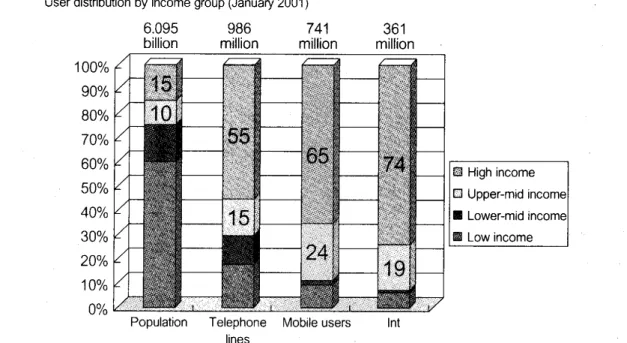
In spite of the fast development, adoption and spread of the latest IT worldwide, the global IT divide is very evident. Teledensity in the Asia Pa- cific region stood at 7. 2% in 2000 while the US and Europe had teledensities of 30% (Jong, 2001). In 1999, 5.1% of the global population lived in Canada and the US which accounted for 57% of the global Internet users;
Europeans account for 13. 7% of the global population but 23.4% of the global internet subscribers. Although Asia Pacific on the other hand is where 56.2% of the world population resides, Internet connections comprise only 15.80% of the world's total (Henry, 1999). This proves what many analysts claim that the wide spectrum of IT adopters is positively correlated to the level of income. Figure 1 clearly demonstrates that although low in- come groups form a majority of the world population, they have minimal ac-
Figure 1. Income Level and Access to IT, 2001.
User distribution by income group (January 2001) 6.095
billion
986 million
741 million
361 million 100%
90%
80%
70%
60%
50%
40%
30%
20%
10%
0%
!EiJHigh income lZJ Upper-mid income
• Lower-mid income rlil Low income
Population Telephone Mobile users Int lines
Source: lTV World Telecommunications Indicators Database, 2001.
cess to telephone, mobile phones and Internet. Put simply, the digital divide mirrors the global economic divide.
The Asia Pacific market is huge but very diverse in terms of size, population income, education, language and culture. The region is a big market with a total population of 3.3 billion, 523M of whom are in Southeast Asia. In many nations of Asia, more than half of the population lives in the rural areas. The urban-rural dichotomy in the region reflects the economic de- velopment levels of the countries. In the past two decades, these countries of Asia have been actively involved in global trade and investments. For this reason the governments have actively developed their IT infrastructures. In 1998, the UN however indicated that most developing nations are not shar- ing in the IT revolution and this situation is evident in Asia.
Given this situation, let us examine the unequal spread of IT in Asia. ES- CAP (UNESCAP, 2001) grouped Asian countries into three categories:
1
sttier : Japan, Singapore, Hong Kong, Korea, Taiwan, Australia, New Zealand
Characteristics : High penetration rates for advanced IT (multi-media, e- commerce, broadband).
2
ndtier : India, Indonesia, China, Malaysia, Thailand, Philippines, Pakistan, Sri Lanka
Characteristics : IT penetration is rising, telecommunications remain regulated and access to Internet is still difficult.
3
rdtier : Pacific Island, Laos, Vietnam, Pakistan Bhutan
Characteristics : Strict IT regulation limiting the IT penetration rate, limited Internet access and monopoly of IT.
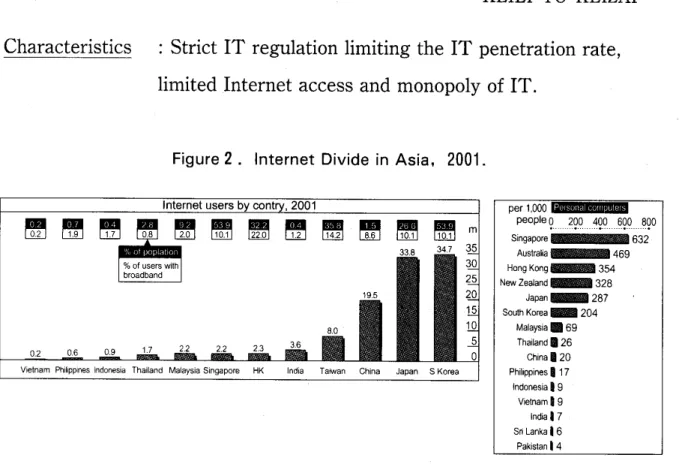
Figure 2. Internet Divide in Asia, 2001.
per1,000
';;g'";"",;;!!!".
people9 290 490690890
Singapore 632
Australia 469
Hong Kong _ 354
New Zealand"" 328 Japan_287 South Korea _ 204
Malaysia I11III69 Thailand 126
China 11120 Philippines. 17 Indonesia. 9
Vietnam. 9 IndiaI7 Sn LankaI6 PakistanI4
~m
34.7
S Korea China Japan
Internet usersbycont ,2001
0.2 0.6 0.9
V"letnam Philippines Indonesia Thailand Malaysia Singapore HK India Taiwan
Source: Business Asia, Economic Intelligence Unit, Market Indicators, Changing Asia, January 28, 2002.
The high IT penetration rates among the first tier countries mentioned above can be attributed to their high rates of connectivity. In 2001, the lead- ing countries in Asia with regard to computer ownership per 1000 people were Singapore (632 persons), Australia (469 persons), (Hong Kong 354 persons), New Zealand (328 persons), Japan (287 persons) and South Korea (204 persons). At the other extreme are countries like Vietnam, In- dia, Sri Lanka and Pakistan where not many people have computers. The low and high computer ownership figures in Asia then correspond to the dis- parity in internet usage as presented in Figure 2.
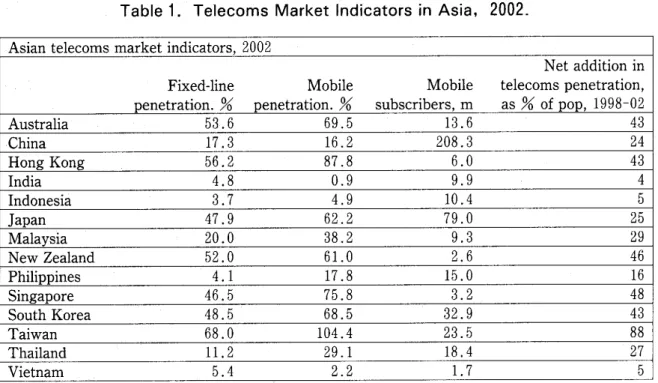
Just like Internet connectivity and as Table 1 shows, high income countries
such as Taiwan, Japan, Singapore, South Korea, Australia, New Zealand
and Hong Kong had high mobile phone penetration rates, followed by the se-
Table
1.
Telecoms Market Indicators in Asia.2002.
Asian telecoms market indicators, 2002
Net addition in Fixed-line Mobile Mobile telecoms penetration, penetration.
%
penetration.%
subscribers, m as%
of pop, 1998-02Australia 53.6 69.5 13.6 43
China 17.3 16.2 208.3 24
Hong Kong 56.2 87.8 6.0 43
India 4.8 0.9 9.9 4
Indonesia 3.7 4.9 10.4 5
Japan 47.9 62.2 79.0 25
Malaysia 20.0 38.2 9.3 29
New Zealand 52.0 61.0 2.6 46
Philippines 4.1 17.8 15.0 16
Singapore 46.5 75.8 3.2 48
South Korea 48.5 68.5 32.9 43
Taiwan 68.0 104.4 23.5 88
Thailand 11. 2 29.1 18.4 27
Vietnam 5.4 2.2 1.7 5
Source: Business Asia, Economist Intelligence Unit, Powering On?, Dec. 16,2002.
cond tier nations like China, Malaysia, Thailand and the Philippines and fi-
nally Indonesia as well as emerging markets like Vietnam and India which
have still much to catch up with. In Asia the government has either deregu-
lated the IT industry or has the sector under its control. Analyzing the corre-
lation between IT policy and penetration rate in Figure 3, the first tier na-
tions except South Korea and Japan, have high net addition in telecom
penetration from 1998 to 2002. The IT companies in Singapore, Taiwan,
Hong Kong and Australia enjoy markets under free competition and minimal
state control of incumbents. In Japan, and China, on the other hand, the sec-
tor is under managed competition and has comparatively low net addition in
penetration rates. South Korea's IT industry though is doing quite well in
spite of some government regulations. India, Vietnam and Indonesia mean-
while have IT sectors that are still regulated by the government and thus
translating to lower net addition in IT penetration rates (Business Asia,
2002).
Most Asian nations are relatively late movers in IT. The antiquated and in- adequate telecom infrastructures had their drawbacks but in a way have fi- nally worked to the countries' advantage. The people of Asia could leapfrog a whole generation of fixed communications infrastructure in a much shorter period of time since they did not have to go through the intermediate stage of using old technology. Instead, most of the people are at the cutting edge of the digital, wireless and mobile IT. In opening up their telecoms sectors, Korea, Singapore and Hong Kong have come to build the most advanced network infrastructures by which people can have access to the most sophisticated telecommunications technology. As a result they ended up leading the IT race. In Asia however, mobile phone is currently gaining
Figure
3.
Regulation and IT Growth, Asia,2002.
Free market
Regulatory policy promotes/mandates competition,state control of incumbent minimal
India Philippines (13.4)
(36.2)
8
Hong Kong (2.9)
4& I gapore (2.0)
Australia(8.4)8 ~.
Taiwan (19.9) Malaysia (7.1)
•
Additions to total fixed and
mobile penetration 1998-2002, ---l~~
as%of poplation (see table)
"Indonesia (11.1) Vietnam (3.6) State-controlled
incumbent,strict
"Iron national development hand" targets,little effective
competition or strictry
managed competition!:-;- _ 0%
•
~
Total additions,msubscribers(in brackets)L
South Korea (20.5) •
50%
Source: Carrot or Stick, Business Asia, Dec. 16,2002, The Economist Intelligence
Unit, 2002.
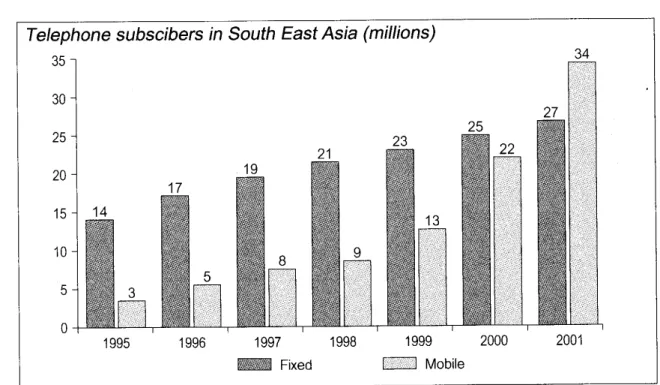
remarkable headway. In terms of geography, Asia is very different. China and India for example are huge countries with vast hinterlands. Philippines and Indonesia are archipelagos composed of thousands of islands. Hence connecting the whole country using fixed line telephony is next to impossible due to the following reasons: cost of rollout, feasibility/profitability, literacy /familiarity of people in rural areas, poverty and marginalization of non ur- ban areas. For these reasons, there has been a mobile boom in Asia. In Southeast Asia, mobile penetration rates have been much higher than fixed lines (Figure 4). In 2000, Asia accounts for 30%of the world's wireless subscribers.
Subscription to mobile phones serves different purposes. In the wealthy na- tions of SEA such as Singapore, Malaysia and Brunei, the people use the mobile phone as supplement to the fixed landline since telephony rollouts in
Figure 4. Mobile vs. Fixed Line Penetration in Asia.
Telephone subscibers in South East Asia (millions)
35
30 25
20 15 10 5
o
34
1995 1996 1997
~fIi'#i!i$if4 Fixed
1998 1999
Mobile
2000 2001
Source: ITU Telecommunication Indictors Update, Nov-Dec, 2001.
these countries are wider. Most of them are affluent enough to have both fix- ed line and mobile phones. There are countries such as Indonesia, Thailand Philippines, Cambodia and Laos where mobile phones are substitutes to the landlines which are not available (Figure 5).
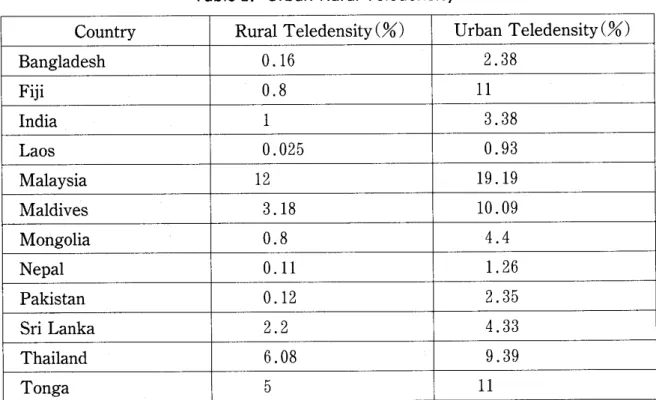
So far, we have outlined the digital divide, world-and region-wise. There is the third kind of digital divide which is the main focus of this paper, the na- tional digital divide. The urban-rural teledensity divide in selected Asian na- tions are presented in Table 2. The rural/urban disparities in developing countries of Asia are widening in terms of infrastructure, facilities, and serv- ices which tend to converge and are well developed in the urban areas. In most parts of Asia Internet access is still a luxury for three reasons: com- puters are still not affordable to many, costs of access are still high, and not
Figure 5. Mobile Phones: Supplement or Substitute, 2000.
Mobile substitution and supplement (2000)
re
80% 100%
60%
40%
20%
~ 90%
§ 80%.~Q'tl'lb(Ji(jjlii;
.c
g-
70%]1 60%
50%
40%
30% Loa
20% 'II!JIIJ 'll!JllJVielnam
10% 'II!JIIJMyanmar
0%- f - - - , - - - , - - - , - - - , - - - ,
0%
Households with fixed telephone (%)
Source: ITU Telecommunication Indictors Update, Nov-Dec,
-2001.all rural areas have electricity/land lines by which internet has to be con- nected to. This is further compounded by the poverty and literacy problems in the countryside. More often the rural areas are left lagging behind in many aspects and IT penetration is one of them. In 1999, lTD reported that in the low middle and low income countries, the rural teledensities were 7. 1
% and 2.3% respectively whereas the urban teledensities stood at 22.1%
and 6.5% respectively (lTD, 1999). As a matter of fact, out of the 300 M people having access to the internet only 1% is in Southeast Asia (Romulo, 2000).
The gap has not tapered off in spite of the rapid IT growth rates in these
Table 2. Urban-Rural Teledensity.
Country Rural Teledensity (%) Urban Teledensity(%)
Bangladesh 0.16 2.38
Fiji 0.8 11
India 1 3.38
Laos 0.025 0.93
Malaysia 12 19.19
Maldives 3.18 10.09
Mongolia 0.8 4.4
Nepal 0.11 1. 26
Pakistan 0.12 2.35
Sri Lanka 2.2 4.33
Thailand 6.08 9.39
Tonga 5 11
Source: WTDR 2002 ; Amarendra Narayan, "Rural Telecommunications: Role of In-
formation and Communications Technologies (ICT) in Development, InfoDev 2001,
Symposium on Information and Knowledge for Trade and Development, Dec. 2002,
China.
countries keeping the rural poor in comparative exclusion. This digital di- vide is counter-productive (Loong Wong, 2002). But, once developed IT can enhance socio-economic development (Barr, 1998) and offer more choices and opportunities for individuals (Naisbitt, 1984, Gates, 1995).
Asian IT Model of Development Government Leadership and Guidance
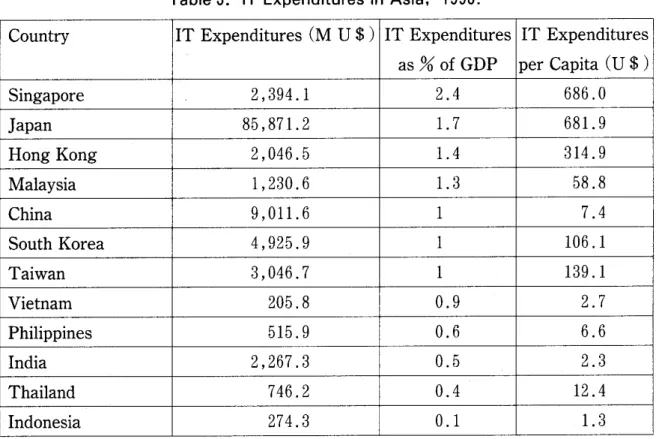
The Asian model of economic development portrays the important role of the government (Umali, 1997). Usually, the government takes the initia- tive and provides the leadership, guidance and planning required to imple- ment national economic development plans. Included in the national de- velopment plans are IT development programs. Looking ahead into the fu- ture, the governments of Asian countries are cognizant that their economic future hinges on how far they can develop their telecommunications infras- tructure. The priority given to the sector by the Asian countries is reflected in their IT expenditures. Singapore's IT spending amounted to 2.4% of GDP, the highest among the Asian countries. Japan was second with 1. 7%, followed closely by Hong Kong 0.4%) and Malaysia 0.3%) (Table 3).
Singapore aspires to be the regional information hub in the Asia-Pacific. In
1996, the government embarked on a project, called Singapore One, at a
cost of S$400M to build a nationwide broadband infrastructure so that
99 percent of households, companies and other institutions can have access
to multi-media information, download files and interact using the internet at
a faster speed. Hong Kong, with its more liberal business environment al-
Table
3.
IT Expenditures in Asia.1998.
Country IT Expenditures (M V $ ) IT Expenditures IT Expenditures as % of GDP per Capita (V $ )
Singapore 2,394.1 2.4 686.0
Japan 85,871.2 1.7 681. 9
Hong Kong 2,046.5 1.4 314.9
Malaysia 1,230.6 1.3 58.8
China 9,011.6 1 7.4
South Korea 4,925.9 1 106.1
Taiwan 3,046.7 1 139.1
Vietnam 205.8 0.9 2.7
Philippines 515.9 0.6 6.6
India 2,267.3 0.5 2.3
Thailand 746.2 0.4 12.4
Indonesia 274.3 0.1 1.3
Source: Export IT Asia: Preliminary Report, International Trade Administration, V.S. Dept. of Commerce, December 2000, http://infoserz.ita.doc.govt/ot/mktctry.nsf.
lows the private sector to take the lead in the development of the telecom- munications sector. To this effect, the government launched the "Digital 21 - Information Technology Strategy", a plan that provides the enabling en- vironment for the sector to grow. It includes provisions such as the develop- ment of the telecommunications infrastructure, educating the people on how to use IT as well as stimulating creativity and innovation in IT.
The Multi-Media Supercorridor (MSC) Project of the Malaysian govern-
ment is part of its 20/20 National Development Plan. The MSC project be-
gan in 1996. It is an industrial park, equipped with fiber optic backbones,
and broadband connections to home and offices, smart homes and a multi-
media university. Fiscal incentives are offered to IT-related and multimedia
companies to set up businesses there, build the infrastructure and develop Putrajaya and Cyberjaya as intelligent cities. Companies in the MSC can apply for the MSC Research and Development Grant of the government to fund IT R&D for two years. The South Korean government has a five year national development plan, called CyberKorea 21, for IT development. In this initiative, the government is directly constructing the telecommunica- tions infrastructure like fiber optic network to provide satellite communica- tions links, connecting schools to PCs, and the creation of online databases.
Taiwan has the National Information Infrastructure Development plan under which IT infrastructure expansion, education and legal reforms are given priority. China, one of the fast growing telecommunications market in the world has included, for the first time, telecommunications development in its 10
th5-year development plan. Thailand has GI-NET plan, and Indonesia has Nusantara 21 (N-2l) , a U$70M national infrastructure plan, both aiming to build their national telecommunications networks.
Public-Private Partnership
What used to be a government responsibility to develop the telecommunica- tions facilities in the rural areas had been passed on to the private sector.
Private sector participation and formation of alliances between and among local firms and foreign investors were necessary to expedite industrial res- tructuring, specially in the midst of fast technological and economic changes.
The government in many instances, has provided the guiding policies and
leadership, although more often, government-private sector partnership was
called for to have the plans, usually grand projects, implemented. As men-
tioned earlier, rural telecommunications infrastructure which required a lot of capital investments, technology and management expertise could not have been developed in Indonesia and the Philippines had the participation of the private sector not been sought. Private companies were awarded licenses to operate on the provision that they develop the telephone and cellular phone systems in their designated areas. In the early 1990s, Telkom of Indonesia established cooperative arrangements (KSOs) with foreign companies on build-operate-transfer (BOT) schemes to install lines both in the rural and urban areas. The private partner did not only bring in financing, technology and management skills, but they also had to pay for the right for the KSO. In 1995, a Public Telecommunications Policy Act divided the whole Philippines into 11 service areas, putting one or two phone companies in charge of in- stalling 333,000 landlines and 400,000 cellular phones lines in their licensed areas in exchange for the right to operate. The strategy proved successful in raising the telephone access in the country, especially in the rural areas.
Similarly, the state-owned enterprises, Organization of Thailand (TOT)
and Communications Authority of Thailand (CAT), had the sole authori-
ties to operate a public telecommunications network in Thailand. To meet
the sudden increase in demand for fixed phone line services, the participa-
tion of the private sector, through BOT concessions, was solicited. TOT and
CAT, the concession providers, and the private firms, the investors in the
construction of the network infrastructure and service providers, shared the
benefits of the monopoly. The Cyberport project launched in Hong Kong in
1999 was a partnership between the SAR and PCCW. Hong Kong Special
Administrative Region (SAR) donated the land and Pacific Century Cyber-
works (PCCW) contributed U$897 M for the project. Cyberport is en-
visioned to become an intelligent city where IT companies and professionals from Hong Kong and overseas could locate.
IT and Development
Implications of IT Development
Figure 6. IT Applications.
T I
l):}r
v
~e: 11
Q }p, Jill
e
n t
"tal"
l:dMcattta Ct•••"., 'ublte A,d.lal,tfatlt"
RVfal Dt'ttt'Mat
In this information age, IT development is seen to have broad range applica- tions: tele-health, distance learning, e-commerce, e-government and rural de- velopment (Figure 6). Although all these applications are equally im- portant, this section puts emphasis on the application of IT to development particularly rural development. The information age triggered with the onset of the Internet, mobile phones, satellites and faxes has paved the way for the formation of an international network as far as society, economy, politics and finance are concerned. IT has been instrumental in the globalization of production and markets which have boosted the economies of many nations.
There are theories that correlate IT with economic development. Studies
(Altic and Rupert, 1999) revealed that the number of people who have ac-
cess to Internet help explain the average growth performance. Bedia (Be-
dia, 1999) on the other hand suggested that IT would impact growth in- directly through output.
IT has been considered in this era to be one of the important tools for socio- economic development and access to IT is the right of any individual to have (Ahmed, 2002). There are other pressing elemental needs however such as health, nutrition, education, safe water and other basic rural infrastruc- tures that are likewise as important for rural development. But programs are now in the pipeline on how IT can help in the alleviation of poverty. Many Asian governments have deregulated their IT sectors in the 1990s as they see the essentiality of IT in economic development. But IT development has been concentrated in the urban areas or on those areas where rollout was deemed feasible. There are arguments though whether the digital divide causes poverty or is it a result of the social and economic divide (Kumar, 2002). The UNDP (Human Development Report, 1999) reports a close positive correlation between access to IT and income, and that digital divide is a reflection of the economic divide (Henry, 2003). The wealthy and educated have more access to IT vis a vis the poor who are living at subsis- tence level in the country, deprived not only of the basic necessities but also of utilities such as electricity, roads, and other infrastructures. Thus correct- ing this digital divide does not simply mean having a computer and the know-how to operate it but the provision of electricity and the affordability of the service have to be considered as well. Government initiatives to this end were implemented but so far universal access has not yet been achieved.
IT has great potentials and applications to offer to local communities that
could improve their way of life (Kumar, 2002) : i). Poverty reduction
through direct and indirect employment effects; ii). Income for village phone operators; iii). Marketing opportunities for producers and small en- trepreneurs; iv). Access to information on government services and train- ing programs; v). Access to remote learning and training; and vi). Em- powerment of rural women through entrepreneurial activities.
For one, rural telecommunications infrastructures are very limited if not non existent and rural residents cannot afford individual lines. Unfamiliarity with IT poses a problem. This drawback is further compounded by the fact that the people are widely dispersed in the hinterland or in numerous distant is- lands such that geography and terrain make the rollout of landlines not feasi- ble. For these reasons, connecting the countryside has low economic value and entail high costs (ESCAP, 2001). Given this reality, IT for the rural areas at the start need not be too complicated, sophisticated or expensive.
IT Applications in Rural Asia
Different approaches have been implemented in different countries to fill the
digital gap in the countryside as part of the rural development drive. Among
them are the public call offices (PCOs), telecenters, and electronic infor-
mation/networking centers (ESCAP, 2001). PCOs serve the public with
fixed line or wireless technology. Under the arrangement, a franchisee pro-
vides voice telephony to local communities. Telecenters provide public voice
telephony, fax, and Internet and is an option to the one-to-one individual ac-
cess to IT which is unaffordable to many (Harris, 2001). They also provide
users with training and other services like health, education and government
services. The electronic information and networking center on the other
MS Swaminathan Foundation of Multipurpose Internet Information
e-Bario-Malaysia Research Foundation, Occupational Community Centres, Mongolia.
(MSSRF) Village Development, Telecentres,
Information Shops (FOOD) Chennai, India Philippines.
Location Central Northern The Union Territory of Four Villages along the Three centres in nothern
Highlands in the East Pondicherry, in southern northern coast of the Mongolia, in Choibolsan,
Malaysian State of India. The MSSRF in island of Mindanao, Dornod and Ulan Baatar.
Sarawak, on the Island of Chenmai, Tami Nadu. southern Philippines.
Borneo.
Project sponsors* Malaysian Institute of MSSRF FOOD Philippine· Government Mongolian Government,
Micrelectronics SOROS Foundation
(MIMOS)
Project description A research project Research into community A rural village community Pilot community Internet centres in two involving a school telecentres in six rural telecentre. telecentres for social and small towns supported by
computer laboratory and villages. economic development in one in the capital.
community telecentre for rural communities.
social and economic development.
Distinguishing Bario is a remote A hub and spoke model of One telecentre in a rural Typical small rural Mixed models of telecentre characteristics community of around information delivery, tribal community in a Philippine communities, design, one in mining
1,000 people who make between one "value relatively remote location include a coastal location. town which is supported up the traditional home of addition centre" and in Tamil Nadu. Information provided by the mine, another one of the smaller ethnic satellite community mostly by government sponsored by the Soros groups in Sarawak. telecentres. All locations agencies, with training Foundation in a remote Access is practical by air are rural. and other support by local town, and the centre in
only as no roads lead in institutions. the capital supporting
from the outside. NGOs and providing
public internet access.
Technology Ten computers in the Three to four corn- Land line telephone and Three to four com- Four to six computers in school laboratory, four puters in the telecen- four computers. puters per centre, the outstation centres, in the telecentre. VSAT tres, 1inked by wireless landline telephone dial more in the capital.
internet access. Locally and land line communi- connection to the VSAT connections to
generated electricity. cations. internet. the internet.
*All projects are funded by the Canadian Government's International Development Research Centre (IDRC)
Source: Harris, Roger
(2001)Telecenters in Rural Asia: Towards a Success Model, Conference Proceedings of International Con- ference on Information Technology, Communications and Development, Nov.
20-30,Nepal, www.itcd.net.
t:::::1
e§:
...a
t:::::1
:;:1' 0:
(tl~p..
...
...
rn
~(')
o:::l
o
S
(=i'
...
"d
S
...(=i' Pl...
o'
:::l rn S'~rn
p;'
...
...
<C>
hand provides information, e-commerce and networking for specific clients.
Although rollout in the countryside is a recent phenomenon, its application hopes to give the rural people more economic opportunities (ESCAP, 2001) such as:
1. Commerce-IT can be used to get market information for locally produced goods and to find more distant market outlets.
2. Market support-Small businesses, producers and fishermen usually suffer from asymmetric information. Rural IT will enable them to have knowledge when to market their products and have more bargaining po- sition once they have the current market information (e.g. price, de- mand and supply) .
3. Other information support-Villagers get government information regarding housing loans, insurance and other government entitlements.
Telecenter is a popular medium. There are a number of successful telecen- ters in Asia: e-barrio (Malaysia), MS Swaminathan Research Foundation (MSSR) Village Information Shop (India), The Foundation of Occupa- tional Development (FOOD) (India), Multipurpose Communication Cen- ter (Philippines) and Internet Information Centers (Mongolia) (Table 4.)
(Harris 2001). According to Colle (Colle, 2000) telecenters can have
different characteristics (Table 5) and a rural IT project can take any for
these features depending on the local conditions and needs of the communi-
ty.
Table 5. Comparative Characteristics of Telecenters.
Characteristics of telecenters:
I.Function
Narrow: provides mainly technology access Broad: provides other services like training 2.Orgnization
Community based: community involvement
Establishment : organized by government or business 3. Affiliation
Stand alone: not affiliated with another institution
Attached: operates in association with another institution 4.Focus
Thematic: focuses on certain areas like health, education Universal: entire need of community
5. Networking
Independent: operates alone
Networked: operates with other telecenters 5. Management
Public : managed by public institution Private: managed by private institution 6. Orientation
Profit : operates as a business entity Service: operates as a service
7.Funding
Public: financed by public funds Private: financed by private funds 8.Operations
Not free: charges fees Free: no charges
Source: Colle, R., Communication Shops and Telecentres in Developing Countries in
Gurstein, M. (ed) , Community Informatics: Enabling Communities with Information
and Communications Technologies, Idea Group Publishing, Hershey, USA, 2000.
Grameen Village Phone
The Grameen Village phone is simple and yet a practical example of how IT can be used in rural development. With a low penetration rate of 4 out of 1000 people in Bangladesh, the Grameen Phone project is an efficient way to bring IT (e.g. cellular phone service) to the villages. Here is an example of a tie-up among three agents: Cell phone operator (Grameen Phone), fran- chisor (Grameen Telephone) and operators (village women entrepreneurs) (Figure 7) (Lawson and Meyenin, 2000). Grameen Telephone (GT) buys airtime from Grameen Phone (GP). GT then provides pay phone serv- ices at low prices to 1,100 remote villages.
Figure 7. Agents in the Grameen Village Phone Model.
Bringing Cellular Phone Service to the Rural Areas in Bangladesh
JV between Grameen Telephone and Telenor of Norway
Non profit co. whose parent Co. is Grameen Bank
2. 8 Million poor villagers in 1,100 remote villages
Source: Adopted from Lawson, Cina and Natalie Meyenin, Bringing Cellular Phone
Service to Rural Areas, World Bank, Private Sector Note no. 205, March 2000.
Traditionally, Grameen Bank (GB) provides micro credit to women en- trepreneurs in the villages and in this model, also provides women with credit to buy cellphones from GT (see Figure 8). The village women act as village pay phone operators who accept incoming/ outgoing calls of villagers for a fee. In this case the GB and GT are support institutions. Grameen Bank is an important conduit between the operator and the GT; GB pays for the phone and the connection fee to GT which the operator pays in instalment.
GT on the other hand supplies the handsets, price list and training of the wo- men on how to operate the phones.
Figure 8. Grameen Village Phone Mechanism.
Participants in the Rollout of Phones in the Villages
Support institutions
Source: Adopted from Lawson, Cina and Natalie Meyenn, Bringing Cellular Phone Service to Rural Areas, World Bank, Private Sector Note no. 205, March 2000.
This project mobilizes women in the provision of IT in the villages in Ban-
gladesh. The rural telephony service provides additional income to the vil-
lage women entrepreneurs. Indirectly, this will boost producers' income
since farmers can get up-to-date market information and thus increase their
bargaining power vis a vis the middlemen. Village people instead of travel- ling all the way to town save on transportation costs and use the phone in- stead.
Rollout in Rural Thailand
The role of the government in rural telecommunications development can not be ignored. In Thailand, TOT, a national carrier was mandated to pro- vide IT to 48,000 villages throughout the nation. Figure 9. TOT in partner- ship with a private company, Acumen, installed more than 4000 very small aperture terminal (VSATs) telephone systems in the villages to provide lo- cal, long distance and international calls to 10, 000 villages of 1. 5 million peo- ple. A village elder is provided one line from where villagers can use the service for a fee (APT 2000).
Figure
9.
Rural Telephony in Thailand
Government enterprise
Private sector Serveces:
-local calls -long distance calls -international calls
Source: APT Yearbook 1999. Current Situation of Rural Telephony in Asia Pacific, 2000.
To make the service affordable to the ordinary villager, Acumen placed a
system of multiple satellite gateways near the TOT main switch all over the
country. Calls are then routed via satellite to the nearest switching point in the TOT's telephone system to the calls' destination. In this way, the calls reach the destination in shorter time at less cost (APT, 2000) .
Concluding note
It is evident that the digital divide, which reflects the economic divide, exists
and will widen if not corrected. IT development can be one of the tools for
alleviating the plight of the rural poor by bestowing them with more oppor-
tunities in terms of market, education, health and government entitlements,
etc. (Cecchini and Prennushi. 2000). But IT development poses a big
challenge due to the situation in the rural areas. IT infrastructures are not in
place, literacy is rather low, income is low to afford either individual phone
or computer, people are geographically dispersed, and electricity is not avail-
able. Nevertheless, IT could be offered in different ways: IT services can be
provided in one common physical space accessible to everyone; solar or
generator power can be an alternative to electricity; and satellite system
maybe more feasible than land line rollout. And more important, building
public awareness among the rural constituents on the use and benefits of IT
has to be started. Education and information dissemination can be
spearheaded by the schools and local governments. The telecenter is a good
example on how to introduce IT in the countryside. The Grameen village
phone is also a model where women can be mobilized in the provision of IT
services to the rural community. Rural rollouts of IT in many nations of Asia
do not bring much economic returns to private operators. Hence at this
stage, government initiative is still called for. Through regulation and incen-
tives, private operators can be mandated to provide IT services in the rural
areas by themselves or in partnership with the government or NGOs.
References: