Fukushima Medical University
福島県立医科大学 学術機関リポジトリ
This document is downloaded at: 2021-11-07T23:28:22Z
Title COMT Val 108/158 Met polymorphism and treatment response to aripiprazole in patients with acute schizophrenia( 本文 )
Author(s) 金子, 春香
Citation
Issue Date 2018-09-28
URL http://ir.fmu.ac.jp/dspace/handle/123456789/715
Rights © The Author(s)
DOI
Text Version ETD
学 位 論 文
COMT Val 108/158 Met polymorphism and treatment
response to aripiprazole in patients with acute schizophrenia
(統合失調症急性期における
COMT Val 108/158 Met
遺伝子多型とAripiprazole
治療反応性)福島県立医科大学大学院医学研究科 神経精神医学分野
金子 春香
1
論 文 内 容 要 旨(和文)
学位論文題名
COMT Val 108/158 Met polymorphism and treatment response to aripiprazole in patients with acute schizophrenia(統合失調症急性期における COMT Val 108/158 Met 遺伝子多型と Aripiprazole治療反応性)
統合失調症治療の薬剤反応性について薬理遺伝学的研究が行われている。COMTは神経伝達物質の代謝酵素で
Val108/158Met(rs4680)多型には酵素活性差がある。Met/Met型は抗精神病薬反応性が高いが、aripiprazole(ARP)を用いた研 究はない。Homovanillic acid (HVA)および3-methoxy-4-hydroxyphenylglycol (MHPG)は各々ドーパミン、ノルアドレナリンの 代謝産物で、血漿HVA、MHPGは中枢神経系のそれを一定の割合で反映し、血漿HVA濃度は抗精神病薬反応性の予測因 子とされる。統合失調症治療にてこの遺伝子多型とARP治療反応性および神経伝達物質との関連は明らかでないため検討 を行った。
DSM-Ⅳ-TR診断基準を満たす統合失調症40名で、未服薬または2週間以上抗精神病薬を内服しておらず、Positive and Negative Syndrome Scale (PANSS)合計scoreが80点以上、かつ少なくとも2つの精神病サブスケールにて4点以上を満たす 者を対象とし、6週間ARP投与した。症状評価はPANSS、Clinical Global Impression (CGI)-S、CGI-Iを用い、入院時の PANSS total scoreから30%減少,またはCGI-Iで中等度以上改善した者を治療反応者とした。入院時と6週目に採血し、血
漿HVA・MHPG濃度を高速液体クロマトグラフィー法にて測定、遺伝子多型はPCR-RFLP法にて分析した。本研究は福島
県立医科大学の倫理委員会で承認され対象者からは書面にて同意を得た。
血漿HVA濃度は治療反応群のみ低下し、血漿MHPG濃度は両群とも低下した。遺伝子型はVal/Val型23名、Val/Met型 13名、Met/Met型4名であった。入院時遺伝子多型間のPANSS 各score、CGI-S、モノアミン代謝産物濃度に有意差はなか った。遺伝子多型間で治療反応率に有意差はなかったが、PANSS total score、PANSS general psychopathology scoreにおいて 遺伝子型×時間の有意な交互作用(P=0.009、P=0.007)、PANSS negative scoreにおいても同様の傾向を認めた(P=0.065)。
血漿モノアミン代謝産物濃度は遺伝子多型との有意な関連はなかった。
本研究は急性期統合失調症にてこの遺伝子多型がARP治療反応性および血漿モノアミン代謝産物濃度に及ぼす影響をみ た初の研究である。抗精神病薬はドーパミンD2受容体遮断により拮抗作用を発揮する。Met型はVal型よりも酵素活性が 低いためドーパミン過剰状態となり拮抗作用は発揮されやすくなり、遺伝子多型による治療反応の違いが部分的に説明さ れる。本研究では遺伝子多型とドーパミン過剰とされる陽性症状の改善との関連を認めず、更なる検討が必要である。前 頭葉機能はドーパミンが適度なレベルで存在することが望まく、非定形抗精神病薬はドーパミンD2受容体とセロトニン 2A受容体を遮断し前頭前皮質のドーパミン伝達を調整し、さらにARPはドーパミンD2受容体部分作動薬という薬理作用 を通しドーパミン機能を調整していると想定されるため、Met/Met型がARPに反応しやすいことは、前頭葉のドーパミン 機能調節を介した認知機能の改善と関係がある可能性がある。モノアミン代謝産物濃度変化と遺伝子多型との関連がなか ったが、COMTはモノアミン代謝酵素で抗精神病薬が直接作用せずモノアミン代謝産物への影響は大きくないと想定され る。本研究からVal108/158Met多型はARPへの治療反応性と関連し、Met/Met型はVal型よりも症状改善が大きいことが示 された。
( Neuropsychiatric Disease and Treatment 2018:14 1657-1663 )
3
【Introduction】
統合失調症には様々な遺伝・環境要因が存在し、ドーパミンを含む脳内神経伝 達物質がその発症や症状に関わっている。抗精神病薬は統合失調症の治療に重 要な役割を担っているが、薬剤反応性には一定の個人差が存在し、薬剤反応性の マーカーや予測因子解明のために薬理遺伝学的研究が行われてきている。
現在までのメタアナリシスにより、抗精神病薬の治療反応性と関連がある遺伝 子多型として、ドーパミン
D2
受容体-141C Ins/del (rs1799732)多型、セロトニン2A
受容体 T102C (rs6313)多型、セロトニン1A 受容体C1019G (rs6295)多型、
Catechol-O-methyltransferase(COMT)Val 108/158 Met (rs4680)多型が報告されて
いる。COMT
はドーパミン、ノルアドレナリン等の神経伝達物質やL-dopa
等の薬物 の代謝酵素である。COMT Val 108/158 Met (rs4680)遺伝子多型のVal
型はMet
型 よりも3-4
倍酵素活性が高いとされ、神経伝達物質や薬物の動態に影響を与えて いると考えられる。最近のメタアナリシスではMet/Met
型を有する者は統合失調 症治療において抗精神病薬への反応性が高いと報告されているが、この研究の 抗精神病薬には他の薬剤と異なるドーパミンD2
受容体部分アゴニスト作用を有する
aripiprazole(ARP)は含まれていない。
Homovanillic acid (HVA)および 3-methoxy-4-hydroxyphenylglycol (MHPG)はそれ
4
ぞれドーパミン、ノルアドレナリンの主要代謝産物であり、血漿中の
HVA、
MHPG
はそれぞれ中枢神経系のHVA、 MHPG
を一定の割合で反映していること が報告されており、血漿HVA
濃度は抗精神病薬への治療反応性や症状改善の予 測因子であると考えられている。統合失調症治療において、COMT Val108/158Met 多型と
ARP
への治療反応性 および神経伝達物質との関連はまだ明らかではない。今回われわれは急性期統 合失調症患者においてCOMT Val108/158Met
多型とARP
への治療反応性および 血漿モノアミン代謝産物濃度との関連を検討したので報告する。【Materials and Methods】
DSM- � -TR
の診断基準を満たす日本人の統合失調症患者で、未服薬または2
週間以上抗精神病薬を内服していない者を対象とした。対象はPositive and Negative Syndrome Scale (PANSS)合計 score
が80
点以上、かつ少なくとも2
つの 精神病サブスケールにて4
点以上を満たす者とし、アルコール/薬物依存、頭 蓋内器質性疾患の者は除外した。対象者には6
週間ARP
の投与を行い、用量は 担当医の判断で調節可能とし、併用薬については不安・焦燥、不眠や錐体外路症 状に対してベンゾジアゼピン系薬剤および抗パーキンソン薬を併用可能とした。症状評価には
PANSS、Clinical Global Impression (CGI)-S、CGI-I
を用い、入院時5
の
PANSS total score
から30%減少,または CGI-I
で中等度以上改善した者を治療反応者と定義した。
入院時および
6
週目に採血を行い、血漿HVA
および血漿MHPG
濃度を高速 液体クロマトグラフィー法にて測定した。COMT Val108/158Met 多型はPCR-
RFLP
法にて分析した。本研究は福島県立医科大学の倫理委員会で承認され、対 象者からは書面を用いて同意を得た。【Results】
40
名の対象者のうち39
名が試験を完了し、1名は効果不十分にて中断となっ た。40
名中治療反応者は16
名であり、ベンゾジアゼピン系薬剤、抗コリン薬の 使用は40
名中それぞれ29
名 (72.5%)、10 名 (25%)であった。治療反応群では 治療前後で血漿HVA
濃度が低下したのに対し、非反応群では変化は認められな かった。血漿MHPG
濃度は治療反応群および非反応群の両群で治療後に低下し た。COMT Val108/158Met多型については、40名のうち、23名がVal/Val
型、13名が
Val/Met
型、4名がMet/Met
型であり、この分布はハーディワインベルグ平衡にあった。ベースラインにおいて、COMT Val108/158Met 遺伝子多型の
3
群間で
PANSS
各score、CGI-S、モノアミン代謝産物濃度に有意差は認めなかった。
COMT Val108/158Met
多型の3
群間で治療反応率に有意差は認めなかったが、6
PANSS total score、 PANSS general psychopathology score
において遺伝子型×時間の 有意な交互作用(p = 0.009、p = 0.007)を認め、またPANSS negative score
におい ても同様の傾向が認められた(p = 0.065)。一方、血漿モノアミン代謝産物濃度については、COMT Val108/158Met多型と の有意な関連は認めなかった。
【Discussion】
本研究は、急性期統合失調症において
COMT Val108/158Met
多型がARP
への治 療反応性および血漿モノアミン代謝産物濃度に及ぼす影響を調べた初めての研 究である。今回の結果はMet/Met
型においてARP
治療による統合失調症症状の 改善が大きいことを示しており、Met/Met
型の者はVal
型を有する者よりも治療 反応が良いというメタアナリシスの結果を裏付けるものであった。COMT Val108/158Met
多型による治療反応の違いは、COMT
の酵素活性という 点で部分的に説明可能かもしれない。Val
型はMet
型よりも3-4
倍酵素活性が高 く、Met/Met 型はCOMT
活性が低いためドーパミン代謝を効果的に行えず、ド ーパミンの過剰状態を引き起こしている可能性がある。抗精神病薬はドーパミ ンD2
受容体の遮断によりアンタゴニスト作用を発揮するが、ドーパミン過剰状 態が存在していればこのアンタゴニスト作用はより発揮されやすいものと考え7
られる。しかしながら、本研究では
COMT Val108/158Met
遺伝子多型と、ドーパ ミン過剰により引き起こされると考えられる陽性症状の改善とは関連が認めら れなかったため、さらなる検討が必要である。また、ドーパミン機能の逆
U-curve
仮説によると、ドーパミン過剰は前頭葉機能の
working memory
を悪化させ、一方でドーパミン不足は認知機能低下を引き起こすと報告されており、ドーパミンが適度なレベルで存在することが望まし いとされている。ARP を含む非定形抗精神病薬はドーパミン
D2
受容体とセロ トニン2A
受容体を遮断し、前頭前皮質のドーパミン伝達を調整していると想定 されている。加えて、ARP はドーパミンD2
受容体部分アゴニストというユニー クな薬理作用を通して前頭前皮質のドーパミン機能を調整していると考えられ ている。これらのことから、COMT Val108/158Met遺伝子多型のMet/Met
型にお いてARP
への反応が良いことは、前頭葉におけるドーパミン機能の調節を介し た認知機能の改善関係があるとも考えられ、この結果統合失調症症状の改善に つながった可能性がある。一方、モノアミン代謝産物濃度については、COMT Val108/158Met多型と血漿
HVA
およびMHPG
濃度の変化との関連はみられなかった。COMT
はドーパミン を含むモノアミンの代謝酵素であり、抗精神病薬の直接作用部位ではないため、COMT Val108/158Met
多型によるモノアミン代謝産物への影響は大きくないと想8
定される。
本研究から、COMT Val108/158Met 多型は他の抗精神病薬と同様
ARP
への治 療反応性と関連し、Met/Met
型においてはVal
型を有する者よりも症状の改善が 大きいことが示された。対象者が少ないため、より大きなサンプルサイズでのさ らなる研究が必要である。9
CONTENTS
TITLE
・・・1
SUMMARY
・・・2
ABSTRACT
・・・3-8
CONTENTS
・・・9
INTRODUCTION
・・・10-12
MATERIALS AND METHODS
・・・13-15
RESULTS
・・・16-17
TABLES AND FIGURE
・・・18-20
DISCUSSION
・・・21-25
COAUTHOR, ACKNOWLEDGEMENTS, REFERENCE
・・・
26-31
10
Introduction
Schizophrenia is a heterogeneous disease that is influenced by various genetic and
environmental factors. Neurotransmitters in brain including dopamine are associated
with the onset, development, and psychopathology of schizophrenia. Antipsychotics
play a critical role in the treatment of schizophrenia, there are considerable inter-
individuals differences in the treatment response to antipsychotics. Pharmacogenetic
studies have focused on various genes to identify meaningful predictors for treatment
response to antipsychotics. Previous meta-analyses showed significant associations
between the treatment response to antipsychotics and the -141C Ins/del (rs1799732)
polymorphism in DRD2
1, the T102C (rs6313) polymorphism in 5HT2A
2, the C1019G
(rs6295) polymorphism in 5HT1A
3, and Val 108/158 Met (rs4680) polymorphism in
COMT
4.
Catechol-O-methyltransferase (COMT) methylates neurotransmitters such as
dopamine and noradrenaline, and drugs such as L-dopa. COMT is located in q11.21 on
chromosome 22 and has various single nucleotide polymorphisms (SNPs). One base of
the 108/158th codon replaces G with A, which changes valine to methionine
5. The
activity of the Val allele enzyme is 3- to 4-fold higher than that of the Met allele
enzyme
6, and this SNP may affect the dynamics of neurotransmitters and the
11
antipsychotic response. A recent meta-analysis showed that individuals with Met/Met
genotype were associated with favorable response to atypical antipsychotics
4. This
meta-analysis included both positive
7-10and negative
11-14studies regarding the
association between the Val 108/158 Met genotype and treatment response to
antipsychotics. However, the meta-analysis did not include studies with aripiprazole,
which has unique pharmacological profile as a partial agonist for dopamine D2
receptors. Furthermore, underlying biological basis of the association between the Val
108/158 Met genotype and treatment response to antipsychotics remains unclear.
Homovanillic acid (HVA) and plasma 3-methoxy-4-hydroxyphenylglycol (MHPG)
are main metabolites of dopamine and noradrenaline, respectively. Plasma levels of
HVA and MHPG reflect 30-50% of HVA
15and one-third of MHPG
16in the central
nervous system, respectively. Although it is difficult to regard plasma monoamine
metabolites as direct reflections of central nervous system activity, plasma HVA levels
are considered a possible indicator of the clinical response to antipsychotic drugs
17.
Furthermore, plasma HVA levels parallel improvement in positive symptoms during
treatment of schizophrenia
18.
Because no studies have examined the association between the COMT Val 108/158
Met polymorphism and treatment response to aripiprazole and the genotype effects on
12
monoaminergic neurotransmission during antipsychotic treatment remains unknown, we
investigated the effects of the COMT Val 108/158 Met polymorphism on treatment
response to aripiprazole and on plasma monoamine metabolite levels in patients with
acute schizophrenia.
13
Materials and Methods
The subjects were Japanese patients who were diagnosed with schizophrenia
according to the Diagnostic and Statistical Manual of Mental Disorders, Fourth Edition
(DSM-IV). Subjects included both drug-naïve and drug-free recurrent patients who had
received no antipsychotic drugs (neither oral nor long-acting injection) for at least 2
weeks before entry into this study. For inclusion in this study, patients had to have a
Positive and Negative Syndrome Scale (PANSS) total score of at least 80 and minimum
score of 4 on at least two psychotic item subscales (hallucination, delusion, conceptual
disorganization, and suspiciousness). Patients who abused alcohol/drugs and/or those
who had organic brain disorders were excluded. Patients received 18 mg/day
aripiprazole on day 1. From day 2 to the endpoint, physicians regulated the doses of
aripiprazole carefully based on the clinical symptoms. Benzodiazepines and
anticholinergics were permitted as additional medications to manage insomnia,
restlessness, and extrapyramidal symptoms. The efficacy of the treatment was evaluated
using PANSS, the Clinical Global Impression (CGI)-S (Severity), and -CGI-I
(Improvement) Scale. Patients with a CGI-I score of 1 or 2 or a ≥30% decrease from baseline in the PANSS total score were defined as responders.
Blood samples were obtained before breakfast at 0 and 6 weeks after aripiprazole
14
administration. Concentrations of plasma monoamine metabolites were analyzed with
high-performance liquid chromatography (HPLC) with electrochemical detection.
Plasma levels of HVA and MHPG were analyzed using the methods of Watanabe et al.
19
. The intra-assay coefficients of variation for plasma HVA and MHPG in our
laboratory were 3.2% and 3.1%, respectively. The inter-assay coefficients of variation
for plasma HVA and MHPG were 8.6% and 7.6%, respectively. Genomic DNA was
extracted from white blood cells from patients, and the Val 108/158 Met genotype in
COMT was determined with the polymerase chain reaction and restriction fragment
length polymorphism (PCR-RFLP) method as previously described
20. The GeneAmp
PCR System 9700 was used to amplify COMT DNA. The primer pairs were the same as
in a previous study
20. The amplification program included initial denaturation at 95°C
for 3 min, followed by 30 cycles of 58°C for 30 seconds, 72°C for 1 min, and 95°C for
30 seconds, followed by a final extension at 72°C for 10 min. Nla III was added to the
PCR products (217 bp), and samples were incubated at 37 ℃ for 60 min. Samples were then electrophoresed on 4% agarose gels (Wako Agarose Xp, Wako, Osaka, Japan) and
visualized with UV. Following amplification and Nla III digestion, the Val/Val genotype
yielded bands of 136 and 81 bp, Val/Met yielded bands of 136, 96, 81, and 40 bp, and
Met/Met yielded bands of 96, 81, and 40 bp. This study was approved by the ethics
15
committee of Fukushima Medical University, and the patients provided written
informed consent after having been informed of the purpose of the study.
We investigated the genotype effects on treatment response (responder rate and
changes in PANSS scores) and on plasma levels of monoamine metabolites.
Furthermore, we performed responder versus non-responder comparison. One-way
analysis of variance (ANOVA) was used to compare the patient’s demographics (age,
duration of illness, etc.), each PANSS score, and the plasma levels of HVA and MHPG
among genotypes. The χ2 test was used to compare the sex ratio. The last observation carried forward (LOCF) method was used when a dropout occurred. Repeated measures
ANOVA was used to compare the genotypes, treatment period, changes in the PANSS
score, and plasma monoamine metabolite levels. The significance level was defined as a
p<0.05. All statistical analyses were performed using IBM SPSS Statistics 23.
16
Results
Of the 40 patients, 39 patients completed the study, and one patient dropped out at
week 4 because of a lack of efficacy based on the physician’s clinical decision. Among
the 40 patients, 16 (40.0%) were responders (Supplementary Table 1). At the endpoint,
doses of aripiprazole ranged from 9 to 30 mg/day (mean ± SD = 24.33 ± 6.33 mg/day).
Of the 40 patients, 29 (72.5%) received benzodiazepines (Val/Val: n=18 (5-
18.3mg/day), Val/Met: n=9 (4.2-22.5mg/day), Met/Met: n=2 (5mg/day) (doses were
converted to diazepam equivalents), and 10 (25%) received biperiden (Val/Val: n=6 (2-
3mg/day), Val/Met: n=4 (1-4mg/day), Met/Met: n=0). In responders, aripiprazole
decreased plasma levels of HVA (p = 0.015), whereas the drug did not change plasma
HVA levels (p = 0.418) in non-responders. The plasma levels of MHPG decreased in
both responders (p = 0.001) and non-responders (p = 0.038). Of the 40 patients, 23
patients were homozygous for Val, 13 were heterozygous, and four were homozygous
for Met. The allele distribution was in Hardy-Weinberg equilibrium (χ
2= 0.98, df = 1, p
> 0.05). At baseline, no significant differences in PANSS scores, CGI-S, or plasma
levels of monoamine metabolites were found (Table 1).
The responder rate to aripiprazole did not differ among the three genotype groups (p
= 0.157) (Table 1). Repeated measures ANOVA revealed significant time effects on
17
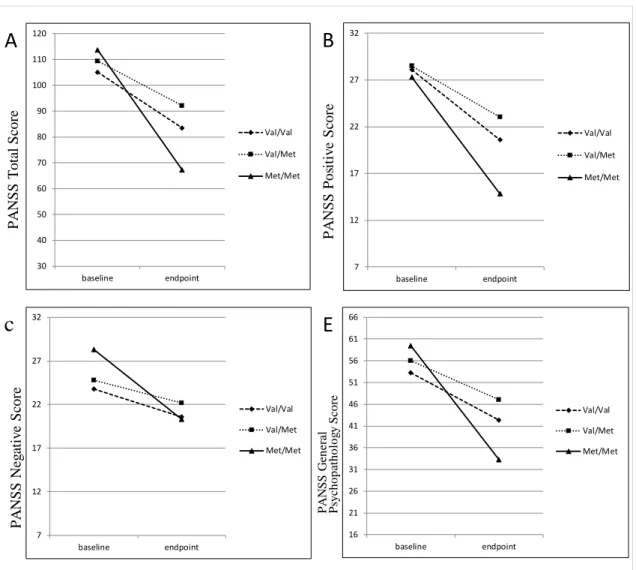
PANSS total (p < 0.001) and positive (p < 0.001) and negative (p < 0.001) scores
(Figure 1). There were significant genotype - time interactions on PANSS total (p =
0.009) and general psychopathology (p = 0.007) scores, with Met/Met genotype
showing greater improvement (Figure 1). We also found a trend level genotype - time
interaction in the PANSS negative score (p = 0.065).
We found a significant time effect on plasma MHPG levels (p = 0.009), but no time
effect was found for plasma HVA levels (p = 0.756) or time - genotype interactions on
plasma levels of HVA (p = 0.21) or MHPG (p = 0.47).
18 Table 1. Comparisons among the three genotypes
Val/Val group (n=23)
Val/Met group (n=13)
Met/Met group (n=4)
p value
at baseline
age (years) 41.6±11.9 43.5±14.2 35.7±2.1 0.621
asex, male/female 13/10 9/4 3/1 0.648
bduration of illness (years) 10.0±9.6 13.7±14.2 8.0±7.0 0.576
aPANSS total 105.1±13.2 109.5±15.1 113.8±10.6 0.412
aPANSS positive 28.1±4.9 28.5±3.5 27.3±2.5 0.867
aPANSS negative 23.8±5.6 24.8±6.4 28.3±6.5 0.390
aPANSS general 53.2±7.7 55.9±9.3 59.5±7.2 0.305
aCGI-Severity 5.5±0.5 5.5±0.8 5.5±0.6 0.983
aplasma HVA level (ng/ml) 17.0±7.1 19.1±7.9 14.1±5.6 0.455
aplasma MHPG level (ng/ml) 11.3±5.3 13.9±7.6 7.9±3.3 0.195
aat endpoint
dose of aripiprazole (mg/day) 22.0±7.4 26.8±4.0 26.0±3.5 0.097
aResponders/non-responders 10/13 3/10 3/1 0.157
bPANSS total 83.5±17.8 92.2±22.1 67.3±24.0 0.094
aPANSS positive 20.6±6.5 23.0±7.0 14.8±5.9 0.107
aPANSS negative 20.6±5.5 22.2±6.8 20.3±9.2 0.734
aPANSS general 42.3±8.1 46.9±11.8 33.3±12.3 0.058
aCGI-Severity 3.8±1.4 4.2±1.4 2.5±1.7 0.119
aCGI-Improvement 2.7±1.1 3.0±1.1 1.5±1.0 0.061
aplasma HVA level (ng/ml) 16.8±11.0 15.4±7.4 19.6±10.6 0.759
aplasma MHPG level (ng/ml) 7.9±3.3 8.6±3.9 6.5±1.9 0.552
aPANSS, Positive and Negative Syndrome Scale; CGI, Clinical Global Impression;
HVA, homovanillic acid; MHPG, 3-methoxy-4hydroxyphenylglycol.
a
One-way analysis of variance (ANOVA)
bPearson’s χ2 test
19
Supplementary Table 1. Comparisons between responders and non-responders Responders
(n=16)
Non-responders (n=24)
p value
at baseline
age (years) 40.3±12.0 42.9±12.1 0.644
asex, male/female 8/8 17/7 0.182
bduration of illness (years) 11.8±11.1 10.9±11.2 0.981
aPANSS total 107.1±9.2 107.6±16.1 0.053
aPANSS positive 27.5±3.8 28.6±4.5 0.750
aPANSS negative 24.9±4.2 24.4±6.9 0.080
aPANSS general 54.6±7.3 54.8±9.0 0.359
aCGI-Severity 5.6±0.5 5.5±0.7 0.214
aplasma HVA level (ng/ml) 17.1±6.5 17.6±7.8 0.466
aplasma MHPG level (ng/ml) 11.5±6.0 12.0±6.3 0.608
aat endpoint
dose of aripiprazole (mg/day) 21.3±6.2 26.4±5.7 0.618
aGenotype groups
(ValVal / ValMet / MetMet)
10/3/3 13/10/1 0.157
bPANSS total 67.8±10.1 96.0±17.9 0.046
aPANSS positive 15.1±3.2 24.5±5.9 0.009
aPANSS negative 17.8±2.9 23.3±6.9 0.020
aPANSS general 34.9±5.5 48.3±9.2 0.056
aCGI-Severity 2.6±0.7 4.7±1.2 0.006
aCGI-Improvement 1.5±0.5 3.5±0.5 0.000
aplasma HVA level (ng/ml) 12.7±3.7 19.3±11.5 0.006
aplasma MHPG level (ng/ml) 6.3±1.8 9.1±3.8 0.004
aPANSS, Positive and Negative Syndrome Scale; CGI, Clinical Global Impression;
HVA, homovanillic acid; MHPG, 3-methoxy-4hydroxyphenylglycol.
aStudent’s
t test (unpaired)
bPearson’s χ2 test
20
PANSS Total Score PANSS Positive Score
PANSS Negative Score PANSS General Psychopathology Score
A B
c E
FIGURE 1. A Mean change in PANSS Total, Positive, Negative and General Psychopasology Scores at baseline and 6 weeks.
A, genotype ×time interactions on PANSS Total Score (F = 5.296; p = 0.009). B, genotype ×time interactions on PANSS Positive Score (F = 2.493; p = 0.096). C, genotype ×time interactions on PANSS Negative Score (F = 2.941; p = 0.065). E, genotype ×time interactions on PANSS General psychopathology Score (F = 5.741; p = 0.007) .
16 21 26 31 36 41 46 51 56 61 66
baseline endpoint
Val/Val Val/Met Met/Met 7
12 17 22 27 32
baseline endpoint
Val/Val Val/Met Met/Met
30 40 50 60 70 80 90 100 110 120
baseline endpoint
Val/Val Val/Met Met/Met
7 12 17 22 27 32
baseline endpoint
Val/Val Val/Met Met/Met