• 検索結果がありません。

Analysing the Reliability of Vocabulary Practice Tests

N/A
N/A
Protected

Academic year: 2021

シェア "Analysing the Reliability of Vocabulary Practice Tests"

Copied!
15
0
0

読み込み中.... (全文を見る)

全文

(1)

Kayoko Kinshi

1.Introduction

      Vocabulary  knowledge  plays  an  important  role  in  language  learning.  In  order  to  discover the meaning and usage of the word, it is useful to use English paper/electronic  dictionaries.  However,  the  second  language  learners  in  Japan  tend  to  almost  entirely  use bilingual English dictionaries in their study. For one thing, it is easy to have a quick  look at the meaning of the corresponding word in Japanese; for another, even if they try  to  use  monolingual  dictionary  to  look  up  the  unknown  word,  they  often  fi nd  it  diffi   cult  to  understand  English  defi nitions  of  it.  This  is  because  of  the  lack  of  their  knowledge  of  basic  defining  words,  which  are  essential  in  order  to  use  monolingual  English  dictionaries.  According  to  Nation  (2008:  114),  in  order  for  learners  to  use  monolingual  dictionary, they need to have a vocabulary of at least 2,000 words. This is because of the  fact that the number of defi ning vocabulary items used in the monolingual dictionary is  around 2,000. Therefore, the Japanese university need to learn the defi ning vocabulary  items to fi ll the gap, and this in turn necessitates the development of vocabulary practice  test for learning defi ning vocabulary.

      This  paper  discusses  the  reliability  of  the  vocabulary  practice  tests  which  are  developed for university students in Japan. The word items in these tests are exclusively  designed  for  learning  the  defi ning  vocabulary  used  in  monolingual  English  dictionaries. 

The  notion  of  reliability  is  referred  to  as  the  consistency  of  the  scores  obtained   (Fraenkel,  J.  R.,  &  Wallen,  N.  E.  1993:  146).  If  a  test  keeps  giving  the  same  result  for  the  same  participant  over  time,  it  can  be  said  to  serve  the  purpose  of  reliability.  In  this  paper,  the  following  two  points  are  mainly  discussed:  the  design  of  the  revised  vocabulary  tests  that  would  make  the  tests  reliable,  and  the  statistical  results  of  test  scores gained from using SPSS.

      Section  2  overviews  the  background  of  the  vocabulary  practice  tests,  and  some  of 

their  statistical  results.  Section  3  begins  by  addressing  the  process  of  revising  the 

(2)

vocabulary test, and presents the test procedures. Section 4 analyses the fi ndings, mainly  focusing on the results from statistic data. Section 5 discusses the features of the revised  vocabulary  tests  and  statistical  results  in  terms  of  reliability.  Finally,  the  conclusion  gives a brief summary and suggestions for further study.

2.Preceding Study

      The  design  of  the  vocabulary  tests  discussed  in  this  paper  begins  with  an  idea  of  compiling a list of vocabulary item for Japanese university students to learn (Kinshi 2009; 

Okada  et  al.  2009).  The  list  was  made  with  the  defi ning  vocabulary  listed  in  two  of  the 

three major English monolingual dictionaries:   

(2000),    (1995),  and 

  (2000).  Out  of  a  total  of  384  headwords,  such  non- content  words  as  numerals,  pronouns,  and  auxiliaries  were  deleted,  resulting  in  300  content  words.  The  300  word  items  are  then  developed  into  two  types  of  fill-in-the- blank tests, a cloze type and a paraphrase type, each of which has 5 tests with 60 words  respectively (totaling 10 tests). Each sheet of the two series of fi ve vocabulary practice  tests ( VP 2008  hereafter) is designed to test 60 words, half of which are devised to be  chosen as answers, and the other half are distracters. In the classroom, a list of 60 words  is distributed two weeks before the VP 2008 is conducted. As Matsui et al. (2004: 101)  reports, one of the eff ective way for learners to study vocabulary is to present  a clearly  defined  word  list  .  .  .  along  with  concrete  steps  toward  achieving  the  study  target.  

Moreover, Nation (2001: 74) mentions that repetition is important to vocabulary learning  in that it  adds to the quality of knowledge and also to the quantity or strength of this  knowledge.   Therefore,  if  learners  take  two  types  of  the  VP  2008  with  the  same  300  words, they are bound to expand their vocabulary knowledge.

   Examining the results of the VP 2008 conducted on 178 Japanese students, Okada et 

al. (2009) reveals that there is an overall score improvement in the second series (i.e., a 

paraphrase type) over the fi rst series (i.e., a cloze type). The mean score of each series 

rises  from  25.46  to  26.75,  out  of  30.  The  Pearson  correlation  coefficient  between  the 

mean scores of the two series is .81 (p<.001), which is highly correlated. Moreover, they 

conduct  the  C-Tests  (the  Pre-and  Post-Test,  respectively),  which  are  developed  by  the 

Writing Research Group of the JACET Kansai Chapter (1995, 1998). The C-Test consists 

(3)

of 4 paragraphs of 48-65 words, in which the last half of every other word is missing as  shown in  Take off your shoes when you enter a Japanese house.  The students need  to fi ll in the underlined part, which is devised to answer the half, or half plus one letter  of each test word. The students have to identify the word form (singular-plural, present- past, etc.) as well as the meaning to fi ll in the blank. Each C-Test is scored out of 100 (two  points for 50 items each). For such responses that are correct in meaning but contain a  structural error, half of a mark (one point) is subtracted from the score.

      As  the  result  of  the  tests,  the  correlation  coefficients  between  the  two  series  of  mean  scores  of  the  VP  2008  and  the  two  C-Tests  (the  Pre-and  Post-Test)  are  .59  and  .68  (p<.001)  respectively,  which  represent  moderately  high  correlation  figures.  These  results would be more highly correlated if the test format of the VP 2008 and the C-Test  were  designed  to  assess  the  similar  vocabulary  ability.  That  is,  whilst  the  former  is  categorized as a  relatively decontextualized  test where context is  largely eliminated,   the  latter  measures  controlled  productive  ability   in  which  there  is  a  clear  need  to  make use of contextual clues  (Okada et al. 2009: 12). Therefore, in order to assess the  aspects of such word knowledge as the infl ectional or derivational forms of words, with  the two types of the tests, i.e., the vocabulary test and the C-Test, the VP 2008 should  be revised to make it a more context-dependent test.

   This study is designed to address the following two research questions:

⑴ Is there any improvement in students  scores of the C-Tests?

⑵  Are there any signifi cant relationships between the revised vocabulary tests and the  C-Tests?

3.Method

3. 1  The Design of the Revised Vocabulary Practice Test

      In  response  to  the  results  of  the  study  in  the  previous  section,  the  VP  2010  was 

developed  as  a  revised  version.  The  purpose  of  the  tests  is  to  design  more  context-

dependent  tests,  in  which  the  learners  have  to  fi ll  in  the  incomplete  words  using  the 

context clues and initial letters. The new version, the VP 2010, diff ers from the previous 

one in the following points: (1) the number of words in each list is reduced from 60 to 

30; (2) each test is composed of 15 cloze type and 15 paraphrase type items, resulting in 

10 tests with 30 words each; (3) 74 out of 300 words (about 25%) in the lists are changed 

(4)

into other forms on the word lists, for example   instead of  , or     for    .

   The signifi cant diff erence between the VP 2010 and the VP 2008 is that the revised  version  is  not  a  multiple  choice  type,  but  a  fi ll-in-the-blank  one,  supplying  the  missing  latter words. In addition, the initial letters are listed at random for every fi ve questions. 

When taking the test, the learners would need to pay careful attention to the sentence  context and not just use the initial letters alone as the clue for fi nding the correct words. 

A sample test from the VP 2010 is shown in Figure 1 below.

[The Cloze Type]

con       1. If you re feeling cold here in the garden, we can go [     ].

cra      2. If you think that today s topic does not [     ] you, you do not have to stay.

indo      3. Tom is not a good student. He is too [     ] to do his homework.

la      4. I heard a loud [     ] outside. I thought there was a car accident.

wed      5. I have been invited to my friends  [     ] next week.

[The Paraphrase Type]

bact      1. not knowing where you are or what is happening around you ble      2. very small living things that sometimes cause disease ch       3. the bottom part of your face, below your mouth

cont      4. an offi   cial writing agreement between two or more people uncon      5. to lose blood

 Figure 1 Sample Tests from VP 2010

3. 2  Test Procedure

   The participants are 45 fi rst- and second-year university students in Japan. They are  all English majors and enroll in the English grammar class. While doing some grammar  exercises  in  the  textbook  and  writing  a  short  paragraph  using  the  topic  they  learned,  they  are  working  for  the  vocabulary  practice  tests  during  the  semester.  Vocabulary  practice  tests  (VP  2010)  are  conducted  every  week  during  the  semester;  that  is,  one  test  sheet  with  30  words  each,  for  10  weeks.  In  order  for  students  to  prepare  for  the  tests in advance, they were given an alphabetically-ordered list of 30 words each week. 

In addition, a sample test sheet is presented, letting them know that, for preparation, it 

is necessary to consult the monolingual English dictionaries and to check the defi nition, 

usage,  and  word  family  of  the  words  on  the  list.  Vocabulary  tests  are  conducted  two 

weeks  after  they  receive  the  word  list.  The  students  are  allowed  to  work  for  10-15 

minutes  on  each  test,  which  is  scored  out  of  30.  At  the  completion  of  the  test,  they 

(5)

score  each  other s  responses,  allowing  them  to  immediately  check  their  errors.  Then  the instructor collects the test sheets in order to check the word items that receive the  lower scores. Such items are presented to the students the following week, with some  explanations by the instructor.

      In  order  to  measure  the  depth  of  the  students   vocabulary  knowledge,  the  C-tests,  which  are  the  same  ones  in  the  previous  section,  are  conducted  at  the  beginning  and  at  the  end  of  the  semester.  The  time  limit  for  each  C-Test  is  15  minutes.  The  tests  collected and scored by the instructor are returned to the students to check the errors  on both occasions. At the end of the term (the week 15), the personal fi les including the  10  test  scores,  the  two  C-Tests  scores,  and  mean  scores  of  each  test,  are  delivered  to  each student to monitor their improvement.

4.Results

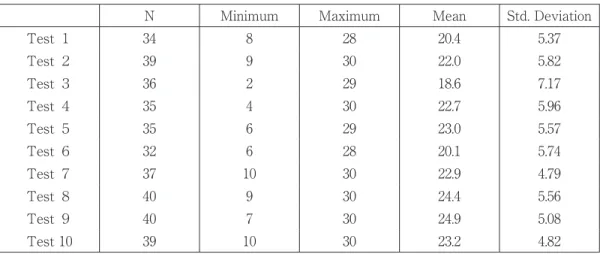
   First, Table 1 shows the mean scores and standard deviation for each of the 10 tests  of the VP 2010. Comparing each of the 10 tests, the result of Test 3 seems diff erent; the  mean score is 18.6 out of 30 points, which is relatively low, and its standard deviation is  7.17, which indicates that the distribution of Test 3 is widely spread out from the mean,  compared to the other 9 tests. However, Cronbach s alpha coeffi   cient among the mean  scores of the 10 series is quite high (α= .97). Therefore, it can be said that there is high  internal consistency among the 10 tests.

Table 1 Scores and Standard Deviation of VP 2010 (10 tests)

N Minimum Maximum Mean Std. Deviation

Test 1 34 8 28 20.4 5.37

Test 2 39 9 30 22.0 5.82

Test 3 36 2 29 18.6 7.17

Test 4 35 4 30 22.7 5.96

Test 5 35 6 29 23.0 5.57

Test 6 32 6 28 20.1 5.74

Test 7 37 10 30 22.9 4.79

Test 8 40 9 30 24.4 5.56

Test 9 40 7 30 24.9 5.08

Test 10 39 10 30 23.2 4.82

(6)

   Next, Table 2 indicates the mean scores and standard deviation for the Pre-and Post- C-Tests.  It  is  apparent  that  the  mean  score  of  the  Post-C-Test  increases  by  8.4  (=75.1- 66.7). The standard deviation of the Post-C-Test (14.59) is smaller than that of the Pre-C- Test (18.26), which shows the distribution of the Post-C-Test scores is more concentrated  around  the  mean  score.  In  addition,  the  result  of  the  Pearson  correlation  coefficient  between  the  scores  of  two  C-Tests  is  .67  (p<  .001),  and  Cronbach s  alpha  coefficient  results in an adequate level (α= .79).

Table 2 Scores and SD of Pre-and Post-C-Tests

N Minimum Maximum Mean Std. Deviation

Pre-C-Test 42 20 96 66.7 18.26

Post-C-Test 42 34 96 75.1 14.59

   As shown in Figure 2, boxplots represent the distribution of the Pre-and Post- C-Test  scores. From the graph, the median of the Post-C-Test is higher, and the bottom whisker  is  shorter  than  that  of  the  Pre-C-Test.  It  can  be  said  that  some  students  with  lower  scores in the Pre-C-Test made progress even though there still exist some outliers for  each C-Test.

Figure 2 Boxplots of Pre-and Post-C-Tests

(7)

      Before  analysing  the  diff erences  between  these  tests,  the  normality  of  these  three  tests  is  examined  fi rst.  Figure  3  depicts  the  distribution  of  the  mean  scores  of  the  VP  2010.  Table  3  and  Table  4  show  the  descriptive  data  and  the  results  of  the  normality  tests of the VP 2010 respectively.

Figure 3 Histogram of the mean scores of VP 2010  

Table 3 Descriptive Data of VP 2010

Statistic Std. Error

vptest Skewness −.928 .354

Kurtosis    .011 .695

Table 4 Tests of Normality (VP 2010)

Kolmogorov-Smirnov

a

Shapiro-Wilk

Statistic df Sig. Statistic df Sig.

vptest .166 45 .003 .910 45 .002

a. Lilliefors Signifi cance Correction

      In order to identify the normality of the graph in Figure 3, the value of skewness and 

that of kurtosis of this data have to be checked. The value of skewness is −.928, and the 

(8)

standard error of skewness is .354. When the value of skewness falls within the range of  normality in which the standard error is multiplied by 2 and also within plus or minus of  that value, the data is normally distributed. In this case, however, the value of skewness is  not included in the range of standard error of skewness (i.e., from −.708 to +.708), therefore,  the distribution of skewness is not normal. Following the same process, the value of kurtosis  is .011, whilst the standard error of kurtosis is .695. In addition, the value of kurtosis does  not fall within the range (i.e., from −1.39 to +1.39), which indicates that the distribution of  kurtosis is not normally distributed. Furthermore, the result of the Kolmogorov-Smirnov test  is signifi cant at the p=.003 level, which also shows that this data is not normally distributed  and a non-parametric test can be applied to test this data.

   Figure 4 is the histogram of the Pre-C-Test. This graph does not seem to be normally  distributed. Table 5 represents the descriptive data and Table 6 shows the results of the  normality tests of the Pre-C-Test. Examining the normality from the descriptive data, the value  of skewness is −.570 and the standard error of skewness is .365, which shows that the value  of skewness is within the normality range (i.e., from −.730 to +.730). In addition, the value of  kurtosis is .216 and the standard error of kurtosis is .717, indicating that the distribution of  kurtosis is normal (i.e., from −1.43 to +1.43). Moreover, the result of the Kolmogorov-Smirnov  test is not signifi cant (p=.200), therefore, this data is normally distributed and a parametric test  can be applied to this data.

Figure 4 Histogram of the Pre-C-Test

(9)

Table 5 Descriptive Data of Pre-C-Test

Statistic Std. Error

prectest Skewness −.570 .365

Kurtosis    .216 .717

Table 6 Tests of Normality (Pre-C-Test)

Kolmogorov-Smirnov

a

Shapiro-Wilk

Statistic df Sig. Statistic df Sig.

prectest .082 42 .200* .961 42 .155

*. This is a lower bound of the true signifi cance.

a. Lilliefors Signifi cance Correction

   Lastly, Figure 5 shows the distribution of the Post-C-Test. Table 7 and Table 8 represent  the descriptive data and the results of the normality tests of the Post-C-Test. The value  of skewness is −.911 whereas the standard error of skewness is .365. The distribution of  skewness does not fall within the normality range (i.e., from −.730 to +.730). However, the  value of kurtosis is .541 and the standard error of kurtosis is .717 (i.e., from −1.43 to +1.43),  which means that the value of kurtosis is normally distributed. Furthermore, no signifi cant  diff erences can be found according to the Kolmogorov-Smirnov test (p=.200), which proves  to be a normally distributed data.

Figure 5 Histogram of the Post-C-Test

(10)

Table 7 Descriptive Data of Post-C-Test

Statistic Std. Error

postctest Skewness −.911 .365

Kurtosis    .541 .717

Table 8 Tests of Normality (Post-C-Test)

Kolmogorov-Smirnov

a

Shapiro-Wilk

Statistic df Sig. Statistic df Sig.

postctest .109 42 .200* .932 42 .015

*. This is a lower bound of the true signifi cance.

a. Lilliefors Signifi cance Correction

      After  examining  and  confirming  the  normal  distribution  of  each  set  of  data,  the  specifi c type of statistical measurement can be used to analyse them. Since the VP 2010  data is not normally distributed, a non-parametric measurement is applied. On the other  hand, the distributions of the two C-Tests are normal, so a parametric test is used.

   In order to determine if there are statistical diff erences between the two C-Tests (the  Pre-and Post-Tests), a paired samples t-test, which is one of the types of parametric test,  is conducted. The result of this data is shown in Table 9.

Table 9 Paired Samples T-Test of Pre-and Post-C-Tests Paired Diff erences

t df Sig. 

(2-tailed) Mean Std. 

Deviation Std. Error  Mean

95% Confi dence Interval  of the Diff erence

Lower Upper

Pair prectest− 

1   postctest −8.487 13.605 2.179 −12.897 −4.077 −3.896 38 .000

      The  diff erence  between  the  Pre-and  Post-C-Tests  is  found  to  be  signifi cant  (t=-3.90,  df=38, p=.001). This means that there are signifi cant statistical diff erences between the  two C-Tests, which means that the students made progress in their C-Test scores.

   Next, in order to identify the relationship between the VP 2010 and the Pre-and Post- C-Tests, the correlation coeffi   cients of these three scores are examined. As a measuring  method, Spearman s rho, a non-parametric correlation, is used. As shown in Table 10, the  correlation coeffi   cient between the scores of the Pre-and Post-C-Tests is high (ρ= .621). 

Also, the correlation coeffi   cients between the scores of the VP2010 and the two C-Tests 

(the  Pre-and  Post-Test)  are  .477  and  .625  respectively,  which  show  that  the  correlation 

(11)

fi gures became higher between the VP 2010 and the Post-C-Test. Moreover, Cronbach s  alpha coeffi   cient among the mean scores of these three tests results in an adequate level  (α= .71). These results need to be analysed in more detail to check if there are signifi cant  statistical diff erences among these tests.

Table 10 Correlations of Pre-and Post-C-Tests and VP 2010 Pre-C-Test Post-C-Test VP 2010

Pre-C-Test ― .621** .477**

Post-C-Test ― .625**

VP 2010 ―

**. Correlation is signifi cant at the 0.01 level (2-tailed).

5.Discussion

5. 1  The Design of VP 2010

   In the process of developing a test design, it is important to set up the purpose of the  test. With regard to creating a vocabulary test, Read (2000) proposes three dimensions  where the scope of vocabulary assessment can be explained in a contrasting way. The  fi rst  dimension  is  concerned  with  the  construct,  or  vocabulary  knowledge,  of  the  test. 

For  measuring  a  distinct  construct,  a  discrete  test  is  used,  while  an  embedded  test  is 

utilized  for  assessing  broad  construct  such  as  writing  ability.  The  second  dimension  is 

related to the assessment of the range of vocabulary. When the knowledge of the specifi c 

word items is assessed, it is a selective vocabulary measure. On the other hand, when 

the whole word items of the materials are measured, it is a comprehensive one. Lastly, 

the  last  dimension  is  connected  to  the  role  of  context.  If  the  vocabulary  knowledge  is 

assessed  with  no  reference  to  the  context  in  the  test,  it  is  context-independent.  If  the 

test  taker s  ability  to  produce  words  is  assessed  with  reference  to  the  context,  it  is 

context-dependent. When the concept of three dimensions is applied to the VP 2010, the 

revised version is classifi ed as discrete and selective, in that the vocabulary knowledge 

is  measured  separately  from  other  components  of  language  ability,  and  its  assessment 

is based on a set of selected target words from the defi ning vocabulary. As for the last 

dimension,  it  should  be  relatively  context-dependent.  Although  there  is  a  debate  as  to 

whether  cloze  tests  are  classified  as  context-independent  or  context-dependent  (Read 

2000: 12), the degree of context dependence is determined by the design of the test itself. 

(12)

The VP 2010 is designed in such a way that the test takers are expected to complete  the missing letters referring to the context as a clue, which would make the test more  context dependent.

      As  for  the  evaluation  of  the  vocabulary  tests,  Nation  (2008)  presents  the  reliability  as  one  of  the  features  of  good  tests.  According  to  Nation  (2008:  153),  the  details  of  the  conditions of reliability are as follows: (a) the test contains at least 30 items or points of  assessment; (b) the test format is familiar to the learners because they have taken such  a test before; (c) the instructions and way of answering are the same in all versions of  the test; (d) the marking uses a marking key and criteria that take account of the most  possible  variations  in  answering.  When  applied  to  the  VP  2010,  each  test  sheet  has  30  word  items  to  be  assessed.  Since  the  sample  test  is  presented  to  the  students  before  taking the test, the test format is familiar to them. Moreover, the same type of test is  conducted to test the 30 word items every week. Lastly, the VP 2010 is designed with  only one possible correct answer by referring to the initial letters of the word and the  context, so it does not allow any alternative response. In terms of fulfi lling the conditions  above, it can be said that the VP 2010 is reliable when it is properly used for its purpose.

5. 2  Findings from Statistic Results

      The  three  tests  (VP  2010,  Pre-and  Post-C-Tests)  are  examined  and  statistic  results  are  obtained  in  section  4.  As  for  the  VP  2010,  considering  the  fact  that  Cronbach s  alpha coeffi   cient among the mean scores of the VP 2010 is quite high (α= .97), it seems  possible  that  each  of  the  10  test  scores  is  consistent.  Comparing  the  Pre-and  Post-C- Tests,  the  mean  score  of  the  Post-C-Test  increases  (i.e.,  from  66.7  to  75.1),  and  also  the  results  of  the  standard  deviation  show  that  the  distribution  of  the  scores  is  more  concentrated around the mean score in the Post-C-Test (i.e., from 18.26 to 14.59).

      With  regard  to  research  question  (1),  the  results  of  a  paired  samples  t-test  indicate  that there is a signifi cant diff erence between the Pre-and Post-C-Tests. This result may  be  explained  by  the  fact  that  after  working  on  the  vocabulary  tests  for  10  weeks,  the  participants  became  accustomed  to  the  tests  in  which  they  have  to  use  the  context  as  a  clue.  Moreover,  the  participants  might  have  learned  to  pay  more  attention  to  the  infl ectional or derivational forms of words with the VP 2010. Therefore, the participants  in this study made an improvement in their scores of the Post-C-Tests.

      Another  important  fi nding,  regarding  research  question  (2),  is  that  the  correlations 

(13)

among  these  three  tests  (VP  2010,  Pre-and  Post-C-Tests)  indicate  moderately  high  correlations. A possible explanation for this might be that the C-Tests and the VP 2010  are  similar  in  their  test  format  compared  to  the  former  version,  VP  2008.  Both  test  types are designed to measure the controlled productive ability of vocabulary. However,  correlations obtained from these tests are not very high, though not too low. The reason  for  this  is  that  whilst  the  participants  are  encouraged  to  study  the  test  items  and  prepare for the vocabulary test every week, there is no time allowed for preparing for  the  C-Tests;  also  the  participants  need  to  respond  using  their  whole  word  knowledge,  which makes the C-tests more diffi   cult and challenging tests.

      Judging  from  these  findings,  the  revised  VP  2010  is  reliable  in  that  each  test  has  consistent results and there are positive correlations between the Pre-and Post-C-Tests,  and lastly, the scores of the Post-C-Tests improved signifi cantly.

6.Conclusion

      The  present  study  is  designed  to  examine  the  reliability  of  the  revised  vocabulary  practice  tests.  After  reviewing  the  previous  study  on  the  VP  2008,  the  process  of  development  of  the  revised  VP  2010  is  presented.  Then,  from  the  viewpoint  of  design,  the  VP  2010  is  a  more  context-dependent  test  to  assess  learners   productive  word  knowledge. Moreover, by examining and analysing the statistic data from the VP 2010  and  the  C-Tests,  the  study  has  shown  that  there  are  significant  differences  among  these  three  tests,  and  the  eff ects  of  the  VP  2010  are  refl ected  in  the  learners   score  improvement in the Post-C-Test. Taken together, these results suggest that the VP 2010  is a reliable vocabulary instruction tool, which will encourage the learners to study the  defi ning vocabulary and also develop their productive word knowledge.

   The fi ndings in this study are subject to the following two limitations. First, as Nation 

(2008)  suggests,  a  good  vocabulary  test  has  to  meet  the  requirement  of  validity,  and 

practicality  along  with  reliability.  Considering  the  fact  that  it  does  not  take  long  to 

take  the  test,  it  is  easy  to  mark,  and  the  score  is  easy  to  interpret,  the  VP  2010  is  a 

practical test. In addition, in order to fulfi ll the condition of validity, careful analyses are 

required.  Since  reliability  and  validity  are  dependent  on  the  context  in  which  a  test  is 

used, closer examination of the VP 2010 is necessary. Another limitation is the number 

of participants. In this study, the number of participants is 45, which is rather small for 

(14)

analysing the data. If there were more participants, the results of the correlations could  be  affected,  and  there  would  be  more  opportunities  to  prove  the  strong  relationship  between the test scores.

   In order to examine the VP 2010 in more detail, further research needs to be done  to  analyse  the  productive  knowledge  of  the  participants.  For  example,  by  collecting  their  writing  samples  and  analysing  the  lexical  diversity  in  their  writing,  a  signifi cant  difference  might  be  found  between  the  tests  and  the  writing  samples.  In  addition,  it  would  be  useful  to  compare  the  results  of  the  vocabulary  practice  tests  with  those  of  such  established  tests  as  the  Vocabulary  Levels  Test.  Since  such  kind  of  tests  are  widely used in the ESL context and fulfi ll the conditions of reliability and validity, more  precise  results  would  be  available  in  analysing  the  data.  Moreover,  it  is  important  to  conduct  a  questionnaire  on  the  vocabulary  practice  activities  with  the  series  of  word  lists.  Examining  the  learners   responses,  their  attitudes  towards  vocabulary  learning  would  be  revealed.  For  instance,  it  would  be  useful  to  check  whether  they  used  the  monolingual  English  dictionary  when  they  prepared  for  the  vocabulary  practice  test  every week. The fi ndings might be one of the factors that could aff ect the improvement  of  the  learners   vocabulary  knowledge.  Also,  those  fi ndings  would  be  of  great  help  to  devise the method of vocabulary instruction in class. Through monitoring the learners   improvement, the instructors give the learners incentives to keep studying on a regular  basis. This may well contribute to the further development of the vocabulary instruction  materials in the future.

References

Fraenkel,  J.  R.,  and  Wallen,  N.  E.  (1993).  .  2nd 

edition. New York: McGraw-Hill Inc.

Kinshi, K. (2009).  Bringing  vocabulary  practice  into  active  use:  Towards  motivated  learning. 

, 8, 15-26.

Kinshi, K. (2011). A Questionnaire Survey Based on Vocabulary Practice Using English Monolingual 

Dictionaries.  , 9, 25-37.

Matsui,  S.,  Okada,  T.,  Ishihara,  K.,  &  Pavloska,  S.  (2004).  Toward  the  use  of  monolingual  English  dictionaries:  Building  knowledge  of  defining  vocabulary. 

, 7, 83-112.

Nation, I. S. P. (2001).  . Cambridge: Cambridge University 

Press.

(15)

Nation, I. S. P. (2008).  . Boston: Heinle.

Okada,  T.,  Ishihara,  K.,  Kinshi,  K.,  &  Pavloska,  S.  (2009).  Practice  Activities  with  Defining  Vocabulary: Making English Dictionary Entries More Accessible. 

, 12, 1-38.

Read, J. (2000).  . Cambridge: Cambridge University Press.

Writing  Research  Group,  JACET  Kansai  Chapter.  (Ed.).  (1995).  Teaching  writing  in  colleges  and  universities: A survey report.

Writing  Research  Group,  JACET  Kansai  Chapter.  (Ed.).  (1998).  Teaching  writing  in  colleges  and 

universities: Practical report.

Table 1 Scores and Standard Deviation of VP 2010 (10 tests)
Figure 2 Boxplots of Pre-and Post-C-Tests
Table 5 Descriptive Data of Pre-C-Test Statistic Std. Error prectest Skewness −.570 .365 Kurtosis    .216 .717 Table 6 Tests of Normality (Pre-C-Test) Kolmogorov-Smirnov a Shapiro-Wilk
Table 7 Descriptive Data of Post-C-Test Statistic Std. Error postctest Skewness −.911 .365 Kurtosis    .541 .717 Table 8 Tests of Normality (Post-C-Test) Kolmogorov-Smirnov a Shapiro-Wilk

参照

関連したドキュメント

I give a proof of the theorem over any separably closed field F using ℓ-adic perverse sheaves.. My proof is different from the one of Mirkovi´c

Keywords: continuous time random walk, Brownian motion, collision time, skew Young tableaux, tandem queue.. AMS 2000 Subject Classification: Primary:

In Section 13, we discuss flagged Schur polynomials, vexillary and dominant permutations, and give a simple formula for the polynomials D w , for 312-avoiding permutations.. In

Then it follows immediately from a suitable version of “Hensel’s Lemma” [cf., e.g., the argument of [4], Lemma 2.1] that S may be obtained, as the notation suggests, as the m A

This paper presents an investigation into the mechanics of this specific problem and develops an analytical approach that accounts for the effects of geometrical and material data on

The object of this paper is the uniqueness for a d -dimensional Fokker-Planck type equation with inhomogeneous (possibly degenerated) measurable not necessarily bounded

In the paper we derive rational solutions for the lattice potential modified Korteweg–de Vries equation, and Q2, Q1(δ), H3(δ), H2 and H1 in the Adler–Bobenko–Suris list.. B¨

While conducting an experiment regarding fetal move- ments as a result of Pulsed Wave Doppler (PWD) ultrasound, [8] we encountered the severe artifacts in the acquired image2.