Journal of Indian and Buddhist Studies Vol. 67, No. 3, March 2019 (54)
― 1096 ―
The Structure of the Second Avalokita Sūtra
in the Mahāvastu
S
ATŌYoshihiro
1.
Introduction
The Mahāvastu (Mv), which is an ancient Indian Buddhist text belonging to the Lokottara-vādins, contains two scriptures named Avalokita Sūtra, whose main subject is the por-trayal of the Buddha s defeat of Māra. The Second Avalokita Sūtra (SAS) also includes a description of the merits of śīlaskandha and stūpa worship. It is difficult to believe that this entire scripture (called Appendix of Mahāvastu in its colophon1)), which contains several themes was completed at once. There are two parallel texts: the Avalokana Sūtra (AS) quot-ed in the Śikṣāsamuccaya (Sikṣ) and the Tibetan version of Ārya
Avalokana-nāma-mahāyāna Sūtra (ĀAS). Some previous studies have commented on the relationship
be-tween these scriptures. Winternitz (1933: 245, note 1) considered the correspondence between the SAS and AS, stating that it was unlikely that AS quoted the SAS. Edgerton (1953: 8, § 1.47–48) and Jones (1952: 329, note 5) noted that these texts must have an ulti-mate original source. In particular, Jones asserted that such a work must have circulated under the title of Avalokita Sūtra or Avalokana Sūtra at one point. Sugimoto (1984) con-ducted a comparative study of the SAS and the Tibetan ĀAS, suggesting that some parallel verses on stūpa worship have been developed more in ĀAS. I believe that these views are reasonable. However, there are currently no studies that have analyzed the structure of the SAS. Therefore, in this paper, I will describe the structure of the SAS and indicate the path of its transformation.
2.
The Structure of the SAS
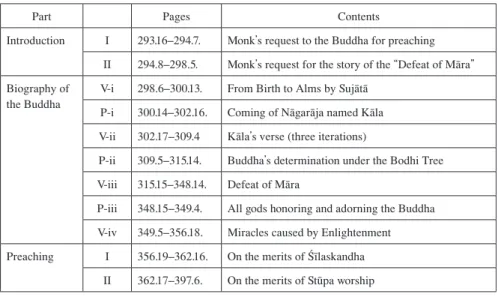
The structure and content of the SAS are shown in Table 1 below. Regarding the Biogra-phy of the Buddha part, the prose (P) and verse (V) portions are displayed separately in this table. The page numbers match Senart s Le Mahāvastu, vol. II.
(55) The Structure of the Second Avalokita Sūtra in the Mahāvastu (Satō)
― 1097 ―
AS parallels Preaching Part II in the SAS. The Tibetan ĀAS corresponds to Introduction Part I and Preaching Part II. Therefore, as mentioned by Jones (1952) and others, if we as-sume that these three scriptures had a prototype, it should have been composed of Intro-duction Part I and Preaching Part II. Moreover, we can assume that the remaining parts are additions. In particular, the Biography part and Introduction Part II, which introduces the Biography, could be regarded as additions to the SAS made with the same intention.
3.
Inconsistency of the Context in the Biography of the Buddha
In the Biography part, there are some inconsistencies in the context as follows. First, Kāla s verse (V-ii) has triple layers. There are two context breaks in Kāla s verse. The first break is in Mv II 304.5, and the second one is in Mv II 308.4. According to the context, un-til Mv II 304.4, the verses are written in the first person, as Kāla s remarks,2) and in 304.5, it is written that Nāgarāja Kāla, with great power, listened to unparalleled voice, accord-ing to the oldest palm leaf manuscript Sa.3) Here, a sudden change of viewpoint occurs. It is not known what or who the term unparalleled voice refers to in the context. Certainly, there is a context break. However, modern translations, i.e., Jones (1952) and Hiraoka (2010), do not indicate the first break; This is probably because they do not refer to
manu-Table 1 Structure and content of the SAS
Part Pages Contents
Introduction I 293.16–294.7. Monk s request to the Buddha for preaching II 294.8–298.5. Monk s request for the story of the Defeat of Māra Biography of
the Buddha
V-i 298.6–300.13. From Birth to Alms by Sujātā P-i 300.14–302.16. Coming of Nāgarāja named Kāla V-ii 302.17–309.4 Kāla s verse (three iterations)
P-ii 309.5–315.14. Buddha s determination under the Bodhi Tree V-iii 315.15–348.14. Defeat of Māra
P-iii 348.15–349.4. All gods honoring and adorning the Buddha V-iv 349.5–356.18. Miracles caused by Enlightenment Preaching I 356.19–362.16. On the merits of Śīlaskandha
(56) The Structure of the Second Avalokita Sūtra in the Mahāvastu (Satō)
― 1098 ―
script manuscripts. On the other hand, Jones (1952: 289, note 4) and Hiraoka (2010: 520, note 103) regarded the second one as a context break for the same reason that I mentioned above for the first one. Jones noted that the verses after Mv II 308.4 are an extract from an-other version of the story of Kāla. Second, it is unclear who is the narrator of the Biogra-phy part. Considering the context of Introduction Part II, the narrator must be the Buddha who is responding to the monk Visuddhamati.4) Accordingly, the Biography part should be written in the first-person perspective of the Buddha; instead, it is written in the third-per-son perspective. Such contextual inconsistency is observed regarding the narrator of the Biography part. Third, the vocative case, such as bhikṣavah. or bhikṣū/u (oh monks!) is never used in the Biography part except in P-iii,5) although such a vocative for the listeners of this story frequently occurs in Preaching Parts I and II. This contrast suggests that the origin of the Biography and Preaching parts is different. Finally, the order of all devas is not consistently determined. The SAS has some descriptions showing all devas in order, from the lowest to the highest. The descriptions of the order are inconsistent. The descrip-tions in P-ii and P-iii of the Biography part claim that the highest devas are Akaniṣṭha, while V-iv and Preaching Part II have descriptions that state that Śuddhāvāsa devas are the highest.6)
Considering above facts, it is clear that the Biography part is a mixture of some extracts from other scriptures.
4. Conclusion
The above discussion clarifies that the transformation from the prototype to the SAS oc-curred by adding Introduction Part II, the Biography part, and Preaching Part I. Further, it can be considered that the Biography part of the SAS is a mixture of several extracts from other scriptures, and these extracts provide an inconsistent context, as mentioned above. On the other hand, among the supplementary materials, Introduction Part II and Preaching Part I, which are the framework of this scripture, have no particular content inconsistency. We can see the contrast between inconsistent and consistent additions in the SAS.
Notes
1) Mv II 397.7: avalokitaṃ nāma sūtraṃ mahāvastusya parivāraṃ samāptaṃ (Sa 235a.6: sāptaṃ) // 2) Because Kāla s verse (V-ii) is introduced by the following sentence at the end of P-i, the context
(57) The Structure of the Second Avalokita Sūtra in the Mahāvastu (Satō)
― 1099 ―
claims that Kāla s verse (V-ii) is written as Kāla s remarks. See Mv II 302.14–16: atha khalu kālo nāgarājā ... gāthābhir(Sa 214b.1: *āhi) adhyabhāṣe //
3) Mv II 304.5–10: śruṇitvā atulaṃ ghoṣaṃ kālo nāgo maharṣiṇaḥ (Sa 214b.5: maharddhiko) / 4) Before the Biography part, it is mentioned that the storyteller is the Buddha. See Mv II 298.5: atha khalu bhagavāṃ tāye velāye imāṃ gāthām (Sa 212b.6: *lāye imā gāthā) abhāṣi //
5) In the Biography part, the vocative case is used only once for the monks who are listeners in P-iii. See Mv II 348.15–16: punar aparaṃ bhikṣū (Sa 224b.3: bhikṣu) tathāgato anuttarāṃ samyaksaṃbodhim abhisaṃbodhitvā (Sa 224b.3: abhisaṃbudhyitvā) saptāhapūraṃ ekaparyaṃkenātināmesi //
6) The description in P-ii is on Mv II 314.3–9, P-iii: Mv II 348.16–349.2, V-iv: Mv II 349.20–21, and Preaching Part II: Mv II 359.19–361.1
In addition to these, there is a description that enumerates the devas even in V-iii. This description is written in Mv II 319.4–8. However, in the manuscript Sa, the name of the highest deva to be placed next to Atapa and Sudarśana is not written.
Abbreviations
AS Avalokana-sūtra (Śikṣ 89.15–90.3; 297.10–309.4).
ĀAS Tibetan translation of Ārya Avalokana-nāma-mahāyāna Sūtra. Phags pa spyan ras rzigs shes bya
ba theg pa chen po i mdo. D no. 195 (tsa), P no. 862(mu).
Mv Le Mahāvastu, Ed. É. Senart. 3 vols. Paris: Imprimerie nationale, 1882–1897 (reprint, Tokyo:
Meicho Fukyū kai, 1997).
P Prose.
Sa Staatsbibliothek zu Berlin/Preußischer Kulturbesitz, Berlin: No. PSB2, pp. 211a.6–235.6. See Yuyama (2001).
SAS The Second Avalokita Sūtra (Mv II 293.16–397.7).
Sikṣ Śikṣāsamuccaya, Ed. C. Bendall. St. Petersburg: Commissionnaires de l Académie impériale des sciences, 1897–1902.
V Verse.
Bibliography
Edgerton, Franklin. 1953. Buddhist Hybrid Sanskrit Grammar and Dictionary. Vol. 1: Grammar. New Haven: Yale University Press.
Hiraoka Satoshi 平岡聡.2010. Buddha no ōinaru monogatari: Mahāvasutwu zen yaku (ge) ブッダの大い なる物語:マハーヴァストゥ全訳(下).Tokyo: Daizō Shuppan.
Jones, J. J. 1952. The Mahāvastu. vol. 2. London: PTS.
Sugimoto Takushū 杉本卓洲.1984. Indo buttō no kenkyū: Buttō sūhai no seisei to kiban インド仏塔の研 究:仏塔崇拝の生成と基盤.Kyoto: Hērakuji Shoten.
Winternitz, Maurice. 1933. Buddhist literature and Jaina literature. Translated from the original German by Mrs. S. Ketkar and H. Kohn, and revised by the author. Calcutta: University of Calcutta Press. Yuyama, Akira. 2001. The Mahāvastu-avadāna in Old Palm-leaf and Paper Manuscripts. 2 vols. Tokyo:
The Centre for East Asian Cultural Studies for UNESCO.
(This research was supported in part by JSPS KAKENHI Grant Number 17J03494.)
Key words Mahāvastu, Avalokita Sūtra, Defeat of Māra, Biographies of the Buddha