An objective evaluation method for assessing body response effects (changing skin temperature) of
washcloth friction stimulus (Part.1)
Ikuyo MANABE, Yukako YAMADA Ehime University Faculty of Education,
Osaka Kyoiku University Faculty of Education Home Economics Education
「繊維製品による皮膚摩擦刺激の生理学的評価法の試み(第1報)」
愛 媛 大 学 教 育 学 部 紀 要 第 56 巻 抜刷
平成 21 年 10 月
An objective evaluation method for assessing body response effects (changing skin temperature) of
washcloth friction stimulus (Part.1)
Ikuyo MANABE and Yukako YAMADA
Ehime University Faculty of Education,
Osaka Kyoiku University Faculty of Education Home Economics Education
「繊維製品による皮膚摩擦刺激の生理学的評価法の試み(第1報)」
(平成 21 年6月5日受理)
Summary
Though a cutaneous stimulus might be generated by friction from clothes, a method of objectively evaluating a dynamic cutaneous stimulus from a physiological respect has not yet been established.
This study focuses on changes in skin temperature caused by rubbing four different textiles against the skin. Four different kinds of washcloth (cotton, ramie, silk, and nylon) available on the market were used in the experiment. Three types of skin temperature reaction were observed in response to the friction stimulation: Type 1 - Sudden rise, Type 2 - Delayed rise, Type 3 - Insignificant change. Increases in temperature were observed over time, and the accumulated temperature values were calculated as the Total Skin Temperature Increment (TSI). This value specifies the degree of friction stimulation reflecting the temperature rise of the skin.
The relationship of this TSI value and a subjective value of Semantic Differential (SD) method was examined. A correlation between the four types of cotton samples and perceived pain of the participants who showed the Type 2 (Delayed rise) reaction was shown. The research method introduced in this study points to a possible new direction in objectively measuring cutaneous stimulus from a physiological
aspect.
Key Words: skin temperature, friction, Total Skin Temperature Increment, Semantic Differential method
1. Introduction
One source of skin trouble is the kinetic friction caused between the skin and the surface of a fiber product. It is common knowledge that this can be considerably unpleasant. (1) The degree of unpleasantness can be vague and is extremely difficult to estimate quantitatively though a person can easily recognize it subjectively. In order to objectively evaluate such a sense of unpleasantness, physiological responses that change alongside the generation of the unpleasant sense can be used as a method of measurement. Brain waves, electrocardiograms and blood pressure can be used as general evaluation indices, but such physiological measurements themselves influence a subject’s sense of unpleasantness.
The focus of this research paper is on the biological reactions of the human body caused by friction stimulation. Skin temperature is measured by non-
Ikuyo MANABE and Yukako YAMADA
contact thermography. Changing skin temperatures are influenced by autonomic nervous activity during friction stimulation to the skin. It is claimed that such skin temperature changes are an effective way to evaluate stimulation of the skin caused by friction with textiles, and that the method described in this paper can be used to assess such cutaneous textile stimulus.
2. Material and methods 2-1 Samples
Four kinds of washcloth available in the Japanese market were examined: cotton, ramie, silk and nylon (regular synthetic fiber or nylon/polyester). See Table 1 for details of their characteristics.
2-2 Friction test
A ‘movability friction examination machine’ was used for the friction test. The washcloth sample is installed in the slider and friction is applied to a 5mm2 area at a speed of 2,000 revolutions per minute. The friction test environment was 25±1℃ and 50±10%RH.
The subjects were 45 healthy female students aged 20 to 25 years old. The friction test site is on the skin on the inside part of the humerus. Before each test each subject rested for 30 minutes with their humerus uncovered. They then sat down at the examination machine as shown in Figure 1. The initial friction force load on the skin is measured with a strain measuring system that was initially adjusted to 10gf/
cm2 before the test began. The skin temperature before and after friction was applied was measured thermographically. The first thermograph was taken
15 seconds immediately after the friction application and subsequent changes in skin temperature were monitored every 15 seconds.
2-3 Research of friction test feeling
After the skin friction test ended subjects were asked to complete the SD feeling investigation questionnaire. This has seven possible evaluations:
±3: very, ±2: considerably, ±1: little, 0: neither. The terms used in the SD evaluation method are as follows: non-prickly-feeling, non-rough, itchy, painless, catchy, and comfortable.
2-4 Measuring the surface properties of the washcloth samples
A KES-FB4 automatic surface tester was used to measure the following surface characteristics: mean coefficient of friction (MIU); mean deviation of MIU (MMD); and, mean deviation of surface roughness (SMD). Compression values were measured with a KES-FB3 machine and bend values with a KES- FB2 machine (all supplied by Kato Tech Co, Ltd).
The surface characteristic values of each sample are shown in Table 2. The coefficient of friction, MIU, is largest in the silk sample, is similar in the cotton and ramie samples, and is smallest among the nylon samples.
3. Results and discussion 3-1 Change in skin temperature Table 1 Construction of samples.
Fig.1 Experimental device for the friction test.
Heat images and temperature graphs showing the skin before and after friction are shown. The four heat images show the skin temperature one minute before and two minutes after friction is applied.
The horizontal axis of the graph divides the skin temperature into six regions showing the ratio of each area in the subject over time. Three types of skin temperature change are shown in Figures 3-(a), (b),(c) and 4-(a),(b),(c). They are described in detail below.
3-1-1 Sudden rise(Type 1)
In Type 1 cases the temperature suddenly rises but soon returns to the resting skin temperature level.
Twenty two out of 45 subjects show this pattern.
Figure 2-1 shows temperature changes over time when friction is applied to cotton under the same conditions as the skin friction experiment. The temperature immediately rises with friction and falls when friction ceases. In this case, the rise of the surface temperature is thought to be the one of frictional heat origin. The sudden rise of Type 1 could be due to the influence of frictional heat that occurs between the skin and the various textiles.
3-1-2 Delayed rise(Type 2)
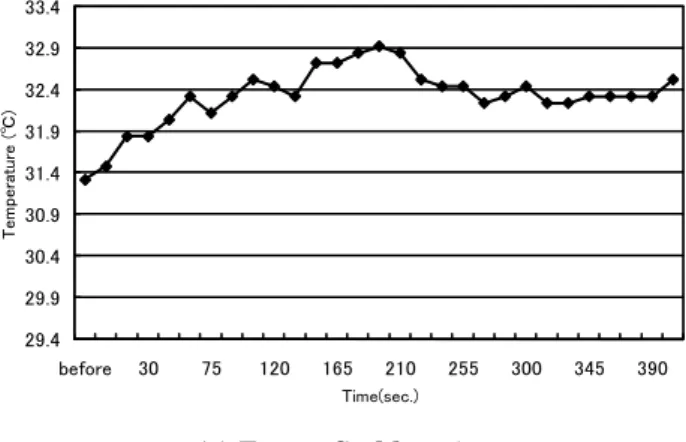
In the 18 Type 2 cases there is a gradual rise in skin temperature right after friction is applied, reaching a peak after two or three minutes. The highest temperature is then maintained and descends gradually. Moreover, the heat image shows that the rise in temperature extends beyond the friction area.
(a) Type.1 Sudden rise
Fig.2 Thermal image data of changes in the skin temperature after the friction test.
Fig.2 - (b) Type.2 Delayed rise (a) Type.1 Sudden rise
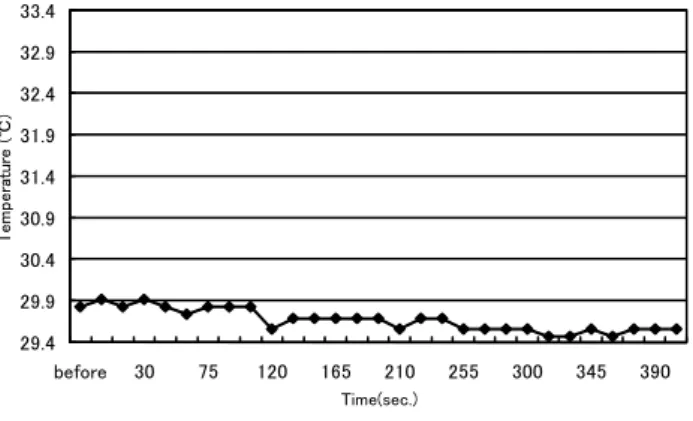
Fig.3 Changes in the skin temperature after the friction test.
Ikuyo MANABE and Yukako YAMADA
T h e m e c h a n i s m c a u s i n g t h e r i s e i n s k i n temperature can be considered as follows. When friction is applied the skin flushes. This originates in the production of the axon reflex in response to stimulation of the sensory nerves. Where the end of the afferent nerve of the spinal cord diverges afferent excitement caused by stimulation to the nerve endings bypasses the nerve centre, is transmitted from the nerve synapse to other nerves and a vasodilator reaction takes place. Flushing appears in and around the rubbed part of the skin 15 to 30 seconds after friction is applied. This causes a sense of pain in the C-afferent nerve in response to the cutaneous stimulus regardless of any excitation by chemical or mechanical means.
The friction stimulation spreads to the nerve synapses causing vasopressor discharge from the nerve endings to the stimulated area. Once vasopressor are discharged cutaneous blood vessels are stimulated and the skin flushes. 2) Flushing extends to the surrounding skin through enlargement of the arterioles. It is possible that skin friction with textiles causes this kind of phenomenon. The pattern diagrams of the axon reflex in Figure 2-(b) show the skin of a subject a Type 2 temperature rise.
The rise of skin temperature in Type 2 corresponds to the skin flushing phenomenon by the axon reflex.
It is possible that in Type 2 subjects the response of the sensory nerve is more acute than in Type 1 and friction causes subjects to flush more easily.
3-1-3 Insignificant change(Type 3)
Five subjects showed little or no change in skin temperature before and after friction. It is possible that the initial friction load of 10gf/cm2 was too low to effect these subjects and the resulting frictional heat was small.
Fig.3 - (b) Type.2 Delayed rise Fig.3 - (c) Mechanism of skin temperature rise by rubbing.
Fig.2 - (d) Type.3 Insignificant change
3-2 Calculation of Total Skin Temperature Increment The total accumulation of rise in skin temperature as a result of washcloth friction was calculated as an index. Skin temperature was measured at ten different points in the friction area. (Fig.4)
3-3 Research of friction test feeling
Figure 6 shows the mean values for SD of all subjects. The results show that the order of perceived stimulation, from high to low, was nylon, ramie, silk and cotton. Nylon was perceived as being especially stimulating while cotton was not; silk and ramie were seen as similar. All samples were seen as both rough and hard but none were evaluated as itchy or painful.
They were seen as suitable for washing one’s body.
Although the friction test revealed the order of stimulation as nylon, ramie, silk and cotton, the surface friction coefficient was in the order of silk, cotton, ramie and nylon. Therefore, it follows that the size of the surface friction coefficient of the washcloth is not reflected by the subjective evaluation of skin stimulation feeling.
3-4 Mechanism of skin temperature change by friction stimulation with a washcloth
There are three main factors affecting skin temperature change resulting from friction stimulation by textiles: (1) Change of environmental temperature. (2) Frictional heat that occurs as a result of friction between a textile and the skin. (3) Skin vasodilator reaction by friction stimulation.
Three types of skin temperature rise were observed with, for example, frictional heat being the main factor in the Type 1 pattern. The mean TSI value Fig.3 - (d) Type.3 Insignificant change
Fig.4 Frequency of Total Skin-Temperature Increment.
Fig.5 SD profile
Ikuyo MANABE and Yukako YAMADA
for each subject in each sample and each Type was compared with the mechanics characteristic value of each sample. Table 2 shows the TSI value (subject average) and surface property value of each Type for every sample. In Type 1, silk has the highest coefficient of friction and surface coarseness, and the TSI value is the biggest. In contrast, nylon has the lowest surface value and lowest TSI value.
It is possible that for Type 1 subjects (who show a rapid rise in skin temperature) frictional heat is the main factor contributing to the dynamic characteristics of the textiles, and that such subjects are easily affected by surface characteristics such as coefficients of friction. Regarding the relatively little change in Type 3 subjects it is thought that the main factor in skin temperature change is frictional heat.
But it is possible that for Type 3 subjects there is little rise in temperature3)and any frictional heat that does occur soon dissipates at low skin temperatures (less than 29℃). Initial skin temperatures are low and fri- ction stimulation appears to have little influence on skin temperature through a vasodilatation reaction, therefore it is difficult to evaluate the effect of the textiles on skin temperature change.
However, for Type 2 subjects the expansion reaction (axon reflex) of the skin blood vessels are easily stimulated in comparison with Types 1 and 3. The rise in skin temperature is large and the vasodilatation reaction appears greater than just as a result of the effect of frictional heat between the textiles and skin.
It is suggested that the subjects of Type 2 show a more sensitive nervous response and that they also report feeling more skin stimulation than the other subjects.
3-5 Skin temperature rise by friction stimulation and correlation with subjective evaluation (SD score) The correlation between SD scores provided by the subjective evaluation questionnaire and TSI values were compared. Table4 shows the correlation R values of the SD mean scores and all TSI scores of all subjects. R = 0.543 for a feeling of pain during the friction using cotton, and R = 0.535 for a feeling of pain in the silk sample.
As mentioned above, three types of response were found with regard to skin temperature change. It was thought that the main factor causing a skin temperature rise was different from Type 1 to Type 2. Therefore, the SD scores were correlated with each skin temperature change type and the TSI values.
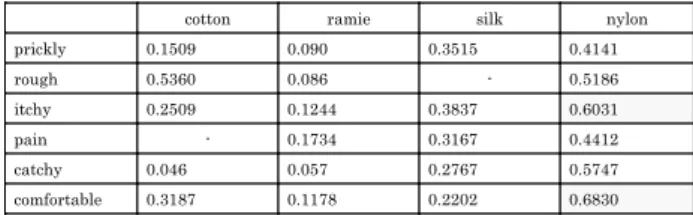
Table4-(a) shows this correlation for the 13 Type 1 subjects. R values were high in these, especially for the combination of comfort (R = 0.683) and cotton hardness (R= 0.679) and nylon.
Table 2 The value of frictional property
Table 3 The correlation R values of the SD mean scores and all TSI scores of all subjects.
In comparison with Type 1, the coefficient of correlation R values rise for each sample and each subjective evaluation for the 12 Type 2 subjects. For the cotton sample, for SD items (feeling of ‘roughness’,
‘scratchiness’, ‘pain’, ‘catchy’) the R value was beyond 0.6, and for the feeling of ‘pain’ R exceeded 0.7 showing that the correlation with the skin temperature rise was high. R was over 0.6 for ‘catchy’
and ‘painful’ for the cotton sample. The combined
‘roughness’ and ‘itchy’ feelings from the SD items correlated highly with rises in skin temperature. In addition, the R value was over 0.6 for a feeling of ‘pain’
in the ramie and silk samples, and was over 0.6 for the feeling of ‘roughness’ in the nylon sample.
Figure 6 shows a straight line and scatter chart for the combination of cotton sample and pain feelings in Type 2 subjects where the correlation coefficient R value was the largest. The straight line is negative showing that the SD score is on a minus side compared with the TSI values.
4. Conclusion
This paper has described how skin temperature changes can be used as a non-contact measurement when friction with various textiles is applied to the skin. The relation between the dynamic characteristic values of the amount of the change and textile goods and the subjectivity evaluation is examined. It is claimed that skin temperature can be used as a cutaneous textile stimulus evaluation index. Four kinds of washcloth (cotton, ramie, silk and nylon) currently on the market were used. The results are as follows.
1) The surface characteristic values (MIU, MMD, SMD) of four kinds of washcloth were measured with an automatic surface tester. The coefficient of friction and surface roughness were largest in silk.
2) Three types of skin temperature reaction were observed in response to the friction stimulation:
Type 1 - Sudden rise. Type 2 - Delayed rise. Type 3 - Insignificant change.
3) It is thought that the rise of skin temperature in Type 2 originates in the skin vasodilator reaction (axon reflex) caused by friction stimulation.
4) An examination of the correlation between TSI values and the subjective evaluation value (SD score), showed there was some correlation between the cotton sample and a feeling of pain in a subject of Type 2 (delayed rise).
References
(1) Ministry of Health, Labour and Welfare of Japan.
Health damage hospital monitoring report relating to 2006 household appliances.(2007.12)
(2) Toshinori Hongo, Igaku-shoin Standard Textbook of Physiology(1996.10)
(3) Akira Inaba, Takanori Yokota, Sympathetic Flow Response in Normal Subjects, The Autonomic Nervous System, 30:1-9(1993)
Table 3-(a) In case of Typel (Sudden rise)
Table3- (b)In case of Type2 (Delayed rise)
Fig.6 The combination of cotton sample and pain feelings in Type 2 subjects.