Academia Arena 2014;6(10) http://www.sciencepub.net/academia
80
On chaotic Cartesian product of graphs and their retractions
M. Abu-Saleem
Department of Mathematics, Al-Laith University College for Girls, Umm AL-Qura University, Saudi Arabia [email protected]
Abstract: Our aim in the present article is to introduce and study a new type of Cartesian product of graphs, namely chaotic Cartesian product of graphs.Chaotic graphs which represented as non trivial subgraphs of chaotic Cartesian product chaotic graphs are characterized. The chaotic incidence matrices and chaotic adjacency matrices representing the chaotic graphs induced from chaotic Cartesian product of graphs are obtained. The effect of retractions on a finite number of product chaotic subgarphs are deducede.
[M. Abu-Saleem. On chaotic Cartesian product of graphs and their retractions. Academ Arena 2014;6(10):80- 83]. (ISSN 1553-992X). http://www.sciencepub.net/academia. 10
Keywords: Chaotic Cartesian product ; Retraction ; Graph
1. Introduction
Chaos theory is applied in many scientific disciplines: mathematics, programming, microbiology, biology, computer, science, economics, engineering, finance, philosophy, physics, politics, population dynamics, psychology, and robotics. Chaotic behavior has been observed in the laboratory in a variety of systems including electrical circuits, lasers, oscillating chemical reactions, fluid dynamics, and mechanical and magneto-mechanical devices, as well as computer models of chaotic processes. Observations of chaotic behavior in nature include changes in weather, the dynamics of satellites in the solar system, the time evolution of the magnetic field of celestial bodies, population growth in ecology, the dynamics of the action potentials in neurons, and molecular vibrations. There is some controversy over the existence of chaotic dynamics in plate tectonics and in economics. One of the most successful applications of chaos theory has been in ecology, where dynamical systems such as the Ricker model have been used to show how population growth under density dependence can lead to chaotic dynamics. Chaos theory is also currently being applied to medical studies of epilepsy, specifically to the prediction of seemingly random seizures by observing initial conditions. A related field of physics called quantum chaos theory investigates the relationship between chaos and quantum mechanics.
The correspondence principle states that classical mechanics is a special case of quantum mechanics, the classical limit. If quantum mechanics does not demonstrate an exponential sensitivity to initial conditions, it is unclear how exponential sensitivity to initial conditions can arise in practice in classical chaos. Recently, another field, called relativistic
chaos, has emerged to describe systems that follow the laws of general relativity. The initial conditions of three or more bodies interacting through gravitational attraction can be arranged to produce chaotic motion[1-8,11,12].
An abstract graph G is a diagram consisting of a finite non -empty set of elements called vertices denoted by V(G) together with a set of unordered pairs of these elements, called edges denoted by
) (G
E [14,15]. A simple graph is a graph with no loops or multiple edges[14,15]. A connected graph is a graph in one piece [14,15]. Let G be a graph without loops with n -vertices labeled 1,2,3,,n. The adjacency matrix A(G) is the nn matrix in which the entry in rowiand columnj is the number of edges joining the vertices i and j [14,15]. The incidence matrix of a graph gives the (0,1)-matrix which has a row for each vertex and column for each edge, and (v,e)1 iff vertex v is incident e upon edge[14,15]. A graph H is said to be a subgraph of a graph G if V(H)V(G) andE(H)E(G) [9,13].
A subset A of a topological space X is called a retract of X if there exists a continuous map (called a retraction) such that
A a a a
r( ) , [10].
2. Main results:
A X r:
Academia Arena 2014;6(10) http://www.sciencepub.net/academia
81
Figure 1. Cartesian product of two graphs
) , (ay
a
b c
) , (ax
x y
) , (bx
) ,
(cx (c,y)
) , (by
H1 H2 H1H2
Aiming to our study we introduce the following:
Let H1
and H2 be two connected simple graphs of two vertex sets {a ,b,c},{x,y}. Then their Cartesian product is simple graph shown in Figure 1.
Both incidence and adjacency matrices
2 2 1
1, A ,I ,A
I respectively of the graphs H1
and
H2 take the forms
0 1 1
1 0 1
1 1 0 , 1 1 0
0 1 1
1 0 1
1
1 A
I
1 0
1 , 0
1
1 2
2 A
I
. On the other hand, both incidence and adjacency matrices of the Cartesian
product
2
1 H
H
has of the following form
.
0 1 1 1 0 0
1 0 1 0 1 0
1 1 0 0 0 1
1 0 0 0 1 1
0 1 0 1 0 1
0 0 1 1 1 0
,
0 1 0 0 1 0
0 0 1 0 0 1
1 0 0 1 0 0
1 1 0 0 0 0
0 1 1 0 0 0
1 0 1 0 0 0
0 0 0 1 1 0
0 0 0 0 1 1
0 0 0 1 0 1
A
I
Then we arrive to the following theorem:
Theorem 1. The matrix of both incidence and adjacency represented the Cartesian product of two connected simple graphs can be obtained by the incidence and adjacency representing each of the given connected simple graphs constituting such a Cartesian product.
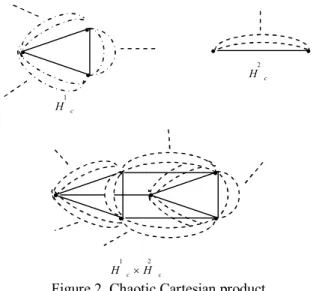
Figure 2. Chaotic Cartesian product.
Now we will discuss the Cartesian product of chaotic graphs. The chaotic graph is a geometric graph carry many other physical characters such that the chaotic graphs
1
Hc
,
2
Hc
,
2 1
c
c H
H
shown in Figure 2.
Where
, )) ( , ) ( ( ))
( , ) (
( 1 1 2 2 2
1
c c c
c c
c V H E H and H V H E H
H
, } , 2 , 1 , , ,
1{a b c i
Vh ih ih ih
, } , 2 , 1 , , ,
1{a b a c b c i
Eh ih ih ih ih ih ih and } , 2 , 1 , ,
2{x y i
Vh ih ih
, } , 2 , 1 ,
2{x y i
Eh ih ih
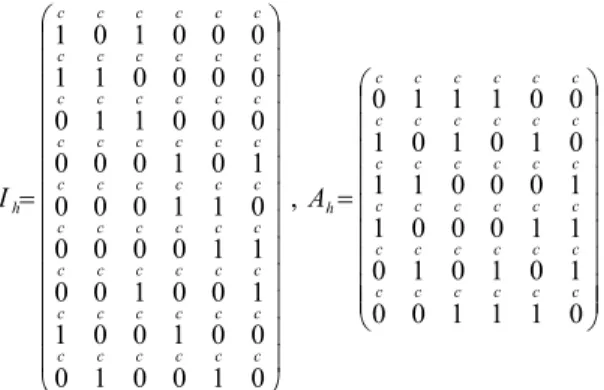
where each pure chaotic vertex overlapped on the geometry. Both of the chaotic incidence and adjacency matrices of the of chaotic graphs
1
Hc
,
2
Hc
are
c c
c c
c c c c c
c c
c c c
c c c
c c c c
c c c
c c c
c A I A
I
0 1
1 , 0
1 1 , 0 1 1
1 0 1
1 1 0 , 1 1 0
0 1 1
1 0 1
2 2
1 1
where, 110123
c
and 000123
c
. On the other hand, both chaotic incidence and adjacency matrices of the chaotic Cartesian product
2 1
c
c H
H
has of the following forms
1
H c
2
H c
2 1
c
c H
H
Academia Arena 2014;6(10) http://www.sciencepub.net/academia
82 .
0 1 1 1 0 0
1 0 1 0 1 0
1 1 0 0 0 1
1 0 0 0 1 1
0 1 0 1 0 1
0 0 1 1 1 0
,
0 1 0 0 1 0
0 0 1 0 0 1
1 0 0 1 0 0
1 1 0 0 0 0
0 1 1 0 0 0
1 0 1 0 0 0
0 0 0 1 1 0
0 0 0 0 1 1
0 0 0 1 0 1
c c c c c c
c c c c c c
c c c c c c
c c c c c c
c c c c c c
c c c c c c
h
c c c c c c
c c c c c c
c c c c c c
c c c c c c
c c c c c c
c c c c c c
c c c c c c
c c c c c c
c c c c c c
h A
I
From the above discussion,we formulate the following theorem:
Theorem 2. The matrix of both incidence and adjacency represented the chaotic Cartesian product of two connected simple graphs can be obtained by the incidence and adjacency representing each of the given connected simple graphs constituting such chaotic Cartesian product.
Definition 1. The chaotic Cartesian product
2 1
c
c H
H of chaotic connected simple graphs
)) ( , ) (
( 1 1
1
c c
c V H E H
H and Hc2(V(Hc2), E(Hc2)), is the chaotic graph with vertex set ( ( ), ( ))
2 1
c
c V H
H V
where the chaotic vertex (aih,xih) is adjacent to vertex (bih,yih),i1,2,,
whenever )
( c1
ih
ihb E H
a
and xihyih
or aihbih and )
( c2
ih
ihy E H
x
. For fixed a chaotic vertex aih of
1
Hc
the vertices (aih,xih):xihV(Hc2)
induce chaotic subgraph of
2 1
c
c H
H
is isomorphic to
1
Hc
. Theorem 3. Let Gc be a connected simple graph
xih
its chaotic vertex.Then there exist a collection of chaotic subgraphs
m c c
c H H
H1, 2,, of Gc ,
, 1,2, ,
2 , 1 , )
(
V H j m i
xih cj
such that
m c c
c
c H H H
G 1 2 induce a retraction m s
for H H
r H
H G
r( c) c1 c2 ( cs) cm, 1,2,,
or ( ) ( ) ,
2
1 m
c t
c s
c c
c H r H r H H
H
for
t s m t
s, 1,2,, , or
m
k s
Hc
r
1
)
(
.
proof: Consider the representation
m c c
c
c H H H
G 1 2
in which all chaotic subgraphs
j
Hc
are indecomoposable and
, ) ( cj
ih V H
x
for all j1,2,m,i1,2,. We prove this result by mathematical induction on m , the number of chaotic subgraphs. When m2 ,
( ( ), ( ) ( ( ), ( )
)
(Hc1 Hc2 r V Hc1 E H1c V H2c E H2c
r
is the retraction of chaotic subgraphs with vertex set
) ) ( , ) (
(V Hc1 V Hc2
where the chaotic vertex (aih,xih) is adjacent to vertex (bih,yih),i1,2,,whenever
) ( c1
ih
ihb E H
a
and xihyih or aihbih and )
( c2
ih
ihy E H
x
. Then clearly we get
( ( ), ( ) ( ( ), ( )
)
(H1c Hc2 r V H1c E Hc1 V H2c E H2c
r
(V(H1c),E(H1c) (V(H2c),E(H2c) or
r
( ( ), ( )or ))
( , ) (
(V H1c E H1c r V H2c E H2c
(V(Hc1),E(Hc1) r(V(H2c),E(H2c).
r
Now suppose that the result is true for (m1) chaotic subgraphs, thus
) (Hc1 Hc2 Hcm1 Hcm r
or ) ( ) (Hc1 Hc2 Hcm1 r Hcm
r
or )
(Hc1 Hc2 Hcm1 Hcm
r
case In . )
1 (
2
1 m
c m
c c
c H H r H
H
) (Hc1 Hc2 Hcm1 Hcm r
) ( ) (H1c Hc2 Hcm1 r Hcm
r
,we obtain from
the induction assumption
) ( ) (H1c Hc2 Hcm 1 r Hcm
r
), ( )) ( ) (
(Hc1Hc2 r Hcs r Hcm1 r Hcm
for s1,2,,m or
or , , , 2 , 1 , ), (
)) ( )
( ) (
( 1 2 1
t s m t
s for H r
H r H
r H
r H
H
m c
m c t
c s
c c
c
m
k s
Hc
r
1
) ( or
. Similarly for other two cases. This completes the proof.
Theorem 4. There are two chaotic connected simple subgraphs
1
Hc
and
2
Hc
such that their limit retraction of a chaotic Cartesian product is not isomorphic to the chaotic Cartesian product of limit retraction. i.e.,
. ) ( lim ) ( lim ) (
lim 1 2 1 2
n n
n rn Hc Hc rn Hc rn Hc
proof: Let
1
Hc
and
2
Hc
be two chaotic connected simple subgraphs shown in Figure 3.
Figure 3. limit retractions.
Academia Arena 2014;6(10) http://www.sciencepub.net/academia
83
rn lim n
(chaoticpoint)
1
Hc
rn lim n
(chaoticpoint)
2
Hc
rn lim n
or
rn lim n 2
1 c
c H
H
Then lim ( 1 2)
n rn HcHc
is either
1
Hc
or homeomorphic to
2
Hc
. But
point chaotic )
(
lim 1
n
rn Hc
. Therefore, )
( lim ) ( lim ) (
lim 1 2 1 2
n n
n rn Hc Hc rn Hc rn Hc
.
Corresponding Author:
Dr. M. Abu-Saleem Department of Mathematics
Al-Laith University College for Girls Umm AL-Qura University, Saudi Arabia E-mail: [email protected] References
1. Abd EL-Kader Z M, Zaki AM, Esmail RM.
Derivations of Tensor Product of Finite Number of Simple C*-Algebras, Journal of American Science, 6(8) 2010:31-38.
2. Abu-Saleem M. Folding on the wedge sum of graphs and their fundamental group, Applied sciences, 12 (2010):14-19.
3. Abu-Saleem M. Dynamical manifold and their fundamental group, Advanced Studies in Contemporary Mathematic, Vol.20, No.1 (2010):125-131.
4. Abu-Saleem M. On dynamical chaotic de sitter spaces and their deformation retracts, Proceedings of the Jangjeon Mathematical society, Vol.14 (2011) 231-238.
5. Abu-Saleem M. Conditional fractional folding of a manifold and their fundamental group, Advanced Studies in Contemporary Mathematics,Vol.20, No.2 (2010), 271-277.
6. Abu-Saleem M. Folding on the chaotic Cartesian product of manifolds and their fundamental group, Tamkang journal of mathematics,39 (2008) : 353-361.
7. El-Ghoul M, A. El-Ahmady E, Homoda T. On chaotic graphs and applications in physics and bilogy, Chaos,Soliton and fractals, 27(2006):
159-173.
8. El-Ghoul M, El-Ahmady E, Abu-Saleem M. On chaotic fundamental group and their foldings, J.Fuzzy Math, 9 (12) (2009): 311-322.
9. Giblin PJ. Graphs, Surfaces and homology, An introduction to algebraic topology, Chapman and Hall Ltd, London, 1977.
10. Massey WS. Algebraic topology: An introduction, Harcourt Brace and world, New York (1967).
11. Mostafa SM, Abdel Naby MA, Elgendy OR.
Fuzzy TM-ideals of TM-algebras, Journal of American Science, 7(9) 2011:17-21.
12. Nada SI, Hamouda E. On the folding of graphs- theory and application, Chaos, Soliton and fractals, 42(2009):669-675.
13. White AT. Graphs, groups and surfaces, Amsterdam, North-Holland Publishing Company, 1973.
14. Wilson RJ. Introduction to graph theory, dinburgh, Oliver & Boyed, 1972.
15. Wilson RJ, Watkins J. Graphs, An introductory approach, A first course in discrete mathematics, Canada John Wiley & sons, Inc., 1990.
1/22/2014