‑ 131 ‑ 厚生労働科学研究費補助金
医薬品・医療機器等レギュラトリーサイエンス政策研究事業 ワクチンの品質確保のための国家検定制度の抜本的改正に関する研究
分担研究報告書
海外のロットリリース制度の状況
−海外アンケート調査報告−
研究分担者 内藤誠之郎 国立感染症研究所 品質保証・管理部 研究協力者 落合 雅樹 国立感染症研究所 品質保証・管理部 藤田賢太郎 国立感染症研究所 品質保証・管理部 岩城 正昭 国立感染症研究所 細菌第二部 清原 知子 国立感染症研究所 ウイルス第二部
嶋崎 典子 国立感染症研究所 インフルエンザウイルス研究センター
研究要旨:海外のワクチン等に対するロットリリース制度の状況を調査する目的で海外の ロットリリース関連機関に対するアンケート調査を実施した。調査項目を設定するにあた っては、
WHOのロットリリースに関するガイドラインも参考にした。カナダ、欧州、中国、
韓国、台湾など
8カ国/地域の機関から、アンケートに対する回答を得た。ワクチン及び 血漿分画製剤をロットリリースの対象にしていること、SLP 審査をロットリリースの必須 要件としていること、国産、輸入を問わず国内で流通するワクチンをロットリリースの対 象にしていること等、ロットリリース制度の基本事項については多くの国/地域で一致し ていた。一方、試験実施項目や試験実施頻度など、国/地域により異なっている点も多く あった。試験実施項目については、力価試験や毒素の不活化といった特異的な安全性試験 など共通性の高い項目もあったが、全体的に多様性が認められた。カナダにおいては製品 のリスクを評価して試験の実施頻度を変更するしくみが導入されていた。このようにロッ トリリース制度は基本的な事項については多くの国/地域で一致しているものの、異なっ ている点も多い。今後、海外の制度や
WHOのガイドライン等も参考にしながら、本邦の 状況に即したよりよい国家検定制度を検討してゆくことが重要である。
A.
研究目的
海外のワクチン等に対するロットリリー ス制度の状況を調査する目的で、海外のロ ットリリース関連機関に対するアンケート 調査を実施した。前年度の報告からさらに 回答が加わったので、改めて、全体をまと めて報告する。
B.
研究方法
海外のロットリリース関連機関にアンケ
ート調査票(別紙
1)を送付した。調査項目を設定するにあたっては、WHO のガイ
ドライン
”Guidelines for independent lot release of vaccines by regulatory authorities” (TRS 978, Annex 2, 2013)を
参考にした。別紙
4にガイドライン全文と
その試訳を対訳形式で掲載したので、参照 していただきたい。
アンケートへの回答を得たのは、以下の 国/地域のロットリリース関連機関からで ある。
カ ナ ダ :
Health Canada, Biologics and Genetic Therapies Directorate (BGTD)欧 州 :
European Directorate for the Quality of Medicines and HealthCare (EDQM)中国:National Institutes for Food and
Drug Control (NIFDC)韓国:Ministry of Food and Drug Safety
(MFDS)台 湾 :
Taiwan Food and Drug Administration (TFDA)以上に加えて
3カ国の機関から回答を得 たが、国名不開示の条件で回答がなされた ので、本報告書では
A国、B 国及び
C国と 表記する。
C.
結果
各国のアンケートへの回答とコメントを 別紙
2、その和訳を別紙
3の表にまとめた。
比較のために、表には日本の状況も記入し てある。以下、設問ごとに各国の回答の概 要を記載する。
Q1. ロットリリースの対象品目
本邦を含むすべての国/地域において、
ワクチンを規制当局によるロットリリース の対象にしていた。B 国を除いては、血漿 分画製剤もロットリリースの対象としてい た。
Q2. ロットリリースの要件
回答のあったすべての国/地域において、
ワ ク チ ン の ロ ッ ト リ リ ー ス に あ た り
Summary Lot Protocol (SLP; 製造・試験記
録等要約書)の審査を実施するとともに、試 験を実施していた。ただし、製品によって は
SLP審査のみでロットリリースする国/
地域、他国のロットリリース証明書を認証 する国/地域もあった。欧州においては、
欧州域内の他の国で発行されたロットリリ ース証明書を相互に受け入れるしくみが整 えられていた。カナダにおいては、低リス クと評価された製品については
SLP審査の みでロットリリースされていた。
Q3.
輸入/輸出製剤をロットリリースの対 象にしているか
国内製造か輸入かに関わらず、すべての 国/地域において、国内で流通するワクチ ンについては、ロットリリースの対象とし ていた。専ら輸出のみされるワクチンにつ いてもロットリリースの対象としていると 回答したのは、カナダ、A 国、B 国であっ た。
Q4. 試験の実施頻度
本邦を含め、欧州、中国、台湾及び
C国 においては、すべてのロットに対して試験 を実施しているとの回答であった。ただし、
Q5-8
の回答によると、ここには外観試験の みを実施しているケースも含まれているよ うである。カナダにおいては、製品ごとの リスクを評価して試験の実施頻度を変える しくみが導入されていた。
Q5-8. 試験の実施項目
麻疹ワクチン、インフルエンザワクチン
(スプリットタイプ) 、精製百日せきワクチ ン、組換えヒトパピローマウイルスワクチ ンに対する試験項目について尋ねた。国/
地域により試験項目の選択に違いがあった
が、力価試験及び毒素の不活化といった特
‑ 133 ‑ 異的な安全性試験については、各国で共通
して実施される傾向にあった。
Q9.
新規ワクチンの試験法に関する製造業 者との協議等の開始時期
試験法に関する協議等の開始時期は製品 によりケースバイケースではあるものの、
多くの国/地域において、承認申請前の早 期(非臨床試験の段階等)または後期(臨 床試験の段階等)から製造業者との協議を 開始する場合があるとの回答であった。
Q10. ロットリリース試験の判定基準
ロットリリースに際して実施される試験 の判定基準として、承認書の規格、公定書 の基準、国際基準のいずれを適用している かを尋ねたところ、承認書の規格及び公定 書の基準を適用しているとの回答が最も多 かった。
Q11-12. ロットリリース試験のデータ開示
試験データを当該ロットの製造業者に開 示する恒常的なシステムがあるかとの問い に対しては、 「ない」との回答が多数を占め た。ただし、本邦を含めて、状況(例えば 試験結果に乖離が見られる場合など)によ っては、製造業者と情報を共有することは あるようである
要求に応じて試験データを第三者に開示 する法的または公式なシステムがあるかと の問いに対しても、 「ない」との回答が多数 を占めた。開示する場合であっても、その 場合の第三者とは秘密保持に同意している 他の規制機関や他国の規制当局を指してお り、一般大衆への開示は各国とも想定され ていないようである。
Q13.
ロットリリース試験の検体を参考品
として保存しているか
検体を参考品として保存しているとの回
答の国/地域が多数であった。
D. 考察
ワクチンと血漿分画製剤をロットリリー スの対象にしていること、ワクチンのロッ トリリースにあたり
SLP審査を必須の要件 としていることなど、ロットリリースに関 する基本的事項は、多くの国/地域で一致 していた。WHO のガイドラインではロッ トリリースにあたり試験を実施することは 必ずしも必須とはしていないが、今回の調 査では試験を実施している国/地域が多数 であった。これは、今回の調査対象の国/
地域が、すべてワクチン製造国であること が関連しているのかもしれない。カナダに おいては、製品のリスクを評価して試験の 実施頻度を変えており、低リスクと評価さ れた製品については
SLP審査のみによって ロットリリースする製品もあるとのことで あった。ロットリリースにあたって実施さ れる試験項目については、力価試験や毒素 の不活化といった特異的な安全性試験など、
多くの国/地域において共通して実施され る項目もあったが、全体的に多様性が認め られた。新規ワクチンの試験法に関する製 造業者と公的試験機関との間の協議等の開 始時期については、多くの国/地域で、本 邦とは異なり承認申請前(非臨床試験また は臨床試験の実施時期等)に開始すること もあるとの回答であった。WHO のガイド ラインでもこのような協議を早期に開始す ることが推奨されており、検討課題と思わ れる。
E. 結語
ロットリリース制度は、基本的な事項に
ついては多くの国/地域で一致しており、
WHO
のガイドラインとも整合しているが、
試験項目や実施頻度など、異なっている点 も多い。今後、海外の制度や
WHOのガイ ドライン等も参考にしながら、本邦の状況 に即したよりよい国家検定制度を検討して ゆくことが重要である。
F.
研究発表
1)誌上発表
なし
2)
学会発表 なし
G.
知的財産権の出願・登録状況
なし
‑ 135 ‑
Questionnaire about vaccine lot release system
The WHO ECBS adopted “Guidelines for Independent Lot Release of Vaccines by Regulatory Authorities” in 2010, and we have recognized anew the importance of having a well-established and globally harmonized lot release system. We are now discussing how our vaccine lot release system can be improved. The information about the lot release system of your country obtained through this questionnaire will make a useful contribution to our discussion. We would like to express our sincere appreciation for your cooperation in advance.
Please answer the following questions by placing a check next to the response(s) that apply to your country’s lot release system. For some questions, depending on the particular product, lot and so on, several different responses might apply to the same question. In that case, please indicate all the responses which apply in the various cases.
[Question about biological products in gener al]
Q1. What kinds of drugs are subject to independent lot release?
□ Vaccines
□ Anti-sera
□ Plasma derivatives
□ Biotherapeutics
□ Other (Please specify in the column below.) Comment:
[Questions about lot release system for vaccines]
Q2. What procedures are required for the lot release of vaccines?
□ Review of manufacturers’ summary protocol only
□ Independent testing only
□ Review of summary protocol plus independent testing
□ Recognition/acceptance of lot release certificates from the NRA/NCL of another country
□ Other (Please specify in the column below.)
Comment:
Q3. Which classes of lots are subject to lot release?
□ Lots which are produced domestically and marketed domestically
□ Lots which are produced domestically but are for export only
□ Lots which are imported or procured and marketed domestically
□ Other (Please specify in the column below.) Comment:
[Questions about independent testing for lot release of vaccines]
Q4. What percentage of lots is tested?
□ Every lot (100% of lots)
□ Less than 100% of lots
□ Zero % of lots
□ Other (Please specify in the column below.) Comment:
Q5. What items are tested when independent testing of measles vaccine is performed?
□ Appearance
□ Potency (Virus concentration)
□ Thermal stability
□ Sterility
□ General safety test (Abnormal toxicity test, Innocuity)
□ Residual moisture
□ Test for freedom from extraneous viruses
□ Test for neurovirulence
□ Identity
□ Other (Please specify in the column below.) Comment:
Q6. What items are tested when independent testing of split influenza vaccine is performed?
□ Appearance
‑ 137 ‑
□ Haemagglutinin content (Potency)
□ Purity
□ Fractionation test
□ Protein content
□ Endotoxin
□ Sterility
□ General safety test (Abnormal toxicity test, Innocuity)
□ Test for leukopenic toxicity
□ Test for Freedom from ether
□ Identity
□ Other (Please specify in the column below.) Comment:
Q7. What items are tested when independent testing of acellular pertussis vaccine is performed?
□ Appearance
□ Potency (Mouse immunogenicity test)
□ Potency (Modified intracerebral challenge assay)
□ Residual activity of pertussis toxin (eg. HIST)
□ Accelerated reversion test
□ Protein content
□ Endotoxin
□ Sterility
□ General safety test (Abnormal toxicity test, Innocuity)
□ Adjuvant content
□ Preservative content
□ Content of residual detoxifying agent
□ pH
□ Identity
□ Other (Please specify in the column below.) Comment:
Q8. What items are tested when independent testing of human papillomavirus (r-DNA) vaccine is performed?
□ Appearance
□ Sterility
□ Endotoxin
□ General safety test (Abnormal toxicity test, Innocuity)
□ Protein content
□ Adjuvant content (adjuvant: )
□ Degree of absorption of each type
□ Degree of absorption of Monophosphoryl Lipid A (if applicable)
□ Potency (in vitro relative potency assay)
□ Potency (in vivo assay)
□ pH
□ Extractable volume
□ Identity of each type
□ L1 purity (for intermediate stages)
□ Degree of intact L1 monomer (for intermediate stages)
□ Other (Please specify in the column below.) Comment:
Q9. For a new product, at what stage do you usually start a collaboration/discussion with a manufacturer regarding development and/or transfer of testing methodology and capability?
□ Early pre-application stage, e.g. non-clinical trial stage
□ Late pre-application stage, e.g. clinical trial stage
□ Immediately before application
□ Post-application stage
□ Post-approval stage
□ No collaboration/discussion
□ Other (Please specify in the column below.) Comment:
Q10. What specifications/standards are used to judge the test results of independent testing?
□ Specifications approved in the marketing authorization dossier
□ Standards prescribed by the official compendium such as pharmacopoeia
□ Standards described in the international guidelines such as WHO recommendations
‑ 139 ‑
□ Other (Please specify in the column below.) Comment:
Q11. Do you have any routine system to disclose the data obtained by lot release testing to the relevant manufacturer?
□ Yes
□ No Comment:
Q12. Do you have any legal or formal system to disclose the data obtained by lot release testing to a third party if detailed data are requested?
□ Yes
□ No Comment:
Q13. Have you stored samples for future reference?
□ Yes
□ No Comment:
Q14. If you have some useful Websites offering information about the lot release system of your country, e.g. information about vaccines and their corresponding testing items, please indicate the URLs in the column below.
Comment:
[Infor mation shar ing about this questionnaire]
Q15. Do you permit your answers to this questionnaire to be shared with relevant persons of other countries’ NCL/NRA or WHO?
□ Yes
□ Yes, however, conceal the name of the country
□ No
Comment:
Q16. Do you wish to receive the compiled results of this questionnaire? If “yes”, we will send it to you later.
□ Yes
□ No
Comment:
‑ 141 ‑
Japan Canada EU China Korea Taiwan A B C
Q1. What kinds of drugs are subject to independent lot release?
Vaccines Anti-sera
Plasma derivatives Others(Tuberculin(
PPD), Varicella antigen, BCG for intravesical injection)
Vaccines Anti-sera
Plasma derivatives Biotherapeutics
Vaccines
Plasma derivatives
Vaccines
Plasma derivatives Other (IVD for blood screening)
Vaccines Anti-sera (Antivenom(Equin e))
Plasma derivatives Others(Tuberculin(
PPD), Botulinum toxin, )
Vaccines Anti-sera
Plasma derivatives Others(Tuberculin(
PPD), Botulium toxin)
Vaccines
Plasma derivatives Others
<Comment #31>
Vaccines
Vaccines Anti-sera
Plasma derivatives Others(Diagnostic agents, Allergens)
<Comment #44>
Q2. What
procedures are required for the lot
release of
vaccines?
Protocol review + testing
Protocol review only
Protocol review + testing
<Comment #5>
Protocol review + testing
Recognition/accept ance of EU OCABR
Certificates
Protocol review + testing
Protocol review + testing
Protocol review + testing
Recognition/accept ance of lot release certificates Others
<Comment #26>
Protocol review + testing
Protocol review + testing
Recognition/accept ance of lot release certificates
Others
<Comment #37>
Protocol review + testing
Q3. Which classes of lots are subject to lot release?
Produced and marketed domestically Imported or procured and marketed domestically
<Comment #1>
Produced and marketed domestically Produced domestically for export only Imported or procured and marketed domestically
<Comment #6>
Produced and marketed domestically Imported or procured and marketed domestically
Produced and marketed domestically Imported or procured and marketed domestically
<Comment #17>
Produced and marketed domestically Imported or procured and marketed domestically
Produced and marketed domestically Imported or procured and marketed domestically
Produced and marketed domestically Produced domestically for export only Imported or procured and marketed domestically
Produced and marketed domestically Produced domestically for export only Imported or procured and marketed domestically
Produced and marketed domestically Imported or procured and marketed domestically
Japan Canada EU China Korea Taiwan A B C
Q4. What
percentage of lots is tested?
100% Less than 100% 100% 100%
Less than 100%
<Comment #21>
100%
Other
<Comment #27>
Less than 100%
<Comment #32>
Less than 100%
Other
<Comment #38>
100%
<Comment #45>
Q5. Test items;
measles
Potency (Virus concentration) Residual moisture Test for freedom from extraneous viruses (For bulk product)
Test for
neurovirulence
(First 5
consecutive lots)
Potency (Virus concentration)
Appearance Potency (Virus concentration) Thermal stability Identity
Potency (Virus concentration) Sterility
General safety test Identity
<Comment #18>
Appearance Potency (Virus concentration) Sterility
General safety test Residual moisture Identity
<Comment #22>
Appearance Potency (Virus concentration) Sterility
General safety test Residual moisture Identity
Potency (Virus concentration) Thermal stability
Appearance Potency (Virus concentration) Thermal stability Sterility
General safety test Identity
pH
<Comment #39>
Appearance Potency (Virus concentration) Thermal stability General safety test Residual moisture Identity
pH
<Comment #46>
Q6. Test items;
split influenza
Haemagglutinin content (Potency) Protein content General safety test Test for leukopenic toxicity
Test for Freedom from ether
Haemagglutinin content (Potency) Endotoxin
<Comment #7>
Appearance Haemagglutinin content (Potency) Purity (On the first
5 lots of
monovalent bulks) Endotoxin
Haemagglutinin content (Potency) Sterility
General safety test Identity
<Comment #19>
Appearance Haemagglutinin content (Potency) Endotoxin Sterility
General safety test Test for Freedom from ether Identity
<Comment #23>
Appearance Haemagglutinin content (Potency, SRID)
Purity
Protein content Endotoxin Sterility
General safety test Identity
Appearance Haemagglutinin content (Potency) Protein content Endotoxin
Appearance Haemagglutinin content (Potency) Endotoxin Sterility
General safety test
<Comment #40>
Appearance Haemagglutinin content (Potency) Protein content Endotoxin General safety test Identity pH Formaldehyde content
<Comment #47>
Japan Canada EU China Korea Taiwan A B C
Q7. Test items;
acellular pertussis
Potency (Modified intracerebral challenge assay) Residual activity of pertussis toxin (eg.
HIST) Accelerated reversion test Endotoxin
General safety test Content of residual detoxifying agent
Potency (Mouse immunogenicity test)
<Comment #8>
Appearance Potency (Mouse immunogenicity test) (On every new final bulk) Residual activity of pertussis toxin (eg. HIST) (On every new final bulk)
Endotoxin (On every new final bulk)
Identity
Potency (Modified intracerebral challenge assay) Residual activity of pertussis toxin (eg.
HIST) Sterility Identity
Appearance Potency (Mouse immunogenicity test)
Potency (Modified intracerebral challenge assay) Residual activity of pertussis toxin (eg.
HIST) Accelerated reversion test Endotoxin Sterility
General safety test Adjuvant content Preservative content
Content of residual detoxifying agent pH
Identity
<Comment #24>
Appearance Potency (Modified intracerebral challenge assay) Residual activity of pertussis toxin (eg.
HIST) Accelerated reversion test Protein content Endotoxin ( SanofiAventis product preformed pyrogen test) Sterility
General safety test Adjuvant content Preservative content
Content of residual detoxifying agent
(detoxification test for 42 days)
pH Identity
<Comment #28>
Appearance Potency (Mouse immunogenicity test)
Appearance Potency (Modified intracerebral challenge assay) Endotoxin Sterility
General safety test Adjuvant content Preservative content pH Identity
<Comment #41>
Appearance
<Comment #48>
Japan Canada EU China Korea Taiwan A B C
Q8. Test items;
human
papillomavirus (r- DNA)
General safety test Adjuvant content
(MPL, if
appricable) Potency (in vitro relative potency assay)
Appearance Adjuvant content (MPL contents, if applicable) Potency (in vitro relative potency assay)
Potency (in vivo assay)
Identity of each type
L1 purity (for intermediate stages)
Degree of intact L1 monomer (for intermediate stages)
<Comment #13>
<Comment #20>
Appearance Sterility Endotoxin General safety test Protein content
Degree of
absorption of each type
Potency (in vitro relative potency assay)
pH
Extractable volume Identity of each type
Appearance Sterility Endotoxin Adjuvant content Degree of absorption of each type
Potency (in vitro relative potency assay)
pH
Identity of each type
Appearance Potency (in vitro relative potency assay)
Appearance
<Comment #42>
Appearance
<Comment #49>
Q9. For a new product, at what stage do you usually start a collaboration/discu ssion with a manufacturer regarding development and/or transfer of testing
methodology and capability?
Post-application stage
Late pre-
application stage, e.g. clinical trial stage
Immediately before application Post-application stage
Post-approval stage
<Comment #9>
Late pre-
application stage, e.g. clinical trial stage
Immediately before application
<Comment #14>
Early pre- application stage, e.g. non-clinical trial stage
Early pre- application stage, e.g. non-clinical trial stage
Late pre-
application stage, e.g. clinical trial stage
Immediately before application Post-application stage
Post-approval stage
<Comment #25>
Immediately before application Post-application stage
Post-application stage
Post-approval stage
<Comment #33>
Early pre- application stage, e.g. non-clinical trial stage
Late pre-
application stage, e.g. clinical trial stage
Immediately before application Post-application stage
Post-approval stage
Late pre-
application stage, e.g. clinical trial stage
Immediately before application Post-application stage
<Comment #50>
Japan Canada EU China Korea Taiwan A B C
Q10. What
specifications/stan dards are used to judge the test
results of
independent testing?
Official compendium
Marketing authorization dossier Official compendium International guidelines
<Comment #10>
Marketing authorization dossier Official compendium
Marketing authorization dossier Official compendium
Marketing authorization dossier Official compendium
Official compendium
Marketing authorization dossier Official compendium
<Comment #34>
Marketing authorization dossier Official compendium International guidelines
Marketing authorization dossier
Q11. Do you have any routine system to disclose the data obtained by lot release testing to the relevant manufacturer?
No
Yes
<Comment #11>
No
<Comment #15>
No No No No
Yes
<Comment #43>
Yes
<Comment #51>
Q12. Do you have any legal or formal system to disclose the data obtained by lot release testing to a third party if detailed data are requested?
No
Yes
<Comment #12>
No
<Comment #16>
No No No
Yes
<Comment #35>
No
Yes
<Comment #52>
Q13. Have you stored samples for future reference?
No
<Comment #2>
Yes Yes Yes Yes No
Yes
<Comment #36>
No
Yes
<Comment #53>
Japan Canada EU China Korea Taiwan A B C
Q14. Useful Websites
http://www.nih.go.
jp/niid/en/mrbp- e.html
<Comment #3>
http://www.jpma.o r.jp/english/parj/
<Comment #4>
http://www.hc- sc.gc.ca/dhp- mps/alt_formats/hp fb-
dgpsa/pdf/brgthera p/gui_sponsors- dir_promoteurs_lot _program-eng.pdf
www.edqm.eu
http://www.nicpbp.
org.cn/directory/we b/WS02/CL0108/
(Chinese Version )
http://drug.mfds.go .kr (no English version)
http://www.fda.gov .tw/TC/download.a spx?cid=114
<Comment #29>
http://www.fda.gov .tw/TC/site.aspx?si d=2008
<Comment #30>
# Comments
1 Lot release will be done for lots which are produced domestically but are for export only, if it is required by the manufacturer.
2 Samples are not stored systemically. They may be stored by the person who handles them.
3 This site offers the Minimum Requirements for Biological Products (English version), though it is not the latest edition.
4 This site offers the English information about pharmaceutical administration and regulations in Japan.
5
BGTD Lot Release Program is a risk/based approach. The release of specific lots may be based on:
a) protocol review and testing, b) protocol review only c) receiving notification only
Activities conducted are rationalized based on the available evidence (product history, use, evidence for consistent manufacture & testing) and documented under our Quality system.
Activities are reviewed on an ongoing basis, and the level of product oversight changed as appropriate based on review of consistency of product quality or in response to emerging issues.
More information in Health Canada Lot Release Guideline http://www.hc-sc.gc.ca/dhp-mps/alt_formats/hpfb-dgpsa/pdf/brgtherap/gui_sponsors-dir_promoteurs_lot_program-eng.pdf.
6 BGTD releases FluLaval lots for the Southern Hemisphere. This product is not marketed in Canada but is subject to the same regulatory oversight as domestic product.
7 Endotoxin testing has been discontinued for seasonal vaccines at this time due to interference in the LAL assay. We are developing an alternative test based on monocyte activation to be used for pandemic lot release and for TF vaccines.
8 Vaccines are tested for potency according to pre-determined criteria included in the product test plan.
9
The discussions occur at different stages depending on the product. Many times discussions on product testing and specifications take place at an early stage (during clinical trials) or during the review of the New Drug Submission (NDS). It is important to note that not all products are tested in clinical trials in Canada, but manufacturers can request pre-submission meeting with BGTD. In addition, discussions regarding product testing including new assays and qualification of new reference standards are part of the review of post-approval changes (see Health Canada Guideline http://www.hc-sc.gc.ca/dhp-mps/alt_formats/pdf/prodpharma/applic-demande/guide-ld/postnoc_change_apresac/noc_pn_quality_ac_sa_qualite-eng.pdf)
10
The specifications are product-specific and are approved as part of the Marketing Authorization. The Marketing Authorization review and the lot release activities are integrated in BGTD.
Product specifications may be based on Pharmacopoeia (e.g. European and US), WHO recommendations or the test results which could be product-specific. Please note that Canada does not have a National Pharmacopoeia.
11 BGTD has direct communication with all relevant manufacturers to discuss any issues regarding testing methodologies, product quality issues, new assays etc. Some manufacturers request regular meetings (e.g. once or twice a year) to discuss Lot Release activities with BGTD, even if no issues are identified.
12
BGTD has Memorandum of Understanding agreements with several regulatory agencies. Under these agreements the disclosure of confidential information including testing results is permitted.
It is important to note that for some of these agreements (e.g. European Official Medicines Control Laboratory network) manufacturers have agreed to allow BGTD to discuss this information. In addition, under special situations BGTD can request the permission of manufacturers to exchange confidential information with a third party.
13 For potency, if an in vitro assay is used to determine the antigen content, it must be done on the final lot. If an in vivo assay is used, it should be done on the final bulk or on a lot of finished product derived it.
14 Early pre-application stage; exchange this early is possible but less common. Late pre-application stage; most often it is in the late clinical trial stages ie: once it is clear there will be an intention to submit for licensing.
15 On the request of relevant manufacturer, the testing data may be disclosed.
16 On the request of third parties to the releasing OMCL data may be shared, this will depend on who the third party is (eg confidential exchange with another NCL or authority will be treated differently than a request from the general public) and on the freedom of information policies in the different member states.
17 Lot release will be done for lots which are produced domestically but are for export only, if it is required by NRA of users.
18 The Content residual of bovine serum albumin and Content residual of antibiotic is also tested for partial lots.
19 The Content of ovalbumin is also tested for partial lots.
20 There is no licensed HPV vaccine available in China now (Dec. 2013).
21 Some preparations are released by summary protocol review only.
22 Korea has only trivalent vaccine (MMR). Other test item, uniformity of dosage units test(mass variation test) is done.
23 Additionally, thimerosal content (if applicable), pH, extractable volume test are done.
# Comments
24 Korea has only trivalent vaccine (DTaP, TdaP for adult). Additionally, thimerosal content (if applicable), extractable volume test are done.
25 Case by case.
26
Vaccine for lot release application must be provide documents like list for reviews, including Packing list, Certificate of Analysis, National Authority release certificate, Approval License and Instruction of direction copy, Standard operating procedures for the control of animal sources of raw materials (SOP) and the Certificate guarantee source of raw materials materials are BSE free, Release protocol for Raw material, Mono bulk , Final bulk, and Final contain product, raw data of some testing items(i.e. potency,safety test,pyrogen etc). Letter for announce in process control of manufacture, sealing label, box appearance, instruction of direction same as License application and guarantee no any change.
27 Same final container lot will be document reviewed only, but if the shipping cold chain temperature is excursion, it will be need check efficacy and safety test again. In domestic product, same final bulk will be filling to different lots ( like filling to 10 lots from same final bulk) , just pick up 2 or 3 lots to performance efficacy test, other lots will not need to testing this test.
28 Taiwan doesn`t have single pertussis vaccine, here performed test item including all of kind acellular base combined vaccine like DTaP, DTaP-IPV, DTaP-IPV-Hib, DTaP-IPV-Hib-HB.
29 This site offers the lot release information (Chinese version). Its information will be update monthly , all of NQC pass product (including vaccine, blood product, Antitoxin). It will be provide brand name, lot number, Packing form, expiry date, sealing dosage , release date, and so on.
30 This site offers the application information about pharmaceutical administration and regulations in Taiwan.
31 Plasma derivatives (Ig and fractionated), Insulins, Hormones (proteins greater than 100 peptides), some (but not all) recombinant therapeutic proteins, but only for a limited number of batches (generally first 3 – 5).
32 Risk-based assessment, based on target population, number of doses, and protocol information.
33 Depends on the nature of the product and the nature of the test.
34 Pharmacopoeial Standards have priority; specifications as approved in dossier for products where there is no monograph at the time of registration.
35 Section xx of the Act for disclosure of any information to another NRA.
36 Usually only until expiry.
37 Label review, appearance test, and perform trend analysis.
38 At least 10% of vaccine lots produced every year especially potency and stability tests; 100% of bulk monovalent polio for second reading of NVT; and appearance test for all types of vaccines.
39 For sterility and general safety tests are performed at least 3 lots per year.
40 For endotoxin, sterility and general safety tests are performed at least 3 lots per year.
41 For endotoxin, sterility, adjuvant content, preservative content and general safety tests are performed at least 3 lots per year.
42 Human papillomavirus (rDNA) are imported vaccines and have certificate of release from origin country.
43 By using trend analysis; comparability study between NCL and manufacturer.
44 Diagnostic agents and allergens which used directly to human body, eg. Tuberculin test kit is included in our lot release system.
45 100% for appearance test, the other tests are performed according to the current situation of each vaccine.
46 For imported products, only test for appearance is performed. For local product, all tests marked above including test for pH are applied. Testing lists may be changed depending on the current situation of each product.
47 For imported products, only test for appearance is performed. For local product, all tests marked above including test for pH and formaldehyde content is applied. Testing lists may be changed depending on the current situation of each product.
48 There is no local produced aP vaccine at this moment.
49 There is no local produced HPV vaccine at this moment.
50 For local produced new products we usually start the discussion/collaboration with the manufacturer at the pre- application stage whereas for import products, we usually start before application or post application stage.
51 We require the official request letter from the manufacturer and reason of the request for our testing data.
52 According to our QMS, we need to get the permission from the relevant manufacturer before disclose the data to the third party.
53 The tested samples are kept in a proper cold chain condition until the end of shelf life. The responsible unit has to get the approval for sample destruction from the Director of the Institute.
日本 カナダ 欧州 中国 韓国 台湾 A 国 B 国 C 国
Q1. どのような 種類の医薬品を 当局によるロッ トリリースの対 象にしています か?
ワクチン 血漿分 画 製 剤 抗 血 清 その他(精製ツ ベルクリン、水 痘抗原、膀胱内 用 BCG)
ワクチン 血漿 分画製剤 抗血 清 バイオ治療 薬
ワクチン 血漿 分画製剤
ワクチン 血漿分 画 製 剤 そ の 他
(血液ス クリー ニング用 の体外 診断薬)
ワクチン 血漿分 画 製 剤 抗 血 清
(ウマ抗 毒素)
その他(精製ツ ベルクリン、ボ ツリヌス毒素)
ワクチン 血漿分 画 製 剤 抗 血 清 その他(精製ツ ベルクリン、ボ ツリヌス毒素)
ワクチン 血漿 分画製剤 その 他
<コメント #31>
ワクチン
ワクチン 血漿 分画製剤 抗血 清 その他(診 断 薬、アレル ゲ ン)
<コメント #44>
Q2. ワクチンの ロットリリース には、どのよう な手順が必要で すか?
SLP 審査+試験
SLP 審 査 の み SLP 審査+試験
<コメント #5>
SLP 審 査 + 試 験 EU の OCABR 証明 書
の認証
SLP 審査+試験 SLP 審査+試験
SLP 審査+試験 ロットリリース 証明書の認証 その他
<コメント #26>
SLP 審査+試験
SLP 審査+試験 ロットリリース 証明書の認証 その他
<コメント #37>
SLP 審査+試験
Q3. どのような 種別のロットが ロットリリース の対象になって いますか?
国内で生産され 流通するワクチ ン
輸入/調達され て自国内で流通 するワクチン
<コメント#1>
国内で生産され 流通するワクチ ン
国内で生産され 輸出のみされる ワクチン 輸入/調達され て国内で流通す るワクチン
<コメント #6>
国内で生産され 流通するワクチ ン
輸入/調達され て国内で流通す るワクチン
国内で生産され 流通するワクチ ン
輸入/調達され て国内で流通す るワクチン
<コメント #17>
国内で生産され 流通するワクチ ン
輸入/調達され て国内で流通す るワクチン
国内で生産され 流通するワクチ ン
輸入/調達され て国内で流通す るワクチン
国内で生産され 流通するワクチ ン
国内で生産され 輸出のみされる ワクチン 輸入/調達され て国内で流通す るワクチン
国内で生産され 流通するワクチ ン
国内で生産され 輸出のみされる ワクチン 輸入/調達され て国内で流通す るワクチン
国内で生産され 流通するワクチ ン
輸入/調達され て国内で流通す るワクチン
日本 カナダ 欧州 中国 韓国 台湾 A 国 B 国 C 国
Q4. 何パーセン トのロットに対 して試験を実施 していますか?
100% 100%未満 100% 100%
100%未満
<コメント #21>
100%
その他
<コメント #27>
100%未満
<コメント #32>
100% 未 満 その他
<コメント #38>
100%
<コメント #45>
Q5. 麻しんワク チンの試験項目 は何ですか?
力価(ウイルス含 量)
含湿度 外来性ウ イルス
否定 (原液) 弱毒 確認 (初め の連 続した 5 ロッ ト のみ)
力価(ウイルス含 量)
外観 力価(ウイル ス含 量) 熱 安 定 性 同定
力価(ウイルス含 量)
無菌性 異常毒性否定 同定
<コメント #18>
外観 力価(ウイル ス含 量) 無菌性 異常毒性否定 含湿度 同定
<コメント #22>
外観 力価(ウイル ス含 量) 無菌性 異常毒 性否定 含湿度 同定
力価(ウイルス含 量)
熱安定性
外観 力価(ウイル ス含 量) 熱 安 定 性 無菌性 異常毒性否定 同定
pH
<コメント #39>
外観 力価(ウイル ス含 量) 熱安定性 異常 毒性否定 含 湿 度 同定 pH
<コメント #46>
Q6. インフルエ ンザワクチン
(スプリット)
の試験項目は何 ですか?
ヘマグルチニン 含量(力価) た ん白質含量 異常 毒性否定 白血球 減少 エーテル否 定
ヘマグルチニン 含量(力価) エ ンドトキシン
<コメント #7>
外観 ヘマグルチ ニン 含量(力価)
純 度 ( 単 価 バ ル クの初めの 5 ロッ ト) エンドトキシ ン
ヘマグルチニン 含量(力価) 無 菌性 異常毒性否 定 同定
<コメント #19>
外観 ヘマグルチ ニン 含量(力価)
エンドトキシン 無菌性 異常毒性 否定 エーテル否 定 同定
<コメント #23>
外観 ヘマグルチ ニン 含量(力価, SRID)
純度 たん白質含 量 エンドトキシ ン 無菌性 同定
外観 ヘマグルチ ニン 含量(力価)
白血球減少 エン ドトキシン
外観 ヘマグルチ ニン 含量(力価)
エンドトキシン 無菌性 異常毒性 否定
<コメント #40>
外観 ヘマグルチ ニン 含量(力価)
たん白質含量 エ ンドトキシン 異 常毒性否定 同定 pH ホルムアルデ ヒ ド含量
<コメント #47>
日本 カナダ 欧州 中国 韓国 台湾 A 国 B 国 C 国
Q7. 精製百日せ きワクチンの試 験項目は何です か?
力価(脳内攻撃 法 ) 百日咳毒 素 の 残 存 活 性
(マウス ヒスタ ミ ン 増 感 試 験 等) 毒性復帰 エ ンドトキシン 異 常毒性否定 不活 化剤残留量
力価(マウス免 疫原性試験)
<コメント #8>
外観 力価(マウ ス 免 疫 原 性 試 験)
(新しい最終バ ルクごと) 百日 咳毒素の残 存活性(マウス ヒスタミン増感 試験等)(新し い 最 終 バ ル ク ご と) エンドトキ シン
(新しい最終バ ルクごと)
同定
力価(脳内攻撃 法 ) 百日咳毒 素 の 残 存 活 性
(マウス ヒスタ ミ ン 増 感 試 験 等)
無 菌 性 同定
外観 力価(マウ ス 免 疫 原 性 試 験)
(新しい最終バ ルクごと) 力価
(脳内接種 法 ) 百日咳毒素の残 存活性(マウス ヒスタミン増感 試験等) 毒性復 帰 エンドトキシ ン 無菌性 異常 毒性否定 アジュ バント含 量 保存剤含量 不活 化剤残留量 pH 同定
<コメント #24>
外観 力価(脳内 接種 法 ) 百日 咳毒素の残 存活 性(マウス ヒス タミン増感 試験 等) 毒性復帰 た ん白質含量 エン ドトキシン
(製品によって は発熱試験)
無菌性 異常毒性 否定 アジュバン ト含 量 保存剤含量 不活 化剤残留量
(42 日の不活化 試験)
pH 同定
<コメント #28>
外観 力価(マウ ス 免 疫 原 性 試 験)
外観 力価(脳内 接種 法 ) エン ドトキシン 無菌 性 異常毒性否定 アジュバント含 量
保存剤含量 pH
同定
<コメント #41>
外観
<コメント #48>
日本 カナダ 欧州 中国 韓国 台湾 A 国 B 国 C 国
Q8. 組換えヒト パピローマウイ ルスワクチンの 試験項目は何で すか?
異常毒性否定 ア ジュバント含 量
(該当する場 合 MPL 含量) 力価
(in vitro 相対 力価法)
外観 アジュバン ト含 量(該当す る場 合、MPL 含 量 ) 力 価 ( in vitro 相対力価 法) 力価試験(in vivo 法) 各型の 確認 L1 純度(中 間段 階) L1 モ ノマー含量
(中間段階)
<コメント #13>
<コメント #20>
外観 無菌性 エ ンドトキシン 異 常毒性否定 たん 白質含量 各型の 吸着率 力価(in vitro 相対力価 法)
pH
採取容量 各 型の確認
外観 無菌性 エ ンドトキシン ア ジュバント含 量 各型の吸着率 力 価(in vitro 相 対力価法)
pH
各型の確認
外観
力価(in vitro 相対力価法)
外観
<コメント #42>
外観
<コメント #49>
Q9. 新規製品に ついて、通常、 ど の段階から試 験 法と試験実施 能 力の開発及び
/又は移転につ いて、製造業者 との協力/協議 を開始していま すか?
承認申請後
承認申請前の後 期(臨床試験の 段階等) 承認申 請直前 承認申請 後 承認後
<コメント #9>
承認申請前の後 期(臨床試験の 段階等) 承認申 請直前
<コメント #14>
承認申請前の早 期(非臨床試験 の段階等)
承認申請前の早 期(非臨床試験 の段階等) 承認 申 請 前 の 後 期
(臨床試験の 段 階等) 承認申請 直前 承認申請後 承認後
<コメント #25>
承認申請直前 承認申請後
承認申請後 承認後
<コメント #33>
承認申請前の早 期(非臨床試験 の段階等) 承認 申 請 前 の 後 期
(臨床試験の 段 階等) 承認申請 直前 承認申請後
承認申請前の後 期(臨床試験の 段階等) 承認申 請直前 承認申請 後
<コメント #50>
日本 カナダ 欧州 中国 韓国 台湾 A 国 B 国 C 国
Q10. 当局による 試 験 の 判 定 に は どのような規格
/基準を用いま すか?
公定書
製造販売承認書 公定書 国際的ガ イドラ イン
<コメント #10>
製造販売承認書 公定書
製造販売承認書 公定書
製造販売承認書
公定書 公定書
製造販売承認書 公定書
<コメント #34>
製造販売承認書 公定書 国際的ガ
イドラ イン 製造販売承認書
Q11. 試験で得ら れ た デ ー タ を 当 該 製 造 業 者 に 開 示 す る 定 ま っ た し く み が あ り ま すか?
いいえ
はい
<コメント #11>
いいえ
<コメント #15>
いいえ いいえ いいえ いいえ
はい
<コメント #43>
はい
<コメント #51>
Q12. 試験で得ら れ た デ ー タ を 請 求 に 応 じ て 第 三 者 に 開 示 す る 法 的 / 公 式 な し く み が あ り ま す か?
いいえ
はい
<コメント #12>
いいえ
<コメント #16>
いいえ いいえ いいえ
はい
<コメント #35>
いいえ
はい
<コメント #52>
Q13. 将来の参考 品 と し て 検 体 を 保 存 し て い ま す か?
いいえ
<コメント #2>
はい はい はい はい いいえ
はい
<コメント #36>
いいえ
はい
<コメント #53>
日本 カナダ 欧州 中国 韓国 台湾 A 国 B 国 C 国
Q14. 参考になる ウ ェ ブ サ イ ト が あ っ た ら 教 え て ください。
http://www.nih.
go.jp/niid/en/m rbp‑e.html
<コメント #3>
http://www.jpma .or.jp/english/
parj/
<コメント #4>
http://www.hc‑
sc.gc.ca/dhp‑
mps/alt̲formats /hpfb‑
dgpsa/pdf/brgth erap/gui̲sponso rs‑
dir̲promoteurs̲
lot̲program‑
eng.pdf
www.edqm.eu
http://www.nicp bp.org.cn/direc tory/web/WS02/C L0108/ (Chinese Version )
http://drug.mfd s.go.kr (no English
version)
http://www.fda.
gov.tw/TC/downl oad.aspx?cid=11 4
<コメント #29>
http://www.fda.
gov.tw/TC/site.
aspx?sid=2008
<コメント #30>
# コメント 1 製造業者から要求された場合、国内で製造されて輸出のみされるロットについてロットリリースが実施される。
2 検体は、体系的には保存されない。取り扱う担当者によっては、保存される場合がある。
3 最新版ではないが、このサイトでは生物学的製剤基準(英語版)を提供している。
4 このサイトでは、日本の薬事行政と規制に関する英語での情報を提供している。
5
BGTDのロットリリースプログラムはリスクベースの方法である。特定のロットのリリースは以下のいずれかの方法で実施される。
a)プロトコール審査と試験 b) プロトコール審査のみ c) 届出の受付のみ
実施される活動は、利用できる証拠(製造履歴、使用履歴、一貫性のある製造と試験結果の証拠)によって正当化され、私たちの品質システムの中で文書化される。
活動は同時進行で評価され、製品監視のレベルは製品品質の一貫性の評価に基づき、又は生じた問題に応じて適切に変更される。 より多くの情報がカナダ保健省 の ロ ッ ト リ リ ー ス ガ イ ド ラ イ ン の ペ ー ジ で 入 手 で き る ( http://www.hc-sc.gc.ca/dhp-mps/alt_formats/hpfb-dgpsa/pdf/brgtherap/gui_sponsors dir_promoteurs_lot_program-eng.pdf.)。
6 BGTDは、南半球への FluLavalのロットリリースを行っている。この製品はカナダ国内では市販されないが、国内製品と同じ規制監視が適用される。
7 エンドトキシン試験は、LALへの干渉のために、現時点では季節性ワクチンに対して実施していない。パンデミックワクチン及びTFワクチンに対する、モノサイト活性化反応に基づく代替法を開 発中である。
8 製品試験計画に含まれるあらかじめ定められた基準にしたがって、ワクチンの力価が試験されている。
9
この協議は、製品によって異なる時期に開始される。早期(臨床試験の段階)又は承認審査の段階で、製品の試験法及び規格に関して多くの回数の協議が実施される。カナダにおいては、臨 床試験ですべての製品が試験されるわけではないことに留意することが重要である。しかし、製造業者は、承認申請前にBGTDに協議を申し込むことができる。加えて、新しい試験法や新しい 標準品の品質評価を含む製品の試験法に関する協議は、承認後の変更審査の一部になっている。 (Health Canada ガイドラインを参照: http://www.hc-sc.gc.ca/dhp-
mps/alt_formats/pdf/prodpharma/applic-demande/guide-ld/postnoc_change_apresac/noc_pn_quality_ac_sa_qualite-eng.pdf)
10 規格は製品特異的であり、製造販売承認の一部として承認される。製造販売承認審査とロットリリース業務は、BGTDのなかで統合されている。製品規格は薬局方(ヨーロッパ薬局方、米国薬 局方等)、WHO勧告、又は製品特異的な試験結果に基づいているかもしれない。カナダは国として独自の薬局方を持っていないことに留意する必要がある。
11 試験法や製品の品質問題、新しい試験法などに関して協議するために、BGTDは関係のある製造業者のすべてと直接のコミュニケーションを行っている。特に問題がなくても、BGTDのロットリ リース業務に関する定期(年に 1 回〜2 回など)の会議を要望する製造業者もある。
12
BGTDは、いくつかの規制機関と同意事項に関する覚書を交わしている。このような協定のもとで、試験結果を含む機密情報の開示が許される。これら協定のいくつかについては(例:欧州 OMCLネットワーク)、このような情報を BGTDが協議することについて製造業者が許可していることに留意することが重要である。加えて、特別な状況では、BGTDは、第三者と機密情報を交 換 することについて、製造業者に許可を求めることができる。
13 力価に関して、抗原含量を決定するためにin vitro試験が利用されている場合には、その試験は最終ロットに対して実施されなければならない。in vivo試験が利用されている場合には、最終バ ルク又はそれに由来する一つのロットに対して実施されなければならない。
14 承認申請前の早期:このような早期に協議を開始することも可能ではあるがまれである。承認申請前の後期:承認申請する意思が明確になった時点など、臨床試験の後期であることが多い。
15 関係のある製造業者に要求に応じて、試験結果が開示されることがある。
16 ロットリリースした OMCLへの第三者から要求に応じてデータが共有されることがあるが、これは誰が第三者かによる(例えば、他国の NCLや当局との間で機密性を保持しながら情報交換する ことは、一般公衆からの要求とは区別して扱われるだろう。)。また、EUメンバー国の中でも情報ポリシーの自由度によって変わってくる。
17 使用国のNRAから要求された場合には、国内で製造され輸出のみされるロットに対するロットリリースが実施される。
18 一部ロットについては、ウシ血清アルブミン残留量及び抗生物質残留量も試験される。
19 一部のロットについては、卵白アルブミン含量も試験される。
20 現在(2013年12月)、中国には承認されているHPVワクチンがない。
21 いくつかの製剤については、サマリープロトコール審査のみによってリリースされる。
22 韓国では、三種混合(MMR)ワクチンのみが使われている。その他の試験項目として、用量の均一性の試験が実施されている。
23 加えて、チメロサール含量試験(該当する場合)、pH試験、採取容量試験が実施されている。
# コメント
24 韓国では、三種混合(DTaP、成人用TdaP)ワクチンのみが使われている。加えて、チメロサール含量試験(該当する場合)、採取容量試験が実施されている。
25 ケースバイケース。
26
ワクチンのロットリリースの申請時には、梱包内容リスト、分析証明書、ロットリリース証明書、承認書及び指導書の写し、原料の由来する動物の管理に関するSOP、原料がBSEフリーであること の保証書、原料、単価バルク、最終バルク及び最終製品のリリースプロトコール、いくつかの試験(力価、安全性、発熱性等)の生データといった、審査対象となる書類が提出されなければなら ない。製造工程管理の告知書、封印ラベル、箱の外観、承認書と一致している指図書、変更がないことの保証書。
27
同じ最終容器のロットは、書類審査のみが実施される。しかし、輸送時のコールドチェーンの温度が逸脱していた場合には、再度、有効性と安全性に関する試験を実施する必要がある。国内 製造の製品について、一つの最終バルクが複数のロットに分注される場合(例えば、同じ最終バルクが10ロットに分注されるなど)には、力価試験を実施するために2〜3ロットを採取し、他の ロットについては試験を実施する必要はない。
28 台湾には単価の百日せきワクチンはない。ここでは、すべての種類の精製百日せきワクチン含有ワクチン(DTaP, DTaP-IPV, DTaP-IPV-Hib, DTaP-IPV-Hib-HB等)を対象にした試験項目を示 した。
29 このサイトはロットリリースに関する情報(中国語版)を提供している。その情報は毎月更新され、すべてのNQC合格製品(ワクチン、血液製剤、抗毒素を含む)の情報が含まれる。情報として、
商品名、ロット番号、包装形態、有効期限、用量、合格年月日などが提供される。
30 このサイトは、申請に関する薬事行政と規制に関する情報が提供している。
31 血漿分画製剤(免疫グロブリンとその分画)、インスリン、ホルモン(100ペプチド以上のたん白質)、いくつかの種類の(すべてではない)組換え治療用たん白質。ただし、ロットリリースの対象に なるのは、限られた数のロット(通常、初期の3〜5ロット)に限られる。
32 投与の対象となる集団、投与回数、プロトコール情報に基づいて、リスクベースの評価を実施する。
33 製品の性質と試験の性質による。
34 薬局方の基準が優先する。申請時にモノグラフがない場合には、承認書の規格を使用する。
35 他国のNRAへの情報開示について規定している法律の第XX条。
36 通常、有効期限まで。
37 ラベル審査、外観試験、及びトレンド分析を実施。
38 特に力価試験と安定性試験に関しては、毎年製造されるロットの少なくとも10%。単価のポリオのバルクについては100%。外観試験についてはすべてのワクチンで実施。
39 無菌試験と異常毒性否定試験は、少なくとも年に3ロットは実施する。
40 エンドトキシン試験、無菌試験及び異常毒性否定試験は、少なくとも年に3ロットは実施する。
41 エンドトキシン試験、無菌試験、アジュバント含量試験及び異常毒性否定試験は、少なくとも年に3ロットは実施する。
42 ヒトパピローマウイルスワクチン (組換えDNA)は輸入ワクチンであり、製造国のロットリリース証明書を入手する。
43 トレンド分析による;NCLと製造業者の比較研究
44 人体に直接使用する体外診断薬及びアレルゲン。例えば、ツベルクリン試験キットは、ロットリリース制度の対象に含まれる。
45 外観試験は100%実施。その他の試験は、各ワクチンのその時の状況に応じて実施する。
46 輸入製品については、外観試験のみを実施する。国内製造の製品については、pH試験を含む上記のすべての試験が適用される。実施する試験項目のリストは、各ワクチンのその時の状況に 応じて変わる場合がある。
47 輸入製品については、外観試験のみを実施する。国内製造の製品については、pH試験及びホルムアルデヒド含量試験を含む上記のすべての試験が適用される。実施する試験項目のリスト は、各ワクチンのその時の状況に応じて変わる場合がある。
48 現時点では、国内製造の精製百日せきワクチンはない。
49 現時点では、国内製造のHPVワクチンはない。
50 国内製造の新規製品については、通常、製造業者との協議/協力を承認申請前に開始する。一方、輸入製品については、承認申請前又は承認申請後に開始する。
51 製造業者からの公式の要求書と試験データを要求する理由の提示を求める。
52 QMSにしたがって、第三者にデータを開示する前に、当該製造業者から許可を得る必要がある。
53 試験検体は、使用期間の終わりまで適切なコールドチェーンの条件で保管される。担当部署は、検体の廃棄について機関の長の承認を得なければならない。
‑ 157 ‑
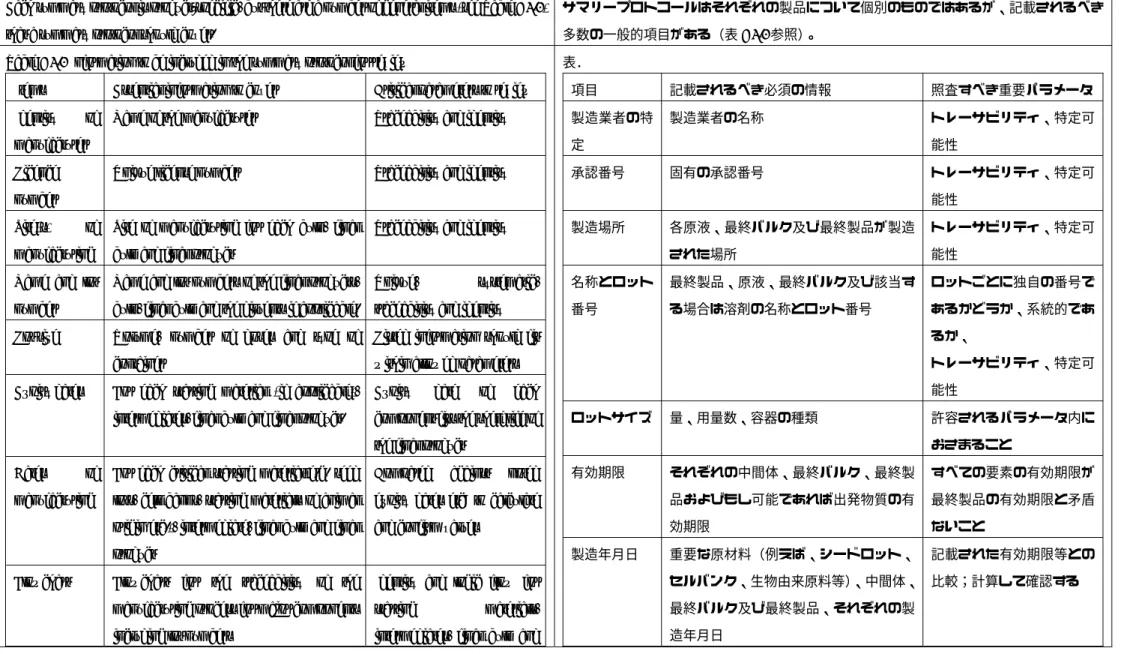
Guidelines for Independent Lot Release of Vaccines by Regulator y Author ities規制当局によるワクチンのロットリリースに関するガイドライン Abbreviations
1. Introduction 1.1 Scope 2. Glossary
3. General consideration
3.1 Considerations for establishing lot release procedures by the NRA/NCL 3.2. Encouragement of networking and work-sharing
4. Responsibilities of the NRA/NCL and manufacturer in lot release 4.1 Responsibility of the NRA/NCL in lot release
4.2 Responsibility of the Manufacturer in NRA/NCL Lot Release 4.3 Establishment of quality management systems for the NRA/NCL 5. Conducting lot release
5.1 Protocol review 5.1.1 Principles
5.1.2 Summary protocol template 5.1.3 Checklist for protocol review 5.1.4 Protocol review process
5.1.5 Handling discrepancies and OOS results in summary protocols 5.2 Independent testing
5.2.1 Purpose of independent testing
5.2.2 Prerequisites for setting up independent testing for lot release 5.2.3 Establishment of a testing policy
5.2.4 Criteria for selection of tests for lot release and percentage of lots to be tested
略語 1. 緒言 1.1 適用範囲 2. 用語集
3. 一般的な留意事項
3.1 NRA/NCLによるロットリリースの手順制定のための留意事項
3.2. ネットワーク形成と業務分担の奨励
4. ロットリリースにおけるNRA/NCL及び製造業者の責任
4.1 ロットリリースにおけるNRA/NCLの責任
4.2 NRA/NCLによるロットリリースにおける製造業者の責任
4.3 NRA/NCLにおける品質マネジメントシステムの構築
5. ロットリリースの実施 5.1 プロトコール審査 5.1.1 原則
5.1.2 サマリープロトコール様式
5.1.3 プロトコール審査のチェックリスト 5.1.4 プロトコール審査のプロセス
5.1.5 サマリープロトコールにおける矛盾や規格外(OOS)の結果の取り扱い 5.2当局による試験
5.2.1当局による試験を実施する目的
5.2.2ロットリリースのための当局による試験をセットアップする前提条件
5.2.3試験実施ポリシーの制定
5.2.4 ロットリリース試験の選択及び試験すべきロットの割合に関する基準
5.2.5 Importance of reference preparations for lot release 5.2.6 Standards
5.2.7 Practical considerations 5.2.8 Release specification 5.2.9 Evaluation of NCL results 6. Data monitoring
6.1 Trend analysis including the data from the NCL
6.2 Comparison of results of the manufacturer with those of the NCL 7. Evaluation of the lot and the decision-making process
7.1 Establishment of decision-making procedures
7.2 Recognition of, and confidence in, lot release by other NRAs/NCLs
7.3 Release certificate issued by the NRA/NCL of a producing/releasing country for United Nations procurement
8. Lot release certificate Authors and acknowledgements References
Appendix 1
A model procedure to document the decision-making process in lot release
5.2.5 ロットリリースのための参照品類の重要性 5.2.6 標準品
5.2.7 実際的な留意事項 5.2.8 合否判定の基準
5.2.9 NCLの試験結果の評価
6. データモニタリング
6.1 NCLによって得られたデータを含むトレンド分析
6.2製造業者とNCLの結果の比較 7. ロットの評価と意思決定プロセス 7.1 意思決定手順の確立
7.2 他のNRA/NCLによって実施されたロットリリースの承認及び信頼
7.3国連調達品を製造/リリースしている国のNRA/NCLによって交付されるリリース証明 書
8. ロットリリース証明書 著者及び謝辞
参考文献 付属文書 1
ロットリリースにおける意思決定過程を文書化する手順のモデル
Abbr eviation 略語
AEFI adverse events following immunization BCG bacilli Calmette-Guérin
DTP diphtheria–tetanus–pertussis vaccine GMP good manufacturing practice HPV human papilloma virus