九州大学学術情報リポジトリ
Kyushu University Institutional Repository
画像向け暗号方式の安全性解析に関する研究
趙, 亮
九州大学システム情報科学府
https://doi.org/10.15017/25136
出版情報:Kyushu University, 2012, 博士(工学), 課程博士 バージョン:
権利関係:
Image Encryption Algorithms
Liang Zhao
July, 2012
Department of Informatics,
Graduate School of Information Science and
Electrical Engineering, Kyushu University
i
Contents
List of Figures v
List of Tables vii
Preface a
Acknowledgments d
1 Introduction 1
1.1 Motivation . . . 1
1.2 Contributions . . . 2
1.3 Organization of the Thesis . . . 4
2 Preliminaries 5 2.1 Security Protection for Digital Media . . . 5
2.1.1 Concept and Application of Digital Media . . . 5
2.1.2 General Description on Encryption of Digital Media . . . 7
2.2 Research Progress of Protection for Image Content . . . 9
2.3 Categories of Security . . . 11
2.3.1 Unconditional Security . . . 11
2.3.2 Computational Security . . . 13
2.4 Targets of Adversary . . . 14
2.5 Categories of Attack Scenarios . . . 15
2.6 Measurement of Attack . . . 17
2.7 Examples on Security Analysis of Image Encryption . . . 18
2.8 Conclusions . . . 19
3 Scrambling Analysis of Image Spatial Scrambling Encryption 21 3.1 Introduction . . . 21
3.1.1 Research Background . . . 21
3.1.2 Previous Work . . . 23
3.1.3 Challenge Issues . . . 23
3.1.4 Our Contribution . . . 24
3.1.5 Organization of the Chapter . . . 25
3.2 Preliminaries on Bit-Plane of Still Image . . . 25
3.2.1 Bit-Plane of Gray-Scale Image . . . 25
3.2.2 Why Use Bit-plane for Scrambling Evaluation? . . . 29
3.3 Details of Scrambling Evaluation . . . 31
3.3.1 Spatial Distribution Entropy of Still Image . . . 31
3.3.2 Centroid Difference of Bit-Plane . . . 32
3.3.3 Steps of Scrambling Evaluation . . . 34
3.4 Experiments and Analyses . . . 36
3.4.1 Scrambling Strategy . . . 36
3.4.2 Scrambling Measurement . . . 37
3.5 Conclusions and Further Discussion . . . 43
4 Security Analysis of Image Encryption Algorithm of Pixel Bits 45 4.1 Introduction . . . 45
4.1.1 Research Background . . . 45
4.1.2 Our Contribution . . . 46
4.1.3 Organization of the Chapter . . . 47
4.2 Description of the Original Algorithm Under Study . . . 48
4.3 Drawbacks in the Original Algorithm and Corresponding Attack . . . 51
4.3.1 Drawbacks of the Original Algorithm . . . 51
4.3.2 Attack Against the Original Algorithm Under Study . . . 53
4.4 Simulation on Proposed Attack . . . 58
4.5 Remarks on Attack . . . 61
4.6 Quantified Comparison . . . 62
4.7 Suggestion on Improvement of Original Algorithm . . . 69
4.7.1 Partitioning Method of Plaintext Image . . . 71
4.7.2 Suggestion on Key Scheduling . . . 71
4.7.3 Encryption Steps . . . 74
4.8 Performance and Security Analysis on Suggested Improvement . . . 77
4.8.1 Resistance to Proposed CPAand KPA . . . 77
4.8.2 Key Space and Sensitivity Analysis . . . 77
4.8.3 Statistical Analysis . . . 79
4.8.4 Information Entropy Analysis . . . 81
4.8.5 Comparison with the Original Algorithm . . . 83
4.8.6 Other Analysis . . . 85
4.9 Conclusions . . . 86
5 Security Analysis of Randomized Arithmetic Codes 89 5.1 Introduction . . . 89
5.1.1 Research Background . . . 89
iii
5.1.2 Previous Work . . . 90
5.1.3 Our Contributions . . . 92
5.1.4 Organization of the Chapter . . . 93
5.2 Randomized Markov Model Based Arithmetic Code and Its Drawbacks . 93 5.2.1 Scheme Review . . . 93
5.2.2 Drawbacks . . . 95
5.3 Insecurity ofACMM. . . 96
5.3.1 Formal Definition on ACMMand Corresponding Security Notions 97 5.3.2 Security Analysis of ACMMunder CPA . . . 102
5.3.3 Security Analysis of ACMMunder COA. . . 108
5.3.4 Extension Consideration . . . 110
5.4 Insecurity ofACMM+RAC . . . 111
5.4.1 Formal Definition on ACMM+RAC . . . 112
5.4.2 Security Analysis of ACMM+RAC underCOA . . . 113
5.5 Simulation of Proposed Attacks . . . 116
5.5.1 Simulation Results of CPA onACMM . . . 117
5.5.2 Simulation Results of CPA onACMM and ACMM+RAC. . . 117
5.6 Conclusions . . . 119
6 Conclusions and Future Research 123 6.1 Summary . . . 123
6.2 Possible Directions for Future Research . . . 125
Appendix 127 Appendix A . . . 127
Appendix B . . . 128
Appendix C . . . 128
Bibliography 131 Published Papers 143 Journal Papers . . . 143
International Conference Papers with Review . . . 143
Japanese Domestic Conference Papers without Review . . . 144
Index 146
v
List of Figures
3.1 Scrambled images of gray-scale image ‘Lena’ of size 128×128: Case of
Generalized Arnold cat map. . . 22
3.2 Eight bit-planes of the gray-scale ‘Lena’: from MSB-P to LSB-P. . . 26
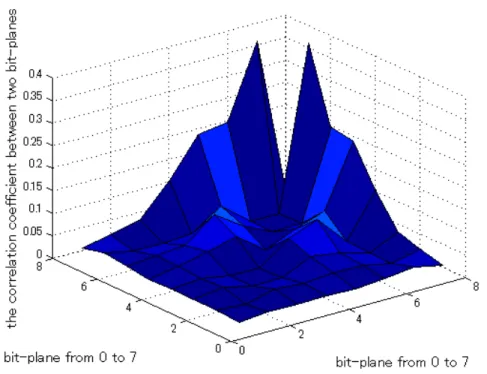
3.3 Correlation coefficients between any two bit-planes of the gray-scale ‘Lena’. 28 3.4 Effect of the bit-plane for gray-scale image. . . 29
3.5 Comparison between bit-planes from two different scrambled images: Orig- inal plaintext image is named as ‘Internetgirl’ of size 128×128. . . 30
3.6 Scrambled gray scale ‘Baboon’ using two kinds of transformations in dif- ferent times of iterations: results of first row is from generalized Arnold cat map; results of second row is from generalized Gray code. . . 37
3.7 Original gray-scale images (‘Baboon’, ‘Boat’, ‘Internetgirl’, ‘Landscape’). 38 3.8 Scrambling degree values for the used two transformations (Size of block is 16×16): first row is corresponding results of ‘Baboon’; second row is corresponding results of ‘Boat’. (blue: four bit-planes selection; red: eight bit-planes selection) . . . 39
3.9 Scrambling degree values for the used two transformations (Size of block is 16×16): first row is corresponding results of ‘Internetgirl’; second row is corresponding results of ‘Landscape’. (blue: four bit-planes selection; red: eight bit-planes selection) . . . 40
3.10 Scrambling degree values for the used two transformations (Size of block is 32×32): first row is corresponding results of ‘Baboon’; second row is corresponding results of ‘Boat’. (blue: four bit-planes selection; red: eight bit-planes selection) . . . 41
3.11 Scrambling degree values for the used two transformations (Size of block is 32×32): first row is corresponding results of ‘Internetgirl’; second row is corresponding results of ‘Landscape’. (blue: four bit-planes selection; red: eight bit-planes selection) . . . 42
4.1 Details of encryption process. . . 48
4.2 Encryption and decryption effect on original scheme. . . 50
4.3 Transformation of a bit pixel in one binary matrix. . . 52
4.4 Examples of plaintext image: (a) One for revealing vector T M, (b) One for revealing vectorT N. . . 53
4.5 Size exchanging before theCPA when M>8N. . . . 55 4.6 Example of attack on T M. . . . 56 4.7 Test images for proposed attacks: (a-c) plaintext image, ciphertext image
and decrypted image of “Lena”;(d-f) plaintext image, ciphertext image and decrypted image of “Cameraman”. . . 57 4.8 Chosen-plaintext attack to ciphertext images b and e in Fig. 4.7: (a, d)
plaintext images for revealing TM; (b, e) plaintext images for revealing TN; (c, f) recovered images of “Lena” and “Cameraman”. . . . 59 4.9 Numbers of used plaintext images/ciphertext images for differentN: (a1)
N=728, (a2)N=468, (b1) N=320, (b2) N=480. . . 64 4.10 Numbers of used plaintext images/ciphertext images for different N: (c1)
N=1024, (c2)N=1600, (c3) N=1920, (d1)N=576, (d2) N=720. . . 65 4.11 Numbers of used plaintext images/ciphertext images for different M: (a)
M=256, (b) M=512, (c) M=1024, (d) M=2250. . . 67 4.12 One round of self-adaptive encryption: (a) partitioning according to vertical-
direction, (b) partitioning according to horizontal direction. . . 70 4.13 Partitioning method of self-correlation encryption. . . 71 4.14 Encryption/decryption demonstration (RN is time of encryption in one
round): (A) encryption procedure; (B) decryption procedure. . . 74 4.15 Test for key sensitivity: (a) plaintext image, (b) ciphertext image using
key x01=0.41236, (c) ciphertext image using key x01=0.41236000000001, (d) difference image of above two ciphertext images, (e) decrypted image using a slight change keyx01=0.41236000000001. . . 79 4.16 Histogram of (a) plaintext image, (b) ciphertext image, (c) decrypted
image about ‘Lena’. . . 80 4.17 Correlation of two adjacent pixels in plaintext image (‘Lena’) and cor-
responding ciphertext image: (a and b) Horizontal-direction, (c and d) Vertical-direction, (e and f) Diagonal-direction. . . 82 4.18 Comparison between original encryption algorithm and improved one: (a)
plain image, (b) original encryption algorithm, (c) improved scheme. . . . 84 4.19 Gray difference degree of improvement. . . 86 5.1 Tow parts of compression: modeling component and encoding component. 90 5.2 Encryption procedure of each symbolsi. . . 94 5.3 Probability model and corresponding initial model. . . 95 5.4 Tow components of compression: modeling and encoding component. . . 96 5.5 Example of pseudorandom bit recovery (S=0010...0), assume thatq1 and
q2 have been revealed. . . 106 5.6 Combined encryption scheme from modeling and encoding component. . 111 5.7 Encryption example according toq=11 and q′=01. . . 112 5.8 Running time of proposed CPA. . . 116
vii
List of Tables
4.1 Number of plaintext images/ciphertext images in our attack and Li and
Lo’s attack. . . 63
4.2 General sizes ofN. . . 64
4.3 Common aspect ratios. . . 66
4.4 Aspect ratios of Fig. 4.9and 4.10. . . 66
4.5 Aspect ratios of Fig. 4.11. . . 68
4.6 Probability PN. . . 69
4.7 Key sensitivity at one round . . . 79
4.8 Correlation coefficients of two adjacent pixels in plaintext image and corre- sponding ciphertext image of ‘Lena’ (128×128) and ‘Cameraman’ (256×256) 81 4.9 Results of information entropy . . . 83
4.10 Permutation space of original algorithm for one row . . . 85
4.11 Spent time for encrypting some gray-scale images with suggested improve- ment (unit: second). . . 87
5.1 Some existing works on modified AC . . . 91
5.2 Attacks on existing works of modified AC . . . 91
5.3 Four states of pseudorandom bit recovery . . . 107
5.4 Interval partition of s1s2=10 and s′1s′2=11 with different q and q′ . . . . 114
5.5 Comparison betweenV alue(q) andV alue(qrv) . . . 118
5.6 Simulation results on the Pr[Privkcoa A,∏′(n)=1] and Pr[Privkcoa A,∏e(n)=1] . . . 120
Preface
With the development of the computer and network technology, digital media infor- mation (specially the multimedia information) is used in many fields more widely, e.g., the industry, medical treatment and academic research. As a result, the correspond- ing security problem of the digital media information becomes increasingly significant.
Moreover, to reduce the volume of the information for the transmission, the digital media information, in general, does the compression as one procedure. Based on this background, there are three kinds of methods for the secure communications of the digi- tal media information. The traditional way is that the digital media information is first compressed to reduce the redundancy, and then encrypted to mask its meaning. How- ever, in some application scenarios, the sender of the digital media information hopes encrypting the original data firstly and the network provider may compress the encrypted information without knowing any knowledge of the original data and the corresponding key. Therefore, the second method which does the encryption followed by the compres- sion has been attracted as the considerable research interest recently. Specially, for the second method, the research of the corresponding encryption algorithms is one of the main research topics in the digital media security. The third method is that the compres- sion of the digital media information and the corresponding encryption can be achieved synchronously. This research always considers the revision of the traditional compres- sion algorithm such as the Huffman coding and the arithmetic coding (AC). The purpose of it focuses on the reduction of the time and computation of each operation (i.e., the compression and encryption), and this kind of research makes the system flexible for the advanced digital media processing.
b
According to the above analysis, it can be found that the second method and the third method are two interesting topics in the field of the digital media security. In fact, there have been many encryption algorithms belonging to these two methods which are proposed for protecting the secrecy of the digital media information. Correspondingly, the security analysis of the proposed algorithms also becomes important before they are employed in practice. In this thesis, we investigate the security of some encryption algorithms for the digital media information. In particular, as the digital image is one of the main carriers of the digital media information which causes that there have been many proposed image encryption algorithms, our security analysis primarily focuses on the digital image related encryption algorithms. In our analysis, we try to identify some properties in the different encryption algorithms which can be exploited to break the corresponding ciphers.
We first present a scrambling analysis of image spatial scrambling encryption algo- rithms. As the image scrambling algorithms, e.g., the Arnold cat map and Fibonacci transformation, are widely used to encrypt the digital image, the scrambling degree of the corresponding ciphertext image should be measured. Therefore, an evaluation method based on the bit-plane has been proposed. Specially, the bit-plane theory is the core of this evaluation method. In the evaluation step, the spatial distribution entropy and centroid difference for the bit-plane are used to measure the scrambling degree of each bit-plane. As the relationship between the original image and most significant bit-plane to least significant bit-plane reduces gradually, we set a level decreasing-based weight for each bit-plane when the final scrambling degree is computed. The experiment re- sults show that this evaluation method can be considered as a candidate for finding the scrambling degree of the image scrambling algorithm.
Then, we address a security analysis on an image encryption algorithm of pixel bits and present the comparison with the previous state of the art. We provide the chosen- plaintext attack (CPA) for breaking an image scrambling encryption algorithm of pixel bits which was presented by Ye and published on Pattern Recognition Letters in 2010.
The proposed attack reveals the equivalent vectors which can substitute for the user-
supplied keys. Compared with the former analysis work observed by Li and Lo which was published on Signal Processing in 2011, our attack has the lower complexity which implies that our attack is more efficient than Li and Lo’s attack. Moreover, a suggested improvement against our attack is presented in details. In fact, we introduce the self- correlation which comes from the idea of the self-adaptive encryption, proposed by Chen et al. and published onJournal of Softwarein 2005, into the original algorithm to enhance the security. The final simulation results show the performance of this improvement which may be better than the original algorithm.
Finally, we provide a security analysis on the randomized arithmetic codes based on the Markov model and the further analysis on the corresponding improvement scheme.
Randomized arithmetic code is seen as a kind of symmetric-key algorithm which can achieve the encryption and the compression for the digital media information syn- chronously. In 2011, Duan et al. proposed one kind of randomized arithmetic code based on the Markov model (ACMM). This research result is published on Communications in Nonlinear Science and Numerical Simulation. In order to achieve the security analysis, we first put forward a formal definition of ACMM, and then explore the corresponding security. In fact, our analysis shows that ACMM is insecure under the ciphertext-only attack (COA) even if a new pseudorandom bit sequence is used for the encryption of each plaintext message. Moreover, an enhanced algorithm which combines ACMM with the randomized arithmetic coding (RAC) is presented. Specially, RAC is introduced by Grangetto et al. and published onIEEE Transactions on Multimedia in 2006. However, the security analysis also shows that the combination schemeACMM+RACis insecure un- der the COA. Finally, we present the simulation results to confirm the proposed attacks for ACMMand ACMM+RAC.
Fukuoka Japan, July 2012 Liang Zhao
d
Acknowledgments
I would like to take the opportunity to thank all the people who supported and accompanied me during my Ph.D studies.
First and foremost, I would like to thank my supervisor Professor Kouichi Sakurai for giving me a very interesting research problem. I would like to present my thanks to Professor Sakurai for having an open door for my questions, and for professor’s comments on my works. Each time when I finished a manuscript, Professor Sakurai would give me some detailed comments from both editorial and technical side. I would also very appreciate that Professor Sakurai gave me the freedom to do the research on this field which I liked. When I encountered the technical confusion on my research, Professor Sakurai always supported me which can give me the confidence. If there is the new idea on my research, Professor Sakurai would send to me at the first time.
I am grateful to Professor Takashi Nishide. Specially, when I asked the questions about my research, Professor Takashi Nishide was always full of patience for answering them. Moreover, Professor Nishide always shared the research expertise and new research topics with me. This made me have a great progress in my research field. I would like to thank you, Professor Nishide. I think that I learned a lot from Professor Nishide not only from the research content but also from the research behavior. I think these research behavior can help me in the future.
I would also like to thank Professor Kyung-Hyune Rhee and Professor Avishek Ad- hikari who were the co-authors on my works. As we had the same research topics, I really enjoyed the co-works with two professors. Every time when I discussed with professors about my research, I can achieved enough information. Specially, if I discussed with
professors about the revision of the manuscript, professors always give me the useful comments.
Moreover, my Ph.D colleagues would obtain my thanks. Thanks for the fun at our trips. We entered our laboratory together, and tried to discuss the research together even if the research topics are not the same. I felt luckily not only for the senseless discussions but also for the friendship among us.
I would specially like to appreciate to my father and mother for their continuous supports and encouragements. During my study, my father and mother experienced every moment of my happiness and sadness.
Lastly, I would be grateful for the governmental scholarship from China Scholarship Council. As the support from the governmental scholarship, I can remove my concerns on living, and only concentrate on my research. I also thank the Ph.D courses scholarship from Kyushu University which gave me the fund support for my travel to attend a number of academic events, including workshop and conference.
1
Chapter 1 Introduction
In this chapter, we will begin to present our work by giving the motivation for our research. Moreover, we provide the contributions in this thesis, and present its overall structure.
1.1 Motivation
In 1956, the first computer network was constructed. After that, various commu- nication networks enter our life and work, e.g., Public Switched Telephone Networks (PSTNs), Public Switched Data Networks (PSDNs), Integrated Service Networks (ISNs) and mobile communication systems [1]. This change brings an important communica- tion vehicle for us, i.e., digital media. In fact, the development of the digital media does always follow the progress of the computer and network technique. Today, we can find the applications of it in many fields, e.g., medical system, government, industry and academic research. This implies that the digital media has become the indispensable tool for our life and work.
Based on the above reason, providing confidentiality for the digital media is of sig- nificance, specially for the insecure communication channels. Therefore, researchers try to propose some kinds of approaches to protect the digital media information from leak- ing to unauthorized users. The encryption algorithm is seen as the main protection method. For the encryption algorithm, as the compression which can reduce the size
of input is the necessary step for the communications of the digital media information, there are three kinds of detailed methods provided for the secure communications of the digital media. The traditional approach is that the digital media information is compressed firstly, and encrypted secondly. This method is called the first-compression- then-encryption approach. The second approach is the reverse process which does the encryption at first and then finishes the compression. This method can be called the first-encryption-then-compression approach. Recently, there is the third approach which can do the encryption and compression in one step. Usually, the third approach focuses on the compression based encryption algorithm.
Since there are the encryption algorithms for protecting the digital media information, security analysis for these encryption algorithms has received considerable attention. The relationship between the security analysis and the encryption algorithm seems to be like the relationship between the lance and the shield. Generally speaking, the purpose of the security analysis is to evaluate or break the encryption algorithms. For a proposed encryption algorithm on the digital media, it needs a variety of security analyses. This is of great importance if the proposed encryption algorithm intends to be used in prac- tice. Moreover, the security analysis is helpful for designing the more secure encryption algorithms.
1.2 Contributions
According to the above description, it can be found that the study on the security analysis of the encryption algorithm is an interesting and hot topic. Specially, as the still image is one of the main digital media vehicles, in this thesis, our works focus on the security analysis of some image encryption techniques and algorithms which belong to the second method and the third method, and present the further consideration. Generally speaking, our works include the following three primary contributions:
• A scrambling analysis of image spacial scrambling encryption algorithms is pre- sented. The image scrambling encryption (e.g., the Generalized Arnold cat map)
1.2. Contributions 3
is one of the main protection methods for the image content. Therefore, intuitively, the scrambling degree of the corresponding cipher image should be measured for satisfying the basic security condition. We propose an evaluation method based on the bit-planefor evaluating the scrambling degree of the scrambled image. The evaluation method utilizes the spatial distribution entropy and centroid difference for achieving the scrambling degree. The final experiment results demonstrate that this evaluation method can find the scrambling degree efficiently for the im- age scrambling schemes.
• A security analysis of an image encryption algorithm of pixel bits is proposed.
Specially, the chosen-plaintext attack for an image scrambling encryption scheme of pixel bits [85] is presented. Compared with the former analysis work observed by Li and Lo [45], our analysis has the lower complexity. This demonstrates that our attack is more efficient than Li and Lo’s attack. Furthermore, a suggested improvement against our attack is provided in details. The performance analysis shows that this suggested improvement may be better than the original algorithm.
• A security analysis of the Markov model based randomized arithmetic codes is addressed. For our analysis, at first, we put forward the formal definition of the randomized arithmetic codebased on the Markov model (i.e., ACMM) [31]. Then, we explore the security ofACMMunder the chosen-plaintext attack and ciphertext- only attack. Moreover, an enhanced encryption algorithm which combines ACMM with randomized arithmetic coding (RAC) [42] is presented, and the security of this combination scheme is also analyzed under the ciphertext-only attack. However, the security analysis shows thatACMM+RACis insecure under the ciphertext-only attack.
The results provided in the thesis have previously been presented in [97, 98, 99, 100, 101].
Specially, the scrambling analysis of the second result is mainly related to the analysis on the spatial scrambling algorithm. The final scrambling degree is used to reflect the scrambling effect of the image scrambling algorithm for the image. The security analysis
of the third result focuses on breaking the image encryption algorithm which is proposed by Ye [85] and finding out the equivalent keys of this algorithm. Note that the image encryption algorithm proposed by Ye [85] can achieve the scrambling of the pixel positions and the encryption of pixel values simultaneously.
1.3 Organization of the Thesis
The remainder of this thesis which includes three parts is organized as follows:
• Literature Review: In Chapter 2, we first present some basic knowledge about the concept and applications of the digital media and the research progress of the security protection of the digital media. In particular, we briefly review the image encryption category and list some examples about the image encryption algorithms. Secondly, we provide the category of the security and the security considerations which include the target of adversary, category of attack scenarios and measurement of attack. Furthermore, some examples on the security analysis of the image encryption are also presented.
• Our Results: In Chapter 3, we propose a scrambling evaluation method based on the bit-plane for evaluating the scrambling degree of the scrambled image which is encrypted by the spatial scrambling algorithm. In Chapter 4, we present the details of our attack on an image encryption algorithm of pixel bits and give the comparison with the previously published attack. In Chapter 5, we provide a security analysis about a randomized arithmetic coding based on Markov model.
In fact, we put forward a formal definition of this randomized arithmetic coding firstly. Then, we present our analysis on it. Moreover, we also address a security analysis on the improvement of this randomized arithmetic coding.
• Conclusions: In Chapter 6, we present the summary about each result in this thesis, and provide some possible directions of the future work.
5
Chapter 2 Preliminaries
In this chapter, on one hand the basic information about the digital media and the corresponding research progress about the security of the digital media are introduced.
Specially, the image encryption classifications and some corresponding encryption algo- rithms are listed. On the other hand, the categories of the security and some security considerations (e.g., target of adversary, categories of attack scenarios and measurement of attack) are also presented. Moreover, some examples about the security analysis of the image encryption are provided.
2.1 Security Protection for Digital Media
2.1.1 Concept and Application of Digital Media
When people enter into the 21st century, the need for the information is becom- ing increasingly large. Specially, with the development of the computer technique and network technique, people can obtain the necessary information from many kind of chan- nels and methods. This implies that the information vehicle is gradually not dependent on the material which is like the paper, but related to the digital media which can be used to load the digital information.
Digital media denotes the information vehicle which can be used for the record, disseminating, acquisition, etc. in the form of the binary system. Rafiq et al. [2] have
listed some examples about the digital media, e.g., the compact disc, digital video and e-book. According to the description from Rafiq et al. [2], the digital media is seen as one kind of media with the electronic data. Specially, the media data is presented in the digital form for the post-processing.
It can be found that the digital media is being developed for associating with many technical problems of our life and work. This implies that it has been widely used in our world. In general, there may be two main categories for the digital media. Firstly, the digital media is assorted based on the time. This division implies the fact that the media content can be the same or be changed with the passage of time. If the media content is not changed it can be so-called still media. Secondly, the digital media is assorted according to the number of the information vehicles. If there is only one kind of information vehicle, this media is called as single media. Otherwise, this digital media belongs to the multimedia. Of course there may be some other categories, e.g., the classification based on the origin of data.
Nowadays, the digital media usually refers to the multimedia which has the complex representation and has been one of the necessary information receivers for people’s life and work. The term ‘multimedia’ in fact was first created by Bob Goldstein in 1966.
After that, this word was imparted by many meanings during some past years. About its concept, Williams et al. [3] provided a brief working definition about the multimedia, i.e., multimedia=variety+integration. Based on this point, we can consider that the multimediais the combination of a variety of information forms (i.e., single media) which is used for the information share and communications.
The above description indicates that some different digital media types are integrated together to acquire the multimedia. If compared with the traditional forms of the printed and hand-produced material, in fact, the term multimedia has three primary merits which are described as follows:
• The cost of the information vehicle is usually low.
• This kind of information is easy to be stored and the corresponding period of
2.1. Security Protection for Digital Media 7
validity is long.
• The kind of information is easy to be spread.
Based on these merits of the multimedia, the communications of the multimedia in- formation is generally being the significant medium for the intercourse of the digital information. Undoubtedly, the above merits are not only related to the multimedia but also suitable for the wider concept, i.e., digital media.
We turn back to the original topic. Generally speaking, the digital media includes the text,still image, video, audio, etc. which are the mainvehiclesof the digital information.
For the term multimedia, it is seen as the interactivity content forms of these mediums.
Therefore, according to the various formats of the digital media, the application of the digital media can be in many fields such as the education, finance, entertainment, medical treatment, military and cultural activities. The details about the application of the digital media can refer to the review [3].
2.1.2 General Description on Encryption of Digital Media
As the wide use of the digital media (e.g., multimedia) in many form, a crucial issue about the security of the digital media is produced. Although the digital media has many innate merits compared with the traditional media, it is still one kind of expression form for the information. Therefore, the importance of the security of the digital media is the same as the importance of that of the traditional media. There are the following three challenges about the protection of the digital media:
(1)Nowadays, as the used network is the shared channel, especially for Internet, it is easy for the adversary to eavesdrop on or falsify the unencrypted digital media information under the transmission.
(2)For the significant digital media information, e.g., the reports about the govern- mental conferences, the information about the business conferences and the medical image, the secrecy for the storage is necessary.
(3)For the digital media consumable, e.g., the MP3 music, the high-quality image and the digital TV, it is crucial to prevent the unauthorized user accessing them.
To settle the above security issues, the encryption can be considered as one of the effective and direct solutions. This is based on the fact that the user can obtain the digital media information until he/she has the corresponding secret keys. Therefore, it can be found that this is useful for ensuring the benefit of the manufacturer and the right of the consumer.
For the practical situation, as the digital media information usually has the huge volume, there is one necessary procedure called compression which is used to reduce the volume of the transmitted data in the network. Based on this precondition, there are three kinds of methods for the secure communications of the digital media, specially for the multimedia. The first and traditional method is that the data of the digital media is compressed firstly to reduce the redundancy, and then encrypted to keep its secrecy. For this method, the traditional compression and encryption algorithms can be utilized. However, according to the research background in the works [4, 5], in some application scenarios, the sender of the digital media intends to encrypt the original data at first for masking the meaning and the network provider may compress the encrypted information without knowing any knowledge on the original data of the digital media and the corresponding secret key. According to this scenario, the second method which does the encryption at first and then achieves the compression has been attracted as the considerable research interest recently. Specially, for this method, some researchers on the information security and the signal processing focus on finding and proposing the encryption algorithms which make use of the characteristics of the digital media, e.g., [55, 88, 61, 85, 39]. Moreover, except the above two methods, there is another candidate which does the encryption and compression simultaneously. In fact, this research is main about the revision of the traditional compression algorithm such as theHuffman coding and the arithmetic coding for implementing the confidentiality protection. There are some examples in the works [36, 44, 76, 78, 31]. However, some researchers also found the method that the compression can be inserted into the encryption algorithm. The
2.2. Research Progress of Protection for Image Content 9
typical example is from the works [6, 7]. Generally speaking, the third method focuses on the reduction of the time and computation of each operation (i.e., the compression and encryption), which may be useful for the processing (or post-processing) about the digital media.
In particular, as a large amount of information can be achieved from thevisionand the still image is one of the important digital media for transmitting the visual information, in the thesis, the main research is about the image encryption. Moreover, according to the above analysis, it can be found that the second and third method do attract the more researchers recently. Therefore, in the following section, the current research progress about the protection of the image content with the encryption is introduced, which specially focuses on the second and third methods.
2.2 Research Progress of Protection for Image Content
For the still image, it has some characteristics which are different from the text [8] or the audio, such as the large volume, the high fidelity and the strong relativity. Therefore, based on thecharacteristicsof the still image, there are three essential conditions for the image encryption in the second method and the third method.
• (For the second method): As the image data has the large volume, for improving the encryption speed, the corresponding encryption algorithm should be efficient.
• (For the second method): As there is the strong relativity among the image pixels, the corresponding encryption algorithm should break the relationship among the image pixels. Specially, it is better to achieve the diffusionin the encrypted image for promoting the security.
• (For the third method): If the compression is produced in the encryption procedure, the compression ratio should be achieved to a certain level.
According to the above conditions, there have been some proposals about the image encryption. Researchers of the works [55, 88, 61] presented some image encryption al-
gorithms which are based on the higher-dimensional Fibonacci transformation, SCAN language and T-matrix, respectively. These image encryption algorithms are based on the fast scrambling of the image pixels. In 2010, Ye [85] proposed an image scrambling encryption of pixel bit. This method can implement the permutation of image pixels and the encryption of the values of the image pixels simultaneously. The similar idea is also used in the work [39], which focuses on the disposal of digital medical images. Podesser et al. [59] introduced a kind of selective image encryption algorithm which considers the gray-scale image as eight bit-plane and only encrypts the four or five most significant bit-plane(MSB). This kind of algorithm can reduce the encrypted image data for enhanc- ing the efficiency. Chen et al. [29] also provided a SCAN-CA-based image encryption algorithm. This algorithm is based on the permutation of the image pixels, which uses theSCAN language, and replacement of the pixel values, which uses the recursivecellular automata (CA). Actually, this algorithm can be seen as the synchronous stream cipher.
Wang et al. [56] proposed an approach of optical image encryption with binary Fourier transform computer-generated hologram (CGH) and pixel-scrambling. For this kind of encryption algorithm, the orders of the pixel scrambling and the encrypted image need to be used as the keys to decrypt the original image.
Moreover, if considering the compression and encryption simultaneously, some re- lated works were also presented. For example, the compression-encryption algorithms which are based on the SCAN technique were presented in the works [24, 54]. Puech et al. [9] provided a reversible method which transfers the image quickly and safely.
Specially, this method can achieve the lossless compression at the same process. Duan et al. [31] proposed a kind of randomized arithmetic coding based on the Markov model.
This encryption algorithm makes use of the permutation of probability of each sym- bol in the Markov tree to encrypt the plaintext. The similar works about the revision of arithmetic coding can be found in the works [36, 44, 76]. In 2005, Wu et al. [78]
also presented a combination algorithm of the compression and encryption, which uses the multiple Huffman tables to finish these two operations. Moreover, a secret key en- cryption algorithm was developed for both image data encryption and compression in
2.3. Categories of Security 11
the work [79]. Specially, in order to achieve the lossless data compression effect, the quadtree data structureis used to represent the image. In order to finish the encryption, the scanning sequences of image data are provided.
After introducing the knowledge about the image encryption algorithm and the cor- responding progress, we should consider the corresponding research from the contrary side, i.e.,security analysis. Therefore, in the next section, some basic information about the security analysis for the image encryption is presented, which includes the categories of the security, target of adversary, categories of attack scenarios and measurement of attack.
2.3 Categories of Security
There can be some categories for the securityof a cryptosystem which also includes the image encryption algorithms in the literature. In this section, two different concepts of security are presented, i.e., the unconditional securityand computational security.
2.3.1 Unconditional Security
For a cryptosystem, if it is unconditionally secure, it can not be broken even under the condition of infinite computational resources [13]. In fact, Shannon [10] had presented a formal definition with the so-called name “perfect secrecy” in the paper “Communication Theory of Secrecy Systems” which was published on Bell Systems Technical Journal in 1949. According to the description from Shannon, the perfect secrecy implies that an adversary can not achieve any useful knowledge on theplaintext according to the obser- vation of the corresponding ciphertext. The definition of the perfect secrecy [11, 10, 13]
is presented as follows:
Definition 2.1 (Perfect secrecy). A cryptosystem has the perfect secrecy if Pr[P =p|C =c] = Pr[P =p]
for all p∈P and c∈C. That is, the a posteriori probability that the plaintext isp, given
that the ciphertext cis observed, is identical to the a priori probability that the plaintext is p.
However, generally speaking, a cryptosystem which is unconditionally secure in a attack scenario may be easy to be broken in another attack scenario. For example, a cipher which may be unconditionally secure against the ciphertext-only attack (COA) (see 2.5 about the ciphertext-only attack) has been not proved that this cipher is also unconditional secure in some other attack scenarios (e.g., chosen-plaintext attack (CPA) (see 2.5)). Therefore, the definition of the unconditionally security is not equal to the definition of the perfect secrecy [13].
According to Shannon’s opinion, the perfect secrecy can only be achieved if the length of the secret key equals or exceeds the length of the plaintext [10]. From this point, the perfect secrecy is impractical. However, the perfect secrecy can be realized by the cipherOne-time padwhich was depicted by Gilbert Vernam at first even if there was no mathematical proof. Moreover, Shannon presented the proof that the One-time pad [43]
can provide the perfect secrecy. Specially, in One-time pad, the keykis chosen uniformly at random and there is no two plaintexts which are encrypted by using the same keyk. Of course this produces the key management issues which limit the utilization of the cipher One-time pad in some commercial applications. Nevertheless, the cipher One-time pad has been employed in the military and diplomatic contexts in which the unconditional security may be very crucial [11]. The description about the One-time pad is as follows [13, 11]:
Definition 2.2(One-time pad). Letn>1 be the length of the plaintext, and takeP=C=K
=Zn2. For p=(p1,. . .,pn)∈P, c=(c1,. . .,cn)∈C and k=(k1,. . .,kn)∈K, the encryption is defined as
Ek(p) = (p1 +k1, ..., pn+kn) mod 2.
The decryption is identical to the encryption. then
Dk(c) = (c1+k1, ..., cn+kn) mod 2.
2.3. Categories of Security 13
2.3.2 Computational Security
As our description, the above unconditional security considers the impractical situ- ation. In fact, we should assume a practical environment that the adversary does not have infinite computational power to break the cryptosystem. Under this assumption, what is the security about the cryptosystem? Therefore, this requires us to present the practical definition on the security, i.e., the computational security.
Before we give the definition of the computational security, the concept about the exhaustive search [43] is first shown. For a cryptosystem, when the adversary is unable to make use of any weakness from it which would make his/her task easier, the exhaustive search can be always used. In general, it can also be called brute-force attack. The definition of the exhaustive search [13] is as follow:
Definition 2.3 (Exhaustive search). Exhaustive search is called an approach that tries all possible candidates in the search space until the right one is discovered. On average half of the candidates have to be tested.
For the practical application, a cryptosystem is allowed to have the capability to resist against the adversary who has the bounded computational resources. This is rather reasonable compared with the unconditional security. The corresponding definition of computational security [13] is presented as follow:
Definition 2.4 (Computational security). A cryptosystem provides n bits of security if the best attack for breaking it requires the computational effort which equals to an exhaustive search over 2n values.
The above definition tells us a condition that if a cryptosystem provides n bits of security in which 2n operations are too large to be computed currently or in the near future, it can be computationally secure. Specially, the parameter n is largely decided by the size of the secret key. The support for the above description is based on one possibility, i.e., the adversary may have to search and try all the 2n secret keys until the right key is discovered. Therefore, the key size is generally used to generate the upper bound of the parameter n and sometimes the lower bound [13].
However, there is a problem that the practical cryptosystem is hard to be proved to be computationally secure. Therefore, the researchers usually focus on the study of a cryptosystem secure against some typical attacks. This is seen as the lower bound for a cryptosystem but does not imply that the cryptosystem can be secure against some other attacks.
The above information has introduced two definitions about the security. Generally speaking, they have given out the target for the designer of the cryptosystem. However, under this background, another question is produced. i.e., what is the target of an adversary? Moreover, How to define the success of an adversary? About these questions, we will present a brief overview on the goals of different attacks and the measurement on the successful attack in the following sections.
2.4 Targets of Adversary
Obviously, under any situation the highest purpose of anadversaryis to find a method to reveal the user-supplied secret key. However, this does not imply that the adversary can obtain the information about the secret key each time. Generally speaking, the adversary may achieve much less information. With this in mind, we present the different goals for the possible attacks in the descending order which are as follows [13, 14, 12]:
• Total Break: The adversary reveals the user-supplied secret keyk which is used for the encryption.
• Global Deduction: The adversary finds an algorithm A which equals to Ek(·) or Dk(·) without knowing the actual user-supplied secret key k.
• Local Deduction: The adversary can recover the plaintext/ciphertext of a previ- ously unseen ciphertext/plaintext.
• Distinguishing Algorithm: The adversary can distinguish the output of a cipher with the randomly chosen encryption key from the output of a random permutation.
2.5. Categories of Attack Scenarios 15
For an adversary, if he/she can reveal the user-supplied secret key k (i.e., Total break), he/she is able to achieve the other four purposes. This implies an inclusion relation among the goals of the attacks, i.e., achieving the higher goal can also achieve all the lower goals.
Beside the introduction of different goals of the attacks, we should also know the details about abilities of the adversary for the attack. In fact, an adversary who can access to the useful data (e.g., plaintext/ciphertext) is more powerful than an adversary who can just do the eavesdropping. Moreover, for the different types of accessed data, the power of the adversary is also different. In the next section, we will present the information.
2.5 Categories of Attack Scenarios
The categories of the capability of an adversary is based onKerckhof f s’P rincipleor Kerckhof f s’ Assumption [66], which is from six requirements for a usable field cipher of Kerckhoffs [67]. This principle or assumption tells us that when cryptanalyzing a cryptosystem, a general assumption is that cryptanalyst can acquire the information on the design and working of the studied cryptosystem. This implies that for any adversary, he/she can know everything on the cryptosystem except the user-supplied secret keys k for the encryption and decryption. Usually, this is a basic standard for the encryption algorithm in nowadays’ secure communications. Therefore, based on the above principle, attacks are classified according to the types of the data [14, 12, 62] which are as follows, and the difficulty level is from the hardest one to the easiest one:
• Ciphertext-Only Attack (COA): The adversary only possesses a string of ciphertext Cgenerated by the encryption. He/she tries to reveal some information about the plaintext P.
• Known-Plaintext Attack (KPA): The adversary can possess a string of plaintext P, and the corresponding ciphertextC.
• Chosen-Plaintext Attack (CPA): The adversary has obtained temporary access to the encryption machinery Ek(·). Hence he/she can request the encryption of the chosen plaintext string P, and intercept the corresponding ciphertext string C.
• Adaptively Chosen Plaintext Attack (ACPA): The adversary can access to the encryption machinery Ek(·) temporarily. He/she can choose the plaintext P after observing the previous chosen plaintext/ciphertext pairs.
• Chosen-Ciphertext Attack (CCA): The adversary has obtained temporary access to the decryption machinery Dk(·). Hence he/she can request the decryption of the chosen ciphertext string C, and intercept the recovered plaintext string P.
• Adaptively Chosen-Ciphertext Attack (ACCA): This is the adaptive version of the CCA. The adversary can access to the decryption machinery Dk(·) temporarily.
He/she can choose the ciphertext C after observing the previous chosen cipher- text/plaintext pairs.
Obviously, the attack we consider is largely dependent on the number of the data and the type of the required data. This implies that the attacks are different and have a difficult degree. Generally speaking, if the cipher is vulnerable to theCOA, it is considered weak, and if the cipher is secure against a very strong attack such asACCA, it can be the convincing analysis on the security of this cipher. The KPA and the CPA are still seen as the realistic scenarios when we consider the attacks in the real world applications.
Moreover, if the cipher is secure against the higher-level attack (i.e., ACCA), it can be also secure against the other attacks whose levels are lower than this attack.
The above introduction presents the abilities of the adversary which have been clas- sified six types. After we know about them, we should focus on fixing the question that how to evaluate the success of the attack. The next section can give the answer.
2.6. Measurement of Attack 17
2.6 Measurement of Attack
In order to evaluate the different types of the attacks, the importance is that which resources can be used to determine the complexity of the attack, and how manyresources are consumed. According to [14], we list the following three resources that are usually used to measure the complexity of the attack.
• Time Complexity: The time required to mount the attack. This is usually consid- ered as the first requirement or the unique thing for a attack.
• Storage Complexity: The amount of memory required during the attack. This complexity is also significant for an attack. If the amount of the memory is very large, the corresponding attack is also impractical.
• Data Complexity: The amount of data for a successful attack. If the attack needs much time to generate the data which is far from the normal usage patterns, the effect of the attack will be limited.
In general, when a cryptosystem is analyzed by itself, the above resources and data types are the most crucial indexes for evaluating the proposed attack [14]. For an ad- versary, he/she should try to find and realize an attack of which complexities are lower than the bound estimated from the designer of the cryptosystem. However, this does not imply that the successful attack can make the cryptosystem vulnerable or useless in practice as the proposed attack may still be computationally infeasible. A realistic mean- ing is that the successful attack which does not break the cryptosystem can reveal the previously unknown weakness of the cryptosystem which may be helpful for developing the further attack.
This section presents the complexity of the attack which is used to evaluate the success of the attack. In the next section, we will give a brief overview about the security analysis of the image encryption algorithms.
2.7 Examples on Security Analysis of Image Encryption
According to the above basic introduction on the attack, when we want to analyze a cryptosystem, various attacks can be proposed and used for it. If considering the target, the adversary can present the corresponding attacks for the targeted cryptosystem based on his/her intention. For the image encryptions, there exist some corresponding security analyses on them [25, 75, 48, 19, 62, 30, 65, 45, 91, 89, 92]. We present some examples which are as follows:
(1)In 2002, Chang et al. [25] analyzed the security of the binary image encryption- compression algorithm proposed by Chung et al. [16]. According to Chang’s anal- ysis, this encryption-compression algorithm is vulnerable against his proposed at- tack, specially under the condition that the same key is used. This encryption algorithm can be broken with some plaintext image and ciphertext image pairs.
(2)In 2005, Wang et al. [75] made use of the chosen-plaintext attack to break a three- dimensional (3D) Cat map based symmetric image encryption algorithm [26], which uses the 3D Cat map to scramble the positions of image pixels. Specially, this attack is composed of two mutually independent processes, i.e., the analysis of the spatial permutation process and the analysis of the diffusion process. Based on this attack, the equivalent initial condition of diffusion process and a valid equivalent 3D Cat matrix can be revealed.
(3)In 2008, Li et al. [48] discussed the security analysis on the general model of permutation-only multimedia ciphers. In that paper, when the plaintext is of size M×N and with L different levels of values, a quantitative cryptanalysis presents that all permutation-only multimedia ciphers are practically insecure againstKPA/
CPAunder the assumption of a uniform distribution of each element in the plain- text. Moreover, the corresponding computational complexity of these attacks is O(n×(M N)2). Specially, the n is the number of the used known/chosen plain- texts.
2.8. Conclusions 19
(4)In 2011, Zhou et al. [91] first presented the weakness of an encryption algorithm which uses multiple Huffman tables [78]. Then, the effective chosen-plaintext attack and known-plaintext attack are introduced. The theoretic analysis and simulation results show that the secret key could be recovered with about 10 blocks of known plaintexts and ciphertexts. Moreover, the ciphertext-only attack was also presented for analyzing this encryption algorithm.
2.8 Conclusions
In this chapter, we briefly reviewed about the basic information of the research progress on the security of the digital media, some definitions and considerations about the security analysis. Firstly, the concept and applications about the digital media were introduced. Specially, we emphasized that the confidentiality is of importance for the digital media and the still image is one of the main communication vehicles in the digital media. Therefore, we presented the research progress on the protection of the still image.
Secondly, the categories of the security, target of adversary, categories of security and measurement of attack were described. According to these considerations, some exam- ples about the security analysis of the image encryption algorithms were introduced. In the following chapters, we will provide our results about the security analysis of image encryption algorithms.
21
Chapter 3
Scrambling Analysis of Image Spatial Scrambling Encryption
In this chapter, we discuss about the scrambling of the spacial scrambling image encryp- tion algorithms. This discussion is related to the evaluation of the scrambling degree of the scrambled image. For presenting the analysis on the scrambling degree, an evalua- tion method is proposed which is based on the spatial distribution entropy and centroid difference.
3.1 Introduction
3.1.1 Research Background
Image spatial scrambling, which is suitable for practical applications on informa- tion protection [38, 39, 55, 88, 61], is one kind of the most prevailing protection meth- ods for image data. It can permute the order (or position) of the plaintext image for achieving the encryption effect. Generally speaking, it breaks the correlation among the pixels. For the image spatial scrambling algorithm, Generalized Arnold cat map [61], Fibonacci transformation [93], Baker map and sub-affine transformation, etc. are widely used. Specially, Generalized Arnold cat map is seen as a typical scrambling map [94]. Moreover, the image spatial scrambling algorithms are also used for the data hid- ing and digital watermarking recently [86, 50, 52]. e.g., Ye et al. [86] proposed the
scrambling method based on the chaotic cellular automata, which is used to scramble the digital image as a pretreatment for the watermarking process. Moreover, Zhu et al.
[50] introduced one kind of novel image scrambling algorithm for the digital watermark- ing. Furthermore, In Lin’s work [52], the pixel scrambling method is adopted by the information hiding. As this technique has the wide applications in the protection of the image data and digital watermarking, the corresponding scrambling performance is of great significance. Therefore, it is necessary to evaluate the corresponding scrambling performance.
Figure. 3.1: Scrambled images of gray-scale image ‘Lena’ of size 128×128: Case of Generalized Arnold cat map.
3.1. Introduction 23
3.1.2 Previous Work
For evaluating these spatial scrambling algorithms, some image scrambling evaluation methods are proposed [49, 87]. Specifically, Yu et al. [87] analyzed the structure of the scrambled image compared with the plaintext image, and proposed a method which makes use of the correlation of adjacent pixels between the scrambled image and the plaintext image to evaluate the image scrambling. Moreover, Li [49] presented a measure for the image scrambling degree, which takes advantage of the gray level difference and information entropy. According to the author, this new proposal evaluates the scrambling degree from both the local discreteness and the global uniformity which consider three aspects of the image, i.e., the randomness in statistical distribution, the discreteness and the uniformity of the discreteness [49].
3.1.3 Challenge Issues
For the scrambling degree evaluation of the image spatial scrambling, how to accu- rately detect the scrambling degrees of different scrambled images which are scrambled by a image spatial scrambling algorithm and how to analyze the ‘weakness’ (see Fig. 3.1) about them in practice are of significance. Of course some image scrambling evaluation methods have been proposed for giving the scrambling degree. However, the following four challenges about the evaluation, if possible, still should be considered:
• When the plaintext image is scrambled, not only the positions of pixels are per- muted, but also the relationship among the adjacent pixels are completely disor- dered. This implies that final scrambling evaluation should consider both of the values and positions of pixels.
• The scrambling degree from the evaluation method can reflect the relationship between the scrambled image and the used spatial scrambling algorithm effectively, such as the relationship between the iteration rounds of the spatial scrambling algorithm and the corresponding scrambled image.
• If there is the weakness (e.g., visual leakage) on the spatial scrambling algorithm which can be reflected by the corresponding scrambled image, the scrambling degree from the evaluation method can also reflect this weakness obviously.
• As the pixel value of the gray-scale image (or color-scale image) has a large value range (e.g., {0, 1,. . ., 255}), the scrambling evaluation based on the original pixel value (e.g., the gray-scale pixel) may be not easy to computed. This implies that a simple basis from the image can facilitate the scrambling evaluation. Moreover, as the scrambled image has large volumes of data, it is better that the evaluation algorithm can achieve the approximate scrambling degree by using the less image data. Specially, this approximate scrambling degree is similar to the scrambling degree achieved by using all the image data.
3.1.4 Our Contribution
According to the analysis and the summarization of Subsection 3.1.3, our priority focus is to present an effective evaluation method which can measure the scrambling degree of the scrambled image, and explore the existing weakness in the image spatial scrambling algorithm.
In this chapter, an scrambling evaluation method based on the bit-plane is proposed.
In our analysis, the gray-scale image are considered as the test image. The bit-plane the- ory is seen as the core of the proposed scrambling evaluation method. In the evaluation process, the spatial distribution entropy and centroid difference for bit-planes are used to measure the scrambling degree of the bit-plane. After that, the value of the scrambling degree of the whole image is obtained according to weighted sum of scrambling degree of bit-planes (as the steps in Section 5.3.3). Note that for a general gray-scale image such as ‘Lena’, as the correlation among the original gray-scale image and most significant bit-plane to least significant bit-plane reduces gradually, we can set a level-decreasing based weight for each bit-plane. In particular, as the last four least significant bit-planes have less relationship with the original image, instead of using the whole original image
3.2. Preliminaries on Bit-Plane of Still Image 25
data, we can use the first four most significant bit-planes for the evaluation. This can reduce 50% of the computational cost. The experimental results show (see Fig. 3.8, 3.9, 3.10 and 3.11) that the scrambling degree of a scrambled image for the four significant bit-planes selection is nearly the same as that for the eight bit-planes. Specially, accord- ing to the experimental analysis (compared with Fig. 3.8, 3.9 and Figs. 3.10, 3.11), it can be found that the dividing size 32×32 used in the evaluation may produce a better scrambling degree than the size 16×16 used in the evaluation.
3.1.5 Organization of the Chapter
The rest of this chapter is organized as follows. In Section 5.2, the corresponding knowledge of the bit-plane and the principle of this evaluation method are introduced.
Section 5.3 introduces an evaluation method based on the spatial distribution entropy and centroid difference of bit-planes. Simulation experiments and analysis about this evaluation method are provided in Section 5.4. Future works and conclusions are drawn in the last section.
3.2 Preliminaries on Bit-Plane of Still Image
3.2.1 Bit-Plane of Gray-Scale Image
Assume that one pixel is located at the position (x, y) of a gray-scale image. Let us denote the corresponding value of it byP(x, y) which is the brightness intensityof that pixel. As the computer only displays the discrete number, according to its representation precision, the brightness intensity of a pixel is divided into 256 parts and the intensity can take any value in the integer set {0, 1,. . . , 255} for the gray-scale image. As the computer only deals with the binary number, every pixel value is represented by an 8-bit binary stream, such as 127=‘01111111’, i.e., 127=0×27+1×26+1×25+· · ·+1×20. The example presents the fact that for a general gray-scale image, which has some large texture areas, it can be represented as eightbit-planesfrom the most significant bit-plane (MSB-P) to the least significant bit-plane (LSB-P). This is shown in Fig. 3.2 (‘Lena’ of
size 128×128).
Figure. 3.2: Eight bit-planes of the gray-scale ‘Lena’: from MSB-P to LSB-P.
From Fig. 3.2, it can be seen that there is a different contribution to such a gray-scale image for each bit-plane. The impact can increase when the bit-plane is from LSB-P to MSB-P. The higher the bit-plane is, the stronger the correlation between the bit-plane and the original gray scale image is. Especially, for this kind of general gray-scale image, we can see that the significant bit-planes portray the outline of an image which reflect the information of the original image. However, the less significant bit-planes look like the pseudorandomness.
Another important fact is that for the general gray-scale image which has some large