Question particle -kO in Finnish
Haruna Sakata
PhD student, Tokyo University of Foreign Studies
Key words: question particle, Finnish, corpus (Kielipankki)
0. Introduction
In this paper I will examine the question particle -kO in Finnish1. The question particle -kO in Finnish is an enclitic2, and as such attaches not only to verb, but also to various word classes, such as noun and adverb. In this study I will examine the appearance and functions of question particle as attaches to the element except for verb, following a frequency-based analysis. I will pose and answer the following two research questions:
a) What kind of elements can the question particle -kO attach to?
b) What is the function of the question particle in each element?
1. Question particle -kO
Let us begin our discussion with a brief examination of question particle in Finnish3. According to Karlsson (1999: 71), direct questions that can be answered by ‘yes’ or
‘no’ are formed by moving the word being questioned to the beginning of the sentence and adding to it the enclitic particle -kO, which almost always follows the initial word of a sentence. For example, (1) bears several different yes/no questions as exemplified in (2) to (5), in each of which -kO follows the initial word.
(1) Pekka saapu-i Turku-un aamu-lla.
Pekka arrive-P+3SG Turku-ILL morning-ADE
“Pekka arrived at Turku in the morning.”
(2) Saapu-i-ko Pekka Turku-un aamu-lla?
arrive-P+3SG-QP Pekka Turku-ILL morning-ADE
“Did Pekka arrive at Turku in the morning?”
1 Finnish belongs to Baltic-Finnic languages, Finno-Ugric group of Uralic language family, and the basic word order is SVO. It has some phonetic phenomenon like vowel harmony or consonant gradation, and is typologically an agglutinative language. For more details, see Karlsson (1999) etc. I take the orthography for the notation. If there are allomorphs in affixes because of the vowel harmony, a/ ä will be represented as A, o/ ö as O. In this paper, Finnish means the common language, spoken mainly at Helsinki.
2 I define the question particle in Finnish as an enclitic. I followed the previous studies, such as Karlsson (1999).
3 The descriptions of previous studies and the glosses of examples are translated by the author. For the abbreviations of glosses, see Abbreviations. In examples question particles are written in boldface.
(3) Pekka-ko saapu-i Turku-un aamu-lla?
Pekka-QP arrive-P+3SG Turku-ILL morning-ADE
“Was it Pekka who arrived at Turku in the morning?”
(4) Turku-un-ko Pekka saapu-i aamu-lla?
Turku-ILL-QP Pekka arrive-P+3SG morning-ADE
“Was it at Turku that Pekka arrived in the morning?”
(5) Aamu-lla-ko Pekka saapu-i Turku-un?
morning-ADE-QP Pekka arrive-P+3SG Turku-ILL
“Was it in the morning that Pekka arrived at Turku?”
(Karlsson 1999: 71)
As we see above, the question particle in Finnish can attach to the element except for verb. Besides, Karlsson (1999: 71-72) claims that if the question particle attaches to an element other than a verb, it indicates that the element in question is emphasized, as is shown below.
(6) Ruotsi-ssa-ko Kalle on?
Sweden-INE-QP Kalle COP+3SG
“Is Kalle in SWEDEN?” (capital letters indicating emphasis)
(7) Presidenti-ksi-kö Koivisto valit-t-i-in?
President-TRA-QP Koivisto select-PASS-P-3SG
“Was Koivisto elected PRESIDENT?”
(Karlsson 1999: 72)
However, the element to which the question particle attaches is not always emphasized. According to Hakulinen et al. (2004: 1593), when the question particle attaches to adverbs such as kauan “for a long time”, paljon “many” etc., it serves as interrogative adverbials such as “how long/ how many (much)”, which are otherwise encoded by a combination of the adverbs in question and kuinka “how”, as in kuinka kauan or kuinka paljon. The examples are listed below:
(8) Kauan-ko usko-t aika-a kulu-va-n
long time-QP believe-2SG time-PAR pass-PR.PART-GEN
kuohu-n laantumise-en?
bubble-GEN calm-ILL
“How long do you think it takes before calming down?”
(Hakulinen et al. 2004: 1593)
Though descriptive grammars of Finnish such as Ogishima (1992) etc., do not refer to possibility where the question particle attaches to the interrogative pronoun like mikä “what”, kuka “who” etc., Hakulinen et al. (2004: 1591) reports that a question particle -kOhAn, consisting of -kO followed by an emphatic particle -hAn, attaches to the interrogative pronoun. In that case, it indicates the same meaning as the form -hAn only. In addition, as is shown in (10) below, -kOhAn may alternate with -kAhAn.
(9) Mitä-kö-hän Mikko nykyään puuha-a?
what+PAR-QP-PC Mikko recently work-3SG
“What does Mikko work recently?”
(Hakulinen et al. 2004: 1591, partly changed by the author)
(10) Miksi-kä-hän tämä-n ohjelma-n lähetys lopete-tt-i-in?
what+TRA-QP-PC this-GEN programme-GEN broadcast finish-PASS-P-3SG
“Why was the broadcast of this programme finished?”
(Hakulinen et al. 2004: 1591)
Moreover, according to Hakulinen et al. (2004: 1600), the question particle can attach to the interrogative pronoun without the -hAn support. In that case, this construction tends to be followed by a rhetorical answer rather than a response to the literal interrogative reading.
(11) Miksi-kö harrasta-mme saappaanheitto-a?
what+TRA-QP be interested-1PL throwing boots-PAR
Tämä on niin hullu laji!
this COP+3SG so foolish kind
“Why are we interested in throwing boots? This is so foolish!”
(Hakulinen et al. 2004: 1600)
2. Method of research
My database in this study is a corpus called Kielipankki, which Finnish IT center for science has released on the Internet. Kielipankki contains a huge amount of the data of articles such as daily newspapers, weekly papers (include local papers), and organs of political party. It contains about 185,000,000 words in total. As the primary data of this
study, I used articles of Iltalehti in 1996 (henceforth IL1996) and Aamulehti in 1995 (henceforth AL1995). Both Iltalehti and Aamulehti are daily newspapers issued at Helsinki. IL1996 contains about 960,000 words and 2,928 articles in total, while AL1995 contains about 3,830,000 words and 13,980 articles. First, to grasp roughly to which kind of elements the question particle can attach, I retrieved and extracted the examples of question particle from IL1996 as a preparatory research. Second, I extracted the examples of question particle from AL1995, except for the examples that it attaches to the verb. These examples include the indirect questions.
The elements that carry a question particle were classified by the part of speech. The criterion of judging part of speech is based on Ogishima (2000). The verbs include the plain verb, the copulative verb, and the negative verb4.
3. Analyses
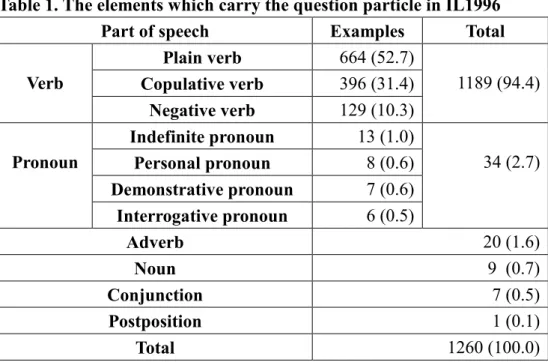
First, I will show the number of examples which carry the question particle in IL1996.
In this data, there were 1,260 examples which carry the question particle. Below is a table that indicates the number of examples classified by the part of speech. The number written in brackets indicates the proportion against the total number (the unit is percent, and the number is rounded off to the first decimal place).
Table 1. The elements which carry the question particle in IL1996
Part of speech Examples Total
Plain verb 664 (52.7) Copulative verb 396 (31.4) Verb
Negative verb 129 (10.3)
1189 (94.4)
Indefinite pronoun 13 (1.0) Personal pronoun 8 (0.6) Demonstrative pronoun 7 (0.6) Pronoun
Interrogative pronoun 6 (0.5)
34 (2.7)
Adverb 20 (1.6)
Noun 9 (0.7)
Conjunction 7 (0.5)
Postposition 1 (0.1)
Total 1260 (100.0)
As we see above, the question particle can attach mostly to the verb. This is followed
4 In case of the negative expression in Finnish, the negative word in principle inflects by the person and the number of the main verb, and the latter loses the inflection. The nagetive word in Finnish therefore is called the negative verb.
by the pronoun (especially the indefinite pronoun) and the adverb.
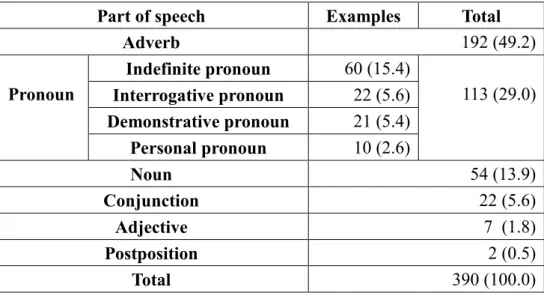
Second, I will show the number of examples in AL1995 to give a detailed analysis of the other parts of speech than the verb. In AL1995, there were 390 examples in which the elements except for the verb carry the question particle. Below is a table that indicates the number of examples. As I do not consider the examples of verb here, I will not show the number of verbs below.
Table 2. The elements except for the verb which carry the question particle in AL1995
Part of speech Examples Total
Adverb 192 (49.2)
Indefinite pronoun 60 (15.4) Interrogative pronoun 22 (5.6) Demonstrative pronoun 21 (5.4) Pronoun
Personal pronoun 10 (2.6)
113 (29.0)
Noun 54 (13.9)
Conjunction 22 (5.6)
Adjective 7 (1.8)
Postposition 2 (0.5)
Total 390 (100.0)
Although there is a slight distributional difference between IL1996 and AL1995, we can say that the adverb and the indefinite pronoun are the majorities, except for the verb. I will describe the result of analyses about each part of speech below.
3.1. Adverb
The largest number was the examples5 of adverb (192 examples). As we saw in Hakulinen et al. (2004: 1593), the question particle is likely to attach to kauan “for a long time” and paljon “many”, and these examples may be the idiomatic expressions.
Besides, there were also quite a few examples in which the question particle attached to the adverb jo “already” like (14), and these three types occupied the majority of the attested examples of -kO as attaching to adverb.
(12) Kauan-ko ole-t ol-lut mukana?
long time-QP COP-2SG COP-PERF together
“How long have you been together?”
5 On the references of examples, the left side of slash mark is the name of data, and the right side is the code of articles which contain the example.
(AL1995/417926)
(13) Paljon-ko se maksa-a?
many-QP it cost-3SG
“How much is it?”
(AL1995/412281)
(14) Jo-ko sinä nyt tul-i-t?
already-QP you now come-P-2SG
“Did you already come?”
(AL1995/415465)
When the question particle attaches to jo, it seems to encode interrogative as well as emphatic meaning. This distinguishes jo from the other two, i.e. kauan and paljon, where the question particle seems to form the question word.
3.2. Pronoun
Pronouns occupied the second largest portion of the total examples of -kO (113 examples). The indefinite pronoun was most frequently observed, where the question particle attached to moni “many people (things)” or its inflected forms. The form moni + the question particle may also be the idiomatic expression. The following (15) is an example of it:
(15) Mon-ta-ko kirjasto-a on Tamperee-lla?
many-PAR-QP library-PAR COP+3SG Tampere-ADE
“How many libraries are there in Tampere?”
(AL1995/421109)
In the examples of the interrogative pronoun (22 examples), there were four occurrence where the form -kOhAn appeared, and in the rest, only the question particle attached to the interrogative pronoun. As we saw in Hakulinen et al. (2004: 1600), there was a sentence that could be the answer soon after the question sentence in eighteen examples, such as (17).
(16) Miksi-kö-hän tutkija-t e-ivät ole ol-leet
what+TRA-QP-PC researcher-PL NEG-3PL COP COP-PERF
kiinnostu-ne-i-ta?
be interested-P.PART-PL-PAR
“Why the researchers had not been interested in?”
(AL1995/414219)
(17) Mitä-kö siveyslaki-a? Se on latinankielinen
what+PAR-QP law of morality-PAR it COP+3SG latin
pronssitaulu, jo-lle on raapuste-ttu vanh-in
board in bronze REL-ALL COP+3SG scrawl-PASS.P.PART old-SUP
säily-nyt senaati-n päätös.
conserve-PERF the Senate-GEN decision
“What is the law of morality? It is the oldest decision of the Senate, which was scrawled on the board in bronze in latin.”
(AL1995/421529)
In the examples of the demonstrative pronoun, it has inflected by the case in fifteen examples of 21, like (19).
(18) Nämä-kö ovat valtti-mme kansainvälise-ssä kilpailu-ssa?
this+PL-QP COP+3PL trump-Px.1PL international-INE competition-INE
“Is it these which are our trumps on the international competition?”
(AL1995/410504)
(19) Tä-hän-kö men-nä-än?
this-ILL-QP go-PASS.PR-3SG
“Is it here where we go?”
(AL1995/417057) The following is an example of the personal pronoun:
(20) Me-kö e-mme muka osaa hoitaa mets-i-ä-mme?
we-QP NEG-1PL probably can take care forest-PL-PAR-Px.1PL
“Is it we who can’t probably take care of our forests?”
(AL1995/419224)
It is noted that when a personal pronoun was marked by -kO, that clause tended not to contain the verb (seven examples of the total 10). In these seven examples, the copulative verb between the subject and the complement was abbreviated in five examples, such as (21). Moreover, in these five examples there was the first person pronoun, so these may not be purely the question, but the expression that expresses
some ironic nuance.
(21) Mitä, minä-kö muka syyllinen?
what+PAR I-QP probably guilty
“What, is it me who is probably guilty?”
(AL1995/415283)
3.3. Noun
It is noted that when a noun was marked by -kO, that clause tended not to contain the verb (thirty eight examples of the total fifty four), such as (23). However, these examples include many one-word sentences, in which there is only the noun with the question particle. Some verbless sentences in which there is not only the noun are the headlines of articles.
(22) Virkamiehe-t-kö ve-i-vät valta-a?
officer-PL-QP take-P-3PL authority-PAR
“Was it the officers who took the authority?”
(AL1995/421595)
(23) Sakko-ja-ko valotto-mi-lle pyöräilijö-i-lle?
fine-PAR-QP unlit-PL-ALL bicyclist-PL-ALL
“The fine against the unlit bicyclists?” (a headline of article)
(AL1995/416753)
Besides, as is illustrated below, there are a few exceptional cases which go against the previous studies’ claim that “the word being questioned is moved to the beginning of the sentence” (Karlsson 1999: 71), That is, two examples involved a construction where the noun followed by the question particle was not on the beginning of sentence.
(24) Talvisoda-n paisu-neen budjeti-n-ko takia?
war in winter-GEN augment-P.PART+GEN budget-GEN-QP for
“Was it because of the budget that the war in winter augmented?”
(AL1995/410541)
(25) Oikein märkä imaisu poske-t lommo-lla-ko?
really damp air cheek-PL pit-ADE-QP
“Was it really the pit of cheek where the damp air came to?”
(AL1995/413513)
3.4. Other parts of speech
In this section I will describe about the conjunction, the adjective, and the postposition.
First, I will show the examples of the conjunction below.
(26) Että-kö saksalaise-t tilaa-vat tällais-ta?
that-QP German-PL order-3PL like this-PAR
“Do the Germans order like this?”
(AL1995/413897)
(27) (...) rakasta-a-ko vai-ko ei.
love-3SG-QP or-QP NEG+3SG
“Does s/he love, or not?”
(AL1995/418025)
In case of the conjunction, there were only two forms above; että “that” and vai “or”.
vai occupied the majority (nineteen examples). The form ettäkö may emphasize the following content, and the form vaiko may emphasize the opposite contents which exist before and after it. The latter form is likely to emphasize two opposite contents especially on the headline of article, like (28).
(28) Natsi vai-ko populisti
the Nazis or-QP populist
“The Nazis or the populist?” (a headline of article)
(AL1995/411986)
Since there were not so many examples of the adjective (7 examples), it cannot be analyzed in detail. The only thing that I note here is that there were three examples that had no verbs.
(29) Vai oma-ko korva-ni pettä-ä?
or own-QP ear+PL-Px.1SG deceive-3SG
“Or is it my own ears that deceive?”
(AL1995/418296)
(30) Toinen-ko kissa?
another-QP cat
“Another cat?”
(AL1995/419806)
I confirmed that the question particle could attach to the postposition, but there were only 2 examples in AL1995. Therefore I also retrieved from articles of Helsingin Sanomat (the biggest daily paper in Finland, issued at Helsinki) in 1995 (about 22,060,000 words, 102,763 articles; henceforth HS1995). Consequently, there were five examples in which the question particle attached to the postposition. The example (31) below is extracted from AL1995, and (32) is from HS1995.
(31) Hoito-a vastaan-ko -- mutta miksi ihmee-ssä?
nursing-PAR against-QP but what+TRA surprise-INE
“Is it against nursing? -- but why in the surprise?”
(AL1995/421486)
(32) Miten-kö-hän sie-ltä sitten on
how-QP-PC it-ABL then COP+3SG
tarkoitus poistua, jalkakäytävä-n kautta-ko?
plan leave sidewalk-GEN across-QP
“Then, how does the plan leave from there? Is it across the sidewalk?”
(HS1995/672390)
At the present moment, I have not seen any description concerned with the fact that the question particle attaches to the postposition, but such a case can be seen from the data.
4. Conclusion
As is shown below, I have confirmed three functions of -kO as attaches to parts of speech other than verb. -kO in such environments serves to:
A) express the question
B) emphasize the part of speech that carries it
C) make the idiom by following the adverb or the indefinite pronoun
The function A) is obviously the primary function of question particle, but in case that it attaches to parts of speech except for the verb, B) can also appears. Moreover, C) can appear when it attaches to the adverb or the indefinite pronoun, and this function has not seen when it attaches to the verb. However, note that -kO can have these three functions at a time, in such a way that these are not independent but interrelated.
Although these functions have been observed in previous studies, this study has
revealed that the question particle can attach to the postposition. We can say that the question particle in Finnish shows very interesting distribution.
Abbreviations -: Affix boundary
+: Plural grammatical category in one element
1, 2, 3: First, second, third person ABL: Ablative case
ADE: Adessive case ALL: Allative case COP: Copulative verb GEN: Genitive case ILL: Illative case INE: Inessive case NEG: Negative verb P: Past tense
PAR: Partitive case
PASS: Passive
PC: Particle (except for question particle)
PERF: Perfect aspect PL: Plural
P.PART: Past participle PR: Present tense
PR.PART: Present participle Px: Possessive suffix
QP: Question particle REL: Relative pronoun SG: Single
SUP: Superative TRA: Translative case
References
Hakulinen, Auli, Maria Vilkuna, Riitta Korhonen, Vesa Koivisto, Tarja Riitta Heinonen, Irja Alho (2004) Iso suomen kielioppi. Helsinki: Suomalaisen Kirjallisuuden Seura.
Karlsson, Fred (1999) Finnish: an essential grammar. London: Routledge.
Ogishima, Takashi (1992) Kiso Finrando-go Bunpoo. Tokyo: Daigakushorin.
_______________ (2000) Finrando-go Nihon-go Shoo-jiten. Tokyo: Daigakushorin.
The corpus
Kielipankki (released on the website of Finnish IT center for science) URL: http://www.csc.fi/kielipankki/
-kO
-kO
Kielipankki
3
a b c