A03
Healing of sedimentary rock on triaxial Slide-Hold-Slide process and its modeling
〇Kiyoshi KISHIDA, Takenori ARAKI, Mamoru KIKUMOTO, Hideaki YASUHARA, Derek ELSWORTH
When estimating the mechanical and the hydro-mechanical properties of rock masses over long periods of time, the influence of the effective confining stress and the thermal conditions should be incorporated. In this research work, slide-hold-slide triaxial experiments have been conducted on a sedimentary soft rock. The experiments have been conducted under several patterns of effective confining stress conditions and several thermal conditions. Consequently, the stress reduction could be observed under holding period and the strength recovery could be observed in the re-slide process. Moreover, the stress reduction and the strength recovery have a time dependency with holding period.
An enlarged view of the deviator stress – axial strain and the volumetric strain – axial strain relations in the slide-hold-slide process is shown in Figure 1. A reduction in stress can be observed in the holding process. And, during the re-shearing process, the deviator stress increases and reaches the peak. Then, the deviator stress returns to close to the residual state. At a room temperature of 20 oC, strength recovery is readily observed. Moreover, dilation can be observed at room temperature under relatively long holding times.
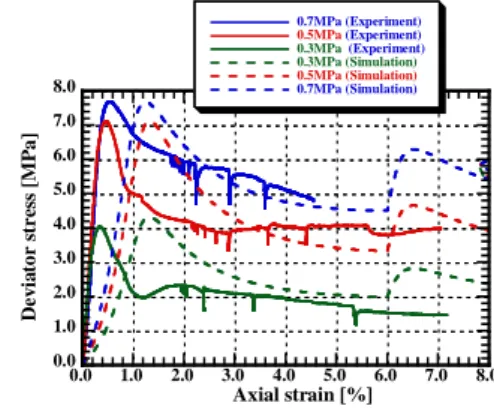
In this study, a constitutive model in which the process of the re-sliding and the strength recovery are incorporated is proposed. The proposed model is based on the modified Cam-clay model and is installed the following concept so as to present the healing process. First, the effect of density (void ratio) on the stiffness and strength is considered by introducing the subloading surface concept proposed by Hashiguchi and Ueno (1977). Second, as the healing of the stiffness and strength is appeared with the increase of the structure with the holding period, the structural variation during the holding period is modeled by the upper movements of the normally consolidation line and the critical state line in the plane of mean effective stress and void ratio. With the re-sliding process, the structure is decreased with the
development of plastic strain and this is modeled by the lower movement of the two state lines. Figure 2 shows the stress ratio and deviator strain relation and the volumetric strain and deviator strain relation through our proposed model. Using the several mechanical parameters through the triaxial Slide-Hold-Slide experiments, in this paper, the simulations of triaxial SHS experiments are conducted with proposed model and its validity is discussed.
Reference
Hashiguchi, K. and Ueno, M. (1977) Elastoplastic constitutive laws of granular materials, Constitutive Equations of Soils (Proc. 9th ICSMFE), JSSMFE, pp. 73 – 82.
3.0 3.5 4.0 4.5 0.60 0.65 0.70 0.75 0.80 0.85 0.90 2.8 3.0 3.2 3.4 3.6 3.8
Deviator stress [MPa]
Volumetric strain [%] D e via to r st res s [M P a ] Vol u m etr ic s tra in [%] Axial strain [%] 58920 sec 1800 sec 900 sec 300 sec 180 sec 60 sec
(Conduct to the transient pulse)
600 sec 0.0 1.0 2.0 3.0 4.0 5.0 6.0 7.0 8.0 0.0 1.0 2.0 3.0 4.0 5.0 6.0 7.0 8.0 0.7MPa (Experiment) 0.5MPa (Experiment) 0.3MPa (Experiment) 0.3MPa (Simulation) 0.5MPa (Simulation) 0.7MPa (Simulation) De v ia to r st r ess [M P a ] Axial strain [%]
Figure 1 Enlarged plots of the deviator stress – axial strain
and the volumetric strain – axial strain relations under an effective stress of 0.3 MPa and at room temperature conditions
Figure 2 The stress ration and axial strain relation through