
Efforts toward commercialization of antifreeze proteins
8
0
0
全文
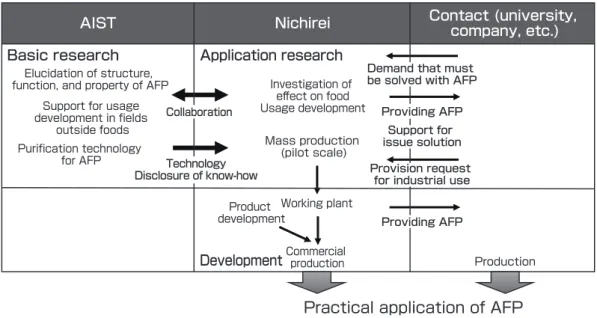
(2) Research paper : Efforts toward commercialization of antifreeze proteins (ISHII H. et al.). Table 1. Division of roles in joint research. Role of AIST. Role of Nichirei. Basic research. Application research. Elucidation of molecular function of AFP. Investigation of effect on food. Genetic and molecular structure analyses of AFP. Establishment of mass production method of AFP. Elucidation of biochemical and physicochemical properties. Usage development, exploration of new usage. fish, insects, plants, and fungi so far. In general, the growth inhibition of ice crystals increases with increase of AFP concentration, which leads to create an unusual frozen state of water composed of millions of tiny ice crystals. There are several types of AFPs depending on the organism with some minor differences in amino acid compositions and threedimensional structures, whose target ice surfaces are also different. Therefore, the size and morphology of ice crystals formed in an AFP solution are diverse according to the concentration and type of the AFPs. 1.4 Joint research for industrial application of AFP The effect of ice growth inhibition by AFP is extremely high, and since there was no other substance that had similar performance, it was expected from the beginning to be used in ice cream, frozen confectioneries, frozen foods, and freeze-dried foods, in which coarseness of ice crystals affected the quality. Nichirei has been engaged in the technological development for inhibiting quality change during freezing and freeze storage in the manufacturing process of frozen foods, and was interested in AFPs that might be effective in such processes, and wanted to study their effectiveness. Although AFPs were discovered almost half a century ago, their rarity prevented them from being put to practical use. Particularly for fish, there was a semi-stereotype idea that AFPs could be found only in fish from Antarctica. This was supported by the fact that an American company started selling AFP from Antarctic fish at a high price ($10 per mg) from the late 1990s. Dr. Tsuda Sakae of AIST Hokkaido broke this stereotype. Tsuda et al. have been studying AFP from the 1990s, and discovered various new AFP species from fishes, plants, and fungi living in the Hokkaido region. It was thought that AFP could only be collected in small amounts from the blood of organisms in the polar region, but Tsuda extracted AFPs from muscle homogenates of regional fish, and this paved the way to collecting AFP in larger amounts that allowed investigation of effects in foods. We noticed the potential of AFPs for practical application in foods, and started joint research with the National Institute of Advanced Industrial Science and Technology (AIST) for industrial application of AFP.. 2 History of development 2.1 Division of roles in joint research with AIST As mentioned earlier, the reason that the practical use of AFPs has not progressed was due to their rarity that made usage development unfeasible. Although AFP was discovered in the organisms of cold regions, the amount and performance in individual organisms were varied, and it was difficult to obtain large amounts of organism-derived raw materials (for example, insects) that contained highly effective AFP for inhibiting ice crystal growth. There were also concerns in production that it might be difficult to obtain from natural products, due to degradation of protein in the extraction and purification processes, as well as overall difficulty of separation and refinement. Investigations of manufacturing AFP by chemical synthesis and genetic engineering have been conducted from a long time ago, rather than using natural substances. However, it appeared that the performance of the synthesized substances was significantly lower compared to the ones obtained from natural sources, and a product with effects that match the cost was not synthesized. AIST was already working on the following: 1) search and functional analysis of AFPs that could be practically applied, and 2) development of a method to purify AFP in amounts necessary for practical use.[3] Preparation of AFPs from natural sources, genetic expression and chemical synthesis were progressed simultaneously, but our initial priority was set to fish and fungi-derived AFPs that could provide excellent performance in gram amounts. In light of this situation, we decided to work jointly with AIST in the search, the mass production, and the effective use of AFPs that were expected to preserve good quality of foods after freezing and defrosting. The division of role was AIST conducted basic research such as elucidation of molecular functions of AFP, and Nichirei worked on application research such as verification of effects on food, usage development, and establishment of a mass production method (Table 1). Figure 1 shows the scenario toward industrial application.. − 86 −. Synthesiology - English edition Vol.12 No.2 (2021).
(3) Research paper : Efforts toward commercialization of antifreeze proteins (ISHII H. et al.). AIST had already checked the effect in over 100 species of organisms, and it was confirmed that several dozen organisms possessed AFP. AIST embarked on the structural analysis and functional clarification, and Nichirei decided to search for AFPs that might be effective in foods and to investigate their concentration.. property, we checked the effect of AFP on how frozen and thawed agar gel maintained its form. Following an initial test, it was found that the effect was not appreciable with the addition of several μg/ml. We hence increased the AFP concentration to several hundred μg/ml, by which the gel structure was still more greatly destroyed, which proved the negative effect.. For mass production, AIST had already established the technology to purify AFP in gram amounts. Therefore, Nichirei aimed for the establishment of a mass production method by constructing a facility at a pilot scale where several hundred grams to several ten kilograms of product could be produced, the search of raw materials that enabled commercial scale production of several tons or more, and the investigation of an efficient purification method for scale up. Moreover, while the usage development of AFP was conducted in various foods, investigations were also performed on additive methods, risks of activity loss in the processing procedure, and persistence of the effect, looking at actual manufacturing and distribution.. The above described tests were conducted according to the method described in the papers. We observed differences in for m and size of the ice cr ystals at several μg/ml concentration, suggested from the observation of ice crystals in the presence of AFP on a photomicroscope system. However, it appeared that a sufficient amount of AFPs had to be present in the food to exert the preservation effect. That is, we conducted the agar gel experiments by increasing the AFP concentration to 1,000 times, and found that the preservation of the gel texture was achieved with such a high concentration; i.e., the quality of agar gel after freezing and thawing significantly increased. Note that it was necessary to spend one year for this verification. If we just followed the published information, we might have determined the effect of AFP on food as “none.” We became aware of the dangers of blindly following prior research results. In our case, it was simply a matter of increasing the concentration if the effect was not seen at an indicated concentration. The situation might have been different if we had AFP in large amounts rather than in grams. A lack of a sufficient AFP preparation method at Nichirei was perhaps another reason for spending one year on that simple experiment.. We created a scenario that by advancing such efforts, a production system for AFP would be established and AFP would be used in many frozen foods in the future. 2.2 Verification of effects in foods In the beginning, we verified the effects in foods using fish AFP that could be easily purified at lab scale. Previous research papers mainly reported experiments at extremely low concentration of several μg/ml, and our verification experiments were conducted based on these reports. Agar gel, a familiar food, was used for verification. Agar gel is a representative food that is less tolerable to freezing. Once it is frozen, the gel structure is destroyed by coarse ice crystals, and when it is thawed, the polymer network cannot be maintained since water is not retained. Based on this. 2.3 Investigation for mass production We started investigation for technology of mass preparation of AFP using fish as raw materials, as we recognized the effect of increased freezing tolerance when added to agar gel, as well as its effectiveness of inhibiting ice crystal growth.. AIST. Nichirei. Basic research. Application research. Elucidation of structure, function, and property of AFP. Purification technology for AFP. Collaboration. Technology Disclosure of know-how. Investigation of effect on food. Mass preparation (pilot scale). Usage development Accumulation of know-how by usage in food. Working plant Product development. Commercial. Development production. Practical application in frozen food Fig. 1 Scenario for industrial application of AFP (realization in frozen foods). − 87 −. Synthesiology - English edition Vol.12 No.2 (2021).
(4) Research paper : Efforts toward commercialization of antifreeze proteins (ISHII H. et al.). Because fish could be obtained as raw materials in kilo units and yielded highly functional AFPs, we started investigation primarily with fish. 2.3.1 Selection of raw materials AFPs in fish are roughly categorized into four types (AFP type I, type II, type III, and antifreeze glycoprotein), and all have the effects of inhibiting ice crystal growth, but their biochemical properties are varied. As indices of raw material selection, we placed importance on high yield and amount, ease of extraction and purification, and performance of purified AFP. We also considered raw material cost, sustainability of procurement, location of fishing, and fishing seasons. Since we were investigating with consideration on obtaining much raw material possible including fish or residues from fisheries processing whether domestic or overseas, as well as differences of fishing seasons, we spent a longer period of time on raw material selection. If it were not fish, there might have been only small quality change caused by location or season, but since importance was placed on being able to obtain high-performance AFP in large amounts, we reached the current results. We were able to obtain knowledge of the best raw material for practical use by investigating a large number of raw materials. 2.3.2 Investigation of purification method Initially, we worked on the establishment of an efficient purification method at pilot scale using a raw material of type III AFP that had high effect of inhibiting ice crystal growth. However, type III AFP was not resistant to heat, and was not appropriate for manufacture for food that needed sterilization and heating. Therefore, considering heat resistance, we investigated a purification method using raw materials of type I AFP and antifreeze glycoproteins. The optimal conditions for crushing, extraction, separation, fractionation, concentration, and drying were investigated. The processes of crushing, separation, and fractionation were performed at low temperature to avoid decomposition by self-digestion and increase in viable count. However, fish contained fatty acids and various proteins, and precipitation of fatty acids during filtration and clogging of the membrane due to aggregation of protein occurred frequently. The yield from raw materials was low at 1 % or less, and there were large amounts of residual substances. Therefore, the main technical point was to select a membrane having an optimal pore-size, which allowed efficient collection of AFPs at high yield without leaving AFPs in the residues. Since there was hardly any budget for facilities, we somehow managed to develop a method for manufacturing at pilot scale, although it was not an optimal solution. 2.4 Accumulation of knowledge in food use for usage development By increasing the additive concentration, effects were seen in many foods such as agar gel, ice cream, boiled eggs, and. tofu. However, they had weak freezing tolerance, and hardly any effect was seen in vegetables, fish, and meat that were often used in frozen food. In the beginning, we thought the problem was permeation to the inner parts. That was because we confirmed by microscope that ice crystal growth was inhibited by increasing the immersion time in boiled eggs and tofu. However, a major difference was not seen for the aforementioned foods even when immersion time was increased or permeation was increased using pressure. At the time, cellular level investigation was not conducted, and we did not have k nowledge of cell preser vation. Therefore, it was thought that cell membranes and cell walls inhibited permeability, but investigation had not been done. Later, the reason for not obtaining the effect became clear, as our knowledge of cell preservation increased and the fact that AFPs adsorbed to the cell membranes became apparent. AFPs did not show effect unless they were adsorbed well to water before freezing. It became clear that in foods with cells, good effects were not seen unless AFPs were distributed thoroughly to tissues and cells. Therefore, it was thought the freezing tolerance of vegetables, fish, and meat did not increase simply with the immersion process.. 3 Activity toward product realization We attempted practical application to frozen foods and worked on usage development and mass production of AFPs, but it was difficult to add freeze-tolerance to vegetables, fish, and meat, and there was no product which we wanted to differentiate by adding purified AFP among inexpensive frozen processed foods. Therefore, the initial scenario had to be changed. Following discussions, we decided to provide AFPs that were produced at pilot scale to organizations outside our company to seek different usage. The scenario for industrial application considering the provision of AFP outside the company is shown in Fig. 2. Since realistic effects were obtained if the additive AFP concentration was increased, we estimated that there would be applications to high additional value products. We created a scenario that if we provided more AFPs for such usage, there would be cost merit of mass production, and use at Nichirei would also increase. 3.1 Efforts for AFP samples As mentioned earlier, there are limited types of foods in which freeze-tolerance can be increased by AFP. Since freeze-tolerance is increased by controlling the water content in the conventional frozen processed foods, dramatic quality improvement cannot be expected by the addition of AFP. Also, there are several inexpensive materials that provide freezing tolerance such as some glycosides, and purified AFP will not be adopted unless there is a special superior effect. Against such a background, it was necessary to extend usage development widely to items other than foods, and we. − 88 −. Synthesiology - English edition Vol.12 No.2 (2021).
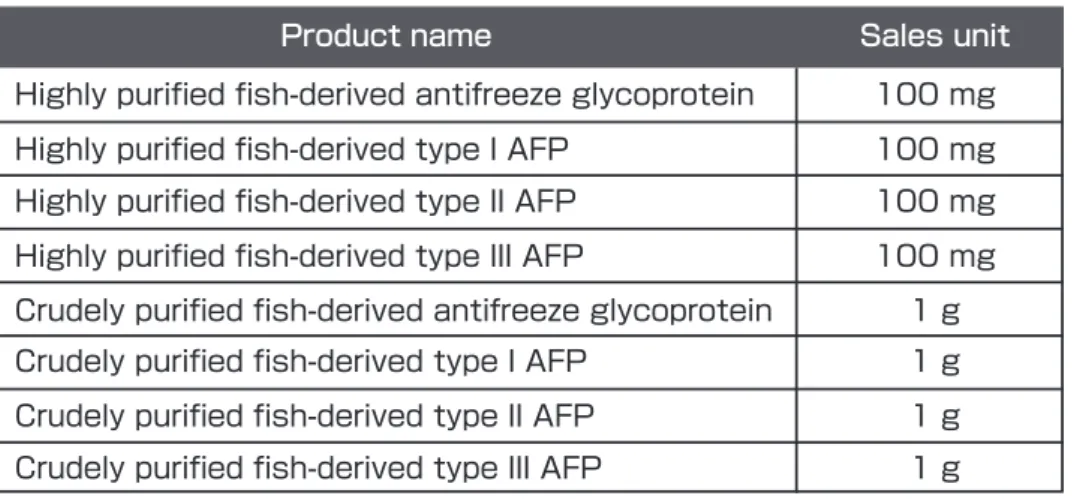
(5) Research paper : Efforts toward commercialization of antifreeze proteins (ISHII H. et al.). started providing AFP samples to organizations outside the company. In practice, we announced the provision of AFP samples on the Nichirei’s website in 2009, had participants sign a material transfer agreement (MTA), and provided crudely purified products. There were dozens of companies to which the samples were supplied. Through this effort, we started to see several areas possessing high potential for AFP application. On the other hand, there were areas in which investigation for practical use did not advance by crudely purified products, and it was necessary to prepare more samples. 3.2 Toward product realization of AFP reagent In the effort of sample provision, we received requests for provision of highly purified AFP and provision of inexpensive samples that could be used at production scale. Since AIST had already established a method for high purity refinement, production was basically performed according to that method. However, there was an issue that although the same protocol was employed, highly purified AFP could not be obtained similarly. For product realization as reagents, the minimum standards were that the product had to clear a certain degree of quality, and there were no variations in performance. Since the products were proteins, we conducted electrophoresis and protein quantification at each purification phase, and checked the yield and quality while changing the purification condition little by little. Finally, we were able to obtain a stable supply of highly purified AFP using a slightly improved method developed by the collaboration research with AIST. The aforementioned variation was resulted from slight differences in the devices and reagents used, and this gave a good opportunity to learn the difficulty of reproducing the results using the same method in a different place, for both Nichirei and AIST.. AIST. To commercialize the product, there was absolutely no established know-how, and we had to find the way. There was neither previous examples nor useful information to commercialize this kind of products within the company, so nothing went forward unless we moved. We had to do everything ourselves, including checking risks from legal and intellectual property aspects, clearing the matters of quality assurance, and writing the text for websites and catalogs. Check of related laws to sell the reagent could not be done solely within the company, and we prepared for imagined risks by consulting experts outside our company.. 4 Product realization 4.1 Product realization of fish AFPs We star ted the sales of research reagents (Fig. 3) in September 2016 from the Nichirei’s website. A press conference “Announcement of the sales of AFPs” was held on the day of launch, and some media covered the event. A list of current AFP products is shown in Table 2. There are four types of fish AFP: antifreeze glycoprotein, type I AFP, type II AFP, and type III AFP. They are all extracted and purified from fish that live in the low temperature regions (antifreeze glycoprotein = Gadidae, type I AFP = Pleuronectidae, type II AFP = Cottoidei, and type III AFP = Zoarcidae). There are two types of products: “highly purified product” in which the purity is 90 % or higher, and “crudely purified product” that contains foreign substances consisting of other proteins that are derived from raw materials. The highly purified product is sold in 100 mg units, and the crude. Nichirei. Contact (university, company, etc.). Application research. Basic research Elucidation of structure, function, and property of AFP Support for usage development in fields outside foods. We received several questions especially about solubility and heat stability of the AFP samples, so we monitored changes and performance of the samples during storage.. Collaboration. Purification technology for AFP Technology Disclosure of know-how. Demand that must Investigation of be solved with AFP effect on food Usage development Providing AFP Mass production (pilot scale). Support for issue solution Provision request for industrial use. Product Working plant development. Development. Commercial production. Providing AFP Production. Practical application of AFP Fig. 2 Scenario for industrial application through provision of AFP to outside organizations. − 89 −. Synthesiology - English edition Vol.12 No.2 (2021).
(6) Research paper : Efforts toward commercialization of antifreeze proteins (ISHII H. et al.). Table 2. List of AFP products sold (as of May 2019). Product name. Sales unit. Highly purified fish-derived antifreeze glycoprotein. 100 mg. Highly purified fish-derived type I AFP. 100 mg. Highly purified fish-derived type II AFP. 100 mg. Highly purified fish-derived type III AFP. 100 mg. Crudely purified fish-derived antifreeze glycoprotein. 1g. Crudely purified fish-derived type I AFP. 1g. Crudely purified fish-derived type II AFP. 1g. Crudely purified fish-derived type III AFP. 1g. product is available in 1 g units. The use of highly purified products is expected to be for basic research at universities and research institutions as well as researchers of cell preservation, while the crudely purified products are targeted mainly at researchers of companies and universities that conduct application research. 4.2 Achievements in sales of reagents Inquiries for AFPs have reached several hundred cases as of May 2019, and the sales performance is over 100 cases. The contents of inquiries are varied concerning food, medical care, industry, and research. We also received inquiries from abroad. Through the sales of reagents, we have had opportunities to meet many people outside our company. There, we listened to the issues in freezing and related matters, and have had discussions on new technological information. Many topics cannot be solved by the AFPs that are being sold now. However, even in the fields different from food, the topics that people wish to solve are often similar, and we believe that a solution can be offered in the future, by utilizing other freezing technologies that Nichirei possesses. Through the efforts on AFPs, Nichirei was able to increase the k nowledge of f reezing tech nology and f resh ness keeping technology. In addition, we received the “Life. Nanotechnology Award” at the International Nanotechnology Exhibition and Conference in 2017. These accomplishments helped Nichirei’s development al effor ts on f reezing technology to be recognized widely both inside and outside the company.. 5 Future issues and prospects The sales of fish AFP products were started in 2016, and many people have realized their effect. We also feel that the awareness of AFP since the launch of the reagent has increased gradually. On the other hand, a little less than three years have passed since the launch, but there has been no major achievement that has led to practical application. However, we believe that AFPs will be widely put to practical use in the future. Currently, in the field of cell preservation, evaluations are being performed using various cells, jointly with universities and research institutions. Various efforts are being made with several companies on the issues of freezing control in cold regions and freezing control during product manufacturing. In foods, effects are seen in foods that were not investigated at Nichirei, and some companies are saying that they would like to use it immediately if it can be used in foods. For raw materials and manufacturing methods, those that were excluded since this product was initially for food are being reconsidered now. As a result, AFPs exhibiting. Fig. 3 Appearance of AFP reagent on the market. − 90 −. Synthesiology - English edition Vol.12 No.2 (2021).
(7) Research paper : Efforts toward commercialization of antifreeze proteins (ISHII H. et al.). the performances that were not identified before are being discovered, and we are working on the method for their mass production. By clarifying the working mechanism of highperformance AFPs, it may become possible to artificially produce more effective AFP. If that becomes possible, I believe the issues of production cost will be cleared. The action of AFP can be seen at ppm order, and good effects can be obtained with a very small amount if it is reacted with water. We are aware that there are issues in each field when utilizing AFPs in a wide range of fields. For example, for foods, it is necessary to manufacture a product that has minimum effect on taste and flavor caused by foreign substances. For medicine, it is necessary to establish a manufacture method that fulfills the standard for animal-derived raw materials. Since Nichirei has succeeded in reagent sales, the R&D for AFP will be continued. In the future, we wish to strengthen collaboration among companies, not limited to joint research with universities and research institutions. We hope to offer solutions to issues of the world through the development of AFPs.. Acknowledgement We shall use this opportunity to thank Dr. Sakae Tsuda of AIST who has been cooperating with us in this research and throughout the joint research.. References [1] S. Tanaka, Y. Kobashigawa, K. Miura, Y. Nishimiya, A Miura and S. Tsuda: Antifreeze protein, Seibutsu Butsuri, 43 (3), 130–135 (2003) (in Japanese). [2] Y. Nishimiya, H. Kondo, M. Sakashita, A. Miura and S. Tsuda: Antifreeze protein: Functions and application, Kagaku To Seibutsu, 48 (6), 381–388 (2010) (in Japanese). [3] Y. Nishimiya, Y. Mie, Y. Hirano, H. Kondo, A. Miura and S. Tsuda: Mass preparation and technological development of a n t i f r e e z e p r o t e i n —Tow a r d a p r a c t i c a l u s e of biomolecules, Synthesiology, 1 (1), 7–14 (2008) (in Japanese) [Synthesiology English edition, 1 (1), 7–14 (2008)].. Authors ISHII Hirotaka Basic Research Group, Technological Strategy Planning Division, Nichirei Cor poration. G raduated f rom the G r a du ate School of Pha r macolog y, Meiji Pharmaceutical University. Joined Nichirei in 2004. Has engaged in search of AFP, establishment of mass production method, and usage development. Worked hard on product realization of A FP reagents, and has been in charge from their production to sales from the initial launch of the product. Currently, working on development of new products and practical applications. In. this paper, was in charge of verification of effect on foods, effort in product realization of the reagents, and writing of this paper. I NOUE Toshifumi Basic Research Group, Technological Strategy Planning Division, Nichirei Corporation. Graduated with specialty in Food Process Engineering, Graduate School of Agriculture, Kyushu University. Joined Nichirei in 1995. Found potential in AFP and has been involved in AFP f rom its begin ning. Worked mainly on verification of effect, search of raw materials, mass production, and usage development. In this paper, was in charge of verification of effect on food, investigation for mass production, and efforts on sample provision.. Discussions with Reviewers 1 Overall. Comment (YUMOTO Noboru, National Cerebral and Cardiovascular Center). This is an interesting paper that describes in detail the transition of the scenario, as industrial application and practical use of antifreeze proteins in frozen food shifted to application in other fields. Although this paper was submitted as a “report,” I see the authors’ originality in the scenario and the synthetic components (selection and integration) and I think it fulfills the requirements as a “research paper” of Synthesiology. Therefore, I recommend that this be published as a research paper. Comment (GOTO Masanori, AIST). This paper is a summary of the basic research on antifreeze protein by Nichirei and AIST, the joint research by these two organizations toward practical use, and the actual product realization. They work on issues such as mass production and application to actual foods that are topics that cannot be tackled by academic researchers. I think it should be read by researchers who are engaging in joint research with companies, and I recommend its publication. “The danger of blindly following prior research results” that you mention in Subchapter 2.2 is a matter that one must consider, regardless of basic or practical research. Also, in Subchapter 2.4, you found the reason why freezing tolerance of vegetables, fish, and meat cannot be increased, how this allowed you to see limits at the time, and gave you the opportunity to change direction. I think this illustrates the importance of basic research in product realization. On the other hand, Subchapter 3.2 describes the story of hardship due to factors that depart from your main business. This sheds light to the internal situation of a company that we don’t get to see often, and I thoroughly enjoyed reading it. 2 Changes in the scenario. Comment (GOTO Masanori, AIST). I think what triggered success was the change in your scenario. I think there are many companies that currently take open innovation strategies, but was there any resistance, at the time, in providing information and materials to organizations outside your company? Answer (INOUE Toshifumi). Since we were working on this project for application to our company’s product, there were voices of opposition to provision outside the company. However, we could not see enough effect in. − 91 −. Synthesiology - English edition Vol.12 No.2 (2021).
(8) Research paper : Efforts toward commercialization of antifreeze proteins (ISHII H. et al.). the prospective food groups, and we were pretty much lost. In the first effort for sample provision, we gained company consensus by having clients enter their objectives of use in the MTA, and putting in a clause stating that they must engage in discussions if they obtain results or inventions. 3 Future prospect. Comment (YUMOTO Noboru, National Cerebral and Cardiovascular Center). I think you are in the process of considering to which fields you shall apply AFPs in the future, but can you give us a little more specific prospect (for example, like in the field of cell preservation) and describe the issues in that field? Comment (GOTO Masanori, AIST). I think the most important part is future prospect. Although you succeeded i n product development a s reagent s, t he development of application is the issue if one wishes to have. major business. Particularly, I hope you succeed in the utilization in cells that seem to have stalled in the middle of the study, and I hope this technology is applied to the medical field, not just foods. Answer (ISHII Hirotaka). I added a brief explanation of the examples of work in various fields for practical application of AFPs and the issues in foods and medical fields in Chapter 5. Dr. Tsuda Sakae of AIST has consistently studied the effect of AFP on cell protection. The fact that better usage methods and usage places can be discovered with long and persistent efforts can be said for all usage development, not only in the cell preservation field. Cell protection effect of AFP is thought to be operating through a mechanism different from the existing cell protectants. As we clarify the mechanism, advancement of practical use can be expected. Nichirei is advancing development of AFPs that are expected to be effective, and I think clarification of their action mechanism can be done through collaboration with outside institutions.. − 92 −. Synthesiology - English edition Vol.12 No.2 (2021).
(9)
図

関連したドキュメント
This study was performed to examine attitudes toward evacuation(wish to stay at home, access evacuation sites)among elderly community residents that were able to choose
[Publications] Yamagishi, S., Yonekura.H., Yamamoto, Y., Katsuno, K., Sato, F., Mita, I., Ooka, H., Satozawa, N., Kawakami, T., Nomura, M.and Yamamoto, H.: "Advanced
of the conference on ergodic theory and related topics, II (Georgenthal, 1986), Teubner-Texte Math. Misiurewicz , Dimension of invariant measures for maps with ex- ponent zero,
ABSTRACT: The decomposition method is applied to examples of hyperbolic, parabolic, and elliptic partlal differential equations without use of linearlzatlon techniques.. We
Showing the compactness of Poincar´e operator and using a new generalized Gronwall’s inequality with impulse, mixed type integral operators and B-norm given by us, we
Variational iteration method is a powerful and efficient technique in finding exact and approximate solutions for one-dimensional fractional hyperbolic partial differential equations..
(4S) Package ID Vendor ID and packing list number (K) Transit ID Customer's purchase order number (P) Customer Prod ID Customer Part Number. (1P)
Apply in water as necessary for insect control using a minimum of 15 gallons of finished spray per acre with ground equipment and 5 gallons per acre by air.. Use lower
