Gender disparities in the effects of mothers'
labor force participation on children's time
allocation to pro-education activities in
developing countries : evidence from the rural
Philippines
著者
Okabe Masayoshi
権利
Copyrights 2020 by author(s)
journal or
publication title
IDE Discussion Paper
volume
764
year
2020-01
INSTITUTE OF DEVELOPING ECONOMIES
IDE Discussion Papers are preliminary materials circulated
to stimulate discussions and critical comments
Keywords:
Mothers’ labor force participation; Child time use; Gender heterogeneity; Boys’ underperformance; Poverty-coped family dynamicsJEL classification:
D13; D63; D91; I24; I25; J1; J2; O15* Overseas Research Fellow (Manila), IDE-JETRO; Visiting Research Fellow, School of Labor and Industrial Relations, University of the Philippines Diliman (mokabe@up.edu.ph)
IDE DISCUSSION PAPER No. 764
Gender Disparities in the Effects of Mothers’ Labor
Force Participation on Children’s Time Allocation
to Pro-Education Activities in Developing
Countries: Evidence from the Rural Philippines
Masayoshi OKABE
*
January 2020
Abstract
This study investigates children’s time-allocation patterns to focus on a unique gender disparity in education that emerges in developing countries. Using primary data collected in a rural area of the Philippines, I identify first the “pro-educational” time allocation patterns of children contributing to their educational performance, with a specific focus on the effect of mothers’ labor force participation (MLFP). While statistics show that male children spend less time in pro-educational activities than their female counterparts, an econometric analysis reveals that MLFP accounts for this gender-dependent time-allocation pattern. Results also imply that female children are more likely to spend more time in pro-educational activities with working mothers as their role models. This study identifies MLFP as a maternal “dual burden” for women living in poverty, affecting and affected by family dynamics with their husbands and other family members, revisiting the conventional discourse on gender equality in the Philippines.
The Institute of Developing Economies (IDE) is a semigovernmental,
nonpartisan, nonprofit research institute, founded in 1958. The Institute merged
with the Japan External Trade Organization (JETRO) on July 1, 1998.
The
Institute conducts basic and comprehensive studies on economic and related
affairs in all developing countries and regions, including Asia, the Middle East,
Africa, Latin America, Oceania, and Eastern Europe.
The views expressed in this publication are those of the author(s). Publication does not imply endorsement by the Institute of Developing Economies of any of the views expressed within.
INSTITUTE OF DEVELOPING ECONOMIES (IDE), JETRO
3-2-2, WAKABA,MIHAMA-KU,CHIBA-SHI
CHIBA 261-8545, JAPAN
©2020 by author(s)
No part of this publication may be reproduced without the prior permission of the
author(s).
1
GENDER DISPARITIES IN THE EFFECTS OF MOTHERS’ LABOR
FORCE PARTICIPATION ON CHILDREN’S TIME ALLOCATION TO
PRO-EDUCATION ACTIVITIES IN DEVELOPING COUNTRIES:
EVIDENCE FROM THE RURAL PHILIPPINES
*Masayoshi OKABE
**Institute of Developing Economies, JETRO, Chiba, Japan;
University of the Philippines Diliman, Quezon City, the Philippines
January 2020
This study investigates children’s time-allocation patterns to focus on a unique gender disparity in education that emerges in developing countries. Using primary data collected in a rural area of the Philippines, I identify first the “pro-educational” time allocation patterns of children contributing to their educational performance, with a specific focus on the effect of mothers’ labor force participation (MLFP). While statistics show that male children spend less time in pro-educational activities than their female counterparts, an econometric analysis reveals that MLFP accounts for this gender-dependent time-allocation pattern. Results also imply that female children are more likely to spend more time in pro-educational activities with working mothers as their role models. This study identifies MLFP as a maternal “dual burden” for women living in poverty, affecting and affected by family dynamics with their husbands and other family members, revisiting the conventional discourse on gender equality in the Philippines.
Keywords: Mothers’ labor force participation; Child time use; Gender heterogeneity; Boys’
underperformance; Poverty-coped family dynamics
JEL Classifications: D13; D63; D91; I24; I25; J1; J2; O15
* This paper is based partially on Chapters 5–6 of Okabe (2019b), of which background presentation entitled
“Economic Analysis on Child Time-allocation Patterns in Pursuit of Boys' Underperformance in Education: Evidence from Marinduque” was given in the Graduate School and College of Public Affairs and Development Seminar at the University of the Philippines Los Baños (UP Los Baños) on April 29, 2019. The author is grateful to Maragtas S.V. Amante, Ronahlee A. Asuncion, Rolando T. Bello, Emily C. Cabegin, Jose Camacho Jr., Norbert Norris Falguera, Rebecca S. Gaddi, Homer L. Montejo, Yuto Kitamura, Tomohiro Machikita, Momoe Makino, Toru Nakanishi, Delfin Natal Jr., Lolita Natal, Yasuyuki Sawada, Yuichi Sekiya, and Ryuichi Tanaka for their academic assistances and comments. The author thanks institutional assistance from the Philippine Statistics Authority (PSA) and Department of Education (DepEd). I express gratitude that the fieldwork of data collection in Marinduque has been financially supported by the Toyota Foundation Research Grant D16-R-0798. Yet, the opinions expressed in this study are solely of the author’s and do not represent ones of any other third parties including them.
** Author: Masayoshi Okabe, Overseas Research Fellow (Manila), Institute of Developing Economies, JETRO; Senior Lecturer and Visiting Research Fellow, School of Labor and Industrial Relations, University of the Philippines Diliman (UP-SOLAIR). E-mails: [email protected]; [email protected].
2
I. INTRODUCTION
tudies of economic development and poverty reduction have recently focused on and are linked to education or the accumulation of human capital (Heyneman and Stern, 2015). Development perspectives on education cover not only expanding enrollment rates but also alleviating gaps and inequalities in educational attainment across social groups, both domestically and internationally. Those gaps are largely associated with the extent to which students themselves engage in activities that prepare them for learning. Hence, it is straightforward to assume that schoolchildren who face obstacles to spending time learning and reviewing schoolwork at home as well as at school are more likely to perform poorly. This is also likely to increase the frequency of dropouts (Randall and Anderson eds., 1999). Among these obstacles, poverty or other financial constraints would, theoretically, be one of the most critical. Poverty can be a chronic problem even after children are successfully enrolled in schools. Therefore, it is insufficient to look only at enrollment status as a predictor of educational outcomes in developing and emerging economies, including the Philippines (Torres, 2011), the focus of our research.
This study begins by examining a gender disparity in human capital formation, “boys’ underperformance in education” (UNGEI, 2012) or “boys’ crisis” (Miralao, 2008). In contrast to the majority of developing countries, certain developing countries such as the Philippines, Cambodia, Bangladesh, and countries in Latin America and the Caribbean have been experiencing gender disparity in education that is unfavorable for male children (Asadullah and Chaudhury, 2009; Randall and Anderson, 1999; Torres, 2011; UNGEI, 2012;
Zimmermann and Williams, 2016). Although enrollment rates in elementary education in the Philippines are almost gender-equal, or only slightly favor females, the rates for secondary education show a clear gender gap that is unfavorable to males. The Philippines stands out among other developing regions in terms of its high (greater than 1.0) gender parity index (GPI). The GPI in the Philippines is considerably higher than in other developing countries and is not limited to basic education but extends to higher levels of education in the country (Miralao, 2008; Yamauchi and Tiongco, 2013). The same tendency is observed not only for school enrollment rates in the Philippines but also in the degree of illiteracy and low level of educational attainment; furthermore, it has been reported that there are more males than females among the country’s out-of-school youths and children (OOSY/C).1
This gender gap in the Philippines has been expanding inter-generationally.2
1 See Appendix Figure A- 1 and Appendix Figure A- 2. Likewise, the same gender gap is also observed in
the educational performance measured as the school report-card scores of the sampled children in the current study’s primary data. See Appendix Table A- 3.
2 See Appendix Figure A- 3: For the age cohort 60–64 (the oldest generation in the sample), the GPIs of both
levels were the same; from the oldest generation, the GPI of “level 4” increases over succeeding generations up to 1.3 for the youngest generation in the sample; in contrast, the GPI of “level 0” decreases over generations from oldest to youngest, to around 0.5 for the youngest generation. In other words, (i) 1.3 times as many women obtained a level of literacy equivalent to at least a graduate of secondary education as their male counterparts but (ii) twice as many men attained the lowest literacy level compared to their female counterparts.
3
Gender disparity is smallest among older generations and has increased among younger generations, so although a reverse gender gap may seem to be a recent phenomenon, gender disparity for education in the Philippines is actually quite persistent and is definitely not new. Despite its persistence, this issue has been studied far less than more conventional topics.
There is even a notion that female children are seen as more adaptable or suitable to school culture than male children (Torres, 2011; UNGEI, 2012).3 Comments made by local adult representatives during interviews conducted for this research portrayed boys as “lazier” and girls as “more diligent.” There is, however, still much room for quantifying this issue. This study conducted a time-allocation survey for children, conducted together with a general household survey. As with conventional economic concerns regarding intra-household gender biases, this study is likewise concerned with differences that may exist regarding children’s time-allocation patterns, their magnitude, and the circumstances under which the differences are gender dependent (Deaton, 1997: 223); this last issue is the specific focus of this study.
The remainder of this paper is organized as follows: Section II presents a literature review and explains our analytical framework. Section III explains the data and methods used to conduct our time-allocation survey. Section IV discusses our empirical analysis and models. Section V provides the results, while Section VI adds further issues to consider. Finally, Section VII concludes.
II. MOTIVATIONS AND ANALYTICAL FRAMEWORK
This study is motivated by an interest in reaffirming the primary role children play in investing in their own human capital, and as the originators of that human capital. The interconnections among learning, working, and leisure are the focus of the child time-use survey used in this study. In particular, leisure is given special attention as a limitation as described in previous literature. Finally, the impact of mothers’ labor force participation (MLFP) on their child time allocations is also of interest; its asymmetric effect on sons and daughters is given special attention.
A. Reaffirmation of the Prime-Player Role of Children as Learners
Although human capital investment has been included in households’ decision- making, there has been a theoretical notion that children are not prime players in this process (Deaton, 1997: chap. 4). According to this line of thought, families are controlled or governed by adults and thus children are not vital members of their families. This notion has been predominant in development studies and been an (implicit) assumption not only behind the unitary model but also behind the collective model in the economics of the family (Browning
3 In advanced economies, studies of labor economics have come to focus not on the level of education but
on the type (contents) of education, or the academic specialty, as women’s goal of having access to higher education and gender equality in the quantitative sense has largely been achieved. Therefore, in developed countries, if there are differences in the latter spheres in education between men and women, the wage gaps between men and women become even more difficult to understand than before (O’Reilly et al., 2015; Rubery and Grimshaw, 2015; ILO, 2016).
4
et al., 2014; Eswaran, 2014). More recent studies have emphasized how children’s roles are exercised within the family. For example, Attanasio and Kaufmann (2009) andAttanasio and Kaufmann (2010) found that in developing countries, not only parents but also children form their subjective expectations regarding gains from the children’s education in the current school term. They advocated that expectations of both children and adults be used as predictors of children’s attendance in senior high schools and enrollment in colleges. This reaffirms the youths’ commitments to the decision-making process for their own education. While parents have expectations, children have their own expectations and they behave based on these expectations when deciding on their level of educational investment.
Children’s own behavioral patterns are therefore the focus of our interest, such that these patterns can, in turn, form the basis for parents’ decision-making. This is thus a motivation to analyze children’s behaviors as measured by their time-allocation patterns, where we assume those behaviors can be converted into tangible time-allocation patterns. B. Time Availability of Children in Learning, Working, and Leisure
1. Child labor–education tradeoff
One of the characteristics that distinguish developing countries from developed countries is that in developing countries, children can be engaged in a considerable degree of labor activities that compete with education for their time. Working children are found nationwide in the Philippines, and boys are more often reported to be engaged in labor activities than girls (Alegado, 2012). It is fairly common for children to be thought of not only as learners who attend school but also part of the labor force, particularly as they become physically mature. Here child labor can broadly include compensated work outside the home as well as unpaid domestic work within households.4 The latter is relatively more common among female children.
It is theoretically safe to assume that working children sacrifice a certain amount of the time they spend engaged in labor at the expense of schooling activities. Child labor and education are thus thought to be in a substitutive relationship in a microeconomic sense, and child labor can be demanded and provoked by a household’s economic circumstances.
Psacharopoulos (1997) highlighted that child labor is associated with a reduction in schooling while contributing significantly to household income. Focusing on the former channel, Heady (2003) found a negative relationship between child labor and educational attainment measured by abilities in reading and mathematics in a study of Ghanaian schoolchildren. Likewise, Beegle et al. (2009) showed the negative consequence of child labor on the child laborers’ enrollment status and test scores after five years, using national data from Vietnam. The majority of the literature supports the negative consequences of child labor on education, or the intuitive child labor–education tradeoff (Patrinos and
4 Indeed, during the author’s fieldwork at the research site, a considerable number of school youths were
observed engaging in various types of labor where the child’s age was questionable. Some youths helped their fathers repair tricycles; worked in operations in water stations; stripped the skins off of coconuts and split them; minded the sari-sari store (family-owned small shops selling daily consumables in small amounts); fished together with their fathers; and did household chores such as washing clothes and dishes, sewing, cleaning, arranging furniture and surroundings, and babysitting their younger siblings. They reported that some jobs provided some compensation and others were unpaid. The former seems to apply to labor done in the market (outside the home), while the latter is domestic work.
5
Psacharopoulos, 1997).
In contrast, Ravallion and Wodon (2000) made a distinctive contribution to the literature by finding a weakness in the view of a substitutive relationship between child labor and education in a developing country setting using Bangladeshi data. Their study showed that school stipends, which were even less than the mean wages of child laborers, increased children’s school attendance but did not proportionally decrease the time spent in child labor. In other words, an increase in the amount of time spent on education did not systematically lead to a decrease in the time spent working. Using data from rural northern India, Fuwa et al. (2006) presented similar evidence that the factors determining child labor and school enrollment were not clearly inversely correlated. In this sense, they supported the findings of Ravallion and Wodon (2000), emphasizing that education and child labor are unclear substitutes in poverty settings. Kurosaki et al. (2006) also support these findings, providing robustness to this view.
The imperfect nature of the substitutive relationship between education and labor for children in terms of time allocation cannot be that surprising when we consider that a child’s time is allocated not just to education and child labor but also to other activities. Fuwa et al. (2006) mentioned the necessity for future studies to examine leisure time in the analytical framework of time-allocation studies. In this regard, aside from the economic context, sociologists also pay special attention to time allocations for leisure (Jacobs et al., 2004). Nevertheless, a literature review of developing countries by Lloyd et al. (2008) finds that relevant studies focused on the leisure time of youths has thus far been limited (Lloyd et al., 2008: 102–103).
2. The Philippines setting
The issue of schoolchildren engaged in labor is highly relevant to the issue of boys’ basic education in the Philippines (Alegado, 2012). In the Philippines, child labor occurs more in rural areas than in urban centers, and economically, it occurs more in poor households than in rich ones (Okabe, 2019b: 14; 194). Poor households in rural areas are more likely to face demands for labor and it is not unusual for children to find opportunities to work in fields growing crops. Studies of the Philippines formalized an idea that Filipino boys are demanded to join the labor force at a younger age than their female counterparts while they are of school age, particularly in rural settings; many of these boys cannot manage working and studying at the same time and therefore they can lag behind their female counterparts in education (Estudillo et al., 2001a; Estudillo et al., 2001b; Quismbing, 1994).
Male children’s comparative advantage in finding more working opportunities earlier in a rural setting, even during the course of their schooling, is justified by their physical development in terms of muscle strength developed in adolescence, which is compatible with the need for farming and field labor (Alesina et al., 2013).5 Furthermore, this physical labor-related perspective is theoretically consistent with assumptions that, on the one hand, the demands for cash and the time-discount rates of the poor are high and, on
5 Ravallion and Wodon’s study of Bangladesh also found that having more working-age men in households
reduced the probability of a child being forced into child labor. It suggests a scarcity leading to a “greater pressure for boys to earn income in families where there are fewer adult male earners” (Ravallion and Wodon, 2000: C172).
6
the other hand, the marginal utility of short-term immediate contributions to household livelihoods is larger than from the long-term, uncertain benefits of investments in human capital.6 If the aforementioned findings in South Asia are applicable to other regions as well as the Philippines, the previously formalized idea in the rural Philippines can still be an open question. It is necessary to study child time-allocation patterns that incorporate leisure time, as has already been emphasized. For these reasons, the current study chooses to analyze time-allocation patterns as an appropriate approach to studying this issue.
C. Working Mothers, Child Education, and Family Dynamics
Female labor force participation has been growing in some developing East Asia and Pacific region countries (Cameron et al., 2001). However, that is not yet a universal tendency in all of the countries in the region; therefore, it has been difficult for researchers to investigate the effect of parental work on children’s education and welfare that may differ depending on the gender of the parents, and also of the children in developing countries (Antman, 2012: 296). Despite this, increasing female labor force participation in some regions has enabled academic research investigating these effects. Where female labor force participation is growing, not only are more unmarried women working but also more mothers are going to work. In general, MLFP is considered one of means by which households cope with shocks and fluctuations in their financial condition, and/or to address additional financial demands, outside of motives related to women’s voluntary decisions or preferences to work.
In spite of this, it is still controversial and disputable as to whether MLFP positively contributes to child welfare in terms of education based on the additional income MFLP generates, since maternal work is observed less often than paternal work (Antman, 2012).7
Afridi et al. (2016) presents evidence of a positive effect of MLFP on children’s schooling in India even after accounting for the income effect brought about by MLFP; the authors interpreted it in the context of working mothers gaining a greater voice and influence in their households that in turn led to positive consequences on children’s education. In contrast, negative consequences of MLFP on child labor are also found by research that shows MLFP lead to an increase in child labor in Bolivia, Columbia, Côte d’Ivoire, and the Philippines (Grootaert and Patrinos, 1999; Grootaert and Patrinos, 2002) and also in India (Sawada et al., 2006).
6 Aside from this micro perspective, more structural and historical perspectives are relevant. Social
movements for women in the Philippines increased during the late 20th century, in response to which more
human-right protections for women were institutionally and legally established at the national level, such as the 1989 Republic Act (RA) 6725 (anti-discrimination law for women) and the 2010 RA 9710 (Magna Carta of Women). The concepts of American democracy and Catholic equalitarianism rooted in the Philippines are exceptional among developing countries, which has achieved high rankings among Asian countries in internationally comparable gender equality rankings. These appear to form a persuasive framework to explain why the Philippines is achieving greater gender equality. Yet, while higher gender equality would suggest that gender disparities are shrinking in the educational sphere, it does not explain why a male gender gap in education still persists. In other words, a certain equalization principle is not a sufficient explanatory framework for another disproportion principle. Our motivation here is to explore this problem more deeply.
7 Antman (2012: 296) also reviews that, in this situation, the Philippines is an exceptional case with greater
7
Considering that the education–labor nexus may differ depending on a child’s gender also gets our attention because female children in developing countries have been shown to suffer a negative effect from MLFP (Grootaert and Kanbur, 1995). For instance,
Sawada et al. (2006) found that child labor among daughters is more likely to be triggered by their mothers entering the labor force, as the daughters took over the mothers’ roles in domestic work. It is consistent with the general tendency in developing countries that female children that are forced to quit schooling to participate in the wage labor force to help boost their household incomes or to play a surrogate role for their mothers while the mothers work outside the home (Grootaert and Kanbur, 1995: 192; Strauss and Thomas, 1995: 1990). It has also been reported that younger siblings’ education comes at the expense of their elder sisters’ exits from education (Parish and Willis, 1993).
Among various forms of parental work, overseas work is expected to significantly benefit the income of the families left behind in their home countries, particularly if those countries are developing economies and the countries where the overseas work is located are developed economies. Despite this, literature finds unfavorable consequences of that type of work on child welfare. For example, Cortes (2015) examined the consequences of parents working abroad on the educational attainment of their children who remained in the Philippines. One research focus has been the impact on parental time availability with their children.
Parental labor force participation has different effects regardless of whether the work is overseas or domestic; namely, a wealth effect and a time effect. The former is presumed to be positive to child welfare and education while the latter is assumed to be negative, because working parents cannot avoid reducing the amount of time available to spend with their children at home. Yet, only the former was conventionally looked upon as affecting a child’s education (Grootaert and Kanbur, 1995: 192). In contrast, Cortes (2015)
presents evidence of a negative effect of mothers working abroad, showing it causes their children to lag behind in terms of their level in school, i.e., it is associated with a gap between their actual and expected level calculated by their ages and the schooling system. This is consistent with a more casual finding in the Philippines by Battistella and Conacothe (1998), showing that parents’ working abroad is not detrimental for children’s development and education as long as the mothers remain in their home. Findings in psycho-social research showing a greater demand from male children for parental involvement during their juvenile years are also relevant (Bertrand and Pan, 2013).8
Despite these research findings, the relationship between gender and the effect of parental work on child welfare and education is ambiguous, and thus, there are open questions to be resolved. For example in China, it is reported that parental work has a negative effect on girls’ education (Meyerhoefer and Chen, 2011). For Latin America, Acosta (2011) shows that the effect of parents working overseas is not gender neutral for children pursuing an education in El Salvador; when mothers work overseas, female children benefit from remittances that increase school attendance and allow them to pursue tertiary education but male children do not. McKenzie and Rapoport (2011) finds the effect of
8 Bertrand and Pan (2013) focus on the tendency of male children to engage in more disruptive, aggressive
and delinquent behaviors. According to their study, in the United States, the family environment is found to be more influential for boys’ mental development than the school environment, and male children are more sensitive and responsive to the inputs of their parents than their female counterparts.
8
parental work overseas differs between sons and daughters’ education in Mexico but there is little conclusive evidence to evaluate how positive or negative the effect is. In sum, gender heterogeneity between parental work and child welfare is not predictable a priori across regions and countries. Still, these studies shed light on the relationship between gender and the effects of parental inputs and involvement needed for children’s welfare and development (Nguyen, 2016).
D. Analytical Framework
By combining the aforementioned discussions, the current study hypothesizes that male children’s use of time and the patterns of that usage are influenced by their mothers’ participation in the labor force through a channel of the home time available to mothers and their sons, and the mothers’ monitoring power over sons. In addition, the relative balance matters to those mothers who also have daughters. This hypothesis is examined by analyzing the time-allocation pattern described in the following sections. The Philippines is unique or unusual compared to its counterparts in South Asia or the Middle East, for example, in that female labor force participation has not been resisted culturally (Antman, 2012; Fuwa et al., 2006; Takahashi, 1972). Some initial conditions in the Philippines have been found by rural studies, which have led to this lack of resistance to female labor.
Although Filipino women are treated indifferently than men, while men exercise authority and power inside the families, women are not necessarily weaker than their husbands; for example, women usually control the purse strings (Takahashi, 1972: 159). According to observations made as early as the 1960s, Filipino women have been referred to as being among those who are best able to participate in the labor force in Asia, enabled by less cultural and mental resistance in the country (Takahashi, 1972).9,10
= Figure 1 around here =
Therefore, one important research question is what the consequences are with respect to child education as predicted by children’s time-allocation patterns if their mothers participate in the labor force. These consequences, which are still an open question in the development literature, are of interest for both academics and policymakers. Note that MLFP in the current study is mainly concerned with domestic, local employment, which is still considered to be universal and widely observed in rural and poor regions. Despite this, less has been analyzed about local work compared to the cases of parental overseas work, the frequencies of which differ depending on whether the family lives in a geographically and socioeconomically disadvantaged rural area to move to overseas work (cf. Appendix Table
9 Yet, in varying degrees, there is an equivocal aspect when it comes to female labor. Recent studies report
that Filipino female workers are still not treated and compensated as favorably as men in the labor market, even if the females strive for the attributes and equivalent qualifications that men have (Asuncion, 2018; Serrano and Certeza, 2014; Yamauchi and Tiongco, 2013).
10 Indeed, according to the nationally representative statistics, the female labor force participation rate is
particularly higher in MIMAROPA Region (Region IV-B), where the rural research site is located, than the national average (Figure 1).
9
A- 1). In contrast, domestic employment is significant in poor regions.11
Also note that working mothers in our research site are qualitatively different from not only mothers working abroad but also middle-class working mothers in urban centers within the Philippines who can work by hiring so-called “yaya” (babysitters and “maids”) as substitutes in the childcare sphere. In rural areas, MLFP is usually triggered by poverty. While relying heavily on provisions from the government, the rural poor face demands to maintain even a subsistence level of existence. In this sense, the situation of the rural poor is an extreme and unwanted condition, rather than a reaction to what Illich referred to as the “radical monopoly” that covers contemporary technological urban centers (Illich, 2001).
III. DATA COLLECTION AND SURVEY METHODS
A. Research Site and Sampling
This study uses data the author gathered in Marinduque Province in the Philippines, using a tailored household questionnaire survey. The author visited the province a number of times, engaging in fieldwork activities to prepare for the household survey beginning in August 2017. After several visits through December in 2017, the author surveyed around 300 children from 150 households through March 2018 including a pilot survey (dry run) conducted between the end of December 2017 and mid-January 2018. The sample households were selected using the stratified random sampling method from nine sampled
barangays (the smallest local government unit in the Philippines) in the three selected
municipalities in the province in the MIMAROPA Region in the Philippines (see Figure 2 for the location of Marinduque Province). Marinduque Province was chosen because it has one of the highest educational gender disparities in the Philippines, with males underperforming (see a companion paper, Okabe 2019a, for details).
= Figure 2 around here =
B. Collected Information
The intensive survey collected information in the following four categories: (1) individual characteristics of the sampled children; (2) schooling and educational profiles of the children; (3) basic information about the household; and (4) time allocations of two selected children per household, primarily those who are high school aged. The questions for categories (1), (2), and (4) were asked directly to the children whereas the questions for category (3) were directed to a parent or grandparent (adult guardian). In a few cases where parents were not available at the time of our survey visitations, relatives (uncles, aunts, or grandparents) or adult siblings responded on behalf of the parents.
Category (1), children’s characteristics, is a set of information that includes names, gender, birthday, birth order among siblings, and number of siblings. Category (2) includes either enrollment status and school-related information if the responding children are
11 Domestic employment, rather than overseas work, is dominant in our research site’s regional setting (see
Appendix Table A- 1 to look at MIMAROPA Region). The qualifications and hurdles required for those who want to work overseas are still highly selective and difficult for workers in the region to overcome.
10
enrolled in school or the reasons for quitting schooling if the respondents are not enrolled in school. For category (3), basic household information, we collected demographic, educational, employment, and earning information for the parents or guardians, including home addresses. The description for category (4) is given in the next subsection.
C. Time-Allocation Survey 1. Survey designs
Time allocation with respect to work (paid, voluntary, and unpaid [care] work) has been a central topic in the literature of time-allocation studies (Chen et al., 2005: 24; Dong and An, 2015: 547; Esquivel et al., 2015: 107). This is reflected in the motivation of achieving recognition of the value of women’s work from an economic perspective, in recalculating, reevaluating, and imputing value to unpaid and domestic work mainly contributed by adult women, into the system of national accounts. Time-use surveys for juveniles are still quite limited. In addition, designing and conducting time-use surveys in developing countries is not as easy as in developed countries (Esquivel et al., 2015); hence, the limited use of time-use surveys involving adolescent juveniles in developing countries is pronounced (Lloyd et al., 2008).
There are some exceptions. In examining the relationship between mother’s labor and child labor under credit constraints in rural India, Sawada et al. (2006) used the “one week time-use module” to collect time-use information over a seven-day period prior to the interview date. Bouis et al. (1998), in analyzing the contributions of adolescents to household livelihoods, employed a retrospective method wherein selected adolescents in the surveyed
barangays in a rural Philippines, Bukidnon Province, were asked to recall their time use for
the past week. However, leisure time allocations were not explicitly surveyed in these studies (as discussed in subsection B-1, section II).
Certainly, the reference periods used in most surveys have been in the past (Esquivel et al., 2008; Lloyd et al., 2008), including studies done in developing countries (Esquivel et al., 2008: 145–152). However, this study considers a sort of recall bias that includes the potential for a respondent to unconsciously change his or her answer(s) for fear that the responses would be exposed to and identified by somebody else, such as their parents. Such a bias could be crucial in cases where a respondent would feel at risk of being judged on a normative or ethical basis if the time allocated to a certain activity that the respondent believes would be seen as a good (bad) deed might possibly be over-reported (under-reported).
One way to deal with this potential bias is to collect data in a forward-looking way. The current survey design takes its cue from Kudo et al. (2019);12 thus, our survey design pays attention to the following issues. First, it focuses explicitly on such leisure activities as playing. In addition, time spent in computer-game shops is also included here as a reflection
12 Actually, this refers to the World Bank Economic Review’s preprinted version in 2017 of Kudo et al. (2019).
Their study measured the impact of providing solar-lanterns on students’ academic performance in rural Bangladesh, where time-use information was collected in a forward-looking way: They gave students diaries and asked them to complete them every day so the information would be fresh, rather than relying on their memories.
11
of the situation in today’s Philippines, as Filipino youths commonly go to such shops to surf the Internet and play online games. Second, our design avoids using a retrospective approach because respondents may not be confident in remembering and recalling how they spent their time, even just a few days ago. Third, the collected time- allocation information is not discrete or categorical as has been the convention; the data is numerically continuous for more efficient use in statistical or econometric analyses.
The survey instructions included the following steps. 13 First, diary-type questionnaire sheets were distributed to the respondents and it was explained to each respondent through both a written form and an oral orientation that this researcher simply wanted to know their ordinary time uses. In the instructions, the author emphasized to them that all personal information and any of their responses would be immediately coded into numerical and anonymous information and that no one could discover the identity of the respondents. Second, we directly collected completed documents from the respondents without showing them to their parents or reading through them. Third, the importance of honest answers was also explained to their parents/guardians and they were urged never to look at or censor the questionnaire sheets that the children were keeping. Finally, it was emphasized both to the respondents and their parents/guardians that it would not matter at all whether they were–––or pretended to be–––devoted to the family, diligent, studious, or hard-working, since we as researchers were not their educators, supervisors, or authority figures. Lastly, two siblings were sampled per household to take advantage of their mutual monitoring, in case incorrect or exaggerated responses were reported by one of them.
2. Collected information on child time allocations
The information on time allocations includes education-related time, working time, and leisure (home) time along with unstructured time. The leisure (home) category includes time spent playing outside with friends or playing computer games in computer shops. Theoretically, leisure time can be divided into two categories: unstructured and structured activities (Lam and McHale, 2015). Combining these classifications with the observations gathered from the author’s pilot survey activities, the questionnaire was set as semi-structured with some free descriptions.
The questionnaire was self-administered, and hence, the author prepared all parts in the questionnaire sheets in Tagalog, the mother tongue of the locals. The respondents were asked if they had already finished school as of the survey date or would have exams in the current semester and if so, they were asked for the exam date. The regression analyses contain information on whether the survey respondents were expected to have term exams and how many days remained until the exam date to control for this factor in educational time usage. After collecting the completed questionnaires after seven days or later, the author checked to see if there were unclear or inconsistent responses that required changes. Depending on the lack of clarity, the case respondents were asked to report their answers again by mobile phone or were interviewed again in person in an attempt to assure the quality of answers.
13 Although not an interventional study, these steps simultaneously attempt to mitigate the exposure
12
IV. EMPIRICAL MODELS
A. Time-Allocation Function
Obviously, every individual 𝑖𝑖 faces the same daily time constraint, denoted as 𝑇𝑇 (equals to 24 hours), in allocating her or his time to various activities. Denoting the time allocated to 𝑎𝑎 types of activity set 𝑡𝑡𝑎𝑎, there are 𝑎𝑎 different activity classifications, and the
time constraint is expressed by the relationship in Eq. (1):
� 𝑡𝑡𝑘𝑘,𝑖𝑖 𝑎𝑎 𝑘𝑘=1
+ 𝜃𝜃𝑖𝑖= 𝑇𝑇, where 𝜃𝜃𝑖𝑖 > 0. (1) In Eq. (1), the residual term 𝜃𝜃𝑖𝑖 represents unstructured “inactive” or “idle” time
with which individuals are not consciously cognizant of what they are formally doing. It is assumed that every individual has at least some 𝜃𝜃𝑖𝑖 (therefore, 𝜃𝜃𝑖𝑖> 0). In contrast, a certain
𝑡𝑡𝑘𝑘,𝑖𝑖 can be zero, depending on 𝑖𝑖’s attributes (e.g., youths who have quit school allocate no
time to schooling). Recalling the points stated by Ravallion and Wodon (2000), Fuwa et al. (2006), and Kurosaki et al. (2006), we explicitly extract leisure activities from the term 𝜃𝜃𝑖𝑖, as
leisure used to be included in 𝜃𝜃𝑖𝑖 in the literature. Individuals thus face a tradeoff in
allocating time to each activity under the time constraint represented as Eq. (1). B. System of Equation Model
The time-allocation model for an activity 𝑘𝑘(∈ 𝐴𝐴) is expressed as
𝑡𝑡𝑘𝑘,𝑖𝑖𝑖𝑖= 𝐱𝐱𝒊𝒊𝒊𝒊𝛃𝛃𝒌𝒌+ 𝜔𝜔 + 𝑢𝑢𝑘𝑘,𝑖𝑖𝑖𝑖. (2)
where the vector 𝐱𝐱𝒊𝒊𝒊𝒊 comprise the individual- and household-level characteristics
(including the individual’s gender indicator and its interaction terms with other covariates), where one variable of interest, the MLFP indicator, is included; 𝜔𝜔 is the controlling effect for unobserved heterogeneity as discussed later; and 𝑢𝑢𝑖𝑖𝑖𝑖 is the stochastic error term, all
regarding an individual 𝑖𝑖 from a household 𝑗𝑗.
An empirical issue is that, as shown by Eq. (1), individuals’ time is not allocated to education, for example, independently from other activities. Rather, time is allocated in relationship to other activities. In this sense, a single-equation approach to estimating each “time-use” function does not precisely consider the interdependency of the system of equations because ordinary estimations such as OLS hypothesize the error terms are uncorrelated with each other. This issue has already been recognized in the time-use literature. In this setting, the seemingly unrelated regression (SUR) approach, which is classified as a system of equations model (Srinivasan and Bhat, 2005; Don and An, 2015), is an appropriate estimation method. The model is transcribed as shown in Eq. (3), where, unlike the OLS model, we relax the model so that the covariances of error terms can be nonzero, and are jointly estimated allowing Cov(𝑢𝑢𝑘𝑘, 𝑢𝑢𝑙𝑙) ≠ 0, ∀𝑘𝑘, 𝑙𝑙 ∈ 𝐴𝐴, 𝑘𝑘 ≠ 𝑙𝑙 (Wooldridge, 2002: chap. 7):
13 ⎩ ⎨ ⎧𝑡𝑡𝑡𝑡1,𝑖𝑖𝑖𝑖 = 𝐱𝐱𝒊𝒊𝒊𝒊𝛃𝛃𝟏𝟏+ 𝜔𝜔 + 𝑢𝑢1,𝑖𝑖𝑖𝑖, 2,𝑖𝑖𝑖𝑖 = 𝐱𝐱𝒊𝒊𝒊𝒊𝛃𝛃𝟐𝟐+ 𝜔𝜔 + 𝑢𝑢2,𝑖𝑖𝑖𝑖, ⋮ 𝑡𝑡𝑎𝑎,𝑖𝑖𝑖𝑖 = 𝐱𝐱𝒊𝒊𝒊𝒊𝛃𝛃𝒂𝒂+ 𝜔𝜔 + 𝑢𝑢𝑎𝑎,𝑖𝑖𝑖𝑖. (3)
C. Endogeneity Concern and Instrument Variable Approach
In estimating the MLFP effect on child time allocations in the SUR model shown in Eq. (3), we must consider the possibility that the assumed exogeneity of the variable MLFP is violated. Conceptually, in a similar manner to what has been addressed in migration studies (Antman, 2013: 293–294), in the link between the determinants of MLFP and child time uses, it is possible that endogeneity may take the form of reverse causation. For instance, if a child spends more time helping with household chores, it may be easier for the mother to work outside the home. Similarly, if a mother is working, her child may allocate more time to playing outside or less time to studying because the child perceives that the mother is less able to monitor him or her. In other words, MLFP, the independent variable, may both explain and be explained by children’s time uses, the dependent variables, to some degree. If this is the case, a causal relationship cannot be precisely identified unless the endogeneity is addressed. To do so, this study employs the instrumental variable (IV) approach.
In the IV approach, ideally the instrument satisfies the exclusion restriction. Namely, the instrument should be a determinant of MLFP but should correlate indirectly with the child’s time allocation only through the channel of MLFP. As such, this study exploits the individual-level wage-trend information from the labor market for the occupations of mothers, for mothers know whether the recent wage trend is favorable, unfavorable, or indifferent for them. The trend, if favorable (unfavorable), is believed to encourage the mothers to (not to) join the labor force or for currently working mothers to (not to) continue working.
However, as the instrument, this information is not directly correlated with the children’s time-allocation decisions. In this sense, this study assumes that short-term wage-trend information is used in the mother’s decision-making process regarding whether or not to participate in the labor force but such short-term information does not directly change a child’s preferences regarding time-use except via the MLFP status of the child’s mother. Certainly, if the wage-trend information were collected on a long-term or dynamic basis, some children might perceive this information as a factor that encouraged (did not encourage) them to study while at home and to stay in school, for example. However, the assumption in the current analysis relies on the fact that the wage-trend information is short term. In addition, in such a short term as one to two years, no general equilibrium effect of their individual-level labor force participation on those wage trends is assumed.
This wage-trend information for mothers was gathered in the household questionnaire surveys. This indicator shows whether the wage trend has been increasing in the past two years for their occupations. If interviewees were working when they were interviewed, this trend information was asked regarding their specific occupations; if they were not working, this trend information was asked regarding the occupation that she was most likely to engage in if she started to work now. Although approximately half of the mothers in the sample were not in the labor force when they were interviewed, a considerable number of them reported that they could choose specific occupations if they
14
were to start working soon.14 This may reflect that they had worked previously or that they had recently exited from the labor force for some external reason. Note that this information was not about abstract and general female labor markets but was about specific occupations in which they were currently or most likely to be engaged. The endogeneity test and weak instrument test are described in the estimation section.
Therefore, the SUR model is extended to a three-stage least squares (3SLS) model with the instrumental variable (Wooldridge, 2002: chap. 7). The 3SLS is an extended application of SUR to deal with endogenous regressors that are included in the system of equations using the instrument(s). The 3SLS models are estimated by the full-information maximum likelihood method and do not explicitly present test statistics for the validity of instruments. Thus, test statistics to assess the validity of the instrument is based on 2SLS estimators that are reported in subsection D in section VI to show the results of the endogeneity test and the weak instrument test.
V. ESTIMATION RESULTS
A. Summary Statistics
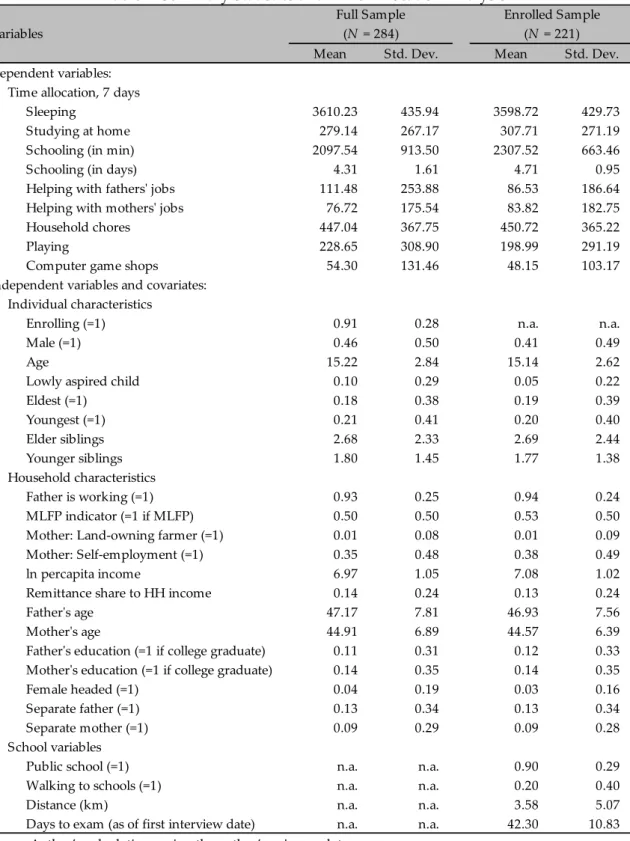
Table 1 reports the summary statistics of the dependent and independent variables for two sub-samples.15 The systems-of-equation estimations are performed separately on these sub-samples for robustness checks and comparisons. One sub-sample includes all of the children regardless of their school enrollment status (the “Full Sample”) and the other is restricted to enrolled children whose educational achievement scores were collected (the “Enrolled Sample”). Thus, the Full Sample includes children not enrolled in school or so-called OOSY/C. This division into two sub-samples is applied hereafter to other estimations as well.
Table 1 around here
The dependent variables are the child’s weekly time allocations for sleeping, studying at home, schooling, working, playing, and using computer-game shops. In the Enrolled Sample, the average time allocated to education-related activities increases and the average time allocated to leisurely activities decreases compared to the Full Sample. Interestingly, even in the “Enrolled Sample,” the average time allocated to child labor as to helping with their mothers’ jobs increases slightly, while the average time allocated to household chores remains almost the same. This indicates that regardless of enrollment status, children are expected to commit to household chores or to help with their mothers to a certain degree.
The independent variables are classified into three categories: (i) individual child
14 This instrument is made possible by a characteristic of the Philippines discussed in subsection C, section
II; namely, that female labor force participation is high compared to more male-dominated developing countries where females are likely to be discriminated against and have difficulty choosing to work.
15
characteristics; (ii) household characteristics; and (iii) school-related variables.16 In the Full Sample, 91% of children are enrolled in school and the remaining 9% are OOSY or non-enrolled children, of whom there are comparably more males (41.2% vs. 45.8%). In both samples, the mean age is around 15, which meets the survey’s intent to concentrate mainly on high-school-age children. The indicator of “low aspirations child” means the parental aspiration for the child’s education is below the college level, which is the default aspiration. In the Full Sample, 9.5% of the children have parents who aspire for them to complete only the secondary education level or even lower, but in the Enrolled Sample that decreased to 5.0%. Among demographic information (birth orders and number of siblings), the number of siblings averages five to six, including the respondent. It is apparent that there is little difference in the demographic characteristics between the Full and Enrolled samples.
The summary statistics for MLFP indicator show that on average, half of the respondent mothers are working. Additional information on the occupation categories is provided. For the reference category “contract workers,” two dummy variables are used: farmers (landowners) at 1%, and self-employed at 35%–38%. Household monthly income, in log form, is based on a six-month average. The amounts include earnings of fathers and mothers if working and contributions from other members if any (e.g., remittances by their children living independently elsewhere).17
The fathers and mothers in the sample are in their mid-forties, on average. Mothers are slightly more likely to have completed a tertiary level of education than fathers. The percentage of fathers who completed a tertiary level education is 10%–12% compared to 14% for mothers. Most heads of household are men (96%–97%), indicating that the breadwinner role belongs predominantly to men.18 In around 13% and 9%–10% of the households, fathers and mothers are reported to not be living together with other family members, respectively. Regarding children enrolled in school, their school information was used as independent variables only in the “Enrolled Sample” (“n.a.” in the “Full Sample”) in Table 1. Among the children enrolled in school, 90% go to public schools. Regarding the commuting modes, 20% walk to school, which means that 80% use some means of transportation (e.g., tricycles or jeepneys). As a factor in a child’s time allocations, the survey asked about the house-to-school distance. On average, schools are located 3.6 kilometers from the home but there is a high standard deviation around this average, depending on the educational level in which children are enrolled. As of the date of the first time-allocation survey, schoolchildren had 42 days remaining until their exams, on average.
B. Child Individual Characteristics
The 3SLS estimations are performed separately on the two sub-samples, “Full” and “Enrolled,” to allow for a robustness check. Table 2 presents the results for the Full Sample, so we need to control for the school enrollment indicator because it is expected to largely explain the variances in schooling and learning time allocations. The OOSC/OOSY and
16 The third, school-related covariates are included in regression analyses to control for the school-related
variations, the detail interpretation is given in APPENDIX B (page 57) due to a space constraint.
17 The remittance share in the total household income is, on average 13.5%. If this share is high, the
breadwinner roles of the father and/or mother in that household livelihood are likely to be unstable since they are more dependent upon a third-channel remittance.
16
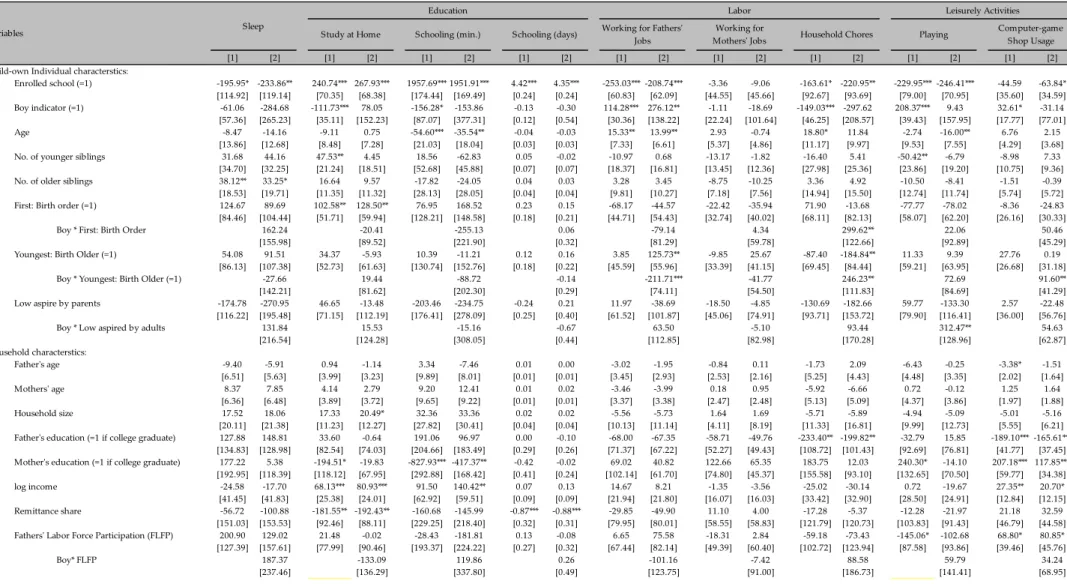
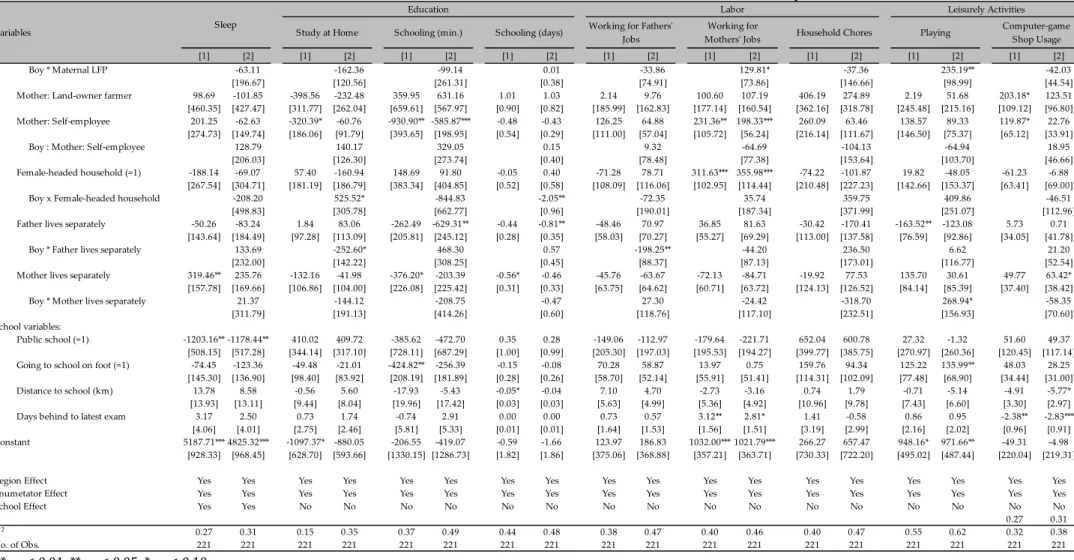
enrolled children are also more likely to be engaging in labor (helping with their fathers’ jobs) and household chores and to have more leisure time than the enrolled children. Given this variation, we first consider the characteristics for each specification for the Full Sample [1] in Table 2. The estimated results show the following tendencies, ceteris paribus.
Male children spend less time on schooling, studying at home, and helping with household chores but spend more time in leisure activities, both playing outside and in computer-game shops, and in child labor helping with their fathers’ jobs compared to their female counterparts. Female children are more likely to spend their time on what we define as “pro-educational” activities and helping with household chores than their male counterparts. In contrast, male children are more likely to engage in child labor activities, particularly in their fathers’ jobs, and to spend more time in leisure activities and less time studying at home than their female counterparts, which we define as a less pro-educational pattern.19 In helping with their mothers’ jobs, no significant gender difference is detected. Older children are likely to stay in school for less time and/or to engage in labor (helping with fathers’ jobs) longer than their younger counterparts. Birth-order information alone predicts that older siblings are more likely to spend a longer time studying at home than their later birth-order counterparts.
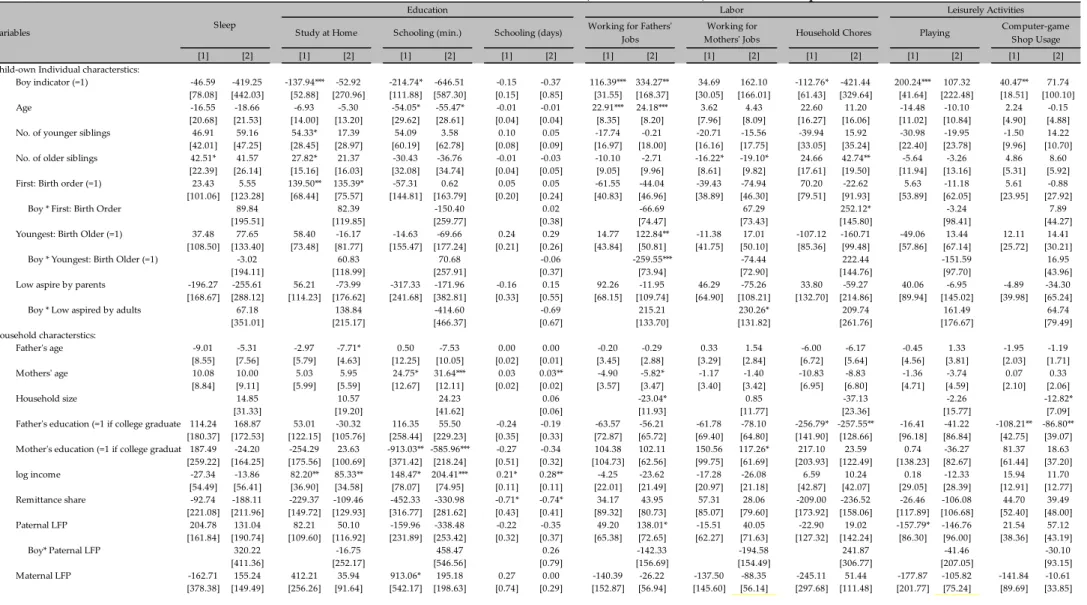
Moreover, according to the results shown in Table 3 for the Enrolled sample, the number of siblings is a statistically positive predictor of the percentage of time a child allocates to studying at home. Based on this, there may be a positive externality among siblings for time spent studying, and it is possible that having older siblings triggers this externality. As for the low parental aspirations, this is not robust in either Table 2 or Table 3; however, the male children for whom the parents have a relatively low level of educational aspiration tend to play longer than others.
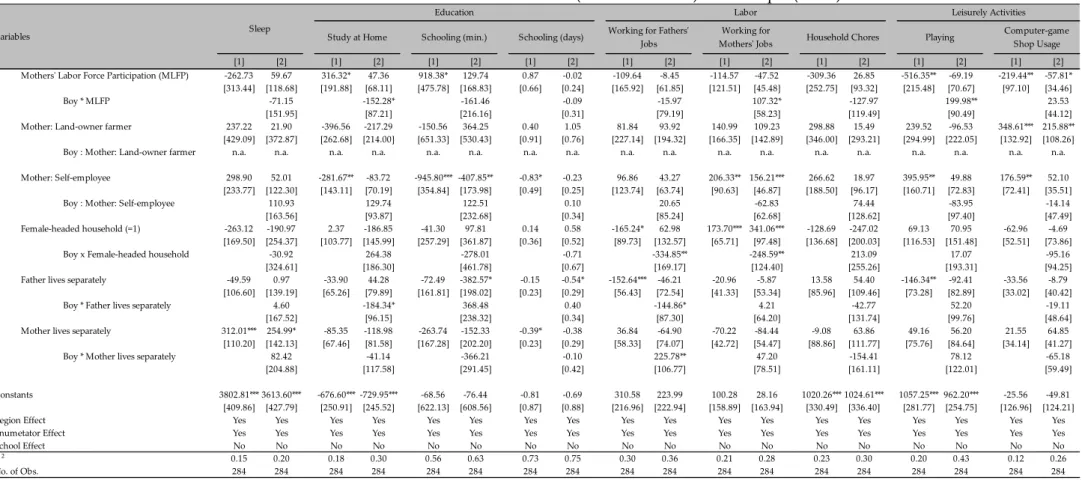
Table 2 and Table 3 around here
C. Household Characteristics
Table 2 and Table 3 show that household income levels are positively associated with children’s pro-educational time allocations, i.e., studying at home and schooling.20 Whereas the household income alone is a positive predictor for children to engage in pro-educational activities, the share of income represented by remittances contributed by other family members negatively predicts the time allocated to those activities. This indicates that while income by itself is a positive predictor for children to spend more time engaged in pro-educational activities, this is attenuated when the household income level is not sustained by the fathers (and mothers) as the prime breadwinners (see also the footnote 17, p. 15).
19 Regarding students’ educational attainment measured by the scores achieved in school subjects (shown
in Appendix Table A- 3), Appendix Table A- 4 shows the results of a multiple regression analysis to find partial correlations using time allocations as independent variables. It reveals that only three uses of time have partial correlations with school performance: studying at home (positive), child labor helping with their fathers’ jobs (negative), and leisurely time playing (negative). Appendix Figure A- 4 visualizes a schematic of the time allocations as predictors of educational attainment and their interrelations based on Appendix Table A- 3, Appendix Table A- 4, and Appendix Table A- 5.
20 At the same time, according to Table 2, household income levels positively predict computer-game shop
17
Of particular concern is the MLFP effect on children’s time allocations. First, according to Table 2, the analyses that combine all respondents without the interaction terms show that the overall effect of MLFP is to increase the time children spend in pro-educational activities (both studying at home and schooling) compared to children whose mothers do not participate in the labor force. MLFP also reduces the time children spend on leisure activities (both playing and computer-game shop use). These results suggest that the effect of MLFP is pro-educational for children.
Notwithstanding the overall pro-educational effect of MLFP, the analyses that include the interaction terms with the child’s gender shows the heterogeneity of the MLFP effect based on gender. The estimators in the specifications [2] for each dependent variable in Table 2 show the MLFP effect reduces sons’ studying time at home but increases both the sons’ labor time in their mothers’ jobs and time spent in leisure activities (both playing and computer-game shop use). The daughters’ responses are qualitatively the reverse of their male siblings’ responses, according to the mathematical signs of estimators. In Table 3 (the Enrolled Sample) the effect of MLFP in increasing sons’ labor time persists despite the fact that children who do not have education-related time are excluded from this sample, and the same is seen for playing time. It is also noteworthy that the effect of fathers’ labor force participation (FLFP) is much less explanatory for the use of children’s time than the effect of MLFP and that the effect of FLFP is homogeneous with respect to a child’s gender.
D. Further Explorations for the MLFP Effect
To further explore the MLFP effects, mothers’ employment-status indicators are also included. According to the questionnaire responses, the majority of working mothers are self-employed (69.4%), followed by contract workers21 at 27.8%, and land-owning famers (called ”magsasakang may lupa” in Tagalog) at 1.4% in a dramatic decrease. Accordingly, “self-employed” and “land-owning farmer” indicators (dummy variables)22 are created to include in the regression equations as “contract workers” is made the reference category. Hence, the coefficients of these indicators are interpreted as additional effects to the effect of MLFP.23
In Table 2, the mathematical signs of the “self-employed” indicator are opposite of those of the MLFP.24 This indicates that children whose mothers are self-employed decrease their pro-educational time and increase the amount of their time spent on labor (mothers’ jobs) and leisure (both playing and computer-game shop use) compared to children whose mothers are more formal workers. Moreover, in contrast to the effect of MLFP alone, the aforementioned additional effects from the category of “self-employed” imply that effects of miscellaneous or less formal types of work are homogenous as to the child’s gender because
21 This is considered more formal than self-employment.
22 The sample does not include sons whose mothers work as land-owning farmers; thus the interaction term
with child = male indicator is not estimated.
23 Letting MLFP, self-employee, and land-owning-farmer indicators be denoted as 𝑀𝑀 , 𝑆𝑆𝑆𝑆 , and 𝐿𝐿𝐿𝐿 , and
their coeffieicents be 𝜇𝜇1, 𝜇𝜇2, and 𝜇𝜇3, the contract-worker effect is expressed as 𝜇𝜇1𝑀𝑀 + 𝜇𝜇2𝑆𝑆𝑆𝑆 + 𝜇𝜇3𝐿𝐿𝐿𝐿 = 𝜇𝜇1∗
1 + 𝜇𝜇2∗ 0 + 𝜇𝜇3∗ 0 = 𝜇𝜇1 . Likewise, the self-employee effect is 𝜇𝜇1𝑀𝑀 + 𝜇𝜇2𝑆𝑆𝑆𝑆 + 𝜇𝜇3𝐿𝐿𝐿𝐿 = 𝜇𝜇1∗ 1 + 𝜇𝜇2∗ 1 + 𝜇𝜇3∗
0 = 𝜇𝜇1+ 𝜇𝜇2 and the land-owning farmer effect is 𝜇𝜇1𝑀𝑀 + 𝜇𝜇2𝑆𝑆𝑆𝑆 + 𝜇𝜇3𝐿𝐿𝐿𝐿 = 𝜇𝜇1∗ 1 + 𝜇𝜇2∗ 0 + 𝜇𝜇3∗ 1 = 𝜇𝜇1+ 𝜇𝜇3.
Therefore, 𝜇𝜇2 and 𝜇𝜇3 are interpreted as additional effects to the effect (𝜇𝜇1) of MLFP, respectively.
18
none of the coefficients of the interaction terms with child gender are statistically significant in Table 2 or Table 3.
These results can be interpreted to mean that, for mothers who work, the time-allocation pattern of their sons tend to be less pro-educational than their daughters’ (or, conversely, for working mothers the time-allocation pattern of their daughters tends to be more pro-educational than for their sons). The effects of MLFP on playing time for sons versus daughters contrast strongly, and their estimators are robust as shown in both Table 2 and Table 3. Additionally, if working mothers are self-employed, the pro-educational effect of MLFP on their daughters is attenuated in comparison with mothers who are more formal workers. Based on the magnitudes of these estimators, this unfavorable attenuation affects all pro-educational, labor, and leisure activities.
The results thus far are summarized as follows: (i) sons whose mothers are working decrease their pro-educational time allocations deserving educational achievement and increase those time allocations as negative predictors of it; (ii) daughters whose mothers are working allocate their time opposite to their male siblings, displaying pro-educational behaviors; however (iii) the pro-educational effect of MLFP that is favorable for daughters is significantly attenuated if their mothers are self-employed rather than formal workers, and (iv) effects of time allocation for leisure and labor activities by children of self-employed mothers are homogeneous with respect to the child’s gender.
E. Consideration of Family Structures
After considering the aforementioned, we note that family structures also predict child time allocations. Those daughters of female-headed households are more likely to work by engaging in their mothers’ jobs, and sons of households where fathers do not live together are likely to spend less time studying at home than sons in two-parent households. These family structures would require mothers to participate in the labor force more than otherwise, and their daughters are more likely to be required to spend some time working to help them in their jobs; and/or the mothers are less able to monitor their sons who may not be studying as much as they would be if the mother was there to observe them.25,26
One interpretation of the negative effect of MLFP on pro-educational time allocations by their children is that children are less likely to be monitored by their mothers as the children’s primary caregiver. This is justified by the qualitatively similar result regarding the estimator for the indicator of sons living apart from their mothers, because the indicator means the sons spend far less time with their mothers in their families (Battistella and Conacothe, 1998; Cortes, 2015; Nguyen, 2016). In this sense, male children are less likely to be monitored, scolded, or guided by their mothers to avoid playing too much or to study more when their mothers are working or are not living in the same household. Leisure time,
25 In the author’s fieldwork, there were mothers who described themselves as gradually having lost their
ability to monitor their children, especially their sons, as they grew older. They explained that monitoring and guiding their children to avoid negatively impacting their studying was highly “time-intensive” due to the continuous demand for attention. Juveniles are reported to be prone to “play hooky” unless they are monitored by adults as a deterrence. This monitoring and guidance role falls more heavily upon mothers than fathers or any other family members, reflecting a traditional rural norm.
26 In Table 3, consistent with this last observation, sons who do not live with their mothers are also more
19
particularly playing outside, is inversely correlated with positive school performance (see Appendix Table A- 4) and competes with time allocated to studying at home (see Appendix Table A- 5). Therefore, the more time allocated to playing, the more children are likely to underperform in school.
It is also interesting that the sons of working mothers are likely to spend time helping with the mothers’ jobs, and that irrespective of the working status of their mothers, male children are likely to allocate time to helping with their fathers’ jobs, even within the “Enrolled Sample” (Table 3). One conclusion that may be reached from these observations is that sons reap more leisure time by studying less at home and, at the same time, sons may be in a sense “acquitted” of such playful behaviors by working not only for their fathers but also for their mothers. In particular, because sons tend to engage in tasks such as carrying heavy items and animal caregiving as their household chores more often than their female siblings, it is likely that sons are expected to do some physically demanding tasks that mothers find difficult (see Appendix Table A- 6).
VI. FURTHER ISSUES TO CONSIDER
A. Determination of MLFP with Predetermined FLFP
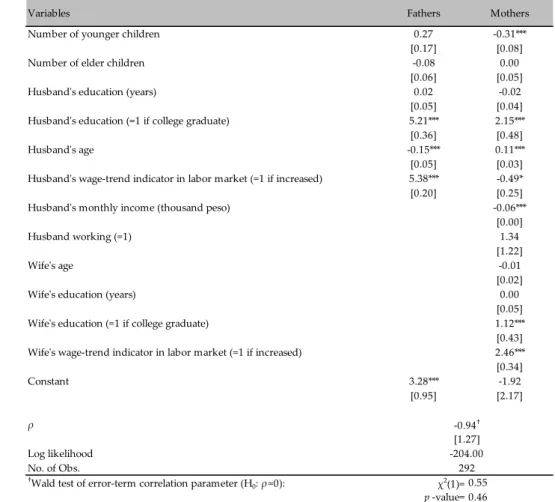
In what situations are mothers more likely to participate in the labor force? Table 4 shows an additional bivariate probit regression result of the determinants of MLFP. It is statistically probable that more educated mothers and mothers whose husbands have low earnings are more likely to participate in the labor force. The more young children they have, the less likely those mothers are to participate in the labor force. It means that women’s labor force participation is hindered by their childrearing role. These results from the sampled mothers are consistently similar to the findings of determinants of MLFP using nationally representative statistics (David et al., 2017: 16–19). The mothers’ own educational level is a significant and positive predictor of MLFP. In addition, MLFP does not simply increase proportionally as years of education increase; there is a sharp, kinking change, i.e., a dramatic increase upon reaching the college graduate level. This sharp increase is reported to be more pronounced in the Philippines compared to South Korea, Thailand, Indonesia, and Sri Lanka (Cameron et al., 2001: 470–472).
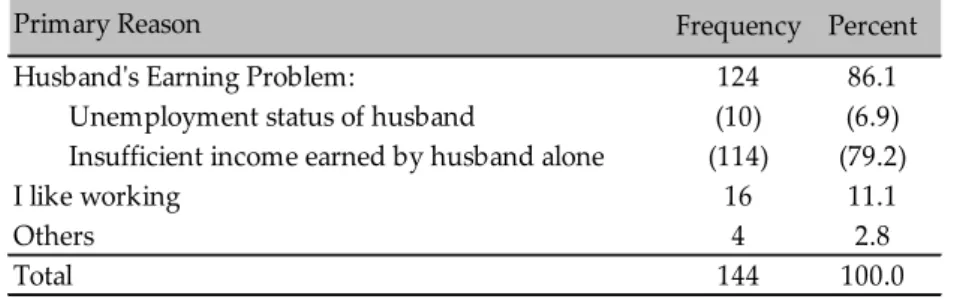
These results are also consistent with the self-reported and perceived reasons for mothers to participate in the labor force, 86% of whom reported that it was their husbands’ earning difficulties that led them to decide to work (Table 5). Between eight and nine out of ten mothers who participate in the labor force are forced to work to make up for their husband’s insufficient earnings, while fewer than two out of ten enjoy working. However, this does not mean that fathers purposely chose to be unemployed or underemployed by leaning on and expecting their wives’ labor force participation.
In other words, FLFP is a given, a predetermined factor for mothers making their decisions about working. The Wald-test statistics of the null hypothesis that the determination of FLFP is exogenous to that of MLFP is shown in the bottom line of Table 4 regarding the correlation of error terms in the system of equations. As stated in subsection C of section II, fathers (husbands) are socially considered to be breadwinners and they are expected to work regardless of their wives’ labor force participation. The null hypothesis is not rejected at any of conventional statistically significant levels. Hence, decisions regarding