Economic development capitalizing on brand
agriculture : turning development strategy on
its head
著者
Fujita Masahisa
権利
Copyrights 日本貿易振興機構(ジェトロ)アジア
経済研究所 / Institute of Developing
Economies, Japan External Trade Organization
(IDE-JETRO) http://www.ide.go.jp
journal or
publication title
IDE Discussion Paper
volume
76
year
2006-11-01
INSTITUTE OF DEVELOPING ECONOMIES
Discussion Papers are preliminary materials circulated
to stimulate discussions and critical comments
Keywords: rural development, brand agriculture, OVOP
JEL classification: O13, Q10, Q16
*
Institute of Economic Research, Kyoto University, Yoshida-Honmachi, Sakyo-ku, Kyoto-shi, Kyoto 606-8501, Japan, and Institute of Developing Economies, JETRO, 3-2-2, Wakaba, Mihama-ku, Chiba-shi, Chiba 261-8545, Japan. Phone: (81-75) 753-7122, Fax: (81-75) 753-7198, e-mail: [email protected]DISCUSSION PAPER No. 76
Economic Development Capitalizing on
Brand Agriculture: Turning Development
Strategy on Its Head
Masahisa FUJITA*
November 2006
Abstract
This paper explores the possibilities of two unique Japanese concepts – the One Village
One Product Movement (OVOP) and Michino Eki (or Roadside Stations) – as potential
tools for bridging the gap between cities and rural areas through community-driven
development. From the viewpoint of spatial economics and endogenous growth theory, this
paper considers both OVOP and Michino Eki as rural development strategies of a broader
nature based on “brand agriculture.” Here, brand agriculture represents a general strategy
for community-based rural development that identifies, cultivates and fully utilizes local
resources for the development of products or services unique to a certain “village.”
Selected examples of OVOP and Michino Eki from Japan and developing countries are
introduced.
The Institute of Developing Economies (IDE) is a semigovernmental,
nonpartisan, nonprofit research institute, founded in 1958. The Institute
merged with the Japan External Trade Organization (JETRO) on July 1, 1998.
The Institute conducts basic and comprehensive studies on economic and
related affairs in all developing countries and regions, including Asia, the
Middle East, Africa, Latin America, Oceania, and Eastern Europe.
The views expressed in this publication are those of the author(s). Publication does not imply endorsement by the Institute of Developing Economies of any of the views expressed within.
INSTITUTE OF DEVELOPING ECONOMIES (IDE), JETRO 3-2-2, WAKABA,MIHAMA-KU,CHIBA-SHI
CHIBA 261-8545, JAPAN
Economic Development Capitalizing on Brand Agriculture:
Turning Development Strategy on Its Head
MASAHISA FUJITA
Challenging the common literature of economic growth and development that tends to assign the agrarian sector the backseat, this paper seeks to move agriculture and rural development to the forefront through a community-based strategy designed to cause major innovation dynamics and human capital accumulation to occur. Specifically, this paper explores the possibilities of two unique Japanese concepts advocating community-based rural development -- the One Village One Product Movement (OVOP) and Michino Eki (or Roadside Stations) -- initiated in the peripheral regions of Japan in the early 1960s and the mid-1990s, respectively. Both OVOP and Michino Eki have attracted widespread attention in many developing countries as potential tools for bridging the gap between cities and rural areas through community-driven development, and are being implemented in many countries. From the viewpoint of spatial economics and endogenous growth theory, this paper considers both OVOP and Michino Eki as rural development strategies of a broader nature based on “brand agriculture.” Here, brand agriculture represents a general strategy for community-based rural development that identifies, cultivates and fully utilizes local resources (including natural, historical, cultural and human resources) for the development of products or services unique to a certain “village” or geographical area. In the context of brand agriculture, selected examples of OVOP and Michino Eki from Japan and developing countries are introduced, with special attention given to the role of various types of infrastructure in the effective promotion of OVOP and Michino Eki.
Masahisa Fujita is Professor of Economics at Kyoto University, and the President of the Institute of Developing Economies (IDE) at the Japan External Trade Organization. The author would like to thank Megumi Muto of the Japan Bank for International Cooperation (JBIC), Kazuhisa Matsui of IDE and Jacques Thisse for their valuable help in developing this paper. The author is grateful also to four anonymous referees, as well as to Maria P. Makabenta-Ikeda and Nobuaki Hamaguchi for their helpful comments on a preliminary draft.
If farmers are rich, then the country will be prosperous. If villages are stable, then the society will also be stable.
― President Hu Jintao, China (TIME, 13 March 2006, 22) Agriculture as the Front Runner behind Two Laps
In common perception, economic development is supposed to proceed with the transformation of the main sector of the economy from agriculture to industry, and then to services. The principal role of rural areas is, therefore, to provide cities with food, while excess labor gradually migrates from rural to urban areas. The engine of economic growth resides in cities where most innovation and learning activities take place. In accordance with such common perception of economic development, most existing textbooks in development economics posit for the agrarian sector a role that consists of producing generic commodities or foods under constant returns to scale, paying little attention to product differentiation, endogenous innovations or knowledge externalities that might take place in the agrarian sector or rural areas.1 Furthermore, to a
remarkable extent practical consideration is hardly given to the location of agrarian activities except in general studies on the dichotomy of urban/rural areas or North/South regions.
In this paper, I dare to challenge such common perception and treatment of the agrarian sector in development economics. This is no mere academic exercise. Indeed, if we were to grant the generally accepted hypothesis regarding the role of the agrarian sector as absolutely true, the agrarian sector and rural areas would have no choice but to remain forever in the backseat of economic development. If we assume constant returns and perfect competition in the agrarian sector, then as pointed out by Romer (1992, p.85), all of agricultural output will have to be paid as returns to input factors; nothing will remain as possible compensation for technological innovations. Thus, productivity enhancement and product innovation could be achieved only through public investments in infrastructure and R&D, leaving no possibility for endogenous innovation dynamics to arise inside the agrarian sector or rural areas. Furthermore, if farmers were to continue producing only generic goods, they would have no way of escaping from the direct competition in price and cost. Then, given the increasingly more severe competition in the commodities markets due to globalization and expanding domestic markets, farmers (except those in the most advantageous locations)
1 For a comprehensive modern textbook in development economics, see, for example,
would be able to survive only under increasing subsidies and protection, while suffering from the gradual decline in their wages and incomes.
Needless to say, from the viewpoint of domestic and international economic policy, the revitalization of the agrarian sector and rural areas is of great importance not only for developing countries but also for developed countries. As illustrated in Figure 1, not only in developing countries but also in many developed countries, sizeable segments of the populations continue to reside in rural areas. Rural areas, of course, are not entirely populated by full-time farmers. Yet, given that most people in rural areas are directly or indirectly connected to the agriculture or local-resource-based activities there, and given that the majority of the poor in the developing world reside in rural areas, the revitalization of agriculture and related activities is essential for invigoration of rural economies.
Figure 1. Rural Population Share in Selected Countries
Historically speaking, although the population share of full-time farmers has become very low in most developed countries, the share of the rural population continues to be significant in most countries. For example, in the US, over the past two hundred years the farming population has fallen from 70% to 2%, while the non-farming segment in rural areas has stayed remarkably stable at about 20% (Kilkenny 2004). Likewise, in France, although the number of farmers has fallen dramatically, non-farming rural population has remained around eight million since 1850 (Ravignan and Roux, 1990). For another example, let us consider Latin America and the Caribbean which together represent a highly urbanized region. In this region, the projections for the year 2020 by the World Bank (2006) show that while the urbanization trend will continue, the absolute number of people living in rural areas will remain roughly the same. Thus, for the sake of a balanced growth in both rural and urban areas, invigoration of rural economies remains an issue of crucial importance for both developing and developed countries.
For the invigoration of rural areas, many things should and/or could be done, possibly including the development of the following with appropriate timing:
(a) Infrastructure
(a-1) hard: electricity, water, sanitation, transportation, telecommunications (a-2) soft: administration, management, financing, marketing, technical and
(b) human capital: health, education, training (c) industries
(c-1) agriculture (including local resource-based industries) (c-2) services
(c-3) manufacturing
Given that each rural area is unique in many aspects, it would not be very productive to discuss in a single paper general strategies for rural development. Rather, we propose, in this paper, to focus on the development of rural areas that locate in the “periphery.” By periphery we mean those areas that are inherently disadvantageous in the cultivation of generic agrarian commodities such as wheat, rice and other standard products. Disadvantages may arise either from steep topography, mountainous land, scarce water supply, extreme weather, or poor transportation access to major markets. Most countries abound in such peripheral areas. Furthermore, in landlocked parts of Asia, Africa and Latin America, many countries are almost entirely in the periphery.
Growing generic agrarian commodities in the periphery entails a population of poor farmers and a constant need for heavy subsidies, assuming the country can afford such subsidies. Meanwhile, in the face of a gloomy outlook for the future under such a development strategy, the country or region is being gradually deserted by her young people. This is true even in rich countries. In 2003, for example, all of the 20 poorest counties (in terms of average wages and salaries) in the US, located on the eastern flank of the Rockies and on the western Great Plains, were engaged in the production of agricultural commodities, their farmers continuing to specialize mostly in wheat, soybeans and cattle (Economist, 10 December 2005, pp. 38-39). In addition, the federal government spent an average of US$9,000 per person in North Dakota counties in 2003, mostly in the form of farm subsidies, while the agriculture in the region has entirely failed to adapt to a world of cheap grain and cattle.
Japan, perhaps, is the worst example among nations whose agricultural policy has almost entirely failed in adapting to the globalizing world. Since the early 1960s, Japanese agriculture has been heavily protected through subsidies, tariffs and other policy measures. In particular, in terms of PSE (producer support estimate), the protection degree of Japanese major crops (rice, wheat for food, etc.) has been “extraordinarily” high either in international comparison or absolute terms (Hayami and Koudo, 2002, p.178). Not surprisingly, such Japanese agricultural policy has heavily distorted the working of normal mechanisms in the agricultural and related markets, while impeding the modernization and adaptation of Japanese agriculture in
the globalizing world.
Despite such a misguided agricultural policy, however, the future of agriculture and rural development in Japan is not entirely hopeless. Indeed, since around the early 1960s, a grassroots movement for rural development has spontaneously arisen in many villages located in the periphery of Japan. Although each movement has evolved in a unique way, all successful rural development programs have been sharing the common basic strategy that identifies, cultivates and utilizes fully the local resources (including female labor and elderly people) for the sustained development of a greater variety of unique local products and services (often including local tourism). Through increasingly sophisticated marketing, these unique local products have been sold in larger markets, often establishing distinctive regional brand names identifying the local manufacturers of these products.
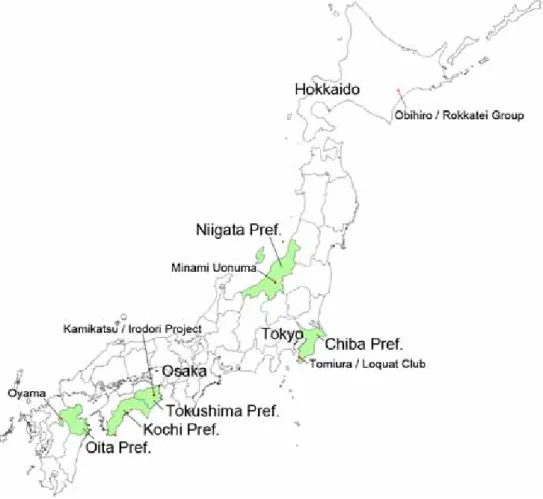
Such grassroots movement has arisen despite, and often acting in an opposite direction to, the national agricultural policy for the promotion of rice production everywhere in Japan. Given that the continued production of rice in inherently disadvantageous locations has provided no hope for the future, such grassroots action originated in Japan’s remote villages invariably out of their desperate struggle to escape from the increasing poverty and depopulation of their areas. The movement suddenly became popular and accelerated further shortly after Mr. Morihiko Hiramatsu, then governor of Oita prefecture (located in the western periphery of Japan, shown in Figure 4), gave it the attractive name of One Village One Product Movement (OVOP) in 1979. Abroad, since its introduction in China in 1983, OVOP has attracted the serious attention of many developing countries. And it has actually been implemented in many countries including Malaysia, Thailand, the Philippines, Indonesia, Cambodia, Laos, Mongolia and Malawi (Africa). The potential attractiveness of OVOP for rural development in developing countries lies in the fact that it has been initiated spontaneously by local communities in the “peripheries” of Japan with little help from the national government. As explained in the fourth section, OVOP implementation experience varies substantially from country to country.
In the early 1990s, another unique concept for local community development called Michino Eki (roadside stations) was initiated in Japan. The Michino Eki roadside service stations are uniquely different from highway or motorway service areas or rest areas in other parts of the world for three reasons (World Bank, 2006). First, although the Michino Eki stations in Japan are under the general guidance of the Ministry of Land, Infrastructure and Transportation (MLIT), the actual planning, implementation, operation and management of each Michino Eki are left almost entirely autonomous in
the hands of the local community. Thus, not surprisingly, Michino Eki provides much stronger links between local communities and the users of the highways, while competing with one another on the basis of their uniqueness in terms of the design of their buildings as well as the functions and services they offer. A typical Michino Eki sells a large set of unique local products developed and produced either within the vicinity of the Michino Eki or in the surrounding rural communities. Hence, local residents are provided opportunities for entrepreneurship to increase their income, thereby empowering themselves (in particular women and elderly people). Second, in addition to economic services through market functions, Michino Eki serves as venue for the provision of a wide variety of public services to the local community such as sanitation, health care, education and training, as well as cultural activities. Third, while a normal way station or service area is intended primarily for highway users, focusing on traveler services, a Michino Eki targets the local residents as well who come either in vehicles, on foot or bicycle. Since the first group of Michino Eki was implemented in 1993, there exist today more than 830 Michino Eki throughout Japan (all outside major metropolitan areas).
Like OVOP, the Michino Eki idea has attracted the curious attention of many developing countries. And, under the guidance of Japanese MLIT, Japan Bank for International Cooperation (JBIC) and the World Bank, Michino Eki is now being implemented or in the phase of pilot study in many developing countries such as Thailand, India, China, Turkey, Kenya, Yemen as well as in Mexico.2
Both OVOP and Michino Eki have a high potential to be used as an effective strategy or tool for bridging the gap between cities and rural areas in developing countries through community-driven development. However, their attractive names tend to disguise the actual complexity of the concepts behind them, often resulting in misunderstanding. The purpose of this paper is to present a comprehensive understanding of the concepts behind OVOP and Michino Eki from the viewpoint of spatial economics and endogenous growth theory, while illustrating such concepts through actual examples of OVOP and Michino Eki both in Japan and developing countries. Special attention is paid to the role of various types of infrastructure in the effective promotion of OVOP and Michino Eki.
From the viewpoint of economic theory, this paper considers that both OVOP and Michino Eki belong to a broader category of rural development strategy based on “brand agriculture.” Here, brand agriculture represents a general strategy for
2 For a comprehensive introduction and guidance re Michino Eki, see World Bank
community-based rural development that successively identifies, cultivates and fully utilizes local resources (including natural, historical, cultural and human resources) for the continual development of an increasingly greater variety of unique local products and services (including local tourism). At the same time, through increasingly sophisticated marketing, these unique local products will be sold in larger markets, gradually establishing local brands to identify them. In so doing, the community will accumulate technical skills, know-how and practical knowledge learned by inference through experience (otherwise known as tacit knowledge) while developing their human resources that are essential for sustained or continual innovation of their unique local products and management system.
In the next section, based on spatial economics and endogenous growth theory, the framework for the analysis of brand agriculture is presented. Then, in the context of brand agriculture, OVOP and Michino Eki in Japan are introduced. The paper concludes with the discussion of policy implications and possible strategies for successful promotion of brand agriculture in developing countries.
Economic Theory and Brand Agriculture
At this point, we may ask what are the essential differences between agriculture and manufacturing or services. It is true that each person has one stomach and hence the capacity for food consumption is limited. But the same is true for manufacturing and services. Each person has a single body and thus the capacity for the consumption of basic products such as clothes for daily wear, TV sets and cars is limited. Likewise, each person cannot watch TV programs, play video games and read books more than 24 hours a day. At the same time, however, one would be delighted in buying new fashionable clothes, a new digital TV set, and the newest version of BMW or Toyota. And, some people can hardly wait for new Korean soap operas (which are now enormously popular in Asia), new games with Play Station 3, and the next version of Harry Potter. Likewise, one would love to try new varieties of fruits and sweets, to receive gorgeous bouquets occasionally, and to visit an onsen (a hot spring resort) and enjoy a $100 dinner from time to time.3 And, some people are ready to pay almost any
3 This is true also for basic foods. For example, even in the production of the most basic
crop, rice, in Japan, after just 10 years since the partial deregulation of its markets, more than a hundred varieties of rice for daily consumption are being cultivated in Japan today, some of which are exported overseas. In my recent trip to Thailand from Japan, the back cover of my air ticket happened to print the PR of one rice brand, Koshihikari cultivated in Minami Uonuma (in Niigata Prefecture), which commands the price of ¥7,660 per 10 kg, which is more than double the average price of rice in Japan.
price for organically-grown, pesticide-free crops and vegetables.
After basic needs have been satisfied, people have almost limitless potential desires for new things. The essence of economic development, thus, lies in the sustained development of new products (both tangible and intangible ones) that cultivate and fulfill such potential desires. This is true not only in manufacturing and services but also in agriculture.
There exist, of course, fundamental differences between agriculture and manufacturing or services. Here and throughout this paper, we consider agriculture broadly to include forestry, fishery and stock-raising as well as all local resource-based industries and activities such as local food processing, crafts, restaurants and tourism. Almost by definition, then, the basic characteristics of agriculture are:
1. It is bound to land and nature, and thus agrarian activity is rather specific to region.
2. Because of land constraint, its activities are geographically dispersed, and thus cannot form a large dense concentration.
3. People engaged in agriculture are also bound to land, working and living together in a rural a community and forming a rather closed society.
As we will see in the rest of the paper, such characteristics of agriculture affect the innovation dynamics and resource development in rural areas differently from cities. This paper suggests that when such innovation dynamics and resource development are appropriately managed and supported by infrastructure, agriculture can become again the front-runner in economic development.
Brand Agriculture and Local Resources
To understand the OVOP and Michino Eki in the broader context of brand agriculture, this paper appeals to the theoretical framework of spatial economics combined with the endogenous growth theory.4 In the same manner that spatial
economics and endogenous growth theory put special emphasis on product differentiation, so does brand agriculture. As noted previously, in order to attain higher value-added in the increasingly competitive domestic and global markets, it is essential for producers to differentiate their products from others and avoid direct competition in price and cost. At the same time, such a sustained development of differentiated
4 Spatial economics is often called the New Economic Geography (NEG). See Fujita,
Krugman and Venables (1999) for a comprehensive exposition of the NEG. See also Fujita and Thisse (2002) and Baldwin et. al. (2003) for the recent development of the NEG. For the endogenous growth theory, see, for example, Grossman and Helpman (1991), Barro and Sala-I-Martin (1995) and Aghion and Howitt (1998).
products constitutes the engine of economic growth.
Unlike the manufacturing and service industries in standard spatial economics, however, product differentiation in agriculture does not lead to the formation of big agglomeration of producers and consumers. Indeed, this is not possible by the very nature of agriculture using land extensively. Rather, the key question in the theory of brand agriculture is how to achieve the sustained development of rural areas in dispersed environments. The answer lies in the role that product differentiation plays in the symbiotic evolution of local resources, local products and infrastructure, leading to the sustained development of rural communities. Figure 2 presents schematically the evolutionary process of brand agriculture through double-loop processes.
Figure 2. Evolution of Brand Agriculture through Double-Loop Processes
To explain Figure 2, let us consider a hypothetical story, representing a typical example of OVOP. Focusing first on the outside loop in Figure 2, suppose that, in a village, a group of farmers get together and try to develop unique products which will eventually supplant the traditional crops grown there. This may be caused by a certain catastrophic event that renders the growing of traditional crops there hopeless. Accordingly, the first step is to identify the existing local resources (both tangible and intangible ones) that the village has. In the absence of any extraordinary or precious local resources, communities need to focus on developing a few local products in which they have comparative advantages under the given set of local resources. Moreover, they will endeavor to produce better products at lower costs. Given that their products are still not very competitive in the national market, they will aim at regional markets located relatively nearby while trying at the same time to establish a brand reputation for their products through stable and continuous supply.
The experience and know-how gained through this initial period of operations will further enrich the local resource base (including various skills and know-how) and management capacity of the group. At the same time, the group may become larger with the subsequent attraction of new participants from the same village. This larger group of farmers, then, will take a fresh look at initial products and try to refine them further, while adding a few new products (some of which may be processed products of local materials). Consequently, the group is better able to exploit the economies of scale/scope better, leading to the supply of a larger variety of products with higher quality at lower costs. One concomitant outcome from such developments would be a more stable supply and a higher reputation of their products in larger markets. In this manner, the brand
agriculture of the village gradually evolves, and in the course of that evolution the village usually introduces a new set of core products periodically. Eventually, the growing reputation of the village will pave the ground for promoting local tourism earnestly. Furthermore, as previous experience has shown, several full-fledged companies using local resources may appear, selling their brand products nationwide and, perhaps, overseas. In this way, the village will become a more invigorated place with increasingly higher local pride.
While a good story this hypothetical example may tell, it is hardly complete. In particular, such evolution of brand agriculture in the village cannot proceed smoothly without consecutive improvement of various kinds of infrastructure surrounding the village in timely manner, which is represented by the inside loop in Figure 2. First of all, the availability of various kinds of basic infrastructure such as water, road and electricity is a prerequisite to the initiation of such an evolutionary process, although the determination of what is basic depends to a great extent on the general environment of the society. Furthermore, although too much assistance from outside agents (assistance, for example, in the form of subsidies) often turns out to be harmful, timely help in developing key new infrastructure such as better access-roads and telecommunication system as well as technical and marketing support will yield enormous benefits in accelerating the process of brand agriculture, for such infrastructure will yield the sustained positive externalities.
Thus, a successful evolution of brand agriculture will follow the double-loop processes of local resource/product development and infrastructure development.
A few additional comments are in order with regard to the hypothetical example above and the key terms in Figure 2.
Local resources: Although some villages may be endowed with truly valuable resources, most rural areas seem to be devoid of any such resource. It is therefore encouraging to see that many successful cases of OVOP and Michino Eki, as will be illustrated later, have managed to change the seemingly ubiquitous resources such as ordinary plants and elderly people into great assets. In this sense, rich local resources cannot be deemed as heaven-sent but rather as having to be created or cultivated through sheer struggle. This also suggests that unique brand agriculture could be developed in almost any region. Furthermore, in identifying valuable local resources in a region, the different thinking and fresh viewpoint of people from other places often turn out to be of great help, as will be elaborated later.
Lock-in effects of local resources: It often happens that successful manufacturing industries (in particular, footloose ones) eventually move out of the original region and
relocate in big cities, seeking better access to markets. Fortunately, however, since a successful brand agriculture is deeply rooted in specific local resources cultivated in the community, it tends to continue to develop in the same region. This represents the great advantage of rural development based on brand agriculture.
Shipped-to products vs. shopped-for products: As is well-known in location theory, the effective marketing strategy for “shipped-to products” is quite different from that for “shopped-for products.” Here, shipped-to products represent those goods that are delivered to consumers (e.g. typical products of OVOP sold through ordinary distribution channels), whereas shopped-for products are those goods or services that consumers come to purchase (e.g. local tourism and products sold at Michino Eki). This point is elaborated further in the following sections.
Scale economies in brand establishment: It is well-known in the literature that establishing brand on an agrarian product requires a certain scale in terms of the number of farmers and land size involved in the operation.5 In particular, a certain
scale is necessary to achieve a stable and continuous supply of the products to key markets while attaining the continuous refinement of the product through a cooperative and competitive organization. This is aside from the economies of scale in mechanization.
Scope economies leading to centipede agriculture: Successful brand agriculture often proceeds with the successive introduction of new products, leading to the so called “centipede agriculture.”6 This is due to the accumulation of local resources (including
skills and know-how) and the enhancement of management capacity, yielding scope economies in product development and marketing. In particular, as emphasized in endogenous growth theory, the cost of developing a new product tends to become lower with the increasing cumulative number of related products developed in the region in the past. Furthermore, with the establishment of a regional brand, the marketing of new products become easier.
Transfusing new blood into the community, while keeping the social capital: Finally, it must be observed that an initially successful brand agriculture often stops developing, leading to the stagnation of the community. This tends to happen from the very nature of rural society, where the same group of people live and work together in a rather closed community. In such a society, mimesis tends to be directed towards the past, custom rules and society becomes static (Toynbee, 1946). “The cake of custom” may
5 For concrete examples of necessary scales in establishing local brand on agrarian
products, see Kojima (2003).
be broken by creative personalities who initiate the brand agriculture in the village. Furthermore, in order to sustain the village in dynamic motion of brand agriculture, the society needs to develop an organizational system that encourages the constant transfusion of new blood in terms of new personalities and new knowledge, while developing the networks of mutual learning with other groups of brand agriculture in the nation and abroad. For this purpose, it is useful, as illustrated later by actual examples, to set up a corporate organization composed of various experts that will coordinate the activity and operations of independent farmers in the village, and also motivate the support of various local institutions such as technical centers and universities.
Location of Brand Agriculture: The Potential Function Approach
In the previous section, we discussed generally the possible evolution of brand agriculture in a given region or village. In this section, we examine more precisely the location of brand agriculture, asking what type of brand agriculture will be most profitable where.
In the past, the location of agriculture has been studied by using the bid rent approach originated by von Thünen (refer to Chapter 3 in Fujita and Thisse, 2002). The von Thünen model, however, is based on the same theoretical framework as the neoclassical economics, assuming the perfect competition in the markets of agrarian products together with the assumption of constant returns in production. In contrast, as explained in the preceding subsection, the theory of brand agriculture emphasized the product differentiation involving increasing returns to scale in production, leading to imperfect competition in the product markets. Thus, we need a new tool for the study of the location of brand agriculture.
In this paper, for the study of the location of brand agriculture, we use the potential function approach in spatial economics. This approach was developed by Fujita, Krugman and Venables (1999) originally for the study of the location of manufacturing activities involving product differentiation and increasing returns. Here, we apply it for the location of brand agriculture.
In order to derive the potential function for each type of brand agriculture, which measures the profitability of each location in the operation of each specific type of brand agriculture, we adopt the monopolistic competition model used in spatial economics and endogenous growth theory. (For the details of the analysis below, please refer to the Appendix. To do so, let us divide all possible types of brand agriculture into H types, denoting each by index h=1 K,2, ,H . In each type of brand-agriculture, a large variety
of products are produced, which are differentiated from each other but share the same basic characteristics in terms of the consumers’ tastes, location of markets and transport costs, and production technology.
First, consumers’ tastes on type h products are specified by the substitution parameter, σh , which represents the elasticity of substitution between any two varieties in type h , which in turn shows the price elasticity of each product in type h . The parameter σh takes a value greater than 1. A value of σh close to 1 means that type h products are highly differentiated from each other, and hence have a low price-elasticity. In contrast, when σh has a large value, type h products are not much differentiated from each other (i.e., highly substitutable to each other), and hence have a high price-elasticity.
Next, concerning the geography and transport costs, in order to make the discussion in this paper concrete, let us consider a specific spatial structure of the economy, represented by the bottom horizontal axis in Figure 3.
Figure 3. Potential Curves for the Three Types of Brand Agriculture
The representative foreign country locates at point F , whereas the domestic economy extends linearly from point M to the right hand side along the horizontal axis r . The major market of the domestic economy is concentrated at point M (metropolis), while small regions of about the same size (in terms of area and income) locate contiguously along the axis r . The foreign country at F is connected with the domestic economy through the port at M . This spatial structure represents roughly the economic geography of many countries dominated by major port-cities, such as Japan and many developing countries. The focus of our analysis is the possible location of each type’s brand agriculture inside the domestic economy along the axis r . The transport cost per unit of product between each pair of regions is given exogenously for each type of products. (Possible fixed costs in transportation are considered later.)
Turning to the production side, we assume here that, across all regions, all varieties in the same type have the same production technology involving the economies of scale. Here, the economies of scale are at the level of variety. (Economies of scope are considered later.) Specifically, in any region, each marginal input of the composite of one unit of land and c units of labor yields h
b
h units of a type h product; in addition tosuch marginal inputs, the production of any variety requires the fixed
f
h units of thesame composite of land and labor. By assumption, the production technology is of constant returns in terms of marginal inputs. However, since the costs of fixed inputs
h
f
are spread over the total output, the unit production cost becomes lower as theoutput level increases. Thus, on the whole, the production of any variety exhibits economies of scale. Indeed, we have introduced here the fixed-cost term in order to represent in the simplest way the scale economies in production. (In practice, in the following discussion, fixed costs can include all the costs associated with the economies of scale in product-development, management, production and transportation.)
In this paper, we study the location of brand agriculture in the context of a partial equilibrium framework.7 That is, as the base line of the analysis, we assume that, prior
to the location of brand agriculture to be chosen, the agricultural land in the hinterland of the metropolis M is occupied by standard agrarian activities (together with their workers) producing generic commodities such as rice, wheat and soybeans. Let
W
r be the wage rate of farm-workers andR
r the land rent in each region r , which are supposed to reflect the zero-profit equilibrium conditions in the production of generic agrarian commodities in each region. In this context, if a type h variety is cultivated in region r , its marginal cost is given byc
hW
r+
R
r whereas the fixed cost is)
(
h r rh
c
W
R
f
+
, implying that both costs are evaluated in terms of the wage rate andland rent prevailing in each region before brand agriculture takes place. Reflecting the standard results of von Thünen model for the location of generic agrarian activities, we assume that both the wage rate
W
r and land rentR
r decrease monotonically with the distance from the metropolis M , implying that the same is true both for the marginal production cost and for the fixed cost.When we calculate the value of the potential function, h r
Ω , for each type h in each region r , for convenience, we divide a priori the entire markets of the economy into the following two:
M : the metropolitan market (combined with the foreign market)
h
r~
: the local markets surrounding region rHere, we assume that the local market,
r~
h, of region r for each product-type h hasbeen specified appropriately, which includes region r itself and an appropriate set of regions adjacent to region r . For simplicity, the effective demand in markets elsewhere is assumed to be negligibly small, and hence we drop it.
In this context, Figure 3 shows the potential curves h r
Ω
for three representative7 For the study of the location of brand agriculture in a general equilibrium framework
(involving the migration of farm-workers and the endogenous determination of
W
r andr
R
, see Fujita and Hamaguchi (2006). The main conclusions of this paper on the location of brand agriculture are confirmed again in Fujita and Hamaguchi (2006).types of brand agriculture (
h
=
1
,
2
,
3
).8 In this figure, the value of h rΩ shows the profitability of cultivating a type h variety in region
r
. It is a normalized measure ofprofitability such that when the production of a type h variety in region r just breaks even, the value of h
r
Ω equals 1; when it yields a positive profit (resp., a negative profit),
h r
Ω is greater than 1 (resp., less than 1). Thus, by examining in each region r how much different from 1 is the value of potential h
r
Ω , we can judge the profitability of type h brand agriculture in each region.
Before examining the location of brand agriculture in a more specific context, let us recall that prior to choosing the location of brand agriculture, each region is occupied by the most profitable generic agrarian activity (e.g., rice) under the zero-profit equilibrium. By definition, then, the potential function of (the most profitable) generic agrarian activity in each region is unity. Thus, in Figure 3, the horizontal line crossing the vertical axis at
1
represents the potential curve (or line) of the generic agrarian activity.Now, using Figure 3, we discuss the location of the three types of brand agriculture in turn, for convenience, first type 1, then type 3, and finally, type 2.
Type 1: Cultivating highly unique products targeting the metropolitan market
When products are highly differentiated from each other (i.e.,
σ
h is small) and hence their price-elasticity is low, the demand is less sensitive to the marginal supply cost which is the sum of the marginal production cost and transport cost. Thus, even a rather high transport cost does not decrease much the effective demand at the destination. In contrast, the fixed cost of production must be borne entirely by the producer as a direct cost. And, by assumption, the fixed cost of production (as well as the marginal production cost) decreases monotonically towards the periphery. Thus, when the major market of the products is at the metropolisM
, and when transport costs tothe market are not exceedingly high, the associated potential curve (measuring the normalized profitability at each location) increases monotonically towards the periphery, implying that the periphery is the best location for this type of brand agriculture. And, when the demand for this type of products at the market
M
is sufficiently large, theassociated potential curve will exceed
1
in the periphery, as shown in Figure 3, implying that this type of brand agriculture can actually grow there. The majority of highly unique agrarian products belong to this type. We may call this type of agriculture the type 1 brand agriculture.Type 3: Cultivating rather homogenous products with high transport costs while aiming
8 For the explicit mathematical expression of the potential function, see the equation
at the metropolitan market
Suppose again that the major market of the products is at the metropolis
M
.As a converse to type 1, however, let us assume that the products of the type in question are not much differentiated from each other, and the transport cost of the products increases rapidly with the distance from the market
M
. Then, the effective demand atthe market for each product is quite sensitive to its marginal supply cost; thus, the effective demand for a product diminishes rapidly as the transport cost from the production site to the market
M
increases. Thus, for this type of products, theassociated potential curve, 1
r
Ω
, decreases monotonically from the metropolis, implying that suburbs of the metropolis is the best location for this type of brand agriculture. Cultivating standard fresh vegetables in greenhouses belongs to this type of brand agriculture, which tends to locate just outside the metropolis. We may call this type of agriculture the type 3 brand agriculture.Type 2: cultivating the products aimed at the local markets
Take the intermediate case between type 1 and type 3 where the degree of product differentiation as well as the transport cost is rather intermediate so that the negative effect of higher transport cost to the market
M
and the positive effect of lowerproduction cost (as the production location moves away from
M
) tend to cancel outeach other. In such a case, as depicted in Figure 3 by the curve 2
r
Ω , the associated potential function tends to achieve the maximum at a middle location where the local demand for that product is large. This may happen when the newly started brand agriculture is not yet very competitive in the metropolitan market, and hence its main target is the local markets nearby. For another example, a successful Michino Eki tends to be at an intermediate location where motorists wish to make a brief stop to rest. We call this type of agrarian activity the type 2 brand agriculture.
We have identified the above three representative types of brand agriculture. Figure 3 shows the location where each of the three types will most successfully thrive. The periphery has the comparative advantage in type 1, the middle location in type 2, and the suburbs of the metropolis in type 3. The remaining areas will continue to be occupied by the traditional agriculture cultivating generic commodities. Given that the main concern of this paper is the development of rural areas in the “periphery” through the development of unique local agrarian activities, and given that the type 3 brand agriculture cultivates rather homogeneous products near the metropolitan areas, in the rest of the paper we focus on types 1 and 2 brand agriculture.
Strategies in Promoting Brand Agriculture and the Role of Infrastructure
In deriving the three basic types of brand agriculture using the potential functions above, both the fixed input parameter
f
h and the productivity parameterb
h havebeen assumed to be independent of region
r
. In practice, however, these parametersmay be different among regions, affected by local nature as well as by local nurture. Thus, we replace parameter
f
h byf
rh, andb
h byb
rh, indicating by indexr
thepossible differences of their values among regions. In this more general context, first, we discuss briefly the infrastructure- and related policies affecting the values of these parameters and hence influencing potential functions. Our focus is on the possible infrastructure policies which enhance the potential functions of type 2 and type 3 in the peripheral regions. In so doing, however, we do not consider explicitly the costs of infrastructure improvement. Neither do we consider the general equilibrium effects. Thus, the discussion below is only suggestive of the possible directions in the promotion of brand agriculture in a given region.
First, the productivity parameter h r
b can be enhanced by improving the hard
infrastructure in region r such as electricity and irrigation and/or by improving the soft infrastructure such as the management and marketing systems and technical assistance. The improvement of telecommunication infrastructure will also enhance the productivity through better management and marketing. Finally, human capital development in terms of health, education and training will certainly improve the productivity parameter h
r
b in the long-run.
Next, concerning the fixed-input parameter h r
f , we can consider this parameter to
represent actually three different things. If we consider h r
f to represent the private
infrastructure (for a group of farmers producing together an agricultural brand product) such as water pumps and private roads, it can be partly replaced by more effective public infrastructure, making h
r
f smaller. When f represents the minimum input rh
scale of land and farm-workers for the stable and continual supply of an agricultural brand product, it can be reduced by appropriate assistance provided by public organizations such as agricultural cooperation and public distribution systems. Lastly, in a dynamic context, if we consider h
r
f to represent the costs (or necessary inputs) for
the development of a new agricultural product, it can be reduced by public assistance in technical development and R&D. We may also note that such development costs can be reduced through the accumulation of learning-by-doing experiences in the region, and through the development of mutual learning networks with other brand-agricultural groups as well as with other learning/academic institutions both in
the same country and abroad. This point is elaborated later by using actual examples. Turning to the transport-cost parameters affecting the potential functions, these can possibly be reduced in many different ways. Improving transport infrastructure such as roads/highways, railways, ports and ships, and airports and airways will certainly reduce transport costs. Introducing modern communication/information systems such as telephones (traditional as well as wireless ones), computers and internet connections, and setting up home pages and portal sites will also reduce transport costs (broadly defined) through better management, marketing and distribution. Promoting brand reputation will also contribute to lowering transport costs.
These transport policies apply to both “shipped-to products” and “shopped-for products.” However, establishing Michino Eki (highway stations) and Satono Eki (village stations) are most effective in reducing transport costs for shopped-for products such as local tourism and restaurants as well as those products sold at the stations. Furthermore, cooperation (as well as mutual differentiation) among nearby Michino Eki stations will also effectively reduce transport costs by attracting more “shopping-for people” to the region.
Furthermore, as we can see from Figure 3, for the sustained development of brand agriculture in the peripheral regions, it is essential to gradually upgrade the products from type 2 to type 3, or, from generic products to type 3, by continual refinement of existing products and the introduction of new unique products. Finally, for the nationwide promotion of brand agriculture, it may be useful to introduce appropriate commercial laws protecting regional brands on agrarian products (while keeping in mind that such protective laws may also cause some negative effects in the long-run.)9
Evolution of Brand Agriculture in Japan: One Village One Product Movement and Michino Eki
We have seen in the preceding section that, even in the absence of particular natural resources, the brand agriculture cultivating highly unique products (type 1) could be developed in the peripheral regions. In the first subsection below, through the history and examples of OVOP movement in Japan, we show that this is indeed the case. We have also seen in the preceding section that the brand agriculture cultivating the
9 For example, a new trademark law was recently introduced in Japan which permits
trademarks with a combination of regional name and product/service name. This is both for the protection of well-recognized regional products and for encouraging the development of new regional products. Although the law is rather restrictive, permitted only to regional groups (not individual producers), the Japanese Patent Office estimates that there exist more than 10,000 products are potentially qualified to be regional trademarks (Nihon Keizai Shinbun, 3 April 2006).
products aimed at the local markets (type 2) could be developed in the middle regions that have a good access to large local markets. In the second subsection below, through the examples of Michino Eki in Japan, we also show that this is indeed the case.
OVOP initiatives in Japan
As noted previously, since around the early 1960s, grassroots movements for rural development have spontaneously arisen in many villages located in the periphery of Japan, sharing the common basic strategy that cultivates and utilizes fully the local resources for the sustained development of an increasingly greater variety of local unique products. Such grassroots action has arisen invariably out of the desperate struggle of village people to escape from the increasing poverty and depopulation of their villages which are located in the remote areas inherently disadvantageous in growing generic commodities such as rice and wheat.
Figure 4. The MAP of Japan with Cited Locations
One of the earliest grassroots movements occurred in Oyama Cho, a small mountain village deep inside Oita Prefecture in Kyushu Island (refer to the map in Figure 4).10 In
1961, the conversion of rice fields to orchards for plums and chestnuts started in Oyama Cho under the leadership of Mr. Harumi Yahata, the then president of the agricultural cooperative of Oyama Cho. This movement, the so-called NPC movement (New Plum and Chestnut movement), was initiated mainly by young farmers despite the strong opposition of elderly farmers (who inherited their rice fields from ancestors) and against the agricultural policy of Oita prefecture and Japanese government for the promotion of rice production. The NPC movement occurred, again, out of the farmers’ desperate struggle to escape from increasing poverty, and apart from the continued production of rice, there provided no other hope for the future. Plums and chestnuts were chosen because they were the ubiquitous wild fruits in the village at the time. It is interesting to note that the NPC movement was initiated with the slogan, “Let’s go to Hawaii by cultivating plums and chestnuts.” In the early 1960s, it was virtually a pipe dream for the people in Oyama village to visit Hawaii for sightseeing. (Surprisingly, in 1967, 16 farmers of the village actually visited Hawaii for the first time.)
Despite many ups and downs, the NPC movement in Oyama Cho grew constantly by
10 Refer to Matsui (2006) and Oita OVOP 21 Promotion Committee (2000) for a
comprehensive discussion of OVOP movement in Japan as well as outside Japan, including the discussion below about Oyama Cho.
adding new local products such as big grapes, watercress, various kinds of herbs and mushrooms, while gradually expanding their markets. In particular, the cultivation of mushrooms started in 1973 by utilizing sawdust (which was abundant in the mountain village) in order to yield a constant income through constant work throughout the year turned out to be a great success. In 1993, for example, while the total sales value of agricultural products of Oyama Cho (with the population of about 4,000) was about 2.4 billion yen, the sales value of velvet shanks alone was about 1.2 billion yen. The transformation of agriculture in Oyama Cho from traditional to various specialty crops such as fruits, herbs and mushrooms not only increased the income of farmers but also reduced the burden of agricultural work, contributing greatly to the empowerment of female workers. Recently, Oyama Cho has been promoting also various projects of eco-tourism in the village, attracting 1.9 million visitors and earning 1.4 billion yen in 2003, for example.
Although we have focused on Oyama Cho above, similar grassroots movements arose in many other remote villages in Oita Prefecture (as well as in a large number of villages throughout Japan) since the early 1960s. As noted previously, the movement suddenly became popular and accelerated further shortly after the then governor Mr. Hiramatsu gave it the attractive name of One Village One Product (OVOP) Movement in 1979. After carefully examining the grassroots movement in several villages (including Oyama Cho) in Oita Prefecture, he developed the Three Principles of OVOP for the success of such a movement (Oita OVOP 21 Promotion Committee, 2000):
(1) Local yet global: Creating globally accepted products that reflect pride in the local culture
(2) Self-reliance and creativity: Realization of OVOP through independent actions utilizing the potential of the region,
(3) Human resource development : Fostering of people with a pioneering and creative spirit.
In particular, Mr. Hiramatsu put great emphasis on human resource development, saying that OVOP’s ultimate goal was fostering global-minded, pioneering leaders who could drive OVOP into further success. For this purpose, a number of regional training schools were funded in Oita Prefecture to educate potential leaders, including the promotion of OVOP Woman’s 100 Member Group. According to Oita OVOP International Exchange Promotion Committee, in 2002, 10 years after the schools first opened, there were 1,991 graduates, all actively involved in OVOP in their respective regions.
the OVOP movement was actively promoted in 58 villages, towns and cities in Oita, triggering its gradual spread throughout Japan. Figure 5 shows the designated OVOP initiatives in Oita in 2000, indicating that the OVOP movement in Oita covered a wide range of activities from community promotion activity (103 projects) to specialties (329 projects). On the whole, the specialties ranged from agricultural products (157) to handicrafts and other items (33). Many of these projects and specialties are quite popular in Japan. For example, although shochu (distilled Japanese liquor) was traditionally made of sweet potatoes and sold mostly to aficionados at cheap prices, OVOP in Oita developed a new kind of shochu made of wheat, which is much smoother and conducive to health than traditional ones. This new shochu greatly changed the traditional image of shochu in Japan, contributing to the surprising fact that the sales value of shochu in Japan has recently exceeded that of sake. For example, in 2004, the sales value of Sanwa Shurui (a brewery in Oita, producing the famous “Iichico”) is 59 billion yen, while that of Nikaido (in Oita, producing “Nikaido”) is 20 billion yen. In eco-tourism, Yufuin town (with a population of 10,000) in Oita succeeded in developing its rustic hot springs as a popular getaway, attracting about four million visitors in 2004. With respect to specialty products, Figure 6 shows the growth of OVOP in Oita Prefecture from 1980 to 1999, indicating that the number of designated specialty products increased from 143 to 329 over the period, with a corresponding jump in sales value from 35 billion yen to 142 billion yen.
Figure 5. Designated OVOP Initiatives in Oita Prefecture in 2000 Figure 6. Growth of OVOP in Oita Prefecture (specialty products)
Although not as systematic as in Oita Prefecture, OVOP initiatives have spread to hundreds of villages and towns in other prefectures of Japan, many of which are quite unique and interesting.11 As an example of such unique initiatives, the development of
Irodori Project in Kamikatsu Cho is explained below.12
11 Given that the definition of OVOP is not very clear, it is not easy to estimate the
number of such movements in Japan initiated in the 1960s. However, given that Oita Prefecture (a rather small prefecture in Japan) alone has 766 designated OVOP initiatives in 2000 (Figure 5), the total number nationwide may be in the order of thousands. Furthermore, as noted in footnote 9, the Japanese Patent Office estimates that there exist in Japan more than 10,000 agricultural products potentially qualified as regional trademarks.
12 Information on Irodori Project is available at the website of Irodori, Inc. at
http://www.irodori.co.jp/ (English/Japanese). See also Japan International Cooperation
Kamikatsu Cho is located deep in the mountains of Tokushima Prefecture, about 40 kilometers from Tokushima City (refer to Figure 4). It used to represent a typical depopulated rural town in Japan, where the population of 6,200 in 1955 has dropped to nearly 2,100 today,,46% of which is over 65 years old. Despite its daunting demographics, Kamikatsu Cho is well-known in Japan as the town that changed leaves into money because of its Irodori Project (Colorful Decoration Project). The main products of the Irodori Project, a town enterprise, are the so-called tsumamono, or seasonal tree leaves and small flowers that are used as decoration and garnish for dishes mostly served in Japanese restaurants. Figure 7 shows three examples of Irodori’s products (the top and middle rows from the left: bamboo leaves, cherry sprigs, and maple leaves), and illustrates how they garnish Japanese dishes.
Figure 7. Products of Irodori Project: Tsumamono for Japanese Dishes
Irodori Project, together with four other related initiatives in the town, has succeeded in turning the once hopeless town to an invigorated place, attracting about four thousand visitors in 2005, from other parts of Japan as well as from abroad, curious about its unique products.
The town of Kamikatsu marks 1979 as its key turning point upon the arrival of Mr. Tomoji Yokoishi, then a fresh graduate of the Tokushima Prefecture Agricultural College who came to work as an agricultural cooperative extension worker. Upon reaching the gloomy town, where farmers earned meager income out of small rice fields and forestry in the deep valleys, he started asking himself how to prevent the imminent demise of the town. The crisis worsened when the citrus tree orchards, a vital source of income supplement for the farmers perished in a severe snowstorm in 1981. The answer came to him while he was in Osaka on business in 1985. While dining in a sushi restaurant, his attention was caught by young girls in a nearby table who were quite excited about something. To his surprise, they were excited not about the sushi but about the small colorful leaves served as artful garnish. When they started wrapping the leaves carefully with their handkerchiefs, the idea of the Irodori Project hit him like a revelation. Kamikatsu has beautiful tree leaves in abundance, whereas a wide variety of tree leaves and small flowers seems to be in demand among high-end Japanese restaurants as tsumamono for dish presentation throughout the year. In addition, unlike heavy oranges, leaves can be easily handled by Kamikatsu’s elderly population. Mr. Yokoishi knew that he could engineer the town’s turnaround with this novel idea.
townsfolk and elicited various negative reactions such as: “If one can make money by selling leaves, everybody in rural areas in Japan would be rich!” “Who would ask for money in exchange for leaves? We are not beggars!” “Leave our town immediately!”
This phenomenon seem to illustrate the point made by A. Toynbee about rural societies such as Kamikatsu: mimesis tends to be directed towards the past. The so-called “cake of custom” needs to be broken by creative individuals such as Mr. Yokoishi. Unfazed and determined, Mr. Yokoishi continued to campaign for support especially among the elderly female farmers. In 1986, Mr. Yokoishi together with some supporters initiated the Irodori Project as a town cooperative. The sales value of the initial year, however, was only 1.2 million yen. With untiring efforts in gathering information and spending most of his salary in expensive Japanese restaurants in Tokushima, Osaka and Kyoto, Mr. Yokoishi gradually learned product development and marketing techniques, and quickly worked together with his supporters to improve Irodori products. As the group accumulated the necessary know-how on product development, quality control, distribution and marketing, the number of participants gradually increased and the brand image of the Irodori Project began to take shape. The sales value of the project increased to 50 million yen in five years, and to 170 million yen in ten years.
Today, Irodori Project consists of 190 members of independent farmers (mostly senior females), the entire activity of which is coordinated by the Irodori Cooperative consisting of just three persons: Mr. Yokoishi, the director and his two young assistants. The average age of Irodori members is 67 years old, while the eldest member (female) is aged 92. In 2005, the total sales of Irodori Project amounted to 270 million yen, or approximately 1.4 million yen per member. Before the initiation of the Irodori Project twenty years ago, they depended solely on cultivating generic commodities such as rice, wheat and oranges, earning annually less than 0.2 million yen per farming household. Thus, considering that more than one member of a farming household regularly participates in the project, in average, farmers participating in the project increased their annual income about ten times over the 20-year period. Given that most participants of Irodori Project are females and that female workers in traditional farming were no more than helpers earning meager cash income, this fact indicates the great contribution of the project to the empowerment of females in Kamikatsu. Figure 8 illustrates how the typical members of the project work in fields for collecting leaves and flowers showing us why Kamikastu is called today “the smiling town.” Needless to say, the beautiful smiles in the picture are not necessarily because of their cash windfall. Most of these senior citizens of the Irodori Project experience difficulties in spending
their income, often resorting to sending money to their children and grandchildren in cities. There is reason to believe that their smiles seem to arise from working in the midst of beautiful nature while actively participating in society through their work.
Figure 8. Irodori Project in Action with All Smiles
Using Figure 2, it has been explained previously that a successful evolution of brand agriculture will follow the double-loop processes of local resource / product development and infrastructure development. This is no exception for Irodori Project. The operation of Irodori Project today is supported by a highly modern and complex system of soft-and hard-infrastructure that has been developed gradually over the 20 years. Figure 9 illustrates the information-transportation system of Irodori Project today.
Figure 9. Information-Transportation System Supporting Irodori Project
In each season, Irodori provides about 300 different products for nearly 90 whole sellers located in major cities throughout Japan (including Tokyo and Osaka). The actual decision for what and how much of each product to be supplied each day is made by individual farmers (i.e., members) who cultivate trees and flowers on their land, while the total supply of each product is to be controlled by the Irodori Cooperative. Furthermore, farmers must make also longer-term decisions for what and how many of trees and flowers to be grown on their land. Thus each farmer needs a lot of newest information (e.g., yesterday’s prices) as well as long-term information (i.e., past trend and future projection). Such information is collected and processed by the Irodori Cooperative, and is provided for individual farmers though the computer system (in combination of a special fax-machine system) shown in the panel (a) in Figure 9, while Irodori Co. regularly provides seminars for all members to learn how to read and utilize the information in their daily business. In each morning, watching the computer screen and fax information, each farmer decides how much of each product will be supplied, and notifies the Cooperative of their decision. Farmers operate their computers using the special (simple) keyboard and big mouse shown in panel (b), which were developed specifically for elderly people. Then, as shown in panel (c), each farmer collects leaves, sprigs and flowers from its land, and packs them for shipping. All the packages are collected at the Agricultural Cooperative of Kamikatsu before 4 PM. Then, using special trucks shown in the panel (d) of Figure 9, they are transported to Tokushima airport and sent by airplanes to Tokyo and other remote cities. Or, they are sent directly to
nearby cities by trucks.
In this way, the entire operation of the Irodori Project is supported by the modern information-transportation infrastructure. In particular, the special computer system shown in panels (a) and (b) in Figure 9 was developed in 1999 at the cost of about 300 million yen (supported partly by the national government and partly by Kamikatsu Cho), boosting the sales value of Irodori Project by nearly 50%. It is also interesting to note that, each evening, the ranking of all members in terms of sales value is announced to individual members through the computer system. But, given that each member is notified of her / his ranking only, but wants to know others’ ranking too, a delicate communication game takes place soon. Each day ends with a handwritten facsimile letter form Mr. Yokoishi, which summarizes in friendly and encouraging tone the results of the Irodori activity for that day, together with his suggestions on tomorrow’s activity.
As noted previously, the annual sales value of Irodori Project increased over 20 years from 1.2 million yen to 270 million yen. This has been accompanied with a constant increase in the number of products, from a few dozens of basic products initially to about 300 products in each season now. All new products have been developed by individual farmers by utilizing local resources that are mostly ubiquitous in the town. Partly because all members of Irodori are closely connected with the markets in major cities of Japan through the daily management of their activities, and partly because they frequently visit high-end Japanese restaurants in various cities in order to find how their products are actually used and what kind of products is appreciated there, they can rethink about their resources always with a fresh outlook, leading to the sustained development of new products. For example, one day, walking along a byway, a lady (in her mid 80s) got the idea of making miniature boats out of tall green grass. They turned out to be very popular to hold wasabi and other condiments, which encouraged her to develop further a variety of similar miniature items for decorating dishes. Another lady, then, created a variety of colorful miniature items out of leaves and berries for decorating tables. In this way, Irodori members are constantly stimulated mentally and physically, which sustains the well-being of the elderly, as illustrated in the pictures of Figure 8. It would be interesting to note that there are only two bedridden villagers to date among Kamikatsu’s elderly (65 years and above age group) which comprise 46% of the village’s 2,100 total population.
In short, out of desperation, a young outsider (Mr. Yokoishi) together with local people succeeded in developing a unique OVOP movement (Irodori Project) in a remote town (Kamikatsu) through sustained efforts over 20 years, in which unique products