Growth of the Firm and Economic Backwardness:
A Case Study and Analysis of China's Mobile
Handset Industry
著者
Kimura Koichiro
権利
Copyrights 日本貿易振興機構(ジェトロ)アジア
経済研究所 / Institute of Developing
Economies, Japan External Trade Organization
(IDE-JETRO) http://www.ide.go.jp
journal or
publication title
IDE Discussion Paper
volume
130
year
2007-12-01
INSTITUTE OF DEVELOPING ECONOMIES
IDE Discussion Papers are preliminary materials circulated
to stimulate discussions and critical comments
Keywords: Boundaries of the Firm, Backwardness, Mobile Handset, China
JEL classification: D23, L63, O12, O53
*
Research Fellow, Institute of Developing Economies (E-mail: [email protected]). This study is still at a preliminary stage, and I should be grateful if those wishing to cite it would let me know in advance. I should like to express my gratitude to Kenichi Imai, Tomoo Marukawa, Jingming Shiu, Hirofumi Tatsumoto, and Masanori Yasumoto for their helpful suggestions. All remaining errors are my own.IDE DISCUSSION PAPER No. 130
Growth of the Firm and Economic
Backwardness: A Case Study and
Analysis of China's Mobile Handset
Industry
Koichiro KIMURA*
December 2007
Abstract
Economic backwardness often influences the growth of firms in developing countries. In this paper, we investigate the growth conditions and paths available for latecomers competing with first movers. Employing the concepts of boundaries of the firm and the disadvantage of backwardness, we present a case study of China's mobile handset industry and proceed to develop a simple model. We find that although significant disadvantage does not allow latecomers to grow, there are possibilities for changing the conditions of growth if latecomers can utilize outside resources and/or indigenous advantages.
The Institute of Developing Economies (IDE) is a semigovernmental,
nonpartisan, nonprofit research institute, founded in 1958. The Institute
merged with the Japan External Trade Organization (JETRO) on July 1, 1998.
The Institute conducts basic and comprehensive studies on economic and
related affairs in all developing countries and regions, including Asia, the
Middle East, Africa, Latin America, Oceania, and Eastern Europe.
The views expressed in this publication are those of the author(s). Publication does not imply endorsement by the Institute of Developing Economies of any of the views expressed within.
INSTITUTE OF DEVELOPING ECONOMIES (IDE), JETRO 3-2-2, WAKABA,MIHAMA-KU,CHIBA-SHI
CHIBA 261-8545, JAPAN
1. Introduction
Economic backwardness has conflicting effects in the form of both advantages and disadvantages. Backwardness represents a difference in entry timings between first movers and latecomers, and this difference yields a positive effect for the latecomers, namely the advantage of backwardness, and a negative one, namely the disadvantage of backwardness,. If firms in developing countries were to have only advantage or advantage over disadvantage, there would be no problem concerning the growth prospects for latecomers, at least from the viewpoint of timing. This is not the case unfortunately. Evidence is available to show that backwardness blocks the emergence and growth of latecomers, and influences their growth paths.
As will be seen in the following chapter, Chinese local firms in the mobile handset industry demonstrate the validity of the above contention. While they have been generally growing, we cannot be so optimistic when we check their growth paths in detail, and behind the growth lies a challenge. When they entered the market after the end of the 1990s, local firms, namely latecomers, had not yet created the ability to develop and design new products. This has meant that they have focused their core business strategies on sales and marketing activities, and not on development and manufacturing. At the time when local firms were establishing themselves, foreign-affiliated firms, which can be characterized as first movers, had not focused on sales and marketing. Their unique strategy made it possible for local firms to grow rapidly within a short time after entering the market. At the same time, development and design ability is becoming increasingly important as a means whereby both foreign-affiliated firms and local ones can create competitive advantage, and local firms are now suffering because of an absence of this ability. Many local firms have tried to develop their own development and design capability, but so far without success. The development of new products is a complicated process and lack of development and design experience has often blocked further growth.
This tendency for local firms to lack development ability is apparent not only in China’s handset industry but also, broadly speaking, in the country’s indigenous electronics industry. For
example even in the local flat-panel display industry which is at present undergoing rapid growth, the same problem exists insofar as Chinese firms do not have the core technology for launching new products in fierce competition with their local rivals and with foreign-affiliated firms. Latecomers must create the ability essential for competitive strength, but because of the disadvantage of backwardness effect, they find it difficult to emulate the first movers, a point that will be explained in the following chapters, in which we discuss the difficulty of achieving growth under the disadvantage of backwardness.
To capture the behavior of the firm – in other words to investigate the relative importance that enterprises attach to development, manufacturing, and sales and management - we focus on the boundaries of the firm. A product consists of many parts and services, and boundaries differentiate whether a firm makes a part or service by itself or whether it buys the part or service from another firm in the market. That is to say, the boundaries of firms represent selections concerning make-or-buy in a supply chain. We can capture the difference in business activities between the first movers and the latecomers through this concept of boundaries.
The mechanism of boundaries has been developed mainly through the seminal studies of Grossman and Hart (1986) and Hart and Moore (1990). When we consider a transaction between a buyer and a seller, the boundaries are determined as follows. Even if the buyer asks the seller to invest a human asset, or a relation-specific asset, to operate a physical asset efficiently, it is unable to circumvent a hold-up problem due to the incompleteness of the contracts concerned. The buyer, therefore, has to own the physical asset in order to maximize the investment of the human asset. This ownership means an integration of the seller’s business activity with that of the buyer and consequently, this is called the property rights approach.
The existing concept of boundaries, however, includes only the division-of-labor relationship between buyers and sellers and for this reason, the concept cannot express the competitive relationship between first movers and latecomers. We need a fresh approach that combines the concept of backwardness with that of boundaries.
undergone by first movers during the process of their creation of competitive strength. As has been mentioned above, this has conflicting effects for latecomers. One of effects is economy in the use of time, which can be considered an advantage of backwardness. Gerschenkron (1962) has pointed out the existence of this advantage, provided that developing countries satisfy certain conditions for economic development. If however the accumulation of experience can be applied to business activities, by-passing experience reduces competitiveness if latecomers merely follow the same paths as those followed by the first movers. In such circumstances, firms suffer from the disadvantage of backwardness. Lieberman and Montgomery (1988, 1998) have characterized the effect as the first-mover advantage.1
A framework composed of boundaries and backwardness, then, leads us to the following prediction. Even if the latecomers wish to integrate their economic activities, their decision cannot become a reality in cases where they encounter considerable disadvantages of backwardness.. In this paper, we discuss this situation and examine the possibilities of growth for latecomers.
The rest of this paper is organized as follows. In the next chapter, we explain the behavior of local firms in the Chinese handset industry. In chapter 3, we investigate the behavior of the firms in theoretical terms. Lastly, we draw our arguments together into a conclusion.
2. Growth and Stagnation in China’s Handset Industry
2.1. Outlook
China's handset industry has grown impressively, especially since the end of the 1990s.2 On the
1
A comparison between these studies is not so simple, because Gerschenkron’s analysis was carried out at country level, while those of Lieberman and Montgomery were done at the level of the firm.
2
See Lou (2003), Imai (2006), Kimura (2006, 2007), Shanghai Caijing Daxue Ketizu (2006), Shiu and Imai (2007), Marukawa (2007), Marukawa et al. (2006, 2007) for details of the development of the
demand side, about 60 million users have joined China's mobile-phone network every year since the end of the 1990s, and by September 2007, the total number of users amounted to more than 520 million people.3 Mobile phones are nowadays used by about 40 percent of the population. Although penetration rates in the major cities are reaching saturation point, China's handset industry continues to grow because of an increasing replacement demand, the exploitation of new markets in local cities and rural areas, and a rising overseas market.
Since the 1990s, and against this backdrop of demand expansion, local firms have raised their output of handsets. In the 1990s, the Chinese market was dominated by foreign-affiliated firms, and at that time, about 80 percent of the market was held by Motorola (United States), Nokia (Finland), and Ericsson (Sweden, at present Britain in the form of Sony Ericsson).4 In 1999, the Chinese government, concerned lest Chinese firms might fail to seize the opportunity of demand expansion, introduced an industrial policy that fostered the growth of the local handset industry. The policy included a license system, the provision of a subsidy to local firms for research and development expenditure, and local content legislation aimed at the foreign-affiliated firms. The license system, in particular, helped local firms to enter into the market. As a result, the scale of production of the Chinese firms, which was about one million handsets in 1999, expanded to 50 million handsets in 2003.
Although local firms suffer from inadequate technological capability, they have grown by employing a sales-and-marketing-oriented strategy. They finally entered the market with the help of the industrial policy, and many of them were unable to develop and manufacture handsets independently. Consequently, their basic strategy was to buy handsets from outside firms and sell the
handset industry.
3
China also has the Chinese PHS (Personal Handyphone System), but this is categorized as a fixed-line phone service in China. For an understanding of the mobile communications system in China, this service cannot be ignored, but for our particular purposes, we are not concerned with the handset industry as it relates to the PHS.
4
The Chinese government also facilitated a nationalization project and achieved it in technological terms. Commercialization, however, has not enjoyed a similar degree of success (Lou 2003).
products under their own brand name.5 They mainly bought simple models which, being equipped with only a narrow range of functions, differed from those produced by the foreign-affiliated firms. These handsets were supplied mainly by OEM/ODM (original equipment manufacturer/original design manufacturer) firms in South Korea and Taiwan. Being dependent on outside firms for their supply of handsets, the Chinese local firms focused their business activities on sales and marketing. Using their own advantages of familiarity with local conditions, they designed handset cases that suited Chinese consumers' preferences, and they constructed sales channels to increase sales and to stabilize prices. Compared with the foreign-affiliated firms, local firms put more business resources into sales and marketing activities.
This unique strategy helped local firms to achieve rapid growth within a short time of entering the market. Thus local firms boosted their total market share from 5.3 percent in 1999 to 52.9 percent in 2003. Table 1 shows the market shares of the major foreign-affiliated and local firms. The major local firms, such as Bird and TCL, increased their shares until 2003 as opposed to the major foreign-affiliated firms, such as Motorola and Nokia, whose market share shrank.. In particular, Bird and TCL increased their market shares by focusing on a strategy that has given emphasis to sales and marketing. In short, local firms have made an important contribution to the diffusion of mobile communications services by selling simple models at lower prices and by employing a unique business strategy.
5
Some of local firms, which introduced technologies from foreign-affiliated firms, manufactured handsets by CKD/SKD (complete knock down/semi-complete knock down).
Table 1: The Market Shares of Major Firms, 1999-2006 Unit: percent 1999 2000 2001 2002 2003 2004 2005 2006 Foreign-affiliated firms Motorola 39.4 35.4 29.3 28.5 9.3 8.9 13.3 24.1 Nokia 32.3 25.1 22.3 18.2 11.1 15.0 23.8 33.6 Seimens 6.0 8.1 9.7 4.7 2.5 1.4 n.a. n.a. Sony Ericsson 6.4 9.2 6.5 2.1 1.1 2.9 4.1 7.4
Samsung n.a. n.a. n.a. n.a. n.a. 8.3 9.6 9.0 Philips n.a. n.a. n.a. n.a. n.a. 2.8 n.a. n.a. Local firms
Bird n.a. 3.2 6.4 9.9 14.2 10.2 6.1 4.1
TCL n.a. 1.0 3.0 8.7 11.2 6.5 3.7 1.9
Konka n.a. n.a. n.a. n.a. 6.2 5.8 2.8 2.5 Lenovo n.a. n.a. n.a. n.a. n.a. n.a. n.a. 4.7 Amoi n.a. n.a. n.a. n.a. n.a. n.a. n.a. 4.1 Notes: 1. The sources for 2005 and 2006 are differ from the others.
2. The market shares of Sony Ericsson before October 2001 are the shares of Ericsson.
Sources: Ministry of Information Industry of P. R. China for 1999 to 2004, Norson Telecom
Consulting for 2005, and Analysys International for 2006.
In recent years, however, changes in the Chinese business environment have meant that the focus of competition among firms has moved from sales promotion to product development capability. As a result, after 2003, the development of local firms began to stagnate, as is clear from Table 1. The changes in the business environment have been fourfold. First there has been a change in the competition strategy of the foreign-affiliated firms, which have widened their product range to cater for the low end of the market and which have strengthened their sales forces in provincial cities and rural areas. Second, new local firms have continuously entered the market. The entry of local firms who have been following the same strategy as those already present has greatly intensified competition among all of the Chinese firms. Third, there has been a change in consumers’ preferences. Replacement demand has increased, and moreover consumers have begun to prefer advanced, multifunctional handsets to ones with a narrow range of functions. Fourth has been a diversification in sales channels. Large electronics stores and telecommunications carriers also have begun to sell handsets through their retail outlets. These changes have reduced the advantage
hitherto enjoyed by local firms in respect of sales networks and marketing.
2.2. The disadvantage of backwardness
For the above reasons, since 2003 or thereabouts, the focus of competition in the industry has moved from sales and marketing to development and design. It has begun to be important for local firms to build up a development and design capability equal to that possessed by their foreign-affiliated counterparts. But, as will now be explained, latecomers attempting to integrate these activities encounter a conflicting effect of backwardness.
First of all there is an advantage of backwardness, and the advantage includes technology maturity. The second-generation mobile communications system, Global System for Mobile Communications (GSM) that broadly prevailed in China had already been commercialized in the middle of the 1990s in Europe, therefore some key components such as IC chips and basic software could be modularized as platforms.6 Major chip vendors supply their own platforms, and the major foreign-affiliated handset manufacturers, including for example Nokia, Motorola, also use them to develop new products. The handset manufacturers, therefore, do not need to independently develop the key components for new-product development, as these have already been developed by other manufacturers. In addition, the latecomers have another advantage, this time on the market side. There already exists a high-end market created by the foreign-affiliated firms, therefore the latecomers do not need to seek for directions in which to develop advanced and multifunctional handsets.
On the other hand, local firms also encounter disadvantages of backwardness. Although use of platforms has simplified the product structure to some extent, the technology of handsets is nevertheless complex in comparison with that of other electronic products, such as desktop personal
6
In addition to the GSM, the Code Division Multiple Access (CDMA ), developed in the United States, is also being operated in China. The CDMA, however, has made little headway, the share of the GSM in China being about 90 percent.
computers. Firms in the handset industry, therefore, need experience for development and design. Furthermore local firms depended on a sales-and-marketing-oriented strategy shortly after their entry, and accumulated little in the way of development and design experience. Consequently there is a significant gap in the accumulation of experience between the first movers and the latecomers, and it is this gap that caused stagnation, after 2003, for many of the local firms. In fact some local firms left the industry altogether. It is clear, in other words, that many local firms have experienced the disadvantages of backwardness more than the advantages.
2.3. The Boundaries of the Firm under Economic Backwardness
2.3.1. Outside orders
Because they have always suffered the disadvantages of backwardness, many local firms have depended on outside firms for development and design (and manufacturing). Because local firms have competed to obtain a development and design capability, an indigenous Chinese design house industry has also emerged, and many local firms have abandoned OEM/ODM firms for the local design houses.7 The indigenous design houses have provided design services and handsets at lower prices than those charged by the OEM/ODM firms in South Korea and Taiwan.
Local firms have always had to depend on outside firms, but their dependence is to some extent the outcome of rationality. Outside orders can decrease the cost of product development. Because the design houses accept orders from many local firms at the same time, they can bring down the average cost per model. While this does not lead to diversity in the range of products that rival local firms can offer, local firms can enrich their own product lineups by developing their own versions of their rivals’ best-selling products, and for this reason too, it is rational to order from outside.
7
2.3.2. In-house activity
While small and medium local firms have depended on outside orders, the major local firms have begun to try to develop and design new products by themselves. For example, Bird agreed a new fifty-fifty joint development base with France's Sagem, and TCL, in an attempt to enhance its development and design capability, virtually merged with the handset division of France's Alcatel. However, merger and acquisition initiatives directed at foreign partners are never easy for any local firm to carry through, and in any case there remain difficulties in mastering the platforms supplied by chip vendors. For these reasons, most local firms, unfortunately, have not been able to improve their business performance.
To cater for this kind of business environment, Taiwan’s MediaTech (hereinafter MTK) has developed an easy-to-use platform for the Chinese handset market, and this has eased the difficulties that local firms have encountered in development and design. The rate of acceptance of the new platform among local firms jumped from 13 percent in 2004 to 71 percent in 2005. Many major local firms, such as Bird, TCL, and Lenovo, have accepted MTK's platforms.
Employing this technological support from MTK, Lenovo, a major Chinese computer manufacturer, has grown at a time when other local firms have stagnated.8 This is largely because of an intelligent strategy that has integrated development and design capability with sales and marketing ability. Lenovo was one of pioneers in the use of the MTK platform, and while other major local firms remained completely dependent on outside firms, Lenovo accumulated its own development and design experience. Based on this approach, Lenovo seized its opportunity by launching a rapid succession of new products that suited the Chinese market. In 2004, for example, Lenovo changed its monochrome displays to color ones across its entire product range, and in 2005 launched handsets with an MP3 function at the time when this was becoming a popular feature.
All of the local firms, meanwhile, have begun to launch their own development and design
8
According to news issued at the time of writing, Lenovo, too, has undergone stagnation in 2007. The implications of very recent changes in the Chinese business situation will be taken into account in a subsequent paper.
initiatives. With tightening competition, local firms have been required to collect market information and analyze it, and have had to accumulate skills and know-how for each separate model. By contrast, the design houses are unwilling to invest human assets that can be utilized only for a single, specific transaction because of the uncertainty concerning the transaction volume. Because of this, local firms may also have to develop their own development and design activities should such investment be advantageous for them in the future.
While it is clear that local firms are now having to build up their own development and design capability, this is by no means an easy option, as is apparent among the major local firms. This is because there is a significant gap in experience between the first movers and the latecomers.
Based on this case study of the Chinese handset industry, we now proceed to set up a model to analyze the problem of backwardness.
3. A Model Analysis
3.1. Behavior of firms
In this chapter, we analyze, in simple terms, the growth of the latecomers. Our framework is formed by boundaries of the firm and the backwardness that has been discussed in section 1 above. However, we do not explicitly deal with the mechanism of incomplete contract here. We assume a situation in which backwardness influences boundaries when the latecomers decide to follow the same activity of the first movers. The growth conditions and processes of the latecomers are taken into account. In applying the concept of backwardness on the boundaries of the firms, we employ Antràs (2005) for the framework of the boundaries.9
9
Antràs has applied the theory of boundaries, and has analyzed the conditions that cause the international division of labor between a developed country and a developing one.
We consider an economy in which the first mover
F
and the latecomerB
are competing. The timing of market entry divides the firms into two types. Suppose each type uses only human assets and produces a single final goody
.The consumers have constant price elasticity of demand
α
, and the demand function is defined as follows:1
0
,
) 1 /( 1<
<
=
λ
− −αα
p
y
. (1) wherep
is the price of the final goods, andλ
>
0
is a coefficient given exogenously.Next we set the first movers’ behavior. Suppose that the first movers use the single human asset
k
f and produce a final good. The production function is then defined as0
>
=
τ
k
fτ
y
. (2) whereτ
is a coefficient. From Equations 1 and 2, the revenueR
of the first movers isα α α
τ
λ
f Fk
R
=
1− .Suppose that the investment cost per a unit is
c
f. The first movers will then maximize the following profit function:f f f F
k
c
k
−
=
λ
−ατ
α απ
1 .The optimal price of the final good for the first movers
p
F is as follows:α
f
F
c
p
=
. (4) The demand function of Equation 1 has a constant elasticity, therefore the price is marginal cost divided by the elasticity.Finally we set the latecomers’ behavior. Suppose that the latecomers use two kinds of human asset,
k
f andk
b, and produce a final good. The human assetk
f is a homogeneous assetthat the first movers invest. By contrast, the other human asset
k
b is a heterogeneous one. The heterogeneous asset is the indigenous advantage owned solely by the latecomers, for examplefamiliarity with the preference of consumers, business customs in the home country and so on. The latecomers can seek out an advantage for competing and can use it by investing it afresh as an asset.10
The production function of the latecomers is then defined as follows:
1
0
,
1≤
≤
=
τξ
−β ββ
b fk
k
y
(5)where
ξ
=
z
−z(
1
−
z
)
−(1−z). From Equations 1 and 5, the revenueR
of the latecomers is.
) 1 ( 1ατ
αξ
α α β αβλ
f b Bk
k
R
=
− −Here we consider the effect of the disadvantage of backwardness as meaning higher investment cost. Because the disadvantage is equivalent to lack of experience, the latecomers have a poorer experience effect than the first movers.11 The unit average costs of the latecomers are, therefore, higher than those of the first movers because of a relative lack of accumulative production units arising from the gap in experience between the two types of firm. This means that the latecomers have to invest more of the homogeneous asset to counterbalance their lack of experience. On this account we introduce a coefficient
a
>
1
which increases the investment cost per unit of the homogeneous asset, as an effect of disadvantage to the boundaries framework. Suppose that the investment cost per unit for the heterogeneous asset isc
b, then the latecomers maximize thefollowing profit function
π
B:b b f f b f B
k
c
k
ac
k
k
−
−
=
λ
−ατ
αξ
α α −β αβπ
1 (1 ) .The optimal price of the latecomers
p
B is as follows:α
β
f β bβ Bac
c
p
−=
1)
(
)
(
. (6) Based on these types of company behavior, we analyze the growth conditions and processes of the latecomers in the next section.10
We here assume that the search has no cost for the latecomers. 11
The experience effect is equivalent to a similar concept known as the learning effect or learning effect curve.
3.2. An analysis
3.2.1. The conditions of growth among firms
In this section, comparing the latecomer's optimal price with that of the first mover, we extract the growth conditions for the latecomers. As regards consumer behavior, we can easily confirm that rational consumers do not want to buy homogeneous goods at a higher price. The optimal price of the latecomer, therefore, has to be set less than the optimal price of the first mover. This condition can be expressed by
p
B(
β
)
/
p
F≤
1
. From Equations 4 and 6, we can extractA
(
β
)
= a
(1−β)/β, then we have the growth condition as follows:b f
c
c
A
(
β
)
≤
. (7)We denote
ω
asc
f/
c
bin what follows. Satisfying this condition under a rate of substitutionβ
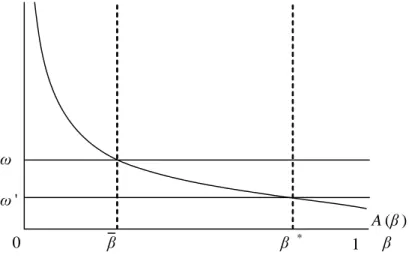
, the latecomer can grow in competition with the first movers.Figure 1 shows the conditions. Suppose that
β
is given, if the latecomer faces a cost ratio underω
, a rational latecomer does not invest due to the higher optimal price under the disadvantage of backwardness. In these circumstances, latecomers cannot enter the industry, because they do not make investments. On the other hand, facing a cost ratio overω
, the latecomers invest their assets and come into the industry.Figure 1: Growth Condition of the Latecomer
ω
A '(β ) A (β )
0 β 1 β
Next we examine a situation in which the disadvantage of backwardness is larger,
a
<
a
'
. This is easy to confirm, as is shown in the curveA
'
(
β
)
in the figure.A
(
β
)
witha
shifts diagonally upwards and rightwards toA
'
(
β
)
. In such circumstances, the new condition is worse than the past condition witha
.3.2.2. Ways to achieve growth under the disadvantage of backwardness
In the previous section, we compared the optimal price of the latecomer and that of the first mover under a value of
β
and a value ofω
. We here consider two kinds of change, taking into account conditions in the handset industry, and we then extract the growth possibilities for latecomers under the disadvantage of backwardness.First, we examine a situation in which
β
increases. In the case of the handset industry, we have found that the rise of the design houses and the launch of a new platform by MTK lowered the technological hurdles for local firms. The changes decrease the value of development ability shared by the first comers, therefore this means thatβ
increases. The changes are depicted in Figure 2. The new growth conditionω
'
is eased more than the past conditionω
by the shift fromβ
toβ
*
.Figure 2: Change in
β
and Possibilities for the Latecomers’ Growthω ω '
A (β )
0 β β *
1 β
Next, we take up a situation in which
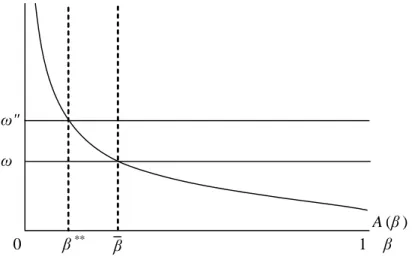
ω
increases. In the case of the handset industry, we have found that a successful firm, Lenovo, exploited the advantage of its understanding of the local market, and by so doing embarked on growth. The advantage that they are able to use naturally decreases the investment cost, therefore this means thatω
increases relatively. The changes are depicted in Figure 3. The new growth conditionω
'
'
is more effective than the past conditionω
, therefore the new condition can accept a smallerβ
*
*
<
β
.Figure 3: Change in
ω
and Possibilities for the Latecomers’ Growth ω" ω A (β ) 0 β** β 1 β4. Concluding Remarks
Let us first summarize the main points of our paper. We began by discussing the growth and stagnation of local firms in the China’s handset industry. The case study illustrates the following trends. Local firms have encountered a disadvantage of backwardness in development and design activity, and as a result, most firms have stagnated after an initial period of rapid growth. Successful firms, however, have realized growth by using outside firms and by employing their indigenous advantage of familiarity with the Chinese market. Therefore in the midst of significant disadvantage, local firms also can grow if they can take advantage of outside resources and in-house resources.
Second, we have proposed a simple model that allows us to understand the findings of the case study in theoretical terms. We have shown that, given that latecomers want to invest in activities that will allow them to emulate the first comers, it is not rational to do so if there is a significant disadvantage of backwardness in these homogeneous activities. Latecomers, however, can grow if they can lower the technological hurdles by using outside support and can also succeed by exploiting the heterogeneous assets embedded in the advantages they possess as Chinese firms familiar with the
Chinese market.
Our discussion allows us to conclude that latecomers' growth can be repressed by the disadvantage of backwardness, even though the local firms are growing as a whole. The discussion suggests that the timing of entry into the market is also a key for growth for firms in developing countries. On the other hand, we have shown that it is possible to achieve growth by methods different from those used by first movers. The nature of these methods depends on the existence of appropriate suppliers and on the presence of the indigenous advantages present in each country, and at the particular time in question. This implies that latecomers can follow diversified growth paths. Thus, as growth paths at country-level can be varied, so the growth paths at firm-level can also be extremely diverse.
References
Antràs, P. (2005). “Incomplete Contracts and the Product Cycle,” American Economic Review, 95 (4): pp. 1054-1073.
Gerschenkron, A. (1962). Economic Backwardness in Historical Perspective, Cambridge: Belknap Press of Harvard University Press.
Grossman, S. and O. Hart (1986). “The Costs and Benefits of Ownership,” Journal of Political
Economy, 94(4): pp.691-719.
Hart, O. and J. Moore (1990). “Property Rights and the Nature of the Firm,” Journal of Political
Economy, 98(6): pp.1119-58.
Imai, K. (2006). “A New Wave of Vertical Disintegration” (Japanese), in K. Imai and M. Kawakami (eds.).
Imai, K. and M. Kawakami (eds.) (2006). The Information Technology Equipment Industry in East
Asia, (Japanese) Chiba: Institute of Developing Economies.
M. Kawakami (eds.).
Kimura, K. (2007). “Product Development of China's Mobile Handset Manufactures” (Japanese), in N. Maruyama (ed.) China's Industrial Development and Technological Progress in the 11th
Five-Year Guidelines, Tokyo: Institute for International Trade and Investment.
Lou, Q. (ed.) (2003). Our Developing Mobile Handset Industry (Chinese), Beijing: Publishing House of Electronics Industry.
Marukawa, T. (2007). Modern China's Industries (Japanese), Tokyo: Chuokoron-Shinsha, Inc. Marukawa, T., M. Yasumoto, K. Imai, and J. Shiu (2006). “A Comparison of Mobile Handset
Industries Between Japan and China” (Japanese), Akamon Management Review, 5 (8): pp. 542-572.
Marukawa, T., M. Yasumoto, K. Imai, and J. Shiu (2007). “Change to Platform and Evolution of Division of Labor among Firms” (Japanese), MMRC Discussion Paper, No. 143.
Shanghai Caijing Daxue Ketizu (2006). China's Industrial Development Report 2006 (Chinese), Shanghai: Shanghai University of Finance & Economics Press.
Shiu, J. and K. Imai (2007). “Market Size and Industrial Upgrading” (Japanese), in K. Imai (ed.)