On
Gigantic Pairs of Minimal Clones
fffffl
$\overline{\pi}$(Machida,
$\mathrm{H}\mathrm{a}\mathrm{i}\mathrm{i}\mathrm{m}\mathrm{e}$
)
$*\mathrm{a}\mathrm{n}\mathrm{d}$Ivo
G.
$\mathrm{R}\mathrm{o}\mathrm{s}\mathrm{e}\mathrm{n}\mathrm{b}\mathrm{e}\Gamma \mathrm{g}\dagger$ $*\mathrm{H}\mathrm{i}\mathrm{t}\mathrm{o}\mathrm{t}\mathrm{S}\mathrm{u}\mathrm{b}\mathrm{a}\mathrm{S}\mathrm{h}\mathrm{i}$University, \daggerUniversit\’edeMontr\’eal1
Introduction
and Preliminary
Observations
In this paperwe deal with
some
problem fromthe ”clone theory”,which standsas araeearch areainmultiplevalued logic and universal algebra. Roughly speaking, a cloneis aset ofoperations
(func-tions) which isclosed under composition.$\uparrow 1\mathrm{A}\mathrm{s}$ an
introduction to ourproblem, onemay describe the
motivation of the problem inverysimpleand elementarywayasfollows:
$n$
Is it possible to generahize the set of operations {NOT,
OR}
on the baseset $\{0,1\}$ toa set ofoperationsonthebaseset $\{0,1, \ldots,k-1\}(k\geq 2)\nabla$ ”
This iscertainly simple, but istoosimple andalmostnothing is conveyedfrom this statement. In
order to statethe problemmoreclearlyand definitely,weextract the following propertiesfromtheset
{NOT,
OR}.
(i)
{NOT}
generatesaminimal clone$\dagger$.
(ii)
{OR}
generates aminimalclone.(iii)
{NOT,
OR}
iscomplete\dagger ($i.e.$, generates all theoperations).Ourproblemasks ifthese propertiescanbegeneralizedinto $k$-valued case.
Problem: Doesthere existapairof operations$f,g$having the above three properties(i), (\"u) and
(i\"u),in placeofNOTand OR, forarbitrary$k\geq 2$?
We shall call thisproblmSzab\’o’sproblem namedafterthefirst personwhotook upthe problem.
Now,weshallfix$k\geq 2$and set$k=\{0,1, \ldots,k-1\}$
.
Lettwo operations$f(x_{1}, \ldots,X_{m}),g(x_{1}, \ldots,x_{n})$on$k$satispthe three properties (i), (ii) and (i\"u),that is,
(i) $[f]$ is aminimal clone.
(ii) $[g]$ isaminimalclone.
(iii) $[f,g]=O_{k}$ ($=\mathrm{t}\mathrm{h}\mathrm{e}$setof alloperationson $k$)$\dagger$
.
Here,for a set $S$of operations, $[S]^{\mathrm{f}}$ denotes theset ofall operations whichare generated by$S$
.
Moreover,we
assume
that both $f$and$g$dependon
everyvariable, $ie$.
$f$isanessetiallym-variableoperation and$g$isanessentiallyn–variable operation.
A pair of operations $(f,g)$ which satisfies the aboveconditions (i), (\"u) and (iii) shall be called a
gigantic pair $\mathrm{f}$
of mininaloperations.
In the following,
some
introductoryobservationsaregivenontheconditions forapair $(f,g)$ tobea
gigantic pair.Claim 1
:
If$f(a, \ldots , a)=a$and$g(a, \ldots,a)=a$hold forsome$a$$\in \mathrm{k},$ $[f,g]$ isnot complete.This is immediate from the factthat $f(a, \ldots,a)=a$and$g(a, \ldots,a)=a$ imply$h(a, \ldots,a)=a$for
anyoperation$h$whichis obtainedby compositionsof$f$and$g$
.
Clain 2 : If$m\geq 2$ and $[f]$ is aminimal clone, $f(x, \ldots,x)=x$ forevery$x\in k$
.
(Suchoperation $f$iscalled idempotent $\mathrm{f}.$
) Thesame istrue for$g$,ofcourse.
Thisisbecause if$f(a, \ldots,a)=b(a\neq b)$ forsome$a,b,$ $[h]\subset[f]$holdsfor unaryoperation$h$defined
by$h(x)=f(X, \ldots , x)$and $[f]$ cannot beaminimal clone.
According to Claims 1 and 2, at least one operation $f$ or $g$ must be unary operation. On the
other hand, the condition (i\"u) clearly requires that at least one operation must notbeunary. These
considerations lead tothefollowing.
Claim 3
:
Let $m\leq n$.
Then $f$isa unaryoperation $(m=1)$ and$g$isan idempotentoperation with2ormorevariables$(n\geq 2)$
.
The following fact characterizingaunaryoperationwhichgeneratesaminimal cloneis well-known
andeasyto$\mathrm{v}\mathrm{e}\mathrm{r}\mathrm{i}\mathfrak{h}\Gamma$
.
Claim 4
:
Supposea unaryoperation $f$ isnot the identity operation. $[f]$ isaminimal clone if andonlyif the following (i) or (\"u) holds.
(1) $f$isnot surjective and the restrictionof$f$to Image$(f)$ is the identity operation onImage$(f)$
.
(2) $f$ isapermutationof prime order.
Aswehaveseen that$g$isanidempotent operation, $f$must beanoperationoftype (2) in Claim 4
in ordertomake the condition $(‘\dot{\mathrm{u}}\mathrm{i})$ hold. Moreover, one canassert,w.l.o.g., that
$f=(01\ldots p-1)(pp+1\ldots 2p-1)\ldots((\ell-1)p\ldots\ell p-1)$
where$k=\ell p$
.
Duetothesimilar argumentwith Claim 1wehave:
Claim 5
:
If$f(S)\subseteq S$and$g(S, \ldots,S)\subseteq S$ forsomeproper subset $S\subset k,$ $[f,g]$ is notcomplete.Thus, when $f$isthe operationgiven above and$\ell>1,$ $g$must beanoperationwhich$\mathrm{s}\mathrm{a}\mathrm{t}\mathrm{i}\mathrm{s}\mathfrak{g}\Gamma,$
$e.g.$, $g(\{0,1, \ldots,p-1\}, \ldots, \{0,1, \ldots,p-1\})\not\subset\{0,1, \ldots,p-1\}$
.
So far, what we have discussed is merely thevery basic properties that operations $f$and $g$must
$\mathrm{s}\mathrm{a}\mathrm{t}\mathrm{i}_{\mathrm{S}}\Phi$
.
Theseobservationsarethefirststepofourstudy. Byextendingthe considerationsnoredeeply,wehave obtainedthefollowingresults whichwill be statedin detail inSection3.
(1) Weobtainedanecessary and sufficientconditionforapairofoperations $(f,g)$ to beagigantic
pair. (Theorem 3.1)
(2) We verifiedthat agiganticpairreallyexists forevery$k\neq 2^{t}(t>1)$by constructing such pairs.
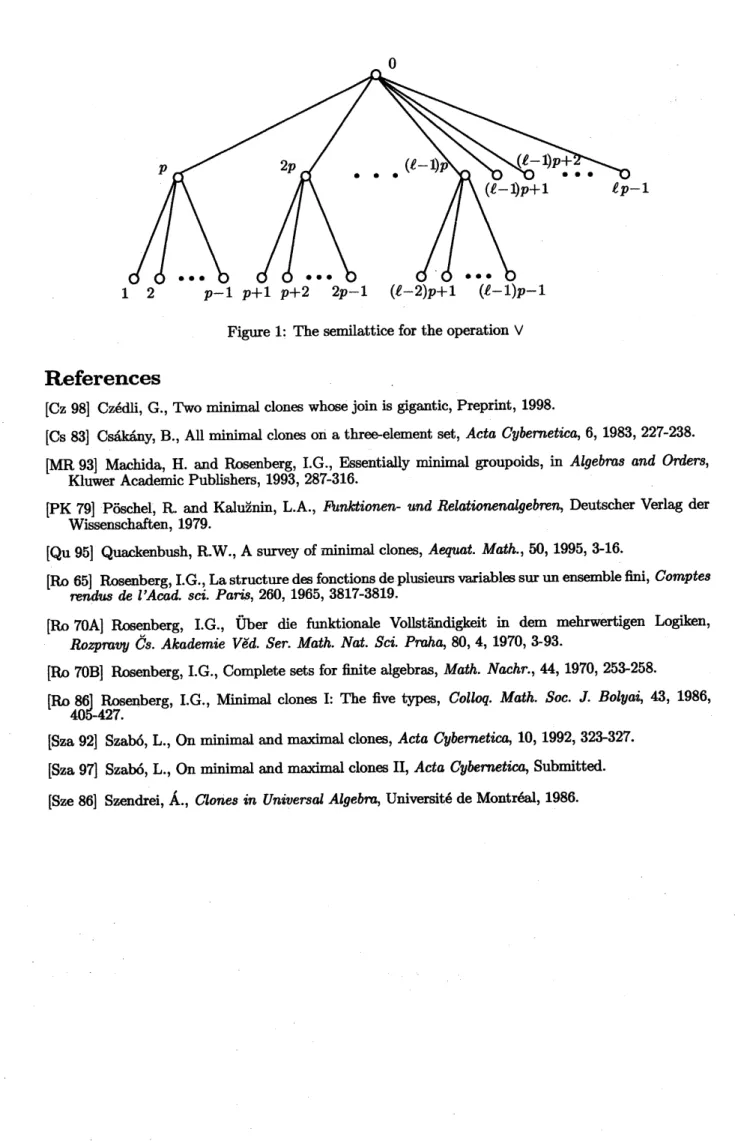
(Theorem3.3)In ourconstruction$g$isthe joinoperator corraepondin$\mathrm{g}$to
some
semilattice $\mathrm{f}$.
(Fig. 1)The reader is invitedto$\mathrm{v}\mathrm{e}\mathrm{r}\mathrm{i}\Psi$ that thepremissin Claim
5
doesnot hold forthis operation$g$and the
above operation $f$
.
Inthefollowing,dueto the lackof space,weshallgive only definitions andtheorems,but (almost)
noproofs.
2
Definitions
Let$\mathcal{O}_{k}^{(n)}$ be the set of alln-axyoperationsfrom $k^{n}$ into$k$andlet $o_{k}(=O_{A})= \bigcup_{n=1}^{\infty}o^{(n}k)$
.
Let$J_{k}$ befor arbitrary $(x_{1}, \ldots,x_{n})$ in $k^{n}$
.
An operation $f\in O^{(n)}$ is idempotentif $f(x, \ldots,x)\approx x$
.
(Here and in the sequel, $\approx$ denotes anidentityover $k,$ $i.e.,$ $f(x, \ldots,x)\approx x$means $f(x, \ldots,x)=x$ for all$x\in k.$)
Deflnition 2. 1 A subset$C$
of
$O_{k}$ is $a$clone on$k$if
(i) $C$ contains$J_{k}$ and(ii) $C$ is closed under(functional) composition.
Definition 2. 2 Fora subset$S$
of
$\mathcal{O}_{k}$, the donegenerated by$S$ isdefined
to be the smallest donecontainingS. It is denoted by $[S].$ A set $S$ iscomplete
if
$[S]=\mathcal{O}_{k}$, i.e., every operation in$\mathcal{O}_{k}$ canbe obtainedby composing operations in$S\cup J_{k}$
.
Definition 2.3 A clone $C$ on$k$ is $a$minimal clone
if
(i) $C\neq J_{k}$ and (\"u) $J_{k}\subset C’\subseteq C$ implies$C’=C$
for
any done$C’$ on$k$.Definition 2. 4 An operation $f$ on$k$ is minimal
if
(i) it generates a minimal clone and (\"u) everyoperation
from
$[f]$ whose arity is smallerthanthe antyof
$f$ is aprojection.Theorem 2. 1 [$Ro\mathit{8}\emptyset$ Every minimal opevation belongs to one
of
thefollouringfive
types:1) Unary operations $f$ ($1.\mathrm{e}.$, selfinaps
of
$k$) such that either (i) $f^{2}(=f\circ f)=f$ or (ii) $f$ is apemutation
of
prime order$p(1.\mathrm{e}., f^{p}=id)$.
2)Idempotent binary opemtions; i.e., $f\in O^{(2)}$ such that$f(x,x)\approx x$.
3)Majority operations; i.e., $f\in \mathcal{O}^{\langle 3)}$ such that$f(x,x,y)\approx f(x,y,x)\approx f(y,x,x)\approx x$
.
4) Semiprojections (or quasiprvjections); i.e., $f\in \mathcal{O}^{\langle n)}(3\leq n\leq k)$ such that there enists$i(1\leq$
$i\leq n)\mathit{8}atishingf(a1, \ldots , a_{n})=a_{i}$whenever$a_{1},$$\ldots,a_{n}\in k$ are notpairurise distinct.
5)
If
$k=2^{m}$, the temaryoperations$f(x,y, z)\approx x+y+z$ where$<k;+>\dot{\epsilon}s$an$elementa\eta$2-gmup(1.$\mathrm{e}.$, the additive grvup
of
an$m$-dimensionalvector space over $GF(2)$).Definition 2. 5 A pair $(f,g)$
of
minimd operations is calledgiganticif
$\{f,g\}$ is complete. $(i.e.$,
$[f,g]=\mathcal{O}.)$
The$\dot{\mathrm{f}}\mathrm{o}$
llowing terminology isfromuniversalalgebra.
Definition 2. 6 A
$=<A;F>is$
analgebraif
$A$ is a set and $F$ is a setof
finitary operationsdefined
overand taking values inA. When$F=\{f_{1}, \ldots, f_{t}\}$, A is also expressed$as<A;f_{1},$$\ldots,f_{t}>$.
Foran dgebraA
$=<A;F>$
, a subset $B$of
A $i\mathit{8}$ $a$subuniverseof
Aif
$B$ is closed under$eve\eta$
opemtion$f$ in F. A subuniverse$B$ $of<A;F>is$ $a$proper subuniverse
if
$\phi\subset B\subset A$.
For an algebra A
$=<A;F>,$
$\theta$ is$a$ congruence
of
Aif
$\theta$ is an equivdence relation on $A$and
satisfies
the property thatfor
$eve\eta$ operation $f$ in $F$,if
$f$ is $n- a\eta,$ $x_{1}\theta y_{1},$$\ldots,xn\theta yn$ implies$f(x_{1,\ldots,n}X)\theta f(y_{1}, \ldots , y_{n})$
for
all$X_{1,\ldots,y_{1},\ldots,yn}X_{n},\in A.$ A congruence9of
A $is$properif
$\theta$ isnot a $t\gamma\dot{\eta}\dot{m}al$equivalence relation. An algebra A $is$simple
if
ithasnoprvpercongruences.Moreover,
for
an algebra A$=<A;F>,$
$\varphi$ is anautomorphismof
Aif
$\varphi$ is apermutationon$A$ and
satisfies
theproperty thatfor
every operation $f$ in$F$,if
$f$ isn-ary, $f(\varphi(x_{1}), \ldots,\varphi(X_{n}))=$$\varphi(f(x_{1}, \ldots,x_{n}))$
for
all$x_{1},$$\ldots$,$x_{n}\in A.$ The setof
all automorphismsof
A is denoted by Aut A. $An$audomorphism$\varphi$ is proper
if
$\varphi$ isnot anidentitypemutation$id_{A}$of
$A$.
FinaUy in this subsection,wesupplysomedefinitions conceming relations.
Definition2. 7 Foraset$A$, an$h$-ary relationon$A$isa subset
of
the Cartesianproduct$A^{h}$.
Forann-aryoperation$f$ in$O_{A}$ andan$h- a\eta$relation$\rho$on$A,$ $f$is saidtopreserve$\rho$
if
$(x_{1\mathrm{j}’ j,\ldots,j}x_{2}xh)\in\rho$for
every$j=1,2,$$\ldots,n$ implies$(f(x_{11,12}x, \ldots,X_{1n}), \ldots,f(xh1,xh2, \ldots,xhn))\in\rho$.
Deflnition 2.8 Let$k=h^{m}$ where $h>\mathit{2}$ and$m\geq 1.$ A set$T=\{\theta_{1}, \ldots,\theta_{m}\}$
of
$e_{\Psi}4ivdence$ relationson$k$ is an$h$-regular system
if
(i) each block(equivalence dass)of
every$\theta_{i}$ has$h$ elements and(\"u)if
B.
$\dot{u}$ a blockof
$\theta$.
for
all$i=1,$$\ldots,m$ then $|B_{1}\cap\cdots\cap B_{m}|\geq 1$.
Nezt, the relation detemined by$T$ is the relation$\lambda_{T}$
defined
as the setof
all$(a_{1}, \ldots,a_{h})\in k^{h}$ such thatfor
each$i=1,$$\ldots,m$ it hol&
3
Main Results
Definition 3. 1 For a$di_{\dot{\mathrm{W}}Sor}pofk$ denoteby$F_{\mathrm{p}}$the set
of
allpemutationsof
$k$ unth$\ell:=k/p$cydesof
length$p$.
Let$f\in F_{p}$ have cydes$C_{0},$$\ldots,$$C_{t-1}$
.
Anequivdence relation$\theta$ on$k$ istransversal to$f$
if
there nist 1) anequivalencerelation$\lambda$on
$\ell$distinct
fivm
theleast equivdence relation on$\ell$ and2) an element$c_{i}\in C_{i}$for
each$i\in\ell$such that$\theta=\{(f^{m}(c_{\mathrm{t}}), fm(C_{j}))|i\lambda j, 0\leq m\leq p-1\}$
.
Apemutation$\psi ofk$is orthogonal to$f$
if
1)$\psi\in F_{q}$for
someprime$di_{\dot{\mathfrak{R}}SO}fqofk,$$2$) $f\circ\psi=\psi\circ f$and 3)
if
$q\neq p$ then each cydeof
$\psi$ meets everyCi
in at mosta
singleton.Now,wecharacterize giganticpairs.
Theorem 3. 1 Let$f\in O^{(m)}$ and$g\in O^{\{n)}$ where$m\leq n$ andlet$\mathrm{A}:=<k;g>$
.
Then the pair$(f,g)$$i\mathit{8}$gigantic
if
and onlyif
(i) $m=1$ and$f\in F_{\mathrm{p}}$
for
someprime divisor$p$of
$k$ (urith cycles$c_{0},$$\ldots,c_{\ell_{-}1}$ ),(ii) $n>1$ and$g$ is minimd,
(i\"u) $C_{1}.\cup\cdots\cup c_{:_{h}}$ is notaprvper subuniverse
of
Afor
any$0\leq i_{1}<\cdots<i_{h}\leq\ell-1$,(iv) Nocongruence
of
A is tmnsversal to$f$,(v) Noautomorphism
of
A is orthogondto $f$,(vi) Let$k=h^{m}$ where$h>2$ and$m>1$
.
If
there nist.$\cdot$ a) a pemutation$\varphi$
of
$m$of
order1 or$p$ andpermutations$f_{0},$$\ldots,f_{m}-1$
of
$h$ suchthat$\alpha)f_{d_{0}}fd1\ldots fd_{\mathrm{p}-1}=id_{h}$
for
eachcyde $(d_{0}\ldots d_{\mathrm{p}-1})$of
$\varphi$,$\beta)$
for
everyfixed
point$i$of
$\varphi$ the permutation$f_{i}$ is
of
orvier 1 or$p$ and$\gamma)$
for
some
fi.
$xed$point$j$of
$\varphi$ the permutation$f_{\mathrm{j}}$ is$fi_{Xed- p}oint- fiu$ andof
oder$p$
and b) a bijection
$\psi:x\mapsto x=(\wedge x^{\mathrm{t}0)\ldots,\mathrm{t})},Xm-1)$
of
$k$ onto$h^{m}$ such thatfor
$dlx\in k$$\overline{f(X})=(f_{0}(x)\mathrm{t}\varphi(0)),$ $\ldots,$
$fm-1(X)\mathrm{t}\varphi(m-1)))$,
then$g$ does notpreserve the h-ary relation
{
$(a_{1},$$\ldots,a_{h})\in k^{h}|\#\{a_{1}^{\mathrm{t}},.,ai)..(p*)\}<p-1$ for every $i=0,$$\ldots,m-1$}.
(vii) a) Let$k=p^{m},$ $\mathrm{b}$) let$x\mapsto x\wedge be$ a bijection
fiom
$k$ onto$p^{m}$ (the latter considered as thesetof
$dlm\cross 1$ matrices
over
$p$), $\mathrm{c}$) letfor
$dlx\in k$$\overline{f(x}\rangle=A^{\wedge}X+B$
where $A=P^{-1}JP,$ $B=P^{-1}B’$ with $P$ a nonsingular (over $GF(p)$) $m\cross mmat\gamma\dot{\tau}x$ over$p$,
$J$ the $m\cross mJo7danmat\dot{m}$ urith
diagon.al
$(1, \ldots, 1)$ and blocksof
sizes $\ell_{1},$$\ldots,\ell_{h}$ and $B’=$$(b_{1}, \ldots,b_{m})\in p^{m}$ is$\mathit{8}uch$ that
$(I+J+J^{2\mathrm{p}}+\cdots+J-1)B’=o_{m}\mathrm{x}1$,
and$b_{\ell_{1}+\cdots+\ell_{u}}\neq 0$
for
some
$1\leq u\leq h$.
Then$g$ doesnotpreserve the quaternary relation $\{(_{X},y,z,t)\in k^{4}|t=x\ominus y\oplus z\wedge\}\wedge\wedge\wedge$.
The proofof Theorem3.1heavily reliesonthefouowingtheorem.
Theorem 3.2 [Ro $70\mathrm{B}$] For a set $B$
of
surjective operations containing an essentidlymore
thanunaryoperation, the set$Bi\mathit{8}$ complete
if
and oilyif
$(A)<k;B>is$simple andhas
no
prvpersubuniverseandnoprvper automorphism,$(B)$
If
$k=p^{m}$for
aprime$p$ and$m\geq 1$ and$if<k;+>is$
anelementaw
abelian$p$-group then some$b\in B$ does not preservethe quaternary relation
$\{(x,y,Z,x-y+z)|x,y,z\in k\}$,
and
$(C)$
If
$k=h^{m}$ urith $h>2$ and$m>1$ and$T$ is an $h$-regudarsystem on$k$ then some $b\in B$ does notpreserve$\lambda_{T}$
.
Example. Let $k=2$ (Boolean case). Thereare4nonunaryminimaloperations, namely, $\vee,$$\wedge,$ $d$and
$r$, whereV and $\wedge$ are ORand AND, $d(x,y,z)\approx$($x$A
$y$) ${ }$($y$A$z$) $\vee(z\wedge x)$ and$r(x,y, z)\approx x\oplus y\oplus z$
.
With theunarynon-identityoperation$\neg$ (NOT),twopairs $(\neg,\vee)$ and$(\neg,\wedge)$ areshowntobegigantic.
These arethe onlygiganticpairsfor $k=2$.
Next,we statethat a giganticpair reallyexistsfor every$k$whichis not apower of 2.
Theorem 3.3 For$eve\eta k$ where$k\neq 2^{t}(t>1)$, there enists agigantic pair.
Proof If$k$is
a
prime, theclaimcanbeverified for the$\mathrm{f}\mathrm{o}\mathrm{u}_{0}\mathrm{W}\mathrm{i}\mathrm{n}\mathrm{g}$twooperations: Define$f(x):\approx x$eland$g(x,y)$ such that$g(x,y)=x$if$x=y$and $g(x,y)=k-1$ if$x\neq y$forall$x,y\in k$
.
Itiseasy to seethat$g$isminimal; in fact,$g$is a$\mathrm{s}\mathfrak{W}\mathrm{l}\mathrm{i}\mathrm{l}\mathrm{a}\mathrm{t}\mathrm{t}\mathrm{i}\mathrm{c}\mathrm{e}$join whose order is$0\leq k-1,$
$\ldots,$$k-\mathit{2}\leq k-1$
.
Supposethat $k$isacomposite number. Let
$p$denote the greatestprimedivisor of$k$and let$\ell:=k/p$
where$\ell>1$
.
Thefollowingunaryoperation$f$ and binaryoperation$g$on $k$sufficefor ourpurpose.
Wedefine$f$bysetting
$f(ip+j):=\{$ $ip+j+1$ $i\in\ell,$ $0\leq j<p-1$,
$ip$ $i\in\ell,$ $j=p-1$
.
Thus, $f$isexpressedin thecyclicnotation as
$f=(01\cdots p-1)(pp+1\cdots 2p-1)\cdots((\ell-1)p(\ell-1)p+1\cdots k-1)$
.
An algebra$\mathrm{A}=<k;>\mathrm{i}\mathrm{s}$ asemilattice if the binaryoperator${ }$isassociative,commutativeand
idempotent ($\dot{u}e.$,it satisfies
$x(y\vee z)=(x\vee y)\vee Z,$ $x\vee y=y\vee X$ and $x\vee x=x$
for all$x,y\in k$). Thebinary relation $\leq \mathrm{o}\mathrm{n}k$corresponding to A is definedbysetting$a\leq b$whenever
$a$$\vee b=b$
.
Itis well-known that $\leq \mathrm{i}\mathrm{s}$ apartial orderin which $a\vee b$is the joinof$a$and$b$.
Conversely,anorder $\leq \mathrm{o}\mathrm{n}k$in which eachpairhas ajoin determinesasemilattice.
Let $g$bethefollowing semilatticeoperatorV on$k$
.
Forevery$x,$ $y$in$k$set$x\vee y=\{$
$x$ $x=y$,
$(i+1)p$ $x=ip+j,$ $y=ip+j’$
$(0\leq i\leq$
.
$\ell-2,1\leq j,$ $j’\leq p-1,$ $j\neq j’\rangle$,$0$ otherwise.
TheHasse diagramoftheorder corresponding to thesemilattice$<k;>\mathrm{i}\mathrm{s}$in Fig. 1. Notice that it
is
a
tree.Figure 1: Thesemilattice for the operation V
References
[Cz 98] Cz\’edli, G., Twominimalcloneswhosejoin is gigantic,Preprint, 1998.
[Cs 83] Cs\’ak\’any, B., All ninimal cloneson athree-element set, Acta Cybemetica, 6, 1983, 227-238.
[MR 93] Machida, H. and Rosenberg, I.G., Essentially minimal groupoids, in Algebras and Otder8,
Kluwer AcademicPublishers, 1993,
287-316.
[PK 79] P\"oschel, R. and $\mathrm{K}\mathrm{a}\mathrm{l}\mathrm{u}\dot{\mathrm{z}}\dot{\mathrm{m}}\mathrm{n},$ L.A., hnktionen- und Relationenalgebren, Deutscher Verlag der
Wissenschaften, 1979.
[Qu 95] Quackenbush,R.W.,A survey ofYllinimalclones, Aequat. Math., 50, 1995, 3-16.
[Ro 65] Rosenberg, I.G.,La structuredesfonctionsde plusieursvariablessurun ensemblefini, Comptes
rendus de l’Acad. sci. Paris, 260, 1965,3817-3819.
[Ro 70A] Rosenberg, I.G.,
\"Uber
die fimktionale Voust\"andigkeit in dem mehrwertigen Logiken,Rozpmvy $\dot{C}s$
.
Akademie $V\dot{e}d$.
Ser. Math. Nat. Sci. Pmha, 80, 4, 1970, 3-93.[Ro 70B] Rosenberg, I.G., Completesets for finite algebras, Math. Nachr., 44, 1970,
253-258.
$\iota \mathrm{R}_{1}86404_{-}42\mathrm{R}\mathrm{o}\mathrm{e}\mathrm{e}\mathrm{n}\mathrm{b}\mathrm{e}7.\mathrm{r}\mathrm{g},$I.G., Minimal clones I: The five types, Colloq. Math. Soc.
J. Bolyai, 43, 1986,
[Sza 92] Szab\’o, L.,Onminimal and maximalclones, Acta Cybemetica, 10, 1992,
323-327.
[Sza 97] Szatxi,L., Onninimal andmaximalclones II, Acta Cybemetica, Submitted.