Title
Web-based Survey Report on Doctoral Degree Qualification: Eligibility for Admission and Graduation Criteria
Author(s) VESTERGAARD, Mun'delanji C.
Citation CGEIアニュアルレポート 2011: 47-54
Issue Date 2012-07
Type Research Paper
Text version publisher
URL http://hdl.handle.net/10119/10698 Rights
Description
Ⅱ.活動報告 / Center Activities, (7) 海外におけ る博士学位修了基準調査 / Survey of Criteria for Doctoral Requirement
<Report>
Web-based Survey Report on Doctoral Degree Qualification:
Eligibility for Admission and Graduation Criteria
Mun’delanji C. VESTERGAARD
(Research Associate Professor, Center for Graduate Education Initiative)
博 士 課 程 の 入 学 及 び 修 了 の 適 正 基 準 に 関 す る ウ ェ ブ 調 査
フ ェ ス タ ー ガ ー ド ・ キ ャ サ リ ン ・ ム ン デ ラ ン ジ
( 大 学 院 教 育 イ ニ シ ア テ ィ ブ セ ン タ ー 特 任 准 教 授 )
Japanese Abstract: 大 学 院 教 育 イ ニ シ ア テ ィ ブ セ ン タ ー で は , 優 秀 な 学 生 の 育 成 の た め に ,方 法 論 ,研 究 の 教 育 ,教 育 の 評 価 基 準 を 改 善 し て い く こ と を 目 標 と し て い る 。 我 々 は 科 学 的 な 客 観 的 ,透 明 性 が 高 く ,質 保 証 さ れ た 博 士 の 学 位 授 与 の 基 準 の 開 発 に 向 け て 科 学 的 な ア プ ロ ー チ を 採 っ て い る 。セ ン タ ー で は 国 内 外 の 大 学 院 機 関 か ら , 博 士 課 程 の 入 学 及 び 修 了 の 適 正 基 準 に つ い て 関 連 情 報 を 収 集 し て い る 。 本 調 査 研 究 は 2 年 目 で あ る 。1 年 目 に は 主 に ア ン ケ ー ト ベ ー ス の 調 査 を 実 施 し ,CGEI ア ニ ュ ー ア ル レ ポ ー ト 2010 に て 予 備 調 査 結 果 を 報 告 し た 。 本 報 告 で は , ア フ リ カ 15 ヶ 国 と 中 東 13 ヶ 国 に お け る 32 の 大 学 院 機 関 の ウ ェ ブ 調 査 よ り 得 ら れ た 知 見 に つ い て 述 べ る 。 日 本 語 訳 : 崔 舜 星 ( 大 学 院 教 育 イ ニ シ ア テ ィ ブ セ ン タ ー 特 任 助 教 )[Key Words: Doctoral degree, Eligibility for admission, Graduation criteria, Web-based survey, Quality assurance, Excellence]
Abstract
At the Centre for Graduate Education Initiative (CGEI) our goals include improvement of methodologies, research instructions, and assessment criteria for graduate education in order to cultivate students of high caliber. Towards the later, we are conducting a scientific-based approach to develop a criteria for doctoral qualification that is objective, transparent and quality- assured. We are gathering relevant information from both domestic and overseas graduate institutions on eligibility for admission and graduation criteria for doctoral programs. This survey is in its second year. During the first year of study, we conducted mainly a questionnaire-based survey, and we reported the preliminary findings in the CGEI 2010 Annual Report. Herein, we report on findings obtained using a web-based survey from 32 graduate institutions in 15 African and 13 Middle Eastern countries.
1 Introduction
This work is a follow-up on a questionnaire-based survey that we conducted a year ago. The summary preliminary findings of that survey are reported in the CGEI Annual Report of 2010 [1]. Please refer to the Annual report for the motivation behind this study [1]. With the questionnaire-based survey, there were a couple of short-comings. The most crucial was that the questionnaire-based survey was conducted mainly at academic meetings, in person, by members of CGEI. We relied on members of faculty to ask their colleagues when away on business trips such as conferences. As such, most of the information obtained was from a narrower geographical range _mainly Europe, and USA_ than we wanted to cover. Since we wanted to survey as many regions of the world as possible, the web-based survey was the next inevitable step forward. We, are now conducting this survey in regions across all continents, and aiming to cover at least 200 graduate institutions. So far, we have surveyed ~ 50 graduate institutions. In each institution, we have surveyed two different fields. In addition to the criteria for doctoral degree qualification that we set out to map, we have also surveyed criteria for eligibility for admission into the institutions. More, through the survey we have identified unique graduate characteristics/activities that could be adapted for enriching and advancing the quality of education for students at JAIST. Some of the findings were presented to JAIST members during CGEI support board lecture ‘Transferable Skills and Qualities’ in April, 2012. At the end of this report, we will tabulate the summary of some of these features (Table 2).
2 Methodology
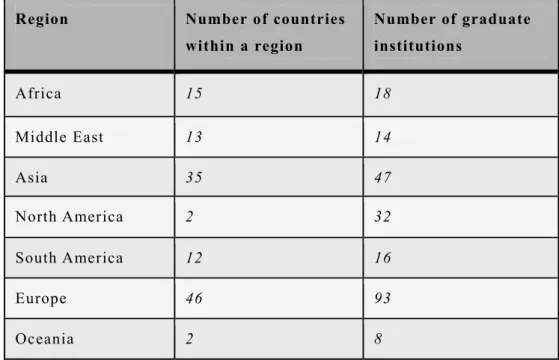
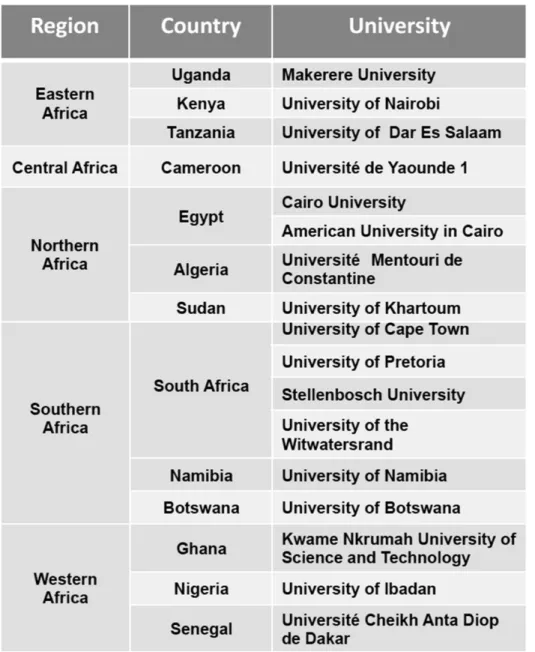
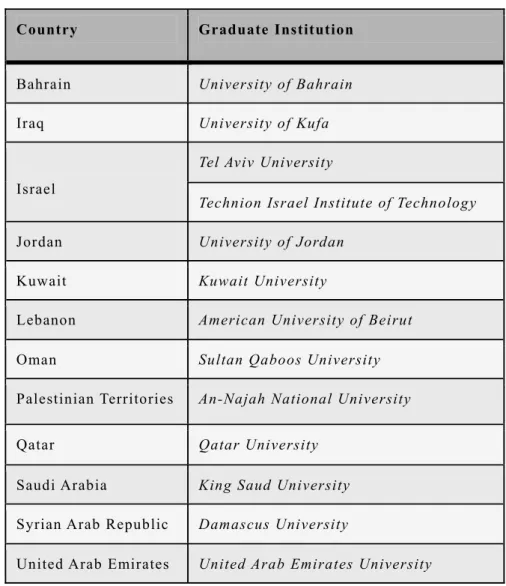
We used a web-based survey to conduct the research. We classified areas of study into seven regions as shown in Table 1. From each region, a few countries were selected. Top-ranked graduate institutions were then chosen from each selected country. All in all, 217 graduate institutions were selected. In this report, we present complete data obtained from two regions (Africa and Middle East). These findings were presented at the International conference: Society for Research into Higher Education Conference (NR strand) [2]. (Please refer to Tables 3 and 4 at the end of the report, for details on which institutions were surveyed in which country). Since then, we have conducted a survey of 10 graduate institutions in Japan, and also in United Kingdom, USA, and some parts of Asia. The survey is on-going. We hope to submit our most recent findings for consideration for oral presentation at an international conference this year.
Table 1. Classification of regions, the number of countries and graduate institutions selected for the study
Region Number of countries within a region Number of graduate institutions Africa 15 18 Middle East 13 14 Asia 35 47 North America 2 32 South America 12 16 Europe 46 93 Oceania 2 8 3 Results
In this report, we have presented the most common criteria for admission and graduation requirements. We have also attempted to highlight a few issues that stand out such as proficiency in English. Although in some institutions there are profound differences between disciplines, we have not presented these differences due to space limitation. We hope to cover these differences in a separate report.
3.1 Eligibility for admission
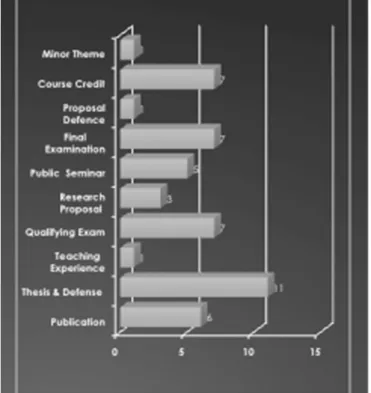
In general, the admission criteria in the African institutions and the Middle Eastern institutions were similar. These included (i) proficiency in English, with most of the institutions using TOEIC or TOEFL scores as the yard stick; (ii) passing an interview as well as an entrance exam; (iii) submission of an acceptable draft research proposal for PhD research; (iv ) the candidate to hold at least a BSc. (Hon) degree, although many required a Masters degree. Approximately 66% of the African institutions only considered students with a Masters degree. This figure was much higher (92%) for Middle Eastern universities. In some Middle Eastern institutions (e.g., Tel Aviv University, Hebrew is the main language for instruction); proficiency in the Hebrew language was also a requirement for eligibility for admission. Figure 1 presents summary data of the eligibility criteria for Middle Eastern institutions.
Figure 1. Eligibility criteria for admission into PhD programs in some (14) Middle Eastern institutions. The list of these institutions can be seen in Table 4 in the supplementary section.
3.2 Criteria for doctoral degree qualification
Similar to eligibility criteria for admission, there were some common features in the two regions (Figures 2 and 3). One of the Middle Eastern universities has a minor theme as part of the criteria for qualification, similar to JAIST. The same institution also required their students to have a teaching experience. Of the 32 institutions surveyed, 28% of them required their PhD students to give public lecture(s)/seminar(s).
In 50% of the institutions in the Middle East, PhD candidates have to pass qualifying exams. Only 2 of the 18 institutions surveyed in Africa have qualifying examinations. In JAIST, there are no qualifying exams at the present time, although this may change. Currently there is a move by the Ministry of Education to introduce some form of qualifying exams in Japanese institutions.
Figure 3. Doctoral degree qualification criteria in some (14) Middle Eastern institutions. The list of these institutions can be seen in Table 4 in the supplementary section.
3.3 Some transferable activities that could be considered at JAIST
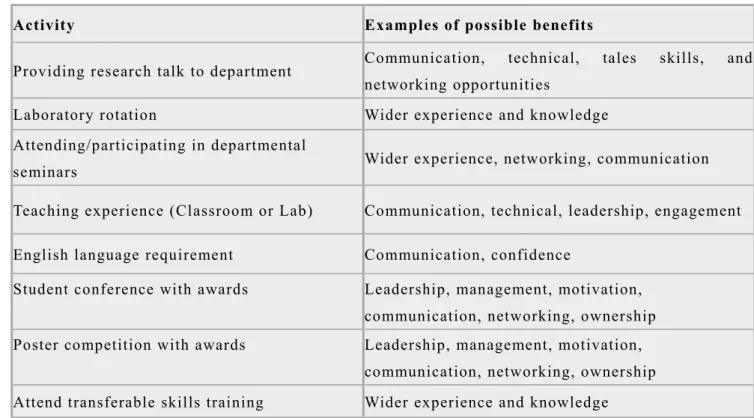
During the survey of the regions we have reported above, and also including some institutions in USA, UK, and Singapore, we identified some interesting special features in some of the institutes that could be easily adapted to fit in the JAIST education system in order to improve the quality of students graduating from JAIST, as well as their employability potential (Table 2). Some of these features are already in place in some of the Schools in JAIST, in some form or another. For example, in JAIST there is a sub theme project aimed to widen students knowledge and experience. This is in some way similar to what we identified in some institutions (eg., American University of Beirut, MIT, University of Oxford, Yale University, Harvard University) as laboratory rotation. Students are required to rotate between a number of laboratories for extended periods of time in order to broaden their scope, be exposed to various supervisors, and establish valuable connections. For example at Harvard, students have 2 to 4 laboratory rotations, each lasting at least 8 to 10 weeks. Another very important activity for students is teaching experience. This is one of the criteria for doctoral qualification at American University of Beirut, MIT, University of Oxford, Yale University and Harvard University. This officially-recognized experience confers the students an employment advantage over their counterparts who do not have such an experience, especially for academic positions. JAIST being a graduate only
institution does not have similar opportunities for its PhD students. Could semi-formal and officially recognized laboratory-based or section-based teaching be an answer for JAIST? In the School of Materials Science for example, these could include lectures on disposal of waste materials, some common laboratory instrumentation, clean-room usage & protocols, cell-culture cultivation and DNA PCR techniques. Simpler, yet effective activities could include institution-wide Poster competition with awards. To add extra experience in terms of ownership, management and leadership, students could organize these poster competitions themselves, with members of faculty playing the supportive roles and mentorship. Table 2 details some of this activities and their possible benefits.
Table 2. Some transferable activities that could be considered at JAIST
Activity Examples of possible benefits
Providing research talk to department Communication, technical, tales skills, and networking opportunities
Laboratory rotation Wider experience and knowledge Attending/participating in departmental
seminars Wider experience, networking, communication Teaching experience (Classroom or Lab) Communication, technical, leadership, engagement English language requirement Communication, confidence
Student conference with awards Leadership, management, motivation, communication, networking, ownership Poster competition with awards Leadership, management, motivation,
communication, networking, ownership Attend transferable skills training Wider experience and knowledge
4 Concluding Remarks
The survey is on-going and we continue to identify issues that can be adapted for implementation at JAIST for continual advancement of education and research. The survey will also form a reference point (database) for other institutions.
5 References
[1] C.M. Vestergaard, (2010). Criteria for doctoral degree qualification: A preliminary report, CGEI Annual Report, 1, 53-58.
7. Supplementary Information
Table 4. Classification of Middle Eastern regions, country and institutions
Country Graduate Institution
Bahrain University of Bahrain
Iraq University of Kufa
Israel
Tel Aviv University
Technion Israel Institute of Technology
Jordan University of Jordan
Kuwait Kuwait University
Lebanon American University of Beirut
Oman Sultan Qaboos University
Palestinian Territories An-Najah National University
Qatar Qatar University
Saudi Arabia King Saud University
Syrian Arab Republic Damascus University
United Arab Emirates United Arab Emirates University