Japan Advanced Institute of Science and Technology
JAIST Repository
https://dspace.jaist.ac.jp/Title
Error Resistant Lossless Data Compression with
Equal Length Coding using Fine Tuned Multiple
Label Mapping
Author(s)
Tervo, Valtteri; Fukawa, Kisho; Matsumoto, Tad
Citation
2012 IEEE International Conference on
Communications (ICC): 4707-4711
Issue Date
2012-06
Type
Conference Paper
Text version
author
URL
http://hdl.handle.net/10119/10890
Rights
This is the author's version of the work.
Copyright (C) 2012 IEEE. 2012 IEEE International
Conference on Communications (ICC), 2012,
4707-4711. Personal use of this material is permitted.
Permission from IEEE must be obtained for all
other uses, in any current or future media,
including reprinting/republishing this material
for advertising or promotional purposes, creating
new collective works, for resale or
redistribution to servers or lists, or reuse of
any copyrighted component of this work in other
works.
Error Resistant Lossless Data Compression with
Equal Length Coding using Fine Tuned Multiple
Label Mapping
Valtteri Tervo*+, K. Fukawa+, Tad Matsumoto*+
{
wade, tadashi.matsumoto}@ee.oulu.fi
*Centre for Wireless Communications, University of Oulu
P.O. Box 4500, 90014 University of Oulu, Finland.
+Japan Advanced Institute of Science and Technology
1-1 Asahi-Dai, Nomi, Ishikawa, 923-1292 Japan.
Abstract—Data inherently including memory can be com-pressed using either equal or variable length coding. This paper proposes a novel method to compress the data with memory by using equal length code words while maintaining the error correction capability. The main drawback of variable length coding (VLC) is that because of the boundary problem, it is very sensitive to errors, which results in many cases in long burst errors due to error propagation. However, VLC is optimal in the sense of minimizing the expected length of the codeword. To reduce the compression rate using equal length code, a technique called multiple label mapping (MLM) is employed in this paper. Furthermore, MLM is extended with a fine tuning block to achieve compression rates as close to the Shannon limit as possible. Simulation results for symbol error rate (SER) evaluation as well as EXIT analysis indicate that the proposed technique can achieve compression rates very close to the VLC performance while maintaining the error correction capability. Furthermore, it is shown that the SER performance of the proposed joint source-channel coding scheme is very close to the Shannon limit.
I. INTRODUCTION
Lossless source codes, e.g., Huffman codes [1] or arithmetic codes [2], can compress data very efficiently, and reach very close to the theoretical limit of the compression rate, i.e., the entropy of the source. However, Huffman and arithmetic codes utilizes the appearance probabilities of the symbols to be encoded, and thereby the code words have different lengths, depending on the appearance probabilities of the source symbols. The codes of this category is referred to as variable length entropy encoding. However, the main drawback of variable length coding (VLC) is that because of boundary problems, it is very sensitive to the bit errors happening in the channel, which results in many cases in long burst errors due to error propagation.
Shannon’s source-channel separation theorem states that as long as the entropy of the source is less than the channel
This research was carried out in the framework of the project Distributed Decision Making for Future Wireless Communication Systems (DIDES) which was funded by the Finnish Funding Agency for Technology and Innovation (TEKES). This work was also in part supported by the Japanese government funding program, Grant-in-Aid for Scientific Research (B), No. 23360170. This research has also been supported by the Nokia Foundation.
capacity, there exists a separable source and channel coding (SCC) scheme which allows transmission over the channel with an arbitrarily low probability of error. However, this theorem assumes that the source can be treated as a stationary stochastic process which satisfies the asymptotic equipartition property (AEP). Moreover, Shannon’s source compression limit assumes the use of infinitely long sequences.
The mobile access of multimedia data, such as video and audio, is one of the key applications in the current and future generation wireless communications. In such applications, source compression is usually performed using well estab-lished techniques, which, in order to achieve high compres-sion gains, often employ VLC. In delay- and/or complexity-constrained transmission scenarios, joint optimization of SCC techniques are often more advantageous than the classical separation based source and channel encoding techniques. Hence, joint SCC (JSCC) schemes has been a core issue during the past several decades [3], [4].
In many approaches to JSCC, the implicit residual source redundancy after source encoding is additionally used for error protection in the decoder. This is useful to reduce the bandwidth and latency for the overall transmission system because very powerful forward error correction coding (FEC), requiring heavy computational burden for decoding, is not necessary [5]. Hagenauer [3] proposes JSCC by combining the trellis diagrams of the source model and the channel code for Viterbi decoding. In [6], [7], residual redundancy of the source is used in JSCC by exploiting the memory structure of hidden Markov models (HMMs). Recently, a technique called
over-complete source-mapping is proposed for joint optimization
of iterative source and channel decoding (SCD) in [8]. VLC is employed on JSCC in [5], [9]. A combined utilization of JSCC and SCD for multiple correlated sources is investigated in [10]–[12].
Conventional source coding under a distortion constraint and channel coding under resource constraints of the chan-nels, such as power and/or spectrum availability, have long been considered as information-theoretic duals of each other, starting from Shannon’s 1959 paper [13]. In [14], an exact
characterization of the Shannon duality between data trans-mission and compression through Lagrange duality in convex optimization is provided. This suggests that excellent channel codes may also be excellent source codes. Garcia-Frias et al. proposes the use of punctured turbo codes for compression of binary sources in [15]. Since then, a lot of work has been conducted related to the utilization of channel codes in source compression. For example in [16]–[22] channel codes are applied in source compression by puncturing, i.e., eliminating bits after the channel encoder.
In this paper, a novel method to remove the error propaga-tion problem in source coding without imposing informapropaga-tion loss is proposed. The idea of multiple label mapping (MLM) [23] is extended by introducing a fine tuning (FT) block, which allows the proposed technique to achieve compression rates arbitrarily close to the limit. FT consists of variable nodes [24], which enable redundancy increment, and check nodes [24], which enable redundancy decrement. Furthermore, an accumulator (ACC), i.e., rate one recursive convolutional code [25] with polynomial 1/(1 + D), is employed before MLM to make the binary bit appearance probabilities equal. The bit appearance has to be equiprobable in order to produce entropy achieving equal length codes. In this paper, the combined block of ACC, FT and MLM is referred to as FT-MLM for notational convenience. Usually, entropy achieving source codes employ VLC, but in contrast to the previous work, FT-MLM uses equal length code words, and hence no code word boundary problem occurs. FT-MLM is actually a form of joint source-channel coding because it can tolerate and even correct errors by utilizing the memory structure of the source in the joint decoding process.
Determining the labeling map of MLM has a crucial role on the performance of the proposed scheme. Adaptive binary switching algorithm (ABSA) [26] is employed for finding the most suitable mapping rule for MLM. It utilizes binary switching algorithm (BSA) [27] with constraints on extrinsic mutual information provided by outer decoder representing the memory structure of the source. The outer decoder in this paper is BCJR decoder [28] of the source, which allows the exploitation of the correlation of a Markov source.
The rest of this paper is organized as follows. The whole system model as well as detailed description of FT-MLM is presented in Section II. In Section III, a cost function for ABSA is derived for finding the most suitable mapping rule for MLM. Numerical results are given in Section IV. Section V concludes the paper with some concluding statements.
II. SYSTEM MODEL
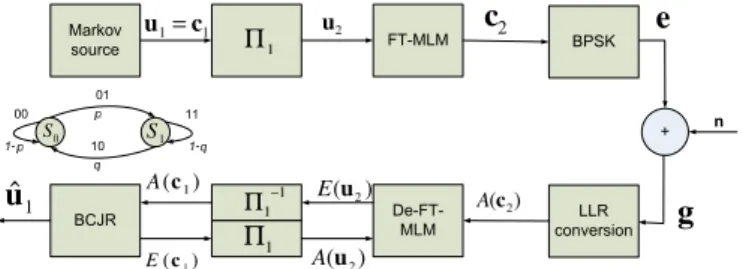
Fig. 1 presents a block diagram of the system considered in this paper. A binary transition emitting Markov (TEM) source is assumed in this paper, however, extension to non-binary TEM within the same theoretical framework is straightforward. In Fig. 1, source parameters p and q are the state transition probabilities; the state changes from S0to S1with probability
p and from S1 to S0 with probability q. At every state
transition, the source emits a symbol comprised of two bits.
Fig. 1. The block diagram of the system model.
The bit sequence c1 emitted from the Markov source is
passed through the random interleaver Π1, which shuffles the
bits randomly and breaks the memory of the TEM source. After Π1 the corresponding bit sequence u2,1, u2,2, . . . , u2,L
is compressed by FT-MLM, resulting in compressed sequence
c2,1, c2,2, . . . , c2,RsL, where Rs is the compression rate of the
FT-MLM algorithm. The compressed sequence is modulated with binary phase shift keying (BPSK), resulting a symbol sequence e and sent through an additive white Gaussian noise (AWGN) channel. The receiver receives the noisy bit sequence
gj = ej + nj, j = 1, 2, . . . , RsL, where ej ∈ {−1, 1} is the transmitted sequence and nj ∈ R is zero mean AWGN component with variance σ2
n. In the receiver, the channel values are converted to LLRs and the inverse operation of FT-MLM, referred as MLM is performed. De-FT-MLM produces extrinsic LLR sequence E(u2), which is
deinterleaved and provided to the BCJR source decoder as
a priori information A(c1). The BCJR decoder exploits the
memory structure of the source and produces the extrinsic LLRs E(c1), which are interleaved and fed back to
De-FT-MLM as a priori information A(u2). Since iterative structure
is employed, matching of the mutual information transfer characteristics between the constituent soft input / soft output (SISO) decoders plays crucial roles to achieve arbitrary low SER as well as to minimize the bit rate after compression.
A. Fine Tuned Multiple Label Mapping
The block diagram of FT-MLM is shown in Fig. 2. First, the incoming bit sequence u2 is passed through ACC which
makes the bit appearance probabilities equal and hence, allows us to design entropy achieving equal length codes. Proof for equal bit appearance probabilities after ACC is given in [29]. ACC produces a bit sequence cACC
2 which is interleaved and
compressed by using MLM with a compression rate RMLM s . This is defined as RMLM s = arg min (RMLM s )0 {|(RMLM s )0− Rs|}, (1) where (RMLM s )0 ∈ {(RMLMs )0j}, j = 1, 2, . . . , o, are the compression rates achieved with MLM1 and R
s is the final
target compression rate of the system. In (1), we just take the (RMLM
s )0, which is closest to a given Rs. MLM produces a bit
1To achieve all compression rates with MLM one needs to determine infinite
number of mapping schemes, such as it used in extended mapping [23]. For practical purposes we can choose fixed number of compression rates in the range from 0 to 1.
Fig. 2. Block diagram of FT-MLM.
sequence cMLM
2 , which is followed by interleaver Π3 resulting
in a bit sequence uFT
2 , which is input to the FT block.
After MLM, the data may still have some redundancy, or the rate after the compression may be excessively low compared with the target compression rate Rs. FT is used to make the
subtle adjustment of the rate such that the compression rate, as a whole, becomes as close to the entropy as possible: on one hand, when incremental redundancy is needed, FT works as a variable node encoder (VNE) [24] with the average variable node degree ¯dv; on the other hand, when the objective
is to decrease the redundancy, FT works as a check node encoder (CNE) [24] with the average check node degree ¯dc.
The compression rate of the FT block is now given by
RFTs = Rs RMLM s . (2) If RFT s < 1 FT is CNE and ¯dc= R1FT
s . The check node degrees
are specified as follows: let Dc be the number of different
check node degrees, and denote their degrees by ˜dc,i, i =
1, . . . , Dc. The average check node degree is calculated as
[24] dc= Dc X i=1 ac,id˜c,i, (3)
where ac,i is the fraction of nodes having degree ˜dc,i. Since
some of the check nodes has to have degree 1 [30], let ˜dc,1=
1. Otherwise, the convergence does not start, because there is zero a priori information to be provided to the De-MLM. The fraction ac,1 ∈ [0, 1] can be chosen arbitrarily, however, it is
reasonable to set ac,1at a relatively small value because it only
determines the left-most point in the EXIT curve of FT. Given ˜
dc,1 and ac,1, one has to choose Dc ≥ 3 in order to achieve
arbitrary compression rate. In order to keep the complexity smallest, we choose Dc = 3. Moreover, ˜dc,3 is chosen to be
the smallest integer satisfying ac,1+ (1 − ac,1) ˜dc,3≥ dc, i.e.,
˜ dc,3= l dc− ac,1 1 − ac,1 m , (4)
where d·e indicates the smallest integer larger than its argu-ment. To achieve a desired value of dc, let ˜dc,2 = ˜dc,3− 1.
With (3) andPDc i=1ac,i= 1, ac,2= ac,1+ (1 − ac,1) ˜dc,3− dc, (5) and ac,3= 1 − ac,1− ac,2. (6) have to be satisfied. If RFT
s > 1 FT is VNE and ¯dv = RsFT. The procedure
for choosing the check node degrees and their distribution can also be used in determining the variable node degrees and their
distribution. It should be noticed that if the equality RFT s = 1
holds, there is no need to use FT.
III. MAPPING RULE OPTIMIZATION
Determining the labeling map of MLM has a significant impact on the performance of the proposed scheme. We use ABSA to determine the labeling map. Initially, BSA was introduced for index optimization in vector quantization [27]. In [31], BSA was applied for finding the most suitable index assignments to arbitrary, high order signal constellations. How-ever, BSA aims to find the optimal mapping pattern assuming that full a priori information is available. ABSA extends the BSA’s optimization criterion such that a priori information is partially available. Moreover, it introduces a weight vector that takes into account which part of the demapper EXIT curve should be modified to achieve the desired result. EXIT constrained BSA (EBSA) [32] further extends the idea by introducing a constraint ²0 which controls the gap between the two EXIT curves. Fundamental difference between EBSA and ABSA is that EBSA aims to minimize the gap between the two EXIT curves while ABSA only aims to push upwards the demapper EXIT curve. Hence, ABSA makes the convergence to the target MI point possible, given the decoder curve. In EBSA, code parameter optimization follows the BSA process, which means that the both decoder and demapper curves are changed wit the aim of rate loss minimization. In this paper, fixed decoder curve is assumed and hence, ABSA is used for labeling optimization.
Let lmap denote the length of the labeling map and let
the cost of the labeling be denoted by Zlap, where lap =
0, 1, . . . , lmap− 1 is the number of known bits. Let ui ∈ U,
i = 1, 2, . . . , 2lmap, be the input binary vector and s
i ∈ S,
i = 1, 2, . . . , n be the code word in MLM. The length of a
binary code word is m = log2n. Let Prob(sv → ˆsv) denote the pair-wise probability that the code word ˆsv is chosen instead of the transmitted code word sv. In order to calculate the Euclidean distance between the code words, the following transformation is performed:
γk,i= η(sk,i) = 2sk,i− 1, (7)
∀i = 1, 2, . . . , m and ∀k = 1, 2, . . . , n, where sk,i is the ith element of the code word sk. Now γk is located in the n-dimensional space V, of which coordinates are the elements of γk. The labeling cost can now be expressed as
Zlap =
1
lmap2lmap−12lmap−lap−1
lmap X v=1 X s|uv=0 X ˆ s|ˆuv=1 exp(−SN RFT||η(s) − η(ˆs)||22), (8)
where the function η(s) returns the point γ in the space V and v denotes the vth bit of an input word for MLM. SN R
FT
denotes the signal to noise power ratio (SNR) after FT decoder. If RFT
s > 1,
where SN Rch is the channel SNR. If RsFT< 1, the standard
deviation of the LLRs provided by the channel is calculated as
σch=
p
4 · SN Rch. (10)
The extrinsic information provided by check node decoder (CND) can be calculated as [24] IE(u3)= 1 − J ³p ¯ dc· J−1 ¡ 1 − IA(g) ¢´ , (11)
where IA(g) is the MI provided by the channel and J(·) is the so called J-function detailed for example in [33]. In this paper the J-function and its inverse J−1 is calculated according to [34]. Now, the SNR after FT can be written as
SN RFT=
(J−1(I E(u3)))
2
4 . (12)
Mapping rule which enables the convergence can be found by performing ABSA with the cost function (8).
IV. SIMULATION RESULTS
In this section, the performance of the proposed method is evaluated through simulations. For FT, ac,1= 0.1 was used in
the simulations. The block length was set at L = 18000 for convergence property evaluations through EXIT analysis, and
L = 250000 for the trajectory and SER simulations.
We use the ABSA algorithm with a cost function derived in Section III to enable the convergence of the system. An example is shown in Fig. 3. If the labeling is optimized only with full a priori information the EXIT curves intersect. However, ABSA lifts up the parts of the De-FT-MLM curve under the BCJR curve, and thereby the intersection can be avoided.
SER results for the same parameters as in Fig. 3 is presented in Fig. 4. The labeling pattern is optimized for Eb/N0= −1.5
dB. It can be seen that our technique achieves SER≤ 10−4 about 2.9 dB away in Eb/N0 from the Shannon limit.
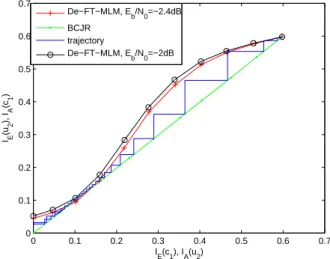
Fig. 5 shows the EXIT behavior of the system with a parameter set p = 0.1549, q = 0.9121, Rs = 0.4970, and
lmap = 4 optimized for Eb/N0 = −2.4 dB. It can be seen
that the trajectory cannot reach the convergence point when
Eb/N0= −2.4 dB due to the too small gap between the EXIT
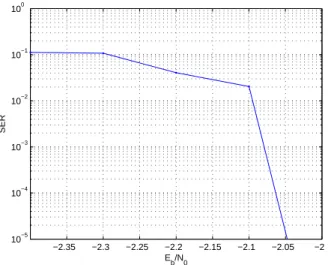
curves. However, as it can be seen in Fig. 6 the convergence threshold is between -2.1 dB and -2 dB.
V. CONCLUSIONS
In this paper a near capacity achieving joint source-channel coding (JSCC) scheme by using iterative decoding has been proposed for binary Markov source. A new compression tech-nique, fine tuned multiple label mapping (FT-MLM) techtech-nique, was proposed which produces equal length code words. This completely avoids the error propagation problem which, with VLC, is likely to happen due to code word synchronization error.
A conclusion of [23] was that in theory the MLM can achieve the entropy of the source, if probability grouping is performed so that the appearance probability of each code
0 0.1 0.2 0.3 0.4 0.5 0.6 0 0.1 0.2 0.3 0.4 0.5 0.6 I E(c1),IA(u2) IE (u2 ),IA (c1 ) BCJR
De−FT−MLM optimized for full a priori trajectory
De−FT−MLM optimized using EBSA
Fig. 3. EXIT chart of the system with p = 0.8741, q = 0.1674, Rs =
0.4174, Eb/N0=0 dB and lmap= 5. −4 −2 0 2 4 6 8 10−5 10−4 10−3 10−2 10−1 100 S E R Eb/N0 FT-MLM, H(M ) = 0.3174, Rs= 0.4174 Huffman, H(M ) = 0.3174, Rs= 0.3655
Fig. 4. SER of the proposed scheme and Huffman code when lmap= 5.
0 0.1 0.2 0.3 0.4 0.5 0.6 0.7 0 0.1 0.2 0.3 0.4 0.5 0.6 0.7 I E(c1), IA(u2) IE (u2 ), I A (c1 ) De−FT−MLM, Eb/N0=−2.4dB BCJR trajectory De−FT−MLM, E b/N0=−2dB
Fig. 5. EXIT chart of the system with p = 0.1549, q = 0.9121, Rs =
−2.35 −2.3 −2.25 −2.2 −2.15 −2.1 −2.05 −2 10−5 10−4 10−3 10−2 10−1 100 E b/N0 SER
Fig. 6. SER of the proposed scheme with p = 0.1549, q = 0.9121,
Rs= 0.4970, and lmap= 4 optimized for Eb/N0= −2.4 dB.
word after MLM is equal. In this paper, accumulator (ACC) is used to equalize the appearance probabilities of the code words. It was also indicated in [23] that the most crucial process of MLM is to find the best grouping of the source alphabet for a given source model. This problem has been solved in this paper by using the adaptive binary switching algorithm (ABSA). MLM can also be applied for quantization which is, however, left as future study.
REFERENCES
[1] D. A. Huffman, “A method for the construction of minimum-redundancy codes,” in Proc. Institute of Radio Engineers, Sep. 1952.
[2] J. J. Rissanen, “Generalized kraft inequality and arithmetic coding,” IBM
Journal of Research and Development, vol. 20, no. 3, pp. 198–203, May
1976.
[3] J. Hagenauer, “Source-controlled channel decoding,” IEEE Trans.
Com-mun., vol. 43, no. 9, pp. 2449–2457, 1995.
[4] T. M. Cover and J. A. Thomas, Elements of Information Theory. New York, USA, 542 p: John Wiley, 1991.
[5] R. Thobaben and J. Kliewer, “Low-complexity iterative joint source-channel decoding for variable-length encoded Markov sources,” IEEE
Trans. Commun., vol. 53, no. 12, pp. 2054–2064, 2005.
[6] J. Garcia-Frias and J. D. Villasenor, “Joint turbo decoding and estimation of hidden Markov sources,” IEEE J. Select. Areas Commun., vol. 19, no. 9, pp. 1671–1679, 2001.
[7] N. D¨utsch, S. Graf, J. Garcia-Frias, and J. Hagenauer, “Source model aided lossless turbo source coding,” in In: Proc. 4th Int. Symp. on Turbo
Codes and Related Topics, Munich, Germany, Apr. 3–7 2006, pp. 1–6.
[8] A. Q. Pham, L. L. Yang, and L. Hanzo, “Joint optimization of iterative source and channel decoding using over-complete source-mapping,” in
Proc. IEEE Veh. Technol. Conf., Baltimore, MD, USA, Sep. 30–Oct. 3
2007.
[9] R. G. Maunder, J. Wang, S. X. Ng, L.-L. Yang, and L. Hanzo, “On the performance and complexity of irregular variable length codes for near-capacity joint source and channel coding,” IEEE Trans. Wireless
Commun., vol. 7, no. 4, pp. 1338–1347, 2008.
[10] J. Garcia-Fras, “Joint source-channel decoding of correlated sources over noisy channels,” in Proc. IEEE Data Compression Conf., Snowbird, UT, USA, Mar. 27-29 2001.
[11] J. D. Ser, P. M. Crespo, and O. Galdos, “Asymmetric joint source-channel coding for correlated sources with blind HMM estimation at the receiver,” EURASIP J. Wireless Comm. and Netw., vol. 2005, pp. 483–492, 2005.
[12] J. D. Ser, P. Crespo, and A. Muoz, “Joint source-channel decoding of correlated sources over ISI channels,” in Proc. IEEE Veh. Technol. Conf., Stockholm, Sweden, May 30–Jun. 1.
[13] C. E. Shannon, “Coding theorems for a discrete source with a fidelity criterion,” IRE Nat. Conv. Rec., pp. 142–163, Mar. 1959.
[14] M. Chiang and S. Boyd, “Geometric programming duals of channel capacity and rate distortion,” IEEE Trans. Inform. Theory, vol. 50, no. 2, pp. 245–258, Feb. 2004.
[15] J. Garcia-Frias and Y. Zhao, “Compression of binary memoryless sources using punctured turbo codes,” IEEE Commun. Lett., vol. 6, no. 9, pp. 394–396, Sep. 2002.
[16] G. Caire, S. Shamai, and S. Verd, “Noiseless data compression with low-density parity-check codes,” DIMACS Series in Discrete Mathematics
ans Theoretical Computer Science, pp. 1–22, Sep. 2004.
[17] J. Hagenauer, J. Barros, and A. Schaefer, “Lossless turbo source coding with decremental redundancy,” in Proc. Fifth Conf. Source and Channel
Coding, Erlangen, Germany, 2004.
[18] N. D¨utch, “Code optimization for lossless turbo source coding,” in Proc.
of 14th IST Mobile & Wireless Commun. Summit, Dresden, Germany,
Jun. 2005.
[19] M. Adrat, P. Vary, and T. Clevorn, “Optimized bit rate allocation for iterative source-channel decoding and its extension towards multi-mode transmission,” in Proc. 14th IST Mobile & Wireless Commun. Summit, Dresden, Germany, Jun. 2005.
[20] N. D¨utch, “Code optimization for lossless compression of binary mem-oryless sources based on fec codes,” European Trans. Telecommun., no. 17, pp. 219–229, 2006.
[21] J. Haghighat, M. R. Soleymani, and W. Hamouda, “Lossless source coding using repeat-accumulate codes,” in Proc. IEEE Int. Symp. Signal
Processing and Its Applications, Sharjah, United Arab Emirates, Feb.
12–15 2007.
[22] L. Schmalen, P. Vary, T. Clevorn, and M. Adrat, “Turbo source compres-sion with jointly optimized inner irregular and outer irregular codes,” in
Proc. IEEE Veh. Technol. Conf., Ottawa, Canada, Sep. 6–9 2010.
[23] V. Tervo, T. Matsumoto, and J. Karjalainen, “Joint source-channel coding using multiple label mapping,” in Proc. IEEE Veh. Technol. Conf., Ottawa, Canada, Sep.6–9 2010, pp. 1–6.
[24] S. ten Brink and G. Kramer, “Design of repeat-accumulate codes for iterative detection and decoding,” IEEE Trans. Signal Processing, vol. 51, no. 11, pp. 2764–2772, Nov. 2003.
[25] P. Elias, “Coding for noisy channels,” in IRE Convention Record
3(4):37-46. (Reprinted in Key Papers in the Development of Coding Theory, ed. E. Berlekamp, New York: IEEE Press, 1955, pp. 48–55).
[26] Z. Yang, Q. Xie, K. Peng, and J. Song, “Labeling optimization for bicm-id systems,” IEEE Commun. Lett., vol. 14, no. 11, pp. 1047–1049, 2010.
[27] K. Zeger and A. Gersho, “Pseudo-gray coding,” IEEE Trans. Commun., vol. 38, no. 12, pp. 2147–2158, Dec. 1990.
[28] L. R. Bahl, J. Cocke, F. Jelinek, and J. Raviv, “Optimal decoding of linear codes for minimizing symbol error rate,” IEEE Trans. Inform.
Theory, vol. 20, no. 2, pp. 284–287, 1974.
[29] V. Tervo, K. Fukawa, K. Tervo, and T. Matsumoto, “Error resistant lossless data copmpression with equal length coding using fine tuned multiple label mapping,” IEEE Trans. Commun., 2011 (under review).
[30] T. Yano and T. Matsumoto, “Arithmetic extended mapping for BICM-ID with repetition codes,” in Proc. ITG Workshop Smart Antennas, Berlin, Germany, Feb.16–18 2009, pp. 1–8.
[31] F. Schreckenbach, N. G¨ortz, and J. Hagenauer, “Optimized symbol mappings for bit-interleaved coded modulation with iterative decoding,” in Proc. IEEE Global Telecommun. Conf., San Francisco, USA, Dec.1–5 2003, pp. 3316–3320.
[32] K. Fukawa, S. Ormsub, K. Anwar, A. T¨olli, and T. Matsumoto, “EXIT-constrained BICM-ID design using extended mapping,” EURASIP J.
Wireless Comm. and Netw., (to be submitted).
[33] S. ten Brink, “Convergence behavior of iteratively decoded parallel concatenated codes,” IEEE Trans. Commun., vol. 49, no. 10, pp. 1727– 1737, Oct. 2001.
[34] F. Br¨annstr¨om, “Convergence analysis and design of multiple concate-nated codes,” Ph.D. dissertation, Chalmers University of Technology, Gothenburg, Sweden, 2004.