レーザーで遊ぶ非線形振動
Nonlinear Oscillation InducedbyLaser
京大 ・院理 吉川 研一 (Kenichi
Yoshikawa) DepartmentofPhysics,Graduate SchoolofScience,
KyotoUniv.
Living organisms
on
ffie emthmaintain their
lives underthermodynamically
open
condition
by accepting ffieenergy
supply ffom ffiesun.
Thus, studieson
ffie generation ofspati0-temporal structure under ligc illumination would be of scientific value not only in basic physics but also in biological
sciences.
As typicalcharacteristics
generated underthermodynamically open
condition, breaking of thetime-translati
nalsymmetry,
or
appearance
of temporal ffiyUlm, would be important in relation to ffie dynamic aspect oflife.12There
are
richvarieties
of exampleson
symmetrybreaking oftime
translationin livingmatter; beating heart,
nervous
fiing, circadian rhythm, cell-cycle, etc., where ffieperiodicity falls,on
ffie order ofms\sim day.3 As for non-biological systems, self-pulsing oflaser is ffie representative oscillatory phenomenon generated under far-from-equilibrium conditions, where ffie periodicity is rathershort,beingon
ffie order ofns
$\sim\mu \mathrm{s}^{\mathrm{H}}$.
In thepresentpaper, we
would like to report anovel rhythmic phenomenon
on
the periodic growth and burst of the cluster ofsubmicrometer-sized
polystyrene beads inaqueous
solution undertheillumination
offocused$\mathrm{N}\mathrm{d}:\mathrm{Y}\mathrm{A}\mathrm{G}$ 恐个$\sigma$beam.
As has been indicated by Ashkin,
an
objectcan
be trapped with focused laser, laser$\mathrm{t}\mathrm{r}\mathrm{a}\mathrm{p}\mathrm{p}\dot{\mathrm{m}}\mathrm{g}^{7}$
.
In general, forcegenerated with focused light is represented
as
the summation of ligtgradientandscattering$\mathrm{t}\mathrm{e}\mathrm{r}\mathrm{m}\mathrm{s},8’ 9$$\mathrm{F}(\mathrm{r})=\mathrm{a}\nabla|\mathrm{E}(\mathrm{r}\lambda^{2}+\mathrm{p}(\mathrm{r})\mathrm{x}$$\mathrm{H}(\mathrm{r})$
.
(1)Where $\mathrm{a}$and$\beta$
are
constants,as
the$\mathrm{f}\mathrm{i}\mathrm{m}\alpha \mathrm{i}\mathrm{o}\mathrm{n}$ofdielectricity, oefiactive index ofmedium, and velocity of ligt. The first term describes
an
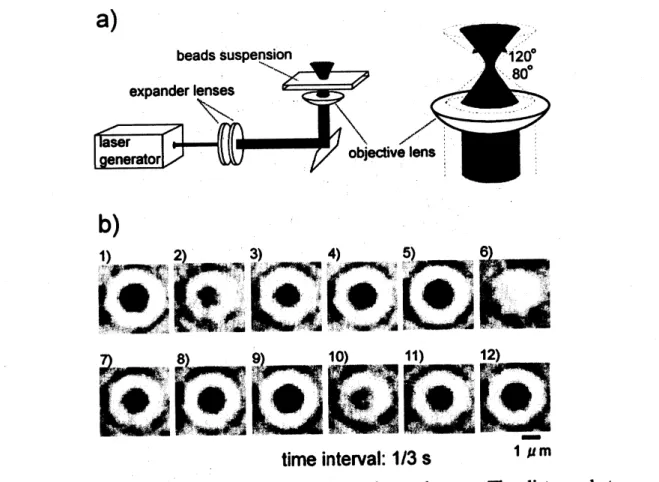
attractive potential around the focus where the attractive force decreases with the sharpening of angle of the opticalcone
(see Fig. la). On the contrary,as
in the lastterm ineq.
(1), the scattering force exertingon
an
objectincreases
with the decrease of the
cone
angle. Itis, thus, expected that instabilityon
optical trapping is induced with the decrease ofthecone
$\mathrm{a}\mathrm{n}\mathrm{g}\mathrm{l}\mathrm{e}.10$ Bearingsuch effect
on
mind,we
have carried outtheexperimenton
laser trappingofsubmicrometer-sized
plasticbeads bearingnegativ数理解析研究所講究録 1254 巻 2002 年 208-214
b)
FIG 1. (a) Schematic representation of the experimental setup. The distance between the expander lenses
was
adjustedso as
to decrease the focusingcone
angle,$ca$.
80. (b)Periodic growth and the burst ofbead-cluster (black region), observedat 1.0 $\mathrm{W}$ of the
laser
power.
Continueswave
$\mathrm{N}\mathrm{d}:\mathrm{Y}\mathrm{A}\mathrm{G}$ laser(1064$\mathrm{n}\mathrm{m}$, $\mathrm{S}\mathrm{L}902\mathrm{T}$, Spectron)was
usedforthe illumination. The mode ofthe laser is TEMoo, the profile of the laser hasGaussian distribution
as
confirmed by abeam profiler (Melles Griot). The laser beamwas
introduced into inverted microscope (TE-300, Nikon) through expander lenses and reflect mirrors, through lOOx oil immersed objective lens. Suspension of negatively charged beads ofpolystyrene latex (0.20 $\}\iota \mathrm{m}$ in diameter)was
purchased from DowChemical. Thebeads suspension, which contains 0.1 %solid,
was
situatedbetween the glass plates. Thethickness ofthe liquidwas
about200$\mu \mathrm{m}$.
Temperaturewas
$20\pm 2\circ \mathrm{C}$
.
charge. Without laserillumination,thebeadsdispersehomogeneously in
aqueous
solutiondue to negative charge. Focused laser under standard angle 120 of the opticalcone
induces stational clustering of the $\mathrm{b}\mathrm{e}\mathrm{a}\mathrm{d}\mathrm{s}.11\cdot 13$ By changing thecone
angle ffom 120 to 80, rhythmicchange ofgrowth and burst ofthe cluster is generated
as
in Fig. $1\mathrm{b}$.
Where the dark circlecorresponds to the dense clustering of the beads trapped
on
the focusb)
$\ovalbox{\tt\small REJECT}\#\Phi\backslash$
$\overline{\mathrm{B}S\mathrm{B}}$
.
Kpower$l\mathrm{W}_{\mathrm{J}}$
FIG2. (a)Time-baceofthecluster
area
(left-handedside)with thetime interval$\mathrm{o}\mathrm{f}1/30$$\sec$ and the
power
spectrum by FFT analysis (rigt-handed side), (b) Diagram ofclustering depending
on
the laserpower.
Closed circle andopen
circle indicate themaximum
and minimum values in the oscillationon
fluctuation
of the cluster,respectively
Figure $2\mathrm{a}$ shows the time-trace of the cluster
area
(left-handed side), together withthe ffequency spectrum of the autocorrelation,
or
power
spectrum of the Fourier Transformation (right-handed side). When the laserpower
is less than0.4
$\mathrm{W}$, small clusterisinduced and trapped in astationary
manner.
With
increase of thepower,
fluctuation of the cluster graduallygrows
(e.g., at 0.5 $\mathrm{W}$), Above $0.6\mathrm{W}$, rhythmic bursting is generated, wherealmost all of the beads
are
blown out at theoccasion
of the burst. Further increase ofthepower
hasthe effectto increase thefrequency ofthe burstingand the amplitude oftheclusterarea
in agradualmanner.
Around1.6
$\mathrm{W}$,theoscillation
tendstobe irregular. When thepower
islarger than 1.8$\mathrm{W}$,
no
oscillation is observed, i.e.,continuos
flowofthebeads-suspension isgenerated, without the formation of cluster
on
the focus. Fig. $2\mathrm{b}$ shows the diagram ofthestate beads-cluster
as
affinction ofthelaserpower.
The
process
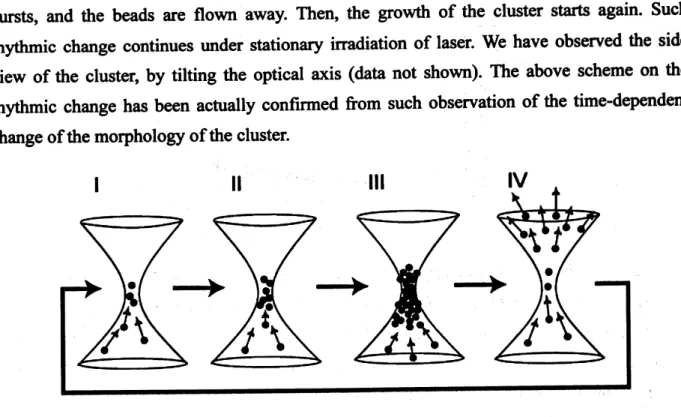
ofthegrowth andburstingof the beads cluster isschematically depicted inFig. 3. (I) Drivenby theradiationpressure,
beads flowtowardthe focused region. (II) and(III),The cluster
grows
gradually. (IV) When the clustergrows up
to acritical size,the clusterbursts, and the beads
are
flown away. Then, the growth of the cluster starts again. Such rhythmic change continues under stationary irradiation of laser. We have observed the side view of the cluster, by tilting the optical axis (data not shown). The above schemeon
the rhythmic change has been actually confirmed ffom such observation of the time-dependent change ofthe morphology ofthe cluster.FIG3. Schematic representation
on
themechanismofperiodic bursting.Based
on
theabove-mentioned experimental
observation,we
consider the following simplemodel.Asfor the growthprocess
ofthe cluster,we
adoptthe kineticsas
ineq.
(2)k,
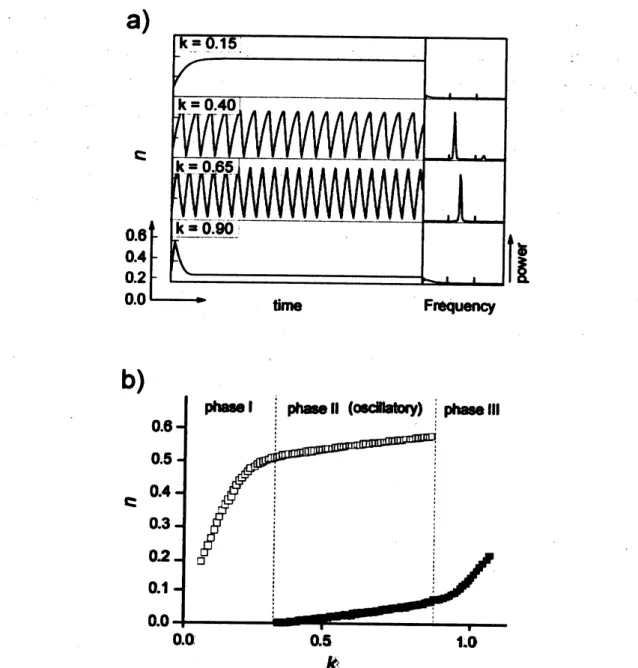
FIG 4. (a) Results ofnumerical simulation
on
the rhythmic bursting,time-trace
of$n$parameters, $a=1.\mathrm{O}$, $b=1.\mathrm{O}$,$c=0.73$,$n_{\mathrm{c}}=3$, $\gamma=0.5$,and $\eta=3$,
were
chosenfor thesimulation (b)Diagram of$n$ depending
on
$k$.
In oscillatory region (open square), themaximumand
minimum
were
displayedineach$k$.
$\dot{n}=k(n_{e}-n)^{r}-u$ (2)
$\mathrm{e}$firsttermin
eq.
(2) representsthe growthrate,$n\mathrm{c}$ isthe
upper
criticalnumber ofbeads $\mathrm{i}$taster, and $k$ is afimction of
attractive
force of the laser. Asthe cluster
grows
witdeformation ffom spherical symmetry, the actual growth rate is rathercomplicated.However, for simplicity
we
take asimple ffinction to describe the growthratebyincorporating asingle parameter $\gamma$to the equation. Fromthe experimental observation, itis found that$\mathit{7}\approx 0.5$
.
Thesecondterm, $u$, corresponds to the rate ofescape ffom the cluster. As for the time dependant
changeof the flowrate, $\dot{u}$ ,
we
adopt the relationshipas
ineq. (3),$\dot{u}=n-(u-a)^{\eta}+cu-b$, (3)
where $a$, $b$, and $c$
are
constants. In the growing phase the cluster size gradually increases.Accompanied with the growth, the effective light-pressure acting
on
the cluster increases. When the clustergrowstoupper
limit,thepositionofthe cluster tendstobe lifted. Owetothenarrowness
of thepotentialnear
thefocus, most of the beads becometo belocated outofthe effectiveattractive
potential (Fig. 3III and $\mathrm{I}\mathrm{V}$). Thiscauses
asignificant instability in thecluster. As aresult,the clusterbursts, due tothe intrinsic repulsive nature between thebeads. Such aswitching of thetime-differential ofescaperate $\dot{u}$ isrepresentedineq. (3),bytaking
$\eta=3$
as
the simplest choice ofthe parameter.Figure $4\mathrm{a}$ shows the time dependent change ofthebead-number in acluster and the
power spectrum of FFT analysis, as is calculatedffom $\mathrm{e}\mathrm{q}\mathrm{s}$
.
(2) and(3). In the simulation,we
have changed $k$
as
arepresentative parameter ofthe laserpower.
The cluster stays stationarybelow alower critical value of $k$
.
When $k$ is between 0.35 and 0.89, the cluster begins toexhibitthe periodicity of growth andbursting. It isnoted that the amplitude increases and the periodicity decreases with the increase of$k$
.
Aboveupper
critical value, 0.9,no
oscillation ofthe clusteris shown. Figure$4\mathrm{b}$ indicates the phasediagram depending
on
$k$.
Such behaviorofthe clustering phenomenon in the simulation of Figs. $4\mathrm{a}$ and $4\mathrm{b}$ correspond well to the
experimental trend, in spite ofthe simplification and roughness assumption in the modeling ($\mathrm{e}\mathrm{q}\mathrm{s}$
.
(2) and (3)). It is expected by taking into account of adding noise andso
on
that theexperimental result
can
be reproducedmore
correctly.In conclusion,
we
showed theappearance
ofoscillatory instability in the cluster of beads undercontinuous laserilluminationby choosing appropriate angle for the opticalcone.
The oscillation is causedowe
to the cooperation between trapping force and scattering force exserted by the focused laserReferences
1. G. Nicolis and I. Prigogine, Self-Organization inNonequilibrium Systems (Wiley, New
YOr41977).
2. H. Haken,Synergetics(Springer-Verlag, Berlin, 1978).
3. A. T. Wmffee, TheGeometry Biological Time(Springer-Verlag, Berlin, 1980).
4.
P. Meystre and M. Sargent, Elements of Quantum Optics (Springer-Verlag, Berlin, 1990).5. H.Haken,Phys. Lett., A53, 77(1975).
6. I. Burak, P. L. Houston, D. G. Sutton, and J. I. Steinfeld, IEEE J. Quantum Electron, QE-7,73 (1971).
7. A.Ashkin, Phys. Rev.Lett.,24, 156(1975).
8. Y. R. Shen, The Principles NonlinearOptics(Wiley&Sons,NewYork, 1984). 9. K. Svobodaand S. M. Block,Annu. Rev.Biophys. Biomol. Struct.,23,247(1994).
10.
G. J. SonecandW. Wang, Rev. Laser Engineer.,24,1139
(1996).11.J. Hofkens, J. Hotta, K. Sasaki, H. Matsuhara, H. Faes, andF. de Schryver, Mol. Cryst. Liq. Cryst. 283, 165(1996).
12. J.Hofkens,J.Hotta, K. Sasaki,H.Matsuhara,and K. Iwai,Langmuir, 13, 414(1997).
13.J.Hotta, K. Sasaki,and H. Matsuhara,J.Am. Chem. Soc., 118,
11968
(1996).謝辞
本研究は、馬籠信之氏・北畑裕之氏・市川正敏氏・野村
ff–
$\mathrm{F}\beta$氏と協同で実施され
ました。各氏に感謝いたします。