
ON 1-BRIDGE TORUS
KNOTS
DOO HO CHOIAND KIHYOUNG KO
ABSTRACT. A1-bridge torus knot is aknot drawn on astandard torus in $S^{3}$ with
1-bridge. We introduce two types ofnormal forms to parametrize the family of l-bridge torus knots thataresimilar tothe Schubert’s normal form and the Conway’s normal form
for 2-bridge knots. For agiven Schubert’s normal form we give aclassificatoin of some
sub class of 1-bridge torus knots. We also give adescription of the double brannced cover
of $S^{3}$ branched along any 1-bridge torus knots by using the Conway’s normal
form
andobtain an explicit formula for the first homology of the double cover.
1. INTRODUCTION
One of traditions in knot theory is to study afamily of knots satisfying acertain
con-dition. Examples of such families include the family of torus knots studied by Dehn and
Schreier and the family of 2-bridge knots studies by Schubert, Montesinos and Conway.
These classes
can
be referred as the classes of knots and links indexed by the pairs $(g, b)$of non-negative integers as defined in [9]. Aknot Ain a3-manifold A# has a $(g, b)-$
decomposition or is called a $(g, b)$-knot iffor some heegaard splitting $M=U\cup V$ ofgenus
$g$, each of$K\cap U$ and $K\cap V$ is consisted of trivial $b$arcs. Acollection of properlyembedded
arcs ina3-manifold $W$with boundaryis trivialifarcs $\alpha$inthe collection together with arcs
on $\partial W$ joining the two ends of the
arcs
bound mutually disjoint disks in $\dagger’V$. A $(g, b)$ knotcatt be embedded in aheegaard surface ofgenus $g$ in $M$ except at $b$ over(or under)-bridges
and viceversa. Torusknots are $(1, 0)$-knots and2-bridgeknots are $(0, 2)$-knots. Clearly the
family of $(g, b)$-knots becomes strictly larger as $g$ or $b$ increase. Since an over-bridge can
1991 Mathematics Subject Classification. $57\mathrm{M}25,57\mathrm{M}27$.
Key words and phrases. 1-bridge torus knot, Schubert’s normal form, Schubert’s normal form, double branched cover.
数理解析研究所講究録 1229 巻 2001 年 19-32
D.H. CHOI AND K.H. KO
be removed by adding ahandle and by embedding the over-bridge into the added handle,
$(g, b)$-knots
are
contained in the family of $(g+1, b-1)$ knots.In this article
we
study the family of 1-bridgetorus knots, thatis, $(1, 1)$ knots in $S^{3}$. Thisfamily contains torus knots and 2-bridge knots and is contained in the family of double
torus knots, that is, $(1, 0)$-knots. Hill and Murasugi studied the family of double torus
knots in $[11, 12]$ andparametrized the family. Non-trivial knots with the trivial Alexander
polynomial
was
found in the subfamily of double torus knots that separate the doubletorus. They alsoconsidered non-separating doubletorus knots and asubfamily of l-bridge
torus knots and found various double torus knots that
are
fibered.The 1-bridge torus knot has the tunnel number one, but not all tunnel-number-0ne knots
are
1-bridge torus knots. In [14], Morimoto, Sakuma and Yokota found tunnel-number-0neknots that
are
not 1-bridge torus knotsas
confirmedby aconditionon
the Jonespolynomial for aknot to admita
$(g, b)$-decomposition in [18]. In [15], they gave another criteria todetermine whether agiven knot has the tunnel number one and whether it is al-bridge
torus knot.
Besides torus knots and 2-bridge knots, the family of 1-bridge torus knots includes
Berge’s double-primitive knots, 1-bridge braids that
were
classified by Gabai in $|10|$ all$([$satellite 1-bridge torus knots. Morimoto and Sakuma studied satellite 1-bridge torus knots
and classified their unknotting tunnels in [13].
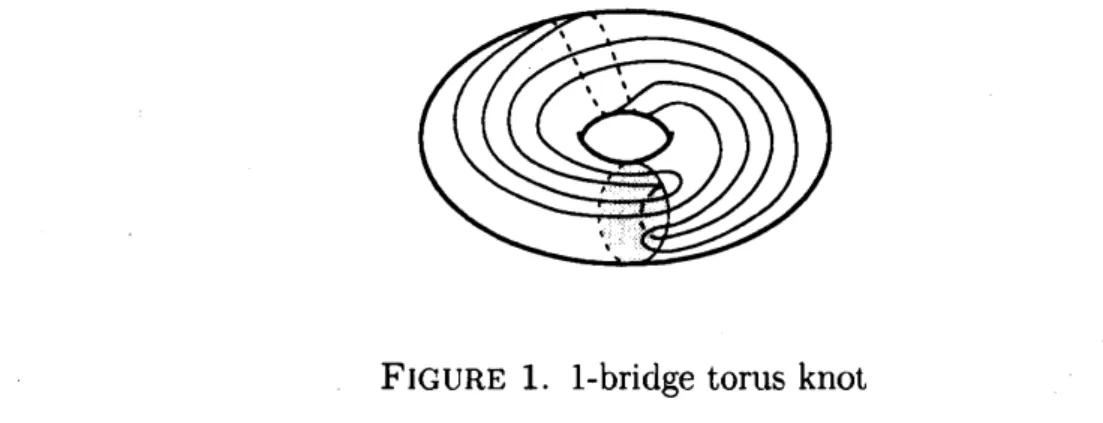
FIGURE 1. 1-bridge torus knot
In this article,
we
parameterize the family of 1-bridge torus knots using two kinds ofnormal forms
as
done for the family of 2-bridge knots. Schubert described a2-bridge knotsON 1-BRIDGE TORUS KNOTS
by apair of integers of acertain condition from its top view. In the top view a2-bridge
knots is embedded in aplane except the two bridges. He in fact completely classified
2-bridge knots using this normal form [17]. Since a1-bridge knot
can
be embedded in astandard torus except the bridge (See Figure 1), we willdescribe it by a4-tupleofintegers
from this top view. We will call such a4-tuplethe Schubert ’s normal
fonn
of the l-bridgetorus knot determined by the 4-tuple. In Section 2, we introduce the Schubert’s normal
forms of 1-bridge torus knots and classify some subfamily of 1-bridge torus knots expressed
the Schubert’s normal forms.
On the other hand, a2-bridge knot can also be viewed as a4-plats as studied first in
[2]. From this side view, it is easy to
see
that the composition of homeomorphisms of afour-punctured sphere that determines the 2-bridge knot. Using this description, Conway
constructed abijectionbetween 2-bridge knots and lens spaces via double branchedcovers
[8]. Asimilar description using the composition of homeomorphisms on atw0-punctured
torus is possible for 1-bridge torus knots and this will be called the Conway’s normal
for
$m$.In Section 3, we construct the double branched cover of $S^{3}$ branched along an l-bridge
torus knot given by the Conway’s normal form and give aformula for the first homology
of the branched double cover.
2. $\mathrm{S}\mathrm{C}\mathrm{H}\mathrm{U}\mathrm{B}\mathrm{E}\mathrm{R}\mathrm{T}’ \mathrm{S}$
NORMAL TORUS
In this section, we introduce anotation describing a1-bridge torus knot which is called
Schubert’s normal form and give aclassification of subfamily of 1-bridge torus knots. The
Schubert’s normal form of a1-bridge torus knot is an analogue of the Schubert’s normal
form of 2-bridge knot or link.
2.1. Schubert’s normal forms.
Theorem 2.1. [6] Any 1-bridge torus knots is represented by a 4-tuple $(r, s, t, \rho)_{\epsilon}$, where
$r$,$s$,$t$ are non-negative integers,
$\rho$ is an integer and$\epsilon$ is a $sign\pm 1$.
D.H. CHOI AND K.H. KO
In the Schubert’s normal form of a1-bridge torus knot, $r$,$s$,$t$ and $\epsilon$ determine the shape
of the knot in the neighborhood of ameridian disk containing the bridge (See Figure 2),
and $\rho$
means
the rotation number (See Figure 3).$\epsilon=+1$ $\epsilon=-1$
FIGURE 2
$\ovalbox{\tt\small REJECT}\rho=\grave{2}$
$\acute{\rho}=-2\ovalbox{\tt\small REJECT}$
FIGURE 3. Schubert’s normal forms of 1-bridge torus knots
Remark 2.2.
(1) $(r, s,t, \rho)_{+1}=(r, t, s,\rho+(2r+1))_{-1}$ (See Figure 3).
(2) A1-bridge torus knot with $(r, s,t,\rho)_{+1}$ is amirror image of a1-bridge torus knot
with $(r, s, t, -\rho)_{-1}$
.
(3) If$r=0$ in the normal form, then it represents a1-bridge braid(See $|1\mathrm{t}$)$|)$.
(4) A $(p,q)$-torus knotisa1-bridge torus knot $(0, 0,p-1, -q)_{+1}$
or
$(0,p-1,0, -q+1)_{-1}$.(5) Any 2-bridge knot in $S^{3}$ has aSchubert’s normal form
$\mathrm{B}(\mathrm{a},\mathrm{e}/3)$ (See Chapter 3of
[1]$)$, where
$\alpha>0,0<\beta<\alpha$, $\epsilon=\pm 1$, $\mathrm{g}\mathrm{c}\mathrm{d}(\alpha,\beta)=1$, and $\alpha,\beta$ odd
ON 1-BRIDGE TORUS KNOTS
A2-bridge knot $B(\alpha, \epsilon\beta)$ is a1-bridge torus knot $(\beta-1, \alpha-2\beta+1,0, \epsilon)_{\epsilon}$ (See
Figure 4).
$B(7,+3)$ $(2,2,0,+1)_{+1}$
FIGURE 4
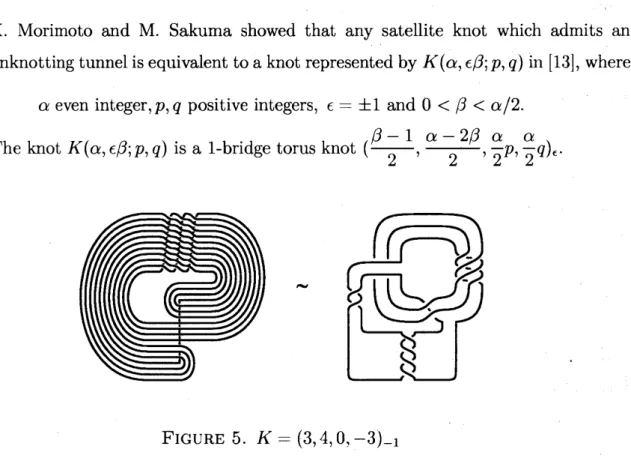
(6) K. Morimoto and M. Sakuma showed that any satellite knot which admits an
unknottingtunnelis equivalenttoaknotrepresentedby $K(\alpha, \epsilon\beta;p, q)$ in [13], where
$\alpha$ even integer,$p$,$q$ positive integers, $\epsilon=\pm 1$ and $0<\beta<\alpha/2$.
The knot $\mathrm{K}(\mathrm{a}, \epsilon\beta;p, q)$ is a1-bridge torus knot $( \frac{\beta-1}{2}, \frac{\alpha-2\beta}{2}, \frac{\alpha}{2}p, \frac{\alpha}{2}q)_{\epsilon}$.
FIGURE 5. K $=(3,$4,0,$-3)_{-}\mathrm{i}$
2.2. sub-class (r,s,0,$\epsilon(s-1))\mathrm{c}$ of 1-bridge torus knots. Consider (r,s,0,$\epsilon(s-1))_{\epsilon}$,
where $r\geq 0$, $s>0$ are integers and $\epsilon=\pm 1$(See Figure 5).
Lemma 2.3. $(r, s, 0, \epsilon(s-1))_{\epsilon}$ is alwaysthe Schubert’s nomal
form of
1-bridge torus $f_{\vee}\eta lot$.Furthermore, $(r, s, 0, -(s-1))_{-1}$ is a mirror image
of
$(r, s, 0, s-1)_{+1}$.D.H. CHOI AND K.H. KO
Proof.
For $(s-1,0,2(r+1), s)$,we
get “1” ffom Compoment Counting Algorithm in [6],since$\mathrm{g}\mathrm{c}\mathrm{d}(1,2r+s+1)=1$. Therefore, $(r, s, 0, \epsilon(s-1))_{\epsilon}$ satisfiesthe conditions of Schubert’s
normal form. $\square$
Since if $s=1$ then $(r, 1,0,0)_{\epsilon}$ represents the unknot,
we
mayassume
that $s>1$.Theorem 2.4. [7] $Lei$ $K_{r,s}$ be $a$ 1-bridge torus knot $(r, s, 0, (s-1))_{+1}$. Then a genus
of
$K_{r,s}$ is$\{$$\frac{2+s(s}{2}\frac{s(s-3)}{-1)^{2}}$
if
$r$ is odd,if
$r$ iseven.
Furthermore, $K_{r,s}$ is
fibred if
and onlyif
$r=0$or
1.Using Theorem 2.4,
we
get the following corollary;Corollary 2.5. $K_{r,s}$ is not isotopic to $K_{\overline{r},\overline{s}}$
if
$r\neq\overline{r}$or
$s\neq\overline{s}$.Proof.
Suppose $K_{r,s}$ is isotopic to $K_{\overline{r},\overline{s}}$.
Case 1) r $=\overline{r}$
If$r$ and $\overline{r}$
are
odd then by Theorem 2.4,$2+ \frac{s(s-3)}{2}=g(K_{r,s})=g(K_{\overline{r},\overline{s}})=2+\frac{\overline{s}(\overline{s}-3)}{2}$
Therefore, $s=\overline{s}$
or
$s+\overline{s}=3$.
Since $s\neq\overline{s}$, $s+\overline{s}=3$andso
$s$or
$\overline{s}$is 1 but this is impossible,since $s,\overline{s}>1$.
If $r,\overline{r.}$
are even
then similarly,we
meet acontradiction. Case 2) r $\neq\overline{r}$If$r$ and $\overline{r}$
are
even(or odd), then by the method ofCase 1,
we
meet acontradiction. Sowe
mayassume
that $r$ is odd and $\overline{r}$ iseven.
$2+ \frac{s(s-3)}{2}=\frac{\overline{s}(\overline{s}-1)}{2}$
Then integer solutions of the above equation
are
$(\overline{s}=2s=1$ , $($ $\overline{s}=0s=1$ , $($ $s=1$ $\overline{s}=-1$ and $($ $s=2$ $\overline{s}=2$
24
ON 1-BRIDGE TORUS KNOTS
Therefore, the only possibility is the last solution. That is, $s=\overline{s}=2$. Then $K_{r,s}(\mathrm{o}\mathrm{r}\mathrm{A}_{\overline{r},\overline{s}}’)$
is a2-bridge knot $B(2r+s+1,r+1)(\mathrm{r}\mathrm{e}\mathrm{s}\mathrm{p}. \mathrm{B}(2\mathrm{r}+\overline{s}+1,\overline{r}+1))$ (See 5. ofRemark 2.2).
Hence, $r=\overline{r}$. But this is impossible. $\square$
Theorem 2.6. [7] $\triangle_{r,s}(t)=$. $\{$ $\frac{(t-1)(t^{s(s+1)}-1)}{(t^{s}-1)(t^{s+1}-1)}+\frac{r}{2}\frac{(t-1)^{2}(t^{s^{2}-1}-1)}{(t^{s+1}-1)}$
if
$r$ is even, $t^{(s^{2}-3s+4)/2}- \frac{r+1}{2}\frac{(t-1)^{2}(t^{(s-1)^{2}}-1)}{(t^{s-1}-1)}$if
$r$ is odd, $s=2$ or3, $\frac{t^{s-1}(t-1)(t^{(s-2)(s-1)}-1)}{(t^{s-2}-1)(t^{s-1}-1)}-\frac{r-\vdash 1}{2}\frac{(t-1)^{2}(t^{(s-1)^{2}}-1)}{(t^{s-1}-1)}$ ,if
$r$ is odd, $s\geq 4$,where $\Delta_{r,s}(t)$ is the Alexanderpolynomial
of
$K_{r,s}$.Corollary 2.7. $K_{r,s}$ is
fibred if
and onlyif
its Alexander polynomial is monic.Proof.
From Theorem 2.6,the leading coefficient of $\mathrm{A}\mathrm{r},\mathrm{s}(\mathrm{t})=\{$
$1+ \frac{r}{2}$ if$r$ is even,
$- \frac{r+1}{2}$ if$r$ is odd,
and $K_{r,s}$ is fibred iff$r=0$ or 1by Theorem 2.4. Hence, the proof is complete. $\square$
Recently, K. Murasugi and M. Hirasawa conjectured the above statement for twisted
torus knots. They proved that it is true for the type 1:1 non-separable double torus knots
and M. Hirasawa showed that the statement is also true for the sub-class of twisted torus
knots. Therefore, their conjecture is true for our class.
Theorem 2.8. [7] For$r\geq 0$, $s\geq 2$,
(1) $V_{K_{r,s}}(t)= \frac{t^{3(s-1)\delta_{r}-s(s+1)/2}}{1-t^{2}}(\sum_{i=0}^{r-1}(-t^{-1})^{i}A(t)+(-t^{-1})^{r}B(t))$
if
$r\geq 1$,(2) $V_{K_{0,\epsilon}}(t)= \frac{t^{-s(s+1)/2}}{1-t^{2}}B(t)$,
where $A(t)=1-t^{s+2}-t^{2(2-s)}+t^{2-s}$ and $B(t)=1-t^{1-s}-t^{s+2}+t$.
D.H. CHOI AND K.H. KO
Corollary 2.9. [7] $K_{r,s}r\geq 0$, $s\geq 2$ is non-amphicheiral except
for
$K_{1,2}$ which is $a$figure-eight knot.
Corollary 2.5 and Corolary 2.9give
us
the classification ofthe 1-bridge torus knots withnormal forms $(r, s, 0, \epsilon(s-1))_{\epsilon}(r\geq 0, s\geq 2)$.
Theorem 2.10. Foranytwo 1-bridge torus$j_{v}\eta lots$$K$,$K’$ with normal
forms
$(r, s, 0, \mathrm{c}(s-1 ))_{\epsilon}$ $(r’, s’, 0, \epsilon’(s’-1))_{\epsilon’}$, respectively,$K$ is not isotopic to $K’$
if
$\epsilon\neq\epsilon’$, $r\neq r’$or
$s\neq s’$except
for
$(1, 2, 0, 1)_{+1}=(1,2,0, -1)_{-1}$ which is afigure-eight knot.3. CONWAY’S NORMAL FORMS AND DOUBLE BRANCHED COVERS
In this section, we
concern
about double branchedcovers
ofa3-sphere branched alongthe 1-bridge torus knots. In order to this,
we
use an
analogue of Conway’s normal form ofthe 2-bridge knot (See Chapter 12. in [1] and Chapter 10. in [16]).
3.1. Conway’s normal forms of 1-bridge torus knots. Let Abe a1-bridge torus
knot, $(V_{1}, t_{1})\cup h(V_{2}, t_{2})$
a
$(1,1)$-decomposition of $(S^{3}, K)$ and $\overline{t}_{2}$ bean arc on
$\partial V_{2}$ such that$t_{2}\cup\overline{t}_{2}$ bounds adiskin $V_{2}$
.
Then $h$isahomeomorphism from $\partial V_{2}$ onto$\partial V_{1}$ which is isotopicto ahomeomorphism $h_{0}$ sending ameridian(resp. longitude) in $\partial V_{2}$ to alongitude(resp.
meridian) in $\partial V_{1}$, and $t_{1}\cup h(\overline{t}_{2})$ is isotopic to $K$. Then $\overline{h}=hh_{0}^{-1}$ is ahomeomorphism on
atorus isotopic to the identity.
The mapping class group $M(1, 2)$ of atw0-punctured torus is generated by $d_{m}$, $d_{\ell}$,
$\tau\ell$, $\tau_{m}$ and $\sigma$ (For exmaple,
see
Chapter 4. in [5]), where $d_{m}$($\mathrm{r}\mathrm{e}\mathrm{s}\mathrm{p}$.
de) is aDehn-twistalong the meridian(resp. longitude), $\sigma$ is ahomeomorphism exchanging two punctures
and $\tau_{m}$ (resp. $\tau_{\ell}$) is ahomeomorphism sliding
one
of punctures along the meridian (resp.longitude)
as
illustrated in Figure 6. By forgetting the punctures, ahomomorphimsm$j_{*}:$ $M(1,2)arrow M(1,0)$ into the mapping class group of atorus is induced. Then $\overline{h}$
is in
$\mathrm{k}\mathrm{e}\mathrm{r}j_{*}$
.
Therefore wecan
say thatan
element of$\mathrm{k}\mathrm{e}\mathrm{r}j_{*}$ represents
a
$(1,1)$-decomposition ofa1-bridge torus knot,
ON 1-BRIDGE TORUS KNOTS
FIGURE 6
Consider the homoemorphisms $h_{\ell}=\tau\ell\sigma\tau_{\ell}^{-1}$ and $h_{m}=\tau_{m}\sigma^{-1}\tau_{m}^{-1}$. Then
$\tau_{\ell}^{2}=h_{\ell}\sigma$ and $\tau_{m}^{2}=h_{m}^{-1}\sigma$.
Thehomeomorphisms$h_{\ell}$ and $h_{m}$ have aneffecton thearc $t_{1}$ in $V_{1}$ as illustrated in Figure 7.
$\mathrm{O}$ $\tau_{\ell}$ $]$ $arrow$ $—..\cdot$ FIGURE 7
For integers $a_{1}$,$\ldots$ ,$a_{m}$,$b_{1}$, $\ldots$ ,$a_{m}$,
(3) $[(a_{1}, b_{1}, a_{2}, b_{2}), (a_{3},b_{3}, a_{4}, b_{4}), \ldots, (a_{m-1}, b_{m-1}, a_{m}, b_{m})]$
represents a1-bridge torus knot in $S^{3}$ that has a $(1,1)$-decomposition $(V_{1}, t_{1}) \bigcup_{h}(V_{2\prime}t_{2})$
such that $h=\overline{h}h_{0}$ and
$\overline{h}=(h_{\ell^{1}}^{a}\sigma^{b_{1}}h_{m}^{a_{2}}\sigma^{b_{2}})(h_{\ell}^{a_{3}}\sigma^{b_{3}}h_{m}^{a_{4}}\sigma^{b_{4}})\cdots(h_{\ell}^{a_{m-1}}\sigma^{b_{m-1}}h_{m}^{a_{m}}\sigma^{b_{m}})$ .
D.H.CHOI AND K.H. KO
The above $(1,1)$-decomposition of a1-bridge torus knot will be called
a
$C,onway$’s nonnalform
of a1-bridge torus knot.FIGURE 8. Conway’s normal form $[(3,$0,1,0),(-1,0,1,$0)]$
Theorem 3.1. [6] Every 1-bridge torus knot has
a
Conway’snor
$mal$form.
FIGURE 9
Remark 3.2. A 2-bridge knot has the Conway’s
no
rmalform
[$2a_{1},2a_{2}$,\ldots ,$2a_{m}\rfloor$ as
il-lustrated in Figure 9. We choose $a$ $(\mathit{1}, I)$-tunnel
$\rho$ as in Figure 9. Then we get $a(\mathit{1}, \mathit{1})-$
decomposition
of
it and the attaching homeomorphismof
the $(\mathit{1}_{\mathrm{Z}}\mathit{1})$-decomposition is $h_{()}$$(\tau\ell\sigma^{-1})(\sigma^{-2a_{m}}\tau_{m}^{a_{m-1}})\cdots$$(\sigma^{-2a_{2}}\tau_{m}^{a_{1}})$($See$ Figure 9). By using the relations
of
$\mathrm{k}\mathrm{e}\mathrm{r}j_{*}$ we canobtain
a
Conway’s normalform of
1-bridge tous
knotfor
the given 2-bridge knot.3.2. Double branched
covers
along 1-bridge torusknots. Consider adouble branchedcover
$\Sigma$of asolidtorus$V$branchedalongatrivialarc
in $V$, whichisagenustwohandlebody
(See Figure 10).
Then from Figure 10 and Figure 11, the following facts
are
evidentON 1-BRIDGE TORUS KNOTS
FIGURE 10. Double branched cover of asolid torus branched along anu arc
(1) The liftingof $\mathrm{h}\mathrm{o},\tilde{h}_{0}$, is ahomeomophism of$\partial\Sigma$ such that $\tilde{h}_{0}(m_{1})=l_{1},\tilde{h}_{0}(m_{2})=l_{2}$,
$\tilde{h}_{0}(l_{1})=m_{1}$ and $\tilde{h}_{0}(l_{2})=m_{2}$.
(2) The lifting of$\sigma,\tilde{\sigma}$, is $d_{c_{2}}$, where $c_{2}$ is acurve as shown in Figure 10.
(3) The lifting of$h_{\ell},\tilde{h}_{\ell}$, is $d_{c_{1}}^{-1}d_{l_{1}}^{2}d_{l_{2}}^{2}d_{\mathrm{c}_{2}}^{-1}$,
(4) The lifting of $h_{m},\tilde{h}_{m}$, is $d_{c_{3}}^{-1}d_{m_{1}}^{2}d_{m_{1}}^{2}d_{\mathrm{c}_{2}}$, where $c_{i}(i=1,2,3)$ is acurve depicted at
Figure 10.
FIGURE 11. The lifting of$\sigma$ and the homoemorphisms $h_{\ell}$, $h_{m}$
Therefore, we can obtain the following theorem;
Theorem 3.3.
If
$a$ 1-bridge torus knot $K$ has a Conway ’s no rnal$form$[($a_{1}$,$b_{1}$,a2,$b_{2}$),$(a_{3},$$b_{3}$,$a_{4},b_{4})$,
$\ldots$ ,$(a_{m-1},$$6$ 1,$a_{m}$,$b_{m})$]
D.H. CHOI AND K.H. KO
then the double branched
cover
$\lambda_{2}’$of
$S^{3}$ branched along $K$ has a genustwo $H$
splitting $\Sigma_{1}\bigcup_{\overline{h}}\Sigma_{2}$ such that $\Sigma_{i}(i=1,2)$ is a genus two handlebody and
$\tilde{h}=(\tilde{h}_{\ell}^{a_{1}}\tilde{\sigma}^{b_{1}}\tilde{h}_{m^{2}}^{a}\tilde{\sigma}^{b_{2}})(\tilde{h}_{\ell}^{a_{3}}\tilde{\sigma}^{b_{3}}\tilde{h}_{m^{4}}^{a}\tilde{\sigma}^{b_{4}})\cdots(\tilde{h}_{\ell}^{a_{m-1}}\tilde{\sigma}^{b_{m-1}}\tilde{h}_{m^{m}}^{a}\tilde{\sigma}^{b_{m}})\tilde{h}_{0}\backslash$
.
Lemma 3.4. [6]
$\tilde{h}_{*}([m_{1}])=1/2\approx_{m}[rm_{1}]+(a_{m^{\tilde{k}}m}+1/2(_{\tilde{k}-1}m+1))[l_{1}]$
$-1/2_{\tilde{\sim}m}[m_{2}]-(a_{m^{\tilde{\rho}}m}+1/2(\approx_{m-1}-1))[l_{2}\rfloor$,
where $z_{m}$ is
a
sequence such $that\approx_{m}=2a_{m-1^{\tilde{\mathrm{x}}},m-1}+\tilde{*}m-2,$ $\approx 0=0$ and $z_{1}=1$.Proposition 3.5. Let $z_{m}$ be
a
sequence satisfying the following recursive$fo$ rnula;$\tilde{‘}m+1=2a_{m}z_{m}+\tilde{k}m-1,z_{0}=0$ and $z_{1}=1$,
where
4is
a
sequence. Then(4)
$\tilde{k}m+1=2^{m}(a_{1}a_{2}\cdots a_{m})+2^{m-2t}\sum_{\in G_{m}^{\acute{\ell}}}A(j_{1},j_{2}, \ldots,j_{t})t=11\frac{m}{\sum 2}1(j_{1},\ldots j_{t})$’
where
$C_{m}^{t}=$
{
$(j_{1},$ $\ldots,j_{t})\in \mathrm{N}^{t}|1\leq j_{1}<\cdots<j_{t}<m,$ $j_{k}-j_{k-1}\geq 2$, A $=1,$$\ldots,$
$t$
}
$A(j_{1},j_{2}, \ldots,j_{t})=(a_{1}a_{2}\cdots a_{j_{1}-1})(a_{j_{1}+2}\cdots a_{j_{2}-1})\cdots(a_{j_{t}+2}\cdots a_{m})$,
and $A(1,3, \cdots, m-1)=1$ then $m$ is
even.
From Lemma 3.4 and Proposition 3.5,
we
caculate the first homology of $-\mathrm{t}_{2}’$. Theorem 3.6. Let $K$ be $a$ 1-bridge torus knot with the Conway’s normalform
$[(a_{1}, b_{1}, a_{2}, b_{2}), (a_{3}, b_{3},a_{4}, b_{4}), \ldots, (a_{m-1}, b_{m-1}, a_{m}, b_{m})]$,
and$X_{2}$ be
a
double branchedcover
of
$S^{3}$ branched along K. Then$H_{1}$(X2) $=\mathrm{Z}/|\approx_{1}$
where $z_{m+1}$ is
a
sequence at theformula
(4)ON 1-BRIDGE TORUS KNOTS
Proof.
By excision, $H_{1}(\lambda_{2}’)\cong H_{1}(\Sigma_{1}\cup(B_{1}\cup B_{2}))$, where $B_{1},B_{2}$ are the tubularneigh-borhoods of meridian disks $D_{1}$, $D_{2}$ of $\Sigma_{2}$. And by Mayer-Vietoris sequence, $H_{1}(_{\grave{\vee}2}’)=$
$\mathrm{C}\mathrm{o}\mathrm{k}\mathrm{e}\mathrm{r}(f:H_{1}(A_{1}\cup A_{2})arrow H_{1}(\Sigma_{1}))$, where $A_{:}=\partial D_{i}\cross I(i=1,2)$. Since $[m_{1}]$ and $[m_{2}]$
generate $H_{1}(A_{1}\cup A_{2})$ and $H_{1}(\Sigma_{1})=\langle l_{i},m:|m_{i}=0, i=1,2\rangle,$ $/([\mathrm{m}\mathrm{i}])=\tilde{h}_{*}([m_{i}])$, $i=1,2$.
From Lemma 3.4 and the periodic property of$X_{2}$,
$f([m_{1}])=(a_{m}z_{m}+1/2(_{\wedge m-1}^{\sim}+1))[l_{1}]-(a_{m\wedge m}^{\sim}+1/2(_{\tilde{\sim}m-1}-1))[l_{2}]$ ,
$f([m_{2}])=-(a_{m^{\tilde{k}}m}+1/2(_{\tilde{\wedge}m-1}-1))[l_{2}]+(a_{n\mathrm{z}^{\tilde{k}}m}+1/2(\approx_{m-1}+1))[l_{1}]$ .
Therefore, $H_{1}(X_{2})=\langle l_{1}, l_{2}|R\rangle$, where
$R=\{\begin{array}{llll}(a_{m}z_{m} +1/2(_{\tilde{\wedge}m-1}+1)) -(a_{m}\approx_{m} +1/2(_{\wedgem-1}^{\sim}-1))-(a_{m}z_{m} +1/2(z_{m-1}-1)) (a_{m\wedge m}^{\sim} +1/2(_{\wedge m-1}^{\sim}+1))\end{array}\}$
Hence, the proof is complete since
$R\sim\{$ 10
0 $2a_{m^{\tilde{k}}m\tilde{\wedge}m-1}+$
$\sim\{\begin{array}{ll}1 00 \tilde{\epsilon}_{m+1}\end{array}\}$
口
Corollary 3.7. $H_{1}(\lambda_{2}^{r})$ is a
finite
cyclic group and $|_{\tilde{e}_{m+1}}|=|\Delta_{K}(-1)|$, where $\triangle_{K}(t)$ isthe Alexanderpolynomial
of
$K$.Corollary 3.8. Suppose $K$ is $a$ 1-bridge torus knots with the Conway’s nonrmal
for
$m$$[(a_{1}, b_{1}, a_{2}, b_{2}), (a_{3}, b_{3}, a_{4}, b_{4}), \ldots, (a_{m-1}, b_{m-1}, a_{nl}, b_{m})]$.
(1)
If
$a_{2i}=0$ or $a_{2i-1}=0$for
$i=1$,$\ldots$,$m/2$ then $K$ is a trivial hiot.(2)
If
$eit/ier$$a_{i}>0$ or $a_{i}<0$ then $K$ is not a trivial knot.REFERENCES
[1] G. Burde and H. Zieschang, Knots, Berlin-New York, Walterde Gruyter (1985)
[2] C. Bankwitz and H. G. Schumann, Over Viergeflechte, Abh. Math. Sem. Univ. Hamburg, 10 (1934)
263-284
[3] Joan S. Birman, On braid groups, Comm. Pure Appl. Math., 22 (1969) 41-7
D.H. CHOIAND K.H. KO
[4] Joan S. Birman, Mapping classgroups andtheir relationship tobraidgroups,Comm. Pure Appl. Math.,
22 (19690213-238
[5] Joan S. Birman, Braids, links, and mapping class groups, Princeton Univ. Press and Univ. of Tokyo Press (1975)
[6] D. H. Choi and K. H. Ko, Parametrizations of1-bridge torus knots, preprint [7] D. H. Choi and K. H. Ko, Sub-class of1-bridge torus knots, preprint
[8] J.H. Conway,Anenumerationofknots and links, andsomeoftheiralgebraic properties, Computational
Problems in Abstract Algebra, Pergamon Press, NewYork (1970) 329-358
[9] H. Doll, A generalized bridge numberfor links in 3-manifolds, Math. Ann. 294, (1992) 701-717
[10] D. Gabai, 1-bridge braidsin solid tori, Topology and its Appl. 37 (1990) 221-235
[11] P. Hill, $\alpha_{1}$ Double-torus Knots. I, J. Knot Theory Ram. 8, no. 8(1999) 1009-1048
[12] P. Hill and K. Murasugi, On Double-torus Knots. II, J. KnotTheory Ram. 9no. 5(2000) 617-667
[13] K. Morimoto and M. Sakuma, On unknotting tunnelsforknots, Math. Ann., 289 (1991) 143-167
[14] K. Morimoto, M. Sakuma and Y. Yokota, Examples of tunnel number one knots which have the
property $\ell 1+1=3’$, Math. Proc. Camb. Phil. Soc, 119 (1996) 113-118
[15] K. Morimoto, M. Sakuma and Y.Yokota, Identifyingtunnel number one knots, J. Math. Soc. Japan, vol. 48, no 4(1996) 667-688
[16] D. Rolfsen, Knots and Links, Publish or Perish, Inc. (19900
[17] H. Schubert, Knotten rnit zwei brichen, Math. Z., 65 (1956) 133-170
[18] Y.Yokota, On quantum$SU(2)$ invariantsand generalizedbridge numbers ofknots, Math. Proc. Camb
Phil. Soc, 117 (1995) 545-557
$\mathrm{D}\mathrm{E}\mathrm{P}\mathrm{A}\mathrm{R}\Gamma \mathrm{M}\mathrm{E}\mathrm{N}\mathrm{T}$ OF MATHEMATICS, KOREA ADVANCED INSTITUTE
0F SCIENCE AND TECHNOLOGY,
TAEJON 305-701, KOREA
$E$-rnailaddress: dhchoi$knot.kaist. ac.kr
$\mathrm{D}\mathrm{E}\mathrm{P}\mathrm{A}\mathrm{R}\Gamma \mathrm{M}\mathrm{E}\mathrm{N}\mathrm{T}$ OF MATHEMATICS, KOREA ADVANCED INSTITUTE
OF SCIENCE AND TECHNOLOGY,
TAEJON 305-701, KOREA
$E$-mail address: $\mathrm{k}\mathrm{n}\mathrm{o}\mathrm{t}\mathrm{Q}\Pi \mathrm{o}\mathrm{t}$
![FIGURE 8. Conway’s normal form $[(3,$ 0,1,0), (-1,0,1, $0)]$](https://thumb-ap.123doks.com/thumbv2/123deta/6033574.1067389/10.892.330.562.240.390/figure-conway-s-normal-form.webp)

