Japan Advanced Institute of Science and Technology
JAIST Repository
https://dspace.jaist.ac.jp/Title
Influences of polypropylene grafted to SiO_2 nanoparticles on the crystallization behavior and mechanical properties of polypropylene/SiO_2 nanocomposites
Author(s) Umemori, Masaki; Taniike, Toshiaki; Terano, Minoru
Citation Polymer Bulletin, 68(4): 1093-1108 Issue Date 2011-09-09
Type Journal Article
Text version author
URL http://hdl.handle.net/10119/10717
Rights
This is the author-created version of Springer, Masaki Umemori, Toshiaki Taniike, Minoru Terano, Polymer Bulletin, 68(4), 2011, 1093-1108. The original publication is available at
www.springerlink.com,
http://dx.doi.org/10.1007/s00289-011-0612-y Description
Influences of polypropylene grafted to SiO
2nanoparticles on the
crystallization behavior and mechanical properties of
polypropylene/SiO
2nanocomposites
Masaki Umemori, Toshiaki Taniike and Minoru Terano*
School of Materials Science, Japan Advanced Institute of Science and Technology, 1-1 Asahidai, Nomi, Ishikawa, 923-1211, Japan
Fax: (+81)761 51 1625; E-mail: [email protected]
Abstract
Influences of polypropylene (PP) grafted to SiO2 nanoparticles (7 nm) were studied on the
crystallization behavior and the mechanical properties of PP/SiO2 nanocomposites. PP for the matrix
and grafting was synthesized in order to have an identical primary structure, aiming at their co-crystallization and resulting reinforcement of filler-matrix interfaces. The grafted PP chains improved the dispersion of SiO2, and notably accelerated nucleation in crystallization. It was plausible
that the grafted chains whose one chain end was pinned to SiO2 became nuclei of the crystallization
(co-crystallization between the matrix and grafted chains), thus directly bridging between the matrix and SiO2 nanoparticles. The Young’s modulus and tensile strength were most improved by the grafted PP
chains at low filler contents such as 2.3 wt%, whose origin was attributed to effective load transfer to SiO2 through the co-crystallization-mediated bridging.
1. Introduction
Polypropylene (PP) materials have been widely used for a variety of fields such as automobile parts, packaging and containers because of the advantages of low price, light weight, high melting temperature, and excellent processability & mechanical properties. They are also environmentally friendly with low production energy and high reusability/recyclability. Due to these advantages, the production and application of PP materials have continuously expanded, in which compounding with other materials has played a key role. Among a variety of PP compounds, nanocomposites containing nano-sized inorganic fillers have attracted a great attention in the last two decades because they are expected to offer properties that are not realizable with micron-sized fillers [1]
excellent properties: 87C higher heat distortion temperature and 4 times higher flexual modulus than those of the pristine polymer were achieved by adding only 5 wt% of nanoclay [2]. With nano fillers, strong interaction is achieved between a matrix polymer and fillers or between fillers at a small content (usually less than 5 wt%) of fillers. For example, percolation thresholds for nanocomposites are considerably lower than those for micro-sized composites, which facilitates much more effective reinforcement with a small amount of fillers [3]. The glass transition behavior is also modulated by a small amount of nanofillers as a result of chain confinement [4]. For semi-crystalline polymers with higher-order structures, the size of nanofiller is smaller than or comparable to the size of spherulites or lamellar morphology, and therefore the addition of nanofiller can greatly change these structures. Nitta et al. have reported that SiO2 nanoparticles in PP depress the spherulite
growth rate as the particle size decreases and as the SiO2 content increases, while
micro-sized SiO2 (diameter of 51 m) did not affect the spherulite growth rate [5]. Moreover,
spherulites were never formed when the theoretical interparticle distance between SiO2
nanoparticles became shorter than the end-to-end distance of PP chains. Thus, nanocomposites exhibit several aspects that are not present in the conventional composites, being expected to give a new class of high-performance materials.
A huge demand from industry has motivated enormous efforts for the development of PP-based nanocomposites. However, the results obtained until now is far from satisfactory, compared with those achieved in other polymers such as nylon 6. One of the most serious problems for PP-based nanocomposites is poor compatibility between PP and inorganic fillers: polar inorganic fillers easily form large aggregates in apolar PP matrix. Early efforts were directed to achieve homogeneous dispersion of fillers, by adding a compatibilizer and/or by an organic modification of the filler surface, for example, using silane coupling agents or organic ammonium salts for clay. Usuki et al. reported that the combination of maleic anhydride modified PP (MAPP) and organic ammonium salts resulted in siginificant exfoliation of nanoclays in PP [6]. However, the degree of mechanical reinforcement was not sufficient with respect to potentially expected reinforcement. Garcia et al. studied the effects of the filler dispersion on the mechanical properties of PP/SiO2 nanocomposites [7].
They found that the improvement of the dispersion of SiO2 hardly affected the tensile
strength. Bikiaris et al. also showed that the addition of MAPP as a compatibilizer decreased the size of SiO2 aggregates in PP, but only moderately improved mechanical
properties [8]. Accordingly, it is concluded that good dispersion of nanofiller is not enough to realize dramatic reinforcement of PP-based nanocomposites. In addition, the most commonly used MAPP compatibilizer is known to accelerate oxidative degradation of PP [9].
fillers without any compatibilizer and organic modification [10]. In this method, matrix polymer is synthesized in the presence of nanoparticles to automatically facilitate the dispersion of the nanoparticles. Although several authors reported good dispersion of clay, SiO2 or carbon nanotube in PP [10-12], the mechanical properties of the resulting
nanocomposites were not sufficiently investigated. It is notable that the in-situ method does not include a strategy to reinforce weak interface between PP and fillers.
One promising method to reinforce the polymer-filler interface is grafting of polymer chains to fillers, which has advantages of improved compatibility between fillers and matrix polymer and strengthed interfacial interaction through entanglements between grafted and matrix polymer chains. In addition, grafted polymer chains may decrease the aggregation tendency of fillers by their steric hinderace. Physical entanglement between grafted and matrix chains is quite attractive, since it is almost impossible to get effective chemical interaction between PP and fillers. Rong and Friedrich et al. have synthesized PP-based nanocomposites using SiO2 nanoparticles with a variety of grafted polymer chains such as
polystylene (PS), polybutylacrylate, polyvinylacrylate and so on [13-16]. However, these grafted chains did not induce large improvements of the mechanical properties of the formed nanocomposites. It is supposed that the immiscibility between PP and the grafted chains might not allow sufficient entanglement.
Based on these backgrounds, it must be preferable to graft PP chains onto nanofiller in order to acquire good miscibility with PP matrix. In employing PP itself as grafted chains, it should be noted that even PP chains can be immicible with each other when they have different primary structures. Maier et al. and Phillips reported immisivility between syndiotactic and isotactic PPs [17,18]. Silvestri et al. reported possible immisibility between isotactic and atactic PPs, depending on Mw of each component [19]. In this sence,
stereo- and regio-structures of grafted PP chains should be identical to those of matrix chains. By fulfilling these requirements, resultant nanocomposites are expected to show much higer mechanical properties not only through entanglement but also through incorporation of grafted PP chains into crystallites of the matrix based on co-crystallization). Such nanocomposites with same grafted and matrix polymer chains were reported for PS and polyethylene (PE) [20-22]. In particular, a PE/PE-g-carbon nanotube nanocomposite showed exccellent improvements of mechanical properties by the grafted PE chains: 1.6 times higher Young’s modulus and 6.9 times higher elongation at breat than those of the ungrafted nanocomposite [22]. Differently from polymers such as PS and PE, radical graft polymerization is not avairable for PP, thus PP-grafted filler is not easy to synthesize.
In this study, terminally hydroxylated isotactic PP (PP-OH) having an identical structure with matrix PP was synthesized and grafted onto SiO2 nanoparticles, so as to
obtain the first PP-based nanocomposite having the same primary structure for the matrix and grafted PP chains. The crystallization behavior and mechanical properties of the nanocomposite were investigated by various techniques such as differential scanning calorimetry (DSC), polarized optical microscopy (POM), a tensile test and dynamic mechanical analyses (DMA).
2. Experimental
2.1. Materials
rac-[dimethylsilylenebis(4,5,6,7)-tetrahydro-1-indenyl)]zirconium dichloride was purchased from Wako pure chemical Co. Toluene and tetradecane were dried over the molecular sieve 13X before usage. Propylene gas of research grade and modified methylalumoxane (MMAO) were donated by Mitsubishi Chemical Co. and Tosoh Finechem Co., respectively. Aerosil 300 (the diameter of 7 nm and the surface area of 300 m2g1) was
employed as filler.
2.2. Synthesis of PP and PP-OH
PP used as a matrix was synthesized with rac-[dimethylsilylenebis(4,5,6,7)-tetrahydro- 1-indenyl)]zirconium dichloride and MMAO in toluene (Al/Zr = 5000 and [Zr] = 4 mol/L) at 0C for 1 h under a continuous propylene flow at 1 atm. PP-OH for grafting was synthesized by hydroxylation of the chain end of PP [23]. In detail, propylene was polymerized for 1 h under the above-mentioned conditions, and then oxygen gas was bubbled in the reactor at 0C for 1 h, followed by the addition of 1 M NaOH and 35% H2O2
aqueous solution. The slurry was stirred for 30 min, to accomplish terminal hydroxylation of PP. The stereoregularity, weight average molecular weight (Mw) and molecular weight
distribution (MWD), and melting point of the obtained PP and PP-OH were measured by
13C-NMR, high-temperature size exclusion chromatography, and differential scanning
calorimetry (DSC). The synthesized PP had a high isotacticity (91 mol% in mmmm), Mw of
307,000 with relatively narrow MWD about 2.6, and a high melting point (Tm = 160C).
PP-OH was found to have the primary structure and thermal properties completely identical to those of the matrix PP.
2.3. Synthesis of PP-grafted SiO2
The terminal OH group of PP-OH was reacted with the silanol groups of SiO2 at 200C
in tetradecane for 7 h with stirring to obtain PP-grafted SiO2 (PP-g-SiO2). An adequate
degradation of PP during the reaction. The made PP-g-SiO2 was washed repeatedly by hot
filtration with o-dichlorobenzene at 145C to completely remove ungrafted PP chains, then rinsed by methanol, and finally dried in vacuo at 60C for 6 h. Successful grafting was confirmed by Fourier-transform infrared spectroscopy (FT-IR, FT/IR-6100, JASCO). The amount of grafted PP was evaluated by thermogravimetric analysis (TG, TG-50, METTLER), where the sample temperature was kept at 200C for 30 min to remove physisorbed water, and then increased up to 650C at 20C/min. The grafted amount was estimated from the difference of the weight loss in 200-650C between PP-g-SiO2 and unmodified SiO2. SiO2
was also modified by octadecyltricholorosilane for the comparison (C18-SiO2). The C18
modification lowers the surface energy of SiO2 as the PP grafting does, while the C18 group is
unable to entangle and co-crystallize with the matrix PP. Thus, C18-SiO2 was utilized to
exploit the relative importance between surface bulk properties (surface energy) and the molecular structure of grafted chains in the design of nanocomposites.
2.4. Preparation of nanocomposites
Nanocomposites were prepared by melt mixing using a two-roll mixer at 20 rpm. PP pellets were kneaded at 185C for 5 min and then a specified amount of unmodified SiO2,
PP-g-SiO2 or C18-SiO2 was added. The mixture was further kneaded at 185C for additional
10 min. Thus produced nanocomposites with a variety of filler contents (0-10 wt%) were hot-pressed into sample films with the thickness of 200 m at 230C and 20 MPa, and then quenched at 100C.
2.4. Instrumentation
The dispersion of SiO2 nanoparticles in the matrix was monitored by a transmission
electron microscope (TEM, Hitachi, H-7100). TEM specimens with the thickness of 100 nm were prepared by an ultramicrotome (Leica, ULTRACUTS FCS) equipped with a diamond knife (Diatome). The obtained TEM images were analyzed with a image analysis software (Image J software, NIH) to quantify the dispersion.
The crystalline structure and crystallinity of the nanocomposites were obtained by the wide-angle X-ray diffraction (Rigaku, Rint2500). Wide-angle X-ray diffraction (WAXD) measurements were performed in a reflection mode at room temperature with Cu K radiation operating at 40 kV and 30 mA. The scanning rate was 1/min over 2 of 10-30. Sample films with a thickness of ca. 200 m were used.
Isothermal crystallization was conducted at 128C with DSC (METTELER, DSC-822). Samples were kept at 200C for 5 min to erase a thermal history, and then cooled down to 128C at a rate of 20 C/min. A crystallization rate was determined as an inverse of the
half time of the crystallization (denoted as t1/2). A nuclear density during isothermal
crystallization at 130C was evaluated by POM (Leica, DMLB HC) equipped with an automated hot stage (METTELER, FP82HT).
Tensile tests were carried out at room temperature using a dumbbell-shaped specimen at a crosshead speed of 1.0 mm/min by a tensile tester (DAT-100, Abecks Inc.). Five measurements were performed for each sample. DMA (UBM, E4000) was conducted for the temperature dependence of oscillatory tensile moduli in the solid state (E’, tan). Measurements were performed in the temperature range from 80 to 170C with a heating rate of 3C/min and the frequency of 10 Hz. The size of a sample specimen was 2 mm x 8 mm x 0.2 mm. The frequency dependence of oscillatory shear moduli in the molten state (G’, G”) was measured by a parallel-and-plate rheometer (TA, AR2000ex) at 180C with a frequency range from 100 to 0.01 rad/sec under N2 atmosphere. The diameter of the
parallel plates was 25 mm. Each measurement was performed within a linear viscoelastic region.
3. Results and discussion
3.1 Preparation of PP-g-SiO2
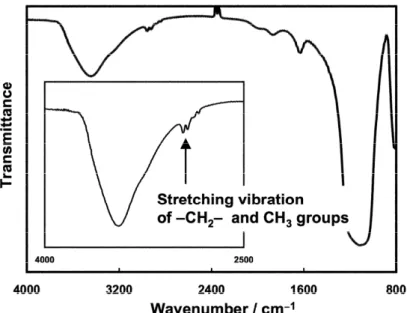
The FT-IR spectrum of synthesized PP-g-SiO2 was measured after careful removal of
ungrafted chains with hot o-dichlorobenzene (Figure 1). The peaks at 2920 and 2950 cm1
(corresponding to the C-H stretching vibrations for the -CH2- and -CH3 groups) indicate the
successful grafting. TG analyses were performed to evaluate the amount of PP chains grafted on SiO2 (Figure 2). PP-g-SiO2 exhibited 12.4 wt% of the weight loss between 200
and 650C. Referencing the weight loss of 11.1 wt% for unmodified SiO2 in the same
temperature range, the amount of the grafted PP chains was estimated as 1.3 wt%. Assuming a poreless and perfect sphere for the SiO2 particles, the number of the grafted
chains was calculated as 1 chain/particle. The amount of the octadecyl group grafted on SiO2 was similarly obtained to be 7.5 wt%.
3.2. Dispersion State of fillers
The dispersion of unmodified SiO2, PP-g-SiO2 and C18-SiO2 in the matrix was studied
by TEM (Figure 3). All the fillers formed small aggregates of 20-100 nm in the matrix. Up to the filler content of 4.0 wt%, the dispersion of PP-g-SiO2 and C18-SiO2 was better than
that of unmodified SiO2. At the filler content of 10 wt%, the three kinds of fillers similarly
formed large and extended aggregates. The better dispersion of PP-g-SiO2 and C18-SiO2
aggregates, which are 50% smaller for PP-g-SiO2 and 30% for C18-SiO2. The average
diameters are about 30% smaller for both PP-g-SiO2 and C18-SiO2. This result proved the
effectiveness of the grafting of PP chains in improving the dispersion of fillers in the PP matrix, even though the grafted amount was as small as 1 chain/particle. The observed dispersion for the three kinds of fillers might be correlated with their cohesion abilities. The modification by short alkyl groups is known to largely reduce the surface energy of SiO2
[24], leading to better dispersion. On the other hand, the largely modified dispersion for PP-g-SiO2 can be explained not only by reduction of the surface energy through the grafting,
but also by steric hindrance from the grafted PP chains [13]. The way of the aggregation clearly depended on the kinds of the fillers. The aggregates of unmodified SiO2 were larger
and had an open or extended shape, while those of PP-g-SiO2 and C18-SiO2 were much
smaller and more compact. Bartholome et al. reported similar effects of grafted PS chains on the dispersion of SiO2 in PS [21].
3.3. Crystalline structure and crystallization behavior
The WAXD patterns of pristine PP, PP/SiO2, and PP/PP-g-SiO2 (Figure 4) exhibited typical
characteristics of the -form crystal with the peaks of 2 = 14.07, 16.85, 18.51, 21.08 and 21.77 corresponding to (110), (040), (130), (111) and (131) reflections, respectively [25]. The other crystalline forms were never observed. Thus, SiO2 nanoparticles and their
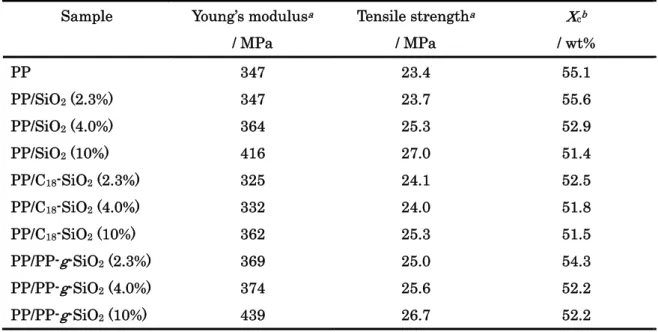
modification had few influences on the crystalline structure of the PP matrix. The WAXD crystallinities (c) summarized in Table 2 were quite similar for all the samples, which
allowed us to fairly compare the mechanical properties of the different samples.
Isothermal crystallization of the nanocomposites was tracked by DSC to examine influences of the fillers on the crystallization behavior of the matrix (Figure 5). Surface organic modification of fillers sometimes enhances a nucleating ability of fillers. It was found that the crystallization of PP was considerably accelerated by the addition of PP-g-SiO2: the crystallization rate was 0.14 min1 for PP/SiO2 at the SiO2 content of 2.3 wt%,
while that of PP/PP-g-SiO2 was 0.30 min1 at the same content. The C18 modification of
SiO2 did not give such that significant enhancement of the nucleating ability. Thus, the
high nucleating ability was originated by the molecular structure of grafted chains rather than the surface bulk nature such as surface energy.
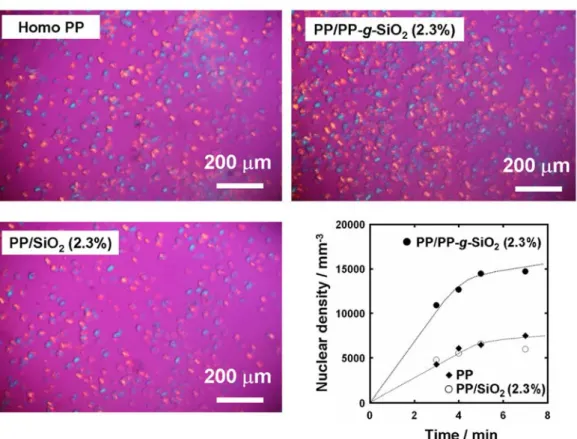
The origin of the high nucleating ability of PP-g-SiO2 was examined by POM, where
the time-course increase of the nuclear densities was plotted during isothermal crystallization at 130ºC (Figure 6). The nuclear density became more than twice by the addition of PP-g-SiO2, indicating that the increase of the crystallization rate by PP-g-SiO2
growth. On the other hand, unmodified SiO2 hardly altered the nuclear density of pristine
PP. Based on the result that the grafted PP chains having the same primary structure with the matrix chains significantly enhanced the nuclear density, it was plausible that the crystallization of the matrix was initiated by the grafted chains with one chain end pinned to SiO2.
3.4. Mechanical properties
Results of Tensile tests are summarized in Figure 7 and Table 2. Unmodified SiO2
hardly affected the Young’s modulus and tensile strength at the lowest filler content, while increased these values above 4.0 wt%. The onset of the reinforcement at 4.0 wt% coincided with the formation of the percolation (described later). PP-g-SiO2 showed the most notable
reinforcement at the lowest content compared with unmodified SiO2. The degree of the
reinforcement became closer to that for unmodified SiO2 at higher contents, but always
larger. Only the exception was the tensile strength at 10 wt%, where the break in elongation occurred in a very early stage for PP-g-SiO2. The C18-modification of SiO2
affected negatively, even though C18-SiO2 showed the better dispersion than unmodified
SiO2.
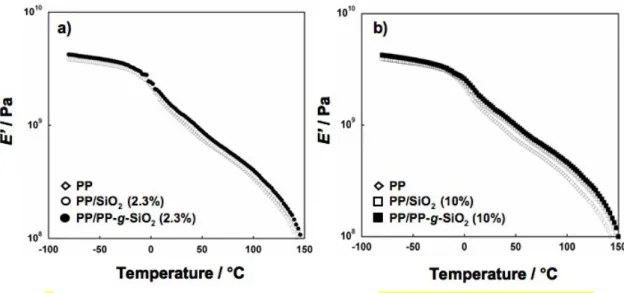
Rheological properties were evaluated to investigate interaction between the matrix and fillers. The temperature dependences of E’ and tan are shown in Figures 8 and 9, respectively. The glass transition temperatures (Tg) determined from E” increased about
5C by modifications irrespective of the content and kind of the fillers (not shown). The E’ values below Tg were almost the same among all the samples. The E’ values above Tg were
increased by the addition of both unmodified SiO2 and PP-g-SiO2 (Figure 8). However, the
ways of the increases were different between the two kinds of fillers: increase of the E’ value from pristine PP was about 2 times higher for PP-g-SiO2 compared with unmodified SiO2,
while the advantage of PP-g-SiO2 over PP/SiO2 became much smaller at higher contents.
These trends for E’ are in line with the results of tensile tests. The peak intensity and area of tan at the glass transition generally correlate with the portion of the amorphous phase and/or the mobility of polymer chains therein [4]. Unmodified SiO2 and PP-g-SiO2 similarly
reduced the peak intensity of tan (compared with pristine PP) (Figure 9). As shown in the c values of Table 2, the amorphous portion was similar among all the samples. Hence, the
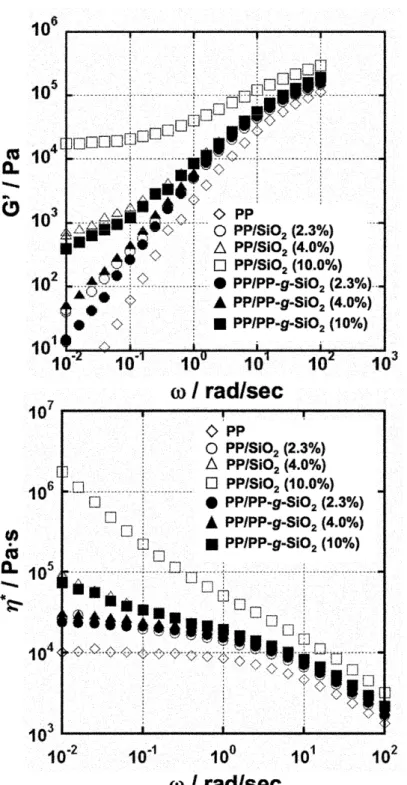
peak reduction by the addition of the fillers must be ascribed by reduced mobility of the amorphous chains, which is known as a confinement effect by nanoparticles [4, 26, 27]. The frequency dependences of G’ and complex viscosity * were shown in Figure 10. A large
difference was observed between pristine PP and the nanocomposites in the low frequency region (< ~0.1 rad/sec). Both G’ and * significantly increased by the addition of the fillers.
At the filler content of 2.3 wt%, the two nanocomposites had similar G’ values with terminal flow. However, the increase of G’ was much more for unmodified SiO2 at the higher
contents. A plateau appeared instead of the terminal flow at the content over 4 wt% for unmodified SiO2, and at the content of 10 wt% for PP-g-SiO2. The appearance of the
plateau in G’ accompanied drastic increase of * by an order of magnitude. This
phenomenon at higher filler contents is general for particulate nanocomposites, and indicates the formation of percolation network of fillers. The percolation has been most precisely studied for polymer/clay nanocomposites, and percolation networks through direct connections among platelets such as “edge-to-edge” or “edge-to-face” have been reported [28-30]. On the other hand, it has been considered for polymer/SiO2 nanocmomposites that
fractal structures formed by open aggregates of SiO2 nanoparticles are responsible for the
percolation [31]. As shown in Figure 3, unmodified SiO2 formed rather open aggregates in
the matrix, while PP-g-SiO2 and C18-SiO2 existed as smaller and compact aggregates. The
lower percolation threshold for PP/SiO2 is clearly explained by this fact, where the
percolation thresholds were between 2.3-4.0 wt% for unmodified SiO2 and 4.0-10 wt% for
PP-g-SiO2.
3.5. Discussion
The obtained effects of the fillers are briefly summarized as follows. Modified SiO2
(PP-g-SiO2 and C18-SiO2) apparently improved the filler dispersion except at the highest
filler content (Figure 3). PP-g-SiO2 and C18-SiO2 made smaller but compact aggregates,
while unmodified SiO2 made network-like aggregates connected with each other.
PP-g-SiO2 showed the nucleation ability much higher than C18-SiO2 and SiO2 (Figure 5). It
was believed that the grafted PP chains initiate the crystallization of the matrix due to their lower mobility and to the same primary structure with the matrix. PP-g-SiO2 showed the
highest reinforcement in the tensile test at the lowest filler content (Figure 7). On the other hand, the degree of the reinforcement was similar to that of unmodified SiO2 over 4.0
wt%. The reinforcement by C18-SiO2 was much poorer, in spite of the better dispersion of
C18-SiO2 than unmodified SiO2. SiO2 and PP-g-SiO2 similarly reduced the intensity of tan
at the glass transition (Figure 9), indicating that the confinement of the amorphous chains by SiO2 nanoparticles was not affected by the grafted chains. G’ of PP/SiO2 at low
frequencies was larger than that of PP/PP-g-SiO2 in the molten state (Figure 10), on the
contrary to the higher Young’s modulus and E’ of PP-g-SiO2 in the solid state. The
disappearance of the terminal flow (corresponding to the formation of percolation network) occurred at a lower filler content for unmodified SiO2 that for PP-g-SiO2. Hereafter, the
discussed, for which C18-SiO2 offers a useful reference.
Although the reinforcement mechanism in polymer-based nanocomposites has not been fully understood yet, the numerous efforts have identified plausible mechanisms into i) strong interfacial interaction between matrix chains and filler particles, and ii) percolation or network structures of filler particles. Load transfer to fillers based on these two mechanisms are also affected by the content, stiffness, aspect ratio, surface chemical nature and dispersion state of fillers.
The percolation threshold for PP/SiO2 lay within the filler content 2.3-4.0 wt%. The
results of tensile tests for unmodified SiO2 were well correlated with the dependence of G’ on
the filler content: little reinforcement at 2.3 wt% before the percolation and sharp increases of the Young’s modulus and tensile strength from 4.0 to 10 wt% after the percolation. Thus, the reinforcement for unmodified SiO2 is believed to be mainly based on the percolation.
On the other hand, PP-g-SiO2 showed the most prominent reinforcement in the tensile test
(compared with unmodified SiO2) at the lowest filler content, i.e. before the percolation.
This suggests that some strong interaction between the matrix and filler particles was responsible for the observed reinforcement. Better dispersion of fillers has been believed to result in higher reinforcement because of more homogeneously distributed load transfer to particles. In this viewpoint, PP-g-SiO2 was considered to be advantageous at lower filler
contents. However, as was described in introduction, good dispersion of fillers is not a sufficient condition for the reinforcement. In fact, C18-SiO2 with better dispersion than
unmodified SiO2 never showed notable improvements. These results claim the importance
of the quality of the interaction between the matrix and filler particles. As in the results of DSC and POM (Figures 5 and 6), the largest difference between PP-g-SiO2 and C18-SiO2
appeared in the nucleating ability of the fillers: the key factor for the nucleation was the molecular structure of grafted chains rather than the surface bulk natures. The considerably high nucleation ability of PP-g-SiO2 suggested the crystallization of the matrix
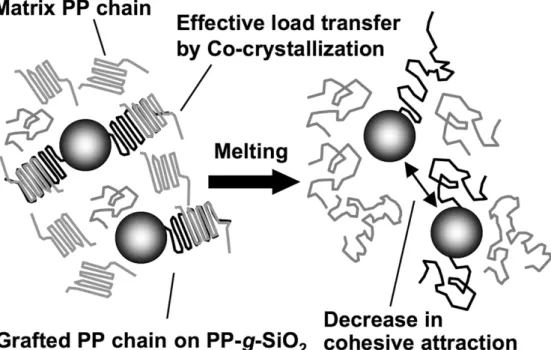
initiated from the grafted chains having the same primary structure with the matrix chains. In this way, we propose that the grafted chains are preferentially co-crystallized together with the matrix PP, and play a role of direct bridges between the matrix and filler particles for effective load transfer. This mechanism is supported by the poorer reinforcement in G’ for PP/PP-g-SiO2 than that of unmodified SiO2 at the lower contents, where all crystallites
were molten. The C18 modification was not effective for both the percolation and
co-crystallization, leading to the poorest reinforcement.
A schematic image of PP/PP-g-SiO2 for both the solid and molten states is drawn in
Figure 11. Since the PP chains covalently grafted to SiO2 particles preferentially
occurred in the solid state, resulting in the better mechanical properties even at the lower contents much before the percolation. On the other hand, the grafted PP chains gave better filler dispersion by steric hindrance without a large increase of complex viscosity in the molten state.
4. Conclusion
In this study, a PP/SiO2 nanocomposite having the same primary structure for the
matrix and grafted PP chains was synthesized. PP-g-SiO2 achieved much higher
reinforcement than unmodified SiO2, at a low filler content (2.3 wt%). We have proposed a
reinforcement mechanism that the grafted PP chains trigger the crystallization of the matrix and are imparted in the lamellae of the matrix, thus directly bridging between the matrix and filler particles for effective load transfer. On the contrary, the increase of the viscosity in melt by the addition of SiO2 was partially suppressed with the grafted PP chains.
In this way, to graft PP chains having an identical structure to matrix chains can be a successful strategy to achieve significant reinforcement of PP-based nanocomposites, without sacrificing processability and light weight. Further improvements in the mechanical properties will be achieved by the optimization of the amount and structure of the grafted chains.
References
[1] Ray SS, Okamoto M (2003) Prog Polym Sci 28:1539-1641
[2] Kojima Y, Usuki A, Kawasmi M, Okada A, Fukushima Y, Kuraushi T, Kamigaito O (1993) J Mater Res 8:1185-1189
[3] Zhang Q, Archer LA (2002) Langmuir 18:10435-10442
[4] Tsagaropoilos G, Eisenberg A (1995) Macromolecules 28:6067-6077 [5] Nitta K, Asuka K, Liu B, Terano M (2006) Polymer 47:6457-6463
[6] Hasegawa N, Okamoto H, Kato M, Usuki A (2000) J Appl Polym Sci 78:1918-1922
[7] Garcia M, Vliet G, Jain S, Schrauwen BAG, Sarkissov A, Zyl WE, Boukamp B (2006) Rev Adv Mater Sci 6:169-175
[8] Bikiaris DN, Papageorgiou GZ, Pavlidou E, Vouroutzis N, Palatzoglou P, Karayannidis GP (2006) J Appl Polym Sci 100:2684-2696
[9] Morlat S, Mailhot B, Gonzalez D, Gardette JL (2004) Chem Mater 16:377-383 [10] Kaminsky W, Funck A, Wiemann K (2006) Macromol Symp 239:1-6
[12] Funck A, Kaminsky W (2007) Compos Sci Technol 67:906-915
[13] Wu CL, Zhang MQ, Rong MZ, Friedrich K (2002) Compos Sci Technol 62:1327-1340
[14] Rong MZ, Zhang MQ, Zheng YX, Zeng HM,Walter R, Friedrich K (2001) Polymer 42:167-183 [15] Cai LF, Huang XB, Rong MZ, Ruan WH, Zhang MQ (2006) Polymer 47:7043-7050
[16] Zhou HJ, Rong MZ, Zhang MQ, Ruan WH, Friedrich K (2007) Polmer Eng Sci 47:499-509 [17] Maier RD, Thomann R, Kressler J, Mülhaupt R, Rudolf B (1997) J Polym Sci Part B: Polym Phys
35:1135-1144
[18] Phillips RA (2000) J. Polym Sci Part B: Polym Phys 38:1947-1964 [19] Silvestri R, Sgazi P (1998) Polymer 39:5871-5876
[20] Fragneaud B, Varlot KM, Montiel AG, Terrones M, Cavaillè JY (2008) Compos Sci Technol 68:3265-3271
[21] Bartholome C, Beyou E, Lami EB, Cassagnau P, Chaumont P, David L, Zydowicz N (2005) Polymer 46:9965-9973
[22] Yang BX, Pramoda KP, Xu GQ, Goh SH (2007) Adv Funct Mater 17:2062-2069 [23] Han CJ, Lee MS, Byun DJ, Kim SY (2002) Macromolecules 35:8923-8925 [24] Vidal A, Papirer E, Jiao WM, Donnet JB (1987) Chromatographia 23:121-128 [25] Farrow G (1961) Polymer 2:409-417
[26] Zhang X, Loo LS (2009) Macromolecules 42:5196-5207
[27] Wilkinson AN, Man Z, Stanford JL, Matikainen P, Clemens ML, Lees GC, Liauw CM (2006) Macromol Mater Eng, 291:917-928
[28] Okamoto M, Morita S, Kim YH, Kotaka T, Tateyama H (2001) Polymer 42:1201-1206 [29] Okamoto M, Nam PH, Maiti P, Kotaka T, Hasegawa N, Usuki A (2001) Nano Lett 1:295-298 [30] Wagener R, Reisinger TJG (2003) Polymer 44:7513-7518.
Fig. 1 IR spectrum of PP-g-SiO2
Fig. 2 TG analysis of PP-g-SiO2 and unmodified SiO2. The amount of grafted PP chains on SiO2 was
Fig. 3 TEM images of prepared PP-based nanocomposites. Filler contents were varied from 2.3 to 10
Fig. 4 WAXD patterns of pristine PP and nanocomposites. Regardless of the filler contents, all the
samples showed characteristic peaks of -form and other forms were never observed.
Fig. 5 DSC curves for isothermal crystallization at 128C
Fig. 6 POM images in isothermal crystallization at 130C (t = 7 min) and the time dependence of the
Fig. 7 Stress-strain curves (cross head speed of 1 mm/min) at the filler content of a) 2.3 wt% and b) 10
Fig. 8 Temperature dependence of tensile storage modulus E’ for pristine PP and nanocomposites.
Measurements were performed in the temperature range from 80 to 170C with a heating rate of 3C/min and the frequency of 10 Hz.
Fig. 9 Temperature dependence of loss tangent for pristine PP and nanocomposites. Measurements
were performed in the temperature range from 80 to 170C with a heating rate of 3C/min and the frequency of 10 Hz.
Fig. 10 Frequency dependence of shear storage modulus G’ (upper) and (bottom) complex viscosity *
for pristine PP and nanocomposites. Measurements were performed at 180C with a frequency range from 100 to 0.01 rad/sec under N2 atmosphere.
Table 1 Size of SiO2 aggregatesa
Sample Area / 104 nm2 Feret diameter / nm
PP/SiO2 (2.3%) 4.60 338 PP/SiO2 (4.0%) 5.03 340 PP/PP-g-SiO2 (2.3%) 2.15 218 PP/PP-g-SiO2 (4.0%) 2.62 230 PP/C18-SiO2 (2.3%) 2.82 250 PP/C18-SiO2 (4.0%) 3.52 250
a Approximately 400 aggregates of SiO2 were analyzed and averaged by a software.
Table 2 Mechanical properties and crystallinities
Sample Young’s modulusa
/ MPa Tensile strengtha / MPa cb / wt% PP PP/SiO2 (2.3%) PP/SiO2 (4.0%) PP/SiO2 (10%) PP/C18-SiO2 (2.3%) PP/C18-SiO2 (4.0%) PP/C18-SiO2 (10%) PP/PP-g-SiO2 (2.3%) PP/PP-g-SiO2 (4.0%) PP/PP-g-SiO2 (10%) 347 347 364 416 325 332 362 369 374 439 23.4 23.7 25.3 27.0 24.1 24.0 25.3 25.0 25.6 26.7 55.1 55.6 52.9 51.4 52.5 51.8 51.5 54.3 52.2 52.2