Can the Common
European
Framework
Be the Standard
for English
Proficiency
Testing?
Yoshihiro
Omura
1 . Introduction
There are numerous English proficiency exams available today in Japan as well as in the world. In fact, test takers have the luxury of choosing which one they prefer. However, are all such tests able to measure an individual's proficiency level accurately, consistently, and at approximately the same competence level? Do all the exams test the skills needed for specific purposes, such as academic and/or professional work, as they claim? This paper will classify, review and compare most of the globally recognized English proficiency exams, as well as a few others offered mostly in Japan, in terms of tested skills, availability, format, cost and acceptability. This paper focuses on globally available English exams that test general English proficiency for adults and, thus, does not thoroughly review English exams that are available only in a single country or English exams for children. English proficiency exams that are available only in a specific country include General English Proficiency Test (GEPT) in Taiwan, and Test of English Proficiency Developed by Seoul National University (TEPS), Test of Oral Proficiency in English (TOP), and Test of Written Proficiency in English (TWP) in South Korea. English for specific purposes are listed in Table 5 and briefly reviewed. Exams for younger learners include London Tests of English for Children, Cambridge Young Learners English Tests, and Jido EIKEN (or English Proficiency Tests for children offered in Japan).
2 . The Common European Framework of Reference for Languages
Is it, then, possible to compare the test results on one test to another based upon comparisons? As Taylor (2004) states, the "ability to relate different tests to one another in useful and meaningful ways is becoming more and more important for test users (p. 2)."
ritliOd 7 t 2j-6' (2007 • 12)
Thus, having a common standard will make it easier for anyone to compare the test results across the platforms, especially for those who need to rank order examinees' English proficiency for various purposes. Following the widely accepted standard in Europe, many exams today seem to have adopted the Common European Framework of Reference for Languages as a benchmark. Although some researchers refer to the Common European Framework of Reference for Languages as CEFR, this paper will use the more common term, CEF. This paper will explore whether it is realistic to compare and relate various English proficiency exams using the CEF as the proficiency level indicator. Due to the nature of this investigation, the most up-to-date information has been obtained from websites all accessed as of September 2007, unless otherwise indicated.
First of all, it is necessary to review the CEF. The CEF is "a document which describes in a comprehensive manner i) the competences necessary for communication, ii) the related knowledge and skills and iii) the situations and domains of communication (Council of Europe, 2007)." The CEF gives guidelines to course designers, textbook writers, testers, teachers and teacher trainers — in fact to all who are involved in language teaching and testing. The Council of Europe, the oldest organization working for European integration since 1949, has developed the CEF in cooperation with several organizations in order to promote the project "Language Learning for European Citizenship" between 1989 and 1996. The Council of Europe needed a common basis, i.e., the CEF level description, to be able to link the language proficiency levels across languages used in Europe for the unity of the region.
The Association of Language Testers in Europe (ALTE 1), an association of academic institutions within Europe which produce examinations for and certify language learners, was one of the contributing organizations to the development of CEF. The ALTE completed a long term project to establish their 'Can Do' statements in order to define levels of ability for language users at each level. Since some ALTE members were involved in the development of the CEF, the ALTE 'Can Do' statements and the ALTE framework were quickly linked
1 The concept of ALTE was initially formed by the Universities of Cambridge and Salamanca late in 1989. At the first meeting of the association in 1990 there were eight founding universities. Since then membership has grown so that there are now 31 members, representing 26 European languages.
to the CEF. Thus, the
adapted from the ALTE
CEF levels came to be described by a series 'C
an Do' statements.
of 'Can Do' statements
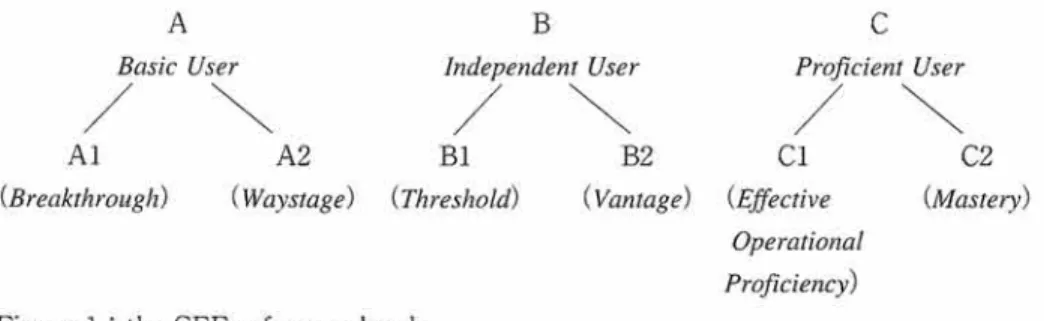
A Basic User Al A2 (Breakthrough) (Waystage) B Independent User B1 (Threshold)
Figure 1 : the CEF reference levels
Table 1 : B2 (Vantage) C Proficient User Cl (Effective Operational Proficiency) C2 (Mastery)
Common Reference Levels : Global Scale (Common European Framework, p. 24)
Al A2 Bl B2 Cl C2
Can understand and use familiar everyday expressions and very basic phrases aimed at the satisfaction of needs of a concrete type. Can introduce him/herself and others and can ask and answer questions about personal details such as where he/she lives, people he/she knows and things he/she has. Can interact in a simple way provided the other person talks slowly and clearly and is prepared to help.
Can understand sentences and frequently used expressions related to areas of most immediate relevance (e.g. very basic personal and family information, shopping, local geography, employment). Can communicate in simple and routine tasks requiring a simple and direct exchange of information on familiar and routine matters. Can describe in simple terms aspects of his/her background, immediate environment and matters in areas of immediate need.
Can understand the main points of clear standard input on familiar matters regularly encountered in work, school, leisure, etc. Can deal with most situations likely to arise whilst traveling in an area where the language is spoken. Can produce simple connected text on topics which are familiar or of personal interest. Can describe experiences and events, dreams, hopes & ambitions and briefly give reasons and explanations for opinions and plans.
Can understand the main ideas of complex text on both concrete and abstract topics, including technical discussions in his/her field of specialization. Can interact with a degree of fluency and spontaneity that makes regular interaction with native speakers quite possible without strain for either party. Can produce clear, detailed text on a wide range of subjects and explain a viewpoint on a topical issue giving the advantages and disadvantages of various options.
Can understand a wide range of demanding, longer texts, and recognize implicit meaning. Can express him/herself fluently and spontaneously without much obvious searching for expressions. Can use language flexibly and effectively for social, academic and professional purposes. Can produce clear, well-structured, detailed text on complex subjects, showing controlled use of organizational patterns, connectors and cohesive devices.
Can understand with ease virtually everything heard or read. Can summarize information from different spoken and written sources, reconstructing arguments and accounts in a coherent presentation. Can express him/herself spontaneously, very fluently and precisely, differentiating finer shades of meaning even in more complex situations.
Afitic*TiF4ftri gISEW 7 a 2 161- (2007 • 12)
The Common European Framework divides learners into six levels as Figure 1 shows. Each level is on a global scale and aspects of language learning (e.g, grammatical competence, sociolinguistic knowledge) are described. Table 1 illustrates how each level is referenced in the 'Can Do' style though only on the global scale.
Being thorough and clear, the CEF level description seems to be becoming the global benchmark for assessing language teaching and testing.
3 . English Exams
Fifteen English proficiency exams available today are listed and classified in Tables 2, 3, and 5 : Some are well-known to the general public, while others may be known only in a particular region. English proficiency exams are given either for general or specific purposes. Some general English exams are offered at several levels and test takers either pass or fail each level, while others provide test scores or assign proficiency levels depending on how well the test taker performed. As for the test score usage, some exams are used mainly for college admission in English speaking countries by international students who are not native speakers of English, while other tests are used by corporations needing a reliable way of assessing the language ability of employees or trainees. Thus, this paper classifies English exams into three categories 1) multi-band general English exams, 2) general English exams given at each level, and 3) English exams for specific purposes. English exams only in category 1), i.e., multi-band general English exams, are internationally available, while exams for each level and exams for specific purposes are offered mostly in the domestic market. In this sense, Cambridge ESOL exams (i.e., CPE, CAE, FCE, PET, and KET) are the only exceptions in that they are offered internationally through British Council and Cambridge ESOL subsidiaries.
A quick glance will reveal that University of Cambridge and Educational Testing Service (ETS) are the two major testing organizations in the world today. University of Cambridge offers a wide range of exams from general English to English for Specific Purposes such as business, law and finance. In fact, according to their website, over 2 million people in 130 countries take Cambridge ESOL exams each year. On the other hand, ETS offers two of the most widely taken English language exams : Test of English for International Communication
(TOEIC) and Test of English as a Foreign Language (TOEFL).
3-1. Multi-band General English Exams
As Table 2 shows, there are at least several globally recognized, widely popular multi-band general English exams : some measure general skills, while others are designed to see if a test taker has enough English proficiency level to work in an academic or business setting. These are categorized as 'multi-band' because these tests are not designed for learners at a specific proficiency level on a pass or fail basis. Rather, these exams provide test scores or assign levels in their test reports.
Table 2 : Multi-band general English exams, which assign scores or levels
Testing Organization Tested History Frequency # of test Test fee' In
skills' takers * Japan
TOEIC ETS LR 1979— 8/year 4.5 million Y 6,615 (LR)
LPI LPI 1980— 1.5 million Y 13,000 (LPI) 0
LR+SW SW 2006— (in Japan) ¥9,975 (SW)
TOEFL ETS LRSW 1964— every week 320,000 $ 170
CBT 1998— 18,000 0
iBT 2005— (in Japan)
IELTS University of Cambridge
British Council LRSW 1989— 2/month 0.5 million Y 24.675 0
IDP : IELTS Australia
MELAB U of Michigan LRSW 1985— 1/mo at UM 4,794 $ 80, x
(S option) $ 120 (w/S)
TEPS Language Education LRSW 1999— 1/month 183,000 30.000 Won x
Institute (S. Korea) Reading * in 2005 -6
3-1-1. TOEIC
Among the multi-band general English exams, the TOEIC test is best known to the
2 L-listening, R-reading, S-speaking, W-writing
3 Exchange rates for the listed currencies are as follows as of September 26, 2007: $ 1----Y114.65, 1 Won=Y0.126.
idaiC'4-4M4-4ftWii1S42, 7 t 2-- (2007 • 12)
general public in Japan. TOEIC is the acronym for Test of English for International Communication. ETS developed the TOEIC test at the request of the Japanese Ministry of Trade and Industry in the 1970s and the first test was given in 1979 in five cities in Japan. As of 2006, it had been taken by 4.5 million people in more than 60 countries, including 1.5 million Japanese. In Japan, the Institute for International Business Communication administers the TOEIC test. ETS claims that the TOEIC test is a global standard for the assessment of communicative English ability. Important to the TOEIC test is that the proficiency of the examinee is indicated by a numerical score between 5 and 495 for both the listening and the reading parts, thus giving a total score between 10 and 990 rather than a pass or a fail. Companies use the TOEIC test as a tool to assess the English proficiency of employees, as a standard for selecting personnel for overseas assignments, and as a criterion for promotion and pay increases. The TOEIC test is also used by universities as a placement test where its scores may be accepted as a substitute for English language course requirements. The TOEIC test changed in 2006 by modifying the test format and by providing four different accents in the listening section, which represent United States, Canada, Britain, and Australia rather than only North American accent.
Despite its growing popularity, however, TOEIC has received criticism from researchers in mainly two aspects. One is that it is not clear if it is "a test of general proficiency or a test of a language for business-related communication, or both (p. 19, O'Sullivan.) " The other is that it does not measure everyday skills such as speaking or pragmatics in an international work environment because it focuses only on listening and reading (p. 18, O'Sullivan). Reagarding the first point, ETS states different purposes of TOEIC on its websites. In their USA-based site, it says that "the Test of English for International Communication (TOEIC) is an English language test designed specifically to measure the everyday English skills of people working in an international environment'" but it does not specifically indicate English skills in business environment. On the other hand, their European site does indicate that TOEIC
4
htttp://www.ets.org/portal/site/ets/menuitem.1488512ecfd5b8849a77b13bc3921509/?vgnextoid=ed262d3631 df4010Vg0/CM10000022f9519ORCRD8ivgnextchannel=2d40d898c84f4010VgnVCM10000022f9519ORCRD
measures "proficiency in business English at intermediate and advanced levels s". In their Japanese site, test takers receive mixed information. In Japanese, the claim is "43d:/:11-96--h,
< tit-Agiff-C =/ 3 ./.-C;Zt'Lli';-) gill V) Its or it measures how well one can communicate in English on broad topics ranging from everyday life to business' (translated by the researcher) while in English the claim is that " [the TOEIC test is a global standard for the assessment of communicative English ability' and it does not refer to business. Thus, what TOEIC is measuring is confusing and indeed unclear.
The other criticism that TOEIC tests only listening and reading skills also seems to the point. Although ETS (in their Japanese TOEIC site) claims that "the test is designed in such a way that the objective measurement of the passive skills of listening and reading allows an overall assessment of ability to communicate in English, including the productive skills of speaking and writing ", it is not illustrated how the measurement of the passive skills can be used to assess the productive skills. ETS, responding to this criticism, developed and started to offer TOEIC speaking and writing tests in 2006 in Asia and will start these in Europe in October 2007. The speaking and writing tests are given through an internet-based test (iBT), thus examinees are required to type and to speak into a microphone on the computer unlike the paper and pencil format of the original TOEIC listening and reading tests. For both the speaking and writing, the results are indicated in a numerical score between 0 and 200. In addition to the TOEIC speaking and writing tests, ETS has also been offering the TOEIC LPI (Language Proficiency Interview) since 1980 for skilled examinees only in Japan. This is similar to the Oral Proficiency Interview (OPI) offered by the American Council on the Teaching of Foreign Languages (ACTFL). The TOEIC LPI uses a scale similar to the ACTFL OPI scale, which was originally developed based uopn the Foreign Service Institute
(FSI) scale. ETS also offers the TOEIC Bridge test, a simplified TOEIC test which is designed for those at beginning and intermediate proficiency levels. In any case, the TOEIC test has been evolving and improving itself by offering, as an option, four-skill-based test
5 http://www.toeic.eu/no _cache/toeic-sites/choose-your-country/ 6 http://www.toeic.or.ip/toeic/about/
7 http://www.toeic.or.jp/toeic_en/
id-icfi*AllgisEW 7 t 2 (2007 • 12) format and directly measuring productive skills.
3-1 -2. TOEFL
The TOEFL test, one of the oldest English proficiency exams available', evaluates the English proficiency of learners, especially how well they can use and understand American English in an academic setting. It is required for non-native applicants at many English-medium colleges and universities'. The National Council on the Testing of English as a Foreign Language, managed by the Modern Language Association, first developed TOEFL for its initial administration in 1964. Since 1965, ETS has been managing and continuing the development of TOEFL. In 1976, the TOEFL test was revised and the format was shaped into today's paper-based test format (PBT). The final PBT score ranges between 310 and 677 and is based on three subscores : Listening (31— 68), Structure (31 — 68), and Reading (31— 67). Just like TOEIC, TOEFL was also criticized for tesing only passive skills of the examinees (i.e., listening and reading). Responding to the criticism, ETS developed and offered the Test of Spoken English, used for the first time in 1981, to "measure the ability of non-native speakers of English to communicate in a North American context (p. 4, TSE and SPEAK Score User Guide)." The examinees are given 12 questions to respond to approximately in 20 minutes and the scores are reported on a scale of 20 to 60 in increments of five. In addition, ETS started to offer an optional writing section, called the Test of Written English (TWE), taken in conjucntion with the TOEFL test in 1989. Scores for the writing section are assigned on a 1— 6 point scale in increments of 0.5.
In 1990, ETS launched a computer-based test (CBT) TOEFL in order to further accommodate the needs of the test takers. Some of the major improvements included the following : 1) computer-adaptive listening and structure questions, meaning that the difficulty level of the question depended on the correctness of the previous responses, 2) a mandatory writing section was added, and 3) provided the computers and system were available, the
8 See http://www.cieej.or.jp/toefl/mailmagazine/for detailed history of TOEFL in Japan.
9 More than 6,000 institutions in 110 countries use TOEFL scores to select applicants with the English skills needed. (source: http://www.toefl.org/)
examinees could take the test on any day except holidays. The scores are assigned in the following manner. Subscores are obtained on a 0 — 30 scale for each of the listening, structure , and reading sections. Then, these subscores are averaged to obtain the final score, which is on a 0 — 300 point scale. The score for the writing section is assigned separately, on a 1— 6 point scale. In 2005, the newest Internet-based test format (iBT) TOEFL, finally incorporating all four skill sections (i.e., listening, reading, speaking, and writing) was introduced. With the inclusion of the speaking section, the test continues for as long as 4.5 hours. Examinees receive subscores on a 0-30 point scale from the listening, reading, speaking and writing sections, and then, these subscores are added to obtain the final score, which is on a 0-120 point scale. The major changes in the iBT test are following : 1) a speaking section has been added, 2) the examinees are allowed to take notes in all sections, and 3) the questions in all sections have become more realistic and practical to an academic setting. With the introduction of the iBT test, the CBT test was entirely discontinued as of 2006. The PBT, however, is still offered at a few locations irregularly. In sum, the TOEFL test has also improved itself by offering a four-skill-based test format and by directly measuring productive skills. The main drawback regarding the improvements of TOEFL is the fact that the final score scales are different amongst three formats of the TOEFL test. This is very confusing for test takers and other users, even with the use of the conversion table.
3-1-3. IELTS
The International English Language Testing System (IELTS) has a long history of development. The British Council has used the English Proficiency Test battery (EPTB), a traditional multiple choice test, since the mid 1960s to screen international students who wished to study at universities in Britain. In 1980, it was replaced by the English Language Testing Service (ELTS). The ELTS test had a very complicated format. Each candidate was required to take three of the six essay components called modules (i.e., Life Science, Social Studies, Physical Sciences, Technology, Medicine, and General Academic) or one module and two common tests in the General section (i.e., Study Skills, Writing, General Reading, General Listening, and Individual Interview). Because of this complicated format, the test did not attract many candidates and promoted further change. The ELTS test was revised by a joint
id.-RWHI*Volgli42,7'A 2 (2007 • 12)
effort of the British Council and University of Cambridge ESOL Examinations (Cambridge ESOL) then was offered as the IELTS test in 1989. Today, the IELTS test is jointly managed by the British Council, IELTS Australia and Cambridge ESOL, and the exam is offered at more than 350 locations in 120 countries'. It measures English proficiency in four skills for people who intend to study or work where English is the language of communication. The test scores are accepted for admission by most Australian, British, Canadian, Irish, New Zealand and South African universities, by an increasing number of universities in the United States, and by various professional organizations. In 1989, the exam was given in four skill areas (i.e., listening, speaking, reading, and writing). All candidates took the same listening and speaking tests, but there was a choice among three field modules for the reading and the writing test. Module A was Physical Science and Technology, Module B was Life and Medical Science, and Module C was Business Studies and Social Sciences. Examinees received scores on a band scale form 1 ("Non User") to 9 ("Expert User") for each skill as well as an overall band score. In 1995, further modifications to the test were implemented ; the field specific reading and writing modules were replaced by one academic reading and one academic writing module with more generalized content. At the same time, general training reading and writing modules were introduced. Thus, all candidates today take the same listening and speaking tests, but choose between academic and general training for the reading and the writing tests. There was further improvement to scoring in 2007: examinees receive scores on a band scale form 1 ("Non User") to 9 ("Expert User") in whole and half bands for each skill as well as an overall band score. The IELTS test is also experiencing continuing development. From 2005, selected IELTS test centers started to offer a computerized version of the test.
3-1-4. MELAB
The Michigan English Language Assessment Battery (MELAB) was developed by the English Language Institute (ELI) at the University of Michigan in 1985 to assess the English proficiency of applicants applying to universities, colleges, or community colleges in the United
States and Canada. The MELAB is designed to measure one's proficiency in the four basic language skill areas : writing, listening, reading, and speaking. The entire MELAB lasts 2.5 hours and consists of three mandatory parts : a written composition, a listening comprehension test, and a multiple choice test containing grammar, cloze reading, vocabulary, and reading comprehension problems. In addition, one can choose to take an optional speaking test. Many academic institutions in the US and Canada accept the MELAB as an alternative to the TOEFL, but it is not as widely accepted as TOEFL or IELTS. The unpopularity is clearly seen in the number of examinees. Only 4,794 learners took the MELAB test in 2006, whereas 320,000 took TOEFL and 500,000 took IELTS due to the limited number of acadamic institutions that accept MELAB as well as limited number of test locations outside the United States.
3-1-5. TEPS
The Test of English Proficiency developed by Seoul National University (TEPS) is an English proficiency test created by the Language Education Institute of South Korea to evaluate Korean test takers' English proficiency. TEPS consists of 200 questions in four sections (i.e., Listening [60 Questions], Grammar [50 Questions], Vocabulary [50 Questions] and Reading [40 Questions]). TEPS has been administered throughout South Korea since January 1999 and some claim that it is gaining popularity over TOEIC there. However, only 183,000 took TEPS, while 1.8 million took TOEIC in 2005. The English exam trend may change in 2011 when the Ministry of Education and Human Resources Development introduces its own new government-administered English test, which will assess four skills.
3-2. General English exams given at each level
There are two very popular general English exams out of Britain, while there is only one from the Unites States. Among these, only the ones by Cambridge ESOL are available in Japan. In addition, several countries have similar English exams that are available exclusively for domestic use, such as the Society for Testing English Proficiency (STEP) exam in Japan and General English Proficiency Test (GEPT) in Taiwan. The following section will review some of these in detail.
id-icP4-*Z-11,MSEW 7 t 2 (2007 • 12)
Table 3 : General English Exams given at each level
Test name Level
name CEF level Testing organization Tested skills
History Frequency Test fee" In Japan Cambridge ESOL CPE C2 U of Cambridge 4 skills 1970s — 1/month €150 0 CAE Cl 1990— €150 0 FCE B2 2004— € 140 0 PET B1 1970s — €80 0 KET A2 1994— €75 0 Michigan ECPE C2 U of Michigan 4 skills 1953— 1/year $ 46 x
ECCE B2 2/year N/A
LTE
Level 5 C2
Pearson
Group 4 skills 1982— 3-5/year S 100
x Level 4 Cl Level 3 B2 Level 2 B1 Level 1 A2 Level Al Al EIKEN 1 N/A STEP 4 skills 1963— 3/year Y 7500 0 in US and UK pre-1 Y6000 2 4 skills * Y4100 pre-2 Y3600 3 Y2500 4 3 skills ** Y 1500 5 Y 1400 GEPT (General English Proficiency Test) Superior N/A The Language Training and Testing Center (Taiwan) 4 skills 2004— by request N/A x Advanced 2002— 1/year 1650 TWD Hi-Intermediate 2001— 2/year 800 TWD Intermediate 2000— 650 TWD Elementary 2001— 580 TWD
* no actual writing ** no speaking
3-2-1. Cambridge ESOL Exams : CPE, CAE, FCE, PET, and KET
The University of Cambridge ESOL examinations (Cambridge ESOL) test English proficiency for non-native speakers of English. These are taken by over 2 million learners in more than 130 countries each year. Exams cover general English, Business English, Academic English and English for Young Learners. The general English exams consist of the Key English Test (KET), Preliminary English Test (PET), First Certificate in English (GCE),
11 Exchange rates for the listed currencies are as follows as of September 26, 2007: 1 TWD:=43.48, € 1=Y161.25, £ 1=Y230.31, $ 1=Y114.65
Certificate in Advanced English (CAE), and Certificate of Proficiency in English (CPE). Each exam level corresponds to the CEF level as seen in Table 6 below.
All five exams are given in a paper format, testing listening, reading, speaking and writing skills, but the number of paper is different depending on the proficiency level : KET and PET has three papers (Reading and Writing, Listening, and Speaking) and FCE, CAE, and CPE have five papers (Reading, Writing, English in use, Listening, and Speaking). Although the number of CPE candidates is not disclosed, the numbers of applicants for other exams are : over 46,000 for KET, over 96,000 for PET, over 250,000 for FCE, and over 70,000 for CAE in 2002. Cambridge ESOL offers the IELTS English exam for academic purpose which, as well as CAE and CPE, is accepted at most secondary institutions worldwide for admission. The British Council used to administer these five exams in Japan until summer 2007, but they will henceforth be offered only through Cambridge ESOL Japan office. Detailed information is not available as of October 2007 yet.
3-2-2. Michigan English Exams : The Examination for the Certificate of Proficiency in English and the Examination for the Certificate of Competency in English
Founded by Charles C. Fries in 1941, the English Language Institute (ELI) at the University of Michigan was the first academic institute to teach and conduct research in English as a Second Language in the United States. Under the contract to the United States Information Agency, the ELI developed the Examination for the Certificate of Proficiency in English (ECPE) in 1953. Today, the exam is given annually at approximately 125 test centers in 20 countries. Examinees who perform satisfactorily on all sections receive an official certificate. The ECPE is an advanced-level general English as a Second or Foreign Language proficiency test in four sections. The first three sections are speaking, writing, and listening. The last section includes grammar, cloze, vocabulary and writing. The scoring system is shown in Table 4. Although the ECPE is designed for academic use, one can request to have their ECPE certificate converted into an MELAB score and have it sent to institutions that accept those because MELAB score is already accepted by universities.
i.q.2/-1-1,f4ftWg-132, 7 t 2 24- (2007 • 12)
Table 4 : The ECPE Scoring System
SECTION HONORS PASS FAIL
Speaking 4 3 — 2 1
Writing A B — C D
Listening above 90% above 60% — 65% below 60% — 65%
Grammar, Ooze,
Vocabulary and Reading above 90% above 60% — 65% below 60% — 65%
The Examination for the Certificate of Competency in English (ECCE) test is a simpler version of ECPE. It is a high-intermediate level English as a Second or Foreign Language proficiency test in the same skill areas as ECPE. Unlike the ECPE's four scale scoring in speaking and writing sections, examinees of the ECCE receive their results on a five point scale (A, B, C, D, or E). Although the ELI at the University of Michigan still plays a key role in the development of English language teaching and research throughout the world, its influence today seems smaller compared to when it was the model English language teaching institute. This is possibly due to strong competition by ETS and University of Cambridge ESOL. Thus, the ECPE and ECCE tests are not as widely accessible nor are they offered as frequently to examinees as other institutional exams.
3-2-3. London Tests of English : Level 5, 4, 3, 2, 1, and Al
The London Tests of English (LTE) were originally developed in 1982 by the University of London Schools examination board, which in 1996 became Edexcel, part of today's Pearson Group. The LTE exams are recommended for anyone over 14 years old, while those who are younger are able to take an LTE for children. LTE exams are offered at six levels at the examinee discretion. These six levels are closely related to the CEF as shown in section 4. The LTE exams are unique in that the tests use real-life scenarios rather than grammatical exercises. The use of themes and functions makes this LTE quite distinct from other tests of English. Some of the themes in the LTE include holidays and travel, leisure activities and entertainment, technology, education and work experience, global issues, etc. The LTE exams are given in two parts : written (i.e. listening, reading and writing) and oral. The results are
reported as a simple FAIL, PASS, MERIT, or DISTINCTION. Unfortunately, the LTE exams are available only in selected countries and are not available in Japan.
3-2-4. EIKEN Tests : Grade 1, Pre-1, 2, Pre-2, 3, 4, and 5
The EIKEN Test in Practical English Proficiency (Alli rdiriMg+kk.--) —informally, EIKEN (XIA) often called STEP Eiken or the STEP Test — is an English proficiency test administered by a Japanese non-profit organization, the Society for Testing English Proficiency (STEP), established in April, 1963. STEP is Japan's largest organization that offers a range of English proficiency exams, such as the EIKEN Test in Practical English Proficiency, Junior STEP Test for Kids, and STEP BULATS (See 3-3-6). For the first EIKEN in August 1963, 37,663
examinees participated and only grades 1, 2, and 3 were offered. The number of examinees increased steadily until the 1990s to reach 3 million per year. The number of examinees, however, has decreased to about 2.5 million per year in recent years due to fewer children being born and the possibly that test takers are switching from the EIKEN to the TOEIC.
Today, the EIKEN is offered three times a year as a suite of tests at more than 400 public test sites in Japan as well as London, New York and Los Angeles. The EIKEN test is administered on a pass or fail basis in seven bands called 'grades.' Each grade is considered to have a real-life equivilancy as follows : Grade 1 : university level, Grade Pre-1 : junior college level, Grade 2 : high school graduate, Grade Pre-2 : high school intermediate, Grade 3 : junior high graduate, Grade 4 : junior high intermediate, and Grade 5 : junior high beginner. The Eiken is a four-skill test administered in two stages. The first stage is paper-based and consists of four main testing areas : vocabulary, reading, listening, and writing. A handwritten composition task is assigned only for Grades 1 and Pre-1, while examinees in other grades have their writing skills tested in a multiple choice test format. Examinees in Grades 1, Pre-1, 2, Pre-2, and 3 are required to take the second stage, which is a one-on-one interview to assess whether or not an examinee has interactive speaking proficiency.
Being the largest English proficiency exam offered by a Japanese organization, the STEP exams offer benefits to test takers, these being that approximately 1,000 universities, junior colleges, and high schools in Japan recognize the STEP certificates as an admission criterion. In addition, students at numerous universities and junior colleges in Japan receive credits for
35.10c-11:W44-ftri ^;; 7 2(2007 • 12)
English courses with completion of a STEP certificate. In 2003, Wartburg College (Waverly, Iowa) became the first institution outside Japan to recognize EIKEN for international
admissions and today, 275 colleges and universities in the United States and all TAFE (Technical and Further Education) campuses in New South Wales, Australia, accept EIKEN Grade 1, pre-1 or 2 certificates for admission. Considering the relatively low cost (i.e., $75 for Grade 1 and $60 for Grade pre-1 compared to $170 for the TOEIC test or Y24,675 for the IELTS test) the STEP EIKEN test might be a smart choice for international admission.
3-2-5. General English Proficiency Test Exams Superior, Advanced, Hi-Intermediate, Intermediate, and Elementary
The Taiwan Ministry of Education commissioned the Language Training & Testing Center (LTTC) to develop a fair and reliable English test, called the General English Proficiency Test (GEPT), for all English learners at all levels of proficiency. The GEPT is administered in five levels, Elementary, Intermediate, High-Intermediate, Advanced, and Superior twice a year, and includes four skills : listening, reading, writing, and speaking. Applicants pass each level if they correctly answer 80% of the questions.
3-3. English Proficiency Exams for Specific Purposes
Since English proficiency exams for specific purposes are not of central focus of this paper, exams in this category will not be discussed thoroughly. However, it is noteworthy that English exams for specific purposes are gaining more and more popularity and a few new exams are added each year, as seen in Table 5.
Table 5 : English Exams for Specific Purposes
Level Field CEF
level Testing organization
Tested
skill History Frequency In Japan BULATS
(English) Business U of Cambridge 4 skills 1997— N/A 0
BEC BEC Higher Business Cl U of Cambridge 4 skills 1994— 8/year x BEC
Vantage Business B2 4 skills
BEC
Preliminary Business B1 4 skills
TOPEC Engineering Professional English Communication Association 3 skills no S 2002— 2/year 7 IT 2003— ILEC * ILEC Band Cl Law Cl U of Cambridge 4 skills 2007— 2/year x ILEC Band B2 B2 2007— ICFE ** ICFE
Band Cl Finance and Accountancy Cl U of Cambridge 4 skills 2007— 2/year x ICFE Band B2 B2 2007— x STEP
BULATS Business STEP 4 skills 2004—
by
request 0
* International Legal English Certificate ** International Certificate in Financial English
3-3-1. The Business Language Testing Service (English)
The Business Language Testing Service (BULATS) is a language proficiency test specifically for the use of companies and organizations with a multilingual dimension, and thus, the BULATS can be taken in English, French, German, or Spanish. Following a discussion at ALTE in 1990, the BULATS were developed in 1997 and are managed jointly by Cambridge ESOL, Alliance Francaise, Goethe- Institut, and Universidad de Salamanca. The standard BULATS test includes listening and reading comprehension sections and optional speaking and/or writing tests. The Cambridge ESOL and STEP agreed to cooperate in offering the BULATS to the Japanese market in 2004 and the BULATS test is available through STEP in Japan today. This is known as the STEP BULATS.
ARk4-161:VMSEW 7 t 2 1-6' (2007 • 12)
3-3-2. The Business English Certificates
The Business English Certificates (BEC) started in the early 1990s as a joint effort between the National Education Examinations Authority in China and the University of Cambridge Local Examinations Syndicate (UCLES), which later became Cambridge ESOL. BEC tests were first administered in China in two levels starting in 1994, but they expanded into the existing three levels in 1996. BEC tests have spread to other parts of the world and are also available at a few locations in Japan today. The differences between BULATS and BEC are as follows the BULATS is non-certified and offers employers a quick, reliable and flexible method of assessing employees' language proficiency, while the BEC exams are certified and aimed primarily at individual learners who wish to obtain a business-related English language qualification.
3-3-3. Test of Professional English Communication
Test of Professional English Communication (TOPEC) exams are offered by the Institute for Professional English Communication only in Japan for the domestic market in the fields of Information Technology (IT) and Engineering. They first offered the engineering test in 2003 and added IT in 2004. According to the institute's website, they were planning to add more professional fields each year to include a TOPEC Financial Test, TOPEC Medical Test, TOPEC Legal Test, TOPEC Sports Test, TOPEC Tourism Test, TOPEC Mass media Test, and TOPEC Fine Art Test. However, no new field has been added since the introduction of TOPEC IT in 2003.
3-3-4. The International Legal English Certificate and International Certificate in Financial English
The International Legal English Certificate (ILEC) and International Certificate in Financial English (ICFE) are also offered by Cambridge ESOL. The ILEC is for lawyers and legal students requiring English language skills to work effectively in an international legal environment. The ILEC was co-developed with TransLegar. The ICFE, on the other hand, is
for accountants and finance professionals requiring English language skills to communicate effectively in international business communities. This was co-developed with the Association of Chartered Certified Accountants' (ACCA). Both ILEC and ICFE have just started in 2007.
4. Standardizing Exams
The fact that most of the English proficiency exams are linked to the CEF descriptions indicates that the levels of English Proficiency exams are becmoing more and more standardized. Exams need to be able to measure the learners' proficiency level and describe that level in a clear and concise way like the CEF descriptions and the ALTE Can Do' list
do. The trend today is to do just that, but are the above described exams actually linked to specific standard level descriptions? The English proficiency exams developed or co-developed by Cambridge ESOL as well as ALTE 'Can Do' statements are naturally linked to the CEF level descriptions. Thus, one can easily tell at which skill level a candidate is and what he/she can do. Table 6 shows how these tests are linked to the CEF standard (s) .
Table 6 : Level Comparison (Adopted from Exam English)
CEF level Cambridge IELTS level TOEFL iBT
TOEIC * Michigan LTE BEC
C2 CPE 7.5 + ECPE level 5
7.0 100
Cl CAE 6.5 90 level 4 Higher
6.0 80
B2 FCE 5.5 70 785 ECCE level 3 Vantage
5.0 60
B1 PET 4.0 550 level 2 Preliminary
A2 KET 3.0 225 level 1
* Shaded exams are offered by Cambridge ESOL .
13 One of the world's largest and fastest-growing accountancy bodies headquartered in London whose history goes back to 1904.
id-jc444-,w-gmils42, 7 t 2(2007 • 12)
The LTE claims that there are six levels linked to the CEF in their website". In the same
manner, the TOEIC, the TOEFL and the Michigan tests are also shown to be linked to the
CEF levels. ETS explains how they linked the TOEIC and TOEFL to the CEF level in their
websites, Mapping the TOEFL iBT on the CEF and Mapping the TOEIC and TOEIC Bridge
Tests on the CEF. ETS employed a number of researchers from European countries to
establish this link to CEF levels. The main reason why these English proficiency exams were
linked to CEF levels is because the Council of Europe published a manual called Relating
Language Examinations to the Common European Framework of Reference for Languages
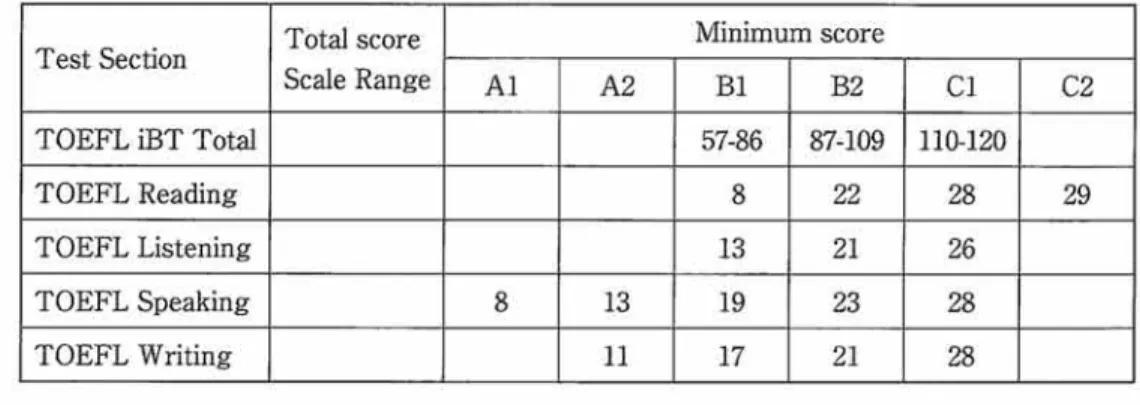
Learning, Teaching, Assessment. This manual states that it was created "in order to assist member states, national and international providers of examinations in relating their certificates and diplomas to the CEF (Language Policy Division, www.coeint/)." It further says that the "primary aim of this manual is to help the providers of examinations to develop, apply and report transparent, practical procedures in a cumulative process of continuing improvement in order to situate their examination (s) in relation to the CEF (ibid.)." ETS claims that the purpose of the mapping study, conducted the study with 23 experts from European countries, was to "identify the minimum scores on the TOEFL iBT corresponding to each level of the CEF (Mapping TOEFL iBT on CEF)." With the readily available tools to link exams to CEF levels, ETS researchers cooperated with the ALTE members and established a link to the CEF. ETS offers a table of minimum scores of TOEFL iBT corresponding to the CEF level for each skill as seen in Table 7.
Table 7 : Minimum TOEFL iBT scores on CEF
Test Section Total score
Scale Range
Minimum score
Al A2 Bl B2 Cl C2
TOEFL iBT Total 57-86 87-109 110-120
TOEFL Reading 8 22 28 29
TOEFL Listening 13 21 26
TOEFL Speaking 8 13 19 23 28
TOEFL Writing 11 17 21 28
A similar table exists for TOEIC and TOEIC Bridge's. In addition to the link to CEF, ETS has
also developed TOEIC Can-Do lists, inspired by the ALTE 'Can Do' list. The more tests
become linked to CEF levels, the more standardized and comparable they will become. The
CEF level descriptions and the ALTE 'Can Do' statements provide course designers, testers
and teachers clear standards to be achieved at successive stages of learning a foreign
language. Using these as practical tools, people in the field of language teaching and testing
will be able to evaluate learners' achievements across platforms and thus, they will be able to
plan language learning programs and certification in a global manner. As long as language
programs and language tests are linked to CEF levels, one can compare outcomes across
exams and on a global scale. Thus, it is natural that almost all language proficiency exams in
Europe have become linked to the CEF. As the move of ETS indicates, this trend to embrace
CEF level descriptions and the ALTE 'Can Do' list is spreading. The CEF level description
and the ALTE 'Can Do' lists will no doubt supply language educators with a solid basis to
build a language program on or to improve their language programs. Educators, like those at
Kinki University, would be wise not to miss this trend by establishing an English program
with a clear set of goals and a Kinki University 'Can Do' list.
References
British Council Japan. (2007). British Council Japan. http://www.britishcouncil.org/jp/japan.htm Chadwick, S. (2007). Exam English. http://www.examenglish.com/
Council of Europe. (2001). Common European Framework of Reference for Languages Learnin teaching, assessment.
Council of Europe. (2007). The C context. http://www.coe.int/t/ Council of Europe. (2003). Relatiru
of Reference for Languages :
Cambri . The
dge : Cambridge University Press.
Common European Framework in its olitical and educational http://www.coe.int/t/dg4/1inguistic/Source/Framework _EN.pdf
rope. (2003). Relating Language Examinations to the Common European Framework Learning, Teaching, Assessment. http://www.coe.int/T/DG4/ Portfolio/documents/Manual %20for %20relating %20Language %20Examinations %20ot %20the
%2OCEF.pdf
Digital Chosun Ilbo. (2005). The End of the Road for the TOEIC? http://english.chosun.com/ w21data/html/news/200512/200512040016.html
Digital Chosun Ilbo. (2007). New English Proficiency Test to Replace TOEFL in Korea. http://
15 in Mapping TOEIC and TOEIC Bridge on CEF.
AR"Jc*-ii-f4ttilic-IsEW 7 0 2 (2007 • 12)
english.chosun.com/w21data/html/news/200707/200707310017.html
Educational Testing Service. (2001). TSE and SPEAK Score User Guide. Educational Testing Service. Educational Testing Service. (2007). Mapping the TOEFL iBT on the Common European Framework of Reference for Languages. http://www.ets.org/Media/Research/pdf/CEF_Mapping_Study_Interim_Report.
Educational Testing Service. (2007). Mapping the TOEIC and TOEIC Bridge Tests on the Common European Framework of Reference for Lan
pdf/toeic_cef mapping_flyer.pdf
Educational Testing Service. (2007). TOEIC (official European site). http://www.toeic.eu/no_cache/
toeic-sites/choose-your-country/
Educational Testing Service. (2007). TOEIC (official Japanese site). http://www.toeic.or.jp/ Educational Testing Service. (2000). TOEIC Can-Do Guide. http://www.ets.org/Media/Research/
pdf/TOEIC_CAN_DO.pdf
International English Language Testing System. (2007). International English Language Testing System. http://www.ielts.org/default.aspx
O'Sullivan, B. (2006). Studies in language testing 17 : Issues in testing business English. uages. http://www.ets.org/Media/Tests/TOEIC/
al European site). http://www.toeic.eu/no_cache/
Cambridge : Cambridge University Press.
Pearson Language Assessments. (2007). London Tests of English. http://www.pearsonlanguageassessments.
com/home/exams/lte/
Taylor, L. (2004). Issues of test comparability, Research Notes 15, 2-5. http://www.cambridgeesol. org/rs _notes/rs_ntsl5.pdf.
The Society for Testing English Proficiency. (2007). EIKEN. http://stepeiken.org/ The Society for Testing English Proficiency. (2007). STEP BULATS.
http://www.eiken.or.jp/bulats/index.html
University of Cambridge ESOL Examinations. (2007). University of Cambridge ESOL Examinations.
http://www.cambridgeesol.org/
University of Michigan English Language Institute. (2007). Michigan English Language Assessment Battery. http://www.lsa.umich.edu/eli/testing/melab/
University of Michigan English Language Institute. (2007). Examination for the Certificate of Competency in English. http://www.lsa.umich.edu/eli/testing/ecce/
University of Michigan English Language Institute. (2007). Examination for the Certificate of Proficiency in English. http://www.lsa.umich.edu/eli/testing/ecpe/
Weir, C. and Milanovic, M. (2003). Studies in Language Testing 15 : Continuity and innovation : Revising the Cambridge Proficiency in English examination 1913 - 2002. Cambridge : Cambridge University Press.