IMPROVING EFFICIENCY OF SAVINGS MOBILIZATION IN GHANA
BY
QUARSHIE JOSEPH
MARCH 2011
THESIS PRESENTED TO THE HIGHER DEGREE COMMITTEE
OF RITSUMEIKAN ASIA PACIFIC UNIVERSITY
IN PARTIAL FULFILLMENT OF THE REQUIREMENTS FOR THE DEGREE OF
ii
TABLE OF CONTENTS PAGE(S)
TITLE PAGE………..……….. i TABLE OF CONTENTS ………..…….……….. ii-iv DECLARATION ………..……….. v ACKNOWLEDGEMENTS ……….……….. vi LIST OF TABLES ……….. vii LIST OF FIGURES ………..…….……… viii-ix LIST OF ABBREVIATIONS AND SYMBOLS ……….………. x ABSTRACT ……….……….……….xi-xii
CHAPTER ONE
1 INTRODUCTION, DEFINITION OF TERMS AND THESIS STRUCTURE ………. 1 1.1 Why improve efficiency of Savings Mobilization in Ghana ………….…….…………. 1-4 1.2 Definition of terms ……….….………….. 4 1.2.1 Savings ………...……… 4-6 1.2.2 Mobilization ……….………..…….. 6-7 1.2.2.1 Proposed Solution of how Savings Mobilization
can be improved in Ghana ……….……..….………. 7-9 1.2.3 Savings Culture in Ghana ………..……..…….….….……… 9 1.2.3.1 Savings in Traditional Ghanaian Society ……… 9-10 1.2.3.2 Efforts at Savings Mobilization by Government and
Financial institutions ………10-12 1.2.4 What is expected to be learnt from Japan’s experience ……….…..…….. 12 1.2.5 What is expected to be learnt from Malaysia’s experience ……….…..…… 12-13 1.3 Background of the research ………..……..…….. 13 1.3.1 Extent of the research (scope) ………..……….. 13-14 1.3.2 Research objectives ………..………...……….. 14 1.3.3 Research questions ………..…….….………… 14-15 1.4 Data Collection and analysis ………..………. 15 1.4.1 Description of Information to be collected and their sources ………..…… 15-16 1.4.2 Tools for analyses and Modeling ……….…....…………. 16 1.5 Limitations of the study ……….………….………… 17 1.6 Outline of the thesis (details of chapters) ……….……….……… 17-18
iii CHAPTER TWO 2 LITERATURE REVIEW ……….……… 19 2.1 Theoretical framework ………..………. 19 2.1.1 Consumption function ………..……… 19-22 2.1.2 Harrod-Domar model ………..……. 22-27 2.2 Conceptual framework (Postal Savings and the Susu System) ……..…….……….….. 27 2.2.1 Post Office Bank ……….….…….. 27-30 2.2.1.1 The Postal Savings Bureau Model ………...….…….. .31 2.2.1.2 National Savings Organizations (NSO) and the Post Office
Savings Bank Model (POSB) ………..………. .31-32 2.2.1.3 National Savings Bank Model ……….….……….………. 32 2.2.1.4 New Postal Savings Start-ups in Asian Transition Economies ……….…….…… 32-34 2.2.2 Susu ………..…….. 34-36 2.2.2.1 Features of Susu ………..…….. .36-37 2.2.2.2 Types of informal savings (Susu) organizations ………..………..…… 37-38 2.2.2.2.1 Rotating Savings and Credit Associations (ROSCAs) ………..…….…….. 39 2.2.2.2.2 Susu Collectors ……….…….……. 39-40 2.2.3 Relationship, Trust and Resource Mobilization in
Traditional Ghanaian Society ………..…….. 40-41 CHAPTER THREE
3 ANALYSES OF THE STATUS QUO: LOW SAVINGS RATE AND INEFFICIENT SAVINGS MOBILIZATION IN GHANA ………..……… 42 3.1 Low Savings in Africa and Ghana ……….……….. 42-45 3.1.1 Calculating the ‘Leakage’ – Number of Economically
active people outside of the formal financial system ……….……….. 45-47 3.1.1.1 Low income level ………..…….. 48-50 3.1.1.2 Existence of credit opportunities especially in the informal sector …………...…. 51-53 3.1.1.3 Availability of affordable consumer goods ………..….. 53-54 3.1.1.4 Physical distance, Hustle for opening and managing
accounts and transaction cost ………. 54-57 3.1.1.5 Interest rate spreads (Low Deposit Rates, High Lending Rates
Interest rates) and Inflationary pressures ……….. 57-59 3.1.1.6 Public sector reforms coupled with socialist states (China, Japan) …………..…... 60 3.2 Means of Savings Mobilization ……….… 61 3.2.1 Postal Savings ……….……… 61-65 3.2.2 Banks, Non-banks and Microfinance Institutions ………...…………. 65-66 3.2.3 Capital Market Investment ……….……….. 66-68
CHAPTER FOUR
4 EFFICIENT MOBILIZATION OF SAVINGS IN GHANA ………. 69 4.1 Household Income and Expenditure in Ghana ………..………… 69-76 4.1.1 Effect on Financial Liberalisation and Monetary
iv 4.1.2 The 3-point Framework ……….….………….. 77-78
4.1.2.1 Government ………..………. 78-82 4.1.2.2 Financial Institutions ………..……….. 82-86 4.1.2.3 Households ………..……… 86-88 4.1.3 Japan’s experience of Savings Mobilization ………. 88-90 4.1.4 Malaysia’s experience of Savings Mobilization ……….………… 90-93
CHAPTER FIVE
5 FINDINGS AND ANALYSES ……….……….. 94-95 5.1.1 How understanding factors relating to income can
help improve efficient mobilization of savings ……….…….………… 95-98 5.1.0 How understanding factors relating to savings rate
can help improve efficient mobilization of savings ………..……. 99-102 CHAPTER SIX
6 CONCLUSION AND POLICY RECOMMENDATIONS ……….……..….……. 103-105 6.1.0 Policy Recommendations ………..…….. 105-107 6.2.0 Further research ……….………..……. 108
BIBLIOGRAPHY ……….…..….. 109-116 APPENDIX 1 – ADDITIONAL LITERATURE ………..……….…….. 117
APPENDIX 1A – Ghana: Country Briefing ………..………..….……… 117-121 APPENDIX 1B – Background Information: Ghana
Living Standard Survey ……….………. 122-123 APPENDIX 2 – TABLES, FIGURES AND CHARTS ………..…………..….. 124-133 APPENDIX 3 – COPY OF STATISTICAL RESULTS ………..………. 134-140
v DECLARATION
I hereby affirm that this research in its entirety is my work through study and inspiration and not a reproduction of previous works.
Borrowed ideas and concepts as well as resources from other sources have been duly referenced and acknowledged.
vi ACKNOWLEDGEMENTS
First and foremost my appreciation goes to Jehovah God, the creator of the Heavens and Earth for life, strength, wisdom and the opportunity to come this far in life.
My profuse appreciation goes to my very competent supervisor, Professor Nakayama Haruo for his unfailing guidance, patience and salient contributions in helping me on this journey.
Much appreciation also goes to the august members of the 2010 Fall Thesis Committee (Prof. Zhang Wei Bin, Professor Suzuki Kanichiro and Prof. Asgari Behrooz) for their essential questions, contributions and the green light to proceed with writing the Masters’ thesis.
I also give a resounding praise to Japan’s Ministry of Education, Culture, Sports, Science and Technology (MEXT) for sponsoring my study at APU and life in Japan.
Finally my appreciation goes to my family and friends both in Ghana and Japan for supporting me in many ways. God bless you all.
vii
LIST OF TABLES PAGE(S)
Table 3.1: 91-day Treasury Bill Rate, Annual Inflation figures and Average
annual lending rate in Ghana 2000 –2009 ………..……..… 50 Table 3.2: Establishment of Postal Savings by Countries in Chronological order .…….. 62 Table 3.3: Number of accounts, types of deposits services and contributions
by labor force in selected African Countries ……….…….…..… 64 Table 3.4: Number of Some Financial Institutions in Ghana as at June, 2009 ……….…. 66 Table 4.1: Household information 1970, 1984 and 2000 ……….… 70 Table 5.1: Key for Data Analysis Results ……….…………..……….. 95 Table 5.2: Gross Domestic Income Partial and Pairwise Correlation
(1966 – 2006) Results ……….……….……. 97 Table 5.3: Gross National Income per capita 1970 – 2006 ………..…….. 98 Table 5.4: Results from the Regression, Partial Correlation and
Pairwise correlation (1966 – 2006) ………..………..…. 101 Table 5.5: Relationship between lending and deposit interest rate on
Gross Domestic Savings (1978 – 2006) ………...……. 102 Table 7.1: Regions of Ghana, regional capitals, and Population distribution ………... 119 Table 7.2: History of Activities of Japan’s Central Council for Savings
Information ………...………...……….. 129-130 Table 7.3: Market Indicators For Some Selected Countries – 2002 ……….….…... 133
viii
LIST OF FIGURES PAGE(S)
Figure 1.1: Flow of funds in an economic system ……….….………. 1 Figure 2.1: Consumption function and the determinant of Marginal Propensity
to Consume (MPC) taking (a) as autonomous consumption and (by) as MPC and indisposable income ……….…..…… 21 Figure 2.2: Composition of national savings ………..……….……….. 27 Figure 2.3: Summary of development and prospects of Ghana Post
Company Limited ………..….…....…. 33 Figure 2.4: Classification of Susu organizations ……….……….….…. 38 Figure 3.1: Number of economic active people gainfully employed in Ghana …... 46 Figure 3.2: Calculating the Leakage (Number of income earners who have
no dealing with regular banking institutions ………..……..…… 47 Figure 3.3: Main sources of credit in the informal sector ………..……….……. 52 Figure 4.1: Income distributions in Ghana by quintile of the
population (1988 – 2006) ……….………..………… 71 Figure 4.2: Sources of Household Income and percentage of contribution ……..….. 73 Figure 4.3: Gross Domestic Income of Ghana (1966 – 2006) ……….…..…. 73 Figure 4.4: Gross National Income per capita of Ghana (1966 – 2006) ………...….…. 74 Figure 4.5: Annual Measures of Household Expenditure per Capita
between 1987 and 1999 ……….………..…. 75 Figure 4.6: Mean Annual household income and expenditure in Ghana Cedis ……. 76 Figure 4.7: 3-point framework ………..…….. 78 Figure 4.8: Role of Government in Savings Mobilization in Ghana ………..….……. 82 Figure 4.9: Roles of Financial Institutions in Savings Mobilization in Ghana …….….. 83 Figure 4.10: Roles of Households in Savings Mobilization in Ghana ………….…………. 87 Figure 4.11: Summary of Formation of Malaysia’s National Savings Bank
(Bank Simpanan Nasional) ……….…...……. 91 Figure 7.1: Summary of Ghana’s Political history ………..…….……….…. 120
ix Figure 7.2: Major Economic Indicators of Ghana between 1960 and 2009 ………... 121
Figure 7.3: Percentage Distribution of Household Expenditure in Ghana 2008….. 131 Figure 7.4: Ghana Poverty Map ……….….……. 132
x LIST OF ABBREVIATIONS AND SYMBOLS
ASB – Amarah Saham Bumiputra ASN – Amarah Saham Nasional BoG – Bank of Ghana
BSN – Bank Simpanan Nasional
ERP – Economic Recovery Programme
FINSAP – Financial Sector Structural Adjustment Programme GCB – Ghana Commercial Bank
GRA – Ghana Revenue Authority GSE – Ghana Stock Exchange GSS – Ghana Statistical Service
HIPC – Highly Indebted Poor Countries NIB – National Investment Bank P&T – Post and Telecommunications PNB – Perbadaran Nasional Berhad WDI – World Development Indicators WHO – World Health Organization $ - United States Dollars
xi ABSTRACT
Ghana’s economy has been stabilized since the introduction of the Economic Recovery Program via the World Bank led Structural Adjustment Program in 1983. Source of funding for government expenditure has been heavily reliant on taxation and acquisition of foreign loans which forced the country into joining the Highly Indebted Poor Countries (HIPC) initiative in 2001 in order to be granted debt relief. Mobilizing domestic savings as a means of financing investment has been ignored in Ghana although it also comes along with the building institutions, social infrastructure and fostering national unity. Consequently, mobilizing domestic savings is a better option of capital formation as opposed to sourcing foreign loans which increases Ghana’s indebtedness to foreign countries hence making Ghana vulnerable to dictates about internal monetary policies, use of the loans acquired, etc. from foreign countries and international organizations.
It was imperative therefore to research into how savings mobilization can be improved and undertaken in Ghana. To do this the history and status quo of savings mobilization in Ghana was analyzed as a means of identifying the inefficiencies. A framework specifying the roles of the government, financial institutions and households was designed and analyzed to ensure that it is requisite to improving savings mobilization in Ghana. In addition, Japan and Malaysia’s experience in using postal savings and national savings bank respectively coupled with nationwide savings awareness campaigns was analyzed to adduce tenets for Ghana.
Although the research dealt with mobilizing savings in general, particular attention was given to mobilizing private savings by focusing on households. The household economy (flow of funds) was exposited in the light of helping to tailor a suitable mobilization program. Regression analysis was conducted with data from 1966 to 2006 to determine the factors that highly influence or have contributed to Gross Domestic Income, Gross Domestic Savings and in effect Savings Mobilization. The results from the regression analysis were contrasted with results from corresponding Pair wise and Partial Correlation as a matter of second opinion.
The major finding of this research was that Rural Population had a moderate positive correlation to both Gross Domestic Income (GDI) and Gross National Income (GNI) per capita while Urban Population had a weak correlation to both GDI and GNI per capita. However, Urban Population had a strong positive correlation to Gross Domestic Savings. In effect supporting the assertion that although the Rural Population are capable of saving, they lack the avenue to do so, thus the advocacy of extending savings means through
xii formalization of informal and traditional savings arrangement called Susu and the use of postal savings supported by the government-led financial literacy education and savings mobilization campaign. Additionally, the inability of the current financial system to mobilize savings of the Rural Population can be attributed to the concentration of most financial institutions especially banks in the urban centers. While Ghana’s population stands at 23.8 million, approximately 12 million economically active people who are gainfully employed in Ghana do not deal with formal financial institutions. Additional findings revealed that credit to private sector had strong positive correlation to Gross Domestic Income. On the other hand, credit to private sector and inflation had strong negative correlations to Gross Domestic Savings meaning that increase in income or macro monetary policies does not necessarily increase savings but rather the availability of the means to save in addition to pertinent education.
It is recommended that since extending the coverage of financial services and avenues for saving is the key to improving savings mobilization, the Banking Act 2004, be amended to include provisions for banks, etc. to graft in Susu collectors or create special accounts for informal savings arrangements. In addition, incentives should be created for banks that will direct their services towards the rural population. Furthermore a portion of corporate taxes from financial institutions is to be used to improve road networks and social amenities in the rural areas in order to increase the incentive for rural banking. In the same vein, provisions should be included in the national budget for public financial literacy education.
1 CHAPTER ONE
1 INTRODUCTION, DEFINITION OF TERMS AND THESIS STRUCTURE
1.1 Why improve efficiency of Savings Mobilization in Ghana
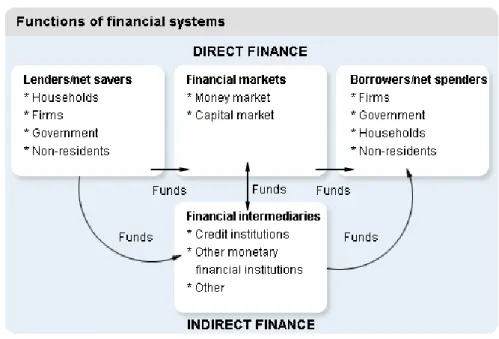
An effective financial system attracts capital from fund-suppliers (household, companies, governments) – people who have more money than they need and want to put some away – and gives it to fund-users (households, companies, governments) – people in need of capital. (Bank of Finland, 2004) It goes without mention that returns (interests) that are made on the invested capital finds their way back to the fund-suppliers in the form of dividends, increased salaries and corporate social responsibility.
Figure 1.1: Flow of funds in an economic system
Source: Bank of Finland (2004). The financial system in brief
In Ghana however the financial system (mainly banks and the capital market) is not doing enough to mobilize funds from fund-suppliers to fund-users, as it were. This problem can be
2 partly traced to the economic anatomy of Ghana that has close to 80% of the working class in the informal sector which in effect accounts for the about 90% of the population not having bank accounts or using the services of formal financial institutions. (Abor et al, 2010: Fidelity Bank Ghana Limited, 2010) That notwithstanding stakeholders of fund mobilization like the government, and the financial system – especially the banking institutions – has failed in facilitating the flow of funds from fund-suppliers to fund-users. Consequently the financial institutions like banks, microfinance organisations do not have the funds available to lend to fund-users. In cases where they are available, lending rates range between 22.7% and 40% depending on the parties involved. (www.thebftonline.com, 2010)
In another vein the capital reserves of about 44% in total requested by the Bank of Ghana to other banks can also be held accountable for the apparent credit crunch in Ghana. (Dordunoo, 2010) Operators of banking institutions have asserted that in order to stay in business, they must charge rates of not less than 23%, the reason being that, after the requirement for the reserves have been observed, there is not much left to grant loans and satisfy other financial obligations of the bank. (Joy Business News – myjoyonline.com, Sep. 2010)
Clearly the problem with Ghana’s financial system begins with at the start of the cycle of funds flow from suppliers to users and this is the scope and focus of the thesis – improving efficiency of savings mobilization so good health will be restored to Ghana’s financial system.
In order to do this, this research will be looking at the use of the postal savings or Post Bank model in collaboration with regular banking institutions and government revenue agencies and also the formalization of the a traditional means of savings mobilization called ‘Susu’.
3 Susu is a less-dubious method of community-based saving and investing, which is still practiced in parts of West Africa and the Caribbean. Susus are essentially savings plans. Man Hau Live is reported to have listed different names for this form of informal savings scheme where, “Latin Americans refer to them as Tandas or Quotas; Koreans call them Kyas or Kaes; Gambians and Nigerians refer to them as Tontines” (Kunzemann, 2007)
One type of Susu is the Rotating Savings and Credit Associations (ROSCAS) where a group of people regularly pay a fixed sum into a pool held by a Susu collector. Each time group members make a contribution, one of them receives the entire sum. Thus, if 20 people each contribute 10 dollars per week, every one of them will receive 200 dollars at a certain point in time. (Kunzemann, 2007)
Susu is believed to have been introduced to Ghana from Nigeria where it is known as “esusu” in the Yoruba language. (Aryeetey and Udry, 1995) Unlike the rotating savings scheme described by Kunzemann, the susu in Ghana mostly takes the form of non-rotating savings scheme. Here, savings are accumulated in the fund rather than distributed with each collection. These groups provide the obvious benefits of reducing saving transaction costs and providing for inexpensive safekeeping of savings. In addition, however, a key property of non-rotating saving associations is the availability of a fund of savings which can be disbursed as loans to members in the case of emergencies. (Aryeetey and Udry, 1995)
This involves a collector (usually male) who visits shops, workplaces, market stalls and homes at agreed times on each day and collects funds towards a savings plan. Following this plan, a saver agrees to deposit a specific amount determined by himself/herself in consultation with the collector for an agreed period of time
-4 usually a month-- after which period, his/her deposits are returned less a day's deposit. (Aryeetey and Udry, 1995; Page 22)
1.2 Definition of terms 1.2.1 Savings
Savings and Investment has been a part of human life and activity since prehistoric times. Indeed, many proverbs and folklore are constructed on the essence of savings. And this is common across cultures and religious faith around the world. One common element that used in many cases is the study of nature. A few of the statements are;
“Little drops of water, makes a mighty ocean” – British
“The Yangtze never runs backwards; man recaptures not his youth.”
“The rich man plans for tomorrow, the poor man for today.” - Chinese
“A crab does not beget a bird.” – Ghanaian
“A penny saved is a penny earned.” - Benjamin Franklin
Savings is therefore a universal activity. Some schools of thought have tried to draw a distinction between the words “saving” and “savings”. Some have described the former as fit for contexts related to rescues, preservation and the like where as the whole lot support the definition of savings as being;
5 Although in relation to this research this definition will be chiefly applied, other definitions by the Oxford and Cambridge dictionaries respectively are;
“An economy of or reduction in money, time, or another resource” (Oxford Dictionary)
“An amount of money that you do not need to spend”
In the two above-mentioned definitions the idea of ‘deferring consumption’ is inherent. Where deferred consumption means money set aside for future use or an opportunity cost. (Encarta, 2009) It is interesting to note that, “Consumption is normally the largest GDP component. Many persons judge the economic performance of their country mainly in terms of consumption level and dynamics.” (Economics Web Institute, 2010) Consumption here is defined as the, “value of goods and services bought by people. Individual buying acts are aggregated over time and space.”
According to Economics Web Institute the composition of consumption,
“…may be divided according to the durability of the purchased objects. In this vein, a broad classification separates durable goods (as cars and television sets) from non-durable goods (as food) and from services (as restaurant expenditure). These three categories often show different paths of growth.” (Piana, 2001)
Deducing from the definition, it can be said that “Savings – deferred consumption” also falls under “Services” which has to do with intangibles expenditure example purchase of capital assets.
6 “A major theme in economic theory is that economic growth requires accumulation” (Minsky, 2008: 24) In order to accumulate – or in this case – undertake savings, there must be the means to do so such as surplus income1, need to meet future financial obligations such as housing, education, retirement, etc. Keynesian theory of consumption function spells out clearly that income affects savings propensities. Income is therefore the “glob in determining consumption behavior.” (Minsky, 2008)
1.2.2 Mobilization
Mobilization according to the Cambridge dictionary is “to organize or prepare something, such as a group of people, for a purpose.” Although this definition is right, it lacks the sense of urgency and the connection to resource (capital or money).
Encarta (2009) defines mobilization as,
“…to organize people or resources in order to be ready for action or in order to take action, especially in a military or civil emergency, or to be organized for this purpose”.
This definition is more suited to the research because unlike that of the Cambridge dictionary, it presents the urgency, what needs to be mobilized (people and resources) as well as opens a window into the future essence of the mobilization exercise which is for productive investments, wealth distribution and general economic growth of Ghana by extension.
Why savings accumulation is not being used it because by definition ‘accumulation’ has to do with “the process of gathering together and increasing in amount over a period of time”
7 (Encarta, 2009) which is far from the intents of this research because it lacks purpose hence the title ‘Savings Mobilization’ in Ghana.
1.2.2.1 Proposed Solution of how Savings Mobilization can be improved in Ghana
According to Harrod-Domar’s model, it is evident that Savings equals Investment. The amount of savings an economy can mobilize is therefore quintessential to capital available for investment. (Hussain et al, 2002) The importance deepens in the case of developing countries like Ghana that are pursuing export-led growth and thus must significantly undertake manufacturing, infrastructural developments, etc. Increase in domestic savings in the long term also unties an economy from knots of increasing foreign debt. With the decline in capital supply to the government in the form of foreign loans, the government will be forced to cut down spending and delegate developmental projects to local industry. This will in turn focus attention of domestic lending by banks to local industry. Consequently, local industry will begin to flourish since access to credit and cost of credit is its major problem. Inflation figures will also reduce owing to cut in government spending thus creating a conducive environment for transacting business and at the same time putting the government in a good position for regulating the system and improving institutions to succour industrial growth. In the long term this will foster effective dissemination of information, financial literacy, patriotism, wealth distribution just to mention a few.
This research is proposing a 3-point framework involving the Government, Banking institutions and Households (represented in a triangle). In this framework, each of the parties has a contribution to and from the other. For instance, if the high capital reserves requirements of banks are reduced by the government, Banks will have a little more money
8 to increase interests on deposits which will attract a relatively high savings edge from Households. Following this, banks will be able to grant loans with relatively lower interest rates to both the Government and Households.
There are trajectories within the framework that might be limited to a chain-reaction but not a complete cause and effect on all parties as described above. For instance, where the Government increases financial literacy coupled with both formal and informal education in the media and school curriculum respectively, Household budgeting and savings plans will encourage an increase in Household savings – some of which might find their way to the banks. From here it is possible banks will engage in productive investment or financing government projects which might require labour from Household. As mentioned earlier, this trajectory does not have a direct contribution from Households to Government.
The major contributions by parties in the framework are;
a. Government
1. to Banking institutions – Reduce Capital reserve requirements and form partnership to reinstate Post Office Banking as a means of proliferating banking infrastructure.
2. to Households – Both formal and informal financial literacy education with more emphasis on savings through school curricula and the mass media. Also printing and distribution of budgeting booklets.
9 b. Banking Institutions
1. to Households – increase outposts and create both mobile and immobile savings deposit centers (formalization of the susu system), increase interest on deposits and reduce lending interest rates.
2. To Government – offer loans at lower interest rates for government projects or domestic investment opportunities and work as partners to increase trust in mobilization effort.
c. Households
1. to Banking institutions – fund-suppliers must deposit money with financial institutions while fund-users ensure to productively invest loans in order to be value enhancing.
2. to Government – take the educational programs seriously, assist in implementing and use of budgeting booklets and offer information during feedback programs.
The abovementioned is chiefly the approach of the thesis in improving efficiency of savings mobilization in Ghana.
1.2.3 Savings Culture in Ghana
1.2.3.1 Savings in Traditional Ghanaian Society
Savings has been a part of Ghanaian culture for as far back as pre-colonial time. Like any other society in the world, once the need for survival is met accumulation of wealth comes next. The wealth created is in many cases handed down to succeeding generations in the form of inheritance. Indeed the word inheritance in the Akan
10 language of Ghana is “agyapadie” literally, “a good father’s things” or better still “things a good father left behind”. It is therefore not out of place to assert that the Ghanaian society has high appreciation for tangible assets. Some other reasons buttressing this assertion is the practice of barter trade before the use of a printed currency in Ghana. It is also interesting to note that life-cycle events such as; weddings, puberty rites, funerals and the like demand the use of tangible assets like pieces of cloth, jewelry, cattle, just to mention a few. In this light, items are prepared or accumulated over a period of time.
Traditionally, the Ghanaian appreciates the importance of savings both as deferred consumption and wealth accumulation.
1.2.3.2 Efforts at Savings Mobilization by Government and Financial institutions
To conclude that there has been no effort at mobilization domestic funds within the over 50 years of Ghana’s independence will be a will be an indictment on resource mobilization in Ghana. What has been lacking is the aim at mobilizing savings in the informal sector.
Until present internal means of raising funds has been through taxation. The Value Added Tax system is used in Ghana. Recently it has been increased to 12.5% owing to the addition of the National Health Insurance Levy. Other instances that might be seen as fund mobilization will be encouragement of investment in the capital market
11 which frankly is direct investment in companies – whether private or government owned – rather than actual lending to the government.
Sale of government bonds like the treasury bills and other long term government papers although present are in a way is means of controlling money supply in the economy.
Plans towards consolidating mobilization of domestic funds since 2004 has led to the establishment of the National Revenue Authority which comprises of three former independent revenue agencies; Customs Excise Preventive Service, Internal Revenue Service and VAT Service.
In the case of financial institutions fund mobilization has mainly been limited to persons in the formal sector. There have been little attempts to mobilize savings from the informal sector. The only notable attempts to reach the informal sector would be the example of Barclays Bank Ghana Limited’s product that involved encouragement of Susu collectors to deposit their ‘stock’ with them. Susu accounts for more than 110 million Euros per year in Ghana alone, according to Barclays figures. (Kunzemann, 2007)
As mentioned earlier, Fidelity Bank is also embarking on the revamping of the Postal savings model which was lost in Ghana after the only Post Office Savings Bank was commercialized in 1975 as the National Savings and Credit Bank. (Boateng et al, 2010) Apart from these two significant efforts, financial institutions comprising of
12 commercial banks, rural banks, micro finance institutions have basically sought to receive deposits and provide credit to clients – mainly in the formal sector.
1.2.4 What is expected to be learnt from Japan’s experience
The choice of Japan as a field for study is fueled by the proximity to information owing to the studies being carried out in Japan, Japan as the second best economy and one with a reputable savings culture alongside Germany.
Lessons from Japan will be drawn from the activities of a council that was formed at the beginning of the Meiji period (1868-1912) as a Savings Promotion Movement. At the time “savings were encouraged by the government as a means to rehabilitate the Japanese economy and to put down vicious inflation.” With the passage of time and change in needs of the Japanese populace, the Central Council for Savings Promotion metamorphosis into the Central Council for Savings Information and the Central Council for Financial Services Information in 1952, April 1988 and April 2001 respectively.
1.2.5 What is expected to be learnt from Malaysia’s experience
After the ethnic riots of 1969 between the indigenous Malay and Chinese in Malaysia, the government enacted the National Economic Policy 1971 which was “aimed at fostering national unity and nation building through eradication of poverty and economic restructuring so as to eliminate the identification of ethnicity and economic function.” Through the First Outline Perspective Plan (OOP1) poverty,
13 irrespective of ethnicity, was sought to be reduced. On the other hand, there was also the objective of “restructuring of employment, ownership of capital in the corporate sector and the creation of Bumiputera2 Commercial Industrial Community (BCIC)”. (Kinuthia, 2010: 2)
The focus of the lesson from Malaysia thus borders on means of achieving ownership of capital in the corporate sector through capital market investment. Secondly is the history of public savings through the Bank Simpanan Nasional or National Savings Bank established in 1974 which had the following as its corporate objectives;
i. To promote and mobilise savings, particularly from small savers ii. To inculcate the habit of thrift and savings
iii. To provide the means for savings by the general public
iv. To utilise the funds of the Bank for investment including financing of economic development of the nation.
(www.mybsn.com, 2010 : Corporate Profile)
1.3 Background of the research 1.3.1 Extent of the research (scope)
Kweku Tsikata (2007) in Challenges of Economic Growth asserts that “Economic growth poses the strongest challenge to the overall development of Ghana”. In this published work, he enumerates; leadership, human capital development, and
2
Bumiputera or Bumiputra is a Malay ter used widely in Malaysia embracing indigenous people of Malay Archipelago. Ther term comes from the Sanskrit word bhumiputra which can be translated literally as “son of earth or soil”. (Kinuthia, 2010: 3)
14 growth-promoting cultures like export-led growth and propensity to save as the major stumbling blocks to Ghana’s economic success.
This research will be focusing on the issue of propensity to save in the context of creating formal channels to mobilize the about 90% informal private savings in Ghana’s economy. The boundaries of this work will thus be limited to improving the means of mobilizing savings and not how the mobilized funds should be used – although that is also essential.
1.3.2 Research objectives
The objectives of the thesis will be, but not limited, to the following;
1. Analyze the history and status quo of savings mobilization in Ghana in order to come up with more efficient means.
2. Engineer means to channel savings of the Ghana populace into the formal sector.
3. Educe tenets from the Japanese and Malaysian experience of savings mobilization through the activities of the Central Council for Savings Information and the New Economic Policy respectively in order to ascertain the extent to which they will serve as templates for Ghana.
1.3.3 Research questions
The issues this research is attempting to find answers to are; 1. Whether or not there is a potential for savings in Ghana?
15 2. Can those savings be mobilized, if yes, what has been or is being done about
it and what factors contribute to its success or failure?
3. Will financial literacy education, formalization of the susu system and expansion of the savings infrastructure coupled with governments efforts to reduce capital reserves requirements be the long awaited solution?
4. To what extent can the capital market assist in the savings mobilization effort in Ghana?
5. How suited and applicable are the experience of the Japanese and Malaysians to Ghana undertaking?
1.4 Data Collection and analysis
1.4.1 Description of Information to be collected and their sources
Although the literature review will deal with works that support ideas and assertions put forward by this research, other secondary data from national and international agencies like the Ghana Statistical Service, World Development Indicators will be consulted for analyses in the methodology and findings of this research.
Data that will be sought will include, but not limited to, reasons for low savings in Ghana as compared and contrasted with other African countries, status quo of savings mobilization in Ghana, trend of bank deposits before and after the financial sector liberalization in Ghana, Household Data on income and expenditure from the GLSS (Ghana Living Standards Survey), contents of the National Revenue Act of 2004,
16 activities of Japan’s Central Council for Savings Information and Implementation of Malaysia’s National Economic Policy.
Data will also be collected using Ritsumeikan Asia Pacific University Library and its online interlibrary system, online research libraries and databases like EBSCO, EMERALD and JSTOR.
1.4.2 Tools for analyses and Modeling
This research hopes to present a cogent model by which savings mobilization can be improved in Ghana. This will be the paramount original idea contributed to academia by this research. Apart from the aforementioned, the “leakage” – amount of informal private savings - described in Hussain et al’s review of the Harrod-Domar model will be employed to justify assertions of whether Ghana truly has about 90% of its citizens not dealing with formal financial institutions. The Harrod-Domar model will also establish to what extent this ‘leakage’ can be converted into funds for investment.
Furthermore, in the quest to reveal what factors really affect income and savings in Ghana, Linear regression will be used. Here, the dependent variable – Income or Savings – will be set against other factors such as; age, educational level, household size, occupation, and the like to test their correlations to the dependent variable as well as help in forecasting after having set a desired mix of independent variables.
17 1.5 Limitations of the study
It is evident that the scale of the research being national rather than focusing on just how a single company can improve its savings drive alone poses enough threat to the load of work required to accomplish it. However the relative easy access to information necessary to conduct the research goes a long way to mitigate that threat as it catalyzes the analyses effort.
The use of primary data in this case would have also been time consuming and expensive pertaining to the large of the populace and even with respect to sampling because of the geographical distance of Ghana and Japan.
1.6 Outline of the thesis (details of chapters)
Chapter 1 deals with the significance of the study in an introduction followed by definition of terms and concepts in addition to a general overview of the content in the main body of the work.
Chapter 2 primarily deals with the review of literature that touches on all aspects of the work especially theoretical and conceptual backgrounds to the research. It also includes a discussion on use of postal services and the formalization of Susu as means of savings mobilization.
The third chapter is dedicated to an in-depth discussion on low savings rate and why there is inefficient savings mobilization in Ghana. The development of three means of mobilizing savings; Postal Services, Financial Institutions and the Capital market are discussed with respect to Ghana’s case.
18 In Chapter 4 the actual process of improving efficiency of savings mobilization in Ghana is presented by looking at Household income and expenditure in Ghana as well as exposition of the 3-point framework designed by the researcher. Japan and Malaysia’s experience in savings mobilization are observed.
Chapter 5 will be on findings and analyses. This is where data collected pertaining to the factors that influence income, savings and savings mobilization in Ghana is analyzed through regression and correlation analysis in order to ascertain the implications of applying the 3-point framework and whether it is the requisite answer to the hypothesis of this research.
Chapter 6 concludes the work with policy recommendations and summary of what has transpired in the entire research.
19 CHAPTER TWO
2 LITERATURE REVIEW 2.2 Theoretical framework 2.2.1 Consumption function
Consumption is the total quantity of goods and services that people in the economy wish to purchase for the purpose of immediate consumption. As such, it is one of the main determinants of an economy’s aggregate demand (that is, the sum of all planned expenditures in the economy). (Miller, 1996) In a closed economy, aggregate demand is defined as the sum of consumption, investment, and government expenditures:
yd = c + i + g
where, yd is aggregate demand, c is consumption, i is investment
and g is government expenditures.
In economics, the consumption function is a single mathematical function used to express consumer spending. It was developed by John Maynard Keynes and detailed most famously in his book The General Theory of Employment, Interest, and Money. The function is used to calculate the amount of total consumption in an economy. It is made up of autonomous
20 consumption that is not influenced by current income and induced consumption that is influenced by the economy's income level. (D’Orlando et al, 2010)
Many macroeconomic policies rely on an ability to influence the aggregate demand in an economy without directly increasing government expenditure. Although Keynes (1936) treats many issues in economic theory, he postulates that the major (and perhaps the only) influence on personal consumption was an individual’s income. (Miller, 1996)
The simple consumption function is shown as the linear function:
C = c0 + c1Yd
Where,
C = total consumption,
c0 = autonomous consumption (c0 > 0),
c1 is the marginal propensity to consume (ie the induced consumption) (0 < c1 < 1),
and
Yd = disposable income (income after taxes and transfer payments, or W – T).
Thus, the consumption level is influenced by an autonomous consumption (c0), and a constant fraction of income (c1Yd). Keynes theorized that the autonomous figure would always be positive, and the multiple of income would lie between one and zero, varying according to the individuals in the economy. (Miller, 1996)
Autonomous consumption represents consumption when income is zero. In estimation, this is usually assumed to be positive. Thus, as income increases, consumption increases.
21 However, Keynes mentioned that the increases (for income and consumption) are not equal. According to Keynes, "as income increases, consumption increases but not by as much as the increase in income" (D’Orlando et al, 2010)
The marginal propensity to consume (MPC), on the other hand measures the rate at which consumption is changing when income is changing.
One key idea raised from this theory was that of saving. By definition, all money not spent on consumption in a two-sector economy (that is, without government) will be saved by an individual. In a three or four-sector economy this assumption still holds, but must be examined more closely; money not spent may be either saved or given as tax, and this tax may be either spent as government expenditure, spent as consumption (via benefits), or is saved.
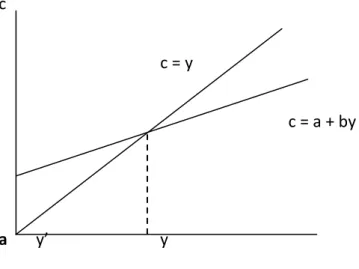
Figure 2.1: Consumption function and the determinant of Marginal Propensity to Consume (MPC) taking (a) as autonomous consumption and (by) as MPC and indisposable income.
c
c = y
c = a + by
a y’ y Source: Miller, 1996
22 Keynes reasoned that there is a certain level of consumption that is necessary for an individual to stay alive; this would typically consist of expenditure on food, heat, and shelter, although in certain cases it could contain other items. This amount, the autonomous element a, can be seen above as the intercept with the y axis. At this point, and, indeed, at any point to the left of y’ (the break-even income), consumption is above income, and individuals must use money from savings (that is, they must dissave) to pay off the deficit. At y’ consumption exactly equals income, and there is no savings or dissaving, while above this level of income (to the right) the individual will save any surplus income not consumed. With reference to the diagram it is quite easy to see why MPC cannot be greater (or even equal to) one – if this was the case, and the autonomous level of consumption was strictly greater than zero, the two lines would never cross and the individual would be in a permanent state of dissaving. (Miller, 1996)
2.2.2 Harrod-Domar model
The Harrod-Domar model is named after two famous economists: Sir Roy Harrod of England and Professor Evesey Domar of the US who independently formulated the model in the early 1950s. (Todaro, 1992) The model is said to have been created to study the business cycles.
It attempts to prove that economic growth is founded on level of savings or savings ratio and productivity of investment. Economic growth therefore depends on “the amount of labour and capital where National Income is expressed as a function of Capital and Labour [NY = f (K,L)] Labour is considered to be in excess supply and thus it is capital that needs to be mobilized in order to pursue development. Capital on the other hand is considered to
23 come through domestic savings, foreign investment or foreign loans. It is important to note that it will be more prudent in the long term for the country to mobilize domestic savings rather than receive foreign loans owing to the fact that loans must be repaid while in the case of using domestic funds the economies’ growth is assured without external pressures of loan repayments which in some instances result in dictates of monetary policies, etc. by the lending economy to the borrowing economy.
The basic model assumes that it is a closed economy and that there is no government, no depreciation of existing capital so that all investment is net investment, and that all investment (I) comes from savings (S).
Assume that there is a relationship between the total capital stock, K, and total GDP, Y.
For example, if $3 of capital is always necessary to produce $1 of
GDP, it follows that any net additions to the capital stock in the form of new
investment will bring about a corresponding increase in national output, GDP.
Now suppose that this ratio, known as the capital-output ratio, is
24 Assume that the national saving ratio, s, is a fixed proportion of national output.
Assume that total new investment is determined by the level of total savings.
Therefore:
Savings, S, is some proportion, s, of national income, Y, such that
S = s (Y)
Investment, I, is defined as the change in capital stock, K, such that:
I = ∆K
Total capital stock, K, bears a direct relationship to total national output (or
income), Y, as expressed by the capital-output ratio, k, (new investment as a percentage of GDP) then:
25 K = kY or
K/Y = k or
∆K/∆Y = k or
∆K = k (∆Y)
Since total national saving, S, must equal total investment, I, then:
S = I
The Harrod-Domar Equation of economic development therefore states that:
The rate of growth of GDP (∆Y/Y) is determined jointly by the national saving ratio (usually expressed as a percentage), s, and the national capital-output ratio (expressed as an integer), k.
26 1) The growth rate of national income is directly (positively) related to the savings ratio, i.e., the more an economy is able to save – and therefore invest – out of a given GDP, the greater will be the growth of that GDP.
2) The growth rate of national income is indirectly (negatively) related to the economy’s capital-output ratio, i.e., the higher is k, the lower will be the rate of GDP growth.
In another vein, Hussain et al (2002) in their study of resource mobilization for some selected African countries consider total national savings (ST) as made up of public saving (SG) and private (Household and Enterprise) savings (SP). Private savings is then further divided into private savings kept in the form of financial assets kept in the formal financial sector (FP) and private savings residue – private savings kept in non-financial forms or put into other uses (L).
27 Figure 2.2: Composition of national savings.
Source: Hussain et al (2002)
2.3 Conceptual framework (Postal Savings and the Susu System) 2.3.1 Post Office Bank
Many developing countries around the world receive financial aid from developed countries like the United States of America, United Kingdom, and international bodies like the International Monetary Fund and the World Bank “that is, borrowing the “savings” of other countries.” (Scher & Yoshino, 2004).3 The practice is good to an extent because naturally, an
3
The field research for this book was conducted by Dr. Scher in fifteen Asian countries and Speical Administrative Regions (SAR), meeting with personnel of national savings, postal services and remittances systems. (Scher and Yoshino, 2004:6)
ST= SG+ SP (1)
SP= FP+ L (2)
28 individual, community or nation might lose his ability to fend for himself if he is always being provided for. The same happens in the case of a nation. The nation refuses to investigate and pursue other avenues for raising funds or capital domestically for its use. In another vein, loans from foreign countries and international bodies also have ‘strings’ – requirements, prescriptions, etc. – attached. It is common knowledge that these, requirements, etc. – consciously or unconsciously, do not greatly improve the development pace of the borrowing or recipient nation.
Scher and Yoshino (2004) after studying savings mobilization in many Asian economies including; Japan, China, India, Malaysia, South Korea, just to mention a few found the following as “concerns for individual savers”.
1. Individual savers is the safety of their deposits 2. Ease of accessing funds when needed
3. Convenience and design of the savings products offered. 4. Access to credit facilities, if needed
5. Interest rate paid on funds deposited.
In all, “postal savings have played a leading role in savings mobilization [in Asia] for a long time.” (Scher and Yoshino, 2004:4) Postal savings systems as formal savings institutions have, since the mid-thirteenth century, provided a secure way for savers to save and for societies to mobilize savings for development. Historically a source of funds for economic and industrial growth in developed countries., most notably in Europe and Japan, today they
29 remain the preeminent depositories by far of individual and household savings. This has also been true in a number of developing countries, particularly in Asia. The individual country case studies in this book examine the Asian experience in postal savings where, in most countries, postal savings have played a leading role in savings mobilization for a long time. (Scher and Yoshino, 2004:4)
In fact, the demand for small savings services outstrips by five-to-one the demand for microcredit. Indeed, as will also be argued, microcredit is unsustainable without small savings, and yet on the other hand, the role of government-sponsored savings institutions has been almost entirely ignored. As a collection system for small-scale savings of households and individuals, postal savings systems provide more access points for savings and other household financial services globally than all the world’s bank branches combined. (Scher and Yoshino, 2004:4)
The essential characteristic distinguishing postal financial services from private banking is the obligation and capacity of the postal system to serve the entire geographic and economic spectrum of the national population. This mandate is unlike the purpose of conventional commercial banks, which seek to service only the sectors of the population they deem profitable, namely, commercial and private banking accounts in urban areas. In the developing countries where they may be much dispersed settlements, the post may represent the only significant service contact may people living in isolated areas have with their government. (Scher and Yoshino, 2004:5) It is however good to have other
30 organizations formed to share the infrastructure (“brick and mortar” facilities) of the postal savings bank. With such an arrangement, the costs of operation will be borne by both organizations.
The experiences of a number of Asian countries in postal savings has raised issues relating to management and organization including savings product development, investment policy on funds collected, methods to increase availability and reduce costs in the transfer of overseas remittances, and issues relating to the introduction of appropriate financial technology.
It is interesting to note that, among those countries that have a shared colonial past and shared postal savings model based on the British, French and Japanese postal systems, various countries in their post independence period took very different paths;
i. The national savings organization model found in India and Bangladesh
ii. The postal savings bureau model found in Japan in the Republic of Korea, and with socialist variations in China and Vietnam
iii. The linkage of postal remittance and benefit payments to postal savings account deposits in Kazakhstan and other Commonwealth of Independent (CIS) countries; and
iv. National savings bank model found in Malaysia, Sri Lanka, and formerly in Singapore.
31 2.3.1.1 The Postal Savings Bureau Model
This is practiced in Japan, Korea and China since 1875, 1905 (and re-established in 1983) and 1986 respectively. This involves an upgrade of the duties of the postal service owing to its reach in the country to mobilize funds for financing national development projects and also provision of simple financial services. In Japan’s case, the Fiscal Investment and Loan Program (FILP, a section of the Ministry of Finance) managed the funds mobilized by the postal service which was under the supervision of the Ministry of Posts. This was to maintain public confidence in the use and management of the funds. In the case of China however, postal financial services has been given some level of autonomy by the central bank. In the last ten years it has increased its services to include; remittance services and payments systems. (Scher et al, 2004:10)
2.3.1.2 National Savings Organizations (NSO) and the Post Office Savings Bank Model (POSB)
The role of the national savings organization in Asia cannot be overemphasized. It is a division of the Ministry of Finance which devises, develops and tests the savings products sold through the Post Office Savings Bank. It is important to note that the services and products are designed with high consideration of the social and cultural background of the populace and thus are designed to cater for and appeal to specific segments of the population, such as; farmers, housewives, urban salaried workers, and the like. The POSB both serves as a deposit and withdrawal point for clients.
32 In India, specially trained female staffs of the NSO go out into “educate and bring in both women and other disadvantaged groups as depositors” by offering savings products and services designed both for housewives and for outreach to rural populations. (Scher et al, 2004:11)
2.3.1.3 National Savings Bank Model
Unlike the first two models which lay more emphasis on reaching the underprivileged by extending financial services and mobilizing savings, the National Savings Bank model, as it were, establishes “their own branch networks in urban markets while still utilizing the postal branch network mainly in rural areas.” NSBs are therefore not owned by the national post offices. (Scher et al, 2004:12)
2.3.1.4 New Postal Savings Start-ups in Asian Transition Economies
“As in most countries in Eurpoe, Asia, and Africa, telecommunications, that is, telephone and telegraph services, were owned by the post office, hence the post was known as the PT&T.” (Scher et al, 2004:12). Economic liberalization policies in the last twenty years has seen the opening up of markets for private investors and the drive to maximize profits has resulted in the decoupling of the post from the telecommunications business. In Kazakhstan, the two services were decoupled in 1990. The revenues by the post office significantly dropped and in order to recoup that started the following postal savings services; First providing payment system for pension benefits and before long “salary transfer services,
33 overseas remittances, foreign currency accounts and foreign exchange facilities, and securities brokerage and dealer activities, agency services for utilities, and insurance and pension fund payments.” (Scher et al, 2004:12,13)
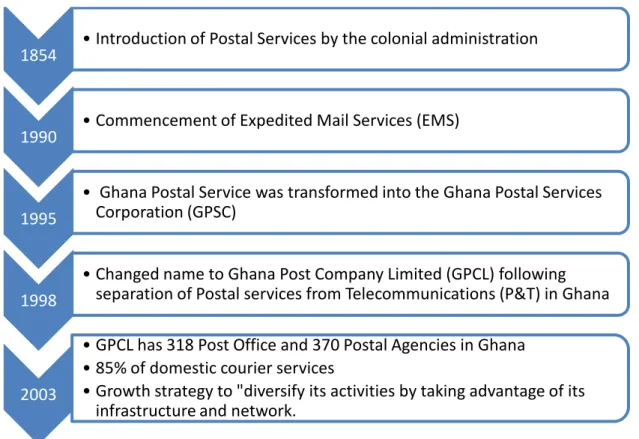
In Ghana, the P&T (Post and Telecommunications) was decoupled following the privatisation of the Telecommunications division in 1998. In Ghana however, only provision of agency services for utility companies like the Ghana Water Company, Electricity Corporation of Ghana are available. There are also money order transfers and payment order services.
Figure 2.3: Summary of development and prospects of Ghana Post Company Limited
Source: EbizGuides Website (2010)
1854 • Introduction of Postal Services by the colonial administration
1990 • Commencement of Expedited Mail Services (EMS)
1995
• Ghana Postal Service was transformed into the Ghana Postal Services Corporation (GPSC)
1998
• Changed name to Ghana Post Company Limited (GPCL) following separation of Postal services from Telecommunications (P&T) in Ghana
2003
• GPCL has 318 Post Office and 370 Postal Agencies in Ghana • 85% of domestic courier services
• Growth strategy to "diversify its activities by taking advantage of its infrastructure and network.
34 In addition to the summary of the GPCL, Figure 2.3 shows that the GPCL has 318 Post Offices and 370 affiliated agencies around the country bringing it to 688 physical infrastructures in all, a positive addition to the about 300 branches of commercial banks in Ghana for savings mobilization.
At a conference in Keio University (2000) the participants found that “demand for access to safe savings services was universal in developing and developed countries alike and, as such, was remarkably insensitive to interest rate incentives in all participating countries”.
2.3.2 Susu
“In Ghana as a whole, informal savings mobilization and credit facilities continue to dominate the financial market, in spite of over thirty years of formal banking in the country. The expression ‘informal financial sector’ is by definition the antithesis of the formal financial system. “The formal financial sector is seen to include all financial institutions, covered by the banking law or other financial regulations of government, thus the informal financial sector absorbs all other financial transactions not covered by the above” (Aryeetey and Gockel, 1991, p. 1). This catch-all definition for the informal sector would then include such schemes as the rotating savings and credit clubs, susu collector schemes, money-lending and to some extent credit unions.” (Bortei-Doku & Aryeetey, 1995: 78)
“For the purpose of savings most men and women keep their cash at home or save with ROSCAs and susu collectors. The ROSCA is known in Ghana as susu. Rotating susu clubs have long existed here [in Ghana] although no date has been firmly associated with their introduction. The essential practice of rotating susu, namely the pooling of scarce resources
35 by a group of people periodically for each member’s benefit, is not new to Ghana. It is likely that the pooling of cash resources gathered momentum with the increased monetization of the economy following the growth of the export economy in the latter part of the nineteenth century.” (Bortei-Doku & Aryeetey, 1995: 79)
In Ghana the majority of collectors are men from primary and middle school teaching fields, who undertake collection on a part-time basis. Only twelve women were found in a collector’s association of 500 members in the Accra District. (Bortei-Doku & Aryeetey, 1995: 88)
Susu clubs have survived due to its flexible and cost effective strategies. When necessary, the clubs have been able to suspend their operation for long periods, and then re-group after improvements in the economic circumstances of members. The fact that rotations are complete cycles on their own promotes fairness and transparency. In addition, the use of oral record-keeping instead of book keeping reduces operational cost.
Harsh economic times especially during the liberalization of the economy under the Structural Adjustment Programme led by the World Bank in the 1980s have a negative effect on the Susu organization. All the same about 43% of susu club members contacted in Accra had failed at least once to pay their contributions on time in their current rotation. Nevertheless, the rotating susu clubs pride themselves in maintaining strict discipline over
36 payments among their members. Mutual trust, obligatory feelings and perhaps personal pride are among the driving forces that sustain regular payments.
2.3.2.1 Features of Susu
Some notable features about Susu clubs are that;
1. No formal application and membership by introduction
“Recruitment is usually drawn from close and trusted associates of the founder. Sometimes members are allowed to bring others as long as they can vouch for them. There is little indication that membership in the susu club runs in the family. Some clubs also do approach people to join them instead of the conventional means of waiting to be approached by an interested person. Members are expected to have a regular income (not necessarily paid employment).
2. Limited membership in the case of clubs (on the average between 10 to 80 people)
3. Oral accounts occasionally
4. Often administered by a founder-leader or in some cases, executive arrangements
5. Multiple contributions from one person is allowed. In this case, the member can only receive the lump sum one at a time as would be done for two separate people in the rotation.
6. Balloting is carried out to determine the order of rotation.
37 i. Single-purpose susu savings clubs and
Makes up for about two-thirds of the clubs that were contacted in the literature’s fieldwork. There is often a founder-leader and an assistant and collections are carried out by group members periodically. General meetings are held occasionally because in most instances, the participants are market women who will not like to leave their wares unattended to. Meetings take about 30 minutes, when they are held.
ii. Mutual aid susu savings clubs with multiple functions
a. Primary focus on savings
b. Provision of limited social security for members
c. Organization of socializing and entertainment programs for members
The typical types of mutual aid provided by the clubs include donations for funerals, child-outdooring, marriage celebrations and heath care. Members also count on each others’ moral support, apart from the donations. (Bortei-Doku & Aryeetey, 1995: 82, 83)
2.3.2.2 Types of informal savings (Susu) organizations
There are mainly two types of informal savings organizations in Ghana. One can be described as ROSCAs (Rotating Savings and Credit Associations) while the other can be termed as the Susu Collector Scheme. Although both primarily deal with savings collections from members, their nature differs in relation to; Membership relations and Receipt of the contributions.
38 Figure 2.4: Classification of Susu organizations
Pertaining to membership relations, Susu Collector Scheme types involve individuals who make personal arrangements with the Susu collector and thus do not have any relations or connections with the other members making contributions to the Susu collector where as ROSCAs are organized groups, clubs, or associations and thus have a known or recognized membership.
Secondly, in Susu Collector Scheme, contributions (normally daily) are received either at the end of the week or at an agreed time. The susu members receive their savings minus a day’s contribution, which is the collector’s fee for the service he provides. (Bortei-Doku & Aryeetey, 1995: 89) On the other hand, members of ROSCAs at one point in the rotation receive a lump sum i.e. total of all the contributions collected from other members.
Informal Savings Organisations (Susu) Rotating Savings and Credit Associations (ROSCAs) Susu Collector Scheme
39 2.3.2.2.1 Rotating Savings and Credit Associations (ROSCAs)
Advantages of Susu:
1. Members receive lump sum that supports their economic activities. For example, traders gain substantial sums through susu in order to pay off credit purchases made in the past, debt or make purchases for business.
2. Members in Susu associations also use their memberships as security for repayments when accessing loans or making credit purchases. It boosts their credit-worthiness.
3. As members of associations, especially those in the mutual
4. In terms of flexibility a member must discontinue after a rotation is completed
Disadvantages
1. Owing to the large memberships of some associations, it takes a long time to complete a cycle. That also means that some members will have to wait in line for a long time to receive their lump sums.
2. Members are obliged to contribute regularly.
2.3.2.2.2 Susu Collectors
Advantages
1. Contributions to the susu collector are personalized to suit the individuals capacity.