Abstract
Separation between military (TNI) and police (POLRI), both structure and roles, is perceived as a great achievement of military reform in Indonesia. Such separation was nonexistence during Soeharto s authoritarian regime as both of them were operated under Angkatan Bersenjata Republik Indonesia (ABRI) and shared the internal security role, including for handling domestic terrorism. Following the reform, their roles have been redefined towards its original function in which POLRI manages internal security and TNI handles defence matters. However, the raise of domestic terrorism threat has triggered further discussion on who is responsible to handle terrorist threat. Since it occurred domestically, POLRI claimed that it is their role in managing internal security. While the military also claimed that counter-terrorism is also part of their role, as mentioned under the task of Military Operation Other than War (MOOTW). Along with ambiguous approach of Anti-Terrorism Law and civil authorities indecisiveness in defining counter-terrorism measures, it has brought tension for both institutions. This paper aims to identify the political dynamics of TNI-POLRI relations in searching for counter-terrorism authority.
Military-Police Relations in
Counter-Terrorism Post New Order:
Rivalry, Authority Competition, and Political Bargain
M
ENGKO, Diandra Megaputri
*RITSUMEIKAN INTERNATIONAL AFFAIRS Vol.16, pp.79-102 (2019).
Keywords:
Military-Police relations, TNI, POLRI, Counter-terrorism, Terrorism
I
NTRODUCTIONTerrorism is not a new security threat for the world or Indonesia. It has appeared since 1980 s and has been transforming ever since, in the context of perpetrators, agenda, influenced ideology, target, modus operandi, and the magnitude of impact (Rapoport, 2002).1) However, the 9/11 attacks remarked a new nature of contemporary terrorism which characterized with intensified trans-national nature as well as bigger impact in spreading the fear as technology and media been taken advantage (Conte, 2010, p. 7). The same nature also shown in Indonesia, as can be seen in first Bali Bombing (October, 2002). The perpetrator was
Jamaah Islamiyah (JI) who had deep linkage with Al-Qaeda. Since that
bombing, terrorist attacks in Indonesia have evolved and activated several domestic Islamic radical groups in Indonesia. Three latest attacks at Surabaya Bomb (2018), Kampung Melayu Bomb (2017), and Thamrin Bomb (2016) have also shown connectivity with the rise of Islamic State of Iraq and Al-Sham (ISIS) in Middle East – although the connectivity might not be as deep as JI to Al-Qaeda (Zakiyah, 2016, pp. 24-28).
Considering its deep trans-national nature, the response to terrorism could no longer bear by one institution only. It demands collective measure that involves security agencies (police, military, intelligence) and other non-security agencies. For consolidated democracies, coordinating collective measures in counter-terrorism efforts might have less complicated –at least normatively, since they may have rigid legislations and democratic procedures that manage each role, particularly regarding how they coordinate, how they engage with certain situation, and so on. While for young democracies like Indonesia (adopted democratic system in 1998), coordinating counter-terrorism efforts may face a great challenge especially in managing what roles should be performed by certain
1) To see how the nature of terrorism has evolved, David Rapoport (2002) divided it into four waves: anarchist wave, anti-colonial wave, new-left wave, and religious wave.
institutions, to what extent, and in what context. Not to mention the issues of vague legislations and democratic procedures on how each should be deployed and coordinated. Failure to define each role and how they are deployed under democratic procedures might not only lead to ineffective counter-terrorism measures, but also could become bad precedent to the progress of democracy. Therefore, managing counter-terrorism efforts should consider not only in its effectiveness, but also how it is carried out in democratic manners.
In the context of Indonesia, counter-terrorism measures in reformasi era have always been a struggle for power between Indonesian Police (Kepolisian Republik Indonesia, POLRI) and Indonesian Military (Tentara Nasional Indonesia, TNI). Before reformasi, in Soeharto s authoritarian regime (1966-1998), such competition never existed. Back then, counter-terrorism measures were conducted by Angkatan Bersenjata Indonesia (ABRI) –which the police and military were merged and shared internal security roles. However, after separation of TNI-POLRI, in which POLRI manages internal security and TNI handles defence matters,2) the discourse on who should be involved in counter-terrorism effort started, and continues to heat up. At one hand, POLRI claims that counter-terrorism measure is part of their role because terrorist attack occurred in domestic context. In other hand, TNI also claims that it is also part of their role, as it is mentioned on their task of Military Operation Other than War (MOOTW).3)
In that context, this paper will discuss political dynamics of TNI-POLRI relations in counter-terrorism measures during reformasi. The discussion will be presented with four parts. The first part will explain the ideal counter-terrorism model for democratic states and its implication on the role of military and police. Second part will examine Indonesia s counter-terrorism model. Third part will discuss TNI-POLRI relations in counter-terrorism measures. The fourth part would try to provide analysis for future tendency of TNI-POLRI relations in counter-terrorism measures
2) This separation is based on TAP MPR No.VI and VII/2000, TNI Law No.34/2004 and POLRI Law No.2/2002.
3) Article 7(2b) point 3 TNI Law mention that TNI could conduct counter-terrorist operation, apart from point 10 that notes about TNI s assistance to POLRI. Therefore, the TNI perceived that they could conduct independent operation on counter-terrorism aside from assistance to POLRI s counter-terrorism operation.
and its implication to military reform progress in Indonesia.
I
DEALC
OUNTER-
TERRORISMM
ODELFORD
EMOCRATICS
TATES ANDI
TSI
MPLICATIONTOR
ELATIONSOFP
OLICE ANDM
ILITARYIn academic literature, there are two distinct responses to terrorism that are always in conflict: criminal justice model vs war model. Both have different paradigm in perceiving terrorism as well as its implication towards its measures. Criminal justice model basically sees terrorism as an act that violates criminal law, which therefore the response should be taken in the law enforcement corridor that also means putting the Police force as central actor to handle terrorism. Meanwhile war model sees terrorism as existential threat to states. Therefore, civilian authorities should declare war (against terrorism), which later will impact to position the military as central actor in handling terrorism (McGauley, 2009, pp. 64-68).
Empirically, there is no state that purely adopted one particular model. Most of states combine both approaches depend on certain context –although it might lean towards one approach. For example, United States adopted war model in dealing with terrorism as declared by former President Bush in his famous speech Global War on Terror after the 9/11 attack. However, such model was only conducted to combat terrorism abroad, not in domestic context. Meanwhile in dealing with domestic terrorism, most of liberal-democratic states adopted criminal justice model that puts the police as central actor. It should be acknowledged that criminal justice model is also ideal model recommended by United Nations. This could be seen from former UN Secretary General speech, Kofi Annan, at Security Council s Counter Terrorism Committee on 6th March 2003 that note ...as terrorism involves the calculated use of violence
in violation of the law, our response to terrorism should aim to ensure the rule of law... (United Nations Office on Drugs and Crime (UNODC), 2009,
pp. 5-6).
There are two important considerations why criminal justice model or putting the Police as central actor is seen as ideal approach in dealing with terrorism. First is about its effectiveness. A study conducted by RAND Cooperation in 2008 showed that among 648 terrorist groups that were active between 1968-2006, most ended because they were being
penetrated and eliminated by local police and intelligence agencies (40 percent) –also imply the use of criminal justice model.4) While the use of military force (war model) has only led to the end of terrorist groups in 7 percent of the cases. This study notes that the use of military tends to be most effective when it is used against terrorist groups engaged in insurgencies in which the groups are large, armed, and well-organized (Jones & Libicki, 2008, pp. 34-42). But against most terrorist groups, military force was usually too blunt an instrument and often led to the use of jujitsu politics by terrorist group to magnify their power –using the enemy s strength against it by mobilizing the psychology of the victims of attack and all who sympathize with them (McGauley, 2009, pp. 67-68).
Second is about its impact towards democracy. The excessive and disproportionate military involvement in domestic counter terrorism measures might impact negatively to democracy because it will provide a way for military to get involved with domestic affairs. It should be acknowledged that counter-terrorism measure is not only about eliminating particular groups. It also includes prevention such as educating the citizen, counter-radicalization, de-radicalization, and so on, as the roots of terrorism lie on social, economic, and political problems in society. In that context, the involvement of military might encourage the misleading stigma that sees political, economic, and social problems could be resolved through violent or military instrument (Erbay, 2012, pp. 5-6).
Although the adoption of criminal justice model is seen as ideal counter-terrorism measures, the author believes that mechanism to involve military in counter terrorism measures should remain exist. In the context of emergency or in the condition that the police need further assistance from military, the involvement of military in counter terrorism might give its best support. But the involvement should be in case of emergency or limited context, limited objective and time, and conducted under democratic procedure.
So, what does it imply for ideal relations of police and military in
4) Aside from being penetrated and eliminated by local police and intelligence, this study also notes that most terrorist groups also ended because they reached a peaceful political accommodation with their government (43 percent). However, most terrorist groups that ended because of politics sought narrow policy goals. The narrower the goals, the more likely the group was to achieve them through political accommodation ̶ and thus the more likely the government and terrorists were to reach a negotiated settlement.
counter-terrorism measures? The police should be the central security actor in counter-terrorism measure that is in line with criminal justice model. In the peaceful condition, the military should have no role in counter-terrorism measures. If the crisis condition occurs and the situation has undergone beyond police capability, then the civil authority could decide to involve the military –but only as supporting actor, in limited context and provide certain support that needed by the police. And if the emergency condition occurs and is declared by civilian authorities, then the military could be fully involved in counter-terrorism measures -but only last until the peaceful condition has restored. In that context, the relations of both security actors might become synergize and support each other. However, the political context in each state might add complications to implement such governance and later impact to the relations of police and military that is not always synergetic, even sometimes in conflict. In the next section, the discussion focuses on the counter-terrorism model that being adopted by Indonesia and how it regulates the military and police role in countering domestic terrorism.
R
EVISITINGI
NDONESIA’
SC
OUNTER-T
ERRORISMM
ODELBasically, Indonesia s counter-terrorism model could be traced in legislation and security governance in Indonesia. During Soeharto s authoritarian regime (1966-1998), Indonesia did not have any specific regulation on terrorism. However, during the Soeharto Era, there was only one security actor existed which was Angkatan Bersenjata Republik
Indonesia (ABRI). Since the police and military were merged under ABRI
and shared internal security roles, the discourse on counter-terrorism model became irrelevant –all security threats including terrorism were dealt by ABRI.
Such condition has gone much different since Indonesia adopted democratic political system in 1998. Following the demand to conduct security sector reform, the military (TNI) and police (POLRI) were separated into two different organizations and their roles have been redefined towards its original function. The separation was based on TAP MPR No.VI and VII/2000, and later each security actors were regulated under two different legislations: POLRI Law No.2/2002 and TNI Law No.34/2004.
Although POLRI is mandated to deal with domestic security threat and TNI is mandated to deal with defence matters, in the context of counter-terrorism measures, both legislations remain too vague –not clear enough about each role. What is certain from TNI and POLRI Laws is that both have made three possibilities for TNI-POLRI relations in counter-terrorism:
• First possibility is to put POLRI as central actor as terrorism is perceived as criminal acts/domestic security threat, which is in line with POLRI Law No.2/2002.
• Second possibility is to put TNI as central actor as terrorism perceived as existential threat to the state. This could be based on article 7 (2) point 3 in TNI Law that sets TNI s role in combatting terrorism under one of MOOTW (Military Operation Other Than War) tasks. Its deployment should be based on state political decision (article 7(3) TNI Law).
• Third possibility is to involve TNI in the context of providing assistance to POLRI in crisis.5) This could be based on article 7(2b) point 10 in TNI Law No.34/2004 and article 41 (1) in POLRI Law No.2/2002. However, it should be noted that both TNI and POLRI Laws have mandated establishment of new regulations on military assistance to police. Unfortunately, until 20 years of reformasi (2018), the regulation has never existed. Therefore, both legislations would only provide normative rules (only about its deployment that should be based on state political decision), without exact rules of engagement (RoE).
At this point, it is clear that all possibilities are open, and it implies that Indonesia s counter-terrorism model will depend on other specific legislation (anti-terror legislation) and how the civil authorities perceive terrorism threat itself.
The presence of Anti-Terror Law No.15/20036) basically affirms the
5) All TNI s deployment in the context of MOOTW, including TNI s assistance to POLRI, should be based on state political decision (article 7(3) TNI Law).
6) After first Bali attack, Government of Indonesia published Presidential Decree No.4/2002 on Anti-Terror, which was then improved by the National Policy on counter-terrorism in form of a regulation in lieu of law (Peraturan Pengganti Undang-Undang, Perppu) No.1 and 2/2002, and then transformed into Anti-Terror Act No.15/2003.
adoption criminal justice model (in counter-terrorism) as the word terrorism itself is defined as criminal act which means putting POLRI as the central actor to counter domestic terrorism (falling into first possibility in previous explanation). Nevertheless, the perception of civilian authorities appears to be inconsistent with Anti-Terror Law. Following the second Bali Bombings in October 2005, President Susilo Bambang Yudhoyono gave speech at 60th TNI anniversary (5th October 2005) that explicitly requested greater military role in counter-terrorism measures: ...I asked the TNI to take part in counter-terrorism more effectively to
prevent, and to take action against terrorism... . (Merdeka, 2005). That
statement was ambiguous as it had never been any urgency explained why military needs to be involved, as well as legally confusing because it has never been formalised into state political decision.
Such inconsistency basically reinforces growing public s suspicion that the adoption of criminal justice model in Anti-Terror Law was more affected by pragmatic calculations, rather than a long-term design that considers effectiveness, appropriateness and democratic principles. This was driven by an assumption that TNI was too difficult to develop military combat ability in counter-terror measures due to international embargo problems in 1994-2005 (Muradi, 2009, pp. 85-86). Therefore, after the embargo was dismissed, the perception of civilian authorities changed.
Without clear guidance, it propelled opaque rivalry between TNI-POLRI in searching for bigger role in counter-terrorism.7) Establishment of National Counter-Terrorism Agency (BNPT) in 20108) that supposedly becomes a coordinating agency in counter-terrorism measures (including coordination between TNI and POLRI) remains too weak to synergize both security institutions. In many cases, TNI and POLRI keep referring to their-own legislations (TNI and POLRI Laws), which impacted to the role of BNPT itself that seems more like procedural coordination for both (Rajab, 2016, pp. 8-9).
Meanwhile, public discourse was split into two. At one hand, civil
7) Rivalries between TNI and POLRI not only existed in counter-terrorism measures. Over the last 20 years, there have been several tensions recorded between TNI-POLRI due to personal factors, competition over budget, and growing perception of POLRI domination over TNI. This trend consequently poises detrimental impacts to Indonesia s democratic consolidation, let alone their effectiveness in handling security issues.
8) BNPT established under Presidential Regulation No.46/2010 and revised into Presidential Regulation No.12/2012.
society groups, especially NGOs, continue to give criticism to civilian authorities to follow criminal justice model and put the Police as central actor, as adopted in Anti-Terror Law. But on the other hand, the psychology of the general public, especially after terrorist attacks, often misleads and encourages the government to involve the military in combating domestic terrorism. The discourse then culminated after Thamrin bomb (2016) and Kampung Melayu bomb (2017). After that attacks, Indonesian parliament (Dewan Perwakilan Rakyat, DPR) agreed to discuss revision of Anti-Terror Law and reconsider the options of military involvement. The debate in parliament itself was quite complicated and took a long time.
In the midst of parliamentary discussion process, terrorist attack took place in Surabaya (2018). This time, civilian authorities is using this momentum to indicate the weak Anti-Terror Law as black sheep of the re-occurrence of terrorist attack in Indonesia. Having agreed with the civilian authorities, TNI-POLRI supports the revision of this Law to pursue their-own interests –but not to strengthen coordination between them. For POLRI, they are searching for bigger authority to arrest terrorist suspects. While for TNI, they are keen on playing a role in countering domestic terrorism. Along with full support from TNI-POLRI, President Joko Widodo gave the DPR an ultimatum to finalise the Bill or he would use his executive powers to issue a governmental regulation in lieu of law (Perppu) to accommodate both TNI-POLRI demands (Nabbs-Keller, 2018).
Finally, on 25th May 2018, Indonesian parliament passed a revised Anti-Terrorism Law No.5/2018 that granted TNI-POLRI greater authorities in counter-terrorism measures. Under this new Law, a person accused of conducting terrorism can be held by POLRI in custody for up to 14 days without charges. POLRI can also hold them for up to 200 days after officially charging them with terrorism. While for the TNI, this new Law also grants a greater role in counter-terrorism by legally defining terrorism as a security disruption –previously mentioned as criminal acts , to pave the way for the TNI s direct involvement. Although further mechanism for involving the TNI are mandated (by this new Law) to be regulated under new presidential regulation (not yet formed), the military has responded very quickly by re-activating its special counter-terrorism unit -TNI s Joint Special Operations Command (Koopsusgab) not long
after this new law was formed. In addition, Koopsusgab was first established in 2015 but dissolved in the same year for unknown reasons. (Ramdhani, 2018).
The passing of this revised Anti-Terror Law then made counter-terrorism model in Indonesia ambiguous. It seems that criminal justice paradigm still dominates the Law, because POLRI remain considered as one of central actor, even they have bigger authorities compared to previous Law. However, to some degree, this new Law also open bigger opportunity for military involvement – which means that it could also transform into war model paradigm. What kind of authority, to what extent and in what context that the military could perform its role, it would all heavily depend on further presidential regulation that will be established. The problem of Indonesia s national security system that is not formulated comprehensively most likely will also add complications to determining when and how the TNI-POLRI should perform their-own role, or when both institutions should cooperate together in countering domestic terrorism.
TNI-POLRI R
ELATIONSINC
OUNTER-T
ERRORISM: S
TRUGGLE FOR AUTHORITY?
The separation of TNI-POLRI in both structure and role after
reformasi leaves many home works, especially on their relations in
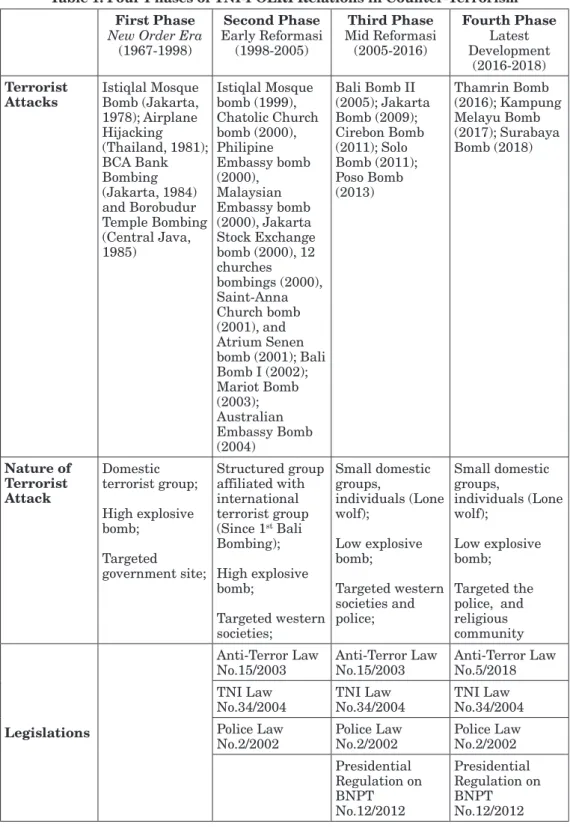
handling domestic terrorism. Ambiguous counter-terrorism model that is adopted in Indonesia s, coupled with the obscurity of civilian authorities in implementing such model, has caused the problem of handling domestic terrorism to become political contestation in TNI-POLRI relations. In that context, we could see political dynamics of TNI-POLRI relations in four phases: New Order Era (1966-1998), early reformasi years (1999-2005), mid-reformasi years (2005-2016), and latest development in counter-terrorism measures in Indonesia (2016-2018).
The first phase refers to TNI-POLRI relations on countering domestic terrorism in the Soeharto era (1966-1998). The first phase is important to discuss because it provides the context that triggered rivalries between the two in the subsequent developments.
In Soeharto era, there were several terrorist attacks such as Istiqlal Mosque Bomb (Jakarta, 1978); Airplane Hijacking (Thailand, 1981); BCA
Bank Bombing (Jakarta, 1984) and Borobudur Temple Bombing (Central Java, 1985). Most of these attacks were conducted by domestic radical groups and targeted government sites. Although Indonesia did not have any specific legislation on terrorism, during these times counter-terrorism was handled by ABRI -a merge of TNI and POLRI that shared internal security roles.
It is important to note that within the ABRI itself, the structure of special anti-terror units was only developed under the military. The Army s anti-terror unit was formed in 1982, named Detachment 81 Unit (Den 81 Kopassus/Gultor), the Navy s anti-terror unit was formed in 1984, named Jalamangkara Detachment (Den Jaka), and the Air Force s anti-terror unit was formed in 1990, named Bravo Detachment (Den Bravo Paskhas) (Muradi, 2009, p. 89).
Meanwhile the police did not have any special unit to handle terrorism. They only had a mobile brigade unit (Brimob) that was anti-riot branch, which dealt with special operations. It conventionally operated under joint military command, not in handling particular terrorist attack (East Timor and Indonesia Action Network, 2008). Therefore, during New Order Era, the police played as supporting role for the military.
Considering both military and police are merged into one institution, coupled with the army superiority at that time, there was no discourse occurred on who has the authority to deal with domestic terrorism. It is widely accepted that military, especially the army, has the authority and played dominant role in handling domestic terrorism.
That condition changed drastically in the second phase or in early
reformasi years (1998-2005), as Indonesia adopted democratic system in
1998 and conduct security sector reform. Since TNI-POLRI was no longer merged in ABRI and performs different roles, it leaves counter-terrorism authority in big question mark: who has the authority in dealing with terrorism?
Unfortunately, that question has not yet appeared before the first Bali Bombing (2002). Indonesia did suffer from terrorist attacks between 1999-2001, such as: Istiqlal Mosque bomb (1999), Catholic Church bomb (2000), Philippine Embassy bomb (2000), Malaysian Embassy bomb (2000), Jakarta Stock Exchange bomb (2000), 12 churches bombings (2000), Saint-Anna Church bomb (2001), and Atrium Senen bomb (2001). However, all those attacks were perceived as general criminal acts, therefore it all
handled by POLRI.
After the first Bali Bombing, Indonesian government finally sensed greater threat rather than general criminal act as it showed its linkage with international terrorism. Although the threat perception was increased (perceived as terrorism), Indonesian government adopted criminal justice model in dealing with terrorism, as seen in the establishment of Anti -Terror Law No.15/2003. So that, Indonesian government tried to strengthened the police by establishing Police anti-terror unit: Detachment 88 AT (Densus 88).
The option to adopt war model or to involve the military were basically possible at that time, as military anti-terror units remain existed. However, civilian authorities considerate political context that was faced by the TNI such as embargo and highly negative sentiment to military due to human rights issues. Although the capability of Densus 88 is still limited, civilian authorities still reluctant to involve the military on counter-terrorism. They prefer to reinforce POLRI capability through international cooperation. It is known that in handling terrorist attacks at JW. Marriot bomb (2003) and Australian Embassy (2004), the Police received support from Australian Federal Police (AFP) (Connery, McKenzie, & Sambhi, 2014, pp. 8-9). Therefore, in this second phase, POLRI was perceived as central actor in handling terrorism and the discourse on military involvement in domestic counter-terrorism measures was yet been developed.
Although criminal justice model is being adopted in Anti-Terror Law and the Police established Densus 88, in the next development, the third phase or in mid-reformasi period (2005-2016), the discourse on military involvement in handling terrorism began to emerge. This is triggered by inconsistent gesture of civilian authorities (President SBY) on counter-terrorism measures, as shown in two cases.
First is SBY s response following Bali Bomb II (2005) that demanded greater TNI involvement in counter domestic terrorism –though he never issued formal state political decision. Second is SBY s response after JW Marriot and Ritz Carlton Hotel Bomb in Jakarta (2009). After that attack, there was an intelligence report that indicated that terrorist groups were targeting the President, which came from evidence that SBY s picture was being used as shooting target (Liputan 6, 2009). Although it is known later that its intelligence report was erroneous –the photo evidence was from
the Poso conflict in 2004 and not used by the terrorist group (Tribunews, 2009), the SBY s statement was indicating the mission shift from Western target to national leaders. It further triggered a public discourse that domestic terrorist threat should be seen not only in criminal justice paradigm, but also in the context of war paradigm –also means that it has already threatening state sovereignty, which could become justification to involve military.
Nevertheless, between years of 2009-2016, domestic terrorist attacks did not escalate. Terrorist attacks that occurred in Cirebon (2011), Solo (2011 and 2012) and Poso (2013) showed de-escalating pattern. Instead of structured groups affiliated with international terrorist groups, like
Jamaah Islamiyah (JI), those attacks were committed by individuals.
Moreover, there were shifting targets from Western symbols and national leaders to the Police itself. Their method of attack has also evolved, from high-explosive bombs to low-explosive bombs and guns. This change has indeed diminished the escalation threat perception of domestic terrorism. Furthermore, the POLRI s response in counter-terrorism measure also developed. Densus 88 even could prevent terrorist attack as shown in attempted attack on Gading Serpong (2011) and debunking domestic terrorist network in Indonesia (Tribunews, 2011).
In that context, de-escalating of terrorist threats in Indonesia and developing capability of Police to handle them have hindered the rationale of military involvement. Yet, the discourse within the TNI itself still occurred although limited in high-scale terrorist attack scenario. This could be seen from TNI Commander Gen. Moeldoko (2013-2015) s statements in many occasions that noted the military is ready to be deployed if terrorism undergoes beyond Police capability and threatening Indonesia s sovereignty (Merdeka, 2014). It later culminated in the establishment of TNI s Joint Special Operations Command (Koopsusgab) for terrorism in 2015. However, in the same year, Koopsusgab was dissolved –the reason is still unclear. (Kompas, 2018) At this point, the tension between TNI-POLRI relations begins to emerge.
The fourth phase refers to latest development that could be seen in 2016-2018 period. As the tension of TNI-POLRI relations already emerged in the previous phase, it became intensified in this latest phase. That was triggered by two factors. First is the re-occurrence of major terrorist attacks as seen in the Thamrin Bomb (2016), Kampung Melayu Bomb
(2017), and Surabaya Bomb (2018). The raise of ISIS in the Middle East was said as one phenomenon that activated several small radical groups or individuals to perform attack. Those series of attacks have later ignited the Indonesian government to rethink about counter-terrorism strategy in Indonesia, which one of those considerations is to involve the military.
Second is establishment of first joint operation by TNI-POLRI in the pursuit of one terrorist group, led by Santoso, in Poso at 2016. Previously this operation was only conducted by the POLRI, named Camar Maleo operation. However, the field condition in Poso that was dominated by dense forest caused difficulties for POLRI to arrest Santoso s group. Therefore, Coordinating Minister for Political, Legal and Security Affairs Wiranto considered that the TNI s ability in dense forestry field would be able to help the effectiveness of the operation, which then ended with military involvement, and this operation was renamed as Tinombala operation. (Coordinating Ministry of Politic, Law, and Security Affairs, 2016) Although this operation resulted in the capture of Santoso s group, it is known that military involvement in Tinombala s operation did not follow the scheme as stated in the TNI Law or the MOU. Formally, the status of military operations in Poso at that time was training operation . It is not known exactly why this is not formalised under state policy (Intelligence, 2018).
The occurrence of major terrorist attack and effectiveness of TNI s role in Tinombala operation has later put the discourse of military involvement in countering domestic terrorism on the surface. Based on that, Jokowi s administration seems to be convinced that military involvement is necessary in combating domestic terrorism as seen in Jokowi s statement at 2017: I recommended that TNI s authority (in
countering domestic terrorism) to be granted in this bill (revision of Anti-Terror Act No.15/2013). Certainly, with several specific reasons that Coordinating Ministry of Political, Law and Security Affairs has prepared
(Kompas, 2017).
At first, this idea was strongly refused by the Police, as seen in the statement of National Police Chief, Tito Karnavian, at the end of year 2016. According to him, counter-terrorism measures consist of series of efforts that are not only limited to terrorist arrests operation –which the military might be more effective to conduct such operation in dense forest and mountains. It should be considered that the military training is
different with Police training. The military is largely defined by the doctrine of kill or to be killed , while the Police puts forward the law enforcement paradigm. Although the military has special units in combating terrorist threat, it should be noted also that Police Special Anti-terror unit, Densus 88, has also developed and received special training to counter-terrorism in the last two decades. Further, it would also cost more budget and time to prepare TNI s infrastructure in counter-terrorism measures: as there are no military s infrastructure on forensic laboratory, capability in disaster victim identification, and support from forensic personnel to investigate weapons used by terrorists. It would also bring ambiguity in the legal context, considering the military s accountability mechanism is still on the basis on military court and the absence of search authorities –which POLRI could gain through general court permission (Kompas, 2016).
However, this condition was drastically reversed after the bomb attacks in Surabaya (2018). The interest of POLRI to capture terrorist suspects seemed to become a bargain with the involvement of the TNI in handling terrorism. The position of POLRI was later softened in terms of military involvement. Under these conditions, the government increasingly believes that military involvement will be one of the factors that can help the effectiveness of handling terrorists in Indonesia. Meanwhile the TNI itself has always wanted further involvement in handling terrorism since 2005. Then the revision of the Anti-Terror Law which was issued in 2018, accommodated both TNI-POLRI interests.
Table 1. Four Phases of TNI-POLRI Relations in Counter-Terrorism First Phase
New Order Era
(1967-1998) Second Phase Early Reformasi (1998-2005) Third Phase Mid Reformasi (2005-2016) Fourth Phase Latest Development (2016-2018) Terrorist Attacks Istiqlal Mosque Bomb (Jakarta, 1978); Airplane Hijacking (Thailand, 1981); BCA Bank Bombing (Jakarta, 1984) and Borobudur Temple Bombing (Central Java, 1985) Istiqlal Mosque bomb (1999), Chatolic Church bomb (2000), Philipine Embassy bomb (2000), Malaysian Embassy bomb (2000), Jakarta Stock Exchange bomb (2000), 12 churches bombings (2000), Saint-Anna Church bomb (2001), and Atrium Senen bomb (2001); Bali Bomb I (2002); Mariot Bomb (2003); Australian Embassy Bomb (2004) Bali Bomb II (2005); Jakarta Bomb (2009); Cirebon Bomb (2011); Solo Bomb (2011); Poso Bomb (2013) Thamrin Bomb (2016); Kampung Melayu Bomb (2017); Surabaya Bomb (2018) Nature of Terrorist Attack Domestic terrorist group; High explosive bomb; Targeted government site; Structured group affiliated with international terrorist group (Since 1st Bali Bombing); High explosive bomb; Targeted western societies; Small domestic groups, individuals (Lone wolf); Low explosive bomb; Targeted western societies and police; Small domestic groups, individuals (Lone wolf); Low explosive bomb; Targeted the police, and religious community Legislations Anti-Terror Law No.15/2003 Anti-Terror Law No.15/2003 Anti-Terror Law No.5/2018 TNI Law No.34/2004 TNI Law No.34/2004 TNI Law No.34/2004 Police Law No.2/2002 Police Law No.2/2002 Police Law No.2/2002 Presidential Regulation on BNPT No.12/2012 Presidential Regulation on BNPT No.12/2012
Actors Involved
ABRI POLRI POLRI, BNPT POLRI, TNI,
BNPT Structure - Detachment 88 (Police) Detachment 88 (Police) Detachment 88 (Police) Detachment 81 (Army) Detachment 81 (Army) Detachment 81 (Army) Detachment 81 (Army) Detachment Jalamangkara (Navy) Detachment Jalamangkara (Navy) Detachment Jalamangkara (Navy) Detachment Jalamangkara (Navy) Detachment Bravo (Air Force) Detachment Bravo (Air Force)
Detachment Bravo (Air Force)
Detachment Bravo (Air Force)
- - - TNI s Joint Special Operation Command / Koopsusgab (Military) National Discourse - Establish regulations on Counter-Terrorism Strengthen Police Capacity Revising Anti-Terror Law The need to involve military in crisis situation Revising Anti-Terror Law The need to involve military in all stage of counter-terrorism measures
Based on the assessment of these four phases, we could understand that the new Order era produced a cultural legacy that the military felt responsible in dealing with internal security threats, especially in dealing with terrorism. At the beginning of reformasi, when the position of POLRI is organizationally equal with the military, POLRI started to handle terrorism as it occurred domestically. The military s desire to be involved in dealing with terrorism existed -as an impact of old legacy . However, this was not possible because of the clear gesture of the civilian authorities to put the POLRI as central actor in handling terrorism. But we need to realize that gestures of the civilian authorities were also pragmatic, as they were influenced by the political consideration of public sentiment and embargo problems.
Therefore, the shift in public sentiment towards the TNI in 2005 influenced the attitude of civilian authorities, as seen in SBY s speech. The gray attitude of civilian authorities then revived the long-standing desire
of the military to be involved in terrorism. Nevertheless, the de-escalation of the threat of terrorism between years of 2010-2016 in the country has made difficulties for civilian authorities to justify military involvement.
Once the threat of terrorism re-escalated in 2016-2018 and the success of Tinombala s operation, it then became a strong justification for civilian authorities to accommodate military involvement in combating domestic terrorist threats. The only obstacle then was the gesture of the National Police which strongly refused military involvement. But when the National Police began to require further authority in capturing suspected terrorists in the process of revising the Anti-Terror Law, the a t t i t u d e o f t h e N a t i o n a l Po l i c e wa s s o f t e n e d , r e s u l t i n g i n t h e accommodation of TNI s involvement in the revised Act.
In sum, the process of TNI s involvement in handling terrorism depends on three political factors outside its institution, namely the escalation of terrorism in Indonesia, the attitude of civilian authorities, and the attitude of the National Police. The issue of handling domestic terrorism has actually become a political commodity used as a bargain in the context of TNI-POLRI relations in Indonesia during the reform period.
F
UTURET
ENDENCYANDI
MPLICATIONOFTNI-POLRI R
ELATIONS:
C
OUNTER-
TERRORISMM
EASURESIf we trace back TNI s role in dealing with domestic terrorism, the achievement of TNI needs to be appreciated and cannot be ruled out, especially in its success of joint operation of Tinombala. This indicates that the mechanism of TNI s involvement on handling terrorism basically is needed. Especially if terrorist threat escalates into high-scale threat of using weapons of mass destruction. However, it does not mean that the government should give TNI authorities to fully and constantly involve in handling domestic terrorism - as the authority is owned by the POLRI.
In the revision of Anti-Terror Law, arrangement of TNI s involvement still remains to be needed. Article 43(I) of the revised Anti-terrorism Law stated that:
1) TNI s role in counter-terrorism measures is considered as part of Military Operation Other Than War (MOOTW).
2) TNI s engagement in counter-terrorism measure should be carried out in accordance with TNI s main duties and functions.
3) Provisions regarding its implementation are further regulated by presidential regulations.
In that context, there are three possibilities in the formulation of Presidential regulation –and each might trigger different pattern of future TNI-POLRI relations. First, this Presidential regulation will become a legal basis for full and constant military involvement in handling domestic terrorism –also means giving the TNI same authorities as POLRI. Second, the regulation will arrange the rules of engagement (RoE) for TNI s involvement in dealing with terrorism –which means that the military involvement will be limited in certain context and condition. Third, Presidential Regulation will give the authority to decide whether to involve TNI or not to BNPT.
If the government chooses the first option, then it is not impossible that this will ignite the form of conflictual relations between TNI and Polri. The reason is that the authority possessed by the TNI will be exactly the same as the authority owned by POLRI. However their different doctrines and paradigm might impact on their different nature in dealing with terrorism.
TNI s kill or to be killed doctrine tends to bring them in targeting particular groups. This will lead to further conceptual and legal problems: which group that will be considered as terrorist group? It certainly cannot be whole Muslim groups, most Muslim do not support killing civilians. Nor can be whole radical groups, considering that not whole radical groups believe in violence/terrorism, some just hold intolerant, narrow and unbending views. It should also be considered that the use of excessive force also might trigger to more savage terrorist attacks. While for POLRI who has adopted law enforcement paradigm, their target would simply refer to individual who violates criminal codes (McGauley, 2009, pp. 64-67). In that context, the pattern of handling domestic terrorism would be conflictual to each roles. It might trigger conflict at grass-roots level between personnel, up to elite level which both might compete for counter-terrorism budget. This condition certainly could give negative impact not only on the effectiveness of handling terrorism, but also on the relationship between the TNI and Polri itself.
In contrast, if government chooses the second option, which is more idealistic, this would prevent conflictual relations between TNI-POLRI. In this option, TNI s involvement would be seen in limited context and
condition, which largely depend on terrorist threat escalation. Although Indonesia still suffers from regulation lack in managing national security system, Indonesia already has State of Emergency Law No.23/1959 that could be used in interpreting the escalation of terrorist threat. This Law basically regulates the state of emergency in a peaceful situation until emergency situation. In that context, classification of TNI-POLRI roles could be more specifically defined. In the peaceful situation, POLRI will remain as central actor in dealing with terrorism. While during emergency situation –which requires declaration from civil authorities, TNI will be central actor in dealing with terrorism, which POLRI will play supporting role.
In cases which the condition remains peaceful but civilian authorities see the urgency of military involvement –which begins with POLRI s request, this mechanism could exist under the context of Military Operation Other Than War (MOO TW) as regulated in TNI Law N o.34/2004. R e g a r d i n g t o t h a t , t h e f i r s t t h i n g t h a t s h o u l d b e accommodated is the principle of civilian supremacy. TNI s deployment on MOOTW tasks should be based on political decision. But before the civilian authorities issue one political decision, they should consider the nature of MOOTW itself which should not be carried out excessively and improperly. TNI s role in MOOTW could have negative result if it disrupts military concentration, training and preparation in dealing with its main role –facing the war. (Huntington, 1993, pp. 39-43) Further, improper military involvement in MOOTW also could lead military intervention in civil realm, which will be a bad precedent for democracy and development of military professionalism itself (Anwar, 2001, pp. 42-45). Therefore the consideration of state political decision will be a prominent factor in determining limited context and condition of military involvement in counter-terrorism measures –which could prevent conflictual relations with the POLRI.
If government chooses third option, the relations between TNI-POLRI might either become conflictual or synergized, depend on how far Chief of BNPT could use this authority wisely. However, considering the role that has been conducted by BNPT since its inception –that reflected rival nature of TNI-POLRI, it seems that giving such authority to Chief of BNPT would only shift the pressures from President (in issuing state political decision) to Chief of BNPT, but the struggle for authority most
likely will occur constantly. Regarding this option, it should also be noted that the TNI might have anticipate this. In October 2018, following the revision of Anti-Terror Law, TNI and BNPT signed the Memorandum of Understanding (MoU). The scope of the MOU included information exchange, counter-radicalization and deradicalization, increasing the c o m p e t e n c y a n d u t i l i z a t i o n o f h u m a n r e s o u r c e s, f a c i l i t i e s a n d infrastructure, as well as other activities agreed upon both parties in accordance with laws and regulations (Media Indonesia, 2018). In this case, choosing the third option will bring the same impact with choosing the first option (full and constant TNI s involvement) which may lead to conflictual relations between TNI and POLRI.
What option Indonesian government will adopt in Presidential R e g u l a t i o n s t i l l b e c o m e s p u b l i c d i s c o u r s e u p u n t i l n o w (2019) . Nevertheless, considering the dynamics of the TNI-POLRI relation in handling terrorism, this presidential regulation formulation will likely to be influenced by three factors: the escalation of terrorist threat, the gesture of civilian authorities, and the gesture of POLRI itself.
If in the future major terrorist attack occurs, it is likely that the military gains justification to be involved in domestic counter-terrorism. The emergence of this attack will also influence pragmatic civil authorities gesture (President or BNPT) that most likely chooses to involve the TNI. In that case, POLRI is likely to get public pressure because it is seen as inadequate measure to handle domestic terrorism - which then weakens the bargaining position of POLRI itself in the context of counter-terrorism authority. If this happens, it is likely that the Presidential Regulation will fall into the first or third option. If that happens, conflictual relations between TNI and POLRI are difficult to avoid.
In other hand, if POLRI or intelligence services succeed in reducing domestic terrorist threats escalation, the POLRI s bargaining position will be far stronger than the TNI in convincing the choice of civilian authorities. If this happens, Presidential Regulation is likely to adopt second option. In that context, the dynamics of conflictual relations between TNI-POLRI in terms of handling terrorism can certainly be minimized.
But it should be put in mind that since Anti-Terror Law mandates to regulate TNI involvement in counter-terrorism on the form of Presidential Regulation, it might become a fluid arrangement. The regulation might be
different from one President to another, depending on the political context and civil authorities perception. That means all three option will always be open (although the most ideal arrangement is the second option). In that case, the form of Presidential Regulations (TNI s involvement in counter-terrorism) might give complexity and negative impact on democ-racy as it could always become commodity for political bargain between civil-military relations in Indonesia.
B
IBLIOGRAPHYAnwar, D. F. (2001). Demokrasi, Keamanan dan Peranan Militer. In I. N. Bhakti, Dina-mika Pemikiran Internal tentang Peran dan Fungsi TNI di era Transisi Demokra-si . Jakarta: Pusat Penelitian Politik.
Connery, D., McKenzie, M., & Sambhi, N. (2014). Partners Against Crime: A Short His-tory of the AFP-Polri Relationship. Canberra: Australian Strategic Policy Insti-tute.
Conte, A. (2010). Human Rights in the Prevention and Punishment of Terrorism. Ber-lin: Springer-Verlag Berlin Heidelberg.
Coordinating Ministry of Politic, Law, and Security Affairs. (2016). Anev Pelaks Ops Ti-nombala dan Rencana ops TiTi-nombala 2016. Coordinating Ministry of Politic, Law, and Security Affairs. Jakarta: Coordinating Ministry of Politic, Law, and Security Affairs.
East Timor and Indonesia Action Network. (2008, March 10). Background on Human Rights Violations by Indonesia s Kopassus and Brimob. Retrieved December 3, 2018, from Etan.org: http://www.etan.org/etanpdf/2008/Background%20on%20 Kopassus%20and%20Brimob.pdf
Erbay, T. (2012). The Role of Military in Counter Terorrism: Unintended Consequences. Washington: Naval Post Graduate Shcool.
Huntington, S. (1993). New Contingencies, Old Roles. Joint Forces Quarterly , 38-43. Intelligence, O. o. (2018, September 6). Military Intelligence in Reformasi Era. (M.
Haripin, & D. Mengko, Interviewers)
Jones, S. G., & Libicki, M. C. (2008). How Terrorist Groups End: Lesson for countering Al Qaeda. Santa Monica: RAND Corporation.
Kompas. (2016, July 22). Karena hal ini, Kapolri anggap TNI sulit menindak kasus terorisme. Retrieved December 3, 2018, from Kompas.com: http://nasional.kompas. com/read/2016/07/22/17412181/karena.hal.ini.kapolri.anggap.tni.sulit.menindak. kasus.terorisme
Kompas. (2017, May 30). Alasan Jokowi Ingin Libatkan TNI dalam Pemberantasan Terorisme Dipertanyakan. Retrieved December 3, 2018, from Kompas.com: https:// nasional.kompas.com/read/2017/05/30/20484651/alasan.jokowi.libatkan.tni. dalam.pemberantasan.terorisme.dipertanyakan
Kompas. (2018, May 17). Yang Perlu Diketahui dari Koopsusgab, Gabungan Satuan TNI Tumpas Terorisme. Retrieved December 3, 2018, from Kompas.com: https:// nasional.kompas.com/read/2018/05/17/14271481/yang-perlu-diketahui-dari-koop-susgab-gabungan-satuan-elite-tni-tumpas?page=all
Liputan 6. (2009, July 17). SBY Sasaran Tembak Teroris. Retrieved December 3, 2018, from Liputan6.com: http://news.liputan6.com/read/237379/sby-sasaran-tembak-teroris.
McGauley, C. (2009). War versus criminal justice in response to terrorism: the losing logic of torture. In W. G. Stritzke, Terrorism and Torture: An Interdisciplinary Per-spective (pp. 63-85). Cambridge: Cambridge University Press.
Media Indonesia. (2018, October 30). BNPT dan TNI Resmikan Kerjasama Penanggu-langan Terorisme. Retrieved December 3, 2018, from Mediaindonesia.com: http:// mediaindonesia.com/read/detail/194283-bnpt-dan-tni-resmikan-kerja-sama-pen-anggulangan-terorisme.
Merdeka. (2005, October 5). Presiden SBY Himbau Peran Aktif TNI Menindak Teror-isme. Retrieved December 3, 2018, from Merdeka.com: https://www.merdeka.com/ politik/presiden-sby-himbau-peran-aktif-tni-menindak-aksi-teroris-iva2ujg.html Merdeka. (2014, December 23). Moeldoko sebut teror tidak bisa diatasi Polri, TNI
tu-run tangan. Retrieved December 3, 2018, from Merdeka.com: https://www.merde-ka.com/peristiwa/moeldoko-sebut-teror-tak-bisa-diatasi-polri-tni-turun-tangan. html
Muradi. (2009). The 88th Densus AT: The Role and the Problem of Coordination on Counter Terrorism in Indonesia. Journal of Politics and Law , 2 (3), 85-96.
Nabbs-Keller, D. G. (2018, August 26). Indonesia s Revise Anti-Terrorism Law. Re-trieved December 3, 2018, from Australian Institute of International Affairs: htt- ps://www.internationalaffairs.org.au/australianoutlook/indonesias-revised-anti-terrorism-law/
Rajab, A. (2016). Urgensi Penguatan BNPT dalam rangka Menjaga Keamanan dan Kedaulatan Negara. Rechts Vinding , 5 (1), 1-15.
Ramdhani, N. F. (2018, May 25). Breaking: Indonesia passes stronger anti-terrorim law. Retrieved December 3, 2018, from The Jakarta Post: http://www.thejakarta-post.com/news/2018/05/25/breaking-indonesia-passes-stronger-antiterrorism-law. html
Rapoport, D. (2002). The Four Waves of Rebel Terrorism and September 11. Anthropo-etics , VIII (1).
Tribunews. (2009, July 22). SBY Dibohongi Foto Teroris. Retrieved December 2018, 2018, from Surya.co.id: http://surabaya.tribunnews.com/2009/07/22/sby-dibohongi-foto-teroris
Tribunews. (2011, August 9). Pujian Semu Sidnet Jones Soal Teroris di Indonesia. Re-trieved December 3, 2018, from Tribunews.com: http://www.tribunnews.com/ tribunners/2011/08/09/pujian-semu-sidney-jones-soal-teroris-di-indonesia
Justice Response to Terrorism. New York: United Nations.
Zakiyah. (2016). The Chronicle of Terrorism and Islamic Militancy in Indonesia. Jour-nal of Social Science and Religion , I (1), 19-39.