Studies on Some Marine Algae from Southern
Japan VI
著者
TANAKA Takeshi
journal or
publication title
鹿児島大学水産学部紀要=Memoirs of Faculty of
Fisheries Kagoshima University
volume
14
page range
52-71
別言語のタイトル
日本南海産海藻類の研究 : その6
Vol. 14, pp. 52^71 (1965).
Studies on Some Marine Algae from Southern Japan-VI
Takesi Tanaka*
Abstract
The studies of the marine algae in deep sea by dredging have been made by the writer in the Southwestern-sea of Japan and Ryukyu Islandssince 1957. In the following papers some descriptions have been made of nine species; of these nine, four are new species and two are new to Japanese waters, and the other two species were ascertained, this time, to be the plants with reproductive organs, though these two were reported by Dr. Okamura in 1921 and 1931
respectively.
Caulerpa scalpelliformis (R. Brown) Weber van Bosse
Fig. 1, and PL I, A.
Monog. des Caulerpes (1898) p. 286; Reinke, Ueber Caulerpa (1899) p. 13; Svedelius, Ceylon species of Caulerpa (1906) p. 109; Okamura, Icones of Japanese Algae, vol. 4 (1921) p. 106, pi. 175; Boergesen, Some Indian green and brown
algae especially from the shores of the presidency of Bombey, II (1932) p. 55, fig.
1, PL 1Caulerpa scalpelliformis C. Agardh, Spec. Algarum (1821) p. 437, Harvey,
Phy-cologia Australica (1858) pi. 17.
forma denticulata (Decaisne) Weber van Bosse
Monog. des Caulerpes (1898) p. 228, pi. 28, figs. 8-10.
Caulerpa denticulata Decaisne, "Plantes de Arabie heureuse, p. 120, tab. VI, figs.
1-3."
Japanese name. Amamino-kurokizuta.
Hab. Kamikatetsu, Kikai Island, Amami Islands (Col. by Isao Matsuda).
March, 27th, 1964. Growing on sandy bottom in the sublittoral zone. Distribution. Red Sea; Indian Ocean; Japan.Plants with sparingly forking, wide spreading stolons to 10 cm. long, usually 1.5-2 mm. diam., giving of short descending rhizoid bearing branches at intervals
0.5-1.5 cm., and at slightly greater intervals bearing ascending foliar branches;
foliar branches comparatively short stalked, oblong or broadly lanceolate, 3-6 cm.
tall, 0.6-1.4 cm. broad, usually simple and not forked, subpinnately divided, with a flat midrib about 0.3-0.5 cm. broad and with closely placed, sometimes overlap ping: lobes opposite or alternate, usually irregular oblong in shape, arcuated upwards and basally little narrowed, gradually attenuated towards at the apical portion where several minute spines are clearly observed; colour of the frond deep
green or little yellowish green; deep green coloured small striation or hair often observed on the midrib of the foliar branches (reproductive organ?).
Fig. 1. Caulerpa scalpelliformis (R. Brown)Weber van Bosse forma denticulata W. v. B. Habit of
a plant. X 1.4.
The present reaches a size of about 6 cm. and the foliar branch is about 1.4 cm. broad. The lobes are about 0.5 cm. long and 0.3-0.4 cm. broad near the base.
In Caulerpa scalpelliformis Weber van Bosse, the foliar branches of forma denticulata
Web. van Bosse, compared with forma typica or intermedia, are not so long, but the
blades are shorter and broader and of variable shapes and are always supplied
with minute spines.The present alga from Kikai Island, Amami Islandsseems to be the same as Cau
lerpa scalpelliformis W. v. B. forma denticulata W. v. B., as it seems to agree quite
well with the plates of Weber van Bosse (1. c. pi. 28, 8-10). The writer was for
tunate enough to examine and compare this one with some specimens from Ama,
Beppu Bay, Oki Islands, Japan sea. One of the specimens from the Japan sea was
observed to be wanting in the minute spines of the lobes. (PL II, lower specimen).
Judging from the specimens of the Japan sea and also from Okamura's figures
in Icones of Japanese Algae, vol. 4, pi. 175, the forma of the plant from the Japan
sea seems to be closely related to forma typica or f. intermedia and not to formadenticulata. In Japan, Caulerpa scalpelliformis Web. van Bosse was recently reported
by Mr. Nomura (1957, 1959) from Ehime Pref. and also Okinoshima, Tosa Prov.
respectively.But the writer has not yet examined these plants and therefore the proper
forma of these plants were uncertain.Gelidium amamiense Tanaka et K. Nozawa spec. nov.
Figs. 2-3.
Frons parva, rigidula, linearis, erecta, 0.8-1.2 cm. alta, ancipitocompressa,
rhizomatibus filamentibus adfixa, margine regulariter pinnatim ramosa; pinnis
brevis, erectis 0.8-1.5 mm. longis et 300-500 Mlatis, apicibus pinnarum acutis
vel obtusis, pinnis et pinnulis ad basin leviter constrictis vel non constrictis; soris
tetrasporangiis tumido-rotundatis, prope partes apicem pinnulis inflatis,
tetra-sporangiis ovatis vel elliptico-ovatis, 20-28 A diam., cruciatis divisis; cystocarpiis
et antheridiis ignotis.
Planta typica in loco dicto Naze, Amamioshima, legit
Tanaka et K. Nozawa, no. 19651, 6 Aug. 1963.
Japanese name. Shinkai-himebuto.
Habitat. Naze, Amamioshima, Amami Islands. August, 6th, 1963. Dredged
from 60 meter's depth on coral rock.Frond small, linear, somewhat rigid, purplish redj erect, 0.8-1.2 cm. high,
ancipito-compressed, attached to the substratum by means of short creeping bra
nched filaments; pinnately branched in regular manner from both margins of the
Fig. 2. Gelidium amamiense Tanaka et K. Nozawa. Habit of the tetrasporic plants. X 5.
Fig. 3. Gelidium amamiense Tanaka et K. Nozawa.
A. The tetrasporangia sorus of the branchlets. X 260. B. Transverse section of the frond. X 100.
single main axis; pinnae single, straight and short, usually 0.8-1.5 mm. long and 300-500 /* wide, slightly constricted or no constriction towards the base, usually acute or blunt at the apex, often again branched to short pinnulae; main axis 500-800/* in breadth, gradually narrower towards the apex; structure in trans verse section, cortical layer composed of rather square cells and 2-3 layers, me dullary cells round or elliptical, scattered, about 17 x 19-27 x 29/* in size, having thick membrane, rhizoidal filaments chiefly aggregated at the inner side of subcortex, about 3-4.5/* in diam., comparatively scanty in the central tissue; tetrasporangial sorus usually rounded and swollen, 250-400/* in diam., forming in the apical portion of pinnae or pinnulae, tetrasporangia ovate or elliptical-ovate, 20-28/* in diameter, cruciate divided; cystocarps and antheridia unknown.
The present species seems to be one of the smallest among the genus Gelidium. This species is assumed to be allied to Gelidium nanum Inagaki (1950, p. 20, fig. 1.), in its outer appearance, but it differs from that in its regular pinnate bran ching and the round-shaped tetrasporic branchlets, and also in the rhizoidal filam ents in subcortex tissue which are located comparatively closer in the margin.
The rhizoidal filaments in the frond are usually aggregated at the inner side of the subcortex and also in the central tissue.
Gelidium isabelae Taylor Figs. 4-5.
Pacific Mar. Alg. Allan Hancock Expedit. Galapagos Islands (1945) p. 154, pi. 5, figs. 8-12.
Japanese name. Herahimebuto.
Habitat. Kubura, Yonakuni Island, Ryukyu Islands (Oct. 30th, 1959); Koniya,
Fig. 4 Gelidium isabelae Taylor. Portions of several branckes showing the tetrasporangial sorus. X 8.
Iflf ®@ © ©©®® f® @© ®@®® §©i § § ®i st ®®
A
ii@©iii® i©
Fig. 5 Gelidium isabelae Taylor.
A. Transverse section of the frond. X 400.
B. Transverse section of the tetrasporangial sorus. X 400.
Amamioshima, Amami Islands (August 6th, 1962). Distribution. Ecuador; Colombia.
Plant small and slender, 1-1.5cm. high, 1.5-2mm. broad, carnose or membrana ceous, attaching to the coral by means of cylindrical slender creeping rhizomes; blades erect and complanate, 3-5mm. high, 500-800/* broad, ligulate to spathulate
or linear lanceolate, blunt or obtuse at the apex, with a short cylindrical stalk,
branching chiefly froliferous from the margin, sparingly and loosely pinnate or rarely palmate; structually showing the medullary cells scattered, elliptical in shape, cortical cells forming 2-3 layers, roundish in shape and 4-7/* in size, rhizoidal cells usually scanty and comparatively aggregated porming a mass in the central tissue; tetrasporangia irregularly dispatched in rounded sorus near the
upper end of the ordinary branchlets, usually elliptical, 35-45/* in diameter,
cruciate divided; colour of the frond dull red.
The Japanese plants seem to be a little larger than the Ecuadorian ones.
The most characteristic feature of this plant is that it is rather more fleshy
and carnose than other species of small Gelidium.
differs from the latter in its membranaceous in texture and also in the smaller size of the plant.
Jania capillacea Harvey
Fig. 6.
Nereis Boreali Americana (1853) p. 84; Boergesen, Mar. Alg. Danish West Indies (1917) p. 198, fig. 188; Taylor, Mar. Alg. of Florida, with spec. ref. Dry Tortugas (1928) p. 206, pi. 29, figs. 2, 10, Caribbean Mar. Alg. of the Allan Hancock Exp., 1939 (1942) p. 94, Pacific Mar. Alg. Allan Hancock Exp. Galapagos Islands (1945) p. 195, Plants of Bikini (1950) p. 133, Mar. Alg. Eastern Tropical and Subtropical Coasts of the Americas (1960) p. 412, pi. 49, fig. 4; Dawson, Mar. Alg. Pacific Mexico, pt. 1 (1952) p. 116, pi. 9, fig. 1, Mar. Plants in the Vicinity of Nha-Trang, Viet-Nam (1954) p. 432, fig. 41, An annotated List of Mar. Alg. from Eniwetok Atroll, Marshall Islands (1957) p. 114, Literature of Benthic algae from the Eastern Pacific (1961) p. 419.
Japanese name. Ke-himemosazuki.
Habitat. Tatugo, Amami Island (August 10th, 1963): Mageshima, Tanegashima (June 9th, 1963). Dredged from 20 meter's depth or more deep sea on coral.
Distribution. Bikini; Viet-Nam; Marshall Islands; Galapagos; Mexico; Brazil; Atlantic Coast of America.
Plant minute, erect, capillaceous and cushion-like, 4-8mm. high, growing inter mingled with other small algae in tufts, branching regularly dichtomous at very wide angle of 45°-95°, branches often recurved, segments usually 80-120/* in
diameter, subcylindrical or somewhat flattened cylindrical, 4-10 times as long as broad; conceptacle found as flattened swellings at or near the end of the ultimate branchlets; colour of the frond light red.
Among genus Jania, the present species most closely resembles Jania
decussato-dichotoma Yendo, but it differs from the latter by its smaller and slender segments
of the frond. The present species seems to be distributed widely in the South western sea of Japan, though it has never previously been reported from Japanese
waters.
Rhodymenia prostrata Tanaka spec. nov.
Figs. 7-8.
Frons parva, repens, cripata, subcoriacea, complanata, 3-5cm. long., irregu-lariter ramosa intricataeque, brevissime stipitata; segmentis plus minus linearis irregulariter, 2-5mm. lata et 170-250/* crassa, apicibus rotundatis; cystocarpiis ad vel prope maginem vel ad superficiem segmentorum productis, fere hemi-sphericis, sessilibus; 0.3-0.6mm. diam., frons ex doubus stratis cellularum mag-narum interiorum et uno stratis cellularum subcorticarum, uno vel duobus stratis cellularum parvarum cololatum perifericarum constructa. Planta typica in loco dicto Mageshima, Tanegashima, legit Tanaka, no. 19652, 7 Jun., 1964.
Japanese name. Shinkai-himedarusu.
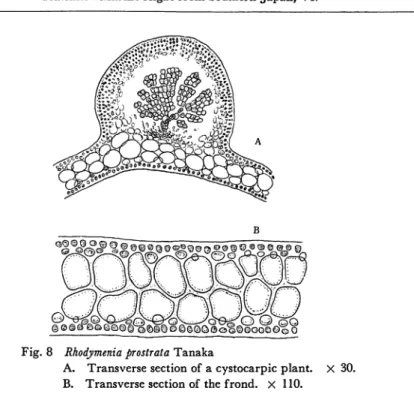
Fig. 8 Rhodymenia prostrata Tanaka
A. Transverse section of a cystocarpic plant. B. Transverse section of the frond. X 110.
X 30.
Habitat. Mageshima, Tanegashima, June 7th, 1964. Dredged from 50 meter's depth on coral bottom.
Frond repens, small, subcoriaceous, complanate, crispate, 3-5cm. long, irregularly branched and branches often one above another, attached to the substratum by means of small stipe from innerside of the frond; segments more or less linear, usually 2-5mm. wide and 170-250/* thick, round at the apex; structurally showing a medulla of two layers of somewhat larger and compressed cells, about 120/* diam., a subcortex on each side of usually one layer of cells about 15-18/* diam., and one or two layered cortex of rounded cells, 3-4.5/* diam.; cystocarps usually marginal or on surface in both side of the segments, prominent, semi-spherical, 0.3-0.6mm. diam., with a thick ostiolate pericarp, carpospores basally attached with a small celled loose placental tissue, and without netlike filamentous investment; colour of the frond deep red.
The present species stands near Rhodymenia parva Yamada and also Fauchea crispa Taylor, but in outer habit as well as in anatomical character, the former can be distinguished from the previous two by the prostrate and creeping habit of the
frond.
Fauchea rhizophylla Taylor
Fig. 9, pi. Ill, B.
Pacific Mar. Alg. Allan Hancock Exped. Galapagos Islands (1945) p. 247, pi. 79, fig. 2.
Japanese name. Hime-hisigatanori.
Habitat. Mageshima, Tanegashima. July 6th, 1964. Dredged from 40 meter's depth on coral bottom.
Distribution. Ecuador.
Plant repent and spreading, membranaceous, very thin, about 180-220/* thick, light yellowish red, producing rhizoidal holdfast from the marginal portions; blades disciform, 3-5 angled with concave sides, and each angles at their end con necting oval to obtriangulate secondary blades; structu ally showing a medulla with usually two central cell layers with colourless thick walled cells to 85/* diam., reproductive organ unknown.
The only plant collected at Mageshima, Tanegashima in 1964 by dredging in deep sea was a sterile specimen. We are not quite certain whether the present plant should be referred to Fauchea rhizophylla Taylor, but we identify it with this species because of its peculiar character of the outer appearance of the frond.
©©£»©©«a©©©© @© © ©©§>©© @© ©©.©©©0©
©©©b ©© <k e ©©@S@© @©© a© @©© ©®@©^©@©
Fig. 9 Fauchea rhizophylla Taylor. Transverse section of the frond. X 200.
Microcladia leptophyllum Tanaka spec. nov.
Figs. 10-11, pi. I, B.
Frons erecta, membranaacea, 15cm. alta et ultra, cylindrica, 0.2-0.5mm. crassa in partibus inferioribus, assurgentes ex filametes prostratis repentibus vel epiphy-ticae in alias algas, ramulisque alternis subdistichiis decomposito-pinnulatis; ram-ulis inferioribus in ramis satis elongatis, incruvis et saepe hamatis in parte superiore, l-2cm. longis; tetrasporangiis in partibus superioribus ramulorum uni-seriatis, globosis vel elliptocis, ca. 320-380/* diam., tripartite divisis; cystocarpiis numerosis sparsis in partibus superioribus ramulorum, late oblongato-ovatis, 700 x 800-800 x 1200/*, breve pedicelatis; colore fusco-purpureo; specimina exsiccatione chartae adhaerent. Planta typica in loco dicto Mageshima, Tanegashima, legit Tanaka, no. 19653, 5 Jul., 1964.
Japanese name. Nankai-saeda.
Habitat. Mageshima, Tanegashima. July 5th, 1964. Dredged from 40 meter's depth on coral rock.
Frond erect, membranaceous, 15cm. high or more, filiformis and cylindrical, 0.2-0.5mm. diam. in the lower portion of the frond, assurgent from prostrate cre eping filaments or epiphytic on other algae, with a percurrent axis branching into several orders and all the branches lying in one plane, erect axis alternately or subdistichously branched, more or less zig-zag, very slightly constricted at the
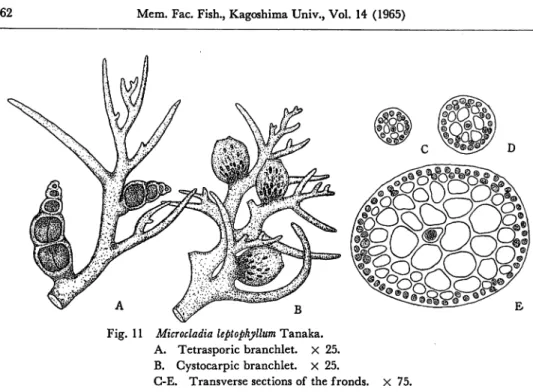
Fig. 11 Microcladia leptophyllum Tanaka. A. Tetrasporic branchlet. X 25. B. Cystocarpic branchlet. X 25.
G-E. Transverse sections of the fronds. X 75.
lower portion, branches in series of 3-4, lowermost branchlets of the branches usually single and very elongated, about l-2cm. long, usually curved or hamate at the apex; structually showing a central axial cell with five or six pericentral cells, cells of the inner layer, excepting central cell, large, gradually smaller towards periphery, lenticular thickenings in the walls of the medullary cell very rarely present; tetrasporangia usually elliptical or globular, 320-380/* in diameter, formed in a single row in swollen stichidial branchlets, these stichidial branchlets short and often little curved, tetraspores irregularly tetrahedrally divided; cysto-carps scattered on the upper branchlets, oblong-ovate, 700 x 800-800 x 1200/*, very short pedicellate, containing comparatively large but few carpospores; an-theridium unknown; colour of the frond light purplish red; specimens adhering to paper in drying.
Among genus Microcladia, the present species shows some likeness to Microcladia
coulteri Harvey in its outer appearance. The most characteristic feature of the present species consists in its having elongated hamate branchlets and peculiar structure of the reporductive organs. The structure of cystocarp of this plant reminds us not of the other species of genus Microcladia but of some genus of Rhodomelaceae.
The branchlets which are issued from the lowest portion of the branches are always longer than those from the upper and not ramified and usually curved and often forming tendrils at the apex. Every branchlet which is to be issued from the lowest basis of the respective branch is always larger than those branchlets shooting from the upper part of the branch, and is simple and curved, and hooked
Fig.' 12 Delesseriopsis elegans Okamura. A. Details of the upper portion of a blade. X 150. B. Details of the lower portion of a blade showing the venation and the arrangement of the intercalary calls. X200. C. Details of the middle portion of a blade. X 150.
o
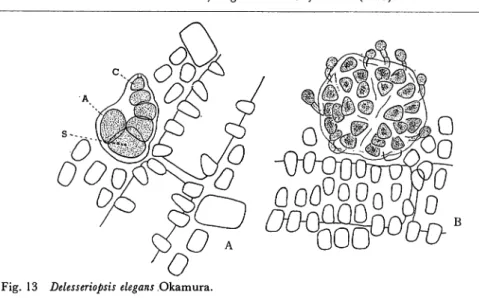
Fig. 13 Delesseriopsis elegans Okamura.
A. A procarp (A. Auxiliary cell, C. Carpogonial branch, S. Supporting cell). X J200. B. Matured cystocarp seen from the surface. X 200.
Delesseriopsis elegans Okamura
Figs. 12-13, pi. Ill, A.
Icones of Japanese Algae, vol. 6 (1931) p. 43, pi. 274, Nipponkaisoshi (1936) p. 715, fig. 341; Kylin, Die Gattungen der Rhodophyceen (;956) p. 395, fig. 309.
Japanese name. Usumurasaki.
Habitat. Mageshima, Tanegashima. July 6th, 1964. The plants were collected by dredging from about 50 meter's depth on coral.
Distribution. Kashiwazima, Tosa Prov.; Mageshima, Tanegashima.
Genus Delesseriopsis eas established by Dr. Okamura in 1931, and it belongs to subfamily Delesseriopsideae in family Ceramiaceae. The characters of the frond of this plant are very peculiar and characteristic among the genus in family Cera
miaceae.
The frond is leaf-like and thinly membranaceous, and traversed by a faint slender midrib. The midrib consists of monosiphonous row of larger cylindrical
cells.
The opposite and distichous monosiphonous pinnae issuing from the every shoul der of the respective articulation of midrib, form a very wide patent manner. Each pinna gives rise to pinnulae in the same manner as that of pinnae and pinnulae does the same to secondary pinnulae and so on. All the cells being loosely united at the places where they come in contact with each other, lying on one and the same plane, and the interspaces become completely filled by smaller cells of primary and secondary pinnulae. By such a mode of branching, the delicate mem brane is made up.
The upper part of the midrib is one cell layer. However, in the lower part of the frond the midrib is covered by several rhizoidal cells, and forms several
layers.
The writer, here, collected several female plants of this species by dredging in deep sea at Mageshima, Tanegashima in 1964. The carpogonial branch consists usually of four cells, although fragmentary found with three, and is almost always curved. The procarp is borne upon the basal cell, perhaps playing also the part of supporting cell, in the lateral pinnae, which are issued in opposite manner from the midrib. The character of development in gonimoblast and carpospores show quite the same feature as that of genus Antithamnion or genus Plathythamnion. The
young cystocarp is often covered with several involucre like filaments. The matured cystocarp is nearly spherical in outline, often reaching more than 450A
in diameter.
The colour of the frond is light purplish red. The antheridial or tetrasporic organs are unknown.
Chondria mageshimensis Tanaka et K. Nozawa spec. nov. Figs. 14-16, pi. Ill, C.
Frons erecta, linearis, 10-14cm. alta textura mollis membranaeceaque, com-planata, 8-12 dichotome ramosae angulis latis; segmentis l-2mm. latis, 300-420A crassis, attenuatis ad apicem; cellulae pericentrales 5-6 cellularum ornatis, tela corticalis comparare tenuis, e 3-4 stralis cellularum parvarum composita, cellulae
Fig. 14 Chondria mageshimensis Tanaka et K. Nozawa.
Fig.15.C〃”〃jamagesh加配血TanakaetK・Nozawa・ Tetrasporangialsorusofthebranchlets.×12. peripheriaelongitudinaliternonnihilelongatae,partemincrassatamlenticulatum adparietemcellularummedullarmostendenti;tetrasporangiisinbrevissimesub‐ cylindricisspecialiterramurorumcompositis,ovatis,100-160〃diam.,irregulariter tripartitedivisis;colorefusco-roseo.;cystocarpiisetantheridiisignotis・ PlantatypicainlocodictoMageshima,Tanegashima,legitTanakaetK・ Nozawa,no、19654,8Au9.,1964. Japanesename・Shinkai-yuna・ Habitat・Mageshima,Tanegashima・August8th,1964.Dregedfrom30meter,s depthoncoralbottom・ Fronderect,linearandslender,tolO−14cm・high,somewhatfleshyand 鱗
謹織織謬篭
Fig.16Cho"〃jamdZg“ノb加e”STanakaetK・Nozawa. A・Transversesectionofthefrond.×110. B・Transversesectionofthetetrasporangialstichidium.×50. C・Corticalcellsseenfromthesurfaceofthefrond.×110. ②亀③ 里③ 回 〆 、 L ノ三つ
趣
;
!
蝋
撫
membranaceous,purplishred,usuallycomplanatethroughoutexceptatthebase
a
n
d
t
h
e
a
t
t
e
n
u
a
t
e
t
i
p
,
8
−
1
2
t
i
m
e
s
d
i
c
h
o
t
o
m
o
u
s
l
y
b
r
a
n
c
h
e
d
a
t
w
i
d
e
a
n
g
l
e
s
o
f
4
5
o
-1
2
0
。
;
s
e
g
m
e
n
t
s
a
b
o
u
t
l
−
2
m
m
、
b
r
o
a
d
a
n
d
3
0
0
-
4
2
0
j
4
z
t
h
i
c
k
,
a
p
e
x
o
f
t
h
e
b
r
a
n
c
h
l
e
t
s
usuallyhavingaterminaldepression;structurallyshowingtheaxiswithfiveors
i
x
p
e
r
i
c
e
n
t
r
a
l
c
e
l
l
s
s
u
r
r
o
u
n
d
e
d
b
y
a
l
o
o
s
e
s
u
b
c
o
r
t
e
x
a
n
d
c
o
r
t
e
x
o
f
b
r
a
n
c
h
i
n
g
c
e
l
l
serieswhichinsmallcellsapproximateasanepidermallayer,lenticularthick‐ eningsabundantinthewallsofthemedullarycells;tetrasporangiaclusteredin specialsmallersubcylindricalbranchlets,tetrasporesusuallyovate,100-160〃in diam.,tripartitelydivided;maleandfemaleorgansunknown・ ThepresentspeciesofCル0"‘雌aisaratherdistinctoneamongtheJapaneses
p
e
c
i
e
s
,
i
t
s
f
r
o
n
d
b
e
i
n
g
s
l
e
n
d
e
r
f
l
a
t
t
e
n
e
d
o
r
c
o
m
p
l
a
n
a
t
e
d
t
h
r
o
u
g
h
o
u
t
e
x
c
e
p
t
a
t
t
h
e
baseandtheattenuateapexofthefrond・Thebranchesaredichotomouslyand extremelydivergent,commonlyunder2mm・inwidth,withoutdistinctivecylin‐ dricalstalk・Thestichidialbranchdiffersfromtheothernormalbranchasit showssmallerandslender,andalsosubcylindricalconstitution. 一 摘 要 一日 本 南 海 産 海 藻 類 の 研 究
(その六) 田 中 剛 今回は近年実施しているドレッヂ採集による深海性の海藻類の調査のうち,本邦南西方海 域および琉球列島近海のものの中から,興味あると思われる9種について報告する. アマミノクロキヅタ:奄美群島,喜界島,上嘉鉄産のクロキヅタの一変種と思われるもの は,従来,日本海の隠岐島産のものとは一見非常な差異があり,WebervanBosseの本種の心 記載や図版等から判断すると,奄美島産のものが本種のformaJe”c"Zαオαに当り,岡村盲博 士の報告された日本海,隠岐島のものは反ってf,if”icaか或はf・"”郷c〃αに近いのではな いかと思われる.なお本邦では本種は四国近海からも報告されているが,これは隠岐産のも のに近いのではないかと思われるが,これは今後の研究にまちたい. シンカイヒメプ卜:奄美大島,名瀬近海の60米の深所から採集された最小形のテングサ属 の一種で,外見,ヒメヒラと酷似するが,枝の分岐,四分胞子製の形成場所,根様糸細胞の 位置の様子等に差異が認められる. ヘラヒメブト:テングサ属の小形の一種で,一見ハイテングサに似ているが,体制がごく 柔軟であること,小形で直立していること等で異なっている. ケヒメモサズキ:本邦南海でごく普通に見られるヒメモサズキ(Jtz減α‘""ssazO-〃ch0加加a Yendo)とよく類似しているが,体節が非常に繊細(直径約120鰹以下)であることで差異が あ る . 南 西 方 海 域 で は 広 く 分 布 し て い る と 思 わ れ る . シンカイヒメダルス;馬毛島近海の50米の深所から採集されたダルス属植物中のごく小形 で 何 句 性 の 体 制 を 有 す る 一 新 種 で あ る .t—fiC^iRKJ; f9^^§tlfc©T?^^©MMA^5^, —J& Fa«cA«a rhizophylla Taylor
^-^*-f-^X^*:^(. ft ji f- x ^");4 © Microcladia coulteri Harvey K fgtTIf >S #*, & ©frWi,
fe©(!:li^S<lotl>T, C©j&, *«©#i^iJ,e.ti5.
^ ^ 7 t t : t©ft#l3:PW1$± (1931) Kit), 4 +"xftffl—ft'llil-'k —SfMtt^li
l/TfSJESnfc/h^OJIL/lsWSttttlWiiS-f^ttttttin?, ^H«#KCti©«tt#1'©
>yy*-fi^ : «€AJE*©30#©**^j&>&S5Jg1S*ifc1 HMBItt*MW*3«"f a**© —Wmretb 3. JfM\±WfrmT-m&llx.Z> /JvfejWfeffl ^-JM+i£ li•?>^H& o fcmk&^irc
References
Agardh, CA. (1821): Species algarum rite cognitae, cum synonymis, differentiis specifices et
de-scriptionibus succinetis. Greifswald.
Boergesen, F. (1913): The marine algae of the Danish West Indies. Dansk Bolanisk Arkiv., 10) — (1932): Some Indian green and brown algae especially from the shores of the Presidency
of Bombay. II. Journ. Indian Botanical Society, XlO)
Dawson, Y. (1953): Mar. Red algae of Pacific Mexico, part 1. Allan Hancock Vacific Exped., 170) (1954): Mar. plants in the Vicinity of the Institute Oceanographique de Nha Trang,
Viet- Nam. Pacific Science, 80)
(1957): An Annotated List of Marine Algae from Eniwetok Atroll, Marshall Islands.
Ibid. 11W
(1961): Literature of Benthic Algae from the Eastern Pacific. Ibid. 15 Harvey, W.H. (1853): Nereis Boreali Americana, II.
(1859): Phycologia Australica, I. London.
Inagaki, K. (1950): Some marine algae from the Central Pacific Coasts of Japan, 1. Journ. Japan.
Bat., 25
Kylin, H. (1965): Die Gattungen der Rhodophyceen. Gleerups, Lund. Okamura, K. (1921): Icones of Japanese Algae, IV<5). Tokyo.
(1931): Ibid.\Ksl
(1963): Nipponkaisoshi (in Japanese). Tokyo.
Reinke, J. (1899): Ueber Caulerpa. Ein Beitrag zur Biologic der Meeres-organismcn. Wiss. Meeresunters.
Abt. Kiel, N. F.V.\.
Smith, G. M. (1944): Marine algae of the Monterey Reninsula, California, Stanford-University. Svedelius, N. (1906): Ecological and systematic studies of the Ceylon Species of Caulerpa. Ceylon
Marine Biolog. Reports. 20)
Taylor, R. (1942): Carribbean Marine Algae of the Allan Hancock Expedition, 1939. Allan
Hancock Atlantic Expedition, 2.
(1945): Pacific marine algae of the Allan Hancock Expeditions to the Galapagos Islands.
Allan Hancock Expedil., 12.
(1950): Plants of Bikini and other Northern Marshall Islands. University of Michigan
Studies, Scientific, series, 18.
(1960): Marine algae of the Eastern tropical and Subtropical Coasts of the Americas.
Ibid. 21.
Plate I
A. Caulerpa scalpelliformis (R. Brown) W. v. B./. denticulata W. v. B. Slightly reduced. B. Microcladia leptophyllum Tanaka. Xl.
Plate II
Caulerpa scalpelliformis (R. Brown) W. v. B. /. denticulata W. v. B. Specimens
hJ& ^
• •^8| ^ 4#*..
tote A'
w
- Cj
ESL -**^w^^r^.
•^1^"'
y^B te^
^P$Kag^
i
c
Plate III
A. Delesseriopsis elegans Okamura. Slightly reduced.
B. Fauchea rhizophylla Taylor. Xl. 2.