レthe\International Language "Broken"しEnglish?
∧ ト ト 犬 Patrick Blanche し >
(Faculりof Humanities aad Economics, Department ofIntercultural Com.mu.nicatiorO
Abstract: After reviewingフsome of the evidence which supports the view of Eng恥h as a world language d仁unprecedented importance, this paperニwill attempt to ana!yzethe reasons for the success o・fEnglish as an・additiona卜language and to speculate on how its role \is likely to change in theニダfuture, in both instances with particu毎r reference砲一the wide
variety of Englishes spoken around the world,トm血y of which have been labelled at one time or another "broken" English. The paper will conclude with some 七面七ativeしsu健叩tions
for how language training in Japan might be jmproved\so as to he1ぴthe Japanese meet their ever-increasing need for effective international communication.し 白: ‥ ‥‥
INTRODUCTION
1
During one of the many 'special lectures' which he gave at the International University of Japan, the late Saburo okita? related an anecdote ・to illust皿te the positionしof English in 如day's internationa卜society. The anecdote concerned a∧group of diplomats at入乱n international conference. One diplomat remarked to several others, of various nationali-ties√th友トイit certainly seems 吃at English haS… …somehow become the international lanぼuage”ト This comment was met with general agreement, eχ叩ptイrom a then Soviet
representative, whoクretorted, "No,犬English・ 沁・not\theトinternational language ... the
international language is 'broken' English! ” し \ ノ ト
Though∇"broken English” is an inappropriate combination of words for reasons tha卜will be diS呻ssed姐ter, the Soviet diplomat had made aトperceptive point, an examination of which canトprovideinsiぼhts into what made English become such an importan:t language for international and intranational communication, and how its role is likely to evolve
hereafter. / づ.し 犬 ・ ・・ 一一・ ニ
FROM HUMBLE BEGINNINGS TO WORLDぐDOMINANCE
Theトterm "international' was introduced into the English l加西age onlyヅ200ダyears・ago by Jeremy Bentham^ a utilitarian philosopher二who shared the concern□expressed muchトearlier by Francis Bacon that learning suffers "distemper" through the大脳ct thatダwords effectively mask and obscure the "weight of matter" which should be at the center of our attention''. The problem of communicating across cultures hadくalso been addressed by Shakespeare,血 TheMerchant ofVenice:"You know l say nothing〉to him, for he understands r!ot me, nor
2
Res. Rep. Kochi Univ. Vol. 43 (1994) Hum.
l him: he hath neither Latine, French, nor Italian…and l have a poore pennyworth in the English…He is a proper maがs picture, but alasレwho can converse with十aフdumbe show?”5 / 犬 ∧ ダ 十 When John Mi比on made the difficult decisionトnot to use Latin and〉instead write a national epic in his native English, he resigned hi血self to the belief that he would・ havむ to be "content w此h these British Islands as my worlds大白he was convinced that he would not
be read or recognized abroad.
A bit more
optimistic about his native tongue was John
Adams,
the secoμd president of
the United States, who declared in 1780(1トyears
before he becameレpresident)
that
"English will be the most
respectable language inダthe
world and the most:universally read
and spoken in the.next centuryパf not before the close of this oneワレHistimingくwas not
accurate, but the substance of his statement was. ト 上十 上 j …………
Whether
the English language is the world's m(沁tニrespectableトornot is a moot
point, but
on the eve of the twenty-first century it is certainly the most
widely read and spoken,
second only to Chinese in sheer number
of speakersいand clearly number
one is terms 6f
geographical spread.
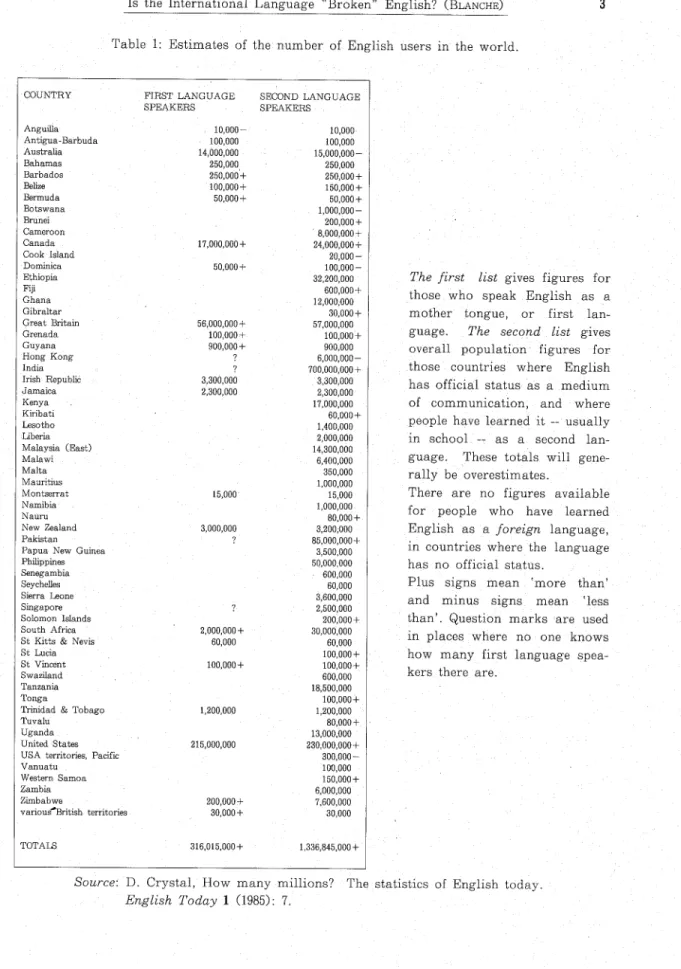
This is shown in Table
1below. つ
THE
EVIDENCE
In many ways, English already meets theトrequirement一of a true world "lingua franca". In
the late seventiesパtW昨犬already spoken native!y∧by approxi早計ely ・300 million people, and
as an additional language by almost that many皿峠e・8☆It was the predominant language
in〉which mail w一臨written (70%) ^ the princip峠1a噌uage of radio broadcasti贈(60%)1o,・
the standard language of aviation, and had become by far the mos卜important language of
diplomacyバn 1970, 0f the then 126 members o卜the United Nations√80坤ceived their basic
working documents in English, and at least !5 mo㈱requested copies in English土in addition
to those they received]n二)ne d the ・other 和ur六丿officiaレlanguages":ニFrench, S・panish,
Russian, and Cれinese卜十In addition to its prominence aレthe UN√English has also been
chosen as an official working language by many other 毎ternational organizations including
Amnesty International, the Inter・ParliamentaryづUnion, the AsianユDevelo!)ment Bankレthe
Asian Industrial Development Council, the Pacific∇Basin Economic Council, the Association
of International Libraries, the〉Association \of Secretaries∧Generaトof Parliaments, the
International Passenger Ship Association, theダAtlantic Trea燧Association, and the Baltic
and International Maritime Conferenceロレ \ ‥‥‥‥‥‥‥‥‥‥‥ づ
As of 1975, English was 仙e sole official designated language of some 21 countries and the
designated叩二〇fficial language of some χ6 more,むven tfioush. it loasコspofeen natiueW by
45%or more{がthe populatioR in onり12トcountries烋 Additionally, there are several other
countries where English is not an official language accordingしto nationaトpolicy but /still
plays 4n importantしand authoritative .parレin△everyday玉fe. Countries in this category
include Kenya, Malaysia, the Sudan, Pakistan, and Myanmaト(Burma until May 26, 1989)".
こ ︼ レ︸
Is the International Language "Broken" English? (BL八nche)
Table l: Estimates of theレnumber of English users in the world
F I R S T L A N G U A G E S P E A K E H S ・ . ・ 1 0 , 0 0 0 - - - ・ 1 0 0 , 0 0 0 1 4 , 0 0 0 , 0 0 0 ・ ・ . 2 5 0 , 0 0 0 2 5 0 , 0 0 0 十 1 0 0 . 0 0 0 十 5 0 , 0 0 0 + 1 7 , 0 0 0 , 0 0 0 + 5 0 , 0 0 0 十 Malaysia (East) Malawi \ Malta Mauritius Montserrat Namibia Nauru 。 New Zealand Pakistan 一一 Papua New Guinea Philippines I Senegambia Seychelles 。・ Sierra Leone・ Singapore Solomon Islands South Africa St Kitts・& Nevis・ st Lucia ・. st Vincent Swaziland Tanzania Tonga
Trinidad & Tobago Tuvalu Ugandaブ ‥ United States \ USA七erritories, Pacific Vanuatu Western Samoa Zambia − Zimbabwe various'British territories TOTALS 5 6 , 0 0 0 . 0 0 0 + 1 0 0 , 0 0 0 十 一 9 0 0 , 0 0 0 十 ? ? 3 , 3 0 0 , 0 0 0 2 , 3 0 0 , 0 0 0 1 6 , 0 0 0 3 , 0 0 0 , 0 0 0 ? ? ● 2 , 0 0 0 , 0 0 0 十 6 0 , 0 0 0 1 0 0 , 0 0 0 十 1 , 2 0 0 , 0 0 0 2 1 5 , 0 0 0 , 0 0 0 2 0 0 , 0 0 0 十 3 0 , 0 0 0 十 3 1 6 , 0 1 5 , 0 0 0 十 S E C O N D L A N G U A G E S P E A K E R S ・ , 1 0 , 0 0 0 ● 1 0 0 , 0 0 0 . ・ . ・ ・ ∧ ・ 1 5 , 0 0 0 , 0 0 0 - - - 2 6 0 , 0 0 0 1 2 5 0 , 0 0 0 + 1 5 0 , 0 0 0 十 5 0 , 0 0 0 十 1 , 0 0 0 , 0 0 0 - - - 2 0 0 , 0 0 0 十 8 , 0 0 0 , 0 0 0 十 2 4 , 0 0 0 , 0 0 0 十 ダ 2 0 , 0 0 0 十 1 0 0 , 0 0 0 − 3 2 , 2 0 0 , 0 0 0 1 6 0 0 , 0 0 0 十 ‥ 1 2 , 0 0 0 。 0 0 0 3 0 , 0 0 0 + 5 7 , 0 0 0 , 0 0 0 1 0 0 , 0 0 0 十 9 0 0 , 0 0 0 6 , 0 0 0 , 0 0 0 − 7 0 0 , 0 0 0 , 0 0 0 十 ∧ 3 . 3 0 0 , 0 0 0 2 , 3 0 0 , 0 0 0 1 1 7 , 0 0 0 , 0 0 0 6 0 , 0 0 0 十 1 , 4 0 0 , 0 0 0 2 , 0 0 0 , 0 0 0 1 4 , 3 0 0 , 0 0 0 几 6 , 4 0 0 , 0 0 0 3 5 0 , 0 0 0 1 , 0 0 0 , 0 0 0 ∧ ・ 1 5 , 0 0 0 / 1 , 0 0 0 , 0 0 0 8 0 , 0 0 0 十 ・ , 2 0 0 ; ・ 0 0 0 ダ 8 5 , 0 0 0 , 0 0 0 + 3 , 5 0 0 , 0 0 0 5 0 , 0 0 0 , 0 0 0 / ・ 6 0 0 , 0 0 0 6 0 , 0 0 0 3 , 6 0 0 , 0 0 0 . ・ 2 , 6 0 0 , 0 0 0 2 0 0 , 0 0 0 十 . ・ 3 0 , 0 0 0 , 0 0 0 6 0 , 0 0 0 ● 1 0 0 , 0 0 0 + 1 0 0 , 0 0 0 十 尚 6 0 0 , 0 0 0 尚 ・ 1 8 , 5 0 0 , 0 0 0 1 0 0 , 0 0 0 十 1 , 2 0 0 , 0 0 0 8 0 , 0 0 0 十 . パ 1 3 , 0 0 0 , 0 0 0 \ 2 3 0 , 0 0 0 , 0 0 0 十 3 0 0 , 0 0 0 - - - 1 0 0 , 0 0 0 ・ 1 5 0 , 0 0 0 十 ‥ 6 , 0 0 0 , 0 0 0 . 7 , 6 0 0 , 0 0 0 3 0 , 0 0 0 1,336,845,000 + 3
The fiΓst list gives figures for
those。who spea・k。English as a
mother tongue, or first
Ian-guage.十The secoixd list gives overall population▽figures ・for
those \countries where English
has official status as a medium
of communication, and白where
people・have learned it -一声sually
in sChoo1/-レas a second Ian-・
guage. These totals will
gene-rally be overestimatesンし
There are no figures available
for△peop!e who have learned \
English as a foreign language,
in countries where the language・
has no official status.・ し
Plus signs mean イmore thanブ
and minus signs mean∧'less
than'. Question marks are used
in places where no one knows
how many f抒S卜language
spea-kers there a・re. 。 ・・
Source:D.
Crystal, How
many
millions? The statisticsof E】nglishtoday
4
Res. Rep. Kochi Univ. Vol. 43 T(!994)Hum.
programs inトvirtually every nation15.ダThe vastトmajority∧of people learning Eng恥3h today are doing it in secondary school, a very signユifican卜fact,上because it is in secondary schools that the educational systems \of developing nations have b叩n experiencing their mo乱 dramatic growth. Growing school 辿e populations together with an increasing percentage of the population十actually enrolled ・inトSむcondary schools mean a demand for English instruction whiむh is increasing at a substantially・higher・rate than the population its〕e1仁上In Asia, the secondary school age-appropでiate cohort doubled in number betweenト1960 a姐 1970, while 97%o仁the actual secondary school enrollment was participating in Engl沁h classes. The situation in上Africa was equally impressive,昭ain with 97% o卜幡e secondary school students taking English classes.ニThe figuresイor other areas d the world were lower, but in: no area was English class enrollment under 50%ヶIn the late seventies,:the proportion of secondary school students taking English巾isses in Europe was 57%. It was
54% m Latin America, and ro贈hly the same (between 53% and 54%) in the republics of the (former) U.S.S.R. ニ \ 二 十六 コ
At the terti町y, or university level, the situation………is complex and it is more difficult to ascertain the role of the langu昭e・. Many non-English mother-tongueしcountries \have university wく)rk conducted in English in some advanced五elds, particularly technologiむ41 fields. It can also
‥be上assumed that
in countries where secondary level education is conducted chiefly thrに)ugh the English medium, tertiary level work is done in English as well. Moreover, a large number of universities around the world offer n叫 only instruction in the langu贈e,ニbut also E昭lish major programs∧thaレoften include literature study v姐
the medium of English. = ・・・.・・ .・ ・.・. ・.
Another way to examine∧the role of English in higher education is to look at the numbers of foreigners studying in English mother-tongue countries. In 1971, the total number of foreign students enrolled in institutions of higher learn毎にaround the world was jus卜QV瞳 500,000. About 40% of those were studying in English mother-tongue countries, aうd of th球ニgroupapproxiTriatel'v 80% came fromレnon-English,mother-tongue countries”.\ = A further・indication of the worldwide status of English is◇仙e abundance and variety of English-language newspapers published 鋤 トnon-English mother-tongueニcountries. The
Politic 「召凹励o萌(ソthe World,四阿19 lists 76 such newspapers in Africa, 50皿Asia√13 1n Latin America, and 4 1n Europe − exclusive of TTwe European,Europe'sイirst肥百凹 「
newspaper”( according. to its publisher)ソwhich was lau面hed\ around 1990. The large number o卜dailies and weeklies publisれed in English in the non-English mother-tongue countries of Africa and Asia shows that there are many pやople who are able to」read the language competently, in non-English speaking reだions of the world and that∇they do so on a regular basis. \∧ ・. \ \ ニ ∧ 犬
REASONS FOR =THE SPREAD OF ENGLISH
The unique role of English as aトworld language, in terms of its number:and geographical spread of native and non-native speakers,・its official and・れonぺ)fficialuses in intern・ational
Is the International Language
"Broken” English? (Blanche)
5 and intranational affairs, and its preeminence in education and in the media, cannot be denied. Like most of the other important languages, it first rose to prominence as the language of an empire: its spread and influence were originally acquired through British imperialism in the nineteenth century. But there is a secor!d reason for its present ascendancy: the phenomenal growth of American economic power in the twentieth century. The combination of the political influence and technological superiority gained through these two successive movements has given English an advantage over the other major imperial languages, such as French or Spanish, while the relative geographical restrictionsof Russian, Chinese in its many forms, or Arabic have made these langu昭es less influential internationally. However, this is far from being the whole story; indeed, it is
where the story of "broken” English begins.
English has not only been the language of British andにsome would say, American imperialists. It has, in fact, also been the converse of that, as it played a vital role for
many countries in their achievement of independence. Ali Mazrui, a Ugandan scholar, has pointed up the very wide range of audiences which had to be addressed in the years leading up to independence by politicians in countries like Nigeria, Kenya and his own. It was necessary to reach such diverse audiences as the local indigenous populationsパocal colonial authorities, European governments, the public at large in European countries, other black African populations, black Americans, the government and people 0f India, and interna-tional organizations and agencies. At the same time, the means of eχpression had to be politically neutralized as much as possible, since 此 would be difficult for anyone to advance a liberation movement using a language filled with associations of colonialism!9. This situation reveals one of the sources of "broken” English: a language was needed that was widely intelligible, but somehow different from・that of the oppressors.
Perhaps English was especially well suited for African independence movements because the colonizers from Britain had never taken pains to teach impeccable Queen's English to ”those born without that grace”, whereas the French had do面 just the opposite with regard to both their language and culture^". Mazrui and other researchers hold that the
explicit educational policy of successive French governments resulted in a kind of "militant linguistic COSmop011taniSm”among French-speaking African leaders in areas where French was the only common language, which tempered the drive for independence in several countries (but, of course, not in either Algeria or lndoChina)21/Leop01d S. Senghor, the first President of Senegal きnd himself a noted poet in French, put a different perspective on the matter in his statement that English "provides an instrument which, with its plasticity, its rythm and its melody, corresponds to the profound, volcanic affectivity of the Black peoples” 22. This is unquestionably not the impression of English which you would expect a first-time foreign visitor to Liverpool to come away with, but Senghor's statement illustrates how English seems to adapt well to a variety of locales and users.
At any rate, compared with French-speaking peopleバwriters and speakersof E昭lish. are lesslikeりt0 let their respect for the language interfere with theirdesireto use it`'23.0ne
6
Res. Rep. Kochi Univ. Vol. 43 (1994) Hum.
uniform
across the world,トwhile English has developed a series of national standards^*.
The extent to which these national standards, and the varieties of English they have engendered, have evolved and continue to \evolveis the key to the unique suitability of English as a universal language of wider communication. Some groups concerned with the promotion of English in the world have viewed this development with alarm. These groups would almost certainly have a tendency to categorize the many national varieties of English together as ”broken”English, with its strong connotation of imperfection and inferiority to so-called "standard” English.
The British linguist Randolph Quirk deals with this kind of bias quite effectively: "notions such as English is the Englishman's gift and the language remains fundamentally 'ours', etc., are parochial and naive”; they ”donot even remotely correspond to linguistic realities and can do nothing but harm to the cause of human relationships and international harmony”25.
The preceding quotation is not meant to apply to the Sovietしdiploma卜in Saburo Okita's anecdote. The diplomat was correct in observing that the language most commonly used for international communication is not the same as that spoken by native speakers in England, Scotland, Ireland, Canada, Australia, New Zealand, New York, Massachusetts, Illinois, Louisiana, Tennessee or California. But considering the ever-growing demands of cross-cultural communication around the wor!d,it should be agreed that the phrase "broken
English” has outlived its usefulness. ,
THEヽFUTURE
Early in the twenty-first century, the non-native speakers of English will in all likelihood
outnumber
those who
speak it natively26トAlready,an important
new
trend in the spread
of English can be observed, in that it is now
being significantly fostered by the non-native
mother-tongue
world, rather than being largely dependent
on the resources, efforts, and
personnel of the native English-speaking countries^''.Even
more impressive is the fact that
"this effort is not only conducted by Third
World
recipients of Western
largesse, but
equally massive programs
via English are being conducted by the[republics of the former]
Sovie卜Union, the Arab
world, and mainland
China − world
powers
that have
their own
well-developed standard languages
and that normally
oppose[or, until recently, used to
oppose]various
political,philosophical, and economic goals of the English mother-tongue
world”28レTwo
complementary
reasons why
this trむndis possible are that (1) in most
parts of the world English has come
to be accepted as a fact of 1廿e, its imperialistic
associations fading rapidly29; and (2)
with the swift increase in global communication,
”peoplelike engineers, doctors, airline pilots and businessmen,
whatever
primary
cultural
values they subscribe to, acquire the secondary culture of their specialtiesand thereby take
out membership
of different occupational and professionaトgroups
without
being involved
Is the International Language "Broken” English? (BL八nche) 了
identity to their particular specialist domain and at the same time fulfill the necessary conditions for communicative efficiency”3o.
The English language will continue to grow in its breadth of uses and number of users, as long as those who speak, read, write and listen to it can feel that it is their own
possession, with its own appropriate range of applications, its own body users with whom they want to communicate, and its own set of linguistic features^*'. That English has indeed become a possession of many of its non-native speakers and writers can be most
clearly seen in countries where policy-makers have tried to decrease its role. As early as 1951, a team of UNESCO specialists urged that an "unwilling public be persuaded to accept education in the mother tongue” 32. President‘ Jomo Kenyatta of Kenya announced in 1969: ”Weare soon going to use Swahili in Parliament, whether people like it or not”33. The following year, the Kenyan ruling party Kanu proclaimed that it would ”not tolerate homes where mothers and children talk to each other in English, forgetting their way of life”34トAbout the same time, a sociolinguistic investigation conducted in Kenyan homes determined that English was the clear first choice of Kenyan children for the language they would like to bring their own children up in^^ Although these examples are all from Kenya, similar ones could probably be found in several other countries, especially those which have attempted to reduce English usage, such as Malaysia and Myanmar. More and more, non-native speakers of English are showing that the language has been accepted from within, that it is 哨詞r language.
Another very good illustration of the extent to which English has come to be accepted from within by non-native speakers is the growing body of creative writing done by non-native speaking authors, up until now predominantly from countries of the Indian sub-continent, East and West Africa, and the Caribbean^". Ironically, the biggest spurt in such English writing has come in the years immediately surrounding the demise of the British Empire. This body of writing continues to grow in both quantity and quality as the authors come to handle a wider range of registers, themes, styles and techniques with increasing authenticity and idiomatic expressiveness (at the same time "nativizing”all
these aspects to suit their own purposes), and as their potential readership widens, both in terms of the ,expanding bilingualism that creates a larger English-knowing indigenous audience, and through international recognition which provides a bigger worldwide
audience. Some of the authors in this group who have achieved broad recognition are Raja Rao, R. K. Narayan, Chinua Achebe, Wole Soyinka, and Elechi Amadi. In the following quotation, Chinua Achebe highlights several of the themes dealt with in this paper:
¨Somy answer to the question, 'Can an Afriむan ever learn English well enough "to be able to use it effectively in creative writing?’ is certainly yes. If ”onthe other hand you ask: 'Can he ever learn to use it like .anative spea-"ker?’ I should say l hope not. It is neither necessary nor desirable for him ”todo so. The price a world language must be prepared to pay is submission ”tomany different kinds of use. The African writer should aim to use English ¨ina way that brings out his message best without altering the language to
8
Res. Rep. Kochi Univ. Vol. 43 (1994) Hum
"lost.■He should aim at fashioning out an English which is at once universal "and able to carry his particular eχperience …It will have to be a new "English, stillin full communion with its ancestral home, but altered to suit "its new African surroundihぽS.”37
As writers such as Achebe go on "legitimizing” local varieties of English, speakers of these varieties will increasingly demonstrate solidarityレidenti町犬with and be loyal to their particular dialect. This portends a bright future for the language as a whole, yet it could also be in the very success of the diffusion of English where trouble lies in after years・ Of course. a massive shift in economic and technological power away from the AUボophone world would (ultimately) lower the status of its common language, but third party inertia would keep reinforcing the use of English for decades or longer'^ The more likely danger is based on the threat that it poses, 0rseems to pose, to other languages. The perception of this threat will keep growing as English continues to become more multicultural, and may gradually lead more and more people to look for an alternativ♂9L Alreadysuch a phenomenon can be seen in the recurring need to control, regulate or tame the expansion of English shown by various governments, among which the French government recently attracted a great deal 0f media attention''". If it is to th出岬aS a lingua franca, English
must abstain from dominating indigenous languages, both socially andダpolitically. Thus, careful and sensible planning has become necessary, to make it, other languages of wider communication and local indigenous languages play their legitimate parts alonside each o仙er in a way that is appropriate for each particular country.
A problem deeply related to the ill feelings which are sometimes caused by the preeminence of English is what sociolinguist Joshua Fishman calls the "parochialism of world
languages” 41. Because of the convenience that the worldwide diffusion of English has afforded the Anglophone nations, most native English speakers are insulated from learning
the. languages (and having to understand the cultures) of other peoples. The resultant parochialism is immediately detrimental to crosscultural goodwill and also likely to have, in time, a negative impact on technology, science and industry in the English-speaking
countries. According to Fishman, "only if massive worldwide efforts t0 learn more English are increasingly matched by Anglophone efforts to learn a good bit more of the langu昭es (and values, traditions, purposes, etc.) of the rest of the world, might the
current extraordinary position of English as an additional langu昭e be any more firmly established than were those of the previous lingua francas of world history. He continues, ≒nfor-tunately, we know far more abouレhow to help the world learn English (little though that may be) than we d6 abou七how to help native speakers of English learn about the world” 42. And so, the future success of English rests in la贈e measure on how well native speakers face up to the responsibilities brought on by its various international roles, and indeed how well they 尽re able ・to accept the fact that English is n0 longer exclusively "their” language, that in its many forms it belongs equally to other people all over the planet.
Is the International Language "Broken” ?(BL八nche) 9
IMPLICATIONS FOR LANGUAGE TRAINING IN JAPAN
In 1859, Yukichi Fukuzawa concurred with John Adams in declaring that English would be the most useful language in the future". A few years later, in 1873, Arinori Mori went much farther and proposed that the Japanese language be abandoned so as to "adopt instead some better, richer, stronger language, such as English or French”44; his sentiments were subsequently echoed by Naoya Shiga''^ The :ideas of‥M(と)riand Shiga were rather eccentric, to put it charitably, but Fukuzawa's prediction is particularly applicable to today's (and tomorrow's) Japan.
Japan would certainly benefit from having more competent speakers of foreign languages. Producinだgood English speakers should be easy, since Japan presumably devotes more resources to English education than any other nation. However, after five to nine years d classroom instruction, most Japanese (i.e. probably over 80% of the country's adult population) today are still unable to communicate at even a basic level in English. What isthe source of the problem?
According to applied linguist Christopher Brumfit, there are three conditions which need to be fulfilled in order to learn a language:
(1) Extensive exposure to the language;
(2)Extensiveopportunity to use the language so far acquired as creatively as possible -- through reading, writing, conversation, listening activities, whichever are most appropriate
toparticular learners; ・・ ▽
(3)Students must be motivated to benefit from (1)and(2)46.
Inthe majority of Japanese schools, English language education still does not meet any ofthese requirements. First, there is no eχtensive exposure to▽the language, but rather only intensive exposure to a few peculiar aspects of it; in: fact, the students are more widely exposed to it outside of the classroom through listening to Anglo-American popular music. Second, the students do not get a (real) chance to use English creatively, but rather devote (moSレof) their efforts to translating the language, which is thus learned back into Japanese as soon as possible. And third, the students' motivation is generated mainly by the looming entrance examination to the next level 0f school.
Probably the greatest single step that could be taken to improve the situation would be to remove the English component from university entrance examinations, unless communiむa- tiveskills in English were to be tested. English will not be used extensively in Japan as longas it is abused as a screening apparatus for university admissions 一一and perhaps also asstudy material for STEP, TOEIC and TOEFL tests"''. In addition, not everybody should berequired to study English. At least under the present circumstances, Takao Suzuki w尽S rightin claiming that it is wasteful to teach it so widely ^^ In the future it may be important for a11 Japanese to have some degree of proficiency in English, yet the present situation demands a reorientation from quantity to quality. Currently, few junior high andhigh school students can see how English will help them once they have joined the workforce. As Peter Strevens has said, "Most people learn as much or as little ofニa
1 0
Res. Rep. Kochi Univ. Vol. 43 (1994) Hum
foreign language as they need − not as much as they are taught” 49. Furthermore, in the coming years Japan is going to have a growing need for speakers ofトother languages, especially other Asian languages. Therefore, many students should be encouraged to study
those languages in place of or in addition 如 English. \ 犬 ト
On the classroom level, what is most needed is a change in attitude away from the "cult of the native speaker”. Japanese teachers of English often avoid using the target language in class because they are hyper-conscious of their inadequacies; l their ,English is not native-like. Since the language is rarely used for communication between Japanese in Japan, a distinct "institutionalized”variety of Japanese English has not developed. In spite of this, whatever sort of "Japanese”characteritics appear in the English of a Japanese speaker are normal and nothing to feel embarrassed about. 0f course teachers should set and try to maintain high standards both for themselves and their students, but those standards should .be appropriate and reasonable for Japan, and they should not interfere with the goal 0f becoming communicative in the language. By using and having
the learners use English as freely as possible, the language will start becoming the learners' own possession.
There are several reasons why .it is counterproductive to be overly concerned about 伍e native speaker model. One is that when Japanese representatives are acting on the international stage, there is a good chance that at least some of the other players will not
be native speakers of English themselves, and the native speaker model will have no special aura for them. Another reason is 七ha七native English dialects are not necessarily more comprehensible than other varieties. In a study which was done some years ago at the University of Hawaii's East-West Center, the intelligibility of a Japanese speaker of English, judged by other non-native speakers from eight different countries, was much greater than that of a native speaker of American English^". For Japanese teachers of English, native-like pronuciation would be almost impossible ,even if itトwere desirable, to achieve, so it is much better to get down to the real work of enabling students to communicate in the target language・
In another study which was sponsored by the East-West Center, but carried out in Japan and eleven other countries, the most severe problems facing English teaching institutions were surveyeが\ Especially in countries where the language was a classroom subject rather than a medium of instruction, these problems were (1) listening comprehension in general and (2) a lack of ability to understand different dialects in particular. Critics might claim that the difficulty in understanding different varieties of English is a by-product of
too much permissiveness toward deviation from a so-called "standard”, which, if the permissiveness continues unchecked, will eventually splinter the language into mutually unintelligible sub-languages.
However, although cross-varietal problems in intelligibility cannot be ignored, the reality of the situation is that worldwide mass media combined with international interactions in business, diplomacy, travel and politics tend to limit this assumed diversity mostly to phonology and a few differences in vocabulary ^'^. Indeed, the research also showed that the three most likely causes for the problems facing English teaching institutions were, in
Is the International Language
"Broken" English? (Blanche)
1 ` 1order of importance,
(1) a lack of eχposure to English, (2) the teachers' general lack of
confidence in their ability to speak a foreign language
and (3) the low
quality of their
initial training.
CONCLUSION
Based on the findings of not only the studies mentioned above but also other studies''^ it can b6 concluded that the same principles which will help Japanese students learn English will make it possible for English to best fulfill its role as an international language. These principles are (1)to be proud of one's own variety of English; (2)to get exposure and develop sensitivity to as many varieties of the language as possible; and (3) to try to understand and appreciate the culture within which each dialect evolved.
If the dissemination of English is to be of any value, in the words of sociolinguists Krishnaswamy and Aziz ”it must end up in better human relationships and international harmony. Without losing their identities, nations want harmony; without losing their valuable values and cultural heritage, people want better relationshipsレThey want to be Indians/Arabs/Japanese/Chinese, etc. and at the same time international” 54. Thus, the three principles that have just been outlined should apply equalりto皿晩加eand 几OR一native speakers of the language. In fact, perhaps it would be useful to consider international English ■as a language having no native speakers, and as being a tool which we can all learn to use more skillfully and sensitively to improve communication worldwide. From this perspective, there would no longer be a context for an eχpression such as "broken English”.
NOTES
1, This paper is the final outcome of research work the writer started in November 1987, when
he was lecturing at the International University of Japan in Niigata Prefecture.
2. A former Japanese Foreign Minister, Dr. Saburo Okita founded the International
University of Japan in 1982 and was President of it until his death on February 9, 1993.
3. R. Quirk, "International Coramunication and the Concept of Nuclear English”I in C.J.
Brumfit (ed.), English, forInternationalCommi£几ication,1982, p. 175・
4. F. Bacon, Advancement ofLearning,1605.・
[Cited in Quirk, op. cit.] ト
5. W. Shakespeare, The Merchantof Venice,Act 1, Scene 2パine 72.
6. J. Milton,Tke Reasono∫Church,一一GouemmentUrg'dagairistPrelaり,1641.
[Cited in Quirk, 0p. cit.]
7.[Cited in]M. M. Mathews,The Beginningsof AmericaれEnglish。1931,p. 42・
8. A. W. Conrad and J. Fishman, "English as a World Language: The Evidence”, in J. A.
Fishman, R. L. Cooper and A. W. Conrad (eds.), The Spread ofE昭託s臨1977, p. 6.
9. Ibid. 10. Ibid.
12
Res: Rep. Kochi Univ. Vol. 43 <1994) Hum.
11. Ibid, p. 9● ニ
Until 1976, Arabic was not an official language of the United Nations.
12. V. Bickley, "The International Uses of English: Research in Progress", in C・ J. Brumfit
(ed.), op. cit., p. 85.
13. Conrad and Fishman, op. dt・, ppフー8, and p. 57 [note 6)]where there is a complete list
・of the countries in which English was spoken natively by 45%or more of the population at
the time of writing・
14, Ibid., pp. 8-9.
15. R. W. Bailey and M, Gorlach (eds.),Englisれasa WorはLangu昭e,1982,p. 2, エ
16. Conrad and Fishman, op. dt・, p. 16・
17. Ibid., p. 27.
18. A. S. Banks. PoliticalHandbookof theWorld,四75, 1975・
19. J. B. PrideドThe Appeal of the New Englishes” ,in J. B. Pride (ed.), New Enがishes,1982.
20. Bailey and Gorlach, 0p. dt・, p, 2, \
21. Ali Mazrui, "The English Language and the Origins of African Nationalism'≒ in R. W,
Bailey andよL. Robinson (eds.), Vaパ ・G('if Present-Da-y E昭江'.sh,1973, pp. 56-70,
22. L. S. Senghor, "The Essence of Language: English and French" , Culture2バ, pp. 75-98.
23. Bailey and Gorlach, op. cit., p. 3,
24. A. Valdman (ed,),Le Fransais hors de France,1979.
25. R. Quirk,Tke UsesofEnglish, 1968・
26. B. B. Kachru (ed.). TkeotherToneue:ETiglish, AcrossCultures,1982, p. 3.
27. J. M. Fishman, "Sociology of English as an Additional Language” ,in Kachru, op. cit., p・
15.
28. Ibid., p. 16.
29. Pride, op. cit., p. 2. 十
30. H. Widdowson, "English as an International Language II: What Do We Mean
by "In- ternational Language'?’≒in Brumfit, op. cit., p. 13.
31. Pride, op. cit., p. 3.
32. Ibid.
33. Ibid., p. 2● ∇
34. Ibid.
35. Ibid., p. 3.
36. It is worthy of note that Derek Walcott, the English-speaking poet and playwright who was
awarded the 1992 Nobel Prize for literature, is from the West Indies.
37. C. Achebe, "English and the African Writer'≒Transitioれ18, pp. 29-30.
38. Fishman, op. cit., p. 21・
39. C. Brumfit, "English as an International Language l: What Do We mean by English?”, in
Brumfit (ed.), op. cit., p. 7.
40. P. Blanche, "Le franglais infiltre"バin this issue of]ResearchReportsofKochi Uniuersity,
43, pp. 15-25,
41. J. Fishman,フEnglish in the Context of International Societal Bilingualis 「', in Fishman,
Cooper and Conrad, op. cit., pp. 334-335.
42. Ibid.
43.[Cited in]Quirk, "International Communication and the Concept of Nuclear English”, 0p.
cit., pp.・ 15 and ・18.
44.[Cited in]R, Miller,The Japanese LarieuaEe ia ContemporaりJapan,1977, p. 41.
45. Kachru, op. cit., p. 5.
46. Brumfit・, op. cit., p. 5,
48
49
50
Is the・International Language ”Broken” English? (Blanche) 13
which appeared in the January 18, 1995 issue oi TheJapan Times: ト ‥ ∧ "When you look at Japaneseイoreign language education, you see that the major犬 ∧ "thrust is れ6tイor the students to acquire communication skillsよbut to pass ▽ "examinations…the reality is thaレtherをis a barrier created by the system・‥.lf.・.・・.・ ・・ てpeople could]speak English fluently, and masterニits 1φポcal thought processes,
"the tendency toward confrontation, and the ability to say "n♂ undoubtedly .
"would carry overトinto the Japanese language, and this would act as a threat: 一 \ 十 "to the system as it now exists・. Unconsciously, this is why the system does not "want the Japanese to develop a capacity to speak fluently"レ.= レノ 十十 犬
Masao Miyamoto is director of quarantine at the Health and Welfare Ministry's Office of Quarantine in Kobe. The above quotation was added to the second proof of this article. T. Suzuki. Column in The Japa几Times.June 24, 1979. ∧ : 犬 犬
p. StrevensドLocalized Forms of English", in Kashru, oうトcit.,トpへ28∧ .・..・. . ・・ L. E. Smith and K. RafiqzadフEnglish for Cross-Cultural Communication:The Question of Intelligibility'≒in L. E. Smith (ed.),Readings in English, as匹 International Language, 1983, pp. 49-58.. 十 ∧ ・● j
51, D. Campbell, P. Ekniyom, A. Haque and L.E. Smith, "English in International Settings: Problems and Their Causes” ,in Smith (edよop. cit., pp. 35-48√ 犬
52. Smith and Rafiqzad, 0p. cit., p. 57. 十 〉
53. See, for example, the studies done by Smith, Smith and Bisazza, Kachru, Strevens,
Krishnaswamy and KzrL, and Baxter, all in Smith (ed.), op. citレ犬 ∧ ‥‥ ‥‥‥
54.N. Krishnaswamy and S.A. Aziz, "Understanding va!ues, TEIL and tれe ThirdダWorld", in
Smith (ed.), op. cit., p. 100. \ ・..・.. ・ . ・.
BIBLIOGRAPHY
Achebe C.」965. English and the African writer. Transitionニ!8: 29-30. ニ ニ >ニ
Bacon F. 1605.Advancement of heaming[ANDNew Atlantis]. Oxford, UレK.: Oゴord
University Press [1980 edition]. = 十 ・・..・..・.. ・・.・. ・. ・・ .・
Bailey, RぐW. 1985. The idea of world English. Enがish Today!1:3-6ト 上 コ
上 and J. LンRobinson (eds.). 1973.Varieties ofPresent-DaでyEnglish,. New York:
Macmillan
and M. Gorlach (eds.). 1981. English,as a WorldLanguageCambridge, U
K.:Cambridge University Press. ニ づ Λ
Banks√A. S. 1975. Pc:)liticalHanboofeof theWorは, 1975. New York: McGraw-Hill.
Bickley, V. 1982. The international uses of English: research:inトprogress. In C. JレBrumfit
(ed.), EnglishforiTLtemationalCommuれicationレOxford, U.K.:Pergamon Press.・
Blanche P. 1994. Le franglais infiltrも. Research,Reportsof KochiUrtiuersit^i[Japan]43: 15-25.
Brumfit, C. J. (edう. 1982. E,几elisfi for ternationalCcmmunication.Oxford, U.K.:Pergamon
Pressト ‥
. 1982. English as an international language l: what do we mean by English? In
CにJレBrumfit (ed.), Enボish for InternationalComjuitnicatioTi. Oxford,U.K.: Pergamon
Press. : ∧
Campbell, D., P. Ekniyom, A. Haque and L. E. Smith. 1983. English in international setting's:
problems and their causes. In L. E. S血ith (ed.), Readingsin Enボish, as an Internation.祠
Language. Oxford, U.K.:Pergamon Press. = 十 \ ∇
Conrad,AレW. and J. A. Fishmanレ1977. English as a world language: the evidence. In J.
14 Res. Rep. Kochi Univ・Vol……43 (11
Massachusetts: Newbury House. ……… 犬 一 上士 ト ‥‥‥‥‥‥‥‥‥‥ ‥
Crystal, D. 1985ごHow many millions? The statistics of English todayレEnglish. Todaン1: 7淮 Fishman, J. A. 1977. English in the∧context o仁internation証言socie毎卜bilingualism……=ln J. A.
∧Fishman, R. L. Cooper and A. W. Conradト(Qdよ), TheSpreadofE昭11織………Rowley,
Massachusetts:Newbury House. \ニ ………六大.・.・・.・・ ・.・・. ・・ ・
バ982. Sociology of English a6 an additional language. In B. B. Kachru (ed.),
Rowley, Ma卵achusetts: Newbury House.………… …… 〉 ..・・.. .・ ・・・ .・1‥‥‥‥‥‥‥‥‥
Kashru, B. B. (edよ 1982。The Otfier Tongue:……En.ボi乱一人cross Cultures△OxfordレU浙.:
.しPergamon・Press・・・.・.. ・上 十六∧ レ ト I・・.. ・.・・...・.・・.・ ・ .・.・.. ・.. ・・ ・.・
Krishnaswamy, N. and S. A. Ktaz. 1983. Under斗巨nding valuesレTEIL and the ThirdレWorld. In
LレEンSmith (ed.)にReadingsin Engl!sh.as anIntern叫ionalLanguage∧:Oxford, U.K.:
犬 Pergamon Press. 十 ‥‥‥‥‥‥,‥ エ 犬
Mathews, M. M.ダ1931レTfie Beginnines of ArれericanEnglish,………Chicago:刃niversity ofパChicago
Press. / ‥ ダニ つ/ 一
Mazrui√A.Mバ973. The English language:面(卜the origins, of African丿ationaliりm.つIn RレW.ご
Bailey and よ L. Robinson∧(eds.), Varieties可,:Present-Dai? E瓦が緬れ……… New∧York:
Macmillan. ‥‥‥‥‥‥ 二 十\ ‥ .ノ ▽
Miller, R. 1977.Tke JapaneseLanguageirレGontemporaりJapan∧W卵吊れgtonレDC; American
\ Enterprise Institute for Public Policy Research. ‥‥‥ ‥‥‥‥‥‥‥‥‥ ‥‥‥‥‥‥ ‥
Milton, J. 1641. Theμeasonが=Church. 万一十GouernmenトUrg'd\aeamst‥丿叩旨ty. London:
Edward Griffin. ・・...・ .. ・・.・..・・ .・ 十 ・....・ ・∧
Miyamoto, M. 1995√Japan, Inc.・survives on a mix of bullyinぽand envy. ・Thp.トJapan, Times,
January・18 issue:・ p. 17. し ・・ .・.・.・.
P柝de, J. B. (ed.)」982,Neu! Enelisんes∧Rowley,万万Massachusetts:/Newbury=Ho叩e.・. . ・.・ ・.
. 1982. The appeal of theトnew Englishes√ In JごB、Pride (ed.)√New Englishes、
and K. Rafiqzad」983, English for cross-cultural communication: theレquestion of
Manusぱipt received: ニSeptember 1, 1994 犬 トPublished:December 26,〉1994
Rowley, Massachusetts:ヶNewbury House∧ \ 二十∧
Quirk, R. 1968. The Usesof ETLglish. vjOndon::Longman.
. 1982よInternational communication・ and the concept∧of nu・cl叩r. English. In CレJ.
Brumfit (ed.), EnglishforInternati匹d=CorrununicatioTi.Oxfo図√U.K.:ニPergaraon Press.
Senghor, L. S. 1975. The essence∧of language: English and French.トCulture 2バ:75-98∧十
Smith, L. E. (edよ1983.Readingsin Enボ!sfi as an Irtterfiational Language,ニOxford,U。.K.:
Pergamon Press。 \ コ ト ‥‥‥‥‥‥‥‥ ‥‥≒へ\……
intelligibility. In L. E. Smithニ(ed.), Readings\伍丿SnglisKas an毎tematiorialソLanguage; Oχford, U.K.:Pergamon PreSS.\ j \ 犬 ‥‥‥‥‥ ‥‥‥‥ 1 . 1111.:
Strevens, P. 1982∧Localized forms of Enぱlish.!n B. B∠Kachru□(ed.), Tれe other Tongue: . English・AcrossCultures, Oxford, U.K.:Pergamon Press. \ 十 \ \ \
Suzuki, T, 1979. Native speakers don't "own"\[廿副English languageレTれeレJapan二Times, <5unり \24 issue: p, 14. レ ∧ ∧ ・.・・.・ ・・.・ .・・. ・.・・. ・.・ .・
Valdman√A, 1979. Le Francaiehors de France.Paris: Champion√◇………1 \
Widdowson, H. 1982. Englishレa \an△international language∧皿: what do we mean byイin- ト ternational language"?:In C. JレBrumfit (ed,), Enがisfi for ternationai Communication. 〉Oχford, U.K.:Pergamon Press.十 \ し ・.・.・・ ...・・.・.・. .・・・. ・.. .・